← Radiolab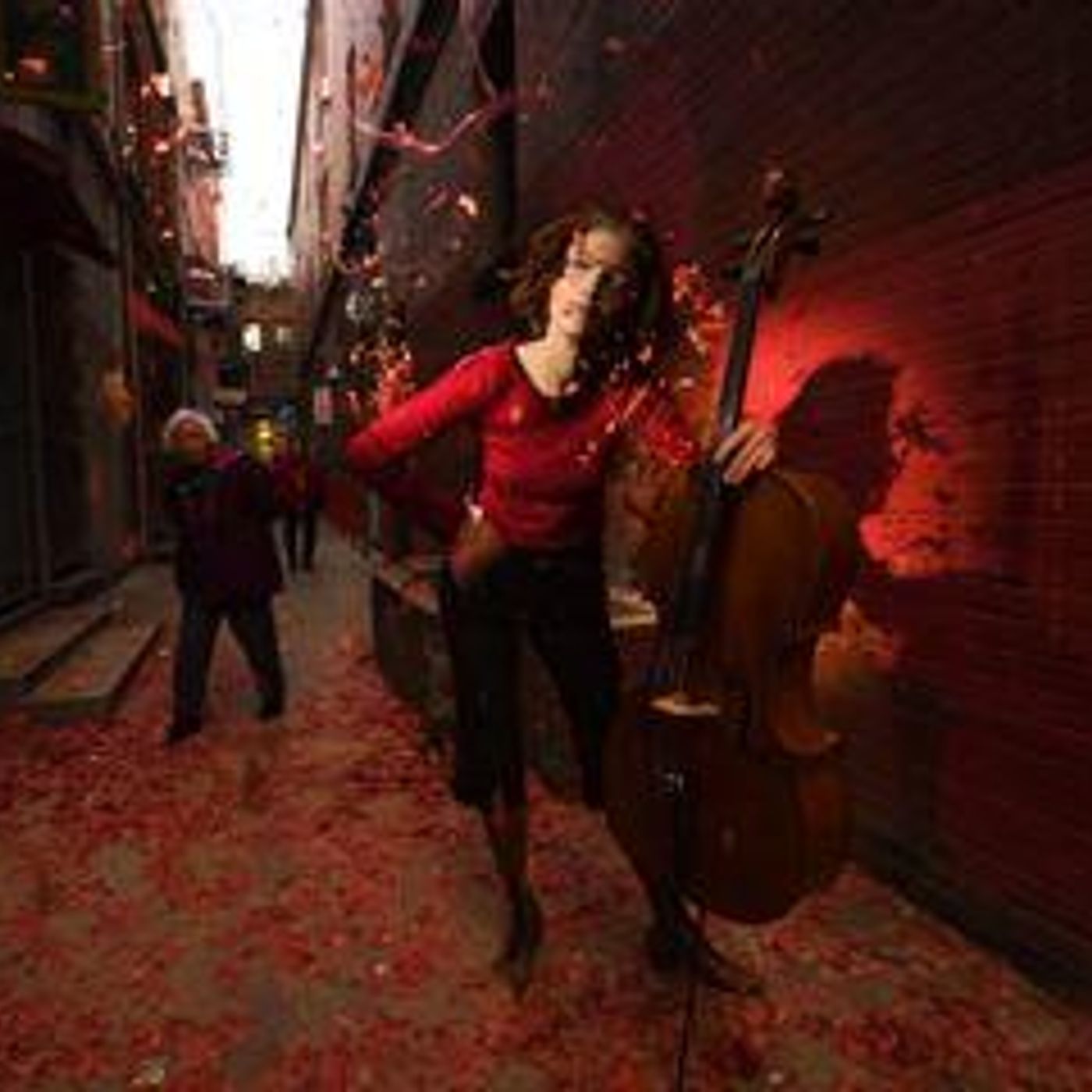
Radiolab
Quantum Cello
00:35:26
Jad and cellist Zoe Keating discuss the physics (if not metaphysics) of looping sound and how to use a 17th century instrument to make avant-garde electronic music.
Loading summary
Transcript107 lines
- [00:02]
A
I quite. You're listening to Radio Lab, the podcast.
- [00:06]
B
From New York Public Radio.
- [00:08]
A
Public Radio, WNYC.
- [00:13]
B
And npr. Hey, everyone. Jad here from Radiolab. This is Radiolab, the podcast. Something a bit different this week and we're not gonna do science. No big ideas today. Actually, I want to introduce you to an amazing musician. Can you do like a loop loop? So I can just make sure that that's getting a. If you happen to catch our War of the World show, this was our live show that we did in Minnesota. You may have noticed some really beautiful lush cello textures threaded all throughout that hour. Well, those textures were played live by Ms. Zoe Keating, who is right here next to me.
- [00:54]
A
Hello. Hello, Jad.
- [00:55]
B
How are you?
- [00:56]
A
I'm great.
- [00:57]
B
And we're sitting in San Francisco, so this is a bit of a. Of an excursion. But lucky enough I get to sit here and listen to you play. Because during the performance, there was a point where we actually stopped chatting and you just played for people and it was amazing. People loved it, but it was only people in the audience got to hear it. So this gives everybody else a chance to hear it. So maybe you could start by explaining all of these blinking lights that are near you. You're sitting here with a gorgeous kind of mahogany colored cello, but then behind you is a laptop and some computer electronic type stuff. So what exactly is all this?
- [01:38]
A
Well, I'm basically doing layered cello by playing cello and then using a combination of a foot controller in a computer to record each layer and then play it back for the audience. So what I might do is I'll just sort of play a loop and then you can see how it happens.
- [01:55]
B
Am I on your way here with your foot pedal?
- [01:57]
A
Okay, so I basically, I've got this foot pedal and I'm going to record a single line like this. Sometimes you get little artifacts in there, but it's kind of nice. So we've done that. Then I might add another one. So that can just play and I can wander off and chat with the audience or have. Have a drink.
- [02:46]
B
It's like little bits of you from the past keep coming into the present.
- [02:49]
A
Yeah, yeah, it is like that. Yeah. And sometimes, you know, hearing your past over and over again can get a little boring. So you might want to start changing it. And you can also do things like I might take them away.
- [03:32]
B
So essentially it's like you can create multiples of you and then sort of just using your feet, you can make some of you go away and then some of you come back.
- [03:42]
A
Yep.
- [03:43]
B
So when we're listening to these pieces. You're hearing these giant washes build, and suddenly they drop out, and you hear just one of the lines, and then all of a sudden they're back. There's a sort of abode bass line. All that is sort of be crafted with your right foot.
- [03:59]
A
Yeah. Okay. Pretty. You know, it's pretty simple.
- [04:02]
B
Yeah. But it's neat to see that you're funneling this just slightly past version of yourself into the present over and over. It's kind of quantum in a weird way.
- [04:11]
A
You know, I never thought of it that way, but you are.
- [04:15]
B
For better or worse. For better or for worse.
- [04:18]
A
Because if you make a mistake, like I make lots of mistakes, then that mistake is repeated over and over and over and over again. Yeah.
- [04:27]
B
Which must make you very comfortable with your own mistakes at a certain point.
- [04:29]
A
It does. You can't do this and be afraid of failure.
- [04:32]
B
So you were in a band called Rasputina. Tell me a little bit about that. How do you go from being a classically trained cellist to a rock. Rock star y kind of cellist? Like, what is that? What does that transition like?
- [04:45]
A
I didn't ever see it as a transition. It just seemed completely natural. I mean, I like rock music, and I think probably if I played guitar or bass, I'd probably play guitar or bass, but I just happened to play cello.
- [04:57]
B
Well, before we talk too much, what are you going to play us first?
- [05:00]
A
Well, I'm going to attempt to play a new piece, which it doesn't have a name. It's going to be on my new record.
- [05:10]
B
Well, whenever you're ready.
- [05:24]
A
Sam sa. Sam sa. Sat. Wow. That's kind of how that works.
- [11:38]
B
Okay. Lord, let me just. Before I fawn too much, let me just plug this in.
- [11:44]
A
Wow. It's so much more fun when you can have all those layers and you can control them. Yeah.
- [11:48]
B
I'm just curious about. You said you didn't have a title for that piece that we just heard.
- [11:53]
A
Yeah.
- [11:54]
B
What does a title really do for a piece like that? Like, I guess what I'm asking is, what do you see or feel? Or where does a piece like that begin? Does it begin as just a pure, really musical line, or is it a picture in your head or a feeling?
- [12:07]
A
It's just a feeling. It's all really abstract. That's why I have a really hard time coming up with titles because I don't like to assign specific meaning. They mean everything, and they mean nothing. And so as soon as you put a title on something that Gives it a meaning. And so sometimes I like to make up words or have something completely random. Kind of like the Mad Libs version of making song titles. But it usually starts as an idea, and so there'll be some sort of, like, emotion about it. And I just try to keep that emotion and see where it goes in a song. And that's all it is, really.
- [12:41]
B
Yeah. Now you were doing all kinds of things. I didn't actually catch all of it because I closed my eyes and just sort of like got sort of. Got sort of taken with all of that wash of sound. But you were doing all kinds of things that were not strictly traditional cello bowing. You were hitting the cello. Can you explain to you how you were making all those sounds?
- [13:00]
A
Well, I only have one cello and I like to make rhythm, so. So I might do this. I might like a. Which is like hitting the bow on the side of the cello. Or I might use my palms and go like this and things like that. And then also I might do little tapping things like, you know, or I might do little, like, things like that. And it's. I'm taking sort of. I like to think of it as like a DJ scratch approach to the cello. And, you know, you make all these like, little electronic sounds. But I like to see how many kinds of electronic sounds I can make using a 17th century instrument. @ first I wanted to get a whole orchestra to play this music. And I actually got like. When I first started doing this, I started working with a couple other musicians to see if I could like, translate the ideas. And I was like, how do you write this? You know, like, how do you write, like, okay, take the back of your instrument, turn it around and hit it with your. How do you write that? And then how do you write like.
- [14:01]
B
Like this, like bowing the. The wood directly?
- [14:05]
A
Like, what's the notation for that? I guess I could make something up, but I like the immediacy of having a computer. Like, if I have some sort of idea, I can just do it. I don't have to explain it. Like, you asked me what my music is about. I have to try to put into words some abstract feeling, and then it's already like, it's removed. Yeah.
- [14:23]
B
Tell me about some of the projects that you're involved in right now. Because you're on your own. You're doing your own stuff, releasing those. But you're also. What?
- [14:31]
A
Mostly I'm working in film right now. Like just writing music for film scores. And it's something I really like doing. So I'm Finishing up a documentary right now. It's called Ghost Bird.
- [14:43]
B
Is it about the woodpecker?
- [14:44]
A
Yeah, the ivory billed woodpecker. And then last year I did. I got into horror, which is very strange for me because I'm a very sensitive person and I can't actually watch horror.
- [14:57]
B
What sorts of cello gestures would end up in a horror film?
- [15:01]
A
Like, you know, sort of.
- [15:08]
B
Oh, suddenly I can hear it.
- [15:10]
A
Can you hear it? Yeah, sure, yeah. Or like really detuned. Ooh, that's scary.
- [15:22]
B
Yeah, that was particularly that squeak at the end.
- [15:25]
A
But it is amazing that you can just do that. Like, that was what was really interesting about your show, the War of the Worlds thing. Like you could just add like one note and then add another note to it and suddenly it's ominous.
- [15:38]
B
Can I hear another?
- [15:39]
A
Sure, sure. I could do. Let's see. Anything really?
- [15:45]
B
Well, you tell me, I'll get out of your way. But if you could introduce it just. Then tell me what you think you're going to play.
- [15:54]
A
Let me think about it for a minute first.
- [15:58]
B
I can make a request, but I don't know if it's one you've prepared.
- [16:00]
A
Yeah, sure.
- [16:02]
B
Album number two, Sun Will Set.
- [16:05]
A
Sunsetting. Yeah, the sun will set.
- [16:07]
B
Is that something that's easy for you to play?
- [16:09]
A
Yeah, it's extremely easy.
- [16:10]
B
Oh, I love that song.
- [16:11]
A
Sure.
- [16:11]
B
Okay, I'm gonna. Give me one second. All right, so introduce it.
- [16:14]
A
This piece is called. It has a name. It's called the Sun Will Set, which it will. Satan. Sam.
- [21:39]
B
That piece is just beautiful. It's just so pretty.
- [21:42]
A
Thanks. It's really fun to play.
- [21:44]
B
Yeah, I love that piece. When did you start on the cello?
- [21:49]
A
When I was eight.
- [21:50]
B
You were eight?
- [21:51]
A
Yep.
- [21:52]
B
And when you started, was it. I mean, you certainly weren't looping and doing all these kinds of things. How was it at the beginning?
- [21:57]
A
I really like the sound of it, you know, like, I don't know if this will come through on the. On the microphone, but I would just do this. Now that's slightly out of tune and you can hear them pulsing. Yeah, but I like that you have two notes playing together, but they make a shape. They make this sort of like wave. Pulsey shape and I would just. I would just like get lost in that for a long time.
- [22:25]
B
Just play the fifths. Yeah. How did you begin? I mean, what. What sorts of ch. Cello stuff were you doing at the beginning? Were you playing. Were you a classically trained musician?
- [22:31]
A
Yeah, I did all the standard things, you know, play some Bach, playing an orchestra. But I Suffered from really debilitating stage fright to the point where I couldn't play in public at all. I would never. I would always think it would be fine, you know, and then I would get up there and I couldn't hold the bow. Like, I couldn't remember how to play the cello. It's like I wouldn't. I wouldn't be able to do it. Like, I actually did have a concert once where I. I got up there and my. My hand is shaking. Was shaking so much that I just. I couldn't even get it on the strings. And then I just dropped it.
- [23:05]
B
You just dropped the bow?
- [23:06]
A
Just dropped the bow. My fingers. It didn't make any sense. It was just really, really, really difficult for me. And so it was like my. The more I progressed as a musician and it became just this, like, terrible nightmare. So I decided not to. Not to pursue classical music as a career, and. And I instead went to study liberal arts. But in college, all my friends were filmmakers and dancers, and so it was just inevitable I would start playing the cello in all their little films, or I would, you know, be like the piano accompaniment to the dancers. And so I would. I would just improvise and they would dance.
- [23:40]
B
And that new. That new version of yourself where you're just playing improvised stuff and it's dancing in this film a lot. Was that easier?
- [23:46]
A
Yeah, I never. I've never had stage fright doing that. Like, if I can play my own music, I'm fine.
- [23:52]
B
And that's the difference. If it's the notes come out of your head versus out of Beethoven's head.
- [23:57]
A
Yeah. There is something about. It's not me. It's like I have to recreate something that is. That already exists, and it's supposed to be a certain way. And there obviously is some part of me that just rebels against that.
- [24:11]
B
And when did you get this idea and I mean, the idea to take a cello and run it through a computer and loop it and all that?
- [24:18]
A
Well, I lived, you know, I always lived with musicians. And most of them would be rock musicians or electronic musicians, and they'd always have, like, little pieces of gear lying around. And I'd be like, oh, I'll try that. You know, let's try the cello through this delay, or let's try the cello through this vocoder, you know, And I would. I think I spent. I don't know how many hours doing that. Just. Just like me, you know, me.
- [24:41]
B
What would you describe the wow? What was the wow exactly? Was it that you were with you no, it was.
- [24:47]
A
It was that the cello is such a linear instrument. Like the pianists can play all these notes at once. But with cello, I can play like two notes at once. And with the looping pedal you could play some notes and then you could play notes on top of it. So it's like you were playing more than one instrument or. And I could also hear all the things I was doing badly. That was really interesting.
- [25:07]
B
I imagine it must have been interesting because you. I mean, because of the stage fright, you know, to hear the things that you didn't do right. Come back and then come back and then come back.
- [25:18]
A
Yeah, but they didn't bother me. That's interesting because you really. You never get to fix your mistakes from the past. Like, very rarely happens. When it does, it's a great moment. But with looping you do. Because, say you record something and it's a mistake, you might be able to add something to it that might make it sound right. It's like that thing I've heard jazz players say where they say, like, if you make a mistake, do it twice. That's interesting. Have you ever heard that?
- [25:44]
B
I haven't, but that makes total sense, though. Can I hear another?
- [25:47]
A
Sure, sure. Okay.
- [25:50]
B
Let me switch headphones again. Alright. So can you introduce this piece?
- [25:53]
A
Sure. This piece is called Legions. Which War. Sa. Sam sa. Sam sa. Sa.
- [30:44]
B
Well, wow, thank you. So that, that was. Tell me the name of that piece one more time.
- [30:48]
A
Legion's War.
- [30:49]
B
Legions War. And that was on your second cd, right? Is there a third coming out?
- [30:54]
A
Yeah, I'm trying to finish it in between finishing up these movies, but I really, really hope to have it out this summer.
- [31:02]
B
And if people want to know more about you and hear more of your music. Where can they do that?
- [31:07]
A
The best place is probably my website, which is Zoe Keating dot com. Or if you just type Zoe and Cello into Google, I think I'm the first thing that comes up.
- [31:16]
B
No kidding.
- [31:17]
A
That's pretty cool. Yeah.
- [31:18]
B
And we'll also link to you@radiolab.org and. And maybe put some clips up, if that's okay with you.
- [31:22]
A
That'd be great. Thanks.
- [31:23]
B
Okay, so can you. Can you take us out with something?
- [31:27]
A
Just improvise.
- [31:28]
B
Okay. Okay. Yeah. Improv.
- [31:36]
A
Sa. It. Sam. Sa. It.
- [35:08]
B
That was so freaking cool. That as an ending.
- [35:11]
A
Wow.
- [35:13]
B
I guess that's it for us. Thank you, Zoe. And this is Jad signing off. Radiolab is funded by the Alfred P. Sloan foundation, the Corporation for Public Broadcasting, the National Science Foundation.
- [35:24]
A
Bye.