← Radiolab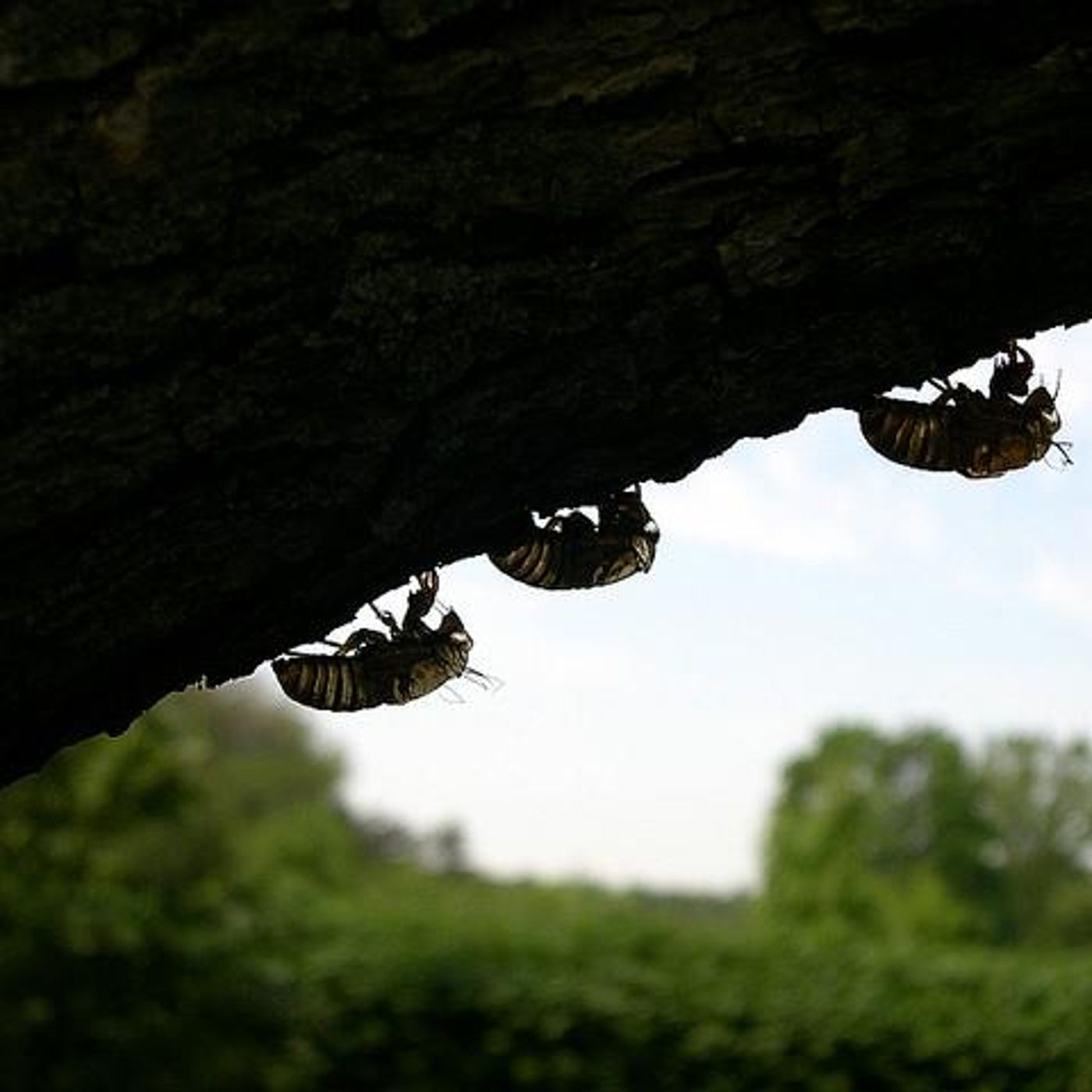
Radiolab
REBROADCAST: Emergence
00:57:54
This spring, parts of the East Coast will turn squishy and crunchy -- the return of the 17-year cicadas means surfaces in certain locations (in patches from VA to CT) will once again be coated in bugs buzzing at 7 kilohertz. In their honor, we're rebroadcasting one of our favorite episodes: Emergence.
Loading summary
Transcript389 lines
- [00:01]
A
You're listening to Radiolab. I'm Jad Abumrad. This is Radiolab, and I am Robert Krylwich. And let's begin today with something deceptively familiar.
- [00:10]
B
Fireflies are something that we have all loved as kids, right? Catching them in the backyard, putting them in a jar and watching them glow. So we don't tend to think of them as anything all that mysterious. Well, they do one thing very nicely, which is flash on and off.
- [00:25]
A
That's all fireflies do, flash. But what interests Steve Strogatz, a mathematician at Cornell University, is that there are places in the.
- [00:32]
B
Not here, but in Southeast Asia, in.
- [00:34]
A
Malaysia or Thailand, where fireflies don't just flash randomly like we're used to, they somehow flash together.
- [00:41]
B
There are enormous congregations of fireflies along riverbanks.
- [00:45]
C
How many?
- [00:45]
B
It could be tens of thousands of thousands, tree after tree, extending for literally miles along the rivers, all flashing in sync like a Christmas tree. Rows and rows of Christmas trees, all wired together, going off. And it's one of the most hypnotic and spellbinding spectacles in nature because you have to keep in mind it is absolutely silent. Picture it. There's a riverbank in Thailand, in the remote part of the jungle. You're in a canoe, slipping down the river. There's no sound of anything. Maybe the occasional, you know, exotic jungle bird or something. And you're looking and you just see whoop, whoop, whoop, with thousands of lights on and then off, all in sync.
- [01:37]
C
Imagine all the trees, as far as you can see, are all brilliantly lit and then totally dark. Brilliantly lit, total darkness, all of them in sync.
- [01:49]
A
Yeah.
- [01:49]
C
And no Westerner had ever seen this site. There was folklore, there was the stories about it, but nobody'd gone in and photographed and captured samples.
- [01:58]
A
Well, not until 1965.
- [02:00]
B
This was done by John Buck. John Buck, B U C K. One of the great researchers, according to the records.
- [02:07]
A
I'm 92.
- [02:09]
B
Buck and his wife, Elizabeth. Elizabeth, masked Buck went to Thailand and captured bags full of male fireflies.
- [02:16]
A
You could just reach up and shake.
- [02:19]
B
The branches and fireflies rained out and brought them back to their hotel room.
- [02:23]
A
And we turned off the lights, we.
- [02:27]
B
Turned them loose and saw that the fireflies flittered around on the walls and ceiling.
- [02:31]
A
They flew back and forth, flashing randomly.
- [02:34]
B
Elizabeth lay on the floor of the room.
- [02:37]
A
I was just tired. John stayed awake, and he was the one who saw.
- [02:43]
B
Within a few minutes, little groups, duos and trios, formed, and after a while, fourth one would join in. They got closer and closer together. And then finally they were synchronized. The whole room was blinking in perfect harmony.
- [02:58]
A
He was excited. The next morning they told me about it. Twenty years later, John Buck is still asking this question. Well, what is going on? Because no one knows.
- [03:10]
B
There are literally 10 theories.
- [03:11]
A
What seems to be clear, says Steve, is there is no one firefly that makes it all happen. It just happens on its own. Order materializes out of nothing. And that has him puzzled.
- [03:22]
B
How can order come out of. Out of disorder? This is what the creationists love to talk about. And it's because they don't understand, and neither do we. This is the big, big mystery of science. I think bigger than black holes are bigger than superstrings. I mean, science has had hundreds of years of success since the time of Galileo and Newton. From reductionism, from looking at the smallest parts, whether they're genes or atoms, whatever, that's great. We need to understand the individuals. But that's not enough.
- [03:47]
A
Obviously, we're not just talking about fireflies anymore. Today on Radiolab, we will do as Steve urges and step away from the individual to find mystery, beauty and order in the group. Not fireflies, though. Groups of city dwellers, groups of Internet surfers, stock traders, even the group of neurons that are inside your head.
- [04:09]
C
This is a science called emergence. So the begin. In the beginning, God created heaven and earth. That's the King James Bible. That's how it starts. The ultimate expression of the boss God telling everything else what to be, how to be. It's a top down kind of order.
- [04:30]
A
But about midway through, the Bible contains another passage, more of a bottom up thing, from King Solomon, the wisest of the kings, where he says, look to the ants, consider her ways and be wise. So we start in California, right here. Deborah Gordon. Deborah Gordon at the office of an ant expert.
- [04:50]
D
Hi, I'm Deborah Gordon, professor of biology at Stanford.
- [04:54]
A
Deborah Gordon has been studying ants for over two decades.
- [04:56]
D
It's because such mindless individuals collectively can do so much that I'm interested in ants.
- [05:01]
A
You might say she's the reigning ant queen.
- [05:04]
C
Well, as long as you bring up the reigning part. When we went there, I thought, well, let's, she has a lot of ants. But I wanted to see what the lost ant looked like.
- [05:12]
A
So she led us to her lab. We're going to the secret ant place where we found, to our disappointment, that she keeps the ants in a big Tupperware container.
- [05:22]
D
This is the foraging area of a colony that's stuck living in the lab instead of out in the desert, where it would probably rather be There's a.
- [05:32]
C
Big plastic box with plastic around it and little bits of sand on it.
- [05:36]
D
That's right. So I'm going to take off the top. Maybe we can see the queen better by going like this.
- [05:42]
C
I've never seen a queen before. When I'm looking for the queen, am I looking for just the ant in the center of the biggest crunch of other ants?
- [05:49]
D
Well, usually there are a lot of other ants around her. She doesn't look much different, but she's bigger.
- [05:54]
A
Do the ants know that she's special?
- [05:58]
D
I think the ants know that she's the queen.
- [06:03]
E
And does that.
- [06:04]
D
What does that mean, the queen in.
- [06:06]
C
The way we think of the queen?
- [06:08]
D
Yeah, I mean, do they know her.
- [06:10]
C
As mommy or not even?
- [06:11]
D
I don't think so, no. I don't think they know anybody as anybody. And remember, she's not in charge. She's not telling anybody what to do.
- [06:21]
C
Wait a second. Wait a second.
- [06:23]
A
Yeah.
- [06:24]
C
This is different than I had actually imagined. I thought that queens gave command like, you know, in Alice in Wonderland kind of thing. But she says, no, she's just a.
- [06:36]
D
Big ant that lays the eggs.
- [06:38]
C
That's it.
- [06:39]
D
That's it. Every year there's a mating flight. And all of the colonies send out their virgin queens who have wings and males who also have wings. And they all go to one place and they gather and they mate. And the newly mated queens flower, fly off and start new colonies.
- [06:54]
A
That's how it starts. Queens scatter, make babies, but that's all they do. They're just the colony's ovaries. They don't sit on a throne and decree anything, nor are there generals or even bosses. The colony somehow gets by without any of that, which is especially hard to believe when you watch these ants. Oh, tell us what's happening here.
- [07:14]
F
This is.
- [07:15]
D
That's an ant carrying a dead ant.
- [07:17]
C
Remember there was this one little itty bitty ant carrying a big fat dead ant on her back. Look at this. She seems to be gradually, although with some difficulty, moving towards my elbow. Then she dropped it, then she picked it up again, then she dropped it, then up again. Now she's turning in the other direction, all the while carrying this heavy corpse.
- [07:37]
D
She may lug it back and forth like that for hours. Sometimes some object will get in there that they can't all carry, and they can spend months tugging it one way and tugging it the other way.
- [07:48]
C
Months tugging back and forth on either side of one seed.
- [07:52]
D
It wasn't a seed. It was a little twig.
- [07:54]
C
One of them is thinking this way. And I was thinking, oh, this way, going this way, this way. And that's all that's going on.
- [08:00]
D
Well, I don't know what they're thinking.
- [08:02]
C
That offends.
- [08:03]
D
One of them is pulling one way because the stick feels like something that needs to be pulled, and the other also feels that the stick needs to be pulled and they just pull.
- [08:14]
C
God, it must be frustrating watching these mindless exchanges.
- [08:17]
D
It is. It can be very frustrating. I don't have very much empathy for ants. They're so. The more you watch ants, the more weird it seems. The way they never get discouraged. They don't care if they do something. Well, it's very alien.
- [08:36]
C
I think she hates them.
- [08:43]
A
Not really. Because here's the thing. You could make an argument that ants are the most successful species on the planet. They thrive in places that are too hot for us, too dry for us, even too cold for us. They outnumber us by a factor of many thousand. In pure evolutionary math terms, they're winning, which intrigues her and also forces her to think about them differently.
- [09:06]
D
I think about what the colony is doing and then I try to think.
- [09:09]
A
How it would work if you do it like that. She says ants are actually amazing, but you have to ignore the individual.
- [09:15]
D
Individually, they're totally incompetent and keep your focus big. As colonies, they do great things.
- [09:21]
A
It's kind of a constant whiplash. You zoom in. Stupid. Two ants pull a twig back and forth for months. You zoom out.
- [09:28]
C
Smart.
- [09:28]
D
I'm impressed that it works at all.
- [09:30]
A
That somewhere between the zooming in and the zooming out, a bizarre intelligence appears, almost like a phantom.
- [09:35]
D
I think the most intelligent thing I've ever seen harvest str ants do is to build a little turret around the opening of the nest just as the summer monsoons are gathering. And then when it rains and floods, it's raised up so that the water doesn't go in. So when I see the first few ants coming out with their little twigs and I look up in the sky and I see a few clouds in the distance, and I realize that there's some link between the change in the barometric pressure or something, and it really is a very tidy and effective little construction.
- [10:08]
C
And what else do ants do? Let me just count them for you, shall I? Ants farm. They have livestock. Ants make gardens. Ants organize wars, have generals and soldiers and things. Take slaves, nurse young ants tunnel involved incredibly good and sophisticated climate control. They can start from two opposite directions and meet precisely midway. Ants are engineers. Ants orchestrate Massive public work projects that puts FDR's new deal. I'm talking about Tennessee Valley Authority from your home state. That's as nothing compared to what ants can do.
- [10:48]
A
All of which raises the question at the center of this program, which is how do so many very stupid creatures with no boss add up to be so smart?
- [10:57]
C
The scientist who first really tackled this idea with some success in the mid-1950s was E. O. Wilson from Harvard University because he made one of the great discoveries in all the science of communication. Certainly we know that creatures make noises to each other, sometimes touch each other, but he figured out pheromones.
- [11:14]
G
Pheromones are the key to understand the communication of the vast majority of animal species. We didn't know it then.
- [11:21]
C
It's a neat story. He told me it a few years back up at 92nd Street Y in New York City.
- [11:25]
G
One day I set out, I was culturing fire ants then in the laboratory at Harvard. And I said, I'm going to get to the bottom of this. And the way I did it was to dissect these tiny, tiny ants. Very difficult to do, but I dissected them and under magnification I can see that it's sticking out its sting and dragging the sting. Something's coming out of that sting, kind.
- [11:51]
C
Of like a fountain pen or something through the.
- [11:53]
G
A little bit like that, yeah. So I proceed to, believe me, folks, this is the way science goes. I mean, it really is simple minded. It's only later when you're doing the technical paper, you know, and you're producing the mathematical models and that it looks tough. It's really, this is the way you're thinking when you're doing science. So I said I'm going to find out what the organs are inside this ant. So what I did was to do anatomy and then, you know, just dissected. I knew approximately what the different glands were and so on.
- [12:27]
C
You snipped off the part where the glands were.
- [12:30]
G
Well, you just dissect open or you opened it. Yeah, an ant. And just the way you would any animal. Although it's exceedingly difficult when it's about the size of a grain of salt. That's the tough part. But anyway, I took out the various organs one after the other and I made a preparation and I made an artificial trail, smeared out one organ after another. No effect.
- [12:55]
C
So there are ants over here and you're drawing lines of gut stuff, I.
- [13:00]
G
Guess basically what it is. Yeah, just different organs. I've washed each one in turn and then smeared it out. And finally I came to a little finger shaped organ which we didn't know the function of. It was just a tiny little thing tucked down there. And I smeared that out and I didn't have to tell them to follow that trail. They exploded out of the nest running along that thing. I started playing around with this. It was so effective for demonstrations. I would write my name and a column of 100, 200, 300 ants would come pouring out back and forth and they'd actually write my name in ant.
- [13:48]
A
So that was the first clue. Smell ants may not take orders from above, but they can exchange information.
- [13:55]
D
See this one with its abdomen bent under?
- [13:58]
C
Yeah.
- [13:58]
D
That one has somehow reacted to us, the strange smells that we're making.
- [14:03]
A
Back at Deborah Gordon's lab, as we watched the colony, one of the ants even stopped what it was doing to smell us.
- [14:09]
D
When they wave their antennae in the air, their looking around because their antennae are their periscopes.
- [14:17]
A
Sounds simple enough. Ants follow scent trails sort of like dogs. But if you stare at them long enough, you will see that when these ants get together, lots of them, the simple sniffing talents they have add up to solve pretty amazing problems.
- [14:34]
D
Here's a forager coming back.
- [14:35]
A
What's that in her mouth?
- [14:36]
D
It's a seed.
- [14:38]
A
Like this. Suppose there are a bunch of forager ants in one part of town and something good to eat in another part of town.
- [14:43]
D
Like if there's a picnic. How does the colony get more ants to your picnic?
- [14:47]
A
They're blind and virtually brainless. So how do they do it?
- [14:50]
D
That's the question. How do they do it?
- [14:52]
G
Hello, abcdefg.
- [14:54]
A
With that question in mind, we visited a Princeton biologist, Ian Cousin.
- [14:58]
G
This one here?
- [14:58]
A
Yeah. What is this? Now he pops open his laptop to show us a beautiful map he's made.
- [15:03]
G
So here on the screen you can see the individual paths coded by color.
- [15:07]
A
An ant map. It's as if he gave a few hundred ants a paintbrush and then let them wander over a canvas.
- [15:13]
G
And the computer has software which tracks the motion of each of these individuals.
- [15:16]
A
The resulting picture is vintage Jackson Pollock. Lots and lots and lots of layers.
- [15:21]
G
Of squiggly lines so you can put food down. I mean here, for example, I've got a droplet of sugar water here that the ants love to feed on.
- [15:27]
A
Ian points to a splotch of white in the upper right hand corner, then flips to the next image, jumping forward in time.
- [15:34]
G
What I've actually shown with this is that the ants have begun forming a chemical trail. And you can actually show how they've laid a trail to this good food source.
- [15:45]
A
This is the type of image that makes you want to stare at static on your TV screen and look for patterns. It's downright eerie. One minute, the screen is a mass chaos of squiggles overlapping, no patterns at all. The next, as if by magic, the squiggles have snapped together to form a vein leading directly to the sugar. It happens every time. And what's weirder, says Ian, is every time it happens, it happens by accident.
- [16:11]
G
Error, really. I mean, this is really what we're talking about, is these ants have probably just made a mistake.
- [16:15]
A
Error is architecture. Imagine 500 ants are exploring a space. Number 411 finds the sugar completely by accident. Except it's not an accident, because the ant has left a scent trail and there are 500 other ants, so surely one other will come along and make the same mistake. Suddenly you've got two chemical trails on top of each other, doubly hot, attracting a third ant, which makes the trail triply hot, attracting 5 more, which makes it octupoly hot. And soon what you've got is a blazing pheromone highway of bumper to bumper ants, not unlike midtown during rush hour.
- [16:56]
H
When I first saw the ants in person, one of the first thoughts I had was, this looks like a small little city.
- [17:04]
A
Steven Johnson noticed this connection and wrote about it in a book called the Connected Lives of Ants Brains, Cities and Software.
- [17:13]
H
A lot of what the ants do is positive feedback loops where they lay down a kind of pheromone chemical signal to, to recruit other ants to do something that they're working on, and those ants lay down more of the same signals. And so very quickly you can get a whole bunch of ants working on a single problem. That's a similar effect that you get in the way that city neighborhoods form.
- [17:31]
A
Accidents that always happen. That is how ants find food. And he says, how cities find their shape.
- [17:38]
H
It gets to what I sometimes call the swerve.
- [17:41]
A
Not that kind of swerve.
- [17:45]
H
This guide, when you're walking down the sidewalk going from point X to point Y, you're going from the subway back to your house and you pass by, completely accidentally, point Z, which is a new boutique or new restaurant, something that catches your eye and you swerve. You see this thing you've never seen before, and you're like, hey, I want to check that out. The whole business, in a sense of sidewalks and thriving urban centers, revolves around the idea that somebody coming to see Boutique A is going to be swerving. Into Boutique B or boutique C. Just because they're near each other and because they're kind of window shopping.
- [18:15]
A
Look how beautiful.
- [18:17]
C
What a neat idea.
- [18:18]
A
Yeah, right.
- [18:19]
C
You wake up thinking, well, here's what I'm gonna do in the city. I'm gonna walk my daughter to school. I'm gonna go to the newsstand and buy a paper. And then on your way, something that you didn't expect, something new catches your eye. Begonias. I always want Sally. That's the begonia she wants, right? So you swerve, which begins as an accident.
- [18:38]
H
But all these kind of local unplanned decisions all add up into this larger macro unit that does have a distinc. And that crucially, can last for hundreds of years.
- [18:47]
C
Which does make you wonder, because personalities of cities, we know about that. How come there are distinct neighborhoods for rich people? There are neighborhoods in some cities for artists, slums. Consider 28th street in Manhattan today. In the flower market we have hydrangeas.
- [19:02]
A
And sunflowers from Florida.
- [19:05]
C
How many flower stores are on this block, would you say?
- [19:08]
B
If I had to guess, I'd probably say about 20.
- [19:10]
C
There are flower stores all around.
- [19:11]
B
It's like a Walmart for flowers in a week.
- [19:16]
C
Now, how did this begin? Let's propose that someone for some reason came here and set up a flower shop which picked up a few customers. So then a second flower merchant says, hmm, since he's getting the traffic, maybe if I open a store like ahead of his on the block, maybe I'll be able to pull some people away from him, have them swerve into my store, location, location, location. And let's say that gets more traffic.
- [19:39]
B
You gotta be where the traffic is.
- [19:40]
C
So then you get a third store that works too.
- [19:42]
B
You could sell pencils that look like ducks and nothing else. And if you're right in the middle.
- [19:45]
C
Of Times Square, you know what? You'll probably make money. That's the key. Traffic is everything. Once a neighborhood becomes the place for duck shaped pencils or the place for flowers, what began as an accident then becomes a neighborhood. So much so if I blindfolded a flower salesman and dropped him onto 100 blocks of. Would he know which one was 28th Street? Absolutely.
- [20:05]
A
Yeah, sure.
- [20:06]
H
Yeah, of course. Why?
- [20:08]
C
I just tighten out my street.
- [20:10]
I
Man, I did smell the flower hyacinth. Did you smell the highest as soon as you walk in there? I mean, of course I would.
- [20:15]
C
Ah, Sound of the hen trucks, reefers screaming, yelling.
- [20:19]
A
I mean, please.
- [20:24]
H
It's a quasi mystical concept. I really do Think. I mean, when you think about a neighborhood in a great city, whether it's New York in the West Village or Paris in the Latin Quarter of the. You know, asks the question, like, who created this neighborhood? Who created the things we love about this neighborhood? Who creates that kind of life force? And the answer is, everybody and nobody at the same time.
- [20:49]
A
So that brings us again to the central mystery of this hour. We're studying here the science of emergence, which asks, where does organization come from? How do you get a neighborhood, a district or a city? How do you get the complexity of an ant colony if there's no leader and everyone in town is stupid? Steve. Steve Johnson proposes that a city is the emergent quality of this swerve. It's a series of accidents, you know, is always going to happen. You multiply the swerves and you get a neighborhood.
- [21:18]
C
Deborah Gordon is arguing that if you look very closely at the ants and you watch them smelling and you multiply their smells, then you get the complexity of an ant colony. But buried in the system, both of them say, is a rule, a sense of direction. But how do you see that rule?
- [21:34]
D
That's the wrong question. And that's what's so uncomfortable. The instructions aren't anywhere. The instructions come out of the way that the colony lives and behaves.
- [21:46]
C
That's hard.
- [21:47]
D
It is hard. If you had one ant on its own, you couldn't take it apart and find the substance that would make it behave in a certain way.
- [21:59]
C
But you see how hard that is. I want to know.
- [22:01]
D
So when you ask me where.
- [22:03]
C
Where do we find the rule? Yeah, it's not in any individual ant. You see it when all the ants get together. But where is it?
- [22:10]
D
Well, where is the thought in your brain? Is it in a neuron? Does each neuron have a little piece of the thought? If you took your neuron out and lay it on the table, could you see the little tiny bit of the thought that's in that neuron? No, it's not in the neuron. It's in the way the neurons interact with each other.
- [22:31]
A
Think about a Seurat painting, that one, where they're all on the banks of the Seine River.
- [22:35]
I
Yep.
- [22:36]
A
You know the one, if you look at it up close, all you see is dots.
- [22:39]
C
Right.
- [22:39]
A
You pull back and the picture emerges with all the ladies and their parasols. But the question with these systems, the big question, is whether there is a Seurat to make the dots to paint the picture, or if somehow the painting just materializes on its own.
- [22:55]
C
Well, you know that I have an opinion about this.
- [22:58]
A
I do.
- [22:59]
C
It's not a science y opinion. I think it's not just fascinating that there are these hidden patterns and hidden rules. I think it's. This is going to change the whole tone. I think it's kind of holy. And I don't have. There's no scientific evidence because there's no science behind this. It's just an instinct. I think when you look at the way ants work or the way a syrah painting emerges before your eyes, you're looking at an author.
- [23:28]
A
See, when you say that, all the air just gets let out of the balloon. For me, it's like the magic is gone.
- [23:35]
C
Really?
- [23:36]
A
Yeah, I think so.
- [23:38]
C
But see what you're left with then everything that you see when you wake up in the morning as beautiful and we all agree that it's beautiful is empty of purpose. Is that okay with you?
- [23:49]
A
Yeah.
- [23:49]
I
Huh.
- [23:50]
A
In a way, it makes it even more mysterious to be alive. In any case, author or not, there's a really good reason why these systems would not centralize put all their eggs into one basket, one supreme being, because if they did, they'd be vulnerable. Case in point, this story from producer Laura Starcheski.
- [24:11]
F
I'll walk you over toward the beehives.
- [24:13]
A
Not about ants, though.
- [24:14]
F
We're sort of in their flight zone. But don't worry bees and we'll just see if we have any luck here.
- [24:21]
A
She met up recently with a beekeeper named John Clayton.
- [24:24]
F
It's always hit and miss trying to find a queen, that's for sure.
- [24:28]
E
She's right there.
- [24:32]
A
Get off me. Thank you.
- [24:36]
F
One of the things that beekeepers really like to do is raise their own queens. All you need to do is take a frame out of an existing hive that has egg cells on it and a bunch of worker bees and put it in its very own box. And they'll realize that they don't have a queen and they'll pull an egg or pull larva and start feeding it the royal jelly, make the peanut shaped Queen cell, and 16 days later you got a brand new queen. Well, one time I made a brand new queen. It was my first queen. I was probably 17 years old at the time and I had it out on my back porch. And I knew come day three, she goes out to mate. So I'm sitting there and here, sure enough, comes the queen out the entrance and she flies off and she takes off. And I'm watching and I'm watching the whole mating process take place. And it takes place in flight. She mates in flight with about 10 drones, and the drones die after mating. They come crashing to the ground, dying. And the queen goes back to the hive. And, well, she started coming back to the hive, and then I realized I had a piece of sticky fly tape hanging up on the back porch. And she flew right into it. And there's my queen all stuck to the fly tape like this. I said, there's my first queen. And I killed the poor thing because there was nothing I could do to save it. You know, it's just a horrible story. So it's one of those things you learn from experience, you know. But it was a sad moment because a queen's a special thing.
- [26:02]
E
Ouch.
- [26:03]
F
Just got zapped there.
- [26:05]
A
Thanks to producer Laura Starcheski and beekeeper John Clayton. Coming up, the science of how a trillion leaderless neurons in your head come together in musical fashion to sing the song of the thought you are thinking right now, which, if you're a caffeine addict like me, just might be.
- [26:23]
C
Coffee.
- [26:29]
A
I'm Jad Abumrad. Robert Krugwich and I will continue in a moment.
- [26:33]
C
Mmm, coffee. All right, now, your new assignments are. Who's gonna be Red Harry will be.
- [26:42]
A
Rid Me.
- [26:42]
C
All right, who's going to be round?
- [26:45]
B
Hi, this is Steve Strogatz. Radiolab is funded in part by the Alfred P. Sloan foundation and the National Science Foundation. Radiolab is produced by WNYC and distributed by npr.
- [26:58]
C
End of message.
- [27:03]
A
This is Radiolab. I'm Jad Abumrad here with Robert Crowicz saying hello. Thank you. This hour, we're trying on a way of looking at the world that has nothing to do with presidents or queens or mayors and everything to do with ants. In science, this is an idea called emergence. How many, many stupid things can add up to something very smart, like a colony or, in our case, a city? Now, speaking of us, it is often and was often assumed that leaderlessness is a bad thing, a very dangerous thing. This was especially the case in the late 19th century, early 20th, which is our next stop. It was a time when, throughout Europe, hostile, irrational crowds were everywhere in the streets.
- [27:40]
E
You really see this enormous backlash in large part in reaction to the rise of democracy.
- [27:46]
A
This is James Surwicki, author of the book the Wisdom of Crowds, and he's talking about the people on the other end of the riots, the intellectual elite.
- [27:54]
E
Look at people like Thomas Carlyle, Gustave Le Bon in France, Nietzsche. Obviously, for all these people, crowds were really the epitome of irrationality and stupidity.
- [28:07]
A
But that was about to change. And he tells this story of a guy named Sir Francis Galton.
- [28:13]
E
Yeah, Sir Francis Galton, who is this sort of famous British scientist and is actually most famous because he was the founder of what we now know as eugenics.
- [28:21]
A
Wow. Is that so?
- [28:22]
E
Yeah, he was sort of a notorious elitist. And what's funny is that this is a story about him finding the opposite of his basic assumptions to be true.
- [28:31]
A
Story goes, on a nice fall day in 1906, Sir Francis Galton, a guy who truly believed that only the better classes should be allowed to vote, rule, or even have children. He decides to spend the day in the country.
- [28:44]
C
Ladies and gentlemen, step right this way. Right this way.
- [28:47]
A
At the county fair.
- [28:49]
C
This is going to be quite an experience for you, young man.
- [28:52]
A
The thing that caught Galton's attention that day was a competition involving an ox.
- [28:59]
C
You might want to avoid that unfortunate plot right there, madam. Pass over it. Now, what I want you to do, please, is I want you to examine this very fat ox. Don't touch it, boy. We don't touch the ox. What we do is we look at the ox and we weigh it in our minds. Yes, in your head, you know.
- [29:18]
E
The group was a really diverse crowd. Family members, local merchants, most of whom.
- [29:23]
A
Were not experts at all in weighing oxen.
- [29:26]
C
Young lady, you know how to weigh a package, don't you? Of course I do.
- [29:29]
I
I carry luggage sometimes.
- [29:31]
C
Well, if you can weigh a package, then you can weigh an ox. Here's how you do it. You take, I don't know, a couple of packages and put them in your head. You say, well, this ox seems to be about 70 packages. So multiply the weight of a package by 70.
- [29:44]
E
I think they paid 6 pence. And they would, you know, make their guess. And the people that had the best guesses would win prizes, large cash prizes. So quite a few people guessed. There's something like 800 people, close to 800.
- [29:56]
A
And while none of those 800 or so people guessed the exact weight of the ox, prizes were awarded. People went home. But the ever inquisitive Sir Francis hung around.
- [30:05]
E
After the contest was over.
- [30:07]
C
Excuse me.
- [30:08]
E
Galton went up to the organizers.
- [30:10]
C
Would you mind telling me, he said.
- [30:12]
E
Can I halve the guesses if I.
- [30:13]
C
Take possession of all 787 tickets?
- [30:16]
E
You know, the slips they had written the guesses on?
- [30:17]
C
All right, you can have them, I suppose. I don't see anything wrong with that. But why? Because I'm wondering something.
- [30:25]
A
See, Sir Francis figured these common people wouldn't have a clue. Most of Them were overwhelmingly uninformed and unexpert in bovine matters. And he just assumed that if you added up a lot of uninformed, unexpert individual opinions, you'd get a very uninformed, unexpert group opinion. That's what he was counting on.
- [30:45]
E
One of the things he did was he just calculated the average gas, that.
- [30:48]
A
Is the midpoint, the mean of all the guesses. He figured they'd be way off. But when he did that, it turned out that collectively, the citizens of Plymouth.
- [30:58]
E
Said The ox weighed 1,187 pounds.
- [31:05]
A
1187 pounds CO peculiar, which was astonishingly close.
- [31:11]
E
The ox's actual weight was 1,188 pounds.
- [31:16]
A
Wow. So they're a pound off.
- [31:18]
E
They were basically perfect, and they were actually better than any single individual in the group.
- [31:23]
A
Galton was stunned.
- [31:25]
F
Did you?
- [31:25]
A
This went against everything he knew to be true. But you have to give him credit because he did publish the results.
- [31:31]
E
He was, you know, curious enough to acknowledge possibilities.
- [31:39]
C
This experience that Galton had, where he went up to a lot of dumb people and collectively they somehow were smarter as a group than any one of them, is an experience that has been experimentally tested over and over and over. So at liberal arts colleges all over the United States, professionally, why liberal arts colleges? Because that's where these kind of things happen.
- [31:58]
A
A science professor never happens in vocational schools, just at the liberal arts college.
- [32:02]
C
All right, I'm being a snobby. At schools everywhere, a science professor, a psychology professor, usually puts a bowl of jelly beans in front of the room and says, how many people here can just guess the number of jellybeans? And over and over and over again, no one in the room gets the exact number, but everyone in the room at the mean comes closest. Somehow, the group is smarter than even the smartest kids in the class.
- [32:26]
A
And according to James Surwicki, this is not just a history lesson, but that.
- [32:30]
E
It actually is something you can see at work in a lot of other places and can be used to solve much more complex problems.
- [32:41]
A
Much more complex problems. Well, let's just take one example, the Internet.
- [32:47]
H
If you go back and read a lot of the discussion of the Internet from 1995 to 1998, it was totally dominated by people saying, yeah, the Internet's neat, but you can never find anything. And nobody says that anymore. I mean, it's just a problem that Google just completely solved. It was an amazing thing.
- [33:04]
A
This, if you remember, is Steven Johnson, author of the book Emergence, and he argues that that exact Same mysterious crowd smarts that was present at the ox guessing contest is what allowed Google to become such a great search engine almost overnight.
- [33:18]
H
So what Google decided to do was to solve the problem of organizing the web in a bottom up rather than a top down approach. And what Google said was, anytime somebody decides to link to a page, we're going to count that as a vote, as a positive endorsement of the page that they're linking to.
- [33:35]
A
So this is like a little democracy.
- [33:36]
H
It's a little democracy, exactly. And so what they said is pages that have a lot of people pointing to them are going to be more highly valued in the Google kind of system or algorithm than pages that nobody points to.
- [33:48]
A
So if some guy has a blog, which is really great, and a ton of other people link to him, he gets in essence, what you're saying, a lot of votes. He wins the election.
- [33:56]
H
He wins the votes. And they added a second layer to it, which is that when that guy points to somebody else, his link is more valuable than your average schmoes because a lot of people point to him. So he has more kind of Google juice. When you think about the way that city neighborhoods form, you ask the question, where do city neighborhoods come from? And the answer is, you know, well, everybody and nobody at the same time is kind of creating this. When you search for something on Google and you get a list of results that is often really, really good because Google, it gives these great results. Ask yourself who decided that? This result here is number one and this result is number two. Well, the answer is everybody and nobody. It's nobody on staff at Google. Google isn't deciding that. This is the premier site for if you search for Steven Johnson, and this is the second best site if you search for Steven Johnson. Collectively, all the people who are authoring documents on the web have decided that this is the best site by choosing to link or not link. Basically, the intelligence of Google is an emergent property of all these local decisions to link, none of which were made until recently with the intent of influencing Google. Now what's happened recently is that people have started to try and trick.
- [35:06]
A
Yeah, that was my next question. To me, you can manipulate.
- [35:07]
H
You can manipulate it. So I actually have this experience. This is one of the most annoying things that's happened to me in the last year. And it's ironic because it comes out of precisely the thing that I celebrated and championed and have been an advocate for for the last five years. I have a website that a lot of people link to, and thus I have a disproportionate power over Google. When I point to something, they will jump up.
- [35:33]
A
Really?
- [35:33]
H
Yeah.
- [35:34]
A
Have you seen this in practical terms?
- [35:35]
H
Oh, absolutely. Well, one way you can tell is that for a stretch of time, if you searched Google for Stephen, I was the number one result.
- [35:42]
A
Just Steven.
- [35:42]
H
Just Stephen.
- [35:43]
A
Of all the Stevens in the world.
- [35:44]
H
All the Stevens in the world, the Steven Spielbergs, the Stephen Kings, I was the number one Stephen. And obviously on some level, Google is wrong in thinking that I am the number one Stephen in the world. I mean, I, I think very highly of myself, but I'm not the most important Stephen in the world. But it's because I have a website that a lot of other bloggers and people in the kind of Internet community point to. Well, maybe you are number one, Steven. According to Google, I'm no longer. Actually, I've dropped to number five or six, which has been a great tragedy in my life.
- [36:09]
A
Who's number one now?
- [36:11]
H
I think at last I looked, it was this. I think he's a country music star like Stephen Curtis Chapman. Yeah, I'm still up there, so it's all right. But anyway, so because I have this power with Google, on my website, there's an open comment area where anybody can come and post a thought in response to something that I had posted. And about a year ago, people started posting these random kind of nonsense posts that would have a link in it pointing off to some, you know, free Viagra site or to a porn site or to, you know, kind of get a mortgage, you know, cheap site.
- [36:43]
A
So it was a coattails thing, like, this guy's good, so I'm gonna get on his coattails.
- [36:47]
H
Exactly. And initially I was like, look, I don't have that many people coming here that it makes sense to advertise in my comments area. But I finally realized that they weren't trying to attract the people who were hanging out on my site. They were trying to attract Google. They were talking purely to Google's automated kind of searching. They were saying, look, Google will see this as an endorsement from Steven Johnson pointing to this free gambling site.
- [37:10]
A
See, this is what separates us from the ants right here, is that we're aware of the colony.
- [37:14]
H
Yes, you can step out and play the system because people are smart and they have this ability to kind of reflect on the system that they're a part of. We're able to advance faster, but you also have cheats and spoilers will destroy the system. And I eventually, you know, this tragic thing that I had to. I had basically to shut down these conversation areas that I had on my site, because I would get literally 100 of these spam posts in a day, and a lot of them are really obscene. So it was like my mother would come to my site and be like, what? What is going on?
- [37:51]
A
Steven Johnson is the author of the book Emergence, as well as Mind Wide Open, and he's working on a new one, which will be out soon, about how everything that's bad for you is actually good for you. So it is no surprise that he is currently number four Steven on Google, behind Steven Spielberg, Stephen Soderbergh, Stephen King. But ahead of the sky, This is Stephen Curtis Chapman.
- [38:22]
C
So from a crowd, even a pretty dumb crowd can emerge magically beautiful complexity. And this, after all, was the great insight of Adam Smith. Wealth of nations. 17.
- [38:33]
A
No, you'll have to fill me in.
- [38:35]
C
1776, he wrote a book in which he proposed that there's an invisible hand when everybody wants to buy something and everybody else wants to sell something, Somehow it all comes together in a perfect balance.
- [38:48]
A
Speaking of which, my name's Ben Rubin.
- [38:50]
H
I'm a sound artist in New York City. And what you're about to hear is a piece I made called Open Outcry.
- [38:56]
A
We'll hear an excerpt.
- [38:58]
D
Silver, up 44, 78.
- [39:02]
A
Crude oil, up 30.
- [39:04]
H
53.
- [39:05]
A
Silver, up silver.
- [39:08]
G
Platinum, down 49, 0.
- [39:23]
A
Zero.
- [39:28]
D
Sometimes I say to people, didn't you hear me bidding?
- [39:31]
A
And I know if they say, I didn't hear you, I know they're not.
- [39:33]
D
Telling me the truth, because people always hear my voice. It's unique, and it's a strong voice, too. If I'm selling October's, you know, you don't say. You say ock, and you don't say the full handle. You'll say like, ock at 10.
- [39:45]
A
So I just yell out, ock at 10.
- [39:47]
C
AUC 70 bit 5, 5, 25. So, 25, 75 bid at 78. Not listening to one person at a time. You're hearing everybody speak at the same time. It's like going to a symphony and.
- [40:10]
A
Hearing every piece of the orchestra, but.
- [40:12]
C
Yet hearing the music at the same time.
- [40:14]
B
And in the middle, in the midst.
- [40:15]
C
Of that, you may observe, for instance.
- [40:18]
B
A broker that you've traded with for years. You know what his face looks like when he's laughing. You know what his face looks like when he's upset about something at home, and suddenly he's got a nervous look.
- [40:30]
A
You can tell when somebody's bluffing when somebody's not bluffing.
- [40:33]
C
And these are all skills that are learned over time. It's really an internal gut feeling as.
- [40:39]
A
Far as just seeing the expression on somebody, somebody's face, the way that somebody's.
- [40:42]
C
Breathing, the way that somebody's leaning on someone else. I always knew when the guy behind me had a real order, because when he had a big, big order, he used to take my shoulder and shove.
- [40:50]
A
It to the ground, trying to hold himself up.
- [41:06]
C
Five and a half.
- [41:24]
A
Orange juice, cotton, Gasoline, natural gas, up. Thanks to sound artist Ben Rubin and the next big thing for letting us borrow that piece. Coming up, the story of the biggest search and possibly discovery since the double helix. And it involves the same guy. I'm Jad Abumrad. Robert Krulwitz and I will continue in a minute.
- [41:58]
H
Keep listening. Okay.
- [42:01]
A
Hey, everyone. This is Matt in St. Louis.
- [42:03]
F
Radiolab is supported in part by the.
- [42:05]
A
National Science foundation and by the Alfred P. Sloan foundation, enhancing public understanding of science and technology in the modern world. More information about Sloan@www.sloan.org. This is Radiolab. I'm Jad Abumrad, here with Robert Krulwich. This hour, we're looking at the science of emergence. How the world often seems to organize itself into being without an obvious plan or a leader.
- [42:34]
B
Well, think about an ant colony or termites, right? I mean, they're trying to build a nest.
- [42:38]
A
Mathematician Steve Strogatz.
- [42:39]
B
And if you look at any individual termite, it's just moving along and its antennas are wiggling and it's smelling pheromones, and it has no idea what it's doing. It doesn't know it's trying to build a nest. It's just responding to whatever little chemical is right in front of its nose. And yet out of this, you see a coordinated group that looks like it's, you know, everybody knows what they're doing, but in fact, nobody knows what they're doing. And the same thing with your brain. No cell in your hundred billion cells in your brain is having a thought, but together they are together. They're falling in love or wanting to write music. So who's in there?
- [43:13]
A
Do we have any idea why this happens or how?
- [43:17]
B
I guess that's. That's the question.
- [43:23]
C
And it's a really fascinating question when you really kind of pause to think about it. For example, look, I have here, you see this? This is my cup of coffee. I look at it and, you know, it's a cup of coffee. But how does my brain know that this is a cup of coffee?
- [43:38]
I
It's.
- [43:38]
B
It's something that's In a way, it's hard to even understand what the question is, because this comes so naturally to us, right? We just look at something and we have this integrated perception of a cup of coffee that, like, what's the big mystery? I hear you did use Oliver Sacks. Had him on the show recently. He would probably be able to talk to you in an interesting way about people for whom this does not come easily.
- [43:59]
C
There is a famous case which was reported in Germany of a woman who had lost motion perception. And there's a very nice description, for example, of her difficulty pouring tea to that Oliver. Now, this woman, she takes the teapot and she starts to pour, and suddenly the image just freezes. She would have stills lasting about 15 seconds. She would see a glacier. She used that term, a glacier of fluid coming from the teapot. Her brain was seeing something not moving, but then her feet were getting. And then suddenly there was a puddle. They were getting wet and indeed, crossing a road. It was impossible for this woman in Germany, dangerous for her to cross.
- [44:43]
B
And so it's those people who help us realize the miracle of perception, right? That to see the world as a coherent thing is a miracle.
- [44:54]
A
Should we hit them at the same time?
- [44:56]
C
No.
- [44:57]
A
Think of yourself as fireflies and you're out buzzing yourself in trees. Okay, so back to your miracle of the coffee cup.
- [45:01]
C
So, yes, for those of us who are healthy, we do this all the time. The question, however, remains how? I have trillions and trillions of neurons in my head firing randomly. Every neuron that you're hearing here is going a little electrical thing. And now the question is, how does this, which seems so rampantly disorganized, how does it resolve coffee into a cup of coffee? How?
- [45:37]
A
Good question.
- [45:40]
C
Now, a few years ago, a number of neurologists trying to figure out how the idea of coffee comes to be came upon a kind of musical analogy that a brain creating a thought, creating, say, a cup of coffee is kind of like a musical event. Neurons in one side of the brain and another side of the brain are recognizing color or shape or something. And if they vibrate together at about.
- [46:01]
B
40 cycles a second, if they create.
- [46:04]
C
Say, the same note in step, that synchrony is a cup of coffee.
- [46:09]
B
What's happening in the brain is that there's a part of the brain responsible for the sense of smell.
- [46:15]
F
Smell.
- [46:17]
B
The neurons that recognize the coffee aroma are firing vigorously as they smell it. Meanwhile, there are color detectors that happen to notice that it's a, you know, a red mug shape detectors, part of the visual system that are noticing the edge of the cup.
- [46:39]
A
At least.
- [46:39]
B
What neurologists think is that it's the simultaneous firing of all of those that are looking at red and at sensing the aroma. It's the coincidence of their firing that's telling them, this is one thing. This is not separate aromas and colors and shapes. This is a coffee mug. They'd be singing together.
- [47:02]
H
No, no, no.
- [47:02]
C
One note come into alignment. One note. So that is a cup of coffee.
- [47:17]
A
And to think we do it every morning. Before we proceed, we should thank the New York City LaGuardia composition class. Our neurons were.
- [47:24]
C
My name's Harry Zill.
- [47:25]
H
And I'm Taste.
- [47:27]
C
My name is Melanie Charles.
- [47:28]
D
Danielle DeVita.
- [47:29]
A
Sasha Nguyen.
- [47:30]
D
Laura Dada.
- [47:30]
A
My name is Jonathan Chu.
- [47:31]
B
And I am smell.
- [47:33]
A
Jonathan Chu. Mr. Smell did the arrangements Robert Apostle conducted.
- [47:37]
C
Now, we say, wait a second here, because this is interesting. Robert Apostle.
- [47:41]
A
Yes.
- [47:42]
C
Their conductor told them what to do. But in your head, when you think of a cup of coffee, who's conducting you?
- [47:50]
B
And this is where we start getting into the very mystical or even the most mysterious part of this is that who is it that's paying attention? I mean, because what is attention? How can you control? I don't really even know how to talk about this, but there's something in you that is says at a certain.
- [48:11]
C
Moment, let's do coffee.
- [48:12]
B
Yeah. I mean, because it's confusing. What is it that brings one thing into attention and not the other? Anyway, I don't know. I'm a little out of my depth here.
- [48:22]
A
Somehow or other, whether we're looking at ants, cities or the Internet, wherever we look, the shape and organization of the world seems to emerge without an obvious plan. And yet there it is. And nowhere is this more mysterious and more difficult to really comprehend than in our own heads.
- [48:39]
C
Even for scientists who work on it day after day in the lab, like this guy.
- [48:44]
I
Christoph Koch. I'm a professor of neuroscience and engineering at the California Institute of Technology.
- [48:50]
C
Christoph Koch is one of the most celebrated neurologists in the world. And for him and for many others, they have a hard time getting rid of a model deep down which says, somewhere in there, there's a conductor. Someone is organizing the action.
- [49:04]
I
You may remember there's a movie by Woody Allen called Everything youg Always Wanted to Know About Sex, But We're Free to Ask. And there's this great skit in it where he has a couple is petting in the back of a car.
- [49:15]
A
Oh, my God, Sydney, can't you wait?
- [49:17]
D
You want to do it right here in the Parking lot.
- [49:19]
I
You see inside the boy's brain.
- [49:22]
A
This is mission control.
- [49:23]
C
Mission control.
- [49:24]
I
You have this NASA type control room. You have this big TV screen corresponding to the output of the eye. Eyes. Brain to eyes.
- [49:30]
C
Come in, eyes to brain. Over.
- [49:32]
I
And you have sort of all these white dressed NASA technicians running around.
- [49:35]
G
Proceed with erection.
- [49:36]
C
All systems go. And we're gonna get an erection in this scene. That's what we're trying to do.
- [49:40]
I
Yeah, exactly. And then you have these, you know, all these semens that line up. They all look, these little parachutes stand.
- [49:46]
C
By with long tails.
- [49:48]
I
I'm scared.
- [49:49]
C
I don't want to go out there.
- [49:50]
I
But I mean, the point is. So there's this control room metaphor that we can all laugh about, but a lot of people, including scientists, have implicitly, the idea is that me, there's a Christoph who sits inside me. Sits, I can tell you, and most people can tell you, sits exactly between my two eyes, between here and here.
- [50:06]
C
And by the way, this Kristoff, I assume, would be saying, okay, she in this, in the movie. Okay, she likes me. Let's make the next move. Prepare for launching.
- [50:15]
I
That's exactly what happens, of course, in the Woody Allen movie. Exactly.
- [50:18]
C
Prepare for launching.
- [50:20]
A
It looks like they're gonna do it. See you guys.
- [50:26]
C
So the point, says Christophe Koch, is that the Woody Allen model, this idea that there's an inner command center, some conductor directing your brain that he thinks is wrong.
- [50:36]
I
Now, clearly, there is no such person inside my head for a lot.
- [50:39]
C
How do you know?
- [50:40]
I
Because who is sitting inside the head of this little Christoph? And then who's sitting inside the head of the person sitting inside my head?
- [50:47]
C
So you see the problem. If Kristoff is thinking about a cup of coffee, and he gets the idea from an inner Christophe, who's thinking about a cup of coffee, where did the inner Kristof get the idea? Maybe from an inner. Inner Kristof.
- [50:57]
I
That wouldn't really solve the problem. We'd just push it one back.
- [51:06]
A
These are heavy problems.
- [51:08]
C
I mean, what happens here is we're tiptoeing up the hill here. That the Mount Sinai of science.
- [51:15]
A
Yeah. Coffee cups and people sitting at the controls. Well, these are kind of the smaller questions on the foothills to the bigger one, which is how does a mind reflect?
- [51:27]
C
Why does someone know who an I is? Why can you contemplate death? What is this Consciousness? That's the big one.
- [51:35]
A
If we can figure this out, whatever circuit is responsible for human. Or circuits responsible for human consciousness, think of what we could do one day, a Doctor could walk into a patient's hospital room where the patient is laying comatose and put a helmet on them. It's a conscious O meter, let's call it, and measure how alive they are, or maybe even tickle a part of their brain and wake them back up.
- [52:01]
C
This idea, by the way, came from one of the most famous scientists of the 20th century who worked very, very closely with Christopher Koch. I'm talking about a man named Francis Crick. Now, even if you know nothing about science at all, you've probably heard about the discovery of the structure of DNA, the DNA molecule by Watson and Crick. This is that Crick, he was a British guy, he moved to Southern California, and at some point he and Christopher Koch met. Now, Koch was much, much younger, decades younger than the older guy. And yet they formed one of the more magical partnerships, a kind of Gilbert and Sullivan or Rodgers and Hammerstein of neuroscience. And one of the ideas that Crick had was that there is a way, there must be a way to figure out what consciousness is all about.
- [52:52]
I
They developed this notion there's no conscious entity inside my head that serves the role of conductor. That's not to say that there may not be places in the brain that act akin to a conductor, that sort of synchronize and that coordinate the various parts of the brain that fire independently. Because one of the remarkable phenomena of conscience is everything is integrated. When I look at you and you talk, your voice comes out of your mouth. When you move, the motion I perceive is attached to your head. Now, in the brain, all those things are analyzed in different parts of the brain. So you need some sort of entity that pulls all these different networks of the brain together.
- [53:32]
C
Is there a place in the brain that does that?
- [53:34]
I
Well, so Francis Crick, and I think so, in fact, this was the subject of his last paper that he worked on, literally on the day he died. There's this odd structure in the brain called the claustrum. Claustrum means hidden away. And it's a small area. It's sort of an elongated sheet like structure beneath the cerebral cortex. You have two of them, one on the left and one on the right. What's remarkable about it, indeed, this structure receives input from almost every cortical area that seems to be in an ideal position. If you want to go to the metaphor of synchronizing all the different activities and making sure they're all in some sort of lockstep.
- [54:10]
C
So Francis and you have this idea, and he is very sick with cancer, and he wants to get this idea Down. Can you describe the scene there?
- [54:21]
I
He first had this idea 10 years ago and he talked about it in a book that he published in 1910 before. And then we never thought much more about it over the last year, we came back to this sort of somewhat obscure structure. So he was very, very interested in it. And, yeah, he felt his, you know, as he felt his illness coming on and getting stronger, he was very adamant about trying to finish up a manuscript. So he literally worked days and days and days. There's this beautiful photograph of his desk covered, probably 4 inches deep, just with paper pertaining to the Klaustrom. And he worked particularly over the last six weeks, day and night to try to finish a manuscript or to get it in a reasonable shape for us to publish.
- [55:09]
C
And so he was. On the day he died, he was still writing.
- [55:13]
I
A scientist to the bitter end.
- [55:15]
C
There's a kind of Mozart's Requiem quality to this.
- [55:18]
I
Yes, yes. Yeah.
- [55:24]
C
What was the last thing that you and he said to each other?
- [55:28]
I
I'll see you on Thursday or Friday. I was supposed to visit him in the hospital to work on this manuscript.
- [55:36]
C
And was the manuscript completed?
- [55:39]
I
No. So I'm currently working on it, editing it and then sending out. I'm about to send it out to friends and colleagues because I feel a little bit exactly like the student of Mozart. His name escapes me. Who finished his Requiem? He had a student and who finishes Requiem? And now musicologists today are deciphering what is actually original Mozart and what was finished in the style of Mozart. And so I very much aware of this.
- [56:11]
C
You should put your stuff in italics or something.
- [56:14]
I
Something like on the other end. We published 22 or 23 manuscripts together. And the way we always work that he wrote the first draft, he was very insistent upon that. Then I wrote, you know, I edited, and then he edited my edits, and so we iterated. Unfortunately, I can't do this here anymore, so, you know, I just have to edit his draft without the benefit of his feedback.
- [56:42]
C
Christoph Koch is a professor of neuroscience and engineering at the California Institute of Technology. His newest book is the Quest for Consciousness.
- [56:52]
A
There's more of radiolab online@radiolab.org communicate with us while you're there. Radiolab@wnyc.org is the address. I'm Jad Abumrad. Robert Grawich and I are signing off. John, somebody's going to have to.
- [57:07]
C
Who's going to hold the phone? All right, Laura, here we go. Radiolab is produced by Ellen Horn and Jada Boom Red, with help from Robert Crowich. And production support from Sally Herships, Robert Robert Kringer, David Martin, Amy o', Leary, Sara Pellegrini, Michael Shelley and Trent Wolby. Special thanks to Elena park and John Elliot and Laura Kippers, and also to us, the LaGuardia High School chorus. Goodbye.