← Radiolab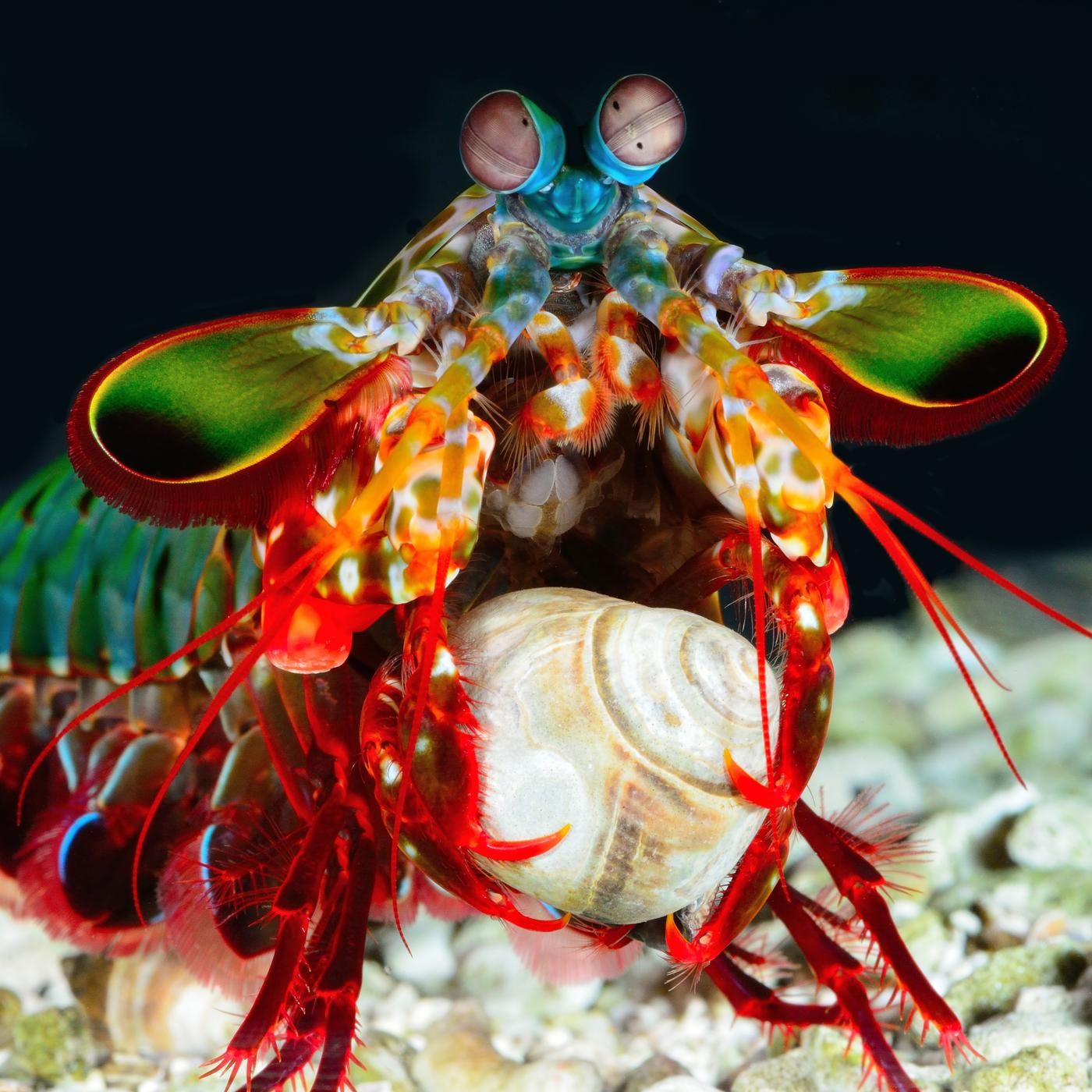
Radiolab
Rippin’ the Rainbow an Even Newer One
00:33:07
One of our most popular episodes of all time was our Colors episode, where we introduced you to a sea creature that could see a rainbow far beyond what humans can experience. Peacock mantis shrimps are as extraordinary as they are strange and boast what may well be the most complicated visual system in the world. They each have 16 photoreceptors compared to our measly three. But recently researchers in Australia put the mantis shrimps’ eyes to the test only to discover that sure, they can SEE lots of colors, but that doesn't mean they can tell them apart. In fact, when two colors are close together - like yellow and yellow-y green - they can’t seem to tell them apart at all. MORE ON COLORS: There was a time -- between the flickery black-and-white films of yore and the hi-def color-corrected movies we watch today -- when color was in flux. Check out this blog post on how colors made it to the big screen from our director of research, Latif Nasser. Our original episode was produce...
Loading summary
Transcript282 lines
- [00:00]
Jad Abumrad
Hey Fidelity, what's it cost to invest with the Fidelity app? Start with as little as $1 with no account fees or trade commissions on US stocks and ETFs. Hmm, that's music to my ears. I can only talk Investing involves risk.
- [00:18]
Robert Krulwich
Including risk of loss.
- [00:19]
Justin Marshall
0 account fees applied to retail brokerage accounts only.
- [00:20]
Jad Abumrad
Sell order assessment fee not included.
- [00:22]
Justin Marshall
A limited number of ETFs are subject to a transaction based service fee of $100.
- [00:24]
Jad Abumrad
See full list of Fidelity.com commissions Fidelity.
- [00:27]
Justin Marshall
Brokerage Services LLC Member NYSE, SIPC LIMU.
- [00:32]
Jad Abumrad
EMU and Doug Here we have the Limu Emu in its natural habitat helping people customize their car insurance and save hundreds with Liberty Mutual.
- [00:45]
Robert Krulwich
Fascinating. It's accompanied by his natural ally, Doug.
- [00:49]
Jad Abumrad
Limu is that guy with the binoculars watching us. Cut the camera, they see us. Only pay for what you need@libertymutual.com Liberty Liberty Liberty Liberty Savings vary underwritten by Liberty Mutual Insurance Company and affiliates excludes Massachusetts get ready to shop Lowe's Black Friday Door Buster deals to save $150 on a 30 inch blackstone griddle now $299 plus choose a whirlpool top load washer or Midea top freezer refrigerator for just $398. These limited time doorbuster deals go fast so get holiday ready today at Lowes. We help you save valid 1128 through 12. One selection varies by location while supplies last. See lowe's.com for more details.
- [01:33]
Robert Krulwich
Hi, I'm Robert Krulwich. Radiolab is supported by Casper and they're experts who make quality mattresses that cradle your body in all the right places. Get $50 towards select mattresses by visiting Casper.com Radiolab and using code Radiolab at checkout. Terms and conditions apply. Hi, I'm Robert Krulwich. Radiolab is supported by Audible as we explore more of how the world is saturated in color, from soft hues to violent stains. Check out Brain Myths Lessons from Neuroscience, available at Audible. Explore the myriad topics in neuroscience through 24 lectures about myths of the brain. Go to audible.com radiolab or text RADIOLAB to 500500 for a free 30 day trial and a free audiobook.
- [02:21]
Jad Abumrad
Hey, I'm Becca Bressler. I'm the production manager here at Radiolab and I'm here to tell you about a new WNYC Studios podcast called Cot that C A U G H T Khat do you remember when you were a kid or a teenager and you made a bad decision and you said to Yourself. If I just get away with it this one time, I'll never do it again. Well, our colleagues at WNYC studios are launching a new series about kids who aren't so lucky. Khat tells the stories of teenagers who make these thoughtless, impulsive decisions and as a result, get sucked into a punitive juvenile justice system that changes their lives. You can find Khat in iTunes or wherever you get your podcasts. Be sure to check it out and subscribe.
- [03:06]
Justin Marshall
Oh, wait, you're listening. Okay.
- [03:09]
Jad Abumrad
All right. Okay. All right. You're listening to Radio Lab. Radio Lab from wnyc. That's hilarious.
- [03:28]
Robert Krulwich
So then I was dismissed. I was not only dismissed from the day I was dismissed from I'm not even supposed to come back tomorrow. And everybody's so elated, and I was kind of mopey and they said, what's wrong with you? I said, well, I don't. I like jury duty.
- [03:39]
Jad Abumrad
So you're gone all day tomorrow?
- [03:40]
Robert Krulwich
No, I'm. I'm not.
- [03:41]
Jad Abumrad
You're around tomorrow.
- [03:42]
Robert Krulwich
I'm around tomorrow.
- [03:43]
Tom Cronin
Oh, my God.
- [03:45]
Jad Abumrad
Okay, so if we want to do.
- [03:46]
Robert Krulwich
This tomorrow, we could. If we wanted to do things.
- [03:48]
Jad Abumrad
Yeah, we could. Oh, that's good. That's good to know. Okay, so, Robert, let me see. Where. Where do we start?
- [03:53]
Robert Krulwich
Well, I think we start where we left off. Right, right. So where we left off, we thought we had simply the most fabulous animal color wise in the world.
- [04:02]
Jad Abumrad
The champion of rainbows.
- [04:04]
Robert Krulwich
Of champion of rainbows.
- [04:05]
Jad Abumrad
This is Radiolab, by the way, Chad Roberts. So 7ish years ago, we did a show about colors. We asked a very simple question. Who among us earthlings sees the best rainbow? We crowned a champion, and we're going to reevaluate that coronation right now, as one does as time passes and science advances. So we're gonna. Here's what I think we should do.
- [04:29]
Robert Krulwich
Okay.
- [04:29]
Jad Abumrad
I think we should play the original seg. Because it is delightful. You hear the crowning of the champion and then we should re evaluate whether the champion deserves to be crowned.
- [04:38]
Robert Krulwich
Okay.
- [04:39]
Jad Abumrad
And the early segment, it started with Robert asking a question to a cognitive scientist by the name of Mark Shangesi.
- [04:46]
Robert Krulwich
Well, here's a question. If a dog and a human and a crow were to be staring at a rainbow, would they be seeing very different things?
- [04:56]
Tom Cronin
Yes.
- [05:00]
Jad Abumrad
Now, this question that Robert just kind of tossed out during an interview, like, about how different creatures would see the rainbow, this ended up taking us down a little wormhole, and we ended up actually getting a choir to help us illustrate what we learned. But Just to set a baseline, your normal rainbow goes like this. Starting bottom up. 3, 2, 1. Red, orange, blue, red, red, orange, yellow, green, blue, violet. Roy G. Yeah.
- [05:29]
Tom Cronin
I don't know why people put the I in there, but that's it.
- [05:31]
Robert Krulwich
If you didn't have the indigo, you couldn't say it though. Be roygbv.
- [05:34]
Tom Cronin
That's why you need the I, I think is to say the Roy G. Biv.
- [05:37]
Jad Abumrad
Yeah. That, by the way, is Tom Cronin.
- [05:40]
Tom Cronin
What'S called a visual ecologist.
- [05:42]
Jad Abumrad
Mark suggested we give him a call. He told us that humans see seven colors in the rainbow. In the case of the dog, very different rainbow. It's gonna start off blue. He'll be able to see blue just fine.
- [05:52]
Tom Cronin
So it would see a rainbow starting.
- [05:54]
Jad Abumrad
With blue, same blue we see, and.
- [05:56]
Tom Cronin
Then grading off into green, same green as us, and then disappearing. The rainbow would end there with a.
- [06:05]
Jad Abumrad
Tiny bit of yellow thrown in.
- [06:07]
Robert Krulwich
That's it.
- [06:07]
Tom Cronin
Yeah. So the rainbow would be only about half as thick as ours.
- [06:11]
Jad Abumrad
Wow, that's a sucky rainbow dog. Yeah.
- [06:14]
Robert Krulwich
That's why when God promised that he would never deliver another deluge, he made the promise in a rainbow. The dogs just were totally unimpressed.
- [06:24]
Jad Abumrad
And what is it about the dog eye that makes it see this way?
- [06:26]
Tom Cronin
It doesn't have red sensitive photoreceptors. No red sensitive cones.
- [06:31]
Jad Abumrad
The weird thing is that the difference between dogs and us, cone wise, is just one. They have cones tuned to blue and green. So do we. We have this one extra red, which doesn't really seem like a big difference. I mean, it's just one cone.
- [06:45]
Robert Krulwich
But to have three is so much better than two.
- [06:48]
Jad Abumrad
That's Jay Knights, vision scientist.
- [06:52]
Robert Krulwich
Because of this kind of multiplicative thing, red can get mixed with blue, which makes purple, or red can get mixed.
- [06:59]
Jad Abumrad
With yellow to make orange, and green can mix with blue to get teal or turquoise.
- [07:05]
Robert Krulwich
And that's how we get about 100 different shades of color that we can see. So by adding one photopigment, instead of adding just one more color, you actually add about 98 colors or so. All right, let's move on. So now we have a crow, Unless you'd like to change the bird.
- [07:22]
Tom Cronin
Well, the crow is not so interesting because it's pretty much like us. So let's take something like a sparrow, because sparrows have ultraviolet vision.
- [07:31]
Robert Krulwich
What do they see?
- [07:32]
Tom Cronin
So they see the rainbow starts before our rainbow starts, where we just see sky. It would see an ultraviolet color and then it would see the violet, then it would see the blue and the green, the oranges, the yellow first and the orange and then the red. And probably would see further into the red than us because they have a more red sensitive red receptor than we have. So we'd see a much broader rainbow. It would start earlier and it would end later.
- [08:06]
Jad Abumrad
Woo.
- [08:10]
Robert Krulwich
So should we assume that we've now that the sparrow is the champion, that that's as high as it gets?
- [08:14]
Tom Cronin
If you're talking about vertebrates.
- [08:17]
Robert Krulwich
No, I'm talking about anything that has a heart and a mind and a.
- [08:21]
Tom Cronin
Once you leave the vertebrates, then all bets are off. Many animals have much better color vision than the vertebrates do. Oh really?
- [08:27]
Jad Abumrad
Like what?
- [08:28]
Tom Cronin
Butterflies are a great example. Butterflies have five or six kinds of color receptors. We only have three.
- [08:34]
Robert Krulwich
Remember, butterflies see more colors than we do.
- [08:37]
Tom Cronin
Yeah.
- [08:38]
Robert Krulwich
So if a butterfly were looking at a rainbow.
- [08:42]
Jad Abumrad
I never thought we'd get here.
- [08:44]
Tom Cronin
Well, they do, I'm sure. I mean, butterflies are out there when the rainbows are up. But we see colors we have no names for. Between the blues and the greens and the greens and the yellows.
- [08:53]
Robert Krulwich
So it would go from ultraviolet, it would see that.
- [08:56]
Tom Cronin
Yep.
- [08:57]
Robert Krulwich
Then it would see violet and then.
- [09:00]
Jad Abumrad
Blue and then blue. Blue, green.
- [09:03]
Tom Cronin
Yep.
- [09:04]
Jad Abumrad
And green, green, bluey, bluey or whatever.
- [09:07]
Tom Cronin
Right.
- [09:07]
Robert Krulwich
And then orange and red and all that.
- [09:09]
Tom Cronin
Yep. They have very complicated eyes.
- [09:14]
Robert Krulwich
Huh?
- [09:14]
Jad Abumrad
Okay, so just to recap, here's the dog, here's us humans. Now the sparrow. Little bit more bass, a little bit more high end, so to speak. And finally the butterfly, which is, you know, not so far above the sparrow, but it's got more mids in there.
- [09:34]
Robert Krulwich
So I'm now thinking butterflies get the crown.
- [09:37]
Tom Cronin
Yeah. But then you, if you go under coral reefs, you come across the. These animals called mantis shrimps.
- [09:42]
Jad Abumrad
What are they called?
- [09:43]
Tom Cronin
Meta, like mantis, like a praying mantis.
- [09:46]
Robert Krulwich
Oh, mantis shrimp.
- [09:47]
Tom Cronin
The shrimp catches prey using an arm like a praying mantis has.
- [09:50]
Robert Krulwich
Oh.
- [09:51]
Tom Cronin
Mantis shrimps are mostly pretty small, about the size of a finger. Some get to be as big as your forearm. They're big animals.
- [09:58]
Jad Abumrad
I'm actually looking this up right here. Oh my God, they're so colorful.
- [10:03]
Tom Cronin
No, they are colorful though.
- [10:05]
Jad Abumrad
Here, look at this. Oh my God. They're just like, it's like they're electric colored.
- [10:09]
Robert Krulwich
Yeah, they're like turquoise or something iridescent.
- [10:12]
Jad Abumrad
And their eyes are like little cartoon eyes. They're gigantic.
- [10:15]
Tom Cronin
Yeah, they have two really big eyes right on the front.
- [10:18]
Jad Abumrad
And you said that dogs have two cones. We have three. How much does the butterfly have again, butterfly has five.
- [10:24]
Tom Cronin
Depends on the butterfly. Mantis shrimps have 16.
- [10:27]
Jad Abumrad
16. Oh, my.
- [10:30]
Robert Krulwich
Well, if you have 16 eyes, 16.
- [10:32]
Tom Cronin
Kinds of receptors, what would the rainbow.
- [10:34]
Jad Abumrad
Look like to them? I mean, could they even see it?
- [10:35]
Tom Cronin
Mantis shrimp would see a rainbow fine because they live in very shallow water, and so the water is pretty clear. Almost like they would start the rainbow way, way, way inside. Where we see violet, they would see extraordinarily deep ultraviolet. And then they would go on through several kinds of ultraviolet, probably five or six kinds of ultraviolet. And then they would get to violet, which is. Now they're reaching our colors, and go through violet and violet, blue and blue and blue.
- [11:03]
Robert Krulwich
Green, where they have those green, green, blue. Blue blues as well.
- [11:06]
Tom Cronin
Yep. And then they would go out into the reds, so they would be about. About as red as us when they.
- [11:14]
Robert Krulwich
Got to the red end, but only in the reds. Yeah.
- [11:23]
Jad Abumrad
What a rainbow that must be.
- [11:25]
Robert Krulwich
Yeah.
- [11:26]
Tom Cronin
They have the most complicated visual system of any animals by a factor of two or more.
- [11:30]
Jad Abumrad
Wait, wait, wait. He said any. Do you mean. You mean that unequivocally? Any.
- [11:34]
Tom Cronin
Yeah. No other animal that we know of has a visual system within 50% as complicated.
- [11:40]
Jad Abumrad
All right. Mantis.
- [11:49]
Tom Cronin
But, you know, on the other hand, their brains are tiny, so who knows.
- [11:52]
Jad Abumrad
What it turns into? They may not have the ability to perceive the beauty of the rainbow in the way they.
- [11:58]
Tom Cronin
No, I don't. I don't know.
- [11:59]
Robert Krulwich
Vanish.
- [12:00]
Tom Cronin
Shrimps are into violence and not really into beauty. They go around and kill things. I mean, really, that's what they do. That's one reason they're so fascinating. They love to go around and kill things. What do they kill? Crabs. Other mantis shrimps. Shrimps. Octopuses.
- [12:15]
Jad Abumrad
They'll kill octopuses?
- [12:16]
Tom Cronin
Yeah, small ones. A good sized mantis shrimp can break the wall of an aquarium.
- [12:21]
Jad Abumrad
Oh, really?
- [12:22]
Tom Cronin
Yeah. There's ones in California that can break aquarium walls if they hit it hard.
- [12:26]
Jad Abumrad
Oh, my God.
- [12:27]
Robert Krulwich
So you have a pugnacious Muhammad Ali seagoing animal with incredibly great visual synths.
- [12:50]
Jad Abumrad
Special thanks to Jim Briggs, our engineer for the choir session, which was a blast.
- [12:54]
Robert Krulwich
To Mark Shangezi for setting us off in this direction.
- [12:57]
Jad Abumrad
To Michael Kirchner and the Young New.
- [12:59]
Robert Krulwich
Yorkers Chorus and John McLay and the Grace Church Choral Society and those folks from the Collegiate Chorale and the Dessef Choirs who joined us.
- [13:06]
Jad Abumrad
And to Alex Ambrose of WQXR for getting everybody together.
- [13:10]
Robert Krulwich
Thank you. Thank you, thank you.
- [13:26]
Jad Abumrad
Okay, so here we are back in the present 2018. That was how we left it. 7ish years ago.
- [13:32]
Robert Krulwich
And now we take a second, somewhat more sober look at this animal. Yes, it's glorious achievement.
- [13:39]
Jad Abumrad
Well, actually I get to, we get to actually look at it like I, I, I get to, I, I, in fact, well, you know what?
- [13:45]
Robert Krulwich
You met one.
- [13:46]
Jad Abumrad
I did. I met the champ. I met the champ. And we shared a moment that I certainly will never forget. That's coming up after the break. This is Amy Lantinga from Boston, Massachusetts. Radiolab is supported in part by the Alfred P. Sloan foundation, enhancing public understanding of science and technology in the modern world. More information about Sloan@www.sloan.org.
- [14:17]
Robert Krulwich
Hi, this is Robert Krulwich. Radiolab is supported by Audible. As we continue to rip the rainbow to pieces in this episode of Colors, check out Brain Myths Lessons from Neuroscience, available at Audible. To start building a more accurate understanding of current breakthroughs in neuroscience, you have to start by shattering popular brain myths. Through 24 different lectures, you can explore the myriad topics in neuroscience like memory, dreams, consciousness and more. The result is an eye opening adventure into the latest understanding of why the brain works the way it does. Go to audible.com radiolab or text RADIOLAB to 500500 for a free 30 day trial and a free audiobook. Hi, I'm Robert Krulwich. Radiolab is supported by Casper. Do you know that you spend one third of your life sleeping with Casper? You can make the most of your sleep on an outrageously comfortable mattress. Casper offers affordable prices, hassle free returns, free shipping in the United States and Canada. Plus you can be sure of your purchase with Casper's 100 night risk free trial. And right now, get $50 towards select mattresses by visiting Casper.com Radiolab and using code Radiolab at checkout. Terms and conditions apply.
- [15:38]
Jad Abumrad
This is Radiolab. I'm Jad Abumrad.
- [15:39]
Robert Krulwich
I'm Robert Krulwich.
- [15:41]
Jad Abumrad
Okay, so we did the thing about the mantis shrimp and partially because of us, partially because I think just the world was ready. The mantis shrimp has become a little bit of a celebrity animal. It's become a quite a popular little celebrated in cartoon.
- [15:54]
Robert Krulwich
Yes, it has been on television. Yes, it has had its, had its, it's had its moments.
- [15:58]
Jad Abumrad
It has had its moment.
- [15:59]
Robert Krulwich
Well, and deservedly so. When you think about what, you know, when you think about what its rods and cones apparently are able to appreciate. Yeah, you know, you just want to close your eyes and imagine whatever it is that animal might be seeing, which.
- [16:12]
Jad Abumrad
Is what we tried to do seven years ago. But as happens, the science keeps Going. And one of the things that happened recently in the last few years is that the people who study the mantis shrimp, they have released more knowledge about what it might be seeing. And we're going to update you on that, on that right now. But first, can I just tell you something?
- [16:35]
Robert Krulwich
Yeah.
- [16:36]
Jad Abumrad
I actually got to meet a mantis shrimp just very, very recently in Brooklyn, as I recall. In Coney Island.
- [16:41]
Robert Krulwich
Yes.
- [16:42]
Jad Abumrad
Oh, yeah. I have dreamt of this moment, I must say. So the mantis is in one of these tanks?
- [16:47]
Tom Cronin
Yeah, one of these saltwater tanks.
- [16:49]
Jad Abumrad
Producer Amanda Naronczyk and I, we found a fish store in Coney Island. Must be warmer. That actually had a real live mantis. Oh, hello. Whoa. It looks exactly as I imagined it. It's so. Wow, they're so cool. He was sort of tucked away in an aquarium in the corner of this sort of diminish. The shop is run by this guy.
- [17:12]
Robert Krulwich
Chris Martin from Creative Aquarium Nation.
- [17:14]
Jad Abumrad
Hi, Chris. Excellent. And this is your store? Yes.
- [17:17]
Tom Cronin
Okay.
- [17:17]
Jad Abumrad
And how long have you been here?
- [17:19]
Robert Krulwich
Four years.
- [17:20]
Jad Abumrad
Chris sells all kinds of fish.
- [17:21]
Robert Krulwich
Tons of brittle starfish, urchin, different kinds of clownfish.
- [17:25]
Jad Abumrad
We have designer clownfish. Hey, have you ever heard of designer clownfish? Have you heard of this?
- [17:30]
Robert Krulwich
I have.
- [17:30]
Jad Abumrad
Like, apparently these fashion designers are designing new clownfish.
- [17:34]
Robert Krulwich
You have a Gucci clownfish or a little Louis Vuitton clownfish?
- [17:37]
Jad Abumrad
Yeah, definitely.
- [17:38]
Robert Krulwich
Actually co designer clownfish.
- [17:39]
Jad Abumrad
Just a little weird fish fact. Anyhow, back to the mantis. It was in the corner of the shop in this aquarium of reinforced glass.
- [17:47]
Robert Krulwich
We actually got someone from Sri Lanka.
- [17:50]
Jad Abumrad
This mantis ship came from Sri Lanka. Yeah. This is one of the stranger creatures I've ever seen. And have you ever seen one of these things up close?
- [17:57]
Robert Krulwich
They're very, very stunningly color.
- [18:00]
Jad Abumrad
Oh, my God. Oh, my God. Color is just, I mean, astounding.
- [18:04]
Tom Cronin
Yeah. These are called peacock because they're particularly colorful.
- [18:07]
Jad Abumrad
So the particular guy that we saw, he was hiding in a tube in the middle of the aquarium. This was a peacock mantis shrimp, as they're called. So if you can imagine, like, it's got. It's. They're big, first of all, they're like seven inches or so. So it's a big creature. And if you can imagine the head of a hermit crab painted like a peacock, stuck on the bright green slithering body of a miniature dragon. That's what it looks like. I mean, they're the weirdest looking things that you've ever seen. Yeah, you can really see its eyes, like, swiveling in all different Directions. And they have these really big googly eyes.
- [18:41]
Tom Cronin
They have beautiful eyes. Well, we're looking at a peacock mantis shrimp. It's sitting in a Lucite tube and it's looking out at the world. It's treating the tube like it's its home burrow, which it would have if it was in the wild. It's basically looking for something to eat.
- [18:56]
Jad Abumrad
Okay, so the voice you just heard, that's Tom Cronin, our mantis expert from the last segment.
- [19:00]
Robert Krulwich
He's your salesperson.
- [19:01]
Jad Abumrad
No, he's an expert.
- [19:03]
Robert Krulwich
He's an expert.
- [19:03]
Jad Abumrad
Okay. I mean, he sells science. He drove down from Baltimore to meet us and remember when he was telling us in the last segment a while ago that the mantis are these violent.
- [19:13]
Tom Cronin
Little bastards, they love to go around and kill things?
- [19:16]
Robert Krulwich
Yes.
- [19:16]
Jad Abumrad
He was not kidding. I just want to, like, describe things to you before we talk about the vision. All right, we're staring at peacock mantis shrimp huddled in a tube in an aquarium, and Chris is about to feed. Now what kind of. What's the poor little blue thing that you're about to put in?
- [19:31]
Robert Krulwich
We're actually going to feed him a damselfish.
- [19:33]
Jad Abumrad
At a certain point, Chris drops in this little blue fish. Looks a little bit like Dory from that movie. So here it goes. Drops it into the mantis tank. Oh, oh. Fish is in.
- [19:42]
Tom Cronin
And the other fish is sensibly hiding in the back.
- [19:45]
Jad Abumrad
Fish is hiding behind the tube as the fish should. The little dory fish swim around for like, I don't know, five minutes trying to find a way out. The whole time, the mantis was like icy calm, just chilling in its tube and then. Oh, is it coming out? Is it coming out? I think it's coming out. It launched out of its tube and then. Just pow. Like, wow. That was just so sudden.
- [20:11]
Tom Cronin
You can hear the snap as it hit it.
- [20:12]
Jad Abumrad
I mean, it made Amanda and I scream. We just. It was shocking, you know, cuz they have these claws on the front of their body that they use to punch their prey. And you can literally hear the snap from across the room. And then he. And this was sad. He then took a lap and then came back and. And just. Oh, oh, just punched the fish a few more times.
- [20:37]
Tom Cronin
Wow, that's a hard ending for the damselfish. It's been hit three or four times now.
- [20:44]
Jad Abumrad
This is one of those nature moments where you're sort of amazed, but you also sort of want to cry. But. So, okay, let's talk about his vision. Now he's back in his hovel. And he's just cleaning his eyes now. After it killed the fish, it went back to its tube and started kind of like scrubbing its eyeballs with its little brushes. So crazy.
- [21:02]
Justin Marshall
He's.
- [21:02]
Tom Cronin
He's doing his eye thing, which is.
- [21:04]
Robert Krulwich
The important thing, because it knows that it's got the best eyes in the house.
- [21:07]
Jad Abumrad
He was like, did you see what I did to that fish? Now check out my eyes. And as for what those eyes see, our notion of that has totally changed over the last few years. So for that, I want to bring in another marine biologist that Amanda talked to. Do you mind introducing yourself?
- [21:22]
Justin Marshall
No. To who?
- [21:23]
Jad Abumrad
To me. My name is Professor Marshall, and this is what I do for a living.
- [21:28]
Justin Marshall
And you want me to do that now?
- [21:30]
Jad Abumrad
Now is good. Now is good.
- [21:31]
Justin Marshall
Okay. Yeah. So, hello, my name's Justin Marshall. I'm a marine biologist and neuroscientist working on the Great Barrier Reef in Australia.
- [21:39]
Jad Abumrad
Hi, Justin. Just for context, Justin is the guy who basically put the mantis on the map. He was the first guy. His lab was the first lab to notice that they saw color at all.
- [21:51]
Justin Marshall
Oh, yeah. I mean, that was cool. That was at the University of Sussex.
- [21:54]
Jad Abumrad
It's about 1995, 96. Apparently, he had a colleague from West Africa who was wearing this particular dress.
- [22:01]
Justin Marshall
She had this wonderfully colorful, traditional dress on.
- [22:04]
Jad Abumrad
She walks into his lab where he's got all the aquariums, and immediately all the mantis shrimp rushed to the beginning, to the top of the aquarium. They're like, hey.
- [22:12]
Justin Marshall
She walked in, and the shrimps went wild.
- [22:14]
Jad Abumrad
What does that mean?
- [22:14]
Justin Marshall
They started waving their appendages, and they show off all their colors. Now that I know a little bit about mantis shrimps, I know exactly what they were saying to her, which would be entirely inappropriate.
- [22:23]
Robert Krulwich
Oh, they were turned on as far as.
- [22:25]
Jad Abumrad
Yeah, they were all aroused.
- [22:26]
Justin Marshall
They were saying, hello, colorful thing. What should we do?
- [22:29]
Jad Abumrad
So Justin was the guy that basically.
- [22:31]
Justin Marshall
Proved, okay, these animals have color vision.
- [22:33]
Jad Abumrad
Like, they see color. He confirmed that with this experiment with colored containers with mantis shrimps.
- [22:38]
Justin Marshall
You can get them to go and just beat the living daylights out of a thing that's colorful because they love to smash things.
- [22:44]
Jad Abumrad
So anyhow, that was all background. Here's the new information. Recently, Justin, in his lab, decided to ask a new question. He decided to say, all right, all of these shrimp, they have so many rods and cones in their eyes. And by the way, he would say there were 12 rods and cones in their eyes, not 16, which is still four times what we Have, Right. So it's a lot. All right. They've got all these rods and cones. How well do they use them?
- [23:06]
Robert Krulwich
I wonder what that means. How well do they use them? They have them. They must use them for something.
- [23:10]
Jad Abumrad
Well, it's sort of like if you're a scientist, you can't just assume that they see things the way that we see things. I mean, you kind of have to make sure, Right? So, I mean, you know, his simple question to start off was, how well do they see different shades of the same color? It's like the kind of thing that we do at the grocery store all the time.
- [23:27]
Justin Marshall
So, you know, if you go pick a banana from a store, even if you pick one that's just gone yellow, it's still a little bit green.
- [23:33]
Jad Abumrad
You're like, is it too green? Not yellow enough? Too yellow? You know, you use your eyes to make the call, right? You wondered, can the shrimp do that?
- [23:40]
Justin Marshall
Can this animal distinguish between this shade of red and that shade of red, this blue and that blue?
- [23:46]
Jad Abumrad
Can they make those fine distinctions?
- [23:47]
Robert Krulwich
Well, I assume so, yeah, because they.
- [23:50]
Jad Abumrad
Got all the rods and cones, right.
- [23:51]
Robert Krulwich
I mean, they wouldn't have all those things in their eyes if they weren't putting them to some extraordinary use. And the obvious use would be more blue or more green.
- [23:58]
Jad Abumrad
More yellow. Sure, exactly. But he wanted to be sure.
- [24:01]
Justin Marshall
So what you do is you say, all right, mantis shrimp, I'm going to give you food from this yellow thing.
- [24:07]
Jad Abumrad
So what he did basically is that he would show the shrimp a yellow light, give him some food. Yellow light food. Yellow light food. They quickly learn that yellow means food.
- [24:15]
Tom Cronin
Cool.
- [24:15]
Jad Abumrad
So then he shows the shrimp a blue light where there is no food, and naturally learns to ignore that very.
- [24:21]
Justin Marshall
Quickly because the food's at the yellow, it's not at the blue.
- [24:23]
Jad Abumrad
Right.
- [24:23]
Justin Marshall
Most animals can do this.
- [24:25]
Jad Abumrad
But then what he did is he sort of mixed it up. He would gradually make the blue side, the non food side, a little more yellow. Very gradually, he would shift the color.
- [24:34]
Justin Marshall
From blue through to blue, green through.
- [24:36]
Jad Abumrad
To green, then greeny yellow, just to see if the shrimp could tell the difference between yellow, which means food, and yellow green, which doesn't mean food.
- [24:46]
Justin Marshall
That's what we did. And we expected the mantis shrimp to have far better distinction at that sort of level and were surprised to find that it was the worst animal on the planet so far tested.
- [24:58]
Jad Abumrad
No, no. Are you exaggerating?
- [25:01]
Justin Marshall
No, not at all.
- [25:03]
Jad Abumrad
Our champion of the rainbow was the worst creature ever tested.
- [25:08]
Robert Krulwich
The worst. So in other words, Nature gives them a panoply of choice and then they can't tell the difference. Then what's the point of that? There's something wrong with this theory.
- [25:18]
Jad Abumrad
I know, it's kind of tragic.
- [25:20]
Robert Krulwich
If I'm Benjamin Mo, come to my paint store. I'm gonna show you 50 shades of purple and you can only see three, then what are you doing in there? Like, I don't know what you're doing.
- [25:28]
Jad Abumrad
Yeah, they seem to have the equipment to see all the purple, all the colors, all the many, many shades. So they've got these amazing eyes, but they just don't seem to use them the way that we do.
- [25:39]
Robert Krulwich
I don't understand that.
- [25:41]
Jad Abumrad
Yeah. Okay, so this is where you need.
- [25:43]
Justin Marshall
To start thinking about color and what colors are.
- [25:45]
Jad Abumrad
I mean, according to Justin Marshall, the basic thing to understand is that you don't actually see color with your eyes. I mean, you're taking the light with your eyes, obviously, but then the color is received in your brain and they have these little insect braids that don't seem to do color the way that our brains do.
- [26:01]
Justin Marshall
The way in which we see color is if I see a thing, let's say somebody wearing a blue sweater walking down the street, nice looking lady or gentleman wearing a blue thing, and my blue photoreceptor in my eye gets really exciting.
- [26:18]
Jad Abumrad
So your brain's gonna see that and think blue. That's a blue sweater, right? Now if that blue sweater had a little bit of red in it, the red photoreceptor would also buzz, but not as loudly.
- [26:28]
Justin Marshall
And it's actually the ratio of those excitations that gives my brain the sensation of color.
- [26:32]
Jad Abumrad
Your brain will basically say, all right, got a lot of blue, a little bit of red. What could that be? Magenta. That's what you end up seeing. Like your brain sort of paints the gap.
- [26:43]
Justin Marshall
And that's how every animal on the planet sees color, except for mantis shrimps.
- [26:49]
Jad Abumrad
Its brain doesn't seem that interested in painting gaps. So back in our segment when we said it sees a full throated, wide voiced spectrum of color, like this ecstatic, glorious vision.
- [27:05]
Robert Krulwich
The best rainbow view of all creatures on earth. That's what we said.
- [27:09]
Jad Abumrad
That's what we said.
- [27:10]
Robert Krulwich
More, more variety in the rainbow than we can or than anybody can. That was our thought.
- [27:16]
Jad Abumrad
That was our thought. We might need to amend that. I mean, so they still see colors that we don't see, but they might not just be seeing as many colors as we thought. Like maybe their rainbow is more a series of rather Focused, discreet bands of color with not a lot in between.
- [27:40]
Robert Krulwich
I am very, very. Well, that's actually extraordinarily puzzling. They're given the equipment that we use to see various shades of color, and they don't use it to see shades of color. What do they use it to see?
- [27:54]
Jad Abumrad
Well, they use it to. I mean, this is all speculative, but, you know, Tom Cronin was telling us in the fish shop that, like, the science seems to be heading towards this idea that they use colors to communicate. And if that's the case, like, they don't need to see all the colors. They just need to see the ones that mean something.
- [28:14]
Tom Cronin
At least in the ultraviolet. There's really good evidence. Now. It's not published, so I don't want to talk about it too much because it's not my work. But it looks like different parts of the UV have very different meanings. Like, one part might mean fear. Don't go there. Another might mean sex. I'd like to get to know more about this.
- [28:36]
Jad Abumrad
Maybe another part means home. Who knows? It certainly varies species to species.
- [28:42]
Justin Marshall
We're talking about a whole range of at least 500 species. So to sort of blanket an explanation over that is a bit simple.
- [28:50]
Robert Krulwich
But what you're saying is that instead of seeing rainbows, they're having a conversation with the color.
- [28:57]
Jad Abumrad
Yeah, Maybe they just.
- [28:58]
Robert Krulwich
So this is their vocabulary. That is, they have all these rods and cones so they can talk to the world. Not that they can see the beauty of.
- [29:06]
Jad Abumrad
And this is complicated, but they have. They can do polarized light. Oh, we can't. Which is so hard to explain, but apparently it's thought that some species can flash polarized light at each other as a way of communicating somehow. I'm not even gonna try and explain that because I don't get it.
- [29:21]
Justin Marshall
They are an unbelievably amazing and different system to any other animal on the planet. So you've got to ask yourself the question, why? And I've been asking myself that question for 30 years. And I guess I'm a failure because I still haven't answered it. So you could call me a failed biologist.
- [29:41]
Jad Abumrad
I don't think we would do that. I don't think we're gonna do that.
- [29:44]
Justin Marshall
Not really.
- [29:45]
Jad Abumrad
Yeah, that seems not really true. If you had to distill the new information that you had that you have, how would you explain it?
- [29:52]
Tom Cronin
Like, the.
- [29:53]
Jad Abumrad
The thing that we know now that we didn't know 10 years ago is this.
- [29:59]
Justin Marshall
They're really fucking weird.
- [30:04]
Jad Abumrad
You know what I'm Left with is that at the end of the day, I mean, you know, yeah, it has eyes. We have eyes. We assume that its eyes do for it what our eyes do for us, but apparently not. And I don't think a choir is going to bridge this gap.
- [30:18]
Robert Krulwich
That's what's called an umwelt. Like. Like every animal in the world lives with its own senses in a world that is defined by those senses. And in a way, it's one of those tragic things that as try as you will, you will never know what a bat knows when it echolates. You will never know what a deer when it looks out, because we know that deer don't see orange. That's why all the hunters wear bright orange and yellow. They just don't see that range. Do they see more of something else? I don't know.
- [30:44]
Jad Abumrad
Well, how do. What's an umwelt?
- [30:46]
Robert Krulwich
It's U M W. It's a great word. Umvelt. It's the word that says that you are limited by what you can feel, touch, smell, see.
- [30:58]
Jad Abumrad
Yeah. Know, on some level, I mean, I feel like that's a problem that exists even between people. You know what I mean? It's like I have. I regularly have moments with my wife where I'm like, that's not blue. And she's like, yeah, it's totally blue.
- [31:10]
Robert Krulwich
I have that, too. I have that all the time.
- [31:12]
Jad Abumrad
I sometimes wonder. I have no idea what you're seeing right now.
- [31:15]
Robert Krulwich
I know that's the lonely part, the unlonely part is that you can try.
- [31:22]
Jad Abumrad
Yeah, that is. It is really fun to try. So we'll just keep trying. The original Mantis Shrimp episode was produced by Tim Howard and Pat Walters and.
- [31:53]
Robert Krulwich
Updated by our producer, Amanda Aranch.
- [31:56]
Jad Abumrad
Very special thanks to Chase Culpan for a recording the Choir the Second Time around, and to Chris Martin from Creative Aquarium Nation, Michael Kirchner and the Young New Yorkers Chorus. And they have quite a range. I'm Jed Abumrad.
- [32:11]
Robert Krulwich
I'm Robert Krulwich.
- [32:12]
Jad Abumrad
Thanks for listening. Radio Lab was created by Jack Appenbreak, is produced by Soren Wheeler. Dylan Keith is our director of sound design. Maria Madia is our managing director. Our staff includes Simon Adler, Evan Wrestler, Rachel Cusick, David Gable, Ethel Hopkte, Tracy Hunt, Matt Guilty Roberts. Walters and Molly Webster, with help from Amanda Aranche, Shima Obi, Maya Hughes and Jake Arlo. Our fact checker is Michelle Harris. One final note. After we wrapped up this episode, we learned that one of the members of our shrimp choir, a baritone by the name of Daniel Thompson was one of the five people who died in the tragic helicopter accident that happened over the east river this past Sunday night. We at Radiolab were devastated to hear this news, and we're sending our thoughts to his family and to the rest of the choir, and we would like to dedicate this episode to him.
- [33:47]
Robert Krulwich
Hi, I'm Robert Krulwich. Radiolab is supported by Casper and they're experts who make quality mattresses that cradle your body in all the right places. Get $50 towards select mattresses by visiting Casper.com Radiolab and using code Radiolab at checkout. Terms and conditions apply. Hi, I'm Robert Krulwich. Radiolab is supported by Audible. As we explore more of how the world is saturated in color, from soft hues to violent stains, check out Brain Myths Exploded Lessons from Neuroscience, available at Audible. Explore the myriad topics in neuroscience through 24 lectures about myths of the brain. Go to audible.com radiolab or text RADIOLAB to 500500 for a free 30 day trial and a free audiobook.