← Radiolab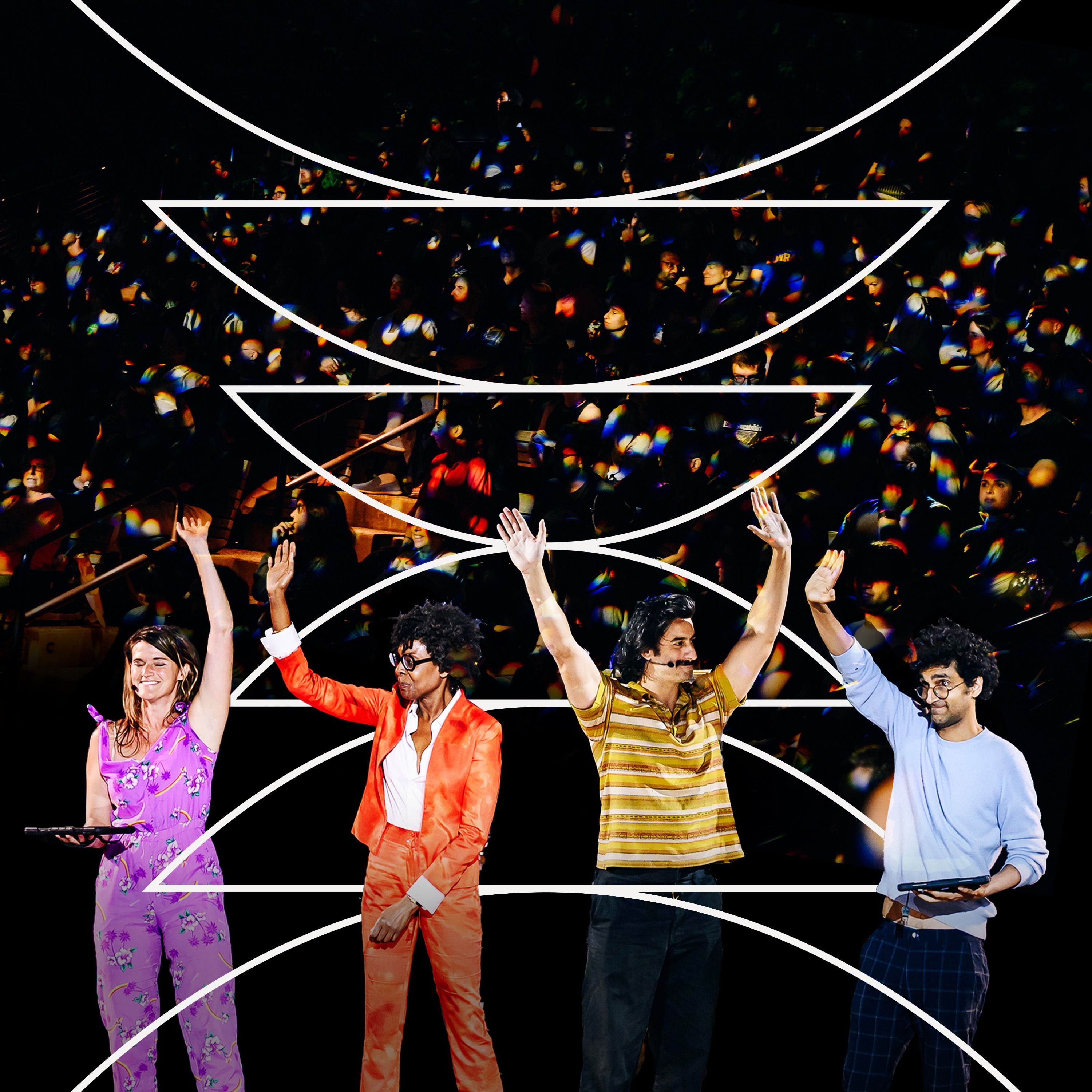
Radiolab
Screaming Into the Void
00:57:16
In August we performed a live taping of the show from a theater perched on the edge of Manhattan, overlooking the Hudson River, overshadowed by the wide open night sky. Three stories about voids. One about a fish that screams into the night – and the mystery of its counterpart that doesn’t. Another about a group of women who gazed at the night sky and taught us just how vast the universe is. And a third about a man who talk to aliens – and the people who tell him he’s putting human civilization at risk by doing so. Finally, we turn back to Earth with the help of a reading from Samantha Harvey’s hit novel Orbital (https://zpr.io/RNi4sY2JVKxK) performed by the artist, actor and podcast host Helga Davis (https://zpr.io/TKGuzzDFnVjN). What does it mean to stand on the edge of a void, and what happens when you scream into it, or choose not to? This episode was originally produced and developed in front of a live audience by Little Island, Producing Artistic Director Zack Winokur, Execu...
Loading summary
Transcript142 lines
- [00:01]
Lulu Miller
Radiolab is supported by AT&T. Few things feel better than knowing someone is in your corner. Like when your friend saves you a seat when you're running late. That's why ATT has connectivity you can depend on. Or they'll proactively make it right. That's the ATT guarantee. Terms and conditions apply. Visit att.comguarantee for details. AT&T connecting changes everything.
- [00:22]
Latif Nasser
Radiolab is brought to you by Progressive Insurance. Do you ever think about switching insurance companies to see if you could save some cash? Progressive makes it easy to see if you could save when you bundle your home and auto policies. Try it@progressive.com Progressive Casualty Insurance Company and affiliates. Potential savings will vary. Not available in all states. Wait, you're listening.
- [00:44]
Lulu Miller
Okay. All right.
- [00:47]
Latif Nasser
Okay.
- [00:48]
Lulu Miller
All right.
- [00:50]
Matt Kilty
You're listening to Radiolab Radio from wny.
- [01:01]
Lulu Miller
The call was coming from the night. It was eerie. Like a foghorn from another dimension rolling through the mists of San Francisco Bay. This is an actual recording of the sound which was plaguing residents of San Francisco in the late 1980s. People had all kinds of. Of theories about what it might be. Secret government activities, submarines, offshore drilling, UFOs. Whatever it was, it was so powerful, it was rattling the houseboats of the bay.
- [01:55]
Latif Nasser
I'm Latif Nasser.
- [01:56]
Lulu Miller
I'm Lulu Miller.
- [01:57]
Latif Nasser
This is Radiolab. And it is with that mystery that we kicked off our latest live show.
- [02:04]
Lulu Miller
About voids, which we performed beneath the void of the night sky at this gorgeous venue called Little island in New York City. It sits right alongside the Hudson river, which itself empties out into the void of the ocean.
- [02:20]
Latif Nasser
Right. And so in that place, in that very void adjacent place, we wanted to make an episode about not just about voids, about people reckoning with voids, standing on the edge of them, trying to decipher the sounds coming out of them, trying to measure them, trying to decide whether or not to scream into them.
- [02:43]
Lulu Miller
Three stories. One by Latif, one by senior producer Matt Kilty, one by me, plus a little extra special bonus by a guest at the very end.
- [02:50]
Latif Nasser
Yeah. So as we head into the fall, we hope you enjoy this end of summer experiment we did. And let's pick back up with that mystery.
- [02:58]
Doug Vakoch
Hum.
- [02:59]
Lulu Miller
Yes. Let me introduce you to a guy who knew exactly what it was, as.
- [03:05]
Dr. Andrew Bass
Musicians have told me. It sounds like a dimmer.
- [03:07]
Doug Vakoch
Joo.
- [03:08]
Dr. Andrew Bass
Oh, I'm pronouncing that.
- [03:10]
Lulu Miller
Oh yeah. Didgeridoo.
- [03:11]
Dr. Andrew Bass
Didgeridoo. Yes.
- [03:13]
Lulu Miller
That is Dr. Andrew Bass, a scientist at Cornell who for decades has been studying the entity that Makes this sound. An entity which is a bottom dwelling fish.
- [03:32]
Dr. Andrew Bass
They've sometimes been referred to as the ugliest fish in the sea.
- [03:35]
Lulu Miller
They are certainly a contender.
- [03:37]
Dr. Andrew Bass
Yeah, it's not like looking at a reef fish, right?
- [03:40]
Lulu Miller
Picture a frog. Now melt it. Add a set of deranged teeth. Luckily for this little guy who is often called the California singing fish, it's not his looks, but his song that attracts a mate. The way that he sings his song is by using an organ that's a little like a drum. Inside his chest, it's an inflated swim bladder against which he strikes not a mallet, but a set of very powerful muscles that he vibrates faster and faster and faster and faster and faster until it releases this om. And sometimes hundreds of them will gather and sing all at once in unison for over two hours, all of their melodies and harmonics swirling together until the sound jumps dimensions. It becomes audible above water.
- [04:50]
Dr. Andrew Bass
It's mesmerizing. It's almost like. I don't. If I can, forgive me if I say this, it's almost like a lullaby, I think.
- [04:58]
Lulu Miller
And if their siren song works as well on the female fish as it does on Dr. Bass, she will follow him to the source of the sound, which is a little hideout beneath a rock that he has dug out just for her in the shallow end of the sea. And there he will keep singing, trying to impress her, Singing out his different yearnings and melodies and rhythms, Impressing her with his stamina. Now, of course, singing out into a void like this can come with a risk. You make yourself known.
- [05:36]
Dr. Andrew Bass
You'll see gulls fly in and grab them.
- [05:39]
Lulu Miller
Wow.
- [05:40]
Dr. Andrew Bass
They'll take them. And there are reports even of eagles sweeping down and taking them out of the water.
- [05:47]
Lulu Miller
But it can also sometimes come with a reward. If the female likes what she hears, she will swim deeper into the cave, turn upside down, and one by one, begin depositing her eggs on the underside of the rock.
- [06:02]
Dr. Andrew Bass
We have videos showing the male will move her sometimes along the roof.
- [06:09]
Lulu Miller
Oh, like helping her to distribute them.
- [06:12]
Dr. Andrew Bass
Well, yeah, this is like, amazing. This is actually. So I have to tell you, my wife, her name is Margaret Moshater, who's worked with me closely on this over the years. She's the one who's made some really amazing videos showing these things.
- [06:27]
Latif Nasser
Oh, neat, right?
- [06:28]
Dr. Andrew Bass
You see something like that and you go, wow. That is such a sophisticated behavior and a delicate behavior.
- [06:37]
Lulu Miller
This delicate scene lasts about 24 hours. And then the female fish swims away. In this species, it is the male that tends to the Children to the babies until they are hatched for weeks. Over the decades, Dr. Bass has made dozens of incredible discoveries about these fish. How they sing and why they sing, and how the circuits in their brain that let them sing look eerily similar to the ones in our brain that let us talk. But none of that is why I called Dr. Bass. Because in the 1980s, he made a discovery that to me, is far wilder. Something he never expected to see, which is that inside this chorus of blustery, singing males, There is a second type of male, A male that lacks the musculature of to sing. A silent male. When I first heard about this little guy, I fell in love. This little slice of quiet in the din. I felt so much affection for him because it seemed to me he had found a way to articulate the value of silence. He's not a fluke in the gene pool. In some populations, up to 1 in every 10 males is anatomically silent. And so I wondered, there must be something about him that allows him to persist, Something that the female is choosing over these vocalizing counterpoints. I pictured a finger, Something that was gorgeous but invisible to most, but through negative space, looked like prize or attribute to some. These are all fancy words for saying, I am so sick of words. Does anyone else feel that the more I use them for a living, the more I have come to mistrust them? That they are just these noisy puffs of hot air, laden not only with anger and violence and insecurity, but so many untruths that despite the etymology of communication, meaning to share, that words are distancing. As I sink. Should have a better word for sink. As I luxuriate into middle age, into mothering, into marriage, into. I find myself more and more turning to silence as anger rises in me or yearning, I turn to silence, to coexist, to connect, to mend, to encounter some bit of good left in another person left in this burning and blustery world. And so I wondered, was there any way that what was going on in the fish could explain this, that the female fish was choosing in the silent male Just a more pure and honest offering of self. So I asked Dr. Bass, so the silent male, does he use silence in a way that's analogous to, like, a rack of tail feathers or gorgeous antlers? Like, is the silence a feature that he's actually, Like, a way that he can, like, actively attract a female?
- [10:19]
Dr. Andrew Bass
Yeah, you know, that's a really good question. We have no evidence to support what you just said.
- [10:26]
Lulu Miller
Okay, so then how does the Silent male. Get the girl. Well, to get the girl, Dr. Bass explained, first of all, you need to know that they don't call him the silent male, but rather sneaker males. Wait, and when you say sneaker male, you're not. It's not because he's sporting cool Reeboks. What do you mean?
- [10:45]
Dr. Andrew Bass
In other words, they were fishes that would sneak into the nest of another male to try to steal fertilizations from them.
- [10:54]
Lulu Miller
Okay, so sneaky skulking, stealth.
- [10:57]
Dr. Andrew Bass
Yeah, yeah, essentially, yeah, sneaky. What we observed was that these smaller males would literally sneak into. So the male already has a female in his nest.
- [11:08]
Lulu Miller
So, okay, so we're at the point where our singer has. He has sung his little heart out. He's attracted her and it's that 24 hour window while she's in there and he's like caressing her to help her lay the eggs. Yeah, yeah. And then what happens with this silent male?
- [11:21]
Dr. Andrew Bass
He tries to sink into the nest. And now.
- [11:25]
Lulu Miller
So wait, there'd be three of them in there?
- [11:28]
Doug Vakoch
Yeah.
- [11:28]
Lulu Miller
Okay, now here's the.
- [11:30]
Dr. Andrew Bass
But here's the dilemma. Here's the dilemma for that male who produce the hum and attractive female.
- [11:36]
Lulu Miller
Yeah.
- [11:37]
Dr. Andrew Bass
Well, what do I do? Do I focus on trying to fertilize the eggs or chasing that other male out of the nest?
- [11:43]
Lulu Miller
Because. Yeah, I was going to ask, like the singing male, when he's helping position her, is he fertilizing that whole time or does he wait till she's gone? Or he's like, right away, he's fertilizing the whole time.
- [11:55]
Dr. Andrew Bass
If she deposits an egg, he fertilizes it.
- [11:57]
Lulu Miller
Okay, I know, like 24 hours straight.
- [12:01]
Dr. Andrew Bass
Yeah. But here's the thing. The sneaker male will release more. You can almost see like a solid thread of sperm being released.
- [12:10]
Lulu Miller
Oh, with the naked eye.
- [12:11]
Dr. Andrew Bass
Yeah.
- [12:13]
Lulu Miller
Whereas with the other. With the singing male, you can't.
- [12:15]
Dr. Andrew Bass
No, because the event is right up. I mean, they're right up against the egg, right?
- [12:19]
Lulu Miller
Oh, I don't know.
- [12:20]
Dr. Andrew Bass
So they have the advantage of proximity. So here's the thing. Why would the little guy try to release lots of sperm? Well, he's trying to flood the other sperm so his. Fertilize the egg before the other one.
- [12:32]
Lulu Miller
Okay, so the singing male is. He's up close and he's like going egg by egg, like, here's some sperm, here's some sperm. I'm up close. And then from like further away, Rambo style, the sneaker male's like shooting a ton.
- [12:46]
Dr. Andrew Bass
Oh, yeah. Basically, that's yeah, yep, to put it simply.
- [12:53]
Lulu Miller
And then he is gone, the silent male back to the depths, leaving the singing male to care for his babies for weeks. The singing male uses his voice to bark away predators foregoing food so that he emerges as a near skeleton to let the silent male's babies hatch and grow. As I think about this silent male, I picture him alone and happy and carefree and healthy in the deep. I see his silence anew, like it sounds aggressive, violent, cowardly, deceptive.
- [13:38]
Dr. Andrew Bass
Oh, those are the strong words.
- [13:40]
Lulu Miller
But he doesn't sound admirable.
- [13:42]
Latif Nasser
No, he doesn't.
- [13:43]
Lulu Miller
Those words, of course, are not meant for fish, for creatures who have no way other than to behave how they might behave to survive. Those words are meant for people, people like me, who have the choice to become unsilent, to heave up from that cozy refuge of silence and risk disinterest, ridicule and attack. To sing out what is true in you, what is angry and yearning and real and just might make enough vibrations to change or at least rattle the rusting fixtures of this thank you guys. When we come back, we are headed out of the sea and up to the stars. Radiolab is supported by AT and T. Few things feel better than knowing someone's in your corner. Whether you're celebrating a win or trying to work through a loss. Staying Connected matters Check ins, no matter how casual or quick they may seem, are are moments that matter. AT and T wants to ensure these moments are always in reach with their guarantee that covers both wireless and fiber Internet service that is all about having your back. Staying Connected matters. That's why in the rare event of a network outage, AT and T will proactively credit you for a full day of service. That's the AT and T guarantee. That's a wrap for now, but if you're thinking of reaching out to someone who has been on your mind, go for it. Credit for fiber downtime lasting 20 minutes or more, or for wireless downtime lasting 60 minutes or more caused by a single incident impacting 10 or more towers must be connected to impacted tower at onset of outage. Restrictions and exclusions apply. See att.com guarantee for full details. AT and T connecting changes everything.
- [15:59]
Latif Nasser
Radiolab is supported by Hims and Hers. If you're someone who values choice in your money, your goals and your future, then you know how frustrating traditional healthcare can be. One size fits all treatments, preset dosages, zero flexibility. It's like trying to budget with a fixed expense you didn't even choose. But now there's another way with Hims and Hers. Hims and hers is reimagining health care with you in mind. They offer access to personalized care for weight loss, hair loss, sexual health and mental health because your goals, your biology and your lifestyle are anything but average. There are no membership fees, no surprise fees, just transparent pricing and real care that you can access from anywhere. Feel like your best self with quality and convenient care through Hims and Hers. Start your free online Visit today@hisss.com Radiolab that's hims.com Radiolab to find your personalized treatment options. Not available everywhere. Prescription products require provider consultation. See website for full details, important safety information and restrictions.
- [17:08]
Lulu Miller
NYC now delivers breaking news, top headlines and in depth coverage from WNYC and Gothamist every morning, midday and evening. By sponsoring our programming, you'll reach a community of passionate listeners in an uncluttered audio experience. Visit sponsorship.wnyc.org to learn more. Lulu Latif Radiolab on with our show about voids ok, so imagine all the lights are off and you're staring at the stage behind which is the river, behind which is the New Jersey shoreline. And then all of a sudden a spotlight comes on and illuminates a man standing way up high on a scaffold.
- [17:56]
Matt Kilty
Hey everybody, don't mind me. I've just been hanging out up here for a little while. I'm a producer at Radiolab. My name is Matt Kilty. Please join me and casting your eyes out to the sublime, the awe inspiring New Jersey. Now pretend it doesn't exist, which like really shouldn't be that hard to do. Instead, just imagine it's just ocean. The sea as far as you can see now, thousands of years ago, that sea that you're imagining your mind's eye was thought of as a river. A river that circled all of Earth. And the thing that was big, enormous, the thing that we thought was at the center of the Earth, the center of the universe, really was the land underneath our feet. The ocean was just this kind of like tidy boundary that seemed to surround this big island we were floating on. And this idea, you can trace it back the world over. Ancient Egypt, Mesopotamia, Babylon. The Greeks handed it down to the Romans. It persisted into the Middle Ages. This idea that the sea, at least on paper, was contained. But then the Europeans, they started building bigger ships. They started venturing further out. And as they did, the sea, the sea began to expand. There was Columbus.
- [19:30]
Latif Nasser
This day we completely lost sight of land.
- [19:32]
Matt Kilty
1492, trying to find India and many.
- [19:35]
Latif Nasser
Men sighed and cried for fear they.
- [19:38]
Helga Davis
Would not see land again for a long time.
- [19:40]
Matt Kilty
They wouldn't see it for 33 days.
- [19:42]
Lulu Miller
Hitherto no land appeared before us.
- [19:45]
Matt Kilty
1501, Amedeva Spucci in the vast sea, sailing south across the Atlantic. We all would have died of hunger. 1520, Magellan crosses the Pacific in that exceedingly vast sea. And in 1580, Sir Francis Drake goes two whole months without sea and land. 10,000 total miles around the globe, proving for the first time ever that the sea, in a sense, is never ending. And with that, in a matter of a century, the ocean went from something that was contained to something that was terrifyingly, staggeringly huge. As these explorers mapped out the oceans, we began to realize that we were just simply a speck floating on this vast churning sea. And to stand on any shore and look out across that vastness, to gaze.
- [20:37]
Helga Davis
Into the depths of the sea, is in the imagination like beholding the vast unknown.
- [20:44]
Matt Kilty
That's writer Victor Hugo and 1866. And for him and others like him, painters, philosophers, poets, the sea became this place to go to contemplate our very own existence. I'm going to wait for the helicopter. At this pivotal juncture, I'm giving it a second, giving it five seconds, giving it 10 seconds. So we contemplated the smallness of it in the face of such enormity. Hit it, Victor.
- [21:23]
Latif Nasser
Analogous to the realm of night and dreams.
- [21:29]
Matt Kilty
All right, it was incredible, but that was then and this is now. And if you are one of those people who still looks out across an ocean, you feel a sense of awe and wonder and a little bit of terror. Well, I'm sorry, but you're a child. I don't know what to tell you. It's really not that big of a deal. It's like a six hour flight to Europe, which is probably what you're looking at. That's it. And I mean, I don't know, to be fair, for like 300 years or whatever, this ocean was kind of like the biggest thing any of us could conceive of. There was nothing bigger until some very obsessive women came along. So around 1890, Boston, Harvard, every night a team of astronomers, all men, would sit in the Harvard Observatory and they would point an 11 foot long telescope into the night sky. And then they would open the shutter and the telescope on a clock driven mount would move in time with the rotation of the earth so that the faint light of the stars would stay fixed in relation to it. They would move at the same rate, telescope stars and lockstep together and for 30 minutes, maybe an hour, that faint light would come rushing down the telescope onto this glass plate, about the size of a notebook that was covered in this emulsion. The light would hit the plate, and slowly little dots would start to emerge. Stars, hundreds of them, thousands of them. Tiny little individual ones, big clusters of stars, all of them trapped within this glass plate. Think of it like a photograph of the night sky captured on the glass. The plate would then be marked with date and time and sent over across the street to. To this brick building that was full of computers. These are maybe people you've heard of, the Harvard computers. These are the women who were not allowed to work in the observatory because of the patriarchy. But they could go to this brick building where they were essentially computing the data, the data of the dots on the plate, the stars. So their job was to figure out, like, you know, the positions of the stars or if a star was actually a star or just like a speck of something or whatever. All of this was a part of our most significant attempt at cataloging the heavens. Now, one of these computers was a woman named Henrietta Leavitt. Got some fans in the house. So Leavitt started at the observatory at the age of 25. She was a former lit major who, her senior year, took an astronomy class and was just like, I think. I have no idea. She didn't write anything about what she experienced in that moment. But whatever it was, it had to be profound, because after that, for 30 cents an hour, she would go to this brick building, sit with about a dozen other women, and using a magnifying glass, she would study plate after plate after plate. And her job was to mark any star that she saw on these plates that were variable stars. What's a variable star? Great question, astute listener. So variable star is a star that, over time, varies in brightness. So some nights it appears a little bit dimmer. Some nights it appears a little bit brighter. This is just a thing that some stars do over the course of their life. So her job was basically to look for these dots on thousands of these glass plates that were getting lighter and darker and lighter and darker, and then circle them. Over the course of 28 years, she finds 2,400 of them. And that's it. That is her job. But it was in the midst of this, in the midst of these 28 years where something incredible happens. The thing that would shift our gaze, our deepest sense of awe and wonder as a species, from the sea to the stars. So Levitt's doing her job day in and day out when she comes across this one plate, a plate that contains the Magellanic Clouds, which is just like a cluster of stars close together that look like a cloud in the night sky. Now, this was crucial. Nobody knew how far that cloud was from Earth. In fact, we knew very little about how far anything was from Earth. We had an approximate distance to the sun, to the Moon, a few nearby stars, but that was pretty much it. Beyond that, we really had no idea, mainly because we didn't have a good way to measure anything in space. We didn't have, like, a yardstick. And so what we had settled on was this idea that everything in the night sky, all of it, was a part of our Milky Way galaxy, and that we here on Earth, we were floating in the center of the Milky Way, and that was the entire universe, us, right there in the center. But this plate was about to change that because Leavitt noticed this pattern, which was the bright stars, the bright variable stars that she was circling on this plate in the cluster. They varied really slowly. So it took him a long time to go from bright to dark, bright to dark. It was almost like uniform. So the brighter the star, the slower it would flicker. And she's like, oh, okay, there's a little pattern here. So she goes looking for it in the other stars in the cluster, and she finds, sure enough, that the dim stars, they varied more quickly. And this pattern, it was really reliable. So reliable, in fact, that one could use the time it takes for a star to flicker to just whoop on a graph, figure out the brightness of that star, which, I don't know, probably doesn't sound that important to anybody here. But this is a thing that would truly crack open the universe because. And this had always been the problem about figuring out distances in space. Like, let's say you're looking at a bright star in the night sky. Well, how do you know that bright star isn't just, like, really close to you or a dim star? Is that a star that's really far away, or is it just a dim star? Nobody knew how to answer these questions, but suddenly Leavitt could. The rate at which a star flickers tells you its intrinsic brightness. And once you figure out the brightness, with some fancy math, you can start to figure out distances. And so if we jump ahead 10 years after Leavitt plots out this pattern, publishes it in paper in the 1920s, Edwin Hubble is out in California with what was then the world's largest telescope, and he's pointing it up at another cluster of stars called the andromeda Cluster. And like I said at that time, people deeply believed that our entire universe was the Milky Way. But Hubble had suspected different. He just never had a way to prove it. And so there he is, pointing this incredible telescope up at the cluster. And in the cluster, he sees a few little flickering stars. So he watches one of them, this star called V1. And he watches it go from bright to dark, bright to dark, counts the number of days, grabs Leavitt's calculations, does a bunch of math, and he gets a number, an astonishing, unfathomable number. 900,000 light years away is that star from us, which is way outside of our Milky Way galaxy.
- [29:09]
Latif Nasser
See.
- [29:11]
Matt Kilty
And this is an important footnote. Hubble actually totally botched it. He's not even close. That star is not 900,000 light years away from us. It is, in fact, 2.5 million light years away. And just to, like, put this into perspective, if you think about it like this, so think of Earth as us here in New York City, the edge of the Milky Way galaxy. What we thought was our universe is probably like out around Moscow. What Hubble was observing, what he was measuring would be like from us here in New York to the Moon. And in astronomy circles, this was huge news. Because what it told us for the first time is that that cluster of stars isn't just a cluster of stars in our own galaxy. It is, in fact, a galaxy in and of itself. And so Hubble keeps at it, and he keeps pointing this telescope, and he finds another cluster of stars that is 2.73 million light years away. He finds another that's nearly 10 million light years away, another that's 15 million light years away, another that'S 23 million light years away. And as he's measuring these galaxies, he realizes that. That they're all moving out away from each other, out into what nobody knows. It is just trillions of galaxies expanding out into the infinite. And with that, suddenly we were confronted by another sort of dark mirror. This one with tiny little specks of light, an even bigger void for us to confront. And it would take some time for people to start waxing on about the enormity of this void, conjuring up just how itty bitty we really are, where our eyes would start to turn away from the sea and up to the stars. A void that goes on forever. I mean, further than forever, a forever that is getting bigger with each passing moment that we sit here and contemplate it. And to do this, to gaze up into the depths of the universe, is as Victor Hugo might say, in the imagination, like beholding the vast unknown.
- [32:04]
Lulu Miller
Senior producer Matt Kilty when we come back, it's time for Latif and Aliens. Maybe stick with us. Radiolab is supported by AT&T. Few things feel better than knowing someone's in your corner, whether you're celebrating a win or trying to work through a loss. Staying Connected Matters Check ins, no matter how casual or quick they may seem, are moments that matter. AT and T wants to ensure these moments are always in reach with their guarantee that covers both wireless and fiber Internet service that is all about having your back. Staying Connected Matters. That's why in the rare event of a network outage, AT and T will proactively credit you for a full day of service. That's the AT and T guarantee. That's a wrap for now, but if you're thinking of reaching out to someone who has been on your mind, go for it. Credit for fiber downtime lasting 20 minutes or more or for wireless downtime lasting 60 minutes or more caused by a single incident impacting 10 or more towers must be connected to impacted tower at onset of outage. Restrictions and exclusions apply. See att.com guarantee for full details. AT and T connecting changes everything I'm Lulu and this episode is sponsored by BetterHelp. Picture it. You're at the salon getting a new haircut. You look in the mirror and begin to think about some of your latest mess ups, some breakups, some things you did wrong, and the words slip out of your mouth. You begin sharing your problems with your hairdresser and they listen. But is that where you should be bringing your problems? Should they have to be the ones to help you fix it? No. They went to school to make you look as dapper as possible beneath the strings of dead keratinized cells known as your hair. If you are looking for help with anxiety, depression, relationships, communication or other clinical issues, do the hairdressers in your life a favor and get guidance from a licensed therapist, someone trained in the art of helping you find you. BetterHelp provides access to mental health professionals with a diverse variety of expertise online at the push of a button. Find your mental fit@betterhelp.com go to betterhelp.com Radiolab to get 10% off your first month. That's betterhelp.com Radiolab and listen to your hairdresser for a change. NYC now delivers the most up to date local news from WNYC and Gothamist every morning, midday and evening with three updates a day. Listeners get breaking news, top headlines and in depth coverage from across New York City by sponsoring programming like NYC now. You'll reach our community of dedicated listeners with premium messaging and an uncluttered audio experience. Visit sponsorship.wnyc.org to get in touch and find out more.
- [34:48]
Latif Nasser
Lulu Latif, Radiolab and today we are playing a recording of a live show we did a few weeks ago in New York City. And for the last story, I'm taking you to space with a guy who is reaching out into that void.
- [35:04]
Lulu Miller
Latif tells this one. And just to picture his stage entrance, it's completely dark. And then he is carried out on an orange armchair holding a book.
- [35:16]
Latif Nasser
So I am in the middle of reading the book series Hitchhiker's Guide to the Galaxy with my son. Yeah. And in the second book, there is this device called the Total Perspective Vortex. It's a closet sized machine that you walk into, close the door behind you. And what it does is it shows you, like really, truly shows you how small and insignificant you are in the universe. And I should have mentioned it's actually a torture device. No one has ever survived it because it is just that psychologically cripplingly unbearable to know how trifling you are in the grand scheme of things. But I think there's something maybe even worse than knowing how small you are. And that is the possibility that we are all alone. How tragic would it be if in all these trillions of galaxies that each have billions of stars, that each have umpteen planets, if nowhere in there was there a single friendly face or tentacle or, you know, whatever else there might be. The cosmic loneliness is just too much to bear. It's like we're all a toddler wandering alone at night in the middle of the Sahara. When I got my first laptop in high school, it was a hand me down for my mom. It's like thick as a brick. And one of the first things that I did was I installed this program called setiome. Has anybody heard of this? Does anybody know what I'm talking about? Yeah. Okay, a few people. All right, so SETI is this decades old research organization. They, you know, they're funded in part by NASA. It's a highly respectable thing. And they, the idea is in the title, it's S E T I Search for Extraterrestrial Intelligence. The reason I heard of it as a high school kid was I watched the movie Contact like four times in theaters in one week. And I was just obsessed. And this, this program, what was so cool about it Was it let you be Jodie Foster on the hood of her car with the headphones on, listening for alien signals? And the way it let you do that was it would, like, use your. Like, for me, with my laptop, you could use your, like, spare compute time when you weren't using the computer. It would, like, analyze all these, you know, radio signals that were slurped up from all over the sky, and they would be looking for some kind of alien message. And I just remember this one night when I was in high school, I woke up and I, like, felt my laptop, and it was super hot, and I was like, oh, my God, is my computer discovering aliens right now? Cut to. Years later, I start working at this show, Radiolab, and one of the first people that I pitch to interview with was this guy Doug.
- [39:02]
Doug Vakoch
Testing, testing. How are we doing?
- [39:04]
Latif Nasser
Okay.
- [39:05]
Doug Vakoch
Are we recording now?
- [39:06]
Latif Nasser
You sound great. Doug Vakoch is his name. He worked at seti, but unlike almost every other employee of seti, he was not an astronomer. He was not a physicist specializing in, like, radio telemetry or anything like that. He wasn't even a scientist. When I was prepping to interview him, I saw his resume, and he had just, like, all kinds of weird things on there. There was, like, he studied comparative religion, but he also studied, like, ecofeminism and psycholinguistics and all these things I never even heard of. And so it would be years before the movie Arrival came out. But like Amy Adams in that movie, that's his job. He is. He's an alien translator. And he. He told me that in the interview, he wanted this job. He had wanted to talk to aliens since he was a little boy.
- [40:05]
Doug Vakoch
I grew up as a kid on a farm out in a remote part of northern Minnesota. And so, especially on winter nights, you know, I would go outside and I would look up there, and it's just beautiful. It's breathtaking. But it also got me thinking, huh? You know, I wonder if there are any kids out there on other planets who are looking up there and thinking the same sort of thing.
- [40:32]
Latif Nasser
So initially, he wanted to be an astronaut until he realized that, like, just space is too big, the distances are too vast. Like, you. You can't actually go meet an alien face to face. You gotta do it remote. So that's why he got obsessed with seti. And he told me about how he basically made the job at SETI for himself. Like, he bugged them until they hired him. And when I interviewed him, he had worked at SETI already for about 15 years. And so I asked him, like, okay, say an alien message appears out of the blue today. Like, how do you even start to translate this thing from an intelligence? Completely different. It's completely foreign. That's totally incomprehensible to us. And his answer was like, okay, well, you can't really know how you'd start until it actually comes and you see how it comes. Dah, dah, dah. But you actually don't have to go that far to practice.
- [41:32]
Doug Vakoch
What if you're talking about a planet, an exoplanet that has this murky cover where short, you know, distance vision really isn't helpful, then you have to use a sense of sound or a sense of touch or a sense of smell. So we look at other species here on Earth and say, how do they encounter the world? And what if there were an alien who used that as their primary way of engaging with their environment, with one another?
- [41:59]
Latif Nasser
So it's like, okay, I'm going to go try to talk to dolphins or octopi or something. Another way to practice, try to understand Mayan or Babylonian ruins. And so that was like, that was his job. He would, like, practice this sort of thing every day, cracking codes and studying animal behavior and deciphering hieroglyphics. And then so that we did that interview, it was great. A couple years later, the movie Arrival actually comes out. And I'm watching it and I'm like, oh, my. This is, like, all I could think about was Doug Etti. So I call him up, but weirdly, this is what I heard on the other end of the line.
- [42:40]
Lulu Miller
Thank you for calling Mehdi.
- [42:44]
Latif Nasser
Mehdi? I thought he worked at Shetty. Like, what the heck is Mehdi? And it turns out there's like a whole juicy backstory behind that single letter change. Tell me the origin story of Mehdi.
- [42:56]
Doug Vakoch
Yeah, the origin story was sure. I had been making the case.
- [43:00]
Latif Nasser
So he explained that for a long time, even before he started at school, seti, he had this feeling that pointing our microphones towards the sky, that just wasn't enough.
- [43:13]
Doug Vakoch
You know, the talks I was giving as a grad student were, you know, and we should be transmitting, too, and not just listening. And so I made that case over the years. The argument is, everyone is sitting around waiting for someone else to take the initiative. And if everyone is simply doing what we are doing, simply sitting here and listening and not transmitting, it's gonna be a really quiet universe.
- [43:43]
Latif Nasser
It's like a high school prom or something, you know? So Doug's like, come on, someone's gotta Say something, anything. It could be as simple as, you know, just like a Yoo Hoo, or it could be something more complicated, like something like, hey, we're a couple billion moderately intelligent carbon based life forms on this third planet off of this particular yellow dwarf over here. So nice to meet you. We love long walks on the beach, breath breathing oxygen, and true crime podcasts. Please get in touch, especially if you know anything about runaway global warming. Thank you. So Doug brings this idea to the SETI board.
- [44:49]
Doug Vakoch
I was able to make my case and I lost.
- [44:53]
Latif Nasser
And one of the big reasons was that people were scared.
- [44:57]
Doug Vakoch
That came up when Stephen Hawking was promoting a new science documentary. He had a documentary and he posed this provocative issue of, you know, if the aliens transmit, don't respond. Because, you know, when we've seen contact between civilizations here on Earth, it often does not work well for the less advanced civilization. So, you know, duck and cover.
- [45:21]
Latif Nasser
One SETI researcher at Berkeley went on record saying that, quote, 98% of astronomers and SETI researchers, including myself, think that this is potentially dangerous and not a good idea. It's like shouting in a forest before you know if there are tigers, lions, bears, or other dangerous animals there. But Douglas was like, okay, look, the.
- [45:45]
Doug Vakoch
Aliens know we're here. I mean, anyone with a technology, a SETI system a little bit more advanced than us can already pick up our leakage radiation.
- [45:54]
Latif Nasser
We've already been beaming out our TV and radio episodes for decades.
- [45:59]
Doug Vakoch
The cat's out of the bag.
- [46:01]
Latif Nasser
So he got together a bunch of other like minded researchers and they started MEDI for messaging.
- [46:08]
Doug Vakoch
Extraterrestrial Intelligence.
- [46:10]
Latif Nasser
Are you like rival siblings? Like, what are, how would you, how would you describe it? Is there an analogy?
- [46:15]
Doug Vakoch
Siblings with quite different interests. I mean, generally shared interests. You know, we value science, we want to be doing these kind of things, but, you know, each of the kids has its own thing that they think is the most important thing in the world. We may never get the other one to agree with us, but it's okay.
- [46:33]
Latif Nasser
Now, when I heard about Doug and SETI and Mehdi rather, I wasn't as much worried about the dark forest problem, but I was more like, who's this guy Doug who wants to speak for all humanity? And like, what kinds of things does he even want to be beaming out there on our behalf?
- [46:53]
Doug Vakoch
So some of them are very heavily based on math and send them in the form of a picture or some have said, oh, what we really want to do is we want to be able to engage and we, we can't do that because of all these distances, let's send an AI, send a computer program that once they have built it on the other end, they can actually interact with it and they'll be able to engage with it even at a distance. Others have said send something like music. In fact, I'm a strong advocate of using some of these telescopes that have multiple dishes and to turn those into an orchestra of a sword.
- [47:39]
Latif Nasser
So in 2017, Doug and his team did it. They encoded a message into a radio signal. It was a mixture of math and electronic music. And they beamed it out from a giant radar antenna eight miles southeast of the Norwegian city of Tromso. The target was, as you obviously can see right here, it was a star called GJ273, or Leutan Star, and its planets, which include at least one so called Super Earth. It's a little over 12 light years away, which means the message is actually still on its way over there. It'll arrive in 2029 or thereabouts. And then best case scenario, or I guess, worst case scenario, if you're afraid of them. Best case scenario, if there are beings out there and they are sentient enough to receive our message and have the technology to be able to respond and they decide they want to do that right away. The earliest we would hear back is the early 2000-40s.
- [48:49]
Doug Vakoch
The biggest impact that we can make in terms of what we're going to be for another civilization is to show up and start. I mean, until now we haven't shown up. I mean, if anyone, if we have a. If we have a reputation in the galaxy, we're lurkers.
- [49:10]
Latif Nasser
That's funny.
- [49:11]
Doug Vakoch
We're there, there, but they're sure not saying anything. I think some of the big discoveries sometimes require a capacity to say what if? And then a willingness to follow through.
- [49:24]
Latif Nasser
On it, and in this case, a hope that there is someone out there listening. Thank you very much. We want to end this evening in which we've been looking out into the void by actually going out there, following Doug's messages, in a sense, out into space, beyond our atmosphere, beyond our gravity, beyond our plodding earthly concerns, with an excerpt from a gorgeous novel, Orbital, by Samantha Harvey, which tells the story of six astronauts on the International Space Station, spending most of their time not gazing out at the cosmos, but gazing down at us. It will be read by the brilliant artist, actress, host of the WQXR podcast, Helga. Please welcome Helga Davis.
- [50:40]
Helga Davis
At first, they're drawn to the views at night, the gorgeous encrusting of city lights and the surface dazzle of man made things. There's something so crisp and clear and purposeful about the earth. By night, its thick embroidered urban tapestries. Almost every mile of Europe's coastline is inhabited and the whole continent outlined with fine precision. The city's constellations joined by the golden thread of Rhodes. Those same golden threads track across the Alps, usually grayish blue with snowfall. At night they can point to home. There's Seattle, Osaka, London, Bologna, St. Petersburg and Moscow. Moscow. One enormous point of light, like the polestar in a shrill clear sky. The night's electric excess takes their breath. The spread of life, the way the planet proclaims to the abyss there is something and someone here. And how, for all that, a sense of friendliness and peace prevails. Since even at night there's only one man made border in the whole of the world. A long trail of lights between Pakistan and India. That's all civilization has to show for its divisions. And by day even that is gone. Soon things change. After a week or so of city awe, the senses begin to broaden and deepen. And it's the daytime Earth they come to love. It's the humanless simplicity of land and sea, the way the planets seems to breathe an animal unto itself. It's the planet's indifferent turning in indifferent space, in the perfection of the sphere which transcends all language. It's the black hole of the Pacific becoming a field of gold. Or French Polynesia dotted below the islands like cell samples. The atoll opal lozenges. Then the spindle of Central America which drops away beneath them. Now to bring to view the Bahamas and Florida and the arc of smoking volcanoes on the Caribbean plate. Uzbekistan in an expanse of ochre and brown. The snowy mountainous beauty of of Kyrgyzstan. The clean, brilliant Indian Ocean of blues untold. The apricot desert of Taklamakan traced about with the faint confluencing and parting lines of creek beds. It's the diagonal beating path of the galaxy, an invitation into the shunning void. So then come discrepancies and gaps. They were warned in their training about the problem of dissonance. They were warned about what would happen with repeated exposure to this seamless earth. You will see, they were told, its fullness, its absence of borders, except those between land and sea. You'll see no countries, just a rolling, indivisible globe which knows no possibility of separation, let alone war. And you'll feel yourself pulled in two directions at once. Exhilaration, anxiety, rapture, depression, tenderness Anger, hope, despair. Because of course, you know that war abounds and that borders are something that people will kill and die for. While up here there might be the small and distant rucking of land that tells of a mountain range, and there might be a vein that suggests a great river. But that's where it ends. There's no war, wall or barrier, no tribes, no war or corruption or particular cause for fear. Before long, for all of them, a desire takes hold. It's the desire, no, no, the need, fueled by fervor, to protect this huge yet tiny earth, this thing of such miraculous and bizarre loveliness, this thing that is given the poor choice of alternatives so unmistakably home. An unbounded place, a suspended jewel, so shall shockingly bright. Can humans not find peace with one another, with the Earth? It's not a fond wish, but a fretful demand. Can we not stop tyrannizing and destroying and ransacking and squandering this one thing on which our lives depend? Yet they hear the news and they've lived their lives. And their hope does not make them naive. So what do they do? What action to take and what use are words? They're humans with a godly view. And that's the blessing and also the curse.
- [58:29]
Lulu Miller
Helga Davis.
- [58:38]
Latif Nasser
And that, my friends, is our show.
- [58:46]
Lulu Miller
That'll do it for today. Before we get to the crowd, I wanted to just say thank you for listening to our voices as they warble out into the void. Over the years, reaching your ears, entertaining your ears, helping the mind inside your ears find meaning, understanding and new questions is why we do it.
- [59:07]
Latif Nasser
As you probably know, it has been a deeply unsettling summer for Radiolab and across public media. In July, Congress voted to eliminate all federal funding for public media in America. For the first time in history. That has resulted in a direct loss of millions of dollars to wnyc, our home station. And so, if you care about what we do, if you want to keep us around, the best way to support what we do is by becoming a member of the Lab. We'd love it. If you check it out, membership starts at just seven bucks a month. Not that much money. If anything we have made has meant $7 in a month to you, that would really mean the world to us.
- [59:47]
Lulu Miller
If you subscribe, you get all kinds of perks, ad free listening, bonus content, and as of right now, a brand new gigantic tote bag with a gorgeous menagerie of sea creatures on it. Designed by our multi talented assistant producer, Anissa Vita.
- [60:01]
Latif Nasser
It's Such a capacious tote bag. It's like you're carrying a void around with you.
- [60:05]
Lulu Miller
It is, it is.
- [60:06]
Helga Davis
It's truly.
- [60:06]
Lulu Miller
It's a big one. So anyway, do us a favor, check it out. If you never have, consider it. Take a peek. Just go to Radiolab.org join All right, now on to thanking all the glorious people that helped us make today's episode happen.
- [60:23]
Latif Nasser
Yeah. So this show was written by me, Lulu Miller and Matt Kilty. It was edited by Pat Walters and executive produced by Sarah Sandbach.
- [60:31]
Lulu Miller
That reading from Samantha Harvey's novel Orbital was by the the amazing Helga Davis. Check out her podcast on our sister station wqxr, which is simply called Helga.
- [60:42]
Latif Nasser
The show is sound designed by Jeremy Bloom and Matt Kilty with live scoring by Mantra Percussion, production assistants by Jessica.
- [60:49]
Lulu Miller
Young, Maria Paz Gutierrez and Rebecca Rand.
- [60:52]
Latif Nasser
Fact checked by Diane Kelly and Natalie Middleton, stage direction by Kristen Marding, scenic design by Norman D. Sherwood, lighting design by Mary Ellen Smith with tons of.
- [61:02]
Lulu Miller
Help from the whole Little island production team, which included Zach Winokore, Ed Wasserman, Sarah Bellen and Jonathan Chang.
- [61:09]
Latif Nasser
We love those people. And one last thank you to our voice actors, Davide Borella, Jim Peary, Armando Risco and Brian Wiles, with casting by Dan Fink.
- [61:21]
Lulu Miller
And that's it. We will be back soon. Catch you then. Hi, I'm Sam from Montclair, New Jersey and here are the staff credits. Radiolab was created by Jad Abumra and is edited by Soren Wheeler. Lulu Miller and Latif Nasser are our co hosts. Dylan Keith is our director of sound design. Our staff includes Simon Adler, Jeremy Bloom W. Harry Fortuna, David Gable, Maria Paz Gutierrez, Sindhu Nyanasambandan, Matt Kielty, Annie McEwen, Alex Neeson, Sara Khari, Sarah Sandbach, Anissa Vista, Arianne Wack, Pat Walters, Molly Webster, Jessica Young with help from Rebecca Rand. Our fact checkers are Diane Kelly, Emily Krieger, Anna Poojal Mazzini and Natalie Middleton.
- [62:12]
Latif Nasser
Hey, Radiolab. Michael, Tacoma, Washington Leadership support for Radiolab science programming is provided by the Simons.
- [62:21]
Lulu Miller
Foundation and the John Templeton Foundation.
- [62:24]
Latif Nasser
Foundational support for Radiolab was provided by the Alfred P. Sloan Foundation.
- [62:39]
Lulu Miller
Since WNYC's first broadcast in 1924, we've been dedicated to creating the kind of content we know the world needs. In addition to this award winning reporting, your sponsorship also supports inspiring storytelling and extraordinary music that is free and accessible to all. To get in touch and find out more, visit sponsorship.wnyc.org.