← Radiolab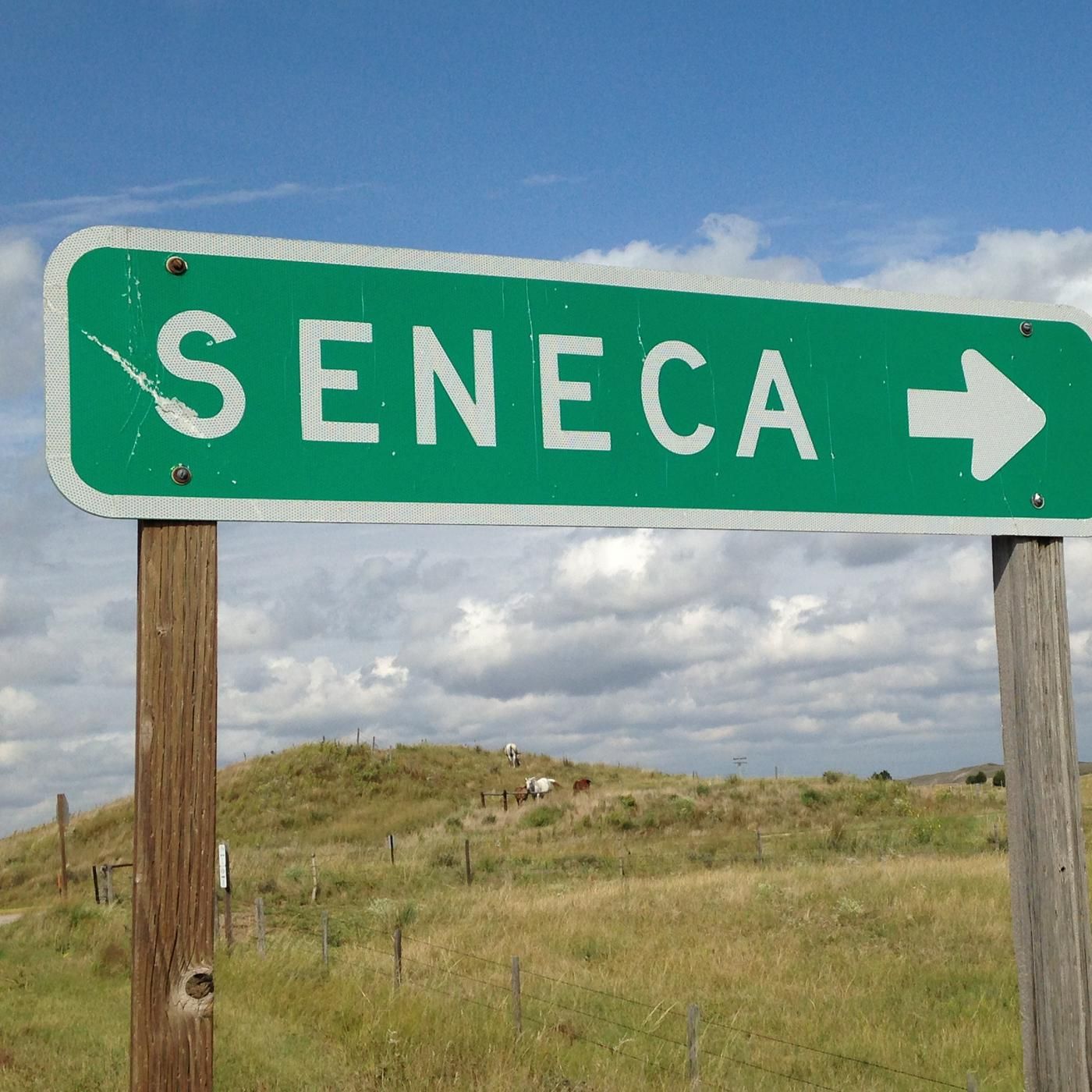
Radiolab
Seneca, Nebraska
00:29:41
Back in 2014 the town of Seneca, Nebraska was deeply divided. How divided? They were so fed up with each other that some citizens began circulating a petition that proposed a radical solution. If a majority wanted to they'd self-destruct, end the town and wipe their community off the map. Support Radiolab by becoming a member today at Radiolab.org/donate.
Loading summary
Transcript204 lines
- [00:00]
A
Save over $200 when you book weekly stays with VRBO this winter. If you haven't seen your college besties since, well, college, you need a week to catch up in a snowy cabin. Take a week long vacation and save over $200. Book now@vrbo.com when it comes to gifting, everyone on your list deserves something special. Luckily, Marshall's buyers travel far and wide, hustling for great deals on amazing gifts so you don't have to. That means your mom gets that cashmere sweater, your best friend that Italian leather bag, your co workers unwrap their favorite beauty brands, and your nephews the coolest new toys. Go ahead. At prices this good, you can grab something for yourself too. Marshalls we get the deals. You gift the good stuff. Shop now@marshalls.com or find a store near you. One day only Thanksgiving Day deals are coming to Lowes.com plus members get early access to online Black Friday doorbuster deals on gifting favorites like the still trending cobalt mini toolbox for just $14.98. Or don't miss up to 50% off for one day only. At Lowe's.com we help you save valid 1127 only on Lowe's.com member only doorbusters and midnight eastern loyalty programs subject to terms and conditions. See lowe's.com terms for details. Subject to change while supplies last. Oh, wait, you're listening.
- [01:18]
B
Okay.
- [01:20]
A
All right. Okay.
- [01:22]
B
All right.
- [01:25]
A
Listening to Radio Lab radio from wnyc. Here we go. Okay. Hi, I'm Robert Krulwich, this is Radiolab. And today with me is Simon Adler. That's me. He's a reporter and producer here. And he's got us a tale. I do.
- [01:44]
B
It's an American tale and a kind of timely one, I think. How would you describe it?
- [01:49]
A
I think it's one of those classic us versus them tales. Well, actually, maybe it's an us versus us story in its way. Yeah. Okay. Yeah, actually, I like that more because in fact, it takes place right in America's heartland. Where in the heartland? Nebraska. Seneca, Nebraska. This tiny little town in central west Nebraska. Okay. It's near the town of Mull in Nebraska, which you obviously also don't know. Yeah, no, that doesn't help me at all. So this is Matthew Hanson. He is a reporter with the Omaha World Herald.
- [02:24]
B
And.
- [02:25]
A
And a couple months back, he got in touch with us because he had a story about this town. Right. So I got an email from a woman who lives a couple miles outside of town. She was really Upset. Cause back in 2014, the town was split in half. And in fact, there was a group of people in the town who were circulating a petition, a petition that would end the town. Wait, circulate a petition to end the town? Yeah.
- [02:50]
B
They didn't want to be a town anymore.
- [02:52]
A
Right. Really? Yeah. You know, by law, if you have enough signatures on a petition, you can get things on the ballot. And the question that ended up on the ballot was, should Seneca cease to exist?
- [03:07]
B
And this split that led a group.
- [03:08]
A
Of people to try to end their own town, it got us thinking about.
- [03:13]
B
The split that seems to be this election right now.
- [03:15]
A
And it occurred to us that maybe.
- [03:18]
B
Just maybe, this tiny little town in.
- [03:19]
A
The middle of Nebraska might have something to say about the rest of us. Well, and let's back up then. Sure. So when did all was well in Seneca until what? It started with the horses. The horses. Okay. What are these horses? There were six horses, actually. Let me step back. There were a lot of horses in Seneca. Most people in Seneca ride horses. Many own them. But there were these six particular horses right in the middle of town. And, you know, the split sort of started right there. So I got so curious about what went down in Seneca that I flew to Denver. 1, 2, 3, 4, 5. Drove five and a half hours into the sandhills of west central Nebraska. Let's see if we can get anything on the radio here. These rolling sand dunes covered in grass that they ranch cattle on. Here's another ranch. What's this one say? And smack dab in the middle of the sandhills. You look like I need a drink right now is sen. After many hours and many miles, we are here. Okay, so got these rolling hills that are green dotted with these yellow flowers. Junction 86A Seneca. Okay, we've got kind of an old, bigger red sign that says welcome Seneca with a big red line. Okay, when you get there, it looks like starting to drive through town. A picture postcard. Small town from yesteryear, bound by railroad tracks. To our right, we've got the railroad. I'm taking a left. I mean, really pretty. To my right, an abandoned house. To my left, another boarded up house. Another street with absolutely nothing on it. An old gas station. It's all boarded up. Another rundown house that says no trespassing. And just really tiny. I think one end to the other is one eighth of a mile. And we're done. So there you go. At 30 miles per hour, it takes 10 seconds. Okay. Turning around and wow. Okay, the house to the left here Has a giant board over one of the windows and spray painted on it is Sandy H is a big fat liar. Interesting. And so I ended up just walking through this tiny town of Seneca.
- [05:35]
B
You're like knocking on every door.
- [05:37]
A
I think I may have knocked on every single door in the town. Oh, man. Yeah. And of course I ended up talking to some folks who wanted to end the town, others who wanted to save it. And first up, Judith Brown's house. She told her notes to me were come downhill. First house is nice. That's not me burnt up yard. I don't know if this is it. How are you this morning?
- [06:05]
B
Well, now that it's morning and now you're here in New York City and how do you do?
- [06:10]
A
Good. Very good to meet you.
- [06:12]
B
Everyone told me I can't let you into my house. But I don't have any other way to cope with it.
- [06:17]
A
I not worried about it.
- [06:18]
B
And you want to plug in, huh?
- [06:20]
A
No, I'm good. I am all set here.
- [06:22]
B
Oh, good. Tell me who else you're going to talk to.
- [06:25]
A
Larry Isom.
- [06:27]
B
Okay. Who else?
- [06:29]
A
And Jackie Sevier.
- [06:32]
B
Okay. I'm the sanest person you're going to talk to today. Just so you know. That's what I think. That's a terrible thing to say. I'm sorry about the cigarettes.
- [06:48]
A
I want to get into more contemporary things, but real quickly to set the stage. When did Seneca pop up on the map?
- [06:55]
B
Well, all I know is when I was a little kid, it was a booming town. Well, I mean, they had great dances and wonderful bands and beer and there was no place else to go. I mean, Seneca used to be really, really fun. Fun, but. Okay, so let me tell you the story. Some people had come and they bought a house in Seneca. Okay? This would have been fine, except they have all these animals. Nobody knows these people and there is a big fuss about them and their abuse of these animals. They're sure these animals are being abused.
- [07:33]
A
See, I was under the impression that this was all about horses in a front yard. Is that true?
- [07:37]
B
They had horses? They had six horses in their backyard.
- [07:45]
A
That's the yard. So we're talking like six horses in the size of a one car garage. Exactly. Do you remember the first time you saw the horses here? Saw them or smelled them?
- [07:55]
B
Yeah, both at the same time.
- [07:57]
A
Larry Isom, former member of the town.
- [08:00]
B
Board I mean, it's pretty hard to miss with when you drive down the street when there's six blocks to the town, you know, it's easy to hear about things you'll be on the list also tomorrow.
- [08:14]
A
Oh, will I? Am I going to be on the list? Probably.
- [08:17]
B
I'll have five phone calls on my phone at home by the time I get there.
- [08:22]
A
And how did you decide that you were going to take this up as a cause? As a member of the town board? Because of the complaints that were called to my house.
- [08:31]
B
What are you going to do about the horses? They're up to their knees in excrement. What are you going to do about it?
- [08:37]
A
And so you wrote an ordinance or.
- [08:40]
B
Yeah.
- [08:40]
A
And what did the ordinance say? I don't remember.
- [08:43]
B
It was two pages.
- [08:44]
A
But in any case, it stipulated a.
- [08:49]
B
Certain amount of square footage per horse as well as shelter. Well, that was part of it. The thing about Seneca is there's always a war in Seneca.
- [09:09]
A
Again, Judith Brown.
- [09:10]
B
Okay, six horses in the front yard were the most concrete thing. But Larry Isom and the bats, you're gonna go see. They have always wanted us to look more like a cute little Colorado tourist town.
- [09:26]
A
Wait, are we talking like beautification? Like.
- [09:28]
B
Yes, yes. They wanted to create rules to create growth. And I think they wanted to keep us lower class people in line. And so they were out here telling us what to do and, oh, they'll tell you things about me.
- [09:44]
A
Judith.
- [09:44]
B
She did the 60s in New York. Judith lived in a commune for a.
- [09:49]
A
Time and burned her brain down to save Seneca 3. Larry Isom Again, Nancy Isom, his wife, and here, Jackie Sevier.
- [09:57]
B
So we don't want to defend, we don't want to bicker, we don't want to open that up. The ordinances were necessary because of the situation that we were presented with. There was no elitism. They weren't on that board to dictate to anybody in this town.
- [10:14]
A
They needed covenants for the horses. That's where you started. And then you had people that was.
- [10:20]
B
Trying to say, you're not going to tell me.
- [10:24]
A
And if you look around the little town, you'll see the ones that take.
- [10:27]
B
Pride in what they have. I'm sorry, but we're getting back to the debate. So the town was split in two. I mean, we could have liked each other, but we've had nothing but constant, constant fighting.
- [10:47]
A
Hello.
- [10:47]
B
Hi. Okay, she won't hurt you.
- [10:50]
A
What's the dog's name?
- [10:50]
B
Presley.
- [10:51]
A
Presley. I'm Simon. Millie.
- [10:52]
B
Come on in.
- [10:53]
A
Also wanted to. To save the town. Asked her last name, not be used.
- [10:56]
B
Boy, this is exciting. I mean, I've heard so much about.
- [11:00]
A
You and I have to ask, where did you hear about me? From who?
- [11:04]
B
Oh, Lord, this is small town. I mean, it just all over the.
- [11:10]
A
Telephones are ringing with my name pretty much.
- [11:14]
B
Okay, I got to be nice, right? You're recording all this?
- [11:16]
A
I'm recording. You don't have to be nice, though. You can be honest.
- [11:19]
B
Oh, I'll be honest. I have no use for those people. I didn't want them to take our town.
- [11:25]
A
How long have you lived in Seneca?
- [11:27]
B
Oh, gosh, about 36, 37 years now.
- [11:32]
A
And how many people live here these days, right?
- [11:36]
B
In town? Maybe. I don't know if even 20 do. Yeah, and we get talked about a lot. I mean, we get talk put down a lot. Like, what are you. Excuse me just a minute. Hi, honey, I can't talk now. Listen, Simon's here. Do you have anything you want me to ask him? Okay. Bye. Bye. She and I have been playing phone tag all day long.
- [12:02]
A
Okay, so you were saying that people are making fun of Seneca.
- [12:06]
B
Well, they do. They make fun of Seneca quite a bit outside, you know, unlike. Oh, Seneca doesn't have anything. What are you still doing here? And it's not like it used to be. I mean, years and years ago, this used to be the neatest little town you'd ever want to live in. And then it just. I don't know, it just went downhill. The town was dying. I mean, that's the only way you can say it.
- [12:34]
A
Sandy Hansen wanted to save the town. Unofficial town historian.
- [12:38]
B
This started back in 73, I believe it was when it stopped being a division point, so the trains no longer stopped here. So that did away with the three hotels, the 24 Hour Cafe, the man that had filling station pulled out in front of a semi at Mullen. That ended that business. His brother had the shoe shop and he died of a heart attack sitting there working on his shoes. The lady that had the variety store tripped on a kitten and broke her hip. That closed that and.
- [13:18]
A
Would you mind if we just wait until the train goes by? Nope.
- [13:26]
B
Anyhow, Seneca really started dying. Presley, get away from there.
- [13:32]
A
Okay, well, so I guess I'm here because I'm trying to talk to as many people as I can to understand what happened with the whole vote to unincorporate again. Savor Millie.
- [13:43]
B
It started out there was six horses. They were up in mud up to their probably belly. And I think one of them had to be put down because it was kicked. This is how close they were together anyway. I mean, I'm an animal lover. I wanted something done about it. Several of us did. So we Had a meeting. The board tried to tell them, that's not sanitary.
- [14:08]
A
Nancy Isom and the rest of the saved Seneca 3. We did discuss it, you know, we're.
- [14:13]
B
Gonna get the horses gone. That's the purpose of the ordinance. But it was not just that.
- [14:19]
A
Judith Brown Ender.
- [14:20]
B
They wanted to get rid of all the horses, all the cattle, all the chickens. That is ridiculous.
- [14:25]
A
Have your chickens, but do you flaunt your chickens?
- [14:28]
B
Do they run around town? People were so afraid that their animals were gonna be taken away from them. And then eventually the board members forbid people to have animals. That was the gist of it. And so more and more and more the town got split. There's a group of people here and a group of people here. Nobody gets along. Nobody on the town board would speak to anybody. Which, of course, then that just meant I'd just yell at them louder. There's certain people that I just give a hand gesture.
- [14:59]
A
A one fingered hand gesture?
- [15:01]
B
Pretty much, yeah. People said things like, my dog doesn't want to be friends with your dog. It was awful.
- [15:08]
A
Are you Terry, by chance?
- [15:10]
B
Yeah.
- [15:10]
A
Can I have 20 minutes of your time to talk? Terry Hartman, who wanted to end the town. Yeah. This just got ugly. They started taking pictures of people's places and put it on Facebook and say how they didn't clean up their property.
- [15:23]
B
And just public shaming people.
- [15:25]
A
This was the Save Seneca people that were posting this.
- [15:28]
B
Supposedly, you know, there were aggressive comments. We did have the sheriff. Did anyone tell you that it was.
- [15:35]
A
Just out of control?
- [15:37]
B
I mean, what about a Xanax? You know, I took a lot of them during those years. It was a very unhappy time. And so finally people started going around with a petition to get the unincorporation on the ballot. We thought, we will just Unincorporate.
- [15:55]
A
Unincorporate.
- [15:56]
B
Unincorporate. Unincorporate.
- [15:58]
A
Our village unincorporated.
- [16:02]
B
There are agitators in every group. Okay, that's me.
- [16:12]
A
That seems kind of like the nuclear option here, right? Like we're just gonna blow the whole thing up.
- [16:15]
B
Oh, yes, absolutely.
- [16:20]
A
I think that sense of shared community was just slowly dissolving year by year again. Matthew Hanson of the Omaha World Herald. And it didn't have. It had probably to do with what was happening in Seneca, but I also believe that it had to do what was happening in the United States. Sort of the idea that winning the argument is more important than the much harder job of coming together and saying, okay, we disagree on this. Let's find a solution to our problem.
- [17:00]
B
I'M having a little trouble figuring out.
- [17:01]
A
What'S about to happen. Like, how close is this? The sense in the town was certainly that this thing was just a dead heat, really split right down the middle. Oh, it's that close. That close. And so when we come back from break, Seneca goes to the voting booth and decides.
- [17:17]
B
This is Kim Esslinger calling from Bismarck, North Dakota.
- [17:20]
A
Radiolab is supported in part by the.
- [17:22]
B
Alfred P. Sloan foundation, enhancing public understanding of science and technology in the modern world.
- [17:28]
A
More information about Sloan@www.sloan.org. radiolab is supported by Bilt. Nobody wants to pay rent, but if you have to, Bilt works to make it more worthwhile. By paying rent, through Bilt, you can earn flexible points that can be redeemed toward hundreds of hotels and airlines, a future rent payment, your next Lyft ride, and more. But it doesn't stop there. You can dine out at your favorite local restaurants and earn additional points, get VIP treatment at certain fitness studios and ENJ exclusive experiences just for built members. Every month earn points on rent and around your neighborhood, wherever you call home, by going to joinbuilt.com Radiolab that's J-O-I-N-B-I-L-T.com Radiolab Hey, I'm Molly Webster and this is an ad by BetterHelp. So it happens every year. The seasons are changing, the days are getting shorter, and basically once it becomes dark outside of my window, I feel like the rest of the world disappears and I'm just alone and there's nothing left to do but watch television. This November, Better help is asking everyone to reach out to our people. That could be your family, your friends, your neighbors, and to resist this call of the cocoon. And yeah, reaching out can take some courage. I've got text messages from January I haven't responded to. And you know what? I'm gonna write em back right now. Hi, sorry I've been missing. How are you? Why don't we all do this sooner? Therapy is the same way. BetterHelp makes it easier to take that first step. You just fill out a short questionnaire and they find a licensed therapist who they think you'll like. Our listeners get 10% off their first month at betterhelp.com Radiolab that's betterhelp.com Radiolab Radiolab is supported by Rippling Finance. Teams often spend weeks chasing receipts, reconciling spreadsheets and fixing errors across disconnected spend tools. This can be frustrating. And that's not software as a service, that's SAD software as a disservice if you've been thinking about replacing stitched together tech stacks with one platform for all departments, Rippling can help. Rippling is a unified platform for global hr, payroll, IT and finance, helping people replace their mess of cobbled together tools with one system designed to help give leaders clarity, speed and control. By uniting employees, teams and departments in one system, Rippling works to remove the bottlenecks, busywork and silos in business software. With Rippling, you can choose to run hr, IT and finance operations as one, or pick and choose the products that best fill the gaps. Right now you can get 6 months free when you go to rippling.com Radiolab learn more at r I p p l-I n g.com Radiolab terms and conditions apply. Radiolab is supported by Planet Visionaries, the podcast created in partnership with the Rolex Perpetual Planet Initiative. The show is hosted by Alex Honnold, who you may recognize from Free Solo, where he climbed El Capitan without ropes. Now he's turning his focus to the biggest challenge of protecting the only planet we've got. Every episode brings you stories that prove climate optimism isn't naive, it's a strategy. The episodes span the globe, from Arctic scientists and Amazon Forest Guardians to entrepreneurs reimagining fashion and food systems. You'll hear from explorers, scientists, activists and storytellers who are working to reshape the future in practical, human ways. In one episode, Alex sits down with wildlife photographer Bertie Gregory to discuss how animals can teach humans resiliency, empathy and hope in partnership with the Rolex Perpetual Planet Initiative. Check out Planet Visionaries Listen or watch on Apple, Spotify, YouTube or wherever you get your podcasts.
- [21:37]
B
Hello.
- [21:38]
A
Hello, My name is Simon. I think I sent you a letter a week back.
- [21:42]
B
We're not going to talk even for five minutes? Nope, I don't want to. You'll probably talk to the haters, but I'm done. Let the lying dogs laid.
- [21:51]
A
Okay, thank you so much.
- [21:53]
B
All right, bye. Goodbye.
- [21:57]
A
All right, so that was Jacqueline Licking, who is the woman who circulated the petition and she just refused to talk to me.
- [22:07]
B
I'm Robert Krulwich.
- [22:08]
A
And I'm Simon Adler, this is Radiolab and Simon Adler is with me.
- [22:12]
B
Just before the break you were saying, Simon, the town was in God awful trouble.
- [22:16]
A
Trouble? Half the town was so upset with the town and the government and the people of the town that they were circulating a petition that would end the town itself. I mean, I got where they were upset, but I certainly don't get the Idea that the solution is to end this place that has existed since 1888. This, again is Matthew Hanson, reporter for the Omaha World Herald. And it bugged me. And why did that bother you? Because I'm from a small town. I could imagine it happening to my town. And I could also empathize with the frustration of the people who wanted to keep it a town. I mean, you have to meet Sandy Hansen. Will you show me a couple of your favorite artifacts you've got here?
- [23:01]
B
Sure.
- [23:01]
A
Who operates a museum of Seneca history.
- [23:04]
B
I want other people to know just how nice this place.
- [23:07]
A
Place is. You cannot go to her museum and not say, wait a second. This place has value.
- [23:13]
B
This one I wish could talk.
- [23:15]
A
What? We've got baseball jerseys here with the ass on them.
- [23:17]
B
This was the Seneca baseball teams. I got the uniforms, even the socks. One pair of pants don't have the caps.
- [23:25]
A
Seneca had a baseball team?
- [23:26]
B
Oh, yes. Known all over the country now. This is the newspaper cutouts, 1860. These are pictures of family that lived here. These are advertisements of people of the area.
- [23:39]
A
We got a Seneca centennial hat.
- [23:41]
B
Yes.
- [23:42]
A
And so people just send you stuff. So is part of the concern here that the history will be forgotten?
- [23:49]
B
Yes, it is. Because we have been a town for 120 some years.
- [23:56]
A
And so what does it mean to be a town?
- [24:01]
B
What does it mean? It means neighbors coming together for the good of each other. When my husband died, he died in Texas. I brought his ashes back. Planned on just having a graveside service out there at the cemetery. Well, the town people wouldn't hear that. They had a big meal prepared. My yard was mowed, the water was turned on. Everything was ready to go. And it became a full service.
- [24:32]
A
And what did that feel like?
- [24:34]
B
Felt like home. Like the way you're supposed to feel, you know, warm and wanted. You see, they're talking about something that.
- [24:47]
A
Used to be again, Judith Brown, who wanted to end the town.
- [24:51]
B
They wanted to preserve it the way it was. And I agree, it used to be a lot of fun. But that's true of any town up and down this railroad.
- [25:01]
A
So if they're trying to preserve it, then what are you trying to do? You're just accepting that we're going downhill here.
- [25:10]
B
No, I'm accepting that for I myself, I can't do any better than this. For myself as an aging woman, I've only lived here 20 years, but I'm from here. My mom, my dad, my cousins are all strung all over these hills. And this grass, you know. Anyway, I guess what I'm Saying is, to me, it's heaven. Like, I don't care about my house falling down. I'm 70 years old, and I'm gonna finish up my art supplies and die at the respectable age of 96. And I do have enough art supplies that I've been putting up for years to do that.
- [25:54]
A
Was that the nerve that was being touched? You're bad because you want to live this way?
- [26:00]
B
Yes. These people saying, we can be proud of our town. We can make it hustle and bustle.
- [26:06]
A
So if they're saying that, then you're saying, no, we can be proud of just the way it is now.
- [26:10]
B
Yeah. See?
- [26:16]
A
Okay, so how. When did you first hear about the petition going around? Oh, gosh again, Millie from the Save Seneca side.
- [26:27]
B
I think the same day it was going around, I heard about it.
- [26:31]
A
And how. How did you feel in that moment?
- [26:34]
B
It was horrible. It really was. It was just. It was more than frustrating. It was just like somebody punches you in the gut and just let all the air out, you know, it's just. It's just sad. Mostly. It just seemed like if we could get rid of this unbelievable piece of bureaucracy, then we could just live here. So finally, the unincorporation, it got on the ballot at the regular election, where you do the senators and all that. We had a special ballot for Seneca where we voted for the town. And would it or would it not be unincorporated?
- [27:14]
A
And what did you feel when you.
- [27:15]
B
Were going to that to vote? I don't remember feeling anything except, I've got to get in there and vote.
- [27:22]
A
If you don't mind just telling me how you voted.
- [27:24]
B
Oh, I voted to unincorporate. I voted to keep the town incorporated.
- [27:32]
A
I have voted to unincorporate.
- [27:33]
B
I voted to keep the town. And then she said, okay, that's the last Seneca ballot.
- [27:40]
A
Shoes on or shoes off?
- [27:41]
B
Shoes on. Heavens.
- [27:43]
A
Jackie Sevier Saver. So, just because I don't think I've had anybody explain this to me yet, can you explain the night of the election and what. What actually happened?
- [27:52]
B
Well, you know, we have Internet access, so we were watching the election results on the Internet to see how it came out.
- [27:59]
A
And who was we?
- [28:00]
B
There were. I don't remember, four or five of us. Six of us, maybe. I'm not sure who all was there?
- [28:05]
A
So what were you, like, refreshing the page over and over again? How did that work?
- [28:09]
B
No, we knew about what time they'd be out. You know, we gave him an hour or so, and we logged on and saw it. We saw that the village was unincorporated. It was by one vote. It was 15 to 16. We lost our town.
- [28:29]
A
Sandy Hansen again. What was that moment like?
- [28:34]
B
I can't say it on the radio.
- [28:37]
A
So what was lost?
- [28:39]
B
Well, the day after they decided to abolish the town, the sheriff come down with them. I don't know whether they thought we were gonna shoot him off with guns or what, but the sheriff came down, they took the grader, they took the tractor that fortook our snowplow, and we no longer have our street maintenance, our lights, maybe our identity. I don't know. We never had much here, but we didn't ask for much. I mean, we lost. We lost. Seneca will be taken off of the map. And if it isn't on the map, where they can look it up there anymore. Nobody even knows it's there.
- [29:19]
A
Well, I cried, but, I mean, it hurt. Nancy Isom again.
- [29:22]
B
Because I've been here since my third grade year. People are moving away. And Jackie Sevier, I myself am ready to go. We're all ready to leave. We don't have anybody. There's been nobody move here since. Nobody.
- [29:36]
A
It sounds like you're saying the future is gone.
- [29:38]
B
I wouldn't say it's gone, but I would say it's very, very limited and unlikely.
- [29:43]
A
Yes, I have voted to unincorporate again. Terry Hartman. But I love this town. And I think the people who voted to unincorporate it was.
- [29:56]
B
Are the people who wanted to keep.
- [29:58]
A
Things the way they were. We didn't want to change. I know everything has to change, but. But I didn't know what else to stop the fighting. You know, this is my hometown, too. I don't know how to explain. Just got so ugly and out of hand. And some of the members of the village board were just crazy.
- [30:19]
B
But the town board was just three members, Millie. They have to do really what the majority of the town wants to do. Otherwise, we can get rid of them.
- [30:32]
A
So you believe in the democracy of Seneca?
- [30:35]
B
I believe in democracy. Does that make me an idiot? I mean, I live in hope, you know.
- [30:50]
A
It just. It really felt like Seneca had lost something essential. When we're talking about basic American democracy again. Matthew Hansen of the Omaha World Herald. And it worried me to see that in part because I could feel that and still feel that happening on a national level. The kind of just complete lack of conversation around shared values or compromise.
- [31:24]
B
I've got to smoke more and drink.
- [31:27]
A
More and one last time.
- [31:30]
B
Okay, Judith Brown. So.
- [31:36]
A
Can I tell you what I hear here? Maybe the strongest argument for keeping Seneca a town on the books is that then there was some sort of framework to force those two communities within the town to be together and to think together. And with that now gone, there is now no communication, no compromise before.
- [32:01]
B
So none of those people had anything to do with us before, except to continually criticize how we were. So we couldn't compromise with these people. They were not rational. All rationality was gone by then. And what's going to happen with this next election?
- [32:22]
A
But America is full of diverse opinions, and it has managed to work. And I guess if we take what happened here and if we apply that model to the rest of the United States, like, if not a town, then what?
- [32:35]
B
We have the county, we have the state. And the little town without those hateful people in it is really quite lovely.
- [32:44]
A
But it's not a town anymore.
- [32:46]
B
I don't know why you think that officially.
- [32:49]
A
Right.
- [32:51]
B
But it is a town. Here we are. I'm gonna live here until I die. And so is Rose and Harry until some woman lands him.
- [33:01]
A
So you would say that even though on the book, Seneca no longer exists. Seneca still exists.
- [33:08]
B
And we're still two tribes. Two tribes of turkeys. That's how I usually put it. That'll never get along. This story was produced and reported by Simon Adler.
- [33:33]
A
Special thanks to Ryan Scott on slide.
- [33:35]
B
Guitar, Michael Shob on trumpet, Chase Culp on engineering help.
- [33:40]
A
Special thanks also to Matthew Hanson, a reporter at the Omaha World Herald.
- [33:45]
B
The Omaha World Herald.
- [33:48]
A
Okay, we'll be back next time.
- [33:52]
B
To go to the Next message, press 6. Message 3.
- [33:56]
A
Hi, this is Matthew Hanson from the Omaha World Herald. Radiolab is produced by Jad Abinrod. Dylan Keefe is our director of sound design. Soren Wheeler is senior editor. Jamie York is our senior producer. Our staff includes Simon Adler, Brennan Farrell, David Gebel, Matt Kielty, Robert Kurlwich, Annie McKeown, Lateef Nassar, Melissa O', Donnell, Arian Wack and Molly Webster, with help from Nigar Fatali, Phoebe Wang, Katie Ferguson, Alexander Lee Young, W. Harry Fortuna and Percy of Berlin. Our fact checkers are Eva Dasher and Michelle Harris.
- [34:32]
B
End of message.