← Radiolab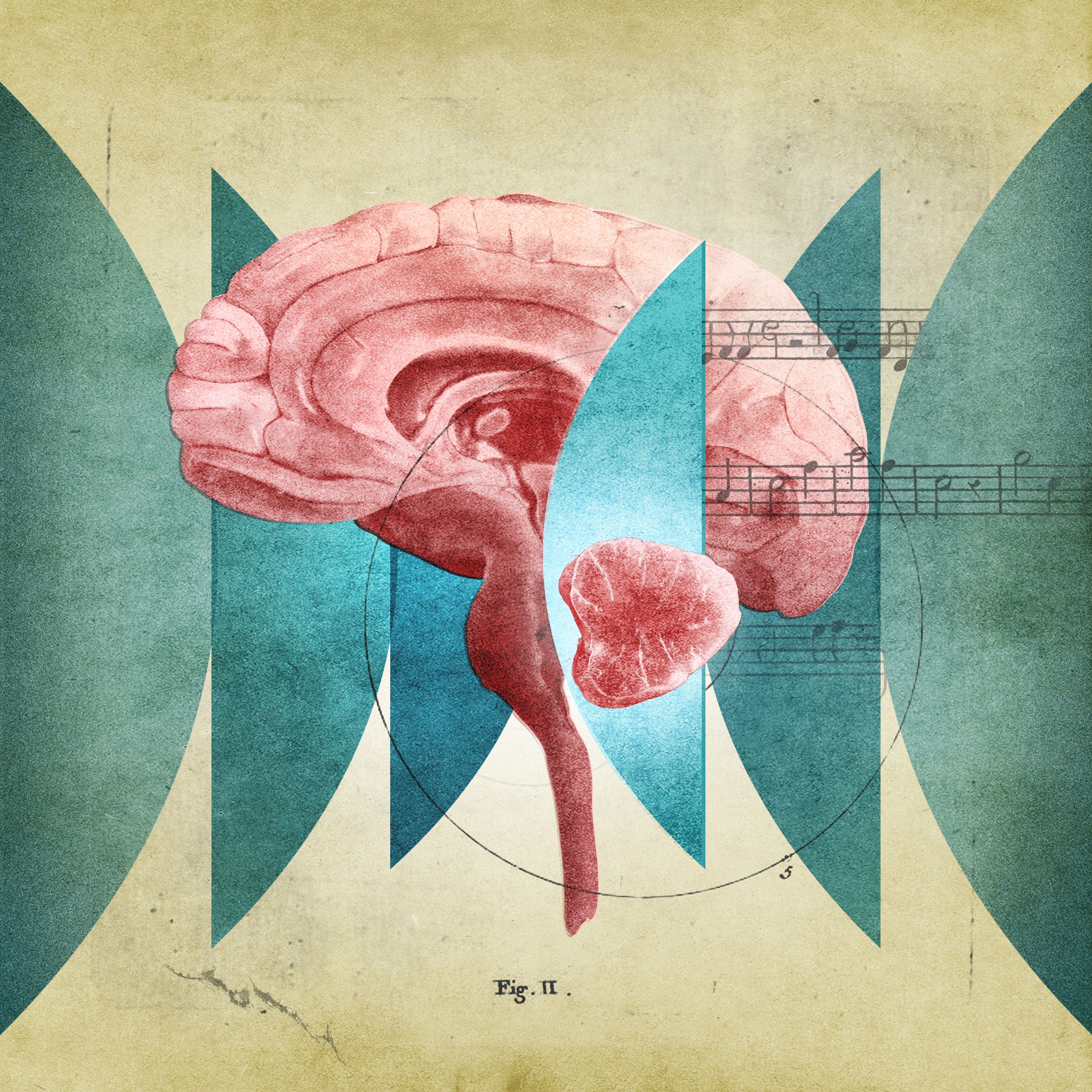
Radiolab
Song of the Cerebellum
00:42:48
One spring evening in 2024, a science journalist named Rachel Gross bombed at karaoke. The culprit was a bleed in a fist-sized clump of neurons tucked down in the back of her brain called the cerebellum. A couple weeks later, her doctors took a bit of it out, assuring her it was just helping her with motor coordination — she might be a bit clumsy for a while, but she’d still be herself. But afterwards, she didn't feel like herself. So she dove into the dusty basement of the brain (and brain science) to figure out why. What Rachel found was a burgeoning new frontier in neuroscience. We learn what singing Shakira on stage has to do with reaching for a cup of coffee — and how the surprising relationship between the two is making us rethink what we think about thinking. Special thanks to Warzone Karaoke at Branded Saloon, Dr. Joanne Loewy and the Singing Together, Measure by Measure choir at the Louis Armstrong Center for Music and Medicine (http://musicandmedicine.org/) at Mount Sin...
Loading summary
Transcript311 lines
- [00:01]
Latif Nasser
Radiolab is brought to you by Progressive Insurance. You chose to hit play on this podcast today. Smart choice. Make another smart choice with Auto Quote Explorer to compare rates from multiple car insurance companies all at once. Try it@progressive.com Progressive Casualty Insurance Company and affiliates. Not available in all states or situations. Prices vary based on how you buy.
- [00:25]
WNYC Sponsor Announcer
WNYC Studios is supported by Odoo. When you buy business software from lots of vendors, the costs add up and it gets complicated and confusing. Odoo solves this. It's a single company that sells a suite of enterprise apps that handles everything from accounting to inventory to sales. Odoo is all connected on a single platform in a simple and affordable way. You can save money without missing out on the features you need. Check out odoo@o d o o dot com. That's o d o o dot com.
- [00:58]
Latif Nasser
Oh, wait, you're listening.
- [00:59]
Rachel Gross
Okay. All right. Okay. All right.
- [01:04]
Robert Barton
You're listening to Radiolab Radio from wnyc.
- [01:15]
Lulu Miller
Hi, Latif.
- [01:17]
Latif Nasser
Hello.
- [01:17]
Lulu Miller
All right, so reporter walks into a bar.
- [01:20]
Jeremy Schmahmann
Okay.
- [01:22]
Lulu Miller
And that's just the beginning of our story. That reporter's name is Rachel GROSS. She is 35. The year is 2024. It's a warm spring night. The bar is in Brooklyn, and it is called the Branded Saloon.
- [01:34]
Rachel Gross
So Branded Saloon is a very gay bar. You know it because there are all these rainbow flags bursting out the front. It's, like, very, very crowded and loud.
- [01:47]
Lulu Miller
She's a regular. Shows up there nearly every Thursday to.
- [01:50]
Rachel Gross
Hang out, like, grab some fries, hang.
- [01:52]
Lulu Miller
Out for an hour, but also for karaoke. So that night she made her way.
- [01:55]
Rachel Gross
To the back room, got on stage, put in, like, a Savage Garden song. Crash and Burn. From, like, my teenage years. Do you know this one?
- [02:03]
Lulu Miller
I don't. Can we pull it up really quick?
- [02:05]
Rachel Gross
Okay.
- [02:05]
Lulu Miller
Crash and burn. Savage Garden.
- [02:07]
Rachel Gross
Okay.
- [02:14]
Lulu Miller
Okay, we got that. Oh, I do know this song.
- [02:19]
Jeremy Schmahmann
Oh.
- [02:19]
Lulu Miller
Oh, okay. Yeah. Okay.
- [02:21]
Rachel Gross
So you're singing along, and I think it was initially going fine, but it's really at the chorus that just, like, nothing came out of my mouth. It was just air.
- [02:32]
Lulu Miller
Could you almost imitate what happened?
- [02:34]
Rachel Gross
Yeah. It goes like. When darkness is upon your door and you feel like you can't take anymore.
- [02:44]
Lulu Miller
Is it like when you have a. And suddenly you're just like, oh, I can't. There's nothing coming out? Or did it feel different? Did it.
- [02:52]
Rachel Gross
No, it was the notes weren't translating from my brain to my vocal cords. And the rest of the song, like, the verses, I just felt like I wasn't on the beat.
- [03:03]
Lulu Miller
But you finished it out. You finished out the song.
- [03:05]
Rachel Gross
Yeah. I mean, I am used to bombing. It's part of my philosophy of karaoke. It teaches you how to be okay with things not going perfectly. So I was trying to, like, keep that in mind while I was like, damn, what just happened? I literally crashed and burned.
- [03:21]
Lulu Miller
And that night, when she got home, Rachel started thinking about another moment from the day that was a little strange.
- [03:27]
Rachel Gross
I was, like, shadowing an acupuncturist because I was writing about alternative medicine. I'd take, like, handwritten notes, and my writing was so poor, I couldn't read it afterwards. So that was another, like, odd. But Friday, I felt myself to be slurring a bit. And then on Saturday, I decided to go for a run, and it felt really weird. It felt like I was, like, forcing my limbs to run in tandem. It was after that run that I decided I needed to go to the hospital. I remember they handed me the form that you just fill out with your basic information. And I couldn't fill out the form. Like, I couldn't write my name and birth date. Whoa. They do a CT scan, and the PA comes up to me and he's like, honey, you have a bleed in the back of your brain.
- [04:31]
Lulu Miller
In other words, she'd had a stroke.
- [04:34]
Rachel Gross
And that's when I went into shock.
- [04:36]
Lulu Miller
So they rushed across town to a hospital that has a stroke ward.
- [04:39]
Rachel Gross
There's, like, a lot of beeping. Most of the patients are over 70. Of course, the neurologist and all her residents come in, and they eventually said, we think this is a cavernoma. It's, like, where very small blood vessels form a little, like, raspberry.
- [04:59]
Lulu Miller
Huh?
- [04:59]
Rachel Gross
And this little raspberry can exist your whole life, but sometimes it bursts, and that's when you have a stroke. And in my case, doctors were saying you should probably have surgery to remove it.
- [05:12]
Lulu Miller
And where exactly in the brain was the stroke?
- [05:15]
Rachel Gross
In the cerebellum.
- [05:16]
Lulu Miller
And where is that? What is that?
- [05:19]
Rachel Gross
I didn't know what the cerebellum was at that point, but the neurosurgeons told me that it's in the back of my head, basically behind my neck, and it's involved in fine tuning motor stuff. They also called it redundant.
- [05:34]
Lulu Miller
Redundant.
- [05:35]
Rachel Gross
And later one of them called it practically vestigial.
- [05:39]
Lulu Miller
It almost sounds like an appendix. Like.
- [05:41]
Rachel Gross
Yeah, exactly. Exactly. Another one said, like, because I was terrified about surgery, obviously. He says, like, you can actually take out, like, a third of it, and people don't even notice what he was like, when you wake up, you might feel a little bit clumsy, but you'll still be you. Huh.
- [06:00]
Lulu Miller
Was it kind of like this is of a place to have a brain situation? The cerebellum's a lucky spot.
- [06:08]
Rachel Gross
Yes, yes. That was definitely, definitely reassuring because the very.
- [06:12]
Lulu Miller
So Rachel went into surgery. They removed a piece of her cerebellum, and then when she woke up, she started, like, testing herself.
- [06:19]
Rachel Gross
So I drew a spiral, and it was smooth, and it didn't tremor or whatever. Within a few more days, I was, like, circling the hall by myself, and nurses were, like, clapping for me. So I was like, I'm gonna have the best recovery they've ever seen.
- [06:33]
Lulu Miller
So you're like, writing check. Walking check.
- [06:36]
Rachel Gross
Yeah, yeah, yeah.
- [06:37]
Lulu Miller
Like, stuff's coming back.
- [06:38]
Rachel Gross
You're like, okay, yeah.
- [06:40]
Lulu Miller
But over the next couple of months.
- [06:41]
Rachel Gross
I could just still hear that slur so much. It bothered me so much. And I tried singing along to a couple karaoke tracks, and I couldn't get the timing right, let alone the notes. But then the other experience I was having was a sentence that I want to say will just kind of disappear or escape me, and I will laugh at something, but it'll come out, like, too big or too, like, rambunctious. It felt much more profound than, dear having some body coordination issues. That's, like, kind of what I'm trying to figure out now.
- [07:26]
Lulu Miller
So Rachel Gross is actually a science journalist, and she writes a lot, really beautifully about the body, right?
- [07:33]
Latif Nasser
Yeah, yeah, yeah. I know her work.
- [07:34]
Lulu Miller
Yeah. She wrote this awesome book called Vagina Obscura.
- [07:38]
Latif Nasser
Terrific book.
- [07:39]
Lulu Miller
And so when she told me she wanted to talk, I figured she was going to tell me a story full of fun facts about this other body part. But as we sat there talking, I.
- [07:48]
Rachel Gross
Need to just go for the nearest word.
- [07:50]
Lulu Miller
It became clear she was in the middle of a story.
- [07:53]
Rachel Gross
That's a difficult thing to accept for someone who's, like, used to writing. Precisely.
- [07:58]
Lulu Miller
It was still unfolding.
- [07:59]
Rachel Gross
There's this confrontation with your sense of, like, who you think you are.
- [08:03]
Lulu Miller
So I guess, like, what do you really want to know? What are you after? What do you want to find out?
- [08:13]
Rachel Gross
I think the simple quest is I want to figure out how to get my karaoke back. But that's not the bigger thing. I think my question now is, why does this feel like more than just a motor problem, more than just fine tuning? Why do I not feel like myself anymore?
- [08:40]
Lulu Miller
So after that conversation, Rachel just started digging in, researching, talking to so many people, reading so many studies. Producer Sindhu nyana Sambandan and I joined whenever we could.
- [08:51]
Latif Nasser
Yeah.
- [08:52]
Lulu Miller
And what Rachel discovered is something I thought we were done finding, which is something totally new about the basic anatomy of the brain and a shift in how we think not just about this part of the brain, but really about thinking itself.
- [09:14]
Latif Nasser
All right. Okay. This is Radiolab. Here we go.
- [09:18]
Lulu Miller
Here we go.
- [09:19]
Rachel Gross
Okay. So I started in kind of the most obvious place. What do we know about the cerebellum?
- [09:26]
Jeremy Schmahmann
So cerebellum is the old Latin term for little brain.
- [09:31]
Lulu Miller
Little brain.
- [09:31]
Ira Flatow
Okay.
- [09:32]
Jeremy Schmahmann
And it's tucked in under the big brain sitting in the back of the brain.
- [09:37]
Rachel Gross
So I ended up calling this scientist named Jeremy Schmalman.
- [09:41]
Jeremy Schmahmann
I'm a neurologist at Mass General Hospital.
- [09:44]
Rachel Gross
He's been studying the cerebellum four decades now. His whole career.
- [09:47]
Jeremy Schmahmann
Yeah.
- [09:48]
Rachel Gross
So can we just back up? And what does it look like?
- [09:51]
Jeremy Schmahmann
Well, it's smaller than the rest of the brain in terms of size.
- [09:55]
Rachel Gross
It's about the size of your fist.
- [09:56]
Jeremy Schmahmann
But it's very deeply folded, unlike the big folds of the cerebral hemispheres. Everybody knows those pictures. The cerebellum has multiple tiny little folds.
- [10:07]
Rachel Gross
And it even lives in its own, like, membrane pocket. So it really looks like a little brain underneath the big brain.
- [10:14]
Jeremy Schmahmann
And the cerebellum was described in 1776 in terms of its structures by this fellow called Malacarni. And then some 50 years later, people start to look at what cerebellum does.
- [10:25]
Rachel Gross
So by the 1800s and early 1900s, scientists are doing these experiments where they basically remove the cerebellum from pigeons and cats or whatever just to see what happens. Okay. But then in World War I, you actually end up with this massive, unintentional human experiment because of the helmets that the British soldiers were wearing. So maybe you've seen pictures of this, but these helmets, they sit up at the top of the head, kind of like an upside down bedpan.
- [10:56]
Latif Nasser
Yeah.
- [10:56]
Rachel Gross
And they essentially leave the whole back of the neck exposed, right where the cerebellum is.
- [11:01]
Latif Nasser
I see.
- [11:02]
Rachel Gross
And the doctors who were fixing up these soldiers noticed that all of them sort of had the same problem. They would stumble around when they tried to walk. They were really jerky. They would fumble when they tried to reach out and grab for something. In other words, they had difficulty with.
- [11:19]
Jeremy Schmahmann
The coordination and the timing of the movement.
- [11:22]
Rachel Gross
So at this point, science basically concludes.
- [11:24]
Jeremy Schmahmann
Oh, this is all about motor control.
- [11:26]
Rachel Gross
What the cerebellum is doing is all the stuff in the background that you don't even think about when you're moving around in the world.
- [11:32]
Jeremy Schmahmann
That's correct.
- [11:33]
Rachel Gross
And that fits really neatly into the map that we were starting to make of the entire brain, where there's kind of this upstairs part, the cerebrum, which is where, like, poetry and art and math and all the things that make us human are happening. And then you have sort of the downstairs, the basement, where we're just sort of doing basic body stuff, animal stuff, like movements, breathing and heart rate.
- [12:03]
Latif Nasser
Right.
- [12:03]
Rachel Gross
And of course, what science is interested in is all of that thinky human stuff to the point that even today, if you look at most neuroscience papers that say that they're exploring the whole brain, they tend to just ignore the cerebellum completely.
- [12:19]
Latif Nasser
Wow. Really?
- [12:19]
Rachel Gross
They literally crop it out of their findings. There are MRI machines that don't cover the cerebellum.
- [12:25]
Latif Nasser
That's crazy.
- [12:26]
Rachel Gross
Yeah. And that's probably why all the surgeons I was talking to when I had my stroke were telling me not to worry. The cerebellum is really just making you less clumsy. And it's really not going to be a big deal if we take a little bit out.
- [12:42]
Jeremy Schmahmann
Well, but almost everything that you've told me was the understanding of the doctors that you've spoken to is outmoded, out fashioned, and predominantly incorrect. Where we are now is a complete paradigm shift. There's been a revolution in our thinking about the cerebellum.
- [12:58]
Rachel Gross
And can we just back up to where that shift started for you personally.
- [13:04]
Jeremy Schmahmann
As a resident in the neurological unit of Boston City Hospital?
- [13:08]
Rachel Gross
This was in 1982.
- [13:09]
Jeremy Schmahmann
I saw a patient with a stroke in the basal ganglia.
- [13:13]
Latif Nasser
And what's the. Remind me, what's the basal ganglia?
- [13:15]
Jeremy Schmahmann
Yeah.
- [13:15]
Rachel Gross
The basal ganglia are these structures that are deep in the brain, and just like the cerebellum, they've been associated with motor control.
- [13:24]
Jeremy Schmahmann
But this patient wasn't aware of the left side of space.
- [13:27]
Rachel Gross
He was having problems with his perception.
- [13:29]
Jeremy Schmahmann
And that's a syndrome that had been exclusively described in people who have damage.
- [13:35]
Rachel Gross
To the cerebral hemisphere, like the upstairs thinky brain.
- [13:38]
Jeremy Schmahmann
So my question was, well, if this motor system can produce a cognitive change, what about the big motor system downstairs? What about the cerebellum? So I had to go back into the stacks of Harvard Medical School's countway library.
- [13:51]
Rachel Gross
So he's there in the dusty stacks and he's pouring through papers for any little footnote or mention of the cerebellum.
- [13:58]
Jeremy Schmahmann
And. And he found this subterranean kind of hidden description of cerebellar damage in people whose behaviors were a Little off the beaten track, whether it was mental or emotional or cognitive, but it really got hidden in the literature.
- [14:18]
Lulu Miller
Everybody knew that the cerebellum controlled motor function.
- [14:21]
Rachel Gross
And one of the people I came across in my reporting was a scientist named, named Henrietta Leiner.
- [14:26]
Lulu Miller
And that was it.
- [14:28]
Rachel Gross
Motor function, they're still teaching that. I think this is an interview of her talking about the cerebellum before she died.
- [14:35]
Lulu Miller
When I first proposed the hypothesis about.
- [14:38]
Rachel Gross
The cerebellum, she'd been arguing that the cerebellum was actually influencing cognitive functions in the upstairs brain.
- [14:45]
Lulu Miller
The peer reviewer of the paper turned it down with a this couldn't possibly.
- [14:53]
Rachel Gross
Be true or we would have thought of it long ago.
- [14:56]
Jeremy Schmahmann
But, you know, science gets driven by people who have powerful influence. And those folks who were saying this is motor control won the day.
- [15:05]
Rachel Gross
And you, I guess, did you start to look into that? What was your next step?
- [15:10]
Jeremy Schmahmann
So we started looking at the anatomy of how the upstairs brain talks to the downstairs brain.
- [15:16]
Rachel Gross
Jeremy figured that if the cerebellum is doing more than just motor stuff, then there would need to be some sor of like, infrastructure between the two.
- [15:25]
Jeremy Schmahmann
In other words, does the cerebellum have access to information that is beyond motor control information?
- [15:36]
Rachel Gross
So Jeremy and his mentor, Dr. Dhiraj Panya, this was in the late 80s. They took rhesus monkeys and injected their cerebrums, or the upstairs brain, with these dyes that act like tracers, tracers that.
- [15:50]
Jeremy Schmahmann
Get picked up by the nerve cell.
- [15:52]
Rachel Gross
Then they left up the monkeys for a week or so, just going about their day, thinking monkey thoughts. And meanwhile, these dyes travel down the.
- [16:00]
Jeremy Schmahmann
Nerve and they end at the point where the nerve ends.
- [16:03]
Rachel Gross
And what Jeremy ends up seeing is these lit up highways going down to.
- [16:08]
Jeremy Schmahmann
The cerebellum from areas of the brain relevant for executive control functions. In the frontal lobe, awareness of ourselves in the environment. Parietal lobe, temporal lobe, involved in language processing. In the gyro, emotional modulation. Am I getting too sciency?
- [16:25]
Lulu Miller
No, we love it.
- [16:25]
Brandon Beltz
It's called radio lab, you know.
- [16:29]
Jeremy Schmahmann
So all those areas send information into the cerebellum. And then other investigators showed that the cerebellum sends information back up to the thinking brain. So now, in a word, you have an anatomical circuitry linking cerebellum to the thinking brain.
- [16:48]
Rachel Gross
Wow.
- [16:48]
Robert Barton
Yeah. The neocortex and the cerebellum are massively interconnected.
- [16:54]
Rachel Gross
And according to evolutionary biologist Robert Barton at Durham University in the uk, there.
- [16:59]
Robert Barton
Seems to be a very particular evolutionary relationship between these two structures.
- [17:05]
Rachel Gross
These connections between the thinky brain and the motor brain might actually be a big part of the story of how humans became humans.
- [17:15]
Lulu Miller
Huh.
- [17:15]
Robert Barton
One of the really popular ideas about brain evolution is predominantly a story of the expansion of the cortex. But we made two discoveries that kind of started to challenge that conventional wisdom.
- [17:31]
Rachel Gross
So what he and his colleagues did was gather up a bunch of data about the size and the structure of the brains of a bunch of different primates.
- [17:38]
Robert Barton
And then if you know how those species are related to each other, you can reconstruct patterns of evolutionary change.
- [17:48]
Lulu Miller
Interesting.
- [17:49]
Rachel Gross
So the first thing Robert notices is.
- [17:51]
Robert Barton
That across all of the primates, their.
- [17:54]
Rachel Gross
Cerebrums and cerebellums are evolving in lockstep.
- [17:57]
Robert Barton
They're pretty tightly coordinated. But then we stumbled on a pattern in the data that took me by surprise, which was that when we get to the apes, the ape part of the story, we see a deviation from that general pattern of coordinate. What we see in the apes is an acceleration in the expansion of the cerebellum.
- [18:21]
Lulu Miller
Wait, so you're saying, like, the cortex got bigger, but the cerebellum got big, faster.
- [18:28]
Latif Nasser
Wow.
- [18:29]
Robert Barton
Kind of outstripping it.
- [18:30]
Rachel Gross
So what Robert is really saying here is that right at the moment that we are becoming human, which everyone has assumed was all about the upstairs brain, it was actually the cerebellum. So the lower brain that was rising to the moment.
- [18:45]
Robert Barton
Yeah, exactly.
- [18:46]
Rachel Gross
To the point where in the human.
- [18:48]
Robert Barton
Brain today, although it's a lot smaller than the neocortex, it has about four times more neurons.
- [18:55]
Rachel Gross
What?
- [18:56]
Alison Hilger
That's a lot.
- [18:57]
Lulu Miller
That's bonkers.
- [18:58]
Jeremy Schmahmann
The cerebellum has about 80% of the brain cells that we have.
- [19:03]
Lulu Miller
Wait, 80% of the brain cells of our whole brain are in the cerebellum.
- [19:08]
Rachel Gross
Right.
- [19:09]
Jeremy Schmahmann
There's a lot of brain in there.
- [19:11]
Latif Nasser
And that cropped out of the MRIs or whatever.
- [19:13]
Rachel Gross
Exactly, exactly.
- [19:15]
Jeremy Schmahmann
But here's the thing that's remarkable. Most of the cerebellum, in terms of the size of cerebellum, is the region that is interconnected with thinking brain, not motor brain.
- [19:27]
Rachel Gross
Wow.
- [19:28]
Jeremy Schmahmann
Most of the human cerebellum has nothing to do with motor control.
- [19:35]
Latif Nasser
So to collect what we have here.
- [19:38]
Rachel Gross
Yeah.
- [19:38]
Latif Nasser
There are old case studies where people with cerebellum injuries. It's more than just a motor problem.
- [19:46]
Rachel Gross
Yeah.
- [19:46]
Latif Nasser
Ape and human cerebellums are bigger than other primate cerebellums.
- [19:50]
Rachel Gross
Exactly. Right.
- [19:51]
Lulu Miller
And it's massively connected to the rest.
- [19:53]
Latif Nasser
Of the brain to thinky parts.
- [19:55]
Rachel Gross
Yeah.
- [19:55]
Alison Hilger
Okay.
- [19:56]
Latif Nasser
So I still. I still do not understand what is this thing even doing.
- [20:00]
Rachel Gross
I mean, that's the 80 million neuron question or the 80 billion neuron question.
- [20:09]
Lulu Miller
And we will get to that right after this break. Hi, I'm Lulu Miller and this episode is sponsored by Better Help. Well, Happy New Year out there. You know what this time of year means. You might be seeing a lot of people making resolutions about how they are going to transform themselves. They are going to have the perfect routine, the perfect discipline and a wicked strong body. But what if we resolve to just be more okay with who we are? Life's short and the you inside you is the only companion you are guaranteed to have for the whole ride. So why not love on that little you inside you, Work on how to give it some breathing room, some care, whatever the you inside you needs help with. I can say that therapy has absolutely helped me come to more peace with me. But finding an affordable, accessible therapist can be hard. BetterHelp is a great place to start. You fill out a short questionnaire and they help match you to someone they think you'll like. BetterHelp says they typically get it right the first time, but if it's not a good fit, switching is very fast and easy. If you want to try it out, you can sign up right now and get 10% off at betterhelp.com radiolab@ that's betterhelp.com Radiolab.
- [21:35]
Latif Nasser
Radiolab is supported by Planet Visionaries, the podcast created in partnership with the Rolex Perpetual Planet Initiative. The show is hosted by Alex Honnold, who you may recognize from Free Solo, where he climbed El Capitan without ropes. Now he's turning his focus to the biggest challenge of all, protecting the only planet we've got. Previous guests include Mark Ruffalo, conservationist and actor, who discusses how he's leveraged storytelling to galvanize community and upcoming guests include David Gruber, marine biologist and professor known for his research on bioluminescence and innovative underwater imaging techniques. In partnership with the Rolex Perpetual Planet Initiative, this is Planet Visionaries Listen or watch on Apple, Spotify, YouTube, or wherever you're listening to this podcast.
- [22:20]
Ira Flatow
This is Ira Flato, host of Science Friday. For over 30 years, the science Friday team has been reporting high quality science and technology news, making science fun for curious people by covering everything from the outer reaches of space to the rapidly changing world of AI, to the tiniest microbes in our bodies. Audiences trust our show because they know we're driven by a mission to inform and serve listeners first and foremost with important news. They won't get anywhere Else and our sponsors benefit from that halo effect. For more information on becoming a sponsor, visit sponsorship.wnyc.org.
- [23:06]
Latif Nasser
Kay Latif Lulu Radiolab.
- [23:09]
Lulu Miller
We are back talking about the cerebellum, this little part of the brain down near the neck that for a long time was believed to be distinctly about motor stuff. Smoothing walking, smoothing handwriting. Until very recently, scientists began noticing that this part of the downstairs brain was wired up to the big brain upstairs where, you know, all kinds of behaviors like speech and decision making and emotional regulation are processed.
- [23:35]
Rachel Gross
Right, right. But the question for Jeremy Schmamann at this point is, what is it actually doing?
- [23:40]
Jeremy Schmahmann
And I remember presenting the anatomy of this story at one of the neuroscience meetings and a well meaning senior colleague said, you're telling us that the cerebellum's involved in behavior. Well, what kinds of behavior? And I really couldn't answer the question. I wasn't sure. So we did what we do in clinical neuroscience. We went to the patient and I met a young woman in her early 20s.
- [24:11]
Rachel Gross
She had slipped on some ice and fallen backwards and hit her head.
- [24:15]
Jeremy Schmahmann
It was just a slip and fall, but she had a CAT scan and they found a tumor in the midline of the cerebellum.
- [24:21]
Rachel Gross
Oh my gosh.
- [24:21]
Jeremy Schmahmann
The tumor was taken out and she did fine from the motor perspective. But what was noted right from the get go by the nurses in the ward is that she had difficulty coming up with words or using words correctly. She had difficulty with planning and organizing her thoughts. And she'd had a change in her personality.
- [24:43]
Rachel Gross
Like what kind of change?
- [24:45]
Jeremy Schmahmann
She was being disinhibited, she was disrobing in the corridor, she was being rude to her parents, she was hiding under the bed covers, she was talking in a high pitched, kind of whiny tone of voice, which was a change for her. But this came from cerebellar damage. The brain upstairs was fine. And we then.
- [25:00]
Rachel Gross
Since then he's had dozens more patients.
- [25:02]
Jeremy Schmahmann
Who'D had cerebellar focused damage and they.
- [25:05]
Rachel Gross
All have different problems with their motor and cognitive and behavioral skills. So what he thinks now is that.
- [25:12]
Jeremy Schmahmann
Cerebellum is doing, we think for the non motor functions what it's doing for motor control.
- [25:19]
Rachel Gross
Cerebellum is doing the same thing for our cognitive processes as it's doing for our body.
- [25:25]
Robert Barton
Yeah, it's using the same kinds of neural circuitry to do those things.
- [25:29]
Latif Nasser
Wait, but what do they even mean by that?
- [25:31]
Jeremy Schmahmann
Well, so when you reach out to hold something or to reach something, both.
- [25:36]
Rachel Gross
Jeremy and Robert Barton Walked me through what the cerebellum does. When you, like, reach out to grab.
- [25:41]
Robert Barton
Something, think about reaching to grasp a piece of fruit.
- [25:46]
Rachel Gross
Although Robert wanted to talk about fruit.
- [25:49]
Jeremy Schmahmann
You'Re reaching out for that cup of coffee.
- [25:50]
Rachel Gross
And Jeremy was all about the coffee.
- [25:52]
Latif Nasser
Okay.
- [25:53]
Rachel Gross
Anyway, with either one, what the cerebellum is doing is figuring out the exact right sequence of moves that you need to make. How to move your arm the right distance, how far it is so you don't like, overshoot or undershoot, how fast.
- [26:05]
Jeremy Schmahmann
To move your hand, how to time.
- [26:07]
Rachel Gross
That with the position of your hand.
- [26:08]
Jeremy Schmahmann
As you reach out to hold the.
- [26:10]
Rachel Gross
Cup, how much force you're using to gently bring it back to your mouth.
- [26:13]
Jeremy Schmahmann
Bring it to your lips so you can drink from the cup.
- [26:16]
Rachel Gross
Or if it's a piece of fruit.
- [26:17]
Robert Barton
You'Re going to manipulate it in a certain way that will end up with, you know, a nice mouthful of food. Either way, that involves a certain degree of planning of movements and adjustment of your movements as you move your hand in space.
- [26:32]
Rachel Gross
And that's what the cerebellum is doing. It's like an invisible orchestra conductor doing all the real time, unconscious, behind the scenes adjustments to plan, sequence and time, all the elements of that action.
- [26:47]
Latif Nasser
I see.
- [26:48]
Robert Barton
And it's not a huge sort of leap from that to think about the mechanisms that might be involved, for example, in organizing any kind of sequence, including a sequence of vocal utterances. Anything from speaking to produce a well articulated sentence to forming a coherent theme.
- [27:09]
Jeremy Schmahmann
Absolutely.
- [27:09]
Rachel Gross
Those things also require the same organizing and planning and sequencing and timing. So the argument here is that the cerebellum is also the invisible conductor of your thinking.
- [27:20]
Jeremy Schmahmann
It's doing in the same way that kind of information processing to language processing and mental manipulation of information.
- [27:30]
Rachel Gross
So you're talking to someone at a party, you're telling them about your day, and like you're kind of deciding, like, what parts to leave out, what parts to highlight, what to emphasize, and you're not really even thinking about it. It's all coming out of you. You're kind of hopping from idea to idea and it's just flowing. Yeah, that's the cerebellum.
- [27:49]
Latif Nasser
Yeah. No, that does sound quite important. That sounds, you know, relatively essential.
- [27:56]
Rachel Gross
Yeah. And on top of that, researchers are starting to suspect it's doing the same thing for the way we respond emotionally in our lives.
- [28:04]
Jeremy Schmahmann
Think about your engagement in society.
- [28:07]
Latif Nasser
Meaning what? Like, somehow affects how you relate to other people?
- [28:12]
Rachel Gross
I mean, it's like you're kind of understanding how I'm Reacting or what I'm looking for. And you are responding with the right level of emotion. And you're also making little adjustments along the way. You're kind of like putting something out into the world and you're getting a reaction back and then you're deciding, okay, maybe I went too far with that. Maybe I should like tone it down a little. It's reading whatever room you're in and helping you attune yourself to it. And that's why, in addition to having trouble with organizing thoughts and using language, Jeremy's patient had these behavioral issues.
- [28:47]
Jeremy Schmahmann
She could be withdrawn and flat affect, disinhibited and inappropriate in comments. And so there's an overshoot and undershoot in emotion regulation.
- [28:57]
Lulu Miller
Had you experienced that side of it?
- [28:59]
Rachel Gross
Yeah. Specifically with emotion, I have found myself even in the past few months, like laughing extra loud at something or like the reaction came out different than I expected.
- [29:12]
Lulu Miller
Like a little bit bigger. A little bit. Yeah, yeah.
- [29:14]
Rachel Gross
And one thing that happens a lot is I have a block where a word escapes me. So it's more nerve wracking to have like spontaneous conversation.
- [29:24]
Latif Nasser
Right.
- [29:24]
Rachel Gross
And now it's like I'm kind of pulling each lever and I have to be more aware of exactly what words I'm using, how I'm showing emotion. I have to manually do all these things that used to be unconscious and in the background.
- [29:43]
Latif Nasser
It is kind of stunning how many different things, things this one little part of the brain is doing.
- [29:52]
Rachel Gross
Yeah, it's really crazy to think that for the first couple hundred years of brain science, up until I was speaking with my surgeons about having some of mine removed, we considered this part of the brain just a motor control device.
- [30:08]
Robert Barton
In the west in particular, we have thought about thinking for hundreds of years as distinct from movement. It started with dualism and Descartes and the way that Western culture conceives of, you know, the soul as something other than and apart from the body. But that's the wrong way to think about thinking. Thinking is intrinsically related to the way we move around in the world. There's no point at which, you know, in evolution we can sort of validly recognize some kind of magical transition from one to the other. They're continuous with each other.
- [30:51]
Rachel Gross
For Robert and for Jeremy too, the cerebellum represents this crucial link between movement and thinking. And they think that if you want to understand how our brains do all the things they do, like navigate language and math and logic and emotion and art in this natural and fluid way, the cerebellum is the place to look.
- [31:19]
Robert Barton
I mean, I think of the cerebellum as the Cinderella of brain structures. You know, it's kind of shyly concealed beneath the cortex, ignored and its qualities underappreciated. Well, it's time Cerebella came to the ball.
- [31:40]
Latif Nasser
You're telling us all this, like, very helpful science, but, like, taking the reporter hat off. Like, how do you. How does. How does that feel, that to be learning all this stuff, knowing that it is. Yeah. Like, it's clearly so personal.
- [32:00]
Rachel Gross
Right. Well, I think initially it felt like I was starting to understand what's happening inside me, and it's helping explain why I feel this persistent sense that there's something off, and that's kind of, like, helpful and satisfying. But then it's also bittersweet because it's kind of forcing me to dwell on what I have lost, which is this effortless, like, fluidity that I didn't even realize I had. And as a writer who puts a lot of stock in selecting the right image and idea and word, I can't help but sometimes feel inadequate. And so it's. I'm. I'm endlessly fascinated by the body, but every time it does come back to me and I'm put back in the patient role, suddenly that curiosity kind of, like, disappears, and I, like. I don't know that I want to know anymore about everything that I've. So I kind of turn towards the science of recovery and how much we still don't know about how the brain heals and adapts after injury. We're good to go.
- [33:35]
Robert Barton
Great.
- [33:36]
Rachel Gross
Wonderful. Would you mind. And that led me to a neuroscientist named David Eagleman.
- [33:41]
Latif Nasser
Amazing. We love Eagleman.
- [33:43]
David Eagleman
I mean, I have to say, I'm not a cerebellum expert as such, so if somebody says, look, there's a new part of the cerebellum, I'd be interested, because I didn't know about that.
- [33:51]
Rachel Gross
He wasn't really, like, up on the latest research about the cerebellum, but what he'd really studied a lot was how the brain recovers after injury or damage.
- [34:02]
David Eagleman
Yeah, the whole system is so flexible.
- [34:04]
Rachel Gross
And he'd found that the key to tapping into that flexibility was motivation.
- [34:09]
David Eagleman
Everything is about the motivation for it. If I tried to run a rehab program for you, and I said, look, Rachel, we're going to teach you how to play the tuba. And you said, I really don't care about the tuba. And I'm like, no, this is great. You're gonna play the tuba. You're just not gonna get very far because you need the right cocktail of neurotransmitters there for plasticity to happen, and that generally maps onto motivation.
- [34:29]
Rachel Gross
I truly have no interest in the tuba. It's Saturday, August 3rd. But what I realized was I'm already doing this with karaoke. I don't want anybody else. And after talking to David, I kind of just threw myself even deeper into that. That felt pretty off, but maybe I can relearn it. I practiced at home. I recorded myself. I took voice lessons. Just a little wobbly, wobbly. Let's try again. All right, Take two. Let's try this one more time. Take three. I felt like if I could just get my karaoke back, I would be back. Okay, well, that happened, and I'm not going to panic, but obviously it's not as natural anymore. Used to be one I knew pretty much by heart, so I better practice. It was kind of like bashing my head against a wall. Like, no matter how many times I sang the song, something still felt.
- [36:00]
Alison Hilger
Yeah, right there at the beginning. I heard you go up and then down. It was like you're trying to calibrate to the note up and down.
- [36:08]
Rachel Gross
So I actually ended up calling this speech language pathologist named Alison Hilger.
- [36:13]
Alison Hilger
Singing is actually the most complicated, most coordinated movement you will ever do in your body.
- [36:19]
Rachel Gross
And she told me that the cerebellum is involved in almost every part of singing.
- [36:23]
Alison Hilger
Oh, my gosh. So you take a breath. Your lung volume has to be at a certain level. Not too high, not too low. If it's too high, you have too much pressure below your vocal folds, and maybe you'll talk too loudly. If it's too low, you're kind of, like, gravelly, and it's hard to talk. Your vocal folds then have to come together at a specific time. There have to be a certain tension.
- [36:43]
Rachel Gross
Again, the cerebellum is the invisible conductor of all of these fine muscle movements.
- [36:48]
Latif Nasser
Right.
- [36:49]
Rachel Gross
But the thing I didn't realize until I did this reporting is that it's also the invisible conductor in all of these other realms. So, like, think about just being on stage and giving a karaoke performance. So you're like. You're reading the lines of the song on a screen. You're kind of conveying the emotion of the song by doing your little hand gestures and dancing and making facial expressions. And then you're also reacting to the crowd in front of you. So you're kind of getting their energy and how they're reacting, and. And you're adjusting your performance in real time to kind of match it. Gosh.
- [37:31]
Lulu Miller
And that's. The cerebellum is. Boop, boop, boop, boop, boop, boop. It's right at that spot.
- [37:35]
Rachel Gross
Yeah. Yeah. It's right at that interface. Like, right in that kind of back and forth that, like, dance that you're doing with the world around you. And I feel, looking back, that it was in that fluidity and that ease that I felt in those moments that my sense of self was emerging.
- [37:56]
Lulu Miller
Yeah.
- [37:57]
Rachel Gross
And then now that fluidity has kind of broken down, and it's really painful sometimes because I want to tell someone in my life how much I appreciate them or this moment we just shared together and what it meant to me, and the words just don't come out right. And it feels very isolating, like, I just have to hope and, like, take the leap of faith that I said it good enough, that it came out close enough.
- [38:28]
Lulu Miller
But there's you inside, Judge feeling like, I don't think I did.
- [38:33]
Rachel Gross
Yeah. Yeah. I think it's helpful when I can figure it out later and then, like, restate it when I have that chance. But, like, a lot of life does happen in these moments that you don't get back.
- [38:48]
Latif Nasser
Hmm.
- [38:50]
Rachel Gross
What.
- [38:52]
Lulu Miller
What do you want to figure out now? Do you have questions that still remain?
- [38:57]
Rachel Gross
Yeah, I think I want to know, like, is the self a language that I can relearn? And just, like, I kept forcing myself to go back on that stage and try to learn to sing again and try to feel comfortable in a new way. If I keep pushing through that awkwardness and those moments of losing control, all these glitches and mistakes and kind of backtracking, will that ever feel like me?
- [39:27]
Lulu Miller
So good to see you.
- [39:30]
Rachel Gross
I'm in a choir for stroke survivors now.
- [39:34]
Jeremy Schmahmann
Really?
- [39:34]
Rachel Gross
Yeah, me. And, like, when did that happen? A few months ago. There's, like, a TBI support group that I'm in. They sent a link for this choir called Measure by Measure, and I was like, yeah, this is perfect, because it's like a support group, but everyone's connected by something that gives them joy.
- [39:52]
Lulu Miller
Yeah.
- [39:53]
Rachel Gross
Tuesday morning. And, like, I'm the only person under 70, and I clearly, like, recovered a lot more than most people in the choir, many of whom were musicians in the past, To be able to still sing after that, in whatever way you can. And know what would have come easier to you? Yeah. To just hold, like, the fact that there is that kind of deep loss in life. You do have to let go of some of that. Let go of, like, control and this image of what you should be and how it should be coming out and just, like, live fully in the moment that you have now. What did he say? It's like people trying to be in community and be on the same page and feel the same song together in whatever, like, stumbling way we can. Nice to see you back.
- [41:31]
Lulu Miller
Take in the miracles around you every day. Have a great week.
- [41:40]
Jeremy Schmahmann
Thank you.
- [41:41]
Rachel Gross
So there actually is one more thing that I have to tell you guys.
- [41:45]
Latif Nasser
What is it?
- [41:48]
Rachel Gross
When Cindy was recording me at Branded that one night, um, next day, I got a DM on Instagram from someone who was there, who found me by my first name and the fact that I followed the karaoke bar. Wait, wait, can someone just read it? Is that fine to me? Do you want me to read it?
- [42:06]
Lulu Miller
Okay.
- [42:06]
Latif Nasser
Wait, what?
- [42:08]
Jeremy Schmahmann
Hi.
- [42:08]
Rachel Gross
This is certainly awkward, but I noticed you at karaoke last night. In parentheses. Look, there are only so many Rachels who follow Brandon on Instagram, and here we are. Well, anyway, I think maybe there was a connection. And I'm still hitting myself for not coming to talk to you then. So now I'm shooting my shot. Can I buy you a cup of coffee again? Can we read? Rachel, your response? Bold move, hitting on a girl with short hair at a gay bar. Fortunately for you, I felt the same smiley face. Thanks for doing the heavy lifting finding me on Insta. I'm impressed enough to definitely let you buy me a drink. P.S. you had some rizz up on that stage.
- [42:41]
Lulu Miller
What?
- [42:42]
Rachel Gross
So damn grateful you're doing the story.
- [42:44]
Latif Nasser
Wait.
- [42:45]
Lulu Miller
Stop it. So, wait, so, like, your singing voice, your new cerebellum. Inflected cerebellum injury. Inflected singing voice. Literally, like, hooked you a lover? What song? Or, like, I mean, we have a recording of this?
- [43:01]
Rachel Gross
Yeah. So it was. Objection. Tango. The Shakira song. Life is funny, you guys.
- [43:12]
Lulu Miller
Life is fun.
- [43:16]
Brandon Beltz
Get away.
- [43:29]
Rachel Gross
Oh, are you falling apart in your hands again? Go ahead. I am falling apart in your hands again.
- [43:45]
Lulu Miller
Awesome.
- [43:45]
Latif Nasser
Thank you, rachel.
- [43:46]
Robert Barton
Thank you.
- [43:47]
Latif Nasser
Thank you, rachel.
- [43:56]
Lulu Miller
The one, the only, Rachel Gross on the mic. This episode was reported by Rachel Gross and produced by Sindhu Namasambandan. Fact checking by Angeli Mercado Special thanks.
- [44:09]
Latif Nasser
To Thursday Karaoke warzone at Branded Saloon. Dag Spicer, curator of the Computer History Museum, and Joanne Lowy, the director of the Singing Together Measure by Measure choir for stroke survivors at the Louis Armstrong Department of Music Therapy.
- [44:24]
Lulu Miller
Thanks also to Daniel A. Gross, Desiree Lee, Mark Gross, Brittany Aguilar, the 14 rhesus monkeys that helped us learn about the links between the upstairs and downstairs brain. And Rachel wanted us to pass on a sincere note of gratitude to Shakira.
- [44:40]
Latif Nasser
Who, in fact checking, we learned that her hips do not lie. It's true. If you want to learn about another overlooked part of your brain, check out our episode, damn it, Basal ganglia. It also involves someone getting pulled more intimately into the mystery of their own brain than they realized they would.
- [44:59]
Lulu Miller
That's it for today. Thank you so much for listening.
- [45:01]
Latif Nasser
Catch you next week.
- [45:11]
Brandon Beltz
Hi, I'm brandon beltz and I'm from new paltz, new york, and here are the staff credits. Radiolab is hosted by lulu miller and lateef nasser. Soren wheeler is our executive editor. Sarah sandbach is our executive director. Our managing editor is pat walters. Dylan keefe is our director of sound design. Our staff includes jeremy bloom, w. Harry fortuna, david gable, maria paz, gutierrez, sindhu nyan sumbundun, matt kielti, mona madgaalker, annie mcewen, saru khari, rebecca rand, anissa vitza, arian wack, molly webster, and jessica yong. Our fact checkers are diane kelly, emily krieger, natalie middleton, angeli mercado, and sophie samii.
- [46:03]
Rachel Gross
Hi, I'm monica and I'm coming from mexico city. Leadership support for radiolab science programming is provided by the simons foundation and the john templeton foundation. Foundational support for radiolab was provided by the alfred p. Sloan foundation.
- [46:29]
David Eagleman
The new year brings new health goals and wealth goals. Protecting your identity is an important step. Your info is in endless places that could expose you to identity theft, leading to lost funds. LifeLock monitors millions of data points per second. If your identity is stolen, our restoration specialists will fix it. Guarantee guaranteed or your money back. Resolve to make identity, health and wealth part of your New year's goals with LifeLock, save up to 40% your first year. Visit LifeLock.com SpecialOffer Terms Apply.
- [46:59]
WNYC Sponsor Announcer
Since WNYC's first broadcast in 1924, we've been dedicated to creating the kind of content we know the world needs. In addition to this award winning reporting, your sponsorship also supports inspiring storytelling and extraordinary music that is free and accessible to all. To get in touch and find out more, visit sponsorship wnyc. Org.