← Radiolab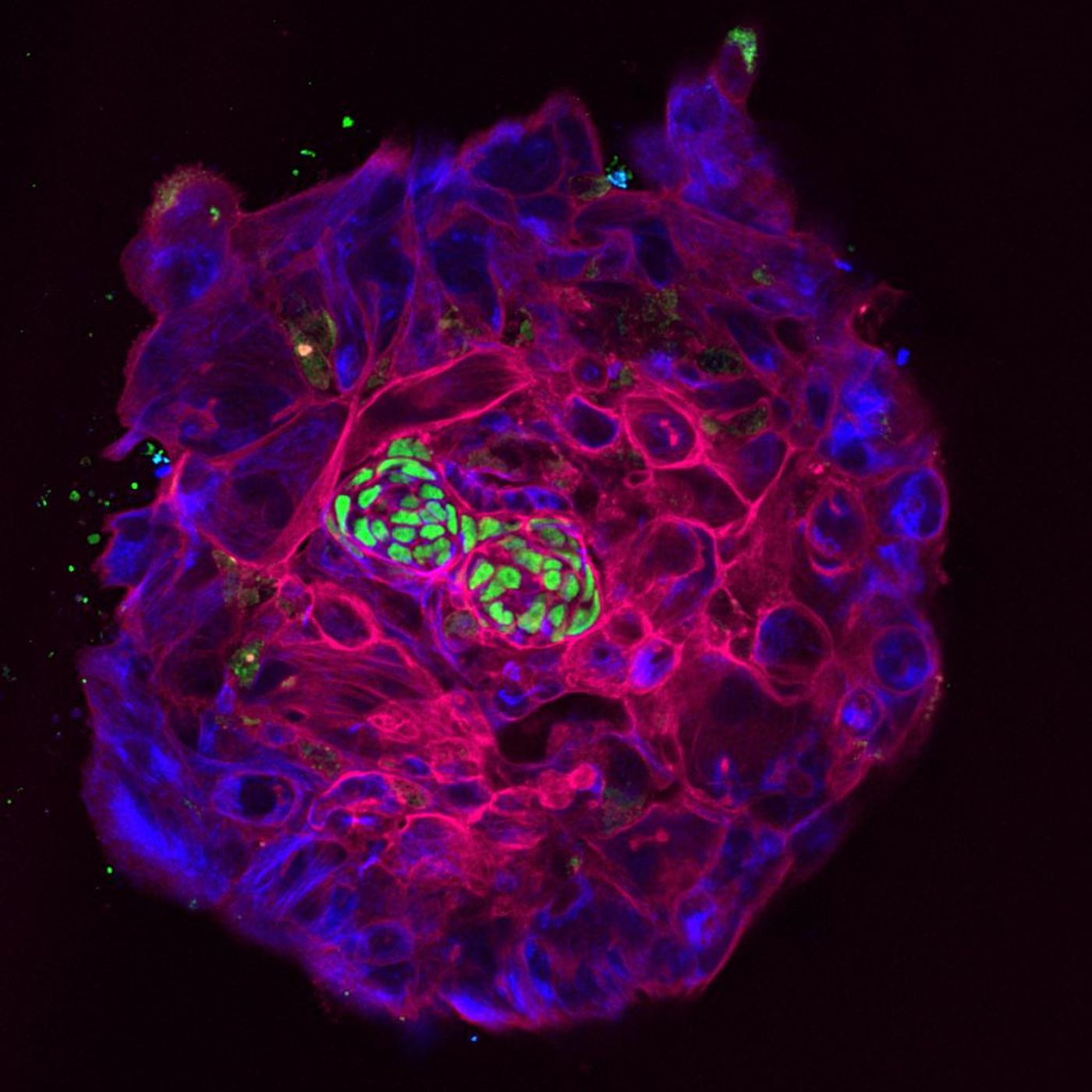
Radiolab
The Primitive Streak
00:29:46
Last May, two research groups announced a breakthrough: they each grew human embryos, in the lab, longer than ever before. In doing so, they witnessed a period of human development no one had ever seen. But in the process, they crashed up against something called the '14-day rule,' a guideline set over 30 years ago that dictates what we do, and possibly how we feel, about human embryos in the lab. On this episode, join producer Molly Webster as she peers down at our very own origins, and wonders: what do we do now? This piece was produced by Molly Webster and Annie McEwen, with help from Matt Kielty. Special thanks goes to the Bioethics Research Library at Georgetown University; Omar Sultan Haque, Kevin Fitzgerald, SJ, and Josephine Johnston; Charlie McCarthy; Elizabeth Lockett, Mark Hill, and Robert Cork; plus, Eric Boodman, Lauren Morello, and Martin Pera. Producer's note about the image: Check out the super cool picture that's running with this piece. Scientist Gist Croft sent i...
Loading summary
Transcript273 lines
- [00:00]
Molly Webster
Hey, Fidelity, what's it cost to invest with the Fidelity app? Start with as little as $1 with no account fees or trade commissions on US stocks and ETFs. That's music to my ears. I can only talk.
- [00:17]
Fidelity App Advertisement
Investing involves risk, including risk of loss. 0. Account fees apply to retail brokerage accounts only. Sell order assessment fee not included. A limited number of ETFs are subject to a transaction based service fee of $100. See full list of Fidelity.com commissions. Fidelity Brokerage Services, LLC. Member NYSE, SIPC.
- [00:34]
Unidentified Female Participant
Oh, wait, you're listening.
- [00:35]
Unidentified Male Participant
Okay.
- [00:37]
Molly Webster
All right.
- [00:38]
Magdalena Zernicka-Goetz
Okay.
- [00:39]
Molly Webster
All right.
- [00:41]
Alex Honnold
You're listening to Radiolab Radio Lab from wny.
- [00:47]
Molly Webster
See?
- [00:47]
Unidentified Female Participant
Yep.
- [00:52]
Molly Webster
We're gonna start with a conversation that I had with Jad a few weeks ago.
- [00:57]
Unidentified Male Scientist (possibly Ollie Rivenloo or another lab member)
Okay.
- [00:58]
Molly Webster
So I like medical stories.
- [01:01]
Unidentified Female Participant
This I know about you.
- [01:02]
Molly Webster
This you know. And so I read this website called statnews.com which does sort of really. It's like a new website out of Boston.
- [01:11]
Unidentified Female Participant
It's new, right?
- [01:12]
Molly Webster
And they basically, it's this collection of really amazing, like, medical reporters. And I will click on stories that look interesting. And there was one about, we've just grown embryos, human embryos, for a long time in a lab. And that was when I read the phrase the 14 day rule for the first time. And it was that apparently there's this thing that you can't grow an embryo in a lab past 14 days.
- [01:38]
Unidentified Female Participant
Huh.
- [01:38]
Molly Webster
Which I didn't even know you could grow an embryo in a lab at all. Right. Or that people were. Or that. I mean, I guess I knew IVF happened.
- [01:48]
Unidentified Female Participant
Sure.
- [01:48]
Molly Webster
Like test tube babies.
- [01:50]
Unidentified Female Participant
How long, if in the average IVF situation, how long is an embryo in a dish for?
- [01:54]
Molly Webster
And then I realized I didn't actually even know that either. So then I just spun out. So, like, the whole article is just interesting because I was like, I don't know about any of this.
- [02:03]
Unidentified Male Participant
Right, Right.
- [02:05]
Molly Webster
I'm Molly Webster.
- [02:06]
Robert Krulwich
Oh, and I'm Robert Krulwich. This is Radiolab.
- [02:08]
Molly Webster
And today on Radiolab, we're gonna zip down a wormhole into another universe. And Robert, you're coming with me.
- [02:14]
Robert Krulwich
Okay, Tell me about this before I buy a ticket.
- [02:17]
Molly Webster
Yeah, okay, you're gonna want to buy a ticket. Because in this universe are twins and souls and mice and something called the primitive streak. And they're all gathered together around a certain rule.
- [02:28]
Robert Krulwich
Oh, and remind me again, what the.
- [02:32]
Molly Webster
So you know how you can fertilize an egg? You get an egg and a sperm and you put them together.
- [02:35]
Robert Krulwich
Yes.
- [02:36]
Molly Webster
Fertilizes the Egg, Right. And then the egg, the fertilized egg, it multiplies. Multiplies. Cell divides. So a scientist could take it to watch it grow, to learn about human development, but then they have to stop at day 14. That's the rule.
- [02:51]
Robert Krulwich
Is this a medical kind of thing or a science limitation? Why do they.
- [02:56]
Molly Webster
It's all those things. It's medical and it's science, and there's, like, philosophy and ethics and obviously religion and.
- [03:03]
Robert Krulwich
And that's it.
- [03:04]
Molly Webster
Yeah. You're buying it now.
- [03:05]
Robert Krulwich
I see the whole shebang.
- [03:07]
Unidentified Male Participant
I have water. Okay, I'll take a sip.
- [03:10]
Molly Webster
Okay, we're gonna begin with this guy Leroy Walters.
- [03:13]
Unidentified Male Participant
Okay.
- [03:14]
Molly Webster
He was an ethicist at Georgetown University, now retired. And to me, he is sort of the father of the 14 day rule.
- [03:21]
Unidentified Male Participant
I never. I never thought of myself as the father of the 14 day rule, but he is.
- [03:28]
Molly Webster
He totally is.
- [03:29]
Unidentified Male Participant
Well, we shouldn't forget the context of 73.
- [03:33]
Molly Webster
All right, so 1973. Leroy has recently graduated with a doctorate in ethics from Yale University and settling into his job. And at the time, medicine and ethics were on a sort of collision course.
- [03:48]
Unidentified Male Participant
Yes. Yes.
- [03:50]
Molly Webster
Mm.
- [03:51]
Unidentified Male Narrator or Scientist
Good evening.
- [03:52]
Molly Webster
January 1973.
- [03:54]
Unidentified Male Narrator or Scientist
In a landmark ruling, the Supreme Court today legalized abortion.
- [03:58]
Molly Webster
Wade happens. It is clear, at least under present law, that an unborn fetus is not a person within the meaning of the Constitution. But just six months after that decision, the issue of fetuses and research done.
- [04:11]
Unidentified Male Participant
With them, fetal research, became a hot topic.
- [04:15]
Unidentified Male Narrator or Scientist
Some of the testimony in here is shocking.
- [04:17]
Molly Webster
There were news reports of butchering and cutting up about dissecting fetuses. Even an instance of decapitating fetuses.
- [04:24]
Unidentified Male Participant
Oh, man.
- [04:25]
Molly Webster
And then, around the same time, used.
- [04:27]
Unidentified Male Participant
As human guinea pigs, the research involving human beings.
- [04:30]
Unidentified Male Narrator or Scientist
The controversial Tuskegee syphilis study.
- [04:32]
Molly Webster
News reports of the syphilis studies that were done on African American men without their knowledge.
- [04:37]
Unidentified Male Participant
There was the sterilization of two daughters.
- [04:40]
Unidentified Male Narrator or Scientist
Had been sterilized without their informed consent.
- [04:42]
Unidentified Male Participant
Women with intellectual disabilities.
- [04:45]
Molly Webster
Experiments in genetic research. Genetic engineering was coming into its own. You have all these questions whirling about, like how we feel about the human body, whether or not we want to experiment on it. What do we protect and what don't we protect? It's just sort of this whirlwind.
- [05:02]
Unidentified Male Narrator or Scientist
And you are about to see a historic birth.
- [05:06]
Molly Webster
Then, most relevant for our story, we.
- [05:08]
Unidentified Male Narrator or Scientist
Are going to deliver her by caesarean.
- [05:10]
Molly Webster
Sect on July 25, 1978.
- [05:13]
Unidentified Male Participant
Scientists in the UK and we are now incising.
- [05:17]
Unidentified Male Narrator or Scientist
The uterus itself.
- [05:21]
Unidentified Male Participant
Produced a child with the aid of in vitro Fertilization.
- [05:28]
Molly Webster
The first baby that was born from an embryo that was grown inside a tube.
- [05:33]
Unidentified Male Participant
Baby Louise Brown.
- [05:34]
Unidentified Male Narrator or Scientist
Baby's not opened her eyes yet.
- [05:41]
Unidentified Male Participant
Everyone in the world was fascinated, but there were people who predicted doom.
- [05:49]
Molly Webster
What was the doom?
- [05:51]
Unidentified Male Participant
That in vitro fertilization would lead to reproduction as a form of manufacture.
- [06:05]
Molly Webster
So the government was grappling with, we need more regulations or we need, as a country, to think about, like, what our ethical guidelines are, right?
- [06:14]
Unidentified Male Narrator or Scientist
So the Department of Health, Education and.
- [06:16]
Molly Webster
Welfare, and they put together something called the Ethics Advisory Board, a panel of.
- [06:20]
Unidentified Male Narrator or Scientist
Doctors, laymen, academics, even a Jesuit priest.
- [06:23]
Molly Webster
To consider some fundamental moral and ethical.
- [06:26]
Unidentified Male Narrator or Scientist
Questions, questions involved in test tube human fertilization. Its meetings and discussions open today.
- [06:33]
Molly Webster
Now, as part of those meetings, the board would call on these expert witnesses. And one of those witnesses was our.
- [06:38]
Unidentified Male Participant
Boy Leroy, right, The staff director.
- [06:41]
Molly Webster
And they asked Leroy, like, ethically, tell us what we should be thinking about when it comes to embryos and how.
- [06:47]
Unidentified Male Participant
We are to regard them.
- [06:49]
Molly Webster
And he says, well, there's a spectrum. And on the one side, you could.
- [06:53]
Unidentified Male Participant
Argue that human embryos should be protected from the time of fertilization forward.
- [06:59]
Molly Webster
We shouldn't even be growing embryos in a lab at all. But then there's the other side.
- [07:03]
Unidentified Male Participant
The most permissive position was that research could be done until about eight weeks. A fetus at about eight weeks can have a reflex response to a stimulus.
- [07:17]
Molly Webster
And then at some point, a committee member turns to leroy and she says, where would you draw the line? He pauses and he says, well.
- [07:28]
Unidentified Male Participant
Well, I would say for me, 14 days.
- [07:33]
Robert Krulwich
Why 14?
- [07:35]
Molly Webster
Well, Leroy had a couple different arguments. For one, before 14 days, about 50%.
- [07:41]
Unidentified Male Participant
Of early human embryos are simply sloughed off.
- [07:46]
Molly Webster
They're just sort of shed from the.
- [07:47]
Unidentified Male Participant
Woman'S uterus and don't develop further.
- [07:50]
Molly Webster
So the thinking was, if we are already losing 50% of them naturally, we.
- [07:54]
Unidentified Male Participant
Don'T have strong moral obligations toward early human embryos.
- [07:59]
Unidentified Female Participant
I see.
- [07:59]
Unidentified Male Participant
You can even pose it as a metaphysical question. If these are important beings, why do 50% of them disappear and we never have any knowledge of them?
- [08:10]
Molly Webster
Argument number two.
- [08:11]
Unidentified Male Participant
Early embryos can split into two, as in twins, or two separate embryos can.
- [08:18]
Molly Webster
Recombine into one embryo.
- [08:20]
Unidentified Male Scientist (possibly Ollie Rivenloo or another lab member)
Right?
- [08:20]
Molly Webster
Like before 14 days, an embryo doesn't know if it's one embryo or if it's, like, going to be one person or if it's going to be two people. So as Leroy put it, it doesn't.
- [08:28]
Unidentified Male Participant
Have a biological identity.
- [08:31]
Molly Webster
And that happens right around 14 days.
- [08:33]
Unidentified Male Participant
Argument number three, the primitive streak appears.
- [08:38]
Unidentified Female Participant
The primitive streak appears.
- [08:39]
Unidentified Male Participant
The primitive streak is the first indication of an axis of the future body.
- [08:47]
Molly Webster
People see it as, like, the body starting to organize itself.
- [08:50]
Unidentified Male Participant
You might say it's the outline of the spinal cord that will develop later on.
- [08:56]
Unidentified Female Participant
It's the first hint of like, shape.
- [09:00]
Unidentified Male Participant
All of those seem to kind of converge around 14 days.
- [09:05]
Molly Webster
Eventually, the committee decides to take Leroy's suggestion and recommend that all research on human embryos be stopped at 14 days.
- [09:13]
Unidentified Male Participant
With high expectations, we submitted the report to Secretary of Health, Education, and Welfare Joseph Califano on May 4, 1979. And on July 19, 1979, before he could respond, Secretary Califano was fired by President Jimmy Carter.
- [09:37]
Molly Webster
It was part of a whole cabinet shakeup.
- [09:39]
Unidentified Male Participant
And so the report has been sitting on shelves, gathering dust, and there has never been a formal response.
- [09:48]
Molly Webster
It did end up becoming a guideline in the US it's actually an international guideline, but we never actually needed it, because 14 days, that was so far.
- [09:56]
Unidentified Male Participant
Beyond the capacity of researchers to culture early embryos that it also seemed like a safe marker, a safe boundary.
- [10:11]
Molly Webster
Because. And this is the interesting thing with IVF, we're familiar with, like, Days 012345 6, which is about the time they put the embryo into the mother. So nobody had ever really seen how an embryo develops from day seven through 14.
- [10:31]
Unidentified Female Participant
Oh, interesting.
- [10:33]
Molly Webster
You can't photograph it through the body for, like, various reasons. For one, no one ever knows they're pregnant that early. Like, when did you and your wife realize you were pregnant? It's like a month after the fertilization happens. Yeah.
- [10:46]
Unidentified Female Participant
It's funny. It's like when she.
- [10:47]
Molly Webster
You.
- [10:47]
Unidentified Female Participant
Even if you're trying, you don't actually know for weeks until.
- [10:50]
Molly Webster
Yeah. And it's so small that even if you did know, the way it attaches to the uterus, it sort of burrows in, and you kind of can't see it. And at the same time, scientists are pretty sure that this is a very important moment in development, and they just can't get to it.
- [11:08]
Robert Krulwich
Wait a second. Life magazine 50 years ago published these gorgeous pictures of a fertilized cell. And then beautiful little baby with eyes, you know, just.
- [11:19]
Molly Webster
Yeah, but that they have pictures of sperms and eggs, then there's a blank spot until at least three and a half weeks. So that magazine spread.
- [11:29]
Robert Krulwich
So Life didn't show the first few, the second or third.
- [11:32]
Unidentified Male Scientist (possibly Ollie Rivenloo or another lab member)
No.
- [11:33]
Robert Krulwich
Really?
- [11:33]
Molly Webster
Yes.
- [11:34]
Robert Krulwich
You're saying that there is a place in the development of the human being that no scientist has seen?
- [11:39]
Molly Webster
No.
- [11:40]
Robert Krulwich
Ever?
- [11:40]
Molly Webster
No. Really? Yeah.
- [11:42]
Magdalena Zernicka-Goetz
So this is this kind of period, which in the textbook you will find described as a black box.
- [11:48]
Molly Webster
Which brings us to Magdalena.
- [11:50]
Magdalena Zernicka-Goetz
So I'm Magdalena Jernicka Goetz at the University of Cambridge in uk.
- [11:55]
Molly Webster
She for years had been trying to figure out how to grow embryos during this period.
- [12:00]
Magdalena Zernicka-Goetz
But for those experiments, and the problem.
- [12:02]
Molly Webster
Was at this point, the embryo is beginning to attach to the mother's uterus. And so it just need certain things from the mother. And if you try and grow it in a dish, it just shrivels up and dies.
- [12:14]
Magdalena Zernicka-Goetz
Yes, yes. So at the time, we were trying really scratch our heads and come up with the most enriching environment we could imagine.
- [12:23]
Molly Webster
Like, maybe I can, like, recreate that really warm, cozy home, but in a dish without the mom.
- [12:31]
Unidentified Female Participant
Interesting. So it's like experimenting, like, what is the right bath that the growing embryo needs to sort of get what it needs.
- [12:39]
Molly Webster
Yeah. And they decided that while they were still trying to figure it out, they would just do it on mice embryos first. And so she started essentially just coming up with, like, chemistry concoctions. They started with the gel, which was of particular elasticity, sort of gloppy and gooey. And then they toss in a serum made from human placentas, added some hormones.
- [13:02]
Magdalena Zernicka-Goetz
Like progesterone, along with fibroblast growth factors.
- [13:06]
Molly Webster
And of course, a dash of selamin, fibronectin. This sounds like someone would sell this as like a face cream or something. They even tried serum from that's placentas that actually really didn't work.
- [13:17]
Magdalena Zernicka-Goetz
It was not so good as the serum from the human placement. Yes.
- [13:22]
Molly Webster
You know, so for five years, they put stuff in, they pulled stuff out, they tried everything, until they ended up was something that, at least on mice, seemed to work really well. So they thought, okay, maybe it's time we try this with human embryos.
- [13:36]
Magdalena Zernicka-Goetz
We took two embryos, just two human blastocysts, put them in a dish with.
- [13:40]
Molly Webster
Their chemical concoction, and amazingly, it worked. One of them did make it to 13 days. The other one didn't.
- [13:51]
Magdalena Zernicka-Goetz
But one made it right.
- [13:55]
Molly Webster
Suddenly they had an embryo that was growing happily into day 8, day 9, day 10, day 11. And they were able to see all of these moments in human development that no one had ever seen before. And guess what, Robert?
- [14:22]
Robert Krulwich
Yeah.
- [14:22]
Molly Webster
I got to see them too.
- [14:23]
Robert Krulwich
You did?
- [14:24]
Molly Webster
I did. You want to come?
- [14:26]
Robert Krulwich
Of course I want to come.
- [14:27]
Molly Webster
Okay, good.
- [14:27]
Robert Krulwich
They should go right now.
- [14:29]
Molly Webster
We are going to go, but we're going to actually have to take a break first.
- [14:32]
Robert Krulwich
Oh, God.
- [14:32]
Molly Webster
So we'll be back in a bit.
- [14:33]
Unidentified Male Scientist (possibly Ollie Rivenloo or another lab member)
Okay.
- [14:36]
Molly Webster
Hi, this is Lizzie from Arlington, Texas. Radiolab is supported in part by the Alfred P. Sloan foundation, enhancing public understanding of science and technology in the modern world. More information about Sloan@www.sloan.org. radiolab is supported by Planet Visionaries, the podcast created in partnership with the Rolex Perpetual Planet Initiative. Stay tuned for a trailer and subscribe wherever you get your podcasts.
- [15:08]
Alex Honnold
I'm Alex Honnold, professional rock climber and founder of the Honl Foundation. I wanted to let you know about a brand new season of the Planet Visionaries podcast in partnership with the Rolex Perpetual Planet Initiative. This is the podcast exploring bold ideas and big solutions from the people leading the way in conservation. Join me in conversation with the likes of climate champion Mark Ruffalo, biologist and photographer Christina Mittermeier, and one of the most successful conservations of our time, Chris Tompkins. Join us on Planet Visionaries. Wherever you get your podcasts, you should.
- [15:37]
Molly Webster
Tell the people who we are and.
- [15:38]
Unidentified Male Scientist (possibly Ollie Rivenloo or another lab member)
What our new show is.
- [15:39]
Molly Webster
I'm Robert Smith and this is Jacob Goldstein.
- [15:41]
Robert Krulwich
And we used to host a show.
- [15:42]
Molly Webster
Called Planet Money and now we're back making this new podcast podcast about the best ideas and people and businesses in history and some of the worst people, horrible ideas and destructive companies in the history of business. We struggled to come up with a name, decided to call it business history.
- [16:00]
Unidentified Male Scientist (possibly Ollie Rivenloo or another lab member)
You know why?
- [16:01]
Robert Krulwich
Why?
- [16:01]
Molly Webster
Because it's a show about the history of business. Available everywhere you get your podcast.
- [16:11]
Robert Krulwich
Okay, we're back. I am Robert Krulwich. I'm Molly Webster, this is Radiolab. And today the 14 day rule.
- [16:18]
Molly Webster
Last we left you, we had just met a woman who managed to grow a human embryo in a lab right up to the 14 day line.
- [16:24]
Robert Krulwich
And now we get to see it, right? That's what you promised.
- [16:27]
Molly Webster
Yes. One earphone on, one earphone off.
- [16:32]
Magdalena Zernicka-Goetz
Good luck.
- [16:33]
Molly Webster
Good luck. Lucky enough for me, there is an embryology lab right here in New York at Rockefeller University. Hi, how are you? Nice to meet you. Run by this guy.
- [16:43]
Unidentified Male Scientist (possibly Ollie Rivenloo or another lab member)
So you're a radio scientist?
- [16:45]
Molly Webster
Ollie Rivenloo. I fake being a scientist, but Ollie's team building off of Magdalena's work. They were also growing human embryos in the lab to the 14 day mark. So he invited me up to see them.
- [16:58]
Unidentified Male Scientist (possibly Ollie Rivenloo or another lab member)
You would realize that your eyes are seeing something that no other human beings has ever seen except the group in.
- [17:04]
Molly Webster
This lab and obviously Magda's lab. How many people are in this lab that you think saw it?
- [17:08]
Unidentified Male Scientist (possibly Ollie Rivenloo or another lab member)
I think we're a total of 25.
- [17:10]
Molly Webster
So then I'll be like, 26. So Ali has to step out of the room. I'm excited. Thank you, Ali. And he passes me off to the guy that runs, like, the human embryology research at the lab.
- [17:22]
Unidentified Male Narrator or Scientist
Guest Croft.
- [17:23]
Molly Webster
And a lab technician, Cecilia Pellegrini. Cecilia Pellegrini. Okay, we got. We go into the lab. We're walking through a cool lab. It's very big, and everyone's looking at me. Lots of benches and microscopes and people pipetting and so a fridge. There's a little sticky note on the fridge that says, experiment 27 embryos here. So we keep them in the tip box, and Cecilia pulls out, like, a plastic box that has a blue bottom and, like a white, opaque top. The lid just came off, and inside there was kind of like a microscope slide, and the embryos were attached to that, but there's condensation on it. So we had to wait, like, 10 minutes. I got weirdly nervous, but eventually you, like, look down into this, like, little square. Well, okay. It's like 10 millimeters by 10 millimeters. And it has a little bit of liquid in it, and then inside that liquid.
- [18:16]
Unidentified Female Participant
Wow.
- [18:17]
Molly Webster
This is a human embryo.
- [18:18]
Unidentified Male Participant
Yeah.
- [18:19]
Unidentified Female Participant
How big is it? How big is an embryo?
- [18:21]
Molly Webster
Oh, my God, it's so small.
- [18:23]
Unidentified Female Participant
I was like. We talk about 14 days, and in my mind, I do imagine a tiny little human. Is it even human? Like, at that point?
- [18:30]
Molly Webster
Tiny dot right there? No, it's just the little white dot. Holy crap. That's really small. That's like a grain of sand. Yeah, it's about that size. And it looks like. I kept also thinking that it looked like if you took a sheet of typing paper and you took a pin and you poked a hole in the paper and a little pinpoint of light came through.
- [18:52]
Unidentified Male Participant
That's what it looks like.
- [18:52]
Molly Webster
It looks like that. I cannot believe that goes into a 5 foot 9 tall human being. So that was a day 12 embryo we were looking at with our naked eye. But Gist and Cecilia also took me over to this badass microscope. What do I. I don't want to break anything.
- [19:11]
Unidentified Male Narrator or Scientist
Yeah, you're not gonna break it. I'll show you how to do this.
- [19:13]
Molly Webster
So we could look at a bunch of images and. And see the development of an embryo day by day, starting with day eight. You see right here, like, you have the embryo mass.
- [19:23]
Robert Krulwich
What are you. What does it look like?
- [19:24]
Molly Webster
It looks very lunar to me. Blown out gray sphere that has, like, mottled surfaces, but inside of it are hundreds and hundreds and hundreds of cells.
- [19:34]
Unidentified Male Narrator or Scientist
There's trophectoderm, primitive endoderm, and there's epiblast.
- [19:37]
Molly Webster
There were like three different types of cells, but to me, it like, looks. Looked like a simple structure. And then this is the same embryo. The next day. Wait, is this day nine? Oh, whoa. It looks totally different. So it starts to get a little more complex.
- [19:51]
Unidentified Male Narrator or Scientist
Now we can see nuclei.
- [19:52]
Molly Webster
Is that what all those bright spots are?
- [19:54]
Unidentified Male Narrator or Scientist
Yeah, there's the nucleus. There's the nucleus.
- [19:56]
Molly Webster
Huh. And then can we switch from 9 to 10? Mm. So what are those, like, oil droplet looking things?
- [20:02]
Unidentified Male Narrator or Scientist
Those look like oil droplets, don't they?
- [20:04]
Molly Webster
Now there are these, like, spherical balls around the edges. And it could be any number of things, but guess thinks they might be fat, like lipid. And the embryo, it starts forming, like the asymmetry. Like, you see things move to different areas of the cell.
- [20:18]
Unidentified Male Narrator or Scientist
It makes a hollow shell inside.
- [20:20]
Molly Webster
And then your inner gut cavity that starts to form.
- [20:23]
Unidentified Male Narrator or Scientist
There's all of a sudden a new cell type we've never seen. The yolk sac trophectoderm cells.
- [20:28]
Molly Webster
So a totally new type of cell no one's ever seen before.
- [20:31]
Unidentified Male Narrator or Scientist
So we don't know where it comes from, and neither does anyone else.
- [20:34]
Molly Webster
And then day 11, I get excited every time you open one of them. Okay. Day 11. Day 11 didn't really, like, look that different to me. Day 12, Day 12 has a lot more going on.
- [20:50]
Unidentified Male Narrator or Scientist
That's the origin of the placenta.
- [20:52]
Magdalena Zernicka-Goetz
Cool.
- [20:53]
Molly Webster
Day 13, there's all this brightness at the bottom in the upper left hand corner.
- [20:58]
Unidentified Male Narrator or Scientist
These could be epiblast cells.
- [20:59]
Molly Webster
Remind me again, the epiblast is.
- [21:01]
Unidentified Male Narrator or Scientist
That is the cell type from which the entire body eventually emerges.
- [21:07]
Molly Webster
Gist says those are the cells that all of the body comes from. Like, all the other stuff is mostly just support.
- [21:13]
Unidentified Female Participant
Oh, wow. So it's like the primal, like, primordial cells.
- [21:17]
Molly Webster
Foundational cells. Foundational cells, yeah.
- [21:19]
Unidentified Female Participant
Yeah.
- [21:22]
Molly Webster
So I actually got there on day 13 of the experiment. So all of the embryos were just sort of waiting to get to day 14. And so that was it.
- [21:32]
Unidentified Male Narrator or Scientist
So let's shut this down and get this guy back in the incubator.
- [21:35]
Molly Webster
And then I was just sort of spit back out into the real world.
- [21:39]
Unidentified Female Participant
Are they learning fantastically new amazing things based on this?
- [21:43]
Molly Webster
Well, like, the big takeaway that both of the groups had was that this embryo grew for another week without any maternal input. And it grew basically as it should.
- [21:55]
Unidentified Male Scientist (possibly Ollie Rivenloo or another lab member)
Have grown, which was mind blowing to me and to all of my colleagues that the human embryo will behave in a self organizing manner in a complete absence of maternal inputs, at least for 14 days.
- [22:09]
Molly Webster
Like I think they always thought even if they got the chemistry right, there'd be some sort of system breakdown because it wasn't getting input from the moment.
- [22:19]
Unidentified Female Participant
Interesting.
- [22:20]
Molly Webster
I always keep thinking of it as like the anti Mother's Day message. The embryo doesn't need you. Happy Mother's Day. But the one pro mom thing is by the end, in between day like 12 to 14, it became clear that it started needing maternal input. I see.
- [22:39]
Unidentified Female Participant
Like, what do they know?
- [22:41]
Molly Webster
Well, so this is the part I thought was cool, was like they saw that the embryo started forming tunnels and pathways for the mom to like infiltrate. So there were little tubes and pathways that formed where like nerve attachment could happen and like circulation. So it prepares itself in this week for the mom and the connection.
- [23:02]
Unidentified Female Participant
That's really cool. It's like hooking itself up to the network in a way.
- [23:07]
Molly Webster
I know, it's funny. It's like coming online as like a human being.
- [23:10]
Unidentified Female Participant
Yeah, that's a good way to put it. Yeah, that's cool.
- [23:12]
Molly Webster
The other cool thing was Gist told me that right around day 10, along the edges of the embryo, this hormone shows up that your body doesn't have before. It's called like a gonadotrophin. So you know when you take a pregnancy test, the thing it's reading is that hormone.
- [23:31]
Unidentified Female Participant
Oh, is that, he thinks, like the embryo broadcasting.
- [23:35]
Molly Webster
Yes. It's like boom, boom, boom, boom, boom, boom. Like out to the rest of the body, like, I'm here, I'm here. Look at this hormone.
- [23:42]
Unidentified Female Participant
Wow, that's super cool.
- [23:48]
Molly Webster
What is it like to look through a microscope and see day eight when we've been stopped at day seven since the 1970s, or day nine or day 10?
- [23:59]
Unidentified Male Scientist (possibly Ollie Rivenloo or another lab member)
It's hard to describe it. When people receive the digital image of the Hubble telescope, those first few eyes who are getting it in their screens. I guess it has to be something very similar to that. When I look inside of our own anatomy at the time where nobody knows that we even exist, it's the same as looking at dimensions that we have never imagined we will ever see because we didn't even know they exist.
- [24:43]
Molly Webster
But then at day 14, you have to essentially embalm it. You, like, can make it stop growing and freeze in the place that it's at. They call it fixing.
- [24:54]
Robert Krulwich
But if they wanted to, could they go past 14 days?
- [24:57]
Molly Webster
Maybe. But Ollie, he said that as they got closer to day 14, they noticed changes in the embryo that made it clear that it started needing more than just the current B it was in. But, like. And Brivanloo says this too, and Magdalena says this. It's like every day feels like an accomplishment. You're like, oh, my gosh, it grew another day. And then you start, like, cheering it on. You're like, grow another day, grow another day. Oh, my gosh, you're at day 12 and it becomes like, you're like, championing it. And then you're like, okay, stop, you're done.
- [25:28]
Unidentified Male Participant
Right?
- [25:29]
Molly Webster
And I felt like when I was standing there, I was like, oh, that's abrupt. Because I wanted it to grow, grow, grow, grow, grow. But obviously I don't want it to grow, grow, grow too far. So I was like, go to day 15. And I'm like, go to day 16. And then I'm like, when does the joy in my voice stop? Eventually, I'm going to hit a. Don't worry. Eventually I'm going to hit a point where I'm like, that's uncomfortable.
- [25:54]
Unidentified Male Participant
Right?
- [25:54]
Unidentified Male Scientist (possibly Ollie Rivenloo or another lab member)
This is something that touches us in the root of our own definition of our being and existence and individuality. It becomes a little bit like a Pandora box. So, yes, you want to open it, but you have to be ready to see what's in it.
- [26:13]
Robert Krulwich
If technology has now moved it a whole other week, so we can go for 14 days, maybe it's pretty soon you can go a whole nother week and then a whole nother week. Does that mean the rule's going to have to change?
- [26:25]
Molly Webster
That is the conversation that's happening right now, basically. Once this research was published, there were commentaries and articles and columns about, what do we do about the 14 day rule. And there's conferences. There's a conference in Boston that's happening in the fall.
- [26:41]
Robert Krulwich
But what are your choices, though? Like, you could choose.
- [26:44]
Molly Webster
You could do any number of things. It depends on where you sort of throw down a biological or moral marker that you feel comfortable with. Like, you could keep it at 14 days and sort of keep it around. Like this idea of twinning and the primitive streak. You could move it a week out to, say, to day 21, when there's interesting sort of neural folds and divisions that are starting to happen in the brain. You could go to eight weeks, but it could also go back to zero.
- [27:10]
Robert Krulwich
So there's no consensus on.
- [27:12]
Molly Webster
No, no, there's no consensus. And the scientists are the first to say, like, they don't want to make this decision. They just think, like, maybe we should have this conversation as a group. So the society decides, not us.
- [27:25]
Unidentified Male Scientist (possibly Ollie Rivenloo or another lab member)
So, yeah, and then.
- [27:25]
Molly Webster
But it's just like, if you say that, like, it's as amazing as, like, the Hubble telescope. How does it feel when you're like, I've gotten this far and now I have to end it?
- [27:37]
Unidentified Male Scientist (possibly Ollie Rivenloo or another lab member)
So that's the toughest question you're going to ask me today. For me, for sure, it was important to stop the experiment where there was still a message that we could convey that would not offend people. This is more than just science. One of the greatest challenges in reproductive biology, especially in human reproductive biology, is to make sure that you don't offend people's sense of identity, dignity, religion.
- [28:12]
Molly Webster
And so Ali, he finds himself trying to keep all of these different perspectives in his head all at once.
- [28:20]
Unidentified Male Scientist (possibly Ollie Rivenloo or another lab member)
So, for example, if the Catholic point of view is human origins, conception, then I have to respect also the Jewish point of view that says, you know, what is that heartbeat? I also have to respect the Muslim point of view about the origin of human life, which surprisingly, for one, seems to be similar than the Jewish point of view. It's also heartbeat. I also have to respect the Buddhist point of view. And what about the Hindus? The Buddhist says, if you don't cut the umbilical cord in, you're not independent, you're not a human being. You don't call an organ a human being because it's attached to you. A Hindu says, I don't know what you guys are talking about. There is no origin or end. We're circles within circles within circles. I'm a butterfly today I'm going to die and come back as a tiger. I'm going to die and come back as a human. Die and come back as an elephant. What origin? A circle does not have an origin. So I am for the progress of science. I am for gaining knowledge. It's my job. It's the way I'm wired as a human being. I satisfy our sense of curiosity, and there is nothing more curious to me than our own origin.
- [29:30]
Molly Webster
So then that would be like. You would love to know, like, what happens on day 21.
- [29:35]
Unidentified Male Scientist (possibly Ollie Rivenloo or another lab member)
Absolutely. And I like to think that before I die, we will know what happens on day 21.
- [30:03]
Molly Webster
This episode was Produced by Annie McKeown, with help from Matt Kilty and Brenna Farrell and Simon Adler. And I actually think the entire Radiolab staff had something to do with this episode. So thanks, guys. And I want to thank the research library at Georgetown University.
- [30:22]
Robert Krulwich
Thank you for listening.
- [30:23]
Molly Webster
See you later.
- [30:25]
Leroy Walters
To play the message, press 2. This is Leroy Walters. I'm a retired faculty member from Georgetown University, where I was part of the Kennedy Institute of Ethics and the Philosophy department. Radiolab is produced by Jad Abumrad. Dylan Keith is our director of sound design. Thorin Wheeler is senior editor. Jamie York is our senior producer. Our staff includes Simon Adler, Brenna Farrell, David Giebel, Matt Chielty, Robert Krulwich, Annie McEwen, Latif Nasser, Melissa O', Donnell, Arianne Wack and Molly Webster, with help from Nigar Fatali, Alexandra Lee Young, Charu Sinha, Persia Verlin and W. Harry Fortuna. Our fact checkers are Eva Dasher and Michelle Harris. That's it. Thanks. Bye. End of message.