← Radiolab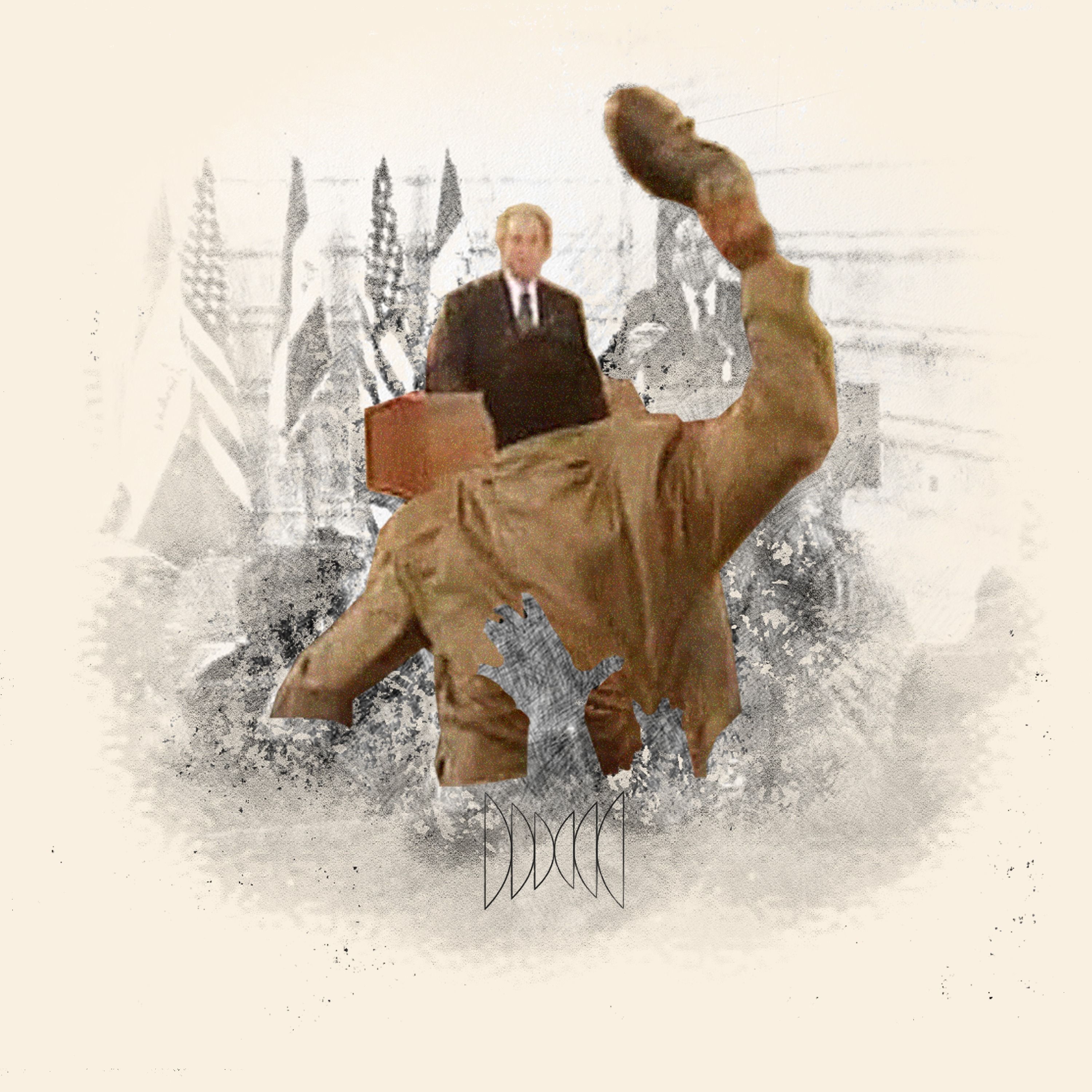
Radiolab
The Shoe Thrower
01:17:29
The world around you is falling apart, and no one is listening. How far do you go to be heard?
Loading summary
Transcript622 lines
- [00:01]
Radiolab Sponsor Announcer
Radiolab is brought to you by Progressive Insurance. Insurance isn't one size fits all. That's why drivers have enjoyed Progressive's name your price tool for years. Now, with the name your price tool, you tell them what you want to pay and they'll show you options that fit your budget. So whether you're picking out your first policy or just looking for something that works better for you and your family, they'll make it easy to see your options. Visit progressive.com, find a rate that works for you with the name your price tool. Progressive Casualty Insurance Company and affiliates price and coverage match limited by state law.
- [00:32]
Latif Nasser
Just before we start, this episode discusses war, casualties of war and torture. It may not be suitable for young or sensitive listeners.
- [00:42]
Sara Khari
Wait, you're listening.
- [00:43]
Mais Al Baya
Okay.
- [00:44]
George W. Bush
All right. Okay. All right.
- [00:48]
Latif Nasser
You're listening to Radiolab Radio Lab from WNY C. Yep. This is Radiolab. I'm Latif Nasser. And today we have a story from our reporter, Sara Khari.
- [01:06]
Sara Khari
Um, okay, so a couple months ago, I got in the studio to do this interview that I'd been trying to make happen for close to a year. Hello?
- [01:15]
Mais Al Baya
Hi, Sarah.
- [01:16]
Muntadhar al-Zaidi
Can you hear me?
- [01:17]
Sara Khari
Yes, yes. I'd been trying to connect with this Iraqi guy in Baghdad, but hold on, I can't hear. Things were not really going to plan,
- [01:27]
Muntadhar al-Zaidi
so we are waiting.
- [01:29]
Sara Khari
It turns out my interviewee was taking his time, having a little tea after his lunch, and then after about 45 minutes, he shows up.
- [01:37]
Muntadhar al-Zaidi (Arabic speaker)
Yeah, Ahlan.
- [01:38]
Sara Khari
Ahlan Muntadhar kai Fahla.
- [01:41]
Muntadhar al-Zaidi (Arabic speaker)
Sarah, did you speak Arabic? You don't speak Arabic?
- [01:45]
Sara Khari
Only a little bit. We fumble through, mostly me doing the fumbling with the help of Iraqi journalist Mais al Baya.
- [01:54]
Muntadhar al-Zaidi
Tcher Rafna Maisie.
- [01:58]
Muntadhar al-Zaidi (Arabic speaker)
But then we have one hour, right, Sarah?
- [02:03]
Sara Khari
So I was hoping to talk to you for longer because I want to get lots of details about your life and tell your story, and I don't want to miss any details. I have a lot.
- [02:11]
Jameela Rakib
Okay.
- [02:11]
Muntadhar al-Zaidi (Arabic speaker)
I hope you have another question or new questions. You have new questions?
- [02:17]
Sara Khari
It was pretty clear that he was sick of talking about the one thing that I really wanted to ask him about. And if you're feeling frustrated, just tell me.
- [02:24]
Muntadhar al-Zaidi (Arabic speaker)
Don't worry, I will tell you which.
- [02:27]
Latif Nasser
Which is what?
- [02:28]
Sara Khari
Well, okay, so maybe let's just start with introduce yourself and tell me why you're famous.
- [02:35]
Muntadhar al-Zaidi (Arabic speaker)
Ana Isaidi.
- [02:37]
Muntadhar al-Zaidi
My name is Muntadar az Zaidi.
- [02:40]
Muntadhar al-Zaidi (Arabic speaker)
Anam rahmat Zawj ahditi Allah. George W. Bush.
- [02:45]
Muntadhar al-Zaidi
And I threw my shoes at George W. Bush.
- [02:50]
Latif Nasser
Oh, yeah.
- [02:52]
Sara Khari
Do you remember him?
- [02:53]
Latif Nasser
Yeah, I remember that guy. Yeah, yeah, yeah.
- [02:55]
Sara Khari
Okay, well, just in case, for anyone who doesn't remember, let me just do a quick refresher.
- [03:00]
Latif Nasser
Okay?
- [03:00]
Mariam Dwadar
Yeah.
- [03:01]
Sara Khari
It's December 14, 2008, more than five years into the war in Iraq, and George W. Bush makes a surprise visit to Baghdad, where he's giving a press conference.
- [03:13]
George W. Bush
Thank you for your kind invitation.
- [03:15]
Sara Khari
Next to him is Nouriel al Maliki, the prime Minister of Iraq.
- [03:19]
George W. Bush
And I'm looking forward to some food.
- [03:22]
Sara Khari
Now, officially, Bush is there to sign an agreement. Shake some hands.
- [03:26]
George W. Bush
You're leaving the next president with a stable foundation for the future, as he's
- [03:30]
Sara Khari
on his way out at the end of his second term. But he's also clearly trying to make this point. War is not over that in his eyes.
- [03:36]
George W. Bush
But with the conclusion of these agreements, it is decisively on its way to being won.
- [03:42]
Sara Khari
The war has been a success. At the end, he says thank you in Arabic and then.
- [03:55]
Muntadhar al-Zaidi (Arabic speaker)
Holy.
- [03:57]
Sara Khari
So you see this guy just sort of pops out of the crowd, out of nowhere and throws a shoe. And George Bush dodges it. And then he throws a second one and Malachi tries to swat that one out of the way. And then it's just chaos. He's tackled to the ground, they're dragging him out. And then the clip ends.
- [04:18]
Latif Nasser
Yeah, it's so quick.
- [04:19]
Sara Khari
I know. It's so quick. And it blows up. I mean, extraordinary scenes took place. You know, it's basically top of the news across the globe.
- [04:28]
Muntadhar al-Zaidi (Arabic speaker)
George W. Bushbar
- [04:31]
Sara Khari
and the clip,
- [04:35]
Muntadhar al-Zaidi
it's
- [04:36]
Sara Khari
all over the Internet. Call it the shoe heard round the world. It's really as viral as something can be in 2008.
- [04:43]
Latif Nasser
Yeah.
- [04:43]
Sara Khari
But even today, I feel like with most people, if you're like, hey, that shoe thrower guy, they're like, oh, yeah,
- [04:50]
Latif Nasser
I remember it feeling silly, right?
- [04:52]
Sara Khari
I mean, and definitely there were some like, how dare he kind of reactions, but generally here in the US it's slightly painful. It was a as much like late night show fodder as it was news.
- [05:07]
Latif Nasser
Shoo me once, shoes on you.
- [05:11]
Sara Khari
And for so many people, shoo me twice. Their main reaction was like, pretty quick moving, pretty quick. George W. Bush was weirdly agile there. Like props to him.
- [05:20]
Latif Nasser
He was quick on his feet. I remember that. And he did a little side to side.
- [05:24]
Muntadhar al-Zaidi (English speaker)
Looks like we finally found something.
- [05:25]
Latif Nasser
President Bush is good at dodgeball.
- [05:29]
Sara Khari
And you know, for me, when this happened, I was 14 years old. I was growing up in a very Muslim immigrant community, going to Islamic school. You know, in this post 911 War on Terror era, very aware of like how so many people had died in Iraq.
- [05:44]
Latif Nasser
Right.
- [05:44]
Sara Khari
And like a lot of people, I had a very intuitive understanding of the anger and frustration that this guy was expressing. But at the same time, I'll admit, like, I just sort of thought he was like a random crazy guy, you know, I didn't think there was that much to it.
- [05:59]
Latif Nasser
Yeah, yeah. It feels like a rash move made in anger.
- [06:03]
Sara Khari
But fast forward to today with everything that is happening in the world right now and things that the US is contributing to in Gaza, in Lebanon and now in Iran, it feels like we're in another never ending, sort of out of control war.
- [06:18]
Latif Nasser
Very unpopular war.
- [06:19]
Sara Khari
Very unpopular. Right. I just find myself flashing back to that era and specifically to that guy. And so a while back I just looked him up and first thing I learned was that he was a journalist, like an Iraqi journalist.
- [06:35]
Latif Nasser
Oh, I didn't know that same.
- [06:36]
Sara Khari
And suddenly I was like, oh, okay. This act of throwing a shoe, I mean, it's not what anybody is supposed to do, but it's especially not what journalists are supposed to do.
- [06:48]
Latif Nasser
That's right.
- [06:50]
Sara Khari
Even for us, we're not supposed to protest or advocate or even express opinions or emotions that could be seen as political.
- [06:58]
Latif Nasser
It's literally in our job description here.
- [07:00]
Sara Khari
Yeah, right, exactly.
- [07:01]
Latif Nasser
And for good reason. The reason is we want people to trust what we say, the coverage we do, that we're not spinning it in one way or another. We don't have our thumb on the scale.
- [07:10]
Sara Khari
Right. No, totally. So I guess to see him not just like express his opinion, but to actually throw something at the President.
- [07:20]
Latif Nasser
Yeah.
- [07:21]
Sara Khari
I just kept thinking, like, what exactly got him to that point, you know, what happened there and what does he think of that moment? Now I can.
- [07:30]
Muntadhar al-Zaidi (Arabic speaker)
Smoking some cigars, I think.
- [07:34]
Sara Khari
So as long as you stay close
- [07:35]
Muntadhar al-Zaidi (Arabic speaker)
to the mic without voice. Okay. Don't worry.
- [07:38]
Muntadhar al-Zaidi (English speaker)
Okay.
- [07:39]
Mais Al Baya
Okay.
- [07:40]
Sara Khari
And once we sort of got warmed up, actually this one interview turned into several. Like, we ended up talking for I think something like eight hours.
- [07:48]
Latif Nasser
Wow.
- [07:49]
Sara Khari
And there was so much about Munther, what happened that I had, and I think most people have no clue about. And also this act at the center of it, this act of throwing the shoe, the more I learned about it, the more it became really layered and fascinating and weirdly kind of perfect, huh? Okay, just to back up a little here. When did you decide to become a journalist and why did you want to become a journalist?
- [08:34]
Muntadhar al-Zaidi
He grew up with big imagination.
- [08:36]
Sara Khari
Mumtadir says that growing up as a kid in Iraq, his mom would read to him every night before bed, which
- [08:44]
Muntadhar al-Zaidi
was very inspiring to him.
- [08:47]
Sara Khari
And he fell in love with stories and books.
- [08:51]
Muntadhar al-Zaidi
He used to visit any neighbors or any family members who have a library, and he would just read all of the books that he can lay his hand.
- [09:02]
Sara Khari
And in particular, as he got older and Saddam Hussein was at the height of his dictatorship, he started to read the work of journalists and political poets who wrote about the plight of ordinary people under repression. Then in 1990, Saddam Hussein invades Kuwait
- [09:26]
George W. Bush
immediately after the Iraqi invasion.
- [09:28]
Sara Khari
And in reaction, the US and its
- [09:30]
George W. Bush
allies, together with many other nations high
- [09:32]
Sara Khari
ordered embargo, place sanctions on Iraq.
- [09:35]
George W. Bush
The stakes are high. Iraq is already a rich and powerful country.
- [09:39]
Sara Khari
And of course, the impact of that is mostly felt by the people of Iraq.
- [09:47]
Muntadhar al-Zaidi
It was like a cancer eating your bones, eating your soul. By some estimates, over half a million children died.
- [09:57]
Sara Khari
Muntadr was just 14 years old at the time.
- [10:02]
Muntadhar al-Zaidi
He had three brothers and three sisters and his mother.
- [10:08]
Sara Khari
So he started lining up at construction sites just looking for any job that he could get.
- [10:14]
Muntadhar al-Zaidi
He would work from the morning till the evening, and all of the income he would get out of it is literally to buy two bags of bread.
- [10:23]
Sara Khari
And then, my fellow citizens, 911 happens at this hour.
- [10:27]
George W. Bush
George W. Bush, American and coalition forces are in the early stages of military
- [10:31]
Sara Khari
operations claiming that Saddam Hussein had weapons of mass destruction, which now obviously we know wasn't true, right? Decides to invade Iraq, to disarm Iraq,
- [10:41]
George W. Bush
to free its people and to defend the world from grave danger.
- [10:45]
Sara Khari
Mantadr, can you tell me about some of your memories of when the invasion started and how old were you when that happened?
- [10:57]
Muntadhar al-Zaidi
He was 24 years old. The first memory of the invasion for him, it was when he was in a bus and he saw a convoy of the American soldiers in Humvees. And one of the American soldiers, he got out of his Humvee in the middle of the traffic and he actually tested on a car and his colleagues were laughing.
- [11:33]
Sara Khari
He told me that in that moment he could feel, As he put it, the disaster that was coming their way,
- [11:48]
Muntadhar al-Zaidi
satisfying come to liberate them. They came to piss on people.
- [11:55]
Sara Khari
And this feeling started to come over him
- [12:00]
Muntadhar al-Zaidi
that he has the duty to write about what's happening, like, I want
- [12:05]
Sara Khari
to become a journalist, because he felt that journalists actually have this very real power. He said this thing to me very along the lines of that saying that journalists write the first draft of history. They are the people that set the record on things.
- [12:28]
Muntadhar al-Zaidi
And he began writing in Newspapers.
- [12:35]
Sara Khari
Eventually, he ends up at a TV station called Al Baghdadiya and he starts reporting on all the ways that the invasion Asian is unleashing, as he put it, suffering.
- [13:07]
Muntadhar al-Zaidi
Agony
- [13:10]
Sara Khari
on ordinary people. Mantada, can you give me some examples of the kinds of stories that you reported?
- [13:19]
Mais Al Baya
Yes.
- [13:23]
Muntadhar al-Zaidi
The story of that little girl, eight years old, girl called Zahra.
- [13:28]
Sara Khari
One day in 2007 in Baghdad, some American soldiers found an explosive device on their convoy.
- [13:36]
Muntadhar al-Zaidi
It exploded in front of them and they start to shoot randomly after that.
- [13:42]
Sara Khari
And because there was a school nearby,
- [13:45]
Muntadhar al-Zaidi
the school guard, he came out from the school and he's like, please don't shoot. But they kept shooting.
- [13:54]
Sara Khari
This little girl, Zahra, was shot and killed.
- [14:01]
Muntadhar al-Zaidi
At that time, the Americans threatened everybody in the area and said that you must not say she was killed by the Americans.
- [14:09]
Sara Khari
And so Mantador says a lot of journalists were intimidated by the story and
- [14:15]
Mais Al Baya
they didn't want to cover it, but
- [14:17]
Sara Khari
he decided he was going to do it.
- [14:22]
Muntadhar al-Zaidi
He interviewed the little girls who were with her outside of the school. They were playing with her and they were talking and laughing. And then suddenly that girl, Zahra, just fell on her face. And her friends, they thought that she was joking.
- [14:43]
Muntadhar al-Zaidi (English speaker)
They nudged her and she didn't say anything.
- [14:46]
Muntadhar al-Zaidi
And they saw blood streaming out of her body. He was. He was heavily impacted by Zahra's story.
- [15:02]
Sara Khari
I'm curious, did you just report the facts or did you add, I don't know, some commentary or. Yeah. What was your perspective in that story?
- [15:13]
Muntadhar al-Zaidi
The way he was writing the story itself, it was very emotional. The final image was like a group photo of Zahra with her friends.
- [15:25]
Muntadhar al-Zaidi (Arabic speaker)
Zahra.
- [15:29]
Muntadhar al-Zaidi
So he said, this is the picture of Zahra who was killed by the American soldier who actually claims that he was in my country to build democracy. Even when he read the script to his colleagues, everyone was crying.
- [15:51]
Latif Nasser
Wow.
- [15:56]
Sara Khari
Now, one note I want to make here is that while I've been able to independently confirm many of the broad strokes of Zaharat's story, I actually haven't been able to track down Muthadr's own report on her. The Baghdadiya archives are really hard to track down all these years later, which means that for a few of the specific details that you just heard, we only have Muntadr's account to go off of. However, from all of my sources familiar with this time period in Iraq, stories like Zahra's were far from the exceptional case. Because what we know today, what is now well documented about the Iraq war, is that the United States military caused widespread harm to civilians, there were rampant abuses of power, like US Forces doing arbitrary raids, stealing, arresting civilians en masse, committing torture and sexual violence, and indiscriminate killing. The estimates of senseless civilian deaths go into the hundreds of thousands. But to this day, we don't actually know the full extent of the civilian loss of life. Yeah, but to go back to month other, what we do know is that a couple of days after the Zahrat story came out, he was in the
- [17:09]
Muntadhar al-Zaidi
street and a car stopped by him and said, get in our car or it's going to get nasty.
- [17:16]
Sara Khari
So he actually got kidnapped.
- [17:19]
Muntadhar al-Zaidi (English speaker)
They put him in a small room.
- [17:20]
Muntadhar al-Zaidi
They wanted Muntadar to be quiet and
- [17:24]
Sara Khari
not speak again, like, no more publishing stories like the one about Zahra.
- [17:31]
Muntadhar al-Zaidi
He believes it probably was someone from the Iraqi government who was connected at that time with the Americans.
- [17:38]
Sara Khari
And I should point out that now it's also well documented that the US Forces were, like, actively shutting down news reports and reporters who were trying to get these kinds of stories out into the world. And in fact, a couple of months later, American soldiers actually took him into custody.
- [17:59]
Muntadhar al-Zaidi
They raided his home, and they detained him.
- [18:01]
Sara Khari
Why?
- [18:02]
Muntadhar al-Zaidi (Arabic speaker)
I don't know.
- [18:08]
Muntadhar al-Zaidi (English speaker)
The shameful part of it was they took him in his pajama.
- [18:14]
Muntadhar al-Zaidi (Arabic speaker)
Pajama. Kanawiyya.
- [18:15]
Muntadhar al-Zaidi (English speaker)
It was a baby blue pajama as well.
- [18:19]
Sara Khari
In your mind, was the arrest also connected to your reporting?
- [18:23]
Muntadhar al-Zaidi (Arabic speaker)
I don't know. I don't know why.
- [18:26]
Sara Khari
But as this was happening to him, the way he was seeing the Iraq war covered in the news around the world felt so upside down. Like, even before the invasion started.
- [18:41]
Muntadhar al-Zaidi
George W. Bush, he said,
- [18:44]
Muntadhar al-Zaidi (English speaker)
the Iraqis are going to welcome the American soldiers with roses and everybody will be happy.
- [18:50]
Sara Khari
Full disclosure, I haven't been able to find evidence of this exact moment. It's actually possible that it wasn't Bush, but it was some other administration official. I mean, Dick Cheney said something like, they're gonna welcome us as liberators, you know?
- [19:01]
Latif Nasser
Yeah, yeah, yeah.
- [19:02]
Sara Khari
So that rhetoric was definitely really prevalent at the time. And weirdly enough, this specific image of Iraqis greeting Americans with flowers or roses is a thing that a lot of people I've talked to actually do remember hearing.
- [19:17]
Muntadhar al-Zaidi
Yeah, it was heavily marketed by the
- [19:21]
Muntadhar al-Zaidi (English speaker)
American media, but also the Western media.
- [19:24]
Sara Khari
What does that make you feel?
- [19:27]
Muntadhar al-Zaidi (English speaker)
When Muntabar heard it, he said he really wanted to kind of say, this is not happening. People are not welcoming the American soldiers with roses.
- [19:38]
Latif Nasser
Yeah, I mean, I can imagine how galling that would be. Like, it's your job to Tell the story of your country, of what's actually happening. And not only is no one listening, like insult to injury, the story that is being told is dead wrong.
- [19:53]
Sara Khari
Exactly. Exactly. And with all of these things piling up, it wasn't long before he hit a breaking point. It happened one day when he was reporting on the bombing of a house.
- [20:08]
Muntadhar al-Zaidi
An Apache warplane strike the house.
- [20:10]
Sara Khari
And as he was looking into the rubble, he saw an elderly man
- [20:18]
Muntadhar al-Zaidi
wearing the Iraqi dishdasha. The white robe in the middle of the wires and the concrete. All of his intestines were out. He could see hands and arms of children trapped under the collapsed roof.
- [20:41]
Sara Khari
And after he submitted the footage to the TV station,
- [20:46]
Muntadhar al-Zaidi
he had a breakdown. He couldn't stop crying. He was so broken at that time.
- [20:57]
Sara Khari
The thing that hit him was that despite the fact that he was reporting all of these stories, he could feel
- [21:04]
Muntadhar al-Zaidi
that no one was listening. No one cared. Maybe people would read about it within Iraq. Maybe maximum would go in the Arab world, but the outside world, like Europe and America, these stories were not reaching. People's pain is not being heard. I really wanted all of this world to hear and understand the pain that people are going through.
- [21:38]
Sara Khari
So finally one day.
- [21:46]
Muntadhar al-Zaidi (Arabic speaker)
I was in the tech shower.
- [21:48]
Sara Khari
Nice.
- [21:49]
Muntadhar al-Zaidi (Arabic speaker)
And I talked to myself.
- [21:52]
Sara Khari
Like, what do I do? I need to do something.
- [21:54]
Muntadhar al-Zaidi (Arabic speaker)
Yes.
- [21:55]
Sara Khari
And that is when the idea pops into his head. I should throw a shoe at George W. Bush.
- [22:02]
Muntadhar al-Zaidi (Arabic speaker)
Yes. Okay. That's great idea.
- [22:09]
Muntadhar al-Zaidi (English speaker)
And I kept thinking about it every single day. Every day when I was going to work, I see him on tv. I say, I swear, as soon as I see you, I'm gonna throw my shoe at you.
- [22:27]
Sara Khari
I don't think. I don't think I fully understand. Like, how did you even get the idea to throw a shoe? Like, I understand you were angry and you were. You know, all this was building up over a long period of time. But where does the idea to throw a shoe come from?
- [22:42]
Muntadhar al-Zaidi (Arabic speaker)
In my. My evil.
- [22:49]
Sara Khari
That loosely translates to mischief, by the way. No, but there's so many ways to do Shayatini.
- [22:55]
George W. Bush
Right.
- [22:55]
Sara Khari
Like, you could have screamed at him. You could have waved a flag. You could have asked him a really pointed question. You could have demanded that he apologize. But why Shoo.
- [23:06]
Muntadhar al-Zaidi (Arabic speaker)
Exactly. That's a good point. I want to speak in Arabic to explain my idea exactly.
- [23:15]
Sara Khari
Sure.
- [23:17]
Muntadhar al-Zaidi (English speaker)
A key reason was the ultimate gift that you can give in the Arab culture is roses. So it's a huge thing. And that is why Muntadar, he said, I wanted to do something completely the opposite of Roses, the complete opposite of that is actually what people wear in their feet, which is the shoe.
- [23:43]
Sara Khari
And, you know, this is a thing in Muslim cultures, but probably a lot of cultures around the world, you know, shoes are unclean. You don't bring them into the house. Especially in Arab cultures, it's an insult to show someone the bottom of your shoe.
- [23:56]
Latif Nasser
It's like, here's what I think of you. You're beneath me.
- [23:59]
Sara Khari
Yeah, exactly.
- [23:59]
Muntadhar al-Zaidi
You know, for our culture, it's by
- [24:03]
Muntadhar al-Zaidi (English speaker)
far the most degrading thing to do to somebody. For example, our mothers, they use slippers on in our culture. And maybe in your culture as well.
- [24:19]
Sara Khari
Definitely.
- [24:22]
Muntadhar al-Zaidi (English speaker)
So that is where it came from.
- [24:24]
Sara Khari
And Muntadar also told me, you know, look, during the occupation,
- [24:32]
Muntadhar al-Zaidi (English speaker)
there were two types of resistance in Iraq. One, which was the armed resistance, like
- [24:38]
Sara Khari
militias that had cropped up fighting the American troops. And then, on the other hand, you
- [24:43]
Muntadhar al-Zaidi (English speaker)
had the intellectual resistance. And I felt that I want to be part of the intellectual resistance, and hence why I decided to throw the shoe.
- [24:55]
Sara Khari
I mean, throwing a shoe is not intellectual resistance. Like, did you realize you were crossing a line beyond just intellectual resistance into something else?
- [25:06]
Muntadhar al-Zaidi (Arabic speaker)
You cannot put yourself in my shoe. To know what happened in my mind in this moment,
- [25:19]
Muntadhar al-Zaidi (English speaker)
I'm actually stunned by your reaction.
- [25:22]
Sara Khari
Really?
- [25:26]
Muntadhar al-Zaidi (English speaker)
Because I just told you that half a million children have been killed, many people have suffered for years and years. And you were just listening and you just. Just acted like, it's okay. It's kind of like, no, it's understandable. Let me just translate for you.
- [25:51]
Sara Khari
Sorry.
- [25:51]
Muntadhar al-Zaidi (English speaker)
Let me.
- [25:52]
Sara Khari
Yeah. I just want to say it's not that. It's not that I don't think.
- [25:57]
Muntadhar al-Zaidi (Arabic speaker)
Let me finish.
- [26:01]
Muntadhar al-Zaidi (English speaker)
I'm not obliged to kind of get a reaction according to your Western standards. And he's not. He's saying. Let me just. Please let me finish. Because it's actually. He said a lot. He said, yes, I am a journalist. I've been documenting a lot, whether it's video, audio, written pieces. No one has listened. No one has done anything. No one was prosecuted. The Americans did not even get my stories. I wanted people to once stop and pause and ask, who is Zahra? What happened to Iraqis? Who are the people who were suffering by this action, which was very intentional action. I made the word ask the question, why this shoe was dethroned. Hence why.
- [27:01]
Muntadhar al-Zaidi
It's been almost 18 years, and he's
- [27:04]
Muntadhar al-Zaidi (English speaker)
still doing all of these interviews to tell the world why he threw a shoe. Is he doing just a question that could embarrass The American President. This is not going to be enough, because that question could be washed away.
- [27:24]
Sara Khari
No, I totally understand. And Matadr, the reason I'm asking so many questions about this is because this is why I wanted to talk to you. Honestly, like, the reason I thought of you. One night, almost two years ago, I was reading the news about Gaza and I was feeling so angry, and I was, like, in bed, I was trying to go to sleep. Okay. And I was just so, so, so angry. And I, you know, I'm a journalist. I was like. And I don't know if you had this, but here in the US there's a lot of pressure on journalists. Like, oh, stay neutral. Just say the facts. Don't say how you actually feel. Don't say anything political, because then people will think that you're biased. I was feeling like being a journalist was like having handcuffs on. I can't say that this is something horrible that's happening, and I swear to God, I don't know why, but in this moment, I thought of you. I thought of what you did. And that's why I want to understand where that idea came from.
- [28:34]
Muntadhar al-Zaidi (Arabic speaker)
Yes.
- [28:34]
Sara Khari
There's so many different options you had, and you picked one specific option, right, which is, I'm going to throw a shoe.
- [28:45]
Muntadhar al-Zaidi (English speaker)
In some moment, I actually thought maybe I should be like an armed resistance. For example, one time I was called by someone who told me that American soldiers raided the house and then they raped his wife and his sisters. So I went there and I talked to the women who were weeping, and they covered their faces because of the shame. The tears were wetting their veil.
- [29:21]
Muntadhar al-Zaidi
I was very angry.
- [29:24]
Muntadhar al-Zaidi (English speaker)
And actually, as soon as I walked out from the house, I saw a Humvee. And Americans were standing just outside that Humvee, smoking and laughing and joking.
- [29:35]
Muntadhar al-Zaidi (Arabic speaker)
That's true story.
- [29:39]
Muntadhar al-Zaidi (English speaker)
And I thought, honestly, if I could have a weapon, I probably would have killed them.
- [29:44]
Sara Khari
Why did you decide not to do that?
- [29:51]
Muntadhar al-Zaidi (English speaker)
Because for me, these crimes that are seen and I've covered, it's not enough to prosecute one soldier or, like, kill one soldier or a couple of them. At the end of the day, those are just people who are following the command. The most important thing is to go to the head of the snake, the person who's giving the orders and who actually allowed and enabled this disaster to happen.
- [30:24]
Sara Khari
When you were thinking about what to do to George W. Bush, did you think of any other options? Did you think of throwing anything worse than a shoe?
- [30:35]
Muntadhar al-Zaidi (English speaker)
No, I never thought of throwing anything but a shoe. And I Tell you why? If I have killed the President of the United States, he will become a hero. He will be, he will be celebrated as a victim and as a martyr.
- [30:51]
Sara Khari
It's so interesting. Cause it's like you had to find the perfect sweet spot between the two options, right? One is the completely nonviolent option which is like keep reporting or something, ask a really tough question or something. And then the other side is like do something that's actually violent. And this is like somewhere in the middle. And I find that very interesting. It's not quite violent, although maybe, I don't know, maybe it's more violent, more on the violent side. But it's like it's somewhere in between the two options.
- [31:28]
Muntadhar al-Zaidi (English speaker)
There's actually, it's interesting you say about that fine line between violence and non violent. So for example, Bolsoni, the Italian Prime Minister in 2009, someone threw a vase at him.
- [31:46]
Sara Khari
It was actually a small statue, but anyway. Oh, this is after you. 2009.
- [31:51]
Muntadhar al-Zaidi (Arabic speaker)
2009, December maybe.
- [31:52]
Sara Khari
Yeah.
- [31:53]
Mariam Dwadar
Okay.
- [31:54]
Muntadhar al-Zaidi (English speaker)
And he ended up bleeding.
- [31:56]
Muntadhar al-Zaidi (Arabic speaker)
Oh, do you see this picture?
- [31:58]
Sara Khari
I can't see it too clearly. Can you describe it?
- [32:01]
Muntadhar al-Zaidi (Arabic speaker)
Okay, one minute
- [32:06]
Muntadhar al-Zaidi (English speaker)
it's of the Italian Prime Minister and his face is full of blood. Despite him being a Kun Prime Minister, people were sympathizing by him because he bled. Even I was sympathizing with the fact that as an old man he was bleeding. To me it's hard to. It's kind of hard to swallow.
- [32:32]
Mais Al Baya
Huh.
- [32:33]
Sara Khari
Okay, so tell me Mantadar, what happens next in the story? It sounds like you have this idea in like 2005, I think, which is like three years before you actually do it, right?
- [32:45]
Muntadhar al-Zaidi (Arabic speaker)
Yes.
- [32:46]
Sara Khari
What happens in the meantime?
- [32:52]
Muntadhar al-Zaidi (English speaker)
I kept chasing Bush in multiple occasions.
- [32:55]
Sara Khari
Oh really?
- [32:56]
Muntadhar al-Zaidi (English speaker)
And I tried to attend his press conferences multiple times and I did not succeed. I even one time I wanted to go to Sharm El Sheikh in order to attend the press conference in Egypt. In Egypt? Yes. And it didn't happen. And so I kept pursuing him and
- [33:15]
Sara Khari
pursuing George W. Bush. Like how did you do that? How did you figure out where he was going to be and try to track him down?
- [33:25]
Muntadhar al-Zaidi (English speaker)
You know, I am a journalist,
- [33:28]
Amy Scott
so
- [33:29]
Muntadhar al-Zaidi (English speaker)
every single time I know there's a press conference, I try to follow it. And interesting enough, that incident that when I threw the shoe at him, I didn't even know he was going to be there.
- [33:43]
Sara Khari
No way.
- [33:44]
Muntadhar al-Zaidi (Arabic speaker)
Yes.
- [33:45]
Sara Khari
Wait, okay, so that's interesting story. Mansadur told me that In December of 2008, one day he's at work in The Baghdadiya newsroom. It's the end of the day, time for him to get up to go home.
- [33:59]
Muntadhar al-Zaidi (Arabic speaker)
That's enough.
- [33:59]
Sara Khari
But
- [34:02]
Muntadhar al-Zaidi (English speaker)
by six o', clock, one of
- [34:03]
Sara Khari
his colleagues turns to him and says,
- [34:05]
Muntadhar al-Zaidi (English speaker)
we need someone early, like one correspondent
- [34:08]
Muntadhar al-Zaidi
and two cameramen to go to cover a press conference.
- [34:11]
Sara Khari
Like, can you go cover this?
- [34:13]
Muntadhar al-Zaidi (Arabic speaker)
Because George W. Bush.
- [34:15]
Muntadhar al-Zaidi (English speaker)
George W. Bush is gonna be there.
- [34:18]
Sara Khari
What do you think? What's your reaction?
- [34:21]
Muntadhar al-Zaidi (Arabic speaker)
I'm shocked. I'm freezing.
- [34:23]
Sara Khari
He asked his colleague to repeat himself, like, are you sure? And then he turns to this other
- [34:29]
Muntadhar al-Zaidi
reporter and I said, you need to
- [34:31]
Muntadhar al-Zaidi (English speaker)
go with the two cameramen.
- [34:33]
Sara Khari
Like, you didn't want to go initially.
- [34:37]
Muntadhar al-Zaidi (English speaker)
No, no, no.
- [34:37]
Latif Nasser
Really?
- [34:38]
Sara Khari
Yeah. In fact, Mantadar told me the next thing that he did was
- [34:44]
Muntadhar al-Zaidi
he got
- [34:44]
Sara Khari
in his car and he went home.
- [34:47]
Mais Al Baya
Huh.
- [34:50]
Sara Khari
Now, of course, we all know how the day is going to end, but the dramatic story of how it all actually goes down is coming after the break.
- [35:25]
Radiolab Sponsor Announcer
Radiolab is supported by Capital One with no fees or minimums on checking accounts. It's no wonder the Capital One bank guy is so passionate about banking with Capital One. If he were here, he wouldn't just tell you about no fees or minimums. He'd also talk about how Capital One cafes are open seven days a week to assist with your banking needs. Even on weekends. It's pretty much all he talks about in a good way. What's in your wallet? Terms apply. See capitalone.com Bankuy Capital One NA member FDIC Radiolab is supported by Bombas. Summer's here and it is time for all things outdoors, from hikes to runs in the park to just kicking up those feet on the grass. You can make the most, most out of your summer plans with BOMBAS supporting the base of your plans, of you, of your feet. Get it? I don't know. Anyway, they've got a whole line of pro level sports specific socks for golf, yoga, the gym and socks for every kind of runner. These socks are soft and cushioned right where you want it. Plus they're airy, sweat wicking so your feet will feel as good at the end of your workout as they did at the start. Head on over to bombas.com Radiolab and use code Radiolab for 20% off off your first purchase. That's B O M B A S.com Radiolab code Radiolab at checkout.
- [36:37]
Amy Scott
I'm Amy Scott, host of How We Survive, a podcast about the messy business of climate solutions. To a lot of people, geoengineering might seem like a dangerous Outlandish way to play God. But some are embracing this sci fi inspired approach as a solution to the climate crisis. Listen to how we survive on your favorite podcast app.
- [37:08]
Latif Nasser
Hey, I'm Latif, this is Radiolab and we are back with Sara Khari.
- [37:13]
Sara Khari
Yeah, so when we left off, Muthadhar had just found out that George Bush was going to be at a press conference in Baghdad. And instead of volunteering to go cover it, he hightailed it back home.
- [37:29]
Muntadhar al-Zaidi (English speaker)
And I run home because I was wearing a brand new shoes that I bought from Beirut, Lebanon.
- [37:39]
Sara Khari
You didn't want to throw.
- [37:42]
Muntadhar al-Zaidi (English speaker)
I want to get the dirtiest and the ugliest one. And actually I covered many massacres by the Americans before.
- [37:59]
Latif Nasser
So he's really thought this through.
- [38:01]
Sara Khari
Oh, yeah, like every last detail. What did the shoes look like, the ones you picked out?
- [38:09]
Muntadhar al-Zaidi (English speaker)
It was a very comfortable one and it was quite heavy.
- [38:12]
Sara Khari
Nice.
- [38:15]
Muntadhar al-Zaidi (English speaker)
It was kind of like medical shoe,
- [38:17]
Sara Khari
you know, like an orthopedic type of shoe. Like.
- [38:20]
Muntadhar al-Zaidi (English speaker)
Yes, I bought it from Egypt.
- [38:25]
Sara Khari
Okay, what, like color?
- [38:27]
Muntadhar al-Zaidi (Arabic speaker)
Black. Okay, but size? You want to know the size? What size my shoes? Same number of George W. Bush, President, same size.
- [38:37]
Sara Khari
How did you know that?
- [38:38]
Muntadhar al-Zaidi (Arabic speaker)
He's 43. President of United States, 43rd.
- [38:45]
Sara Khari
So your size is 43 and he's the 43rd president? Is that your trend? Me say, okay.
- [38:53]
Muntadhar al-Zaidi (English speaker)
It was completely a coincident.
- [38:57]
Sara Khari
Anyway, as he was driving over to the press conference, Mantadar said he just stopped for a second right on the banks of the Tigris River.
- [39:13]
Muntadhar al-Zaidi (English speaker)
It was sunset. So I stood by the river and I was just staring at the river at the sunset, and I thought to myself, this could be the last sunset I would ever see.
- [39:32]
Sara Khari
Like, I might. There's going to be Secret Service there. Like, there's a good chance I get shot and don't make it out alive.
- [39:40]
Latif Nasser
So he's willing to die to do this?
- [39:42]
Sara Khari
Yeah. Were you thinking through a game plan in your mind?
- [39:51]
Muntadhar al-Zaidi (English speaker)
It was very simple. I just wanted to throw my shoe at him and that's it.
- [39:56]
Sara Khari
Can you just walk me through what happened step by step?
- [40:00]
Muntadhar al-Zaidi (Arabic speaker)
Are you curious?
- [40:01]
Sara Khari
I'm very curious. I think you know the answer to that question. So here goes. He told me he entered this area called the Green Zone.
- [40:15]
Muntadhar al-Zaidi (English speaker)
That was an area where most of the Saddam Hussein palaces were.
- [40:21]
Sara Khari
It's where the Americans were based. Pretty locked down.
- [40:26]
Muntadhar al-Zaidi (English speaker)
When I passed all of the checkpoints, I saw my colleagues there from the Baghdadi ETV station and they were kind
- [40:34]
Sara Khari
of like, oh, okay, you came after all.
- [40:39]
Muntadhar al-Zaidi (English speaker)
And he said, no, no, no, I'm coming here as a citizen. I'm just coming here to watch.
- [40:44]
Sara Khari
And he handed them his press credentials, his id and when he entered the
- [40:50]
Muntadhar al-Zaidi (Arabic speaker)
press conference, conference room in the building of Prime Minister Castle, somehow
- [41:00]
Sara Khari
he was the first person in there.
- [41:02]
Mariam Dwadar
There.
- [41:04]
Sara Khari
He looked around,
- [41:07]
Muntadhar al-Zaidi (English speaker)
the hole was, was quite massive. I saw all of the Iraqi and American flags, podium.
- [41:15]
Sara Khari
I saw the red carpet in the rows of chairs. He was trying to figure out where to sit.
- [41:23]
Muntadhar al-Zaidi (English speaker)
In the beginning he went and sat on the first row. But then he thought if I gonna throw my shoe at him, then I actually, I better be a little bit behind. Why?
- [41:32]
Sara Khari
Because that was too close.
- [41:36]
Muntadhar al-Zaidi (English speaker)
Because if I was on the front row and I throw the shoe, then I will be shot dead straight away. But if I am on the third row, they will think before shooting at me.
- [41:49]
Sara Khari
As people were filing in, I could
- [41:53]
Muntadhar al-Zaidi (English speaker)
feel my heart was popping out of my chest.
- [41:57]
Sara Khari
He could feel his body catching up to the reality of what he was about to do. Excitement, fear, what is it?
- [42:07]
Muntadhar al-Zaidi (Arabic speaker)
Both.
- [42:09]
Sara Khari
And then right before they all took their seats, some guards came in and
- [42:16]
Muntadhar al-Zaidi (English speaker)
they were giving us all of these orders and it was quite degrading. They say, you know what, you're going to have to even be so.
- [42:25]
Sara Khari
And when he went up to get
- [42:26]
Muntadhar al-Zaidi (English speaker)
searched, there were two bodyguards.
- [42:29]
Sara Khari
There was this one guard who was
- [42:30]
Muntadhar al-Zaidi
wearing a pilot suit.
- [42:32]
Muntadhar al-Zaidi (English speaker)
Huh. And the pilot one, he was extremely rude.
- [42:37]
Sara Khari
After he was done searching somebody,
- [42:43]
Muntadhar al-Zaidi (English speaker)
he will literally smack them on their bottoms, slap us and say, off you go, go.
- [42:50]
Sara Khari
Wow. And Muthadir at this point was so amped up, you know, that if he got this guy, he just didn't even know how he was going to react. Thankfully ended up getting searched by the other guy. And when he's getting searched, I ended
- [43:10]
Muntadhar al-Zaidi (English speaker)
up taking off my shoes and when
- [43:13]
Sara Khari
he put them back on.
- [43:15]
Muntadhar al-Zaidi (Arabic speaker)
So wait a minute.
- [43:16]
Muntadhar al-Zaidi (English speaker)
I wore them like slippers because I wanted to be able to take them off easily. I was laughing inside because I thought like, if only he knew that this is my actual weapon.
- [43:33]
Muntadhar al-Zaidi
Yeah.
- [43:34]
Sara Khari
Wow. Okay. Finally, when Muntadhar sat back down, it was time.
- [43:41]
Muntadhar al-Zaidi (Arabic speaker)
George W. Bush.
- [43:42]
Muntadhar al-Zaidi (English speaker)
George W. Bush walked in.
- [43:43]
George W. Bush
Thank you for your a kind invitation.
- [43:47]
Muntadhar al-Zaidi (English speaker)
George W. Bush has started saying, I am quite hungry. He was just thinking that the only thing that the President is gonna taste is his truth.
- [44:04]
Sara Khari
When George Bush is giving the speech, are you listening to what he's saying?
- [44:08]
Muntadhar al-Zaidi (Arabic speaker)
No, no, I don't know what he's saying. Sad. I'm in another world.
- [44:17]
Muntadhar al-Zaidi (English speaker)
I was reciting Quran. I was trying to do the whole ceremonies as if, like, I am leaving this world.
- [44:27]
Sara Khari
Oh, wow. He told me it felt like.
- [44:33]
Muntadhar al-Zaidi (English speaker)
Like a very nasty flu.
- [44:35]
Sara Khari
And in this feverish haze, he heard the.
- [44:38]
Muntadhar al-Zaidi (Arabic speaker)
This voice inside.
- [44:40]
Sara Khari
And this voice in his head was saying, like, look at your life. You're chief correspondent. You have your own program. People love you. You have a house, you have a car. Your future is wide open.
- [44:59]
Muntadhar al-Zaidi (English speaker)
Do you really have to do this?
- [45:04]
Muntadhar al-Zaidi (Arabic speaker)
Okay.
- [45:04]
Muntadhar al-Zaidi (English speaker)
And I almost backed off, and I thought, what am I doing?
- [45:10]
Sara Khari
But suddenly, war is not over. It was like he woke up.
- [45:15]
Muntadhar al-Zaidi (English speaker)
And then I was talking to myself
- [45:17]
Sara Khari
and saying, if I back off now,
- [45:20]
Muntadhar al-Zaidi (English speaker)
I would call myself a coward every
- [45:22]
Sara Khari
day for the rest of my life.
- [45:25]
Muntadhar al-Zaidi (English speaker)
If I lose my self respect, I don't care if. If the rest of the.
- [45:30]
Muntadhar al-Zaidi
The world would respect me.
- [45:34]
Sara Khari
And so when George W. Bush neared the end of his speech,
- [45:41]
Muntadhar al-Zaidi (English speaker)
clearly George W. Bush was practicing a lot to say thank you in Arabic.
- [45:48]
Muntadhar al-Zaidi (Arabic speaker)
When he finished his word, in an
- [45:50]
Sara Khari
effort to be at least somewhat honorable and not take him by surprise, he
- [45:54]
Muntadhar al-Zaidi (English speaker)
shouted,
- [45:59]
Muntadhar al-Zaidi
This is my goodbye kiss to you.
- [46:01]
Muntadhar al-Zaidi (English speaker)
Your dog. I never thought actually of saying that, but I. I just said it that moment.
- [46:10]
Sara Khari
Oh, you didn't plan to say that?
- [46:12]
Muntadhar al-Zaidi (Arabic speaker)
No, no, no, no.
- [46:13]
Sara Khari
Abadan, how bad of an insult is it to call someone a dog? Is it a very bad insult?
- [46:18]
Muntadhar al-Zaidi (Arabic speaker)
Yes. Yes, it's very bad.
- [46:25]
Muntadhar al-Zaidi (English speaker)
And George Bush, when he saw I lifted my eyes,
- [46:31]
Muntadhar al-Zaidi
I could see his
- [46:32]
Muntadhar al-Zaidi (English speaker)
face went completely pale, very pale. And he froze. And then I threw the shoe at him, and he bent forward and the shoe came above him.
- [46:50]
Sara Khari
And then, of course,
- [46:53]
Muntadhar al-Zaidi (English speaker)
he was taking the other shoe. Yeah.
- [46:55]
Sara Khari
Was that always the plan, to throw both shoes?
- [47:00]
Muntadhar al-Zaidi (English speaker)
My original plan was just one shoe because I thought that as soon as I'm gonna stand up and throw one shoe, I'm gonna be shot dead. But then, okay, when I threw the first one and there was nothing, I thought, okay, it's time for me to actually do the second side. So I threw the second one.
- [47:23]
Sara Khari
Were you surprised at how quickly he dodged the shoes?
- [47:29]
Muntadhar al-Zaidi (English speaker)
I was mainly focusing on my own actions. And I kept releasing all of the anger from all of the stories I've covered for all of the anger that I was building up inside me for years and years, swearing at him and his father. And I kept saying, this is all of the Iraqis they've killed, they're raped, they affected. So I managed to actually release all of that in one time. The one who stopped me was an Iraqi journalist. He tried to strangle my hand, you know, hold my hand. But then after that, they all gathered
- [48:35]
Muntadhar al-Zaidi
on top of me.
- [48:39]
Muntadhar al-Zaidi (English speaker)
Then I was taken by the security of the Iraqi Prime Minister.
- [48:53]
Latif Nasser
We'll be back with the rest of the story after this quick break.
- [48:59]
Radiolab Sponsor Announcer
Radiolab is supported by Capital One with no fees or minimums on checking accounts. It's no wonder the Capital One bank guy is so passionate about banking with Capital One. If he were here, he wouldn't just tell you about no fees or minimums. He'd also talk about how Capital One cafes are open seven days a week to assist with your banking needs, even on weekends. It's pretty much all he talks about in a good way. What's in your wallet terms apply. See capitalone.com BankGuy Capital One NA Member FDIC.
- [49:25]
Amy Scott
I'm Amy Scott, host of How We Survive, a podcast about the messy business of climate solutions. To a lot of people, geoengineering might seem like a dangerous, outlandish way to play God, but some are embracing this sci fi inspired approach as a solution to the climate crisis. Listen to How We Survive on your favorite podcast.
- [49:58]
Sara Khari
All right, so we ended with you getting tackled to the ground. For most people, obviously, this is the end of the story. But for Mantadr, it was not.
- [50:12]
Muntadhar al-Zaidi
The bodyguards gathered on me. They were beating me really, really bad.
- [50:20]
Muntadhar al-Zaidi (English speaker)
They broke my teeth, they punched me in the eye,
- [50:26]
Muntadhar al-Zaidi
and then they were shouting, oh, he's a terrorist. He's a terrorist.
- [50:30]
Sara Khari
An Iraqi court sentenced him to three years in prison.
- [50:35]
Muntadhar al-Zaidi
They stripped me completely and just kept
- [50:38]
Muntadhar al-Zaidi (English speaker)
me with my underwears.
- [50:39]
Sara Khari
He claims he was tortured pretty horrifically. Doused with cold water, shocked with electricity, beaten with iron bars.
- [50:48]
Latif Nasser
Jesus.
- [50:52]
Muntadhar al-Zaidi
Maliki's staff kept telling me that people are resentful about what I did and that people hated me.
- [50:59]
Sara Khari
And then they.
- [51:05]
Muntadhar al-Zaidi
They took me in solitude confinement and they locked me there for three months.
- [51:11]
Sara Khari
Three months. Oh my goodness.
- [51:24]
Muntadhar al-Zaidi
Every single day was way longer than any days that ever I spent in my entire life.
- [51:30]
Sara Khari
On one of these days, Mantadar was sitting in his cell.
- [51:35]
Muntadhar al-Zaidi (English speaker)
I just looked at my cell's door,
- [51:39]
Muntadhar al-Zaidi
which had two holes only, so there was barely any light coming from it. Then suddenly I just saw Zahra. Zahra, Off white, wearing an off white dress. She came and she sat on the bed. I knew it was Zahra because. Because her mother gave me some of her pictures when I was reporting on the story. And she just looked at me and then she disappeared. I was just surprised. He knows that. This might sound like. Like he was crazy, but this is actually what happened.
- [52:40]
Latif Nasser
Wow.
- [52:41]
Sara Khari
He told me the next thing he remembered was two officers entering his cell
- [52:49]
Muntadhar al-Zaidi
Two high ranking officers from Maliki's office and they were asking me why I threw the shoe at George W. Bush. And I just said it's because they killed Zahra.
- [53:08]
Sara Khari
Madadur says that some of the guards that are sympathetic to him
- [53:13]
Muntadhar al-Zaidi (English speaker)
began to lead me some information about what was
- [53:16]
Sara Khari
going on while he was in prison. Because outside, the shoe throw struck a nerve. In the days after his arrest, people in multiple cities in Iraq poured out into the streets. In the news footage, you can see seas of people waving shoes in the air. And not just in Iraq or in the Middle east, but in Latin America,
- [53:51]
Latif Nasser
Europe,
- [53:54]
Sara Khari
in the United States. I was just watching this really striking footage of these American activists throwing shoes at an effigy of Bush in front of the White House. Take this one on behalf of all
- [54:10]
Muntadhar al-Zaidi
the American people who are disgusted with
- [54:12]
Radiolab Sponsor Announcer
what you've been doing here.
- [54:18]
Sara Khari
But back to Mandadar. After nine months in prison and he ended up getting released. And by this point, like a monument had been put up in his honor. One country had offered him a medal and another country had offered him a citizenship. I'm pretty sure several people have also offered their daughter's hand in marriage to him.
- [54:41]
Latif Nasser
No way.
- [54:42]
Sara Khari
Yeah. Someone in Saudi Arabia reportedly bid $10 million for the shoes.
- [54:47]
Latif Nasser
Oh, my God.
- [54:48]
Sara Khari
Although those allegedly we were destroyed.
- [54:51]
Latif Nasser
Wow.
- [54:52]
Sara Khari
And Mandadar's impact on the culture didn't even end there because jumping ahead a bit, Premier Wednesday started in the few years following Mantada, there's many people used the shoes. A speech on economics interrupted with the new fashionable protest, the throwing of a shoe. There's a rash of copycat shoe throwings at world leaders.
- [55:12]
Latif Nasser
Really?
- [55:12]
Sara Khari
Yeah.
- [55:13]
Muntadhar al-Zaidi (English speaker)
The latest target of a shoe thrower
- [55:15]
Sara Khari
is Iran's credit President Mahmoud Ahmadineja.
- [55:18]
Muntadhar al-Zaidi
You have yet again, this one directed at Prime Minister.
- [55:21]
Sara Khari
The Prime Minister of India, John Howard, Prime Minister of Australia, Hillary Clinton was one I didn't even know about.
- [55:34]
Amy Scott
What was that?
- [55:35]
Mariam Dwadar
A bat?
- [55:36]
Sara Khari
That's somebody throwing something at me. And like, truly, I'm not even joking. This is scratching the surface. There's a great Wikipedia entry of all the different shoe throwings. And I actually didn't realize that there was this much of a response to the shoe at the time until I started reporting on this, which did make me wonder, like, before Mantadar, there was so much protest against the Iraq war already. Like, what was it about this act that made it take on a life of its own? And you know, there are the obvious reasons, like the high profileness of it, the fact that it was like Directly at George W. Bush. The symbolism of the shoe that we talked about earlier, the fact that there were so many cameras in the room. And this era where things kind of newly could go viral, even just the timing of it all, like coming at this moment in the war where people were sick of what was going on. So it does seem like this perfect storm of things. But I do still find myself thinking back to the conversation that Muthadar and I had earlier about that Goldilocks space between violence and nonviolence. It's really something I don't think I ever thought about or even had the words for before I talked to him. Yeah, I'm just curious how you would describe that or what kind of name you would give that.
- [56:56]
Muntadhar al-Zaidi (English speaker)
Yeah.
- [56:56]
Sara Khari
So I went looking for somebody who could help me think through it. Like, what's the label we put on the shoebox? I actually don't even know how to articulate.
- [57:05]
Jameela Rakib
Well, quasi nonviolent methods that include the use of very low levels of. I'm not really sure what the term would be fair. But I think there is that niche space.
- [57:23]
Sara Khari
So this is Jameela Rakib.
- [57:25]
Jameela Rakib
I am the executive director of the Albert Einstein Institution, which is an organization that. That studies and promotes the use of nonviolent action in conflict.
- [57:35]
Sara Khari
And she says that niche space actually does have a rich history.
- [57:40]
Jameela Rakib
There's this long history of people throwing objects at political leaders, at invaders, at occupiers.
- [57:47]
Sara Khari
There's things like throwing eggs, tomatoes, probably tomatoes.
- [57:51]
Jameela Rakib
Potatoes.
- [57:52]
Sara Khari
Potatoes somehow feels more violent than eggs and tomatoes.
- [57:57]
Jameela Rakib
You know what? That's a tricky one, I think. Turns out there's historical precedents for turnips. It goes back to ancient Rome.
- [58:05]
Sara Khari
No way.
- [58:05]
Jameela Rakib
Where people disagreed with the policies of a particular governor and actually threw turnips at him. That sounds painful.
- [58:13]
Sara Khari
Yeah. Heavy root vegetables. Yeah, that sounds more painful, for sure.
- [58:17]
Jameela Rakib
Yes, exactly.
- [58:19]
Sara Khari
And lots of modern day examples come to mind too. Heard about, like pie throwing.
- [58:25]
Jameela Rakib
Glitter.
- [58:25]
Sara Khari
Glitter. Oh, glitter.
- [58:26]
Jameela Rakib
I mean, it's really hard to get off your skin.
- [58:29]
Latif Nasser
Didn't someone throw a milkshake at someone at some point?
- [58:32]
Jameela Rakib
Yes. Nigel Farage.
- [58:34]
George W. Bush
Right.
- [58:36]
Jameela Rakib
The far right leader in the uk. Actually, important to note here also is the case of someone throwing the sandwich.
- [58:43]
Latif Nasser
Oh, I feel like I heard of that one. That was in D.C. is that right?
- [58:46]
Sara Khari
Yes, at Border Patrol.
- [58:47]
Latif Nasser
Okay, okay.
- [58:48]
Mais Al Baya
Yeah, yeah.
- [58:48]
Sara Khari
Part of the power of all of these, Jameela says, is it's a very memorable moment, the sheer spectacle of it.
- [58:55]
Jameela Rakib
But also it shows that you can be anywhere at any time and someone can throw a Object at you no
- [59:01]
Sara Khari
matter how powerful you are.
- [59:03]
Jameela Rakib
Yeah.
- [59:04]
Sara Khari
Cause like one thing I think about with the shoe throw is how it ever so briefly flattens the hierarchy between Mantothor and George W. Bush.
- [59:14]
Latif Nasser
You know, like, it's like, it's just they're no longer a citizen and a president or whatever. It's like, it's just like a dude throwing a shoe and dude dodging a shoe.
- [59:22]
Sara Khari
Right, exactly. It's just like all the roles fall away, which when you consider that one of them has the might of the world's most powerful military behind them and, and the other is a disenfranchised journalist in a war torn country. It's kind of an extraordinary thing that they could even find themselves on the same plane.
- [59:41]
Latif Nasser
Yeah.
- [59:42]
Sara Khari
Although I will say it didn't come without a cost because when Mathadr tried to get back to his life as
- [59:51]
Muntadhar al-Zaidi (Arabic speaker)
a journalist, I cannot find any devastation to work with them.
- [59:56]
Sara Khari
He couldn't find anyone to hire him.
- [59:58]
Jonquil (Radiolab Staff Announcer)
Him.
- [59:59]
Latif Nasser
Why not?
- [59:59]
Muntadhar al-Zaidi (Arabic speaker)
Because there are more, more TV station in Middle east, friends with American and friends with the Iraqi government.
- [60:09]
Sara Khari
He claimed that in order to avoid upsetting either the Iraqi government or the American government, all of these Iraqi channels basically blacklisted him. Which you know, is a claim that's very hard to prove. But from multiple journalists that I've talked to who knew the media landscape around this time, it's definitely plausible. But do you think part of it is that they stopped taking you seriously as a journalist? That they didn't trust you to, I don't know, be neutral and not be an activist?
- [60:38]
Muntadhar al-Zaidi (Arabic speaker)
No, no, not. That's reason. Not that reason. That's not reason.
- [60:42]
Sara Khari
I mean it was clear that many journalists were genuinely upset by what he did.
- [60:47]
George W. Bush
Okay, everybody calm down please.
- [60:49]
Sara Khari
First of all, even if you just go back to the first moments after the shoe throw, the other journalists in the room that day, specifically some of the Iraqi journalists were immediately apologizing directly to Bush.
- [61:07]
George W. Bush
Journalists here were very apologetic. They were, you know, they were said this doesn't represent the Iraqi people. But that's, that's what happens in Free Suspect where people try to draw attention to themselves.
- [61:20]
Mais Al Baya
When I saw it, I felt embarrassed that a journalist would have done something like that.
- [61:25]
Sara Khari
So this is Mais Albaya. You've heard her already translating my conversations with Muthadr. She is an Iraqi British journalist.
- [61:34]
Mais Al Baya
Because Mace just wasn't professional. I mean, I don't think two journalists can disagree about that.
- [61:42]
Sara Khari
I actually called her up after we were done with all of our interviews with Muthadr I think it was just hitting me that you have been through a lot of the same stuff as Muntadhar.
- [61:52]
Mais Al Baya
Yeah.
- [61:53]
Sara Khari
Like him, she was on the ground.
- [61:54]
Mais Al Baya
I've been where Mumtadr was. I've been in the Green Zone reporting
- [61:57]
Sara Khari
on the invasion as it was happening
- [61:59]
Mais Al Baya
for multiple international news outlets.
- [62:02]
Sara Khari
And even though she wasn't one of the Iraqi journalists in the room that day, she told me that when she
- [62:07]
Mais Al Baya
saw it, I was shocked about it. No one sane could have done that, I guess. Yeah.
- [62:12]
Sara Khari
Tell me a little bit more about when I reached out to you and, oh, I want to interview this guy. I don't know, 18 years later. What did you think? What was your reaction to that?
- [62:24]
Mais Al Baya
I was surprised because
- [62:28]
Sara Khari
out of all
- [62:28]
Mais Al Baya
of the stories on Iraq, he would not come to my mind.
- [62:32]
Sara Khari
You're like, there's so much more to say. What? Why him?
- [62:37]
Mais Al Baya
I was genuinely surprised by your quest. But. But going through the interview, I got why you were interested in him. And you know what? It actually put him in a different light.
- [62:56]
Sara Khari
How so? How did it put him in a different light for you?
- [62:59]
Mais Al Baya
Because I always thought that it was just someone who was absolutely crazy and that it was spontaneous that this happened. But when I heard the story and heard about the thought process behind took me back in time. I had a big Flashback back in 2008.
- [63:20]
Sara Khari
Mace had been reporting on the Iraq war for five years.
- [63:23]
Muntadhar al-Zaidi
Like, in a quiet day, it would
- [63:25]
Mais Al Baya
be probably 50 people killed.
- [63:26]
Latif Nasser
Wow.
- [63:27]
Sara Khari
And she was reporting those numbers day in and day out. But she says she started to notice that as the years wore on, it
- [63:34]
Mais Al Baya
became less and less. Less sexy. Because obviously, you know, other things happen in the world. Fair enough. And then instead of taking a headline, it became the second big story, the third big story, and then suddenly became page three.
- [63:50]
Sara Khari
So she said in some sense she understood how Mantadar felt because even though people were seeing her reports, they just didn't have the same power anymore.
- [64:00]
Mais Al Baya
People got used to. And I understand it. I work in the news business. I understand how people are wired. It's like, okay, we know about this. What's the difference between what happened last month and what's happening today? Nothing. People move on. It's a number, it's a statistics, it's a figure. But to me, they are not numbers. They are people. I probably even know their names or people I might be related one way or another to. So when I had the interview with you and him, I got his frustration. I got when he's like, no one cares. Really, no one cares. And he just wanted to grab attention. It changed my mind about him. I respected him more as a person who actually really wanted to make a big statement.
- [64:54]
Latif Nasser
Do you have a sense that, like, I mean, obviously he was expressing a lot of his personal anger and frustration. It seems very clear that he inspired other protests. But did him throwing the shoe have a real measurable impact, like in Iraq on the war or whatever?
- [65:14]
Sara Khari
Yeah.
- [65:15]
Jameela Rakib
So, yeah. I mean, just deeply obsessed with the effectiveness question.
- [65:18]
Sara Khari
When I called Jameela Raqib, I actually asked her that also, and it was interesting to watch her brain work through it.
- [65:24]
Jameela Rakib
I think that it's more interesting how it fit into the larger puzzle of what's happening in the rest of soc.
- [65:33]
Sara Khari
She said, what you need to do is look at the shoe throw in the context of the larger struggle, in
- [65:38]
Jameela Rakib
this case the anti occupation struggle, and
- [65:40]
Sara Khari
ask, how did this act affect not just George Bush and my daughter, but how did this act affect all the characters involved in this struggle?
- [65:48]
Jonquil (Radiolab Staff Announcer)
Yes.
- [65:49]
Sara Khari
So, like, for example, the military, did
- [65:51]
Jameela Rakib
it make it more difficult for them to carry out their policies, their military operations? Did it persuade them in any way?
- [65:58]
Mariam Dwadar
Yeah.
- [65:58]
Sara Khari
Or say, like, the people of Iraq,
- [66:01]
Jameela Rakib
what impact did it have on ordinary Iraq? Did it empower them?
- [66:06]
Sara Khari
For Iraqi journalists, did it make it
- [66:08]
Jameela Rakib
harder for journalists to do their job in the future?
- [66:11]
Sara Khari
Or even for people outside of Iraq,
- [66:13]
Jameela Rakib
did it bring more people to the cause? So I'm curious. These. I mean, I don't know the answer
- [66:18]
Sara Khari
to any of this, and honestly, I don't know either. I mean, in some cases, it felt hard to know definitively how a certain group was affected. And. And on balance, I just came out of the conversation feeling like. It's just hard to imagine how, you know, this one moment changed all that much.
- [66:43]
Jameela Rakib
But it did precisely what it set out to do, which is undermine the narrative that Iraqis were welcoming US Forces as liberators.
- [66:54]
Sara Khari
Jameelah reminded me that, you know, ending the occupation was never the goal of the shoe throw. It was always the about getting people to pay attention. And in that sense, it's hard to deny the legacy of this thing.
- [67:07]
Muntadhar al-Zaidi (Arabic speaker)
You know, I have more than 100k followers in Twitter. There's many people from America. Okay, yeah. Yesterday, from America, he said, mutazar, we need you. America needs you. We will have and pile of shoes at your disposal. Please come throw our government in your shoes. Every time the American people said, please come to throw Biden, Please come to throw Trump.
- [67:49]
Sara Khari
No, I know. And I feel like I see this on the Internet.
- [67:52]
Latif Nasser
Remember that, dude that threw his shoes at George W. Bush.
- [67:55]
Sara Khari
Like, every couple of days, someone thinks of you.
- [67:59]
Latif Nasser
I'm a big fan of so many comedians, but the funniest thing that's ever happened on television in my life was
- [68:04]
Sara Khari
that someone thinks of you. Someone reenacts the chew throw on social media.
- [68:10]
Latif Nasser
Oh, that's funny.
- [68:11]
Sara Khari
Someone just sent me a picture of someone on Instagram that made a ring. Etched into the ring is like a panorama of Bluer throwing the shoes.
- [68:21]
Latif Nasser
Whoa. Wow.
- [68:22]
Sara Khari
People are still thinking about and referencing this moment.
- [68:26]
Latif Nasser
Is it on George W. Bush's Wikipedia page?
- [68:29]
Sara Khari
Oh, good question.
- [68:30]
Latif Nasser
I wonder if that is enough of
- [68:31]
Sara Khari
a. I mean, I will say, like, it is one of the things that George W. Bush still gets asked about. Mr. President, before Donald Trump, there weren't
- [68:40]
Latif Nasser
a lot of funny clips.
- [68:42]
Sara Khari
Like, I just found a clip of George W. Bush going on Jimmy Kimmel just a few years ago. And the first thing that Jimmy Kimmel asks him about.
- [68:50]
Jonquil (Radiolab Staff Announcer)
No.
- [68:51]
Sara Khari
Is this clip. Yeah, you were very.
- [68:53]
Muntadhar al-Zaidi
You have very good reflexes.
- [68:55]
Sara Khari
My guess is that Laura had done that before.
- [68:59]
Latif Nasser
Oh, it is on George W. Bush's Wikipedia page.
- [69:02]
Sara Khari
Is it?
- [69:02]
Muntadhar al-Zaidi (Arabic speaker)
Oh, my God.
- [69:03]
Radiolab Sponsor Announcer
Yeah.
- [69:03]
Latif Nasser
Here's what it says.
- [69:04]
Sara Khari
Is it a section?
- [69:05]
Latif Nasser
It's not a subheading. It's like a sub subheading. Okay, yeah, but it's like a little. It's like a little section.
- [69:10]
Sara Khari
Oh, my God.
- [69:10]
Latif Nasser
It says 2008 Baghdad shoe throwing incident. The word shoe comes up 14 times on this page. It's in multiple places on the Wikipedia page.
- [69:20]
Sara Khari
So, like, you know, one could argue it has become a small part of the legacy of George W. Bush. And even beyond that, honestly, I mean, the most powerful thing to me about the shoe throw is that it's this funny looking Trojan horse where initially you're like, oh, ha ha, that was crazy. Boom. Next thing you know, we're talking about messed up stuff that happened in Iraq. You know, like, to me, that's what journalism is supposed to do. It's supposed to create an opening to talk about these things in a world where I don't think most of us, Americans, at least, are eager to revisit all of the dark stuff that our country did during that time.
- [70:04]
Muntadhar al-Zaidi
I'm sorry, Sarah, but I think I'm gonna have to go by now.
- [70:07]
Sara Khari
You have to go.
- [70:08]
Mais Al Baya
Okay.
- [70:08]
Sara Khari
Back in the interview with Mantadar, by this time, we were in our third sitting. Mace had to go, maryam, are you okay taking over?
- [70:16]
Mariam Dwadar
I mean, we can try. You want to give it a try and we'll see how.
- [70:19]
Sara Khari
Yeah, yeah, that'd be great. And my producer in Baghdad, Maryam Duidar, took over for translation.
- [70:24]
Mariam Dwadar
You might have to like share earbuds
- [70:27]
Sara Khari
now, Maryam, it so happens, in addition to helping me report parts of this story, is a documentary filmmaker who is making a film about Muntadhar.
- [70:35]
Mariam Dwadar
I think at one point he said to me, it's a shame I wasn't like a caterpillar. Like a caterpillar with 40 pairs of shoes.
- [70:41]
Sara Khari
I would have just kept throwing them like one after the other. And when she first met him back in 2018, he'd gone from trying to find a job as a journalist to trying to run for parliament in Iraq. Can you tell me about him running for office?
- [70:56]
Mariam Dwadar
Yeah. So there was a day when I was in Iraq and I went to a market and I was just pulling people off the street and I just said like, hey, did you know that Muntada Rezaidi is running for parliament? What do you think about that? I remember there was one woman that was like, it's like a rough translation of a phrase, but she's like, oh, I would carry him and his shoes on my head. Which is like an honor. She said, if I have a son, I'm going to name him Muntadr.
- [71:20]
Sara Khari
So Muntadr's reputation did get him a lot of attention in the election.
- [71:24]
Mariam Dwadar
But I think the shoe throw only
- [71:27]
Sara Khari
took him so far because come election
- [71:29]
Mariam Dwadar
day he did get some votes, but not enough to win the seat.
- [71:33]
Sara Khari
On some level it does feel like for a lot of the world the image of him did just get paused on him throwing the chute. How about now? What are you doing these days? What's happening in your day to day life?
- [71:46]
Muntadhar al-Zaidi (Arabic speaker)
I'm just write something in social media about the corruptions and follow the news for the dumb Trump and what, what happened in our love.
- [71:58]
Mariam Dwadar
He does a lot of political commentating, cooking at home, playing the piano, which he does a lot, lighting candles. His favorite scents are gardenia and vanilla.
- [72:09]
Muntadhar al-Zaidi (Arabic speaker)
And I'm study now.
- [72:10]
Sara Khari
Oh.
- [72:10]
Muntadhar al-Zaidi (Arabic speaker)
Today I have a new specialized interior design.
- [72:17]
Sara Khari
Interior design in university. Oh, wow.
- [72:20]
Muntadhar al-Zaidi (Arabic speaker)
Yes.
- [72:21]
Sara Khari
What made you want to do that?
- [72:22]
Muntadhar al-Zaidi (Arabic speaker)
I have more skills.
- [72:25]
Sara Khari
It seems like he's also left the door open to maybe running for office again.
- [72:29]
Mariam Dwadar
But yeah, I would say like the shoe throw was, it didn't improve his life in the way I think a lot of people expected.
- [72:37]
Sara Khari
No. The thing I want to know is like do you miss being a journalist?
- [72:39]
Muntadhar al-Zaidi (Arabic speaker)
Journalist, yes, but worth. But worth.
- [72:44]
Sara Khari
What did you say? I don't understand.
- [72:47]
Mariam Dwadar
He's trying to Say it's worth it.
- [72:49]
Sara Khari
It's worth it.
- [72:49]
Muntadhar al-Zaidi (Arabic speaker)
Yes.
- [72:50]
Sara Khari
Why worth. Why was it worth it?
- [72:54]
Mariam Dwadar
The tax he paid was worth it for what he did, even though he lost a lot, for example, like working in the field of media, which he loves, even up until this day.
- [73:03]
Muntadhar al-Zaidi (Arabic speaker)
Yeah.
- [73:05]
Sara Khari
This makes me think about. So as I was telling you yesterday, the reason I wanted to talk to you is because I've been having all of this anger and frustration about things that are happening in the world that I feel like I can't change, and I don't know what to do with it, you know?
- [73:25]
Muntadhar al-Zaidi (Arabic speaker)
Yes. I get you.
- [73:26]
Sara Khari
You get me?
- [73:27]
Muntadhar al-Zaidi (Arabic speaker)
I get you. If you do like me, maybe
- [73:33]
Jonquil (Radiolab Staff Announcer)
you
- [73:33]
Muntadhar al-Zaidi (Arabic speaker)
will without a job.
- [73:36]
Muntadhar al-Zaidi (English speaker)
Yeah. If you want a career change, you know what to do.
- [73:41]
Muntadhar al-Zaidi (Arabic speaker)
I get you.
- [73:42]
Sara Khari
I don't know if I'm being honest with myself. I do wonder sometimes if I should continue being a journalist or maybe I should leave journalism and go do something else, like be an activist or work in politics or, you know, something different.
- [74:03]
Mariam Dwadar
No, don't leave journalism. I don't want you to leave your work, but your work should be for a cause, and you can help to support in one way or another.
- [74:13]
Sara Khari
Mantadar told me he still thinks that journalists do actually have real power to cause change, especially in today's world and especially in the U.S. u.S.
- [74:25]
Mariam Dwadar
He's talking about you in the third person in this. He said, yes, because she has more freedom of speech, more freedom of movement, more freedom of influence. And there is a difference because you're in the heart of decision making in America.
- [74:44]
Sara Khari
The thing he said to me was like, look, within the constraints of my life, I was trying to figure out what worked for me. Me, how I could make a difference.
- [74:57]
Mariam Dwadar
And eventually, I did think of something.
- [75:00]
Sara Khari
Essentially, he was like, you're in very different circumstances. Everybody's case is different. Find something that works for you the way that throwing a shoe worked for me. But I guess the thing I was wondering as much as anything else, was when he found that thing.
- [75:17]
Muntadhar al-Zaidi (Arabic speaker)
Thing.
- [75:18]
Sara Khari
And did it. Did it work for him? Like, did it actually help him as a person? You know, when we were talking before, you were telling me about the anger and the frustration that was building up inside of you. Right, like that you had about Zahra or, you know, seeing that bombing. I guess I just want to know, did throwing the shoe help with any of those feelings?
- [75:43]
Muntadhar al-Zaidi (Arabic speaker)
Feelings,
- [75:46]
Mariam Dwadar
yes, of course. It was an expression of my feelings.
- [75:49]
Sara Khari
He told me. He does still, of course, carry around a lot of those memories from the war.
- [75:58]
Mariam Dwadar
When I think of Zahra I feel grief. I was thinking the other day when I was talking to you, if she was all, she could be a student today or married or something.
- [76:13]
Sara Khari
But at the same time he told me this other story too.
- [76:19]
Mariam Dwadar
When I saw Zahra's mom at the
- [76:20]
Muntadhar al-Zaidi
house,
- [76:26]
Mariam Dwadar
She told me that when I threw the shoe, she felt like I got. The literal translation would be like I can got my daughter's rights, but I think it's like. I guess it would be the equivalent of like revenge.
- [76:40]
Muntadhar al-Zaidi (Arabic speaker)
Revenge for my revenge.
- [76:43]
Mariam Dwadar
It's something along the lines of justice. Revenge.
- [76:46]
Muntadhar al-Zaidi (Arabic speaker)
Yes. Revenge for revenge. Yes.
- [77:04]
Sara Khari
Okay. I think that's all the questions that I have for you, Mantad.
- [77:11]
George W. Bush
Are you sure?
- [77:12]
Sara Khari
Yeah, I think so. So. So you just say your name and however you want to describe yourself.
- [77:20]
Latif Nasser
This episode was reported by Sara Khari with help from Mariam Dwadar, translation by Mais Al Baya and Mariam Dwadar. It was produced by Sara Kari, sound design contributed by by Sara Khari with mixing from Jeremy Bloom and fact checking by Emily Krieger and Hiba El Orbani.
- [77:38]
Sara Khari
If you want to know more about Mehdem's work and believe me when I say her documentary about Mantadar is going to be amazing, keep an eye out for it or Mace's incredible journalism about Iraq. I will link to both of those and their social media in the episode description.
- [77:55]
Latif Nasser
Special thanks also to Asmat King Khan and Mustafa Saleem. If you like this episode and want to hear more deep dives into the Bush era war on terror, check out our episode 60 words or our series the Other Latif. To find Those, search for 60 words. Radiolab or the Other Latif Radiolab on your favorite streaming platform. Okay, and just before we go, if you liked what you heard, you want more, you want in on that sweet, sweet Radiolab bonus content, you are in luck. We have a newsletter, usually comes out on Saturdays. There's all kinds of things in that newsletter. Recommendations from the staff, just random things we like that don't fit in a podcast format. Like one thing we love that we put in there was a rejection let's letter we received from Werner Herzog that was especially florid and hilarious stuff we have coming up. Like the live show that Correspondent Dr. Veer Mitra and executive editor Thorin Wheeler just did together. Yeah, it's just fun stuff. Subscribe@radiolab.org Newsletter.
- [79:18]
Jonquil (Radiolab Staff Announcer)
Hi, I'm jonquil and I'm from brooklyn and here are the staff credits. Radiolab is hosted by lulu miller and latif massa. Soren wheeler is our executive editor. Sarah sandbach is our executive director. Our managing editor is pat walters. Dylan keefe is our director of sound design. Our staff includes jeremy bloom, w. Harry fortuner, david king, gable, maria paz gutierrez, sindhu nyan sambandan, matt kielty, mona matgowka, annie mcewan, alex neeson, sara kari, natalia ramirez, joanna strogatz, anisa vitsa, ariane wack, molly webster, and jessica young, with help from gabby santos and maya appleby malamed. Our fact checkers are nora belglidia, hilary elkins, rachel gross, diane kelly, emily krieger, natalie middleton, and sophie samay.
- [80:18]
Mariam Dwadar
Leadership support for Radiolab science programming is provided by the Simmons foundation and the John Templeton Foundation. Foundational support for Radiolab was provided by the Alfred P. Sloan Foundation.