← Radiolab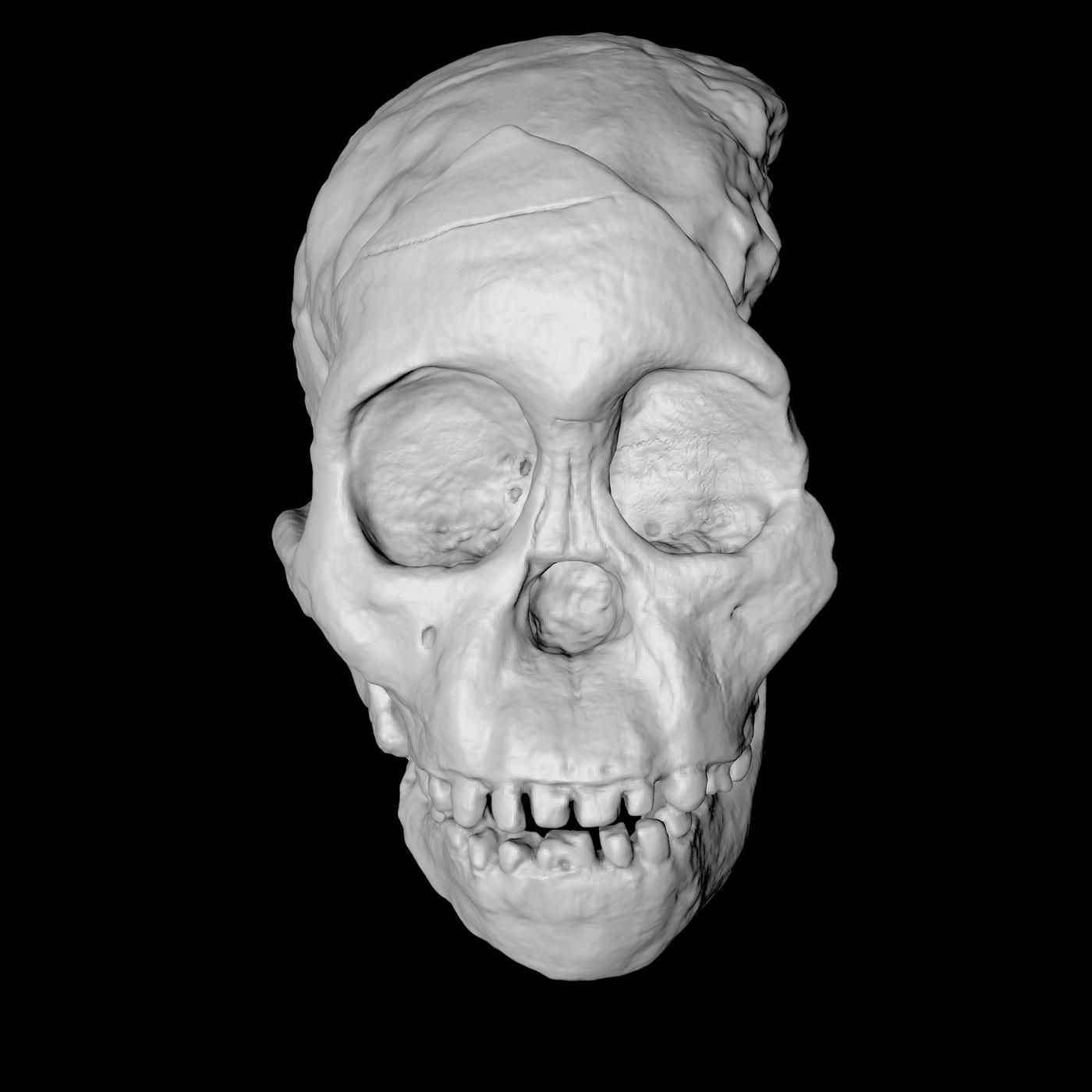
Radiolab
The Skull
00:20:14
Today, the story of one little thing that has radically changed what we know about humanity’s humble beginnings and the kinds of creatures that were out to get us way back when. Wits University Professor Lee Berger and Dr. Chris Stringer from London’s Natural History Museum explain how a child’s skull, found in an ancient cave, eventually helped answer one of our oldest questions: Where do we come from? Then Lee takes us on a journey to answer a somewhat smaller question: how did that child die? Along the way, we visit Dr. Bernhard Zipfel at Wits University in Johannesburg to actually hold the skull itself. We wanted to give you a chance to hold the skull, too. So we did a little experiment: we made a 3D scan of it. If you visit our page on Thingiverse, you’ll see the results. Anyone with access to a 3D printer can print their own copy of the skull. (We printed a bunch, with help from our friends at MakerBot—there’s even a purple one with sparkles.) We also collaborated with ...
Loading summary
Transcript180 lines
- [00:00]
Jad Abumrad
Hey, Fidelity.
- [00:02]
How can I remember to invest every month?
- [00:05]
Fidelity App Narrator
With the Fidelity app, you can choose a schedule and set up recurring investments in stocks and ETFs.
- [00:12]
Professor Lee Berger
Huh, that sounds easier than I thought.
- [00:14]
Jad Abumrad
You got this?
- [00:15]
Professor Lee Berger
Yeah, I do.
- [00:17]
Jad Abumrad
Now, where did I put my keys? You will find them where you left them.
- [00:23]
Professor Lee Berger
Investing involves risk, including risk of loss.
- [00:25]
Dr. Bernard Zeppfel
Fidelity Brokerage Services, llc.
- [00:27]
Jad Abumrad
Member nyse, SIPC.
- [00:34]
Nyquil Commercial Narrator
When the flu is keeping you up at night, don't try to tough it out. Knock out your flu symptoms with NYQUIL Intense Flu. You got this. It provides powerful relief of your flu symptoms so you can sleep well through the night. Nyquil Intense Flu. The nighttime sniffling, aching, aching fever. Best sleep with a flu medicine. Use as directed. Keep out of reach of children.
- [00:56]
Fidelity App Narrator
Get ready to shop Lowe's Black Friday doorbuster deals to save $150 on a 30 inch Blackstone GR griddle. Now $299 plus choose a Whirlpool top load washer or Midea top freezer refrigerator for just $398. These limited time doorbuster deals go fast, so get holiday ready. Today at Lowe's, we help you save valid 1128 through 12. One selection varies by location while supplies last. See Lowes.com for more details.
- [01:26]
Jad Abumrad
Wait, you're listening.
- [01:27]
Robert Krolwood
Okay. All right. Okay.
- [01:31]
Cliff Friedman
All right.
- [01:33]
Jad Abumrad
You're listening to Radiolab Radio Lab shorts.
- [01:38]
Professor Lee Berger
From WNYC.
- [01:43]
Jad Abumrad
And npr. Hey, I'm Jedi Boomerad.
- [01:46]
Robert Krolwood
I'm Robert Krolwood.
- [01:47]
Jad Abumrad
This is Radiolab. And today we're talking about things.
- [01:52]
Dr. Bernard Zeppfel
I don't think there'll ever be another specimen that'll be exactly like this one.
- [01:56]
Jad Abumrad
Actually, our next podcast is a full hour about stories that grow out of particular things, objects. But today we have a preview. Yes, sort of. So that's the place, right?
- [02:06]
Dr. Bernard Zeppfel
This is the place.
- [02:07]
Jad Abumrad
It's a story about a thing. It's in this vault that lives inside a steel vault, inside this huge laboratory at Wits University in Johannesburg, South Africa. We asked a professor there, Dr. Bernard Zeppfel, to pull it out and show it to our reporter, Patricia Hume.
- [02:24]
Dr. Bernard Zeppfel
And this is the original specimen. This is it. We have it right in front of us here. I mean, I. I handle this a lot, but I get goose flesh every time I take this out.
- [02:39]
Jad Abumrad
The reason it gives him goose flesh or goosebumps is because this object seems to completely upend two basic questions about, you know, human history.
- [02:48]
Dr. Bernard Zeppfel
Amazing.
- [02:50]
Jad Abumrad
Where did we begin and when we began? Who was trying to take us out?
- [02:56]
Robert Krolwood
Producer Andy Mills takes the story from here.
- [02:59]
Jad Abumrad
Right.
- [02:59]
With thunder and vigor.
- [03:00]
Robert Krolwood
And gusto.
- [03:01]
Jad Abumrad
With gusto, yes. I'd like to. With gusto, please. All right.
- [03:04]
Professor Lee Berger
Well, it's one of those discoveries that almost didn't happen.
- [03:07]
Jad Abumrad
And here to help me tell you the story.
- [03:09]
Professor Lee Berger
Okay. I'm Professor Lee Berger.
- [03:11]
Jad Abumrad
Is Lee.
- [03:12]
Professor Lee Berger
I am a research professor at the University of the Witwatersrand in Johannesburg and an explorer in residence at the National Geographic Society.
- [03:20]
Robert Krolwood
An explorer in residence. That's a weird title. It seems like you shouldn't. You should be one or the other.
- [03:26]
Professor Lee Berger
It's almost an oxymoron, isn't it?
- [03:27]
Robert Krolwood
Yeah.
- [03:28]
Jad Abumrad
Lee says that our story begins back in the 1920s in South Africa at a place called Taung. Taung.
- [03:34]
Professor Lee Berger
It's T A N U G. Taung is the proper way in Swana, the western way of saying it is Tong. It's a desert area on the southern edge of the Kalahari Escarpment.
- [03:45]
Jad Abumrad
Kind of like your stereotypical picture of Africa. Red rocks, baobab trees, roaming gazelles.
- [03:51]
Professor Lee Berger
And back in the 1920s, the place.
- [03:53]
Jad Abumrad
Was crawling with Europeans digging mines as.
- [03:56]
Professor Lee Berger
They were blasting away with dynamite, drilling with big steam drills and huge explosions would take place.
- [04:03]
Jad Abumrad
And one day, these miners, they're blowing their way through a bit of this hillside. And as the rock falls away and the smoke clears, they realize that they've opened up this cave, an ancient cave.
- [04:17]
Professor Lee Berger
And inside of that cave, they found.
- [04:19]
Jad Abumrad
Dozens of these strange looking rocks, almost like animal bones. One of the miners, he takes those bones, gives them to a geologist. Geologist box them up and sent them to this Australian guy who was living in Johannesburg named Raymond Dart.
- [04:34]
Professor Lee Berger
And that's probably the first miracle in this story. Raymond Dart was a neuroanatomist, a comparative neuroanatomist, one of the only ones in the world.
- [04:42]
Jad Abumrad
This was a guy who knew his fossils. And when this box arrived, he was actually wearing a three piece suit.
- [04:47]
Professor Lee Berger
He's going to be best man at a wedding, in fact, later that afternoon.
- [04:50]
Jad Abumrad
But he's like, that can wait. So he reached into the box, shuffled through some antelope skulls.
- [04:55]
Professor Lee Berger
It was full of baboon skulls, monkey.
- [04:57]
Jad Abumrad
Skulls, until he got to this one rock. Now, to you or me, this would have just looked like a big chunk of limestone.
- [05:05]
Professor Lee Berger
But Raymond Dard immediately realized that he had something special. And he started. He actually went and got his wife's knitting needles and started scratching away at this rock, much to his wife's disgust. He then spent the next several months.
- [05:20]
Jad Abumrad
Delicately chipping away at the limestone until.
- [05:23]
Professor Lee Berger
The rock literally popped free. And there he stared into a Perfect little face.
- [05:33]
Dr. Bernard Zeppfel
You can see here. The face is quite flat and human, like.
- [05:39]
Jad Abumrad
A lot like the face of a child, A human child.
- [05:42]
Dr. Bernard Zeppfel
But humans have a larger brain.
- [05:45]
Jad Abumrad
According to Dr. Zeppfeld, this child's brain was smaller than a human child. It was closer to the size of a chimpanzee. So it had features of a human. It had a brain more like a chimpanzee's. Stranger still, Dart, who, remember, studied this sort of thing. He looked at the foramen magnum, that's.
- [06:02]
Professor Lee Berger
The hole in the base of your skull where your spine goes in.
- [06:06]
Jad Abumrad
He knew that for creatures that walk on four legs, that hole is generally.
- [06:10]
Professor Lee Berger
Towards the back of the skull so they can look forward.
- [06:13]
Jad Abumrad
But here the hole is on the bottom, which suggested to him that this creature walked upright.
- [06:21]
Dr. Bernard Zeppfel
It was not a monkey, it wasn't an ape as we know apes today. It was certainly not a modern human being.
- [06:28]
Jad Abumrad
This was something in between.
- [06:29]
Professor Lee Berger
If you were walking across a broken woodland where Little Taungchow might have lived, you would have seen a person off in the distance. As you approach, though, you'd begin to see that something was wrong with the proportions. Arms were probably a little longer, legs a little bit shorter. The head was too small.
- [06:46]
Jad Abumrad
And as you stepped closer, you'd see.
- [06:48]
Professor Lee Berger
The little Tang Chow's body would have.
- [06:49]
Jad Abumrad
Been covered in this thick hair, potentially.
- [06:52]
Professor Lee Berger
Even fur, more like an ape than we have. But it would be like no ape you've ever seen because it would be standing there in very much the way you would be standing, staring at it on two legs.
- [07:04]
Jad Abumrad
So if. If this is a little bit human and a little bit ape, sort of kind of in the middle, it seems. Did he. Did he feel like this was the, quote, missing link?
- [07:12]
Professor Lee Berger
Well, we don't use that term because evolution doesn't happen that way. But certainly Dart did. He in fact, wrote a book called Adventures with the Missing Link.
- [07:20]
Jad Abumrad
And right after he discovered the skull.
- [07:21]
Professor Lee Berger
He sent a paper off in amazing speed to the journal Nature. It was published in February of 1925.
- [07:28]
Jad Abumrad
He thought that this was going to revolutionize everything.
- [07:31]
Professor Lee Berger
But he was wholeheartedly rejected by the great scientific community of Europe for two reasons. First, we already knew that humans didn't evolve in Africa.
- [07:44]
Chris Stringer
Yeah, Africa was backward.
- [07:46]
Jad Abumrad
That was the belief, says Chris Stringer.
- [07:49]
Chris Stringer
I'm a research leader in human origins at the Natural History Museum in London.
- [07:53]
Jad Abumrad
And he explained that back in the early 20th century, people of the time.
- [07:57]
Chris Stringer
Felt that if you look in Europe, you can see all this wonderful cave art painted many thousands of years ago. They Preferred to think that Europe or Asia were more likely centers of our origins than Africa was.
- [08:10]
Jad Abumrad
Second, scientists already found a skull that they believed belonged to the quote, unquote.
- [08:15]
Chris Stringer
Missing link was something called Piltdown Man.
- [08:17]
Jad Abumrad
It was this ancient man fossil thing that they found in a golf course in England. So in their minds, it was the right place.
- [08:25]
Chris Stringer
And also in Piltdown man, you've got this very large brain and a brain case that looks really quite like a.
- [08:30]
Jad Abumrad
Modern human one, which made sense to them. You know, clearly European ancestors would have had big brains, because they're European.
- [08:39]
Chris Stringer
Yeah. I mean, the Tung individual had a.
- [08:42]
Jad Abumrad
Small brain, way too small.
- [08:43]
Professor Lee Berger
This thing was too primitive. It didn't look right.
- [08:46]
Jad Abumrad
So Dart.
- [08:47]
Professor Lee Berger
He spent the next 20 plus years.
- [08:51]
Jad Abumrad
Arguing, look, people, this is our ancestor. And getting nowhere.
- [08:55]
Chris Stringer
Until in the late 1920s, other fossils started showing up in China, South Africa, Kenya, Ethiopia.
- [09:02]
Jad Abumrad
And these other fossils, they were from roughly the same era as the Piltdown man, But their brains, their teeth, their bone structures, they were all totally different.
- [09:10]
Chris Stringer
So this was very weird. I mean, how do you explain that for decades, nothing else like Piltdown man turns up from anywhere in the world?
- [09:18]
Jad Abumrad
So some forensic experts at the London museum of natural History, they decide maybe we ought to go take a closer look at Piltdown Man.
- [09:25]
Chris Stringer
They started looking at the material under.
- [09:26]
Jad Abumrad
Microscopes, and right off the bat, they.
- [09:28]
Chris Stringer
Found that one of the teeth clearly showed the marks of a metal file, that it had been filed down to look flat.
- [09:39]
Professor Lee Berger
No, Piltdown was a fraud.
- [09:43]
Chris Stringer
It was a fake, a forgery, a hoax.
- [09:46]
Jad Abumrad
And the hoaxers were never caught.
- [09:47]
Chris Stringer
There were questions in the houses of Parliament about the competence of the Natural history Museum that its experts had been formed for all this time, because this.
- [09:56]
Jad Abumrad
Wasn'T even a very good fake.
- [09:57]
Chris Stringer
They had taken the jawbone of an orangutan. They took some modern human skull pieces. They then stained that material dark brown so it looked the same color. They even faked stone tools.
- [10:10]
Jad Abumrad
And all this time, right there in front of them was the Taung child.
- [10:16]
Dr. Bernard Zeppfel
It is estimated, and it's purely an estimate of being around 2 million, 2.2.
- [10:21]
Jad Abumrad
Million years old, which still today is the oldest, not quite yet, human fossil that we have.
- [10:28]
Dr. Bernard Zeppfel
This would be probably the greatest or one of the greatest discoveries ever been.
- [10:35]
Professor Lee Berger
Argued to be the most important single fossil ever, ever discovered in the history of humankind's search for ancestry.
- [10:41]
Dr. Bernard Zeppfel
Because it brought to the fore that humanity originated in Africa, that every human on earth is an African. We are all of African origin.
- [10:54]
Jad Abumrad
But. But more than Just where we came from, which I think is totally cool.
- [10:59]
Yeah. Huh. Super interesting.
- [11:01]
We can. We can look at the skull and we can see things about, you know, what life was like for this, like, little version of us that lived so long ago. We look at the teeth, we can see what it was eating.
- [11:12]
Robert Krolwood
Was it eating, like, what we eat?
- [11:13]
Jad Abumrad
Yeah, yeah. Its teeth are, like, surprisingly similar to our teeth. So, yeah, it wasn't, like, hugely different from what we eat. But I think the most exciting thing that it can tell us is, you know, not just about what our life was like, but what was lurking in the shadows waiting to take us out.
- [11:36]
Robert Krolwood
You can tell that from the skull?
- [11:37]
Jad Abumrad
Yeah. I mean, this skull is kind of at the center of this murder mystery.
- [11:42]
Professor Lee Berger
That is who killed the Taung child. At the time when Raymond Dart made.
- [11:47]
Jad Abumrad
That discovery, he had this sort of gut feeling that this Taung child was killed by one of its own, you know? Cause this is, like, 1924, we were between two wars.
- [11:58]
Professor Lee Berger
World War I had occurred with the horrible destruction.
- [12:01]
Jad Abumrad
Dart was actually a medic in that war. And he walked away convinced that humans.
- [12:05]
Professor Lee Berger
Were inherently evil, creatures that were inherently.
- [12:09]
Jad Abumrad
Violent, and that we were probably a lot worse in the past.
- [12:12]
Professor Lee Berger
And in fact, the opening of 2001.
- [12:16]
Jad Abumrad
A Space Odyssey, where you see the monkeys kind of like, beating each other.
- [12:22]
Professor Lee Berger
With the bones, was based on Raymond Dart's theories of the violent origins on the continent of Africa.
- [12:30]
Jad Abumrad
So that was Dart's, like, pet theory that maybe Taung got clubbed down by his brother or his neighbor. But that ignores one big thing. In that limestone mine where the Taung skull was found, there were also all these other skulls. Baboon skulls, monkey skulls. There was this, like, little collection of bones, more like what you would expect to find in a predator's den. So not a tong like creature, but maybe.
- [12:57]
Professor Lee Berger
A cat, Big cat, At least a large mammalian predator, because that's perfectly acceptable. If we're tough, they're tough. It's okay to be killed by something mean and vicious.
- [13:07]
Jad Abumrad
So that became the new theory.
- [13:08]
Professor Lee Berger
Because what else do humans have to fear, right?
- [13:11]
Robert Krolwood
Well, what. Now, here's where I think maybe you come into the story. For some reason, when you arrive many, many, many years later, this idea that the cat did it seems to disturb you.
- [13:25]
Professor Lee Berger
I was addicted to that story as anyone else. I'd been brought up on it through my anthropology classes. Every book I ever read said that.
- [13:32]
Jad Abumrad
But one day in 1994, he bumps into a completely new idea in an almost eureka moment.
- [13:42]
Professor Lee Berger
Cause there I was at Gladysville an.
- [13:46]
Jad Abumrad
Excavation site in South Africa. Lee and his team were doing what they do, digging for fossils.
- [13:50]
Professor Lee Berger
I just finished excavation. All my team had left. And I was sitting there watching the sunset. And I looked up on the hillside and there was a troop of vervet monkeys. They're a small gray monkey, and they were coming down to forage down the hill. And all of a sudden I heard an alarm call. And I looked up in the sky and there came a huge eagle. The monkeys scatter as this eagle swooped around the edge of the hill. And as it came down around the edge of the hill, I realized it was a trap. Because coming around the other edge of the hill was that eagle's mate. And it zoomed in and whacked one of those large monkeys right in front of me. And everything went silent. The other eagle landed. This eagle sitting on top of a now dead monkey. And the eagle staring at me. I'm staring at it, probably with my mouth open. It looks at me for a moment and then it leaps off the edge of this cliff with this dead monkey and flies away with it down the valley. And I had an idea, so I got into my car, I chased the direction it went. I knew where it was going. I knew where these black eagle nests were. They were up on a cliff face. I crawled up under crossing a river, crawled up under the nest. And there was this pile of bones, huge pile of bones. Hyraxes, little antelopes, a baboon skull, a baby baboon skull. And almost every one of the bones there had these amazing marks on them.
- [15:17]
Jad Abumrad
Keyhole shaped cuts where the eagles have driven their talons into the skulls.
- [15:22]
Professor Lee Berger
These big eagles can have killing talons that are 5, 6, 7 inches long, if you can imagine that. I got in my car, back to the lab in Joburg.
- [15:31]
Jad Abumrad
He whips open the drawer that contains those skulls and bones that were found with the Taung child skull.
- [15:38]
Professor Lee Berger
And the exact same marks. Couldn't believe it.
- [15:43]
Jad Abumrad
There's even like a little mark on the Taung child skull itself. A year later, 1995, he and a colleague, they publish a paper that blamed.
- [15:55]
Professor Lee Berger
Eagles for the death of the Tang Chao. And it was received like a smelly, wet blanket by the field.
- [16:03]
Robert Krolwood
Why? Why would they not say?
- [16:05]
Professor Lee Berger
Oh, of course, because it was entrenched.
- [16:09]
Jad Abumrad
Idea, you know, Lee says maybe subconsciously they felt like our ancestors are being demoted again.
- [16:16]
Professor Lee Berger
That is, that, you know, we were not the masters of our universe because.
- [16:20]
Jad Abumrad
Cats just feel tougher than birds. I don't know. But according to Lee, the big cat Scientists were like, you know, it's been.
- [16:27]
Professor Lee Berger
Published, it's been published. A leopard did it for 40 years. We even got into a debate in the, in the hallowed pages of the journal Nature on the load lifting capacity of birds of prey, on whether or not birds of prey could lift something as large as the Taungchild.
- [16:43]
Jad Abumrad
And these debates, they went on for years. He couldn't convince people we needed something more until one night, it was about.
- [16:51]
Professor Lee Berger
9 o' clock at night. Years later, I was at home singing my little study.
- [16:55]
Jad Abumrad
He was reading an academic paper about eagles and how eagles, sometimes when they kill little mammals, they'll reach into their eye sockets and pluck out their eyes.
- [17:05]
Professor Lee Berger
To get at the nice juicy brain on the inside.
- [17:08]
Jad Abumrad
And in the paper there was this really beautiful image.
- [17:11]
Professor Lee Berger
Well, it's beautiful to people who study dead things, but a beautiful image of a skull, of a primate with the interior sockets of its eyes with these jagged marks in it, these very particular.
- [17:22]
Jad Abumrad
Scratch marks on the underside of the eye sockets.
- [17:25]
Professor Lee Berger
And I was staring at these images and I went, oh my goodness. Or something to that effect. I got into my car, drove down to the lab, opened up the safe, pulled out the tongchild, turned the face over and there they were. On the base of the inside of the eye socket were these jagged, rigid marks that you had to have done by reaching into the orbit. The exact same marks you can see.
- [17:57]
Dr. Bernard Zeppfel
Little squiggle marks, almost like little exclamation marks and little commas. No one had noticed that before.
- [18:05]
Professor Lee Berger
And imagine I'm sitting in the middle of this anatomy department in the middle of the night in a vault containing million year old fossils. It was a magic moment. It was fantastic.
- [18:16]
Jad Abumrad
All right, so now you know a little bit about how this creature lived and how it died. I mean, beyond solving the murder mystery, what does that tell you?
- [18:23]
Professor Lee Berger
Well, first to say solving the murder mystery is kind of cool. That's always a neat thing. And there's nothing wrong with just doing that. But have you ever thought why when you're standing out on a playground or standing out in an open field and a shadow passes over you, do you know that feeling that occurred, whether it be from an airplane or whatever? From first you get that tingly feel on the back of your neck and then you yank your head up. You ever wondered why you do that? Yeah, you do that because the little Taung child died 2 1/2 million years ago because he didn't look up quick enough when that happened.
- [19:05]
Jad Abumrad
Producer Andy Mills. One thing we should say, one very important thing. We should say is actually we did an experiment with this story. We hooked up with some people at Makerbot and some very nice folks at the Field Museum in Chicago. And we had 3D scans made of the Tong child skull. I'm actually holding one right now.
- [19:23]
Robert Krolwood
Me too. Yeah, mine's purple.
- [19:25]
Jad Abumrad
Mine's pink.
- [19:26]
Robert Krolwood
Why is yours pink?
- [19:27]
Jad Abumrad
I don't know. That was the color of the plastic they used. But these are amazing replicas of the T child's skull. I mean, you can see all the ridges, you can feel the scratches and the eyes.
- [19:35]
Robert Krolwood
Imagine if you could listen to the story you just heard while holding the tongue child in your hand.
- [19:39]
Jad Abumrad
Well, that's exactly the reason we did this. We have partnered with a museum called Museum, that's spelled with four M's, two in the front, two in the back. Museum. It's this tiny little elevator shaft sized place here in Manhattan where they display all these sort of like oddities, you know, like little objects from Saddam Hussein's palace.
- [20:01]
They have pool toys that were banned from Saudi Arabia.
- [20:04]
Right. And they will also be displaying our 3D replica of the Tang skull. So if you go there, you can actually hold the skull, you dial in a little number and you can hear.
- [20:15]
Part of the piece while you're standing there.
- [20:16]
Yeah, and I gotta tell you, it's a very different experience to listen to the story while holding this thing. Not only that, if you have a 3D printer of your own and you go to Radiolab.org you can download a scan, a 3D scan of the Tang skull and you can print your own. Thanks again to Makerbot and to Shoot Digital for helping to make that happen. Props to Lynn Levy for conceiving of the whole idea. Go to our website, Radiolab.org, i'm Jad Abumrad.
- [20:41]
Robert Krolwood
I'm Robert Pilwigz.
- [20:42]
Jad Abumrad
Thanks for listening.
- [20:46]
Hi, this is Lisa Beck calling from Fort Worth, Texas. Radiolab is supported in part by the National Science foundation and by the Alfred P. Sloan foundation, enhancing public understanding of science and technology in the modern world. More information about Sloan@www.sloan.org.
- [21:04]
Cliff Friedman
This is Cliff Friedman calling from the University of Miami in Coral Gables, Florida. Radiolab is supported by Squarespace, the all in one platform dedicated to providing a simple way to create a website, portfolio or online store for business or personal use. Squarespace provides templates and drag and drop tools to create professional websites. Users create sites that are mobile ready, including 24, 7 support domain names and ecommerce, all on the same platform. For a free trial, visit squarespace.com radiolab.