← Radiolab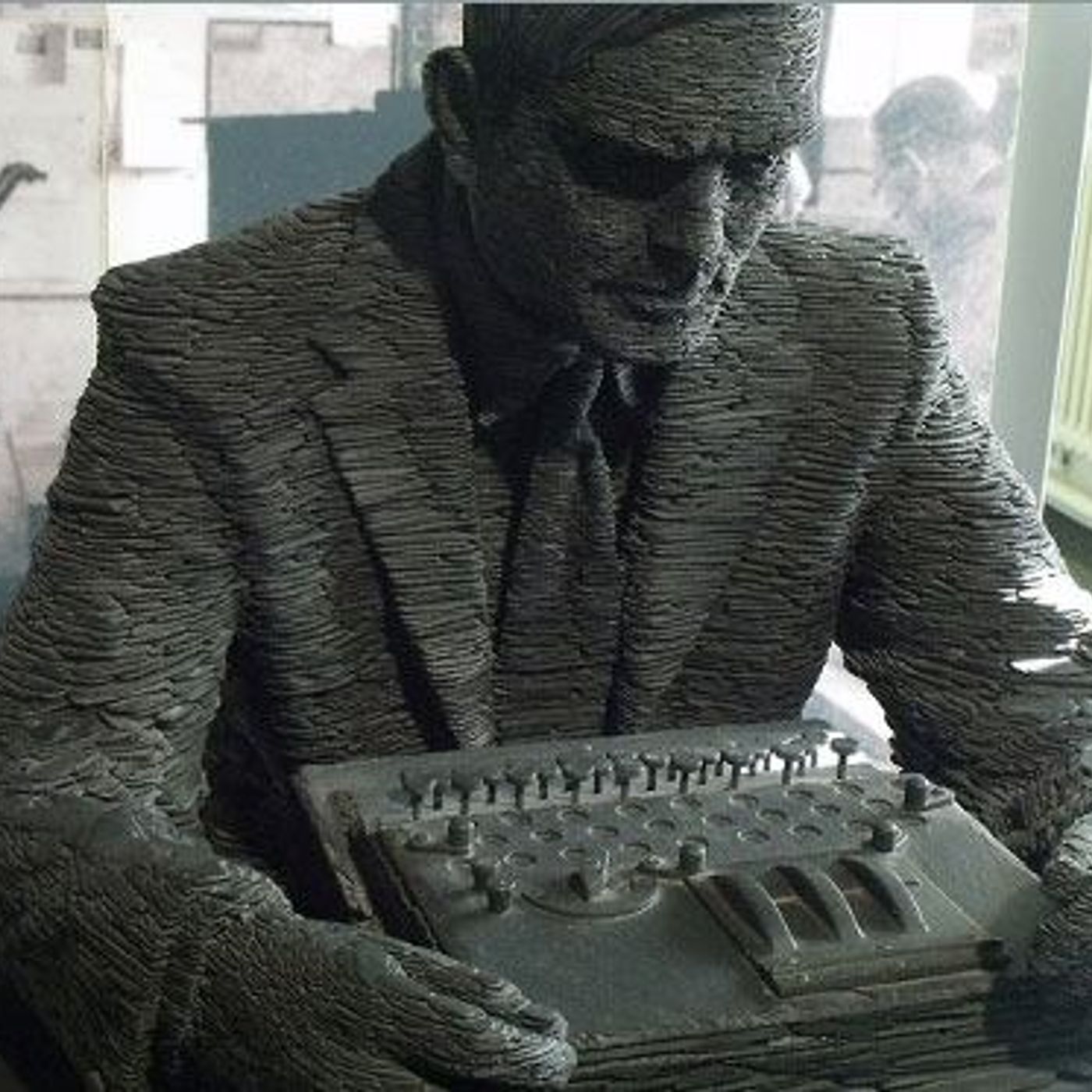
Radiolab
The Turing Problem
00:23:03
100 years ago this year, the man who first conceived of the computer age was born. His name was Alan Turing. He was also a math genius, a hero of World War II and he is widely considered to be the father of artificial intelligence. But the world wasn't kind to Alan Turing. In 1952, he was arrested and convicted under a British law that prohibited "acts of gross indecency between men, in public or private."
Loading summary
Transcript155 lines
- [00:00]
Commercial Announcer 1
Your new home is now ready. Dr. Horton, America's builder has new homes that are ready today with new construction communities in Ellensburg and throughout the Greater Seattle area. Dr. Horton has the right home for you. At Dr. Horton, we're still building with flexible living spaces, smart home technology and two and three car garages. More communities and more homes available every day. Find your new home in ellensburg now ready at Dr. Horton.com Dr. Horton, America's builder and equal housing opportunity builder for delicious meals, you could go out to eat, or you could just make a Marie Callender's meal. Marie Callender's classic chicken parmigiano bowl is so good. It has marinara sauce that's made from scratch and creamy mozzarella cheese over pasta. It's delicious with no artificial flavors, colors or preservatives. And 30 grams of protein. You can find it in the frozen aisle. Marie Callender's what having it all tastes like.
- [00:56]
Commercial Announcer 2
It's never too early for Lowe's Black Friday deals. Snag some of our biggest savings of the season right now, like 20 off select pre lit artificial Christmas trees and get yourself free. Select Dewalt cobalt or Craftsman tools when you buy a select battery or combo kit before the Black Friday rush. Because everyone loves free stuff, right? Lowe's we help you save valid through 123 while supplies last. Selection varies by location.
- [01:25]
Jad Abumrad
Wait, you're listening.
- [01:26]
David Levitt
Okay.
- [01:27]
Jad Abumrad
All right.
- [01:28]
David Levitt
Okay.
- [01:29]
Jad Abumrad
All right. You're listening to Radiolab Radio.
- [01:36]
Robert Krulwich
From WNYC.
- [01:41]
David Levitt
And npr.
- [01:45]
Robert Krulwich
Hey there. I'm Robert Krulwich. JAD is on paternity leave. This is Radiolab, the podcast, and today I thought I'd introduce you to a particular guy on a particular day in Manchester, England. It's 1952, and Alan Turing, a math professor, discovers that a number of things have disappeared from his home. Looked kind of like a burglary. He was missing a shirt, a pair.
- [02:07]
David Levitt
Of shoes, an old pair of pants, maybe a compass.
- [02:10]
Jana Levin
It was stuff. It was just household stuff. Nothing of anything of value.
- [02:14]
Robert Krulwich
That's Jana Levin and David Levitt. Both of them have written books about Alan Turing.
- [02:18]
Jana Levin
And so being very literal minded, he thought, well, what do you do when you're robbed? You call the police.
- [02:22]
David Levitt
So the police come to his house, the detectives, he has this conversation and they say, you know, he's kind of a curious chap. They let him talk and they're like, it's a real shame. We're going to have to arrest him.
- [02:34]
Robert Krulwich
Who?
- [02:35]
David Levitt
Turing?
- [02:37]
Robert Krulwich
Why would they have to arrest. They're just coming to.
- [02:38]
David Levitt
Because he's effectively implicated himself in terms.
- [02:41]
Robert Krulwich
Here's what happened. The police sat turing down and said, who do you think made off with those things of yours? And he says to them he suspected.
- [02:47]
Jana Levin
The thief was an acquaintance of his boyfriend.
- [02:51]
Robert Krulwich
His boyfriend?
- [02:52]
Jana Levin
Yes. Yes.
- [02:54]
Robert Krulwich
See, at the time, there was a.
- [02:55]
Jana Levin
Law in England which criminalized, quote unquote, acts of gross indecency between adult men in public or private.
- [03:02]
Robert Krulwich
So he told the cops that he was having sex with a guy. Was that why we.
- [03:06]
David Levitt
He doesn't exactly say we're having sex, but he says enough that it's clear he was never ashamed of being gay. This is just not something, again, that he understood what the fuss was about.
- [03:18]
Robert Krulwich
So what happened to him? Was he. Was he convicted?
- [03:20]
David Levitt
Yeah, he's convicted and he's.
- [03:22]
Robert Krulwich
What's his sentence?
- [03:23]
David Levitt
Estrogen pills and implants. Estrogen implants.
- [03:27]
Robert Krulwich
Oh, my God.
- [03:28]
David Levitt
Yeah. Chemical castration.
- [03:30]
Robert Krulwich
And when I learned this, I wondered if those policemen had any idea that the guy they were arresting was, first of all, one of the great minds of the 20th century, a war hero who single handedly, almost by himself, shortened World War II by at least two years. And the questions he posed way back then are still, I think, the most provocative ideas I know. But we're getting a little ahead of ourselves. So let me back up to when he was a schoolboy, around 15 or 16, in England.
- [03:59]
Jana Levin
He gets to Sherborne School, which is the public school, as they say in England.
- [04:03]
David Levitt
I guess we would call it a boarding school. Boarding school for boys. Where.
- [04:07]
Robert Krulwich
What did he look like?
- [04:08]
David Levitt
He had dark hair, very dark hair, sort of square face. He wasn't unattractive, he was just so goofy.
- [04:15]
Robert Krulwich
So did the other kids make fun of him at school or did he?
- [04:18]
David Levitt
Yeah, I mean, he's teased, taunted, bullied, but he's not completely unhappy.
- [04:24]
Jana Levin
He falls in love with another student.
- [04:26]
David Levitt
Named Christopher Morcom, who's very charming, very socially smooth, handsome. They have this bond over science. It's an unrequited love.
- [04:35]
Robert Krulwich
Did he express his love to this other kid or.
- [04:38]
David Levitt
I think it was pretty obvious. He was always sort of there, sitting next to Chris Morcom, every class, right behind him, right next to him. And I think at some point Chris commented that, you know, maybe it's a little too much attention, but I don't think he really made a formal declaration of his love. But he did maintain a relationship with Chris mother, even after Chris died. Chris Morecambe died while he was still in school of Bavarian tuberculosis and had kept his illness a secret. Just one day, there was just this announcement he was dead. So I think it came as a complete shock to Alan.
- [05:17]
Jana Levin
His memory really lingered. And I think that.
- [05:19]
Robert Krulwich
How do we know that a kid had a boy crush in school?
- [05:23]
Jana Levin
There are letters. Most moving are the letters that he wrote after Morcam's death.
- [05:28]
Robert Krulwich
We actually went out and found a few of them, and here's one that he wrote to his mother. He says, I feel sure that I shall meet Morecambe again somewhere, and there will be some work for us to do together, as I believe there was for us to do here, now that I'm left asleep.
- [05:43]
David Levitt
He wanted to believe that Chris's spirit lived on, and he was sort of awkwardly trying on these ideas that he had inherited from his religious upbringing.
- [05:51]
Robert Krulwich
But, and you can see this in.
- [05:53]
David Levitt
The letters, too, Turing begins to lose his faith and eventually comes to this sort of brutal conclusion that when Chris was gone, he was gone.
- [06:02]
Robert Krulwich
The only love he had left at that point was mathematics. So he goes off to King's College, Cambridge, to study math.
- [06:08]
Jana Levin
Yeah, exactly.
- [06:08]
Robert Krulwich
He was still kind of a loner.
- [06:11]
Jana Levin
If you look at photographs of Turing, I think I'm always struck by the fact that he looks like he's not actually there. He looks like he's like a lot of mathematicians. He lives simultaneously in two different worlds, the world that the rest of us live in. And he lived in a kind of extraordinary world of abstraction.
- [06:27]
David Levitt
You know, lying in the fields in Cambridge, just him and his thoughts staring.
- [06:32]
Robert Krulwich
Up at the sky.
- [06:33]
David Levitt
He did do that. He would literally go and lie in the meadow and he would have these epiphanies, these realizations.
- [06:40]
Robert Krulwich
And one day he's lying in Grantchester Meadows, that's near the campus, and he's thinking over a pretty tough problem. Is there a quick, automatic way to prove or disprove a mathematical proposition? This was a big question in math at the time, the ins and outs of which aren't all that important to us. What's important is that it led to Alan Turing's idea for, of all things, a machine.
- [07:02]
Jad Abumrad
The machine doesn't exist. The machine is never built. It is never meant to be built.
- [07:07]
Robert Krulwich
This is James Glick, a science writer who has studied Turing.
- [07:10]
Jad Abumrad
It's the world's most impractical machine, but it's very simple. These were the elements of the machine. Number one, piece of tape, infinitely long. So therefore, it's already never going to exist because we can't have infinitely long pieces of tape.
- [07:25]
Robert Krulwich
And number two, something that reads or writes ones and zeros on the Tape and number three, a set of instructions.
- [07:32]
Jad Abumrad
So if you've got a zero, then you go to the left and you write a one, or if you've got a one, go to the left and you write another one. And you got to remember where you've been so you have a certain amount of memory, but that's it. And then he proved that the machine could do anything.
- [07:50]
Robert Krulwich
You could add, of course, and then you could subtract and multiply. You could also do a little calculus, actually a lot of calculus. You could do trig and mathematical proofs and sophisticated mathematical proofs.
- [08:01]
Jad Abumrad
Anything that could be done in mathematics mechanically could be done by his imaginary idiot simple machine.
- [08:11]
Robert Krulwich
Is this such a big idea? I mean, all you're saying really is he figured out how to put logic or actually how to program a machine.
- [08:16]
Jad Abumrad
Okay, but, but no, Robert, you're already cheating because as soon as you say you're going to give the machine some logic and then as soon as you use the word program, you're using very modern bits of knowledge that we've all internalized. But the idea of putting logic into a machine, no one thought of that. That's just weird.
- [08:39]
Jana Levin
Machines at that time bear in mind were generally single function.
- [08:44]
David Levitt
The idea that you do your email on your computer and Photoshop, you know, you don't buy a different machine. That is ingenious. That traces back to Turing's original idea that I can build an electromechanical brain and I can teach it how to do different things.
- [08:57]
Robert Krulwich
This was the dawn of the computer age.
- [08:59]
David Levitt
Computer used to mean a person, usually.
- [09:01]
Jana Levin
A woman, who would sit and do mathematics.
- [09:04]
Robert Krulwich
And now we got this guy who's saying that with a simple formula, tape, code and a set of instructions, we can give human like abilities to a machine. And not just the abilities of our hands, but the nimble ability of our beautiful brains.
- [09:18]
Jad Abumrad
It's a beautiful, magical, simple idea. Turing's machine is Cezanne's watercolors. It's Bach's Prelude. He was a lonely 22 year old just thinking and he invented a thing that lives in the minds of every computer scientist today. He didn't realize that just a few years later he was going to be applying these same skills to winning the war for England.
- [09:51]
Robert Krulwich
The Battle of London, which began with strong forces of Nazi bombers attacking the capital at night, led to a big fire on the Waterside. It's 1940 and the German high command is sending secret messages written in code to naval commanders, to U boat captains saying our sink that ship. Mine. This Harbor. The messages were encrypted in this crazy fangled encrypting thing that they called the.
- [10:13]
David Levitt
Enigma machine, kind of a typewriter.
- [10:15]
Robert Krulwich
So they would type bomb that boat in German, of course, and the machine would swap the letters and turn the type into gibberish.
- [10:23]
David Levitt
But they changed the settings, every transmission. And what this meant was that it was considered by both the Germans and the British to be uncrackable.
- [10:31]
Robert Krulwich
Except Winston Churchill thought, ah, let me try. So in total secrecy, British intelligence brought together the most talented amateur decoders that they could find.
- [10:41]
Jana Levin
They chose mathematicians, chess champions, people who could solve the Sunday Times cross puzzle extremely fast.
- [10:47]
Robert Krulwich
And they were all instructed to go to a set of buildings halfway between Oxford and Cambridge. It was a place called Bletchley Park.
- [10:54]
Jana Levin
But the architect of the effort was really Alan Turing, who was an odd.
- [10:58]
Robert Krulwich
Kind of choice because in many ways he was a very strange man.
- [11:01]
Jana Levin
He was kind of paranoid. I think that was clear. I mean, he had this system where his bicycle chain came off every certain number of revolutions, and he knew how many revolutions he was able to ride before the chain would come off. And it was, I think, in order to stop other people from riding his bicycle. But he was the one who, again, had a very typically Turing ish sort of breakthrough. He thought, well, this code is generated by a machine. Therefore a machine can be built that will be able to break the code. So he built this machine that was called the bomb, and it was a.
- [11:36]
Robert Krulwich
And it was huge. It was the size of a wall. And it could try out all kinds of different solutions to this breaking the code. And Turing decided to focus this machine on one little Achilles heel that he found in the coat itself. At the beginning of a typical message, a German would get on the machine.
- [11:54]
David Levitt
And he'd have sort of habitual openings.
- [11:57]
Jana Levin
You know, phrases that were very, very commonly used. And the Germans were fairly unimaginative, unimaginative.
- [12:02]
Robert Krulwich
At the start, like, you know, heil Hitler or good morning or something like that.
- [12:06]
Jana Levin
Exactly.
- [12:06]
David Levitt
Heil Hitler. Or the weather.
- [12:08]
Robert Krulwich
So, Heil would be H E I L, right?
- [12:10]
David Levitt
Yeah.
- [12:10]
Robert Krulwich
There's your in.
- [12:11]
David Levitt
And then they realized that they could actually crack the code because of this, I would say, mystic.
- [12:17]
Robert Krulwich
Throughout the world, throngs of people hail.
- [12:19]
Jad Abumrad
The end of the war in Europe.
- [12:21]
Robert Krulwich
When the English realized that Alan Turing and his team had broken the code, did that make Alan Turing into a superstar? I mean, did he get birthday greetings from the Queen?
- [12:30]
Jana Levin
Not at all, because it was all top secret.
- [12:32]
Robert Krulwich
Well, does that mean that King George didn't know of Alan Turing or Winston Churchill? Didn't know.
- [12:37]
Jana Levin
Churchill certainly knew.
- [12:37]
David Levitt
Churchill definitely took a particular interest in Turing and Turing's transmissions.
- [12:40]
Robert Krulwich
Oh, he did, sure.
- [12:42]
David Levitt
He's a war hero, there's no question about that. His contribution is of crucial importance in terms of turning the tide of the war in favor of the Allies.
- [12:52]
Jana Levin
And yet, as far as I'm aware, Turing was never thanked or acknowledged for what he did.
- [12:59]
Robert Krulwich
If I were King George, I would sent him a little.
- [13:03]
Jana Levin
He didn't.
- [13:05]
Robert Krulwich
Having defeated the Enigma machine, Turing now goes back to his first love, the Turing machine. Mathematicians all over the world are now building computers and big refrigerator sized contraptions. Actually, there was one at Manchester University where Turing took a teaching job. And the one there did a lot more than just math.
- [13:23]
Jana Levin
And the machine could do all sorts of things. I believe it could sing. I'm pretty sure it could sing God Save the King. Really not very well.
- [13:32]
Robert Krulwich
This is what it actually sounded like. It's not something you really want to march to.
- [13:39]
Jana Levin
It was not the machine that Turing ideally would have liked to build.
- [13:43]
Robert Krulwich
Turing had a bigger idea at this.
- [13:44]
Jana Levin
Point, the idea of the thinking machine. He really invented the field of artificial intelligence and was the first person to hypothesize about whether a machine could actually be said to think.
- [13:55]
Robert Krulwich
And not just think, thought Turing, but maybe flirt with you a little bit or joke with you. To have a sentience inside an electronic manufactured mind.
- [14:05]
David Levitt
When people said, how would you know that mind was truly sentient? He said, just ask it. Just ask it.
- [14:11]
James Glick
Are you truly sentient?
- [14:16]
Jad Abumrad
Yes.
- [14:18]
Robert Krulwich
Well, it's not going to be ever that easy. But Turing did come up with a test. It's a way to test whether a machine is doing something like thinking, like human thinking.
- [14:27]
Jad Abumrad
What we now call the Turing Test.
- [14:28]
Robert Krulwich
We've described it on our show before. This is from the show we called Talking to Machines.
- [14:33]
James Glick
Get a person, sit him down at a computer, have him start a conversation in text. Hi, how are you? Enter good. Pops up on the screen. Sort of like Internet chat.
- [14:42]
Robert Krulwich
Yep.
- [14:42]
James Glick
So after that first conversation, have him do it again, and then again, you know, hi, hello, how are you? Et cetera, back and forth. But here's the catch. Half of these conversations will be with real people. Half will be with these computer programs that are basically impersonating people.
- [14:58]
David Levitt
If you can put this thing behind a curtain and you talk to it and it convinces you that it's intelligent and alive and sentient, then it is. What's the big fuss?
- [15:08]
Robert Krulwich
But there was a big fuss. Hold on. One Second, a neuroscientist at the time, Sir Geoffrey Jefferson, turned to Turing and said, how dare you? No machine will ever think like a human, because no machine can feel like we do, and in all the ways we do.
- [15:24]
Jana Levin
Pleasure at its success, grief when its valves fuse, be warmed by flattery, be made miserable by its mistakes, be charmed by sex, be angry or miserable when it cannot get what it wants. And Turing's response to that was, well, I can say the same thing to you. You know, I can say to you, Robert, I don't know what's going on inside your brain. You tell me what you're feeling and what you're experiencing, but how do I know that what you're. How do any of us know that any other human being is a human being?
- [15:57]
David Levitt
Turing is really one of the first to say. He's the first to say it's not just that I want to build a machine that can think. It's that we are Mach, that think.
- [16:06]
Jad Abumrad
We are nothing more than flesh, blood, neurons. We are just machines ourselves, just soulless biological machines.
- [16:17]
David Levitt
And this isn't a dark moment for him.
- [16:19]
Robert Krulwich
It's a moment of acceptance, says Jana. But this time, it's not about math or science. It's about something bigger. It's about the nature of the universe and our place in it. And according to David, not only did Turing feel like he himself was quite kind of a machine, he felt a kinship with all the thinking machines that would ever be manufactured in the future, all those mechanical minds. He felt he had something in common with them.
- [16:44]
Jana Levin
For Turing, the machines were more likely to be victims, victims of prejudice, victims of injustice, victims of people like Jefferson. Jefferson is saying to the machines, you don't think, because I say you don't think. And you know, England was saying to Turing, you can't be what you are and we're going to change you.
- [17:06]
Robert Krulwich
Which brings us back to where we started this show. It is now 1952. Alan Turing has been convicted of gross indecency, a crime punishable by, as we told you, a jail term. Or the court can order you to take hormone injections.
- [17:21]
Jana Levin
And he was given a choice. He could go to prison or he could be, quote, unquote, cured. And the cure consisted of massive doses of estrogen.
- [17:31]
Robert Krulwich
Nobody importance went and said to the judge, here's a character reference, by the way. This guy won the world war that we just fought.
- [17:38]
Jana Levin
Well, I suppose you could say that they were cutting him a break by not sending him to prison, by giving him this horrific, horrific alternative.
- [17:48]
Robert Krulwich
What were the hormones supposed to do?
- [17:49]
Jana Levin
It was the crudest kind of pseudoscience. There was some claptrap theory that homosexuality could be cured through injections of estrogen. What it really did was it made.
- [18:03]
David Levitt
Him impotent and profoundly depressed. He grows breasts. It certainly doesn't work to repress his homosexuality. He's still vocally gay.
- [18:16]
Robert Krulwich
But he's also worried that because he's now famously gay, his court case being in the papers and all, that, everybody from now on will dismiss his ideas. Writing once to a friend, he said.
- [18:26]
Jana Levin
I'm rather afraid that the following syllogism may be used by some in the future. Turing believes machines think. Turing lies with men, therefore machines do not think. It is signed yours in distress, Alan.
- [18:42]
Robert Krulwich
The hormone treatments ended. He kept working, but his mood darkened.
- [18:46]
Jana Levin
Turing's favorite film was Snow White and the Seven Dwarves. And he particularly loved the scene where the witch dips the apple in the brew. And she chants, dip the apple in the brew. Let the sleeping death seep through.
- [19:02]
Robert Krulwich
One night in 1954, it was June 8, he was at home. And at some point during that night, he kills himself. How?
- [19:12]
David Levitt
He laces an apple with cyanide and he bites from the poison apple.
- [19:20]
Robert Krulwich
He left no note. 55 years later, in 2009, the Prime Minister of Great Britain, Gordon Brown, issued a formal apology to Alan turing. And in 2011, coming up on his 100th birthday, 23,000 people sent a petition to the British government asking that Alan Turing be given a posthumous pardon for the so called crime of moral turpitude. In 2012, a government minister, Lord Tom McNally, said, no, that we will not do. Here's the A posthumous pardon was not considered appropriate as Alan Turing was properly convicted of what was at the time a criminal offense. He would have known that his offense was against the law and that he would be prosecuted. It's an amazing life and I'm in awe that anybody could have accomplished quite as much as he did and suffered as much as he did. It's almost overwhelming, but when I think about it, there's a piece of what Alan Turing thought up that just hurts a little, at least me. This idea that machines can one day become, in effect, our equivalent.
- [20:41]
Jad Abumrad
This is still such a powerful and emotional question for us to deal with. And I guess we're still divided between people who think that would be kind of a cool thing and people who think that would be a horrible thing. And the people who think it would be a horrible thing, I guess feel that way partly because it makes us Feel kind of bad about ourselves. You know, we. Because we aren't. We aren't. There's nothing magical about us. If we're just machines.
- [21:15]
Robert Krulwich
You fall on one side, but I fall on one side of these lines.
- [21:17]
Jad Abumrad
No, I think what I'm willing to say is I think we're just machines, and I think we're just made of matter. I'm sorry to be giving religious opinions here, because these are religious opinions, but for me, that doesn't make me feel that we're any less special. I think, what a wonderful thing that a collection of matter created by a process of evolution that lasted billions of years. How wonderful that this process and that these little collections of matter are able to produce Cezanne's watercolors and Bach's Preludes. But I can live with that.
- [22:00]
Robert Krulwich
Could you? If I built you a computer that could create equally beautiful watercolors and equally beautiful musical compositions, would you feel happier or diminished?
- [22:16]
Jad Abumrad
I think in a way you're asking if you see how the trick is done, does it then vanish? Does it just become a trick? The trick being a great painting or a great piece of music? I feel the art I love is always art that I don't fully understand. There's some mystery there, always. I don't quite fathom it now. So if the computer is churning out a bunch of notes and you know exactly what the rules are that the computer is following, and there's no mystery, how can that possibly be a great piece of music? And the answer is, we don't know how the computer is going to do it. We don't know how the machine is going to do it. And when the machine produces music that is as lovely as the music that you and I love, I believe it will still be unfathomable.
- [23:31]
Robert Krulwich
James Glick is the author of the Information. It's a book about information theory and artificial intelligence. David Levitt has a book called the man who Knew Too Much. It's a biography of Alan Turing. And Jana Levin has a novel about Turing. And Kurt Goodell, another mathematician, she calls her novel. And it's quite something, too, actually. It's got a lot of. Well, anyway, it's called A Madman Dreams of Turing Machines. Jad will be back soon. I'm Robert Krulwich. This is Radiolab.
- [24:02]
Jad Abumrad
Hey, Radiolab. This is Billy Davenport and Lila Davenport. We're listeners from Knoxville, Tennessee.
- [24:08]
Sponsor Announcer
Radiolab is supported in part by the.
- [24:11]
Jad Abumrad
National Science foundation and by the Alfred P. Sloan Foundation. Enhancing public understanding of science and technology in the modern world more information about Sloan@www.sloan.org. thank you, Radiolab. End of message.
- [24:28]
Sponsor Announcer
When you think about meal kit companies, what do you see? Probably long, complicated recipes and subscriptions you can't escape. But with the new Blue Apron, we're doing meal delivery differently. No subscription needed, faster, easier meals, and the same dedication to quality we've always had. Shop 100/Meals@blueapron.com Get 50% off your first two orders with code APRON50. Terms and conditions apply. Visit blueapron.com terms for more. NYC now delivers breaking news, top headlines, and in depth coverage from WNYC and Gothamist every morning, midday and evening. By sponsoring our programming, you'll reach a community of passionate listeners in an uncluttered audio experience. Visit sponsorship wnyc. Org to learn more.