← Radiolab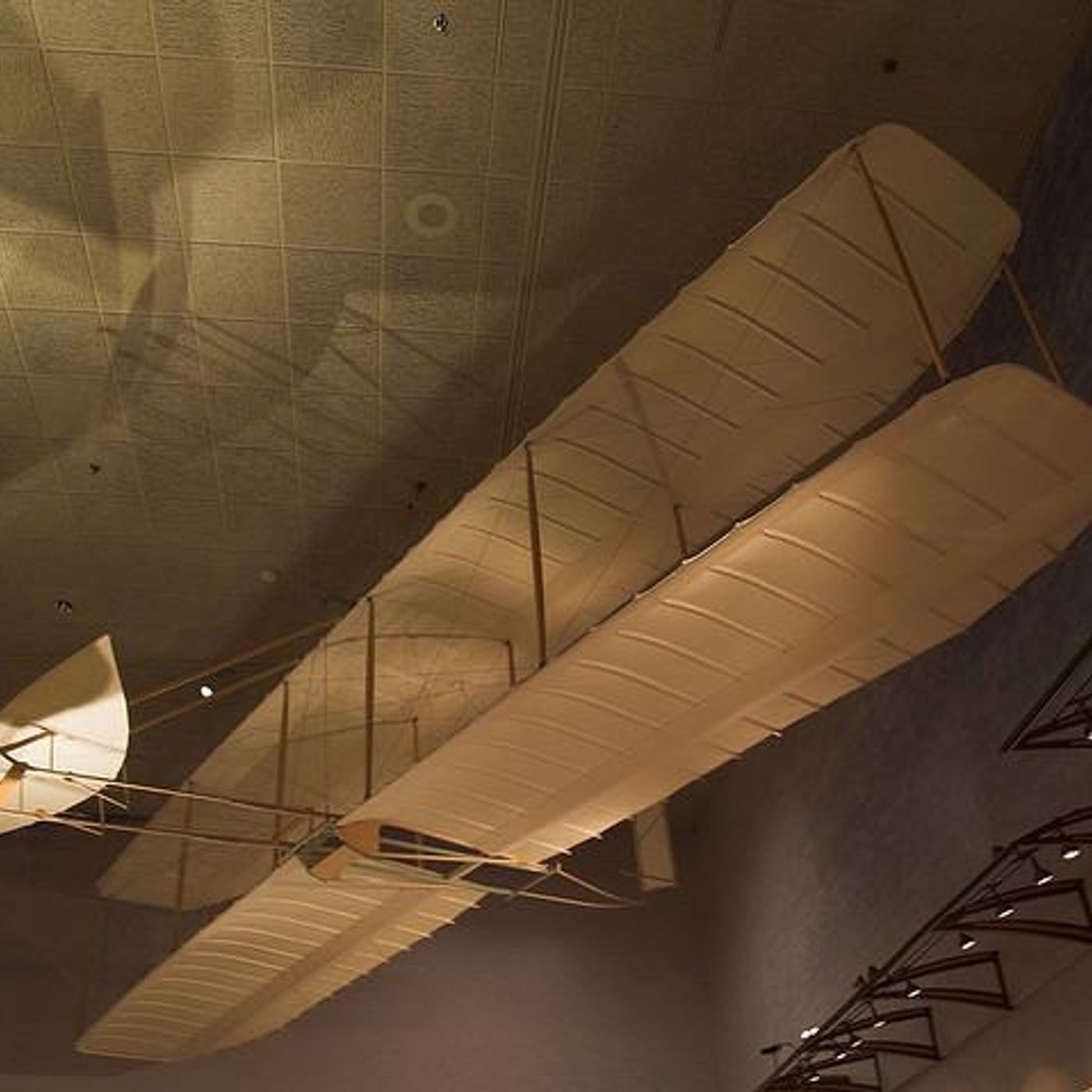
Radiolab
The Wright Brothers
00:10:00
104 years ago this week, Wilbur and Orville Wright managed to coax their spruce biplane off the North Carolina sand for twelve seconds, and those twelve seconds started a revolution in flight. We examine the human desire to fly, and how getting flight changed us.
Loading summary
Transcript65 lines
- [00:00]
Dr. Horton Advertiser
Your new home is now ready. Dr. Horton, America's builder has new homes that are ready today. With new construction communities in Ellensburg and throughout the Greater Seattle area. Dr. Horton has the right home for you. At Dr. Horton, we're still building with flexible living spaces, smart home technology and two and three car garages. More communities and more homes available every day. Find your new home in Ellensburg now ready@dr. Horton.com Dr. Horton, America's builder and equal housing opportunity Builder.
- [00:34]
State Farm Advertiser
If your small business is booming and ready to expand, you might say something like it's happening.
- [00:42]
Radiolab Host (Jad Abumrad)
Crushed it.
- [00:43]
State Farm Advertiser
But if you need someone who can actually help protect your growing business, just say, like a good neighbor, State Farm. He's there. And just like that, your State Farm agent can help you get the coverage you need for your new space for your small business insurance needs. Like a good neighbor, State Farm is there.
- [01:03]
Lowe's Advertiser
Lowe's early Black Friday deals are going fast. Don't miss up to 50% off. Select major appliances. Plus up to an extra 25% off when you bundle. Select major appliances. And with Christmas around the corner, you're gonna need more string lights, right? Save $4 on GE LED 100 count string lights now just $5.98 LOWES we help you save. Valid through 12. 3. Selection varies by location. Select locations only. Wall lowe's.com for more details.
- [01:35]
Radiolab Narrator
You're listening to Radio the Podcast from.
- [01:38]
New York Public Radio, Public Radio, WNYC.
- [01:44]
Radiolab Host (Jad Abumrad)
And npr. This is Radiolab. I'm Jad. Welcome to the podcast. This week we've got an event to commemorate. 104 years ago, on a coldish, blustery day in North Carolina, on the beach, two brothers figured out how to get a plane off the ground. And because of this, we can now take vacations in faraway places. We can overnight packages to one another. But the interesting thing is, if you go back in time and you look at that moment, you realize it was not inevitable. It didn't have to be that way. I suppose that's true with any moment in history, but in this one in particular, I'll just give you an example. A German guy by the name of Otto Lilienthal. He would have been the first had it not been for a Sunday in 1896, he tried to take off in his plane. It soared for a beat and then nose dived and crashed. He broke his back. And story goes, his dying words were sacrifices must be made. In this story, you're going to hear a lot of voices from the Smithsonian National Air and Space Museum. A couple of Experts, some authors, and as it turns out, the great grand niece of Wilbur and Orville. Here it is.
- [03:05]
Radiolab Narrator
There is something about being airborne, sort of an ethereal thing about it, about leaving this earth.
- [03:11]
Radiolab Host (Jad Abumrad)
Bang.
- [03:12]
Radiolab Narrator
You burst out on top of a field of clouds and it's freedom. Gorgeous, bright sunlight.
- [03:16]
Control.
- [03:17]
It's beautiful.
- [03:18]
Flight control. What is such a deeply held dream, perhaps even innate flying. Flying in my aeroplane.
- [03:28]
It's interesting to see how early the Wright brothers became interested in flight.
- [03:32]
In 1878, when Wilbur is 11 and Orville is 7, their father comes back from another church trip.
- [03:39]
Their father was a bishop and he's.
- [03:41]
Brought a present for them. Someday when we own our own little helicopter. It's a little helicopter toy.
- [03:49]
It was a little propeller.
- [03:51]
You know, you wind it up and let it go.
- [03:53]
And the boys played with this?
- [03:55]
Yeah, they played and played with it.
- [03:56]
And that broke pretty quickly until they broke it. And instead of going on to the next toy, I guess as most kids would, these guys began building their own.
- [04:05]
Versions, experimenting, making their own designs.
- [04:10]
Look, an airplane is going to be a complex machine that's made up of three systems, four forces. Gonna have to have wings, aerodynamic lift that'll lift you into the air, thrust, propulsion that will move you forward fast.
- [04:22]
Enough, you have aerodynamic drag resistance.
- [04:24]
And you're gonna have to have a way to control this thing once it's in the air. Now, flight control was the one issue that almost nobody else had given any serious thought to.
- [04:36]
Many of the folks that were also looking at this problem were looking at thrust and power.
- [04:40]
Most sort of fell back on the fact, well, if we just get a light enough engine, then we can fly.
- [04:44]
And the Wright right out of the bag do just the opposite.
- [04:47]
The Wright brothers were far more sophisticated.
- [04:49]
Powered flight or anything like that, that could come later.
- [04:52]
They decide to design and build a heavier than air flying machine that can be absolutely controlled by the pilot every second it's in the air.
- [05:05]
Control was the most important aspect of this.
- [05:12]
They watched birds, they studied them a.
- [05:14]
Lot, the shapes of their wings, how.
- [05:17]
In a turn, a bird would elevate a wing and dip the other wing.
- [05:21]
Increase the angle of attack on one side and decrease it on the other.
- [05:25]
They were trying to find out, you know, how could we do that in a machine?
- [05:29]
Uncle Will, he literally. It is a true story. He was literally holding an inner tube box.
- [05:34]
Wilbur was in the bike shop and he started moving the sides of the box, twisting it back and forth in opposite direction.
- [05:44]
And he realized that that was it.
- [05:48]
That's how you're going to achieve flight control. Come take a trip in my airship Come take a trip round the stars. And in the final version, the pilot's laying prone on the lower wing with his waist in a cradle. And he shifts his weight to the right or left and that drags wire through the system and puts a twist in the wing. Come take a trip and my airship will visit the man in the moon.
- [06:25]
John Alvedi (Senior Curator at Franklin Institute)
We're up on the fourth level of the Franklin Institute, and we have a storage area here. This is a photograph, maybe the most recognizable photograph of the 20th century, showing the first flight on December 17, 1903. They're basically at the shoreline. And you can see the ocean in the background here, see the waves being picked up here.
- [06:58]
Radiolab Narrator
A beautiful, cold, crisp, clear day. A lot of wind.
- [07:04]
John Alvedi (Senior Curator at Franklin Institute)
And the reason why they're in North Carolina is because of the great winds.
- [07:08]
Radiolab Narrator
10:35 in the morning. They set out their little rail that they run the Wright Flyer along. A little $4 set of timber that they used as a launching mechanism.
- [07:18]
A little bit like a sled.
- [07:19]
John Alvedi (Senior Curator at Franklin Institute)
There are no wheels to this plane.
- [07:21]
Radiolab Narrator
And they sent up their flag, which was assigned to the folks at the life saving station to come and help them set the airplane on the track.
- [07:31]
They looked the airplane over very carefully, as they did on every flight that they ever did.
- [07:35]
They'd flipped a coin and it was Orville's turn.
- [07:38]
Orville got on board. Before that, they had had a moment of silence where they shook hands.
- [07:42]
Then they started the engines. And this little airplane of muslin and bicycle chains and spruce rumbled down the track and took off.
- [08:01]
As it launches, a second miracle occurs. The man designated to snap the shutter on the camera does so precisely at the point that Orville breaks ground and is flying.
- [08:12]
John Alvedi (Senior Curator at Franklin Institute)
You can see it's maybe three or four feet off the ground. And here is Wilbur over on the right, running alongside of the uncle.
- [08:20]
Radiolab Narrator
Will ran along the right edge of one wing and held its steady. Helps steady it a bit. And you can see his tracks in the sand. In the famous picture, Orville had only.
- [08:31]
Flown 120ft in 12 seconds. But on the last flight, the fourth flight, Wilbur flies 852ft in 59 seconds. He's in the air almost a minute.
- [08:51]
Well, they changed the world forever. I can't think of anything that is, until the computer brought our world closer.
- [09:02]
We went from determining distance in the miles between two places to determining it in hours.
- [09:11]
It was a vast accelerator of progress. Had they failed on December 17 and quit flying, flying would probably have been postponed by 10 years, because at that moment in time, the wrights were fully 10 years ahead of everybody. Now, that 10 years doesn't sound like a great deal until you factor In August of 1914, World War I began. The French had about 140 airplanes. The British had about 180 airplanes. The Germans had about 250 airplanes. They all had air forces. That wouldn't have happened had the rights not flown on that day at that moment.
- [09:44]
But when you step back from that, even in a normal year, 10 million people will walk through the doors of the National Air and Space Museum. That's more people than go to the British Museum or the Louvre. They walk through the front door of that museum and there's the world's first airplane, the real thing. And hanging right above it is The Spirit of St. Louis, the first airplane to fly faster than sound. The capsule in which John Glenn became the first American to orbit the Earth. People just look around and they say, wow. Before Wilbur and Orville, you really did hear ordinary people on the street say, if God had wanted us to fly, he would have given us wings. After them. What you hear people say is, if we can do that, if human beings can do that, what can't we do?
- [10:38]
The future is whatever anyone can dream.
- [10:49]
Radiolab Host (Jad Abumrad)
104 years ago this week, the birth of flying. That piece featured the voices of Tom Crouch, who is the director of the National Air and Space Museum. Walter Boyne, who's the former director of the National Air and Space Museum. Dr. Jane palace, an aeronautical engineer and leader of the Write Again Project. John Alvedi, the senior curator at the Franklin Institute, he's the guy who had the picture. And Amanda Reit Lane, who's the great grand niece of Wilbur and Orville. Right, that's it for this week. Radiolab is funded in part by the Alfred P. Sloan foundation, the Corporation for Public Broadcasting, and the National Science Foundation. I'm Jad Abumrad. Thanks for listening.
- [11:34]
National Forest Foundation Announcer
Radiolab is supported by the National Forest Foundation, a nonprofit transforming America's love of nature into action for our forests. Did you know that national forests provide clean drinking water to 1 in 3Americans? And when forests struggle, so do we. The National Forest foundation creates lasting impact by restoring forests and watersheds, strengthening wildfire resilience, and expanding recreation access for all. Last year, they planted 5.3 million trees and led over 300 projects to protect nature and communities nationwide. Learn more@nationalforests.org Radiolab.