← Radiolab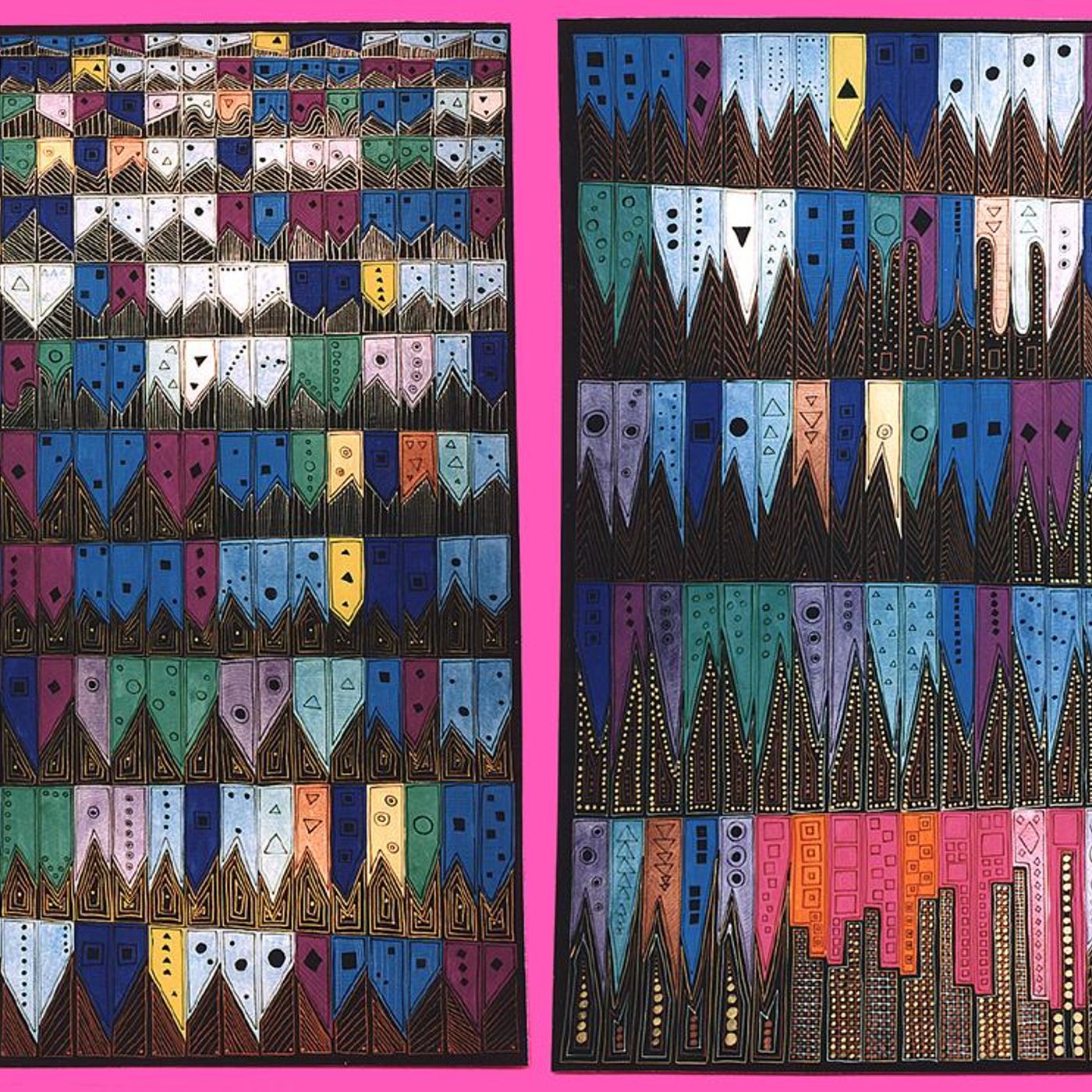
Radiolab
Unraveling Bolero
00:27:13
This week, we're throwing it back to an old favorite: a story about obsession, creativity, and a strange symmetry between a biologist and a composer that revolves around one famously repetitive piece of music. Anne Adams was a brilliant biologist. But when her son Alex was in a bad car accident, she decided to stay home to help him recover. And then, rather suddenly, she decided to quit science altogether and become a full-time artist. After that, her husband Robert Adams tells us, she just painted and painted and painted. First houses and buildings, then a series of paintings involving strawberries, and then ... "Bolero." At some point, Anne became obsessed with Maurice Ravel's famous composition and decided to put an elaborate visual rendition of the song to canvas. She called it "Unraveling Bolero." But at the time, she had no idea that both she and Ravel would themselves unravel shortly after their experiences with this odd piece of music. Arbie Orenstein tells us what happened...
Loading summary
Transcript205 lines
- [00:00]
A
When it comes to gifting, everyone on your list deserves something special. Luckily, Marshall's buyers travel far and wide, hustling for great deals on amazing gifts so you don't have to. That means your mom gets that cashmere sweater, your best friend that Italian leather bag, your co workers unwrap their favorite beauty brands, and your nephews the coolest new toys. Go ahead. At prices this good, you can grab something for yourself too. Marshalls. We get the deals. You gift the good stuff. Shop now@marshalls.com or find a store near you.
- [00:32]
B
Hi, I'm Robert Krulwich. Radiolab is supported by Audible. As we explore this story of obsession, creativity and symmetry, check out this is yous Brain on Music, both a cutting edge study and a tribute to the beauty of music. Go to audible.com radiolab or text RADIOLAB to 500500 for a free 330 day trial and a free audiobook. Hi, I'm Robert Krulwich. Radiolab is supported by Casper. As we continue this episode on creativity and symmetry, check out the Casper or the Wave mattress with a support system that mirrors your body shape. Get $50 towards select mattresses by visiting Casper.com Radiolab and using code Radiolab at checkout. Terms and conditions apply.
- [01:20]
C
This is Jad. Before we start, I would like to let you know about a new podcast that is out there in the world that is aimed at. Drum roll please, kids. I must say I'm particularly excited about this because my kids just discovered podcasting. It's this thing that we can do together. This particular one, which is called this podcast Has Fleas, tells the story of a dog and a cat who live in the same house and have competing podcasts. Hi everybody.
- [01:50]
A
I'm Was. This is Dog Talk, a podcast by a dog.
- [01:54]
C
They both have podcasts. Everybody has podcasts these days. Why would pets be any different? Let me play your tease, a small soup song of what you can expect from the series. This is a moment when Waffles the dog walks into the mudroom.
- [02:05]
D
All right.
- [02:06]
A
We have arrived at the mudroom and.
- [02:07]
C
Discovers that she is not the only pet in the house with a podcast.
- [02:12]
A
Loyal listeners, the cat is sitting in his litter box. He has a microphone and headphones and a big electronic thingy with a lot of buttons on it. He is doing a podcast. Well, I don't care. Sure, it won't be any good.
- [02:33]
E
Cat lovers. This is live from the Litter Box and I am Jones the Cat coming at you with a show so hot it just might explode. Thanks to all you cat lovers who downloaded my hit new single, featured in last week's episode. Let's hear a little bit of it now.
- [02:48]
B
Wow.
- [02:50]
C
Are totally perfect.
- [02:52]
E
Are totally worthy of maximum respect.
- [02:56]
B
Respect.
- [02:57]
E
Who always lands on their feet? Who invented the nap? Who sometimes has bonus toes?
- [03:05]
C
Jay Farrow, Saturday Night Live alum, plays the cat. Emily Lynn plays the dog. Alec Baldwin plays a goldfish. If you have kids. If you don't, check it out. It's called this Podcast Has Fleas from WNYC Studios. You can get it wherever you get your podcasts.
- [03:19]
E
Hey, you're Pretty good, Chatty McDaddy.
- [03:22]
C
Thank you.
- [03:22]
E
And I gotta say, I just love your show. It's an inspiration. You sure you're not a cat?
- [03:28]
C
Yeah.
- [03:31]
B
Wait, you're listening.
- [03:31]
D
Okay.
- [03:33]
C
All right. Okay. All right.
- [03:37]
D
You're listening to Radiolab Radio Lab from wnyc.
- [03:48]
C
I'm Jad Abumrad.
- [03:49]
F
I'm Robert Krulowich.
- [03:50]
C
This is Radiolab. So, okay, so this one. This one, I think you weren't around for the first time.
- [03:56]
B
I wasn't.
- [03:57]
F
I was gone for it.
- [03:58]
B
But then I listened afterwards.
- [03:59]
C
You hate listened.
- [04:00]
F
I hate listened.
- [04:01]
B
Exactly.
- [04:01]
F
I hate listened. And then, as is often the case, I sort of reluctantly became a, like, listener.
- [04:08]
C
Aw, that's the nicest thing you've ever said to me. No, so this one is a. It's, you know me, I'm a music nerd. Right you are. This is a story about the weirdness of creativity and a piece of music that, frankly, I had to study in school, but which unites two people across space and time in a really bizarre way. It's a kind of rhyme. First story begins in the 1980s in Vancouver, British Columbia, with a woman named Ann Adams, who by all accounts, was a brilliant cell biologist.
- [04:44]
D
Oh, yes, Anne was highly articulate.
- [04:47]
C
That's her husband, Robert Adams, you know.
- [04:48]
D
Extremely capable with language. She did cancer research. She actually developed a cell line that I believe still exists. So she was very sharp.
- [04:59]
C
He says that as a scientist, she was a natural. But then, rather suddenly, at the age of 46, Anne kind of did a 180.
- [05:08]
D
Something happened in 86 which changed the course of her life.
- [05:12]
C
It all started when their third son, Alex, gets into a really bad car accident.
- [05:16]
D
And we were told that he would probably never, ever walk again.
- [05:20]
C
Ann decides she's going to take some time off to help him recover. And he does. He does learn to walk again. But while at home, she just decides to quit. To quit science and become a painter.
- [05:31]
D
Yeah, Ann made up her mind then and There that she was going to take up art full time.
- [05:37]
C
Had she ever painted before?
- [05:38]
D
Well, she did a fair amount of it when she was in high school.
- [05:43]
C
Which was a very long time ago. So the whole thing struck him as kind of out of the blue, but he rolled with it. And within a short period of time, she had converted a room in their house into a studio.
- [05:52]
D
And she was painting houses and buildings, little churches.
- [05:56]
C
Simple at first.
- [05:57]
D
Then after that, brightly colored versions of what you see when you look down the barrel of a microscope.
- [06:04]
C
You know, cells, bacteria.
- [06:05]
D
After that, strawberries.
- [06:07]
C
A series of paintings involving these blazing red strawberries.
- [06:11]
D
For instance, a water faucet. And out of it would be coming a stream of strawberries. There was things called Strawberry Universe, where the strawberries had rings around them like Saturn and so on. And I think there were something like 35 or 36 strawberry paintings.
- [06:27]
C
Wow.
- [06:27]
D
But then she would switch to something else.
- [06:29]
C
Even after their son had fully recovered.
- [06:31]
D
Even threw away his crutches and went.
- [06:33]
C
Back to school and kept on painting.
- [06:36]
D
And she would work all day long.
- [06:38]
C
10 hours a day, making these paintings as it got bigger and bigger and more abstract. And there were times, he says, when he was like, wow. Because for someone who hadn't painted since high school, she was suddenly so prolific.
- [06:55]
D
And it's entirely possible that something was happening to her even then, way below the surface.
- [07:02]
C
I mean, on the surface, she was just painting and it was working. People were buying the painting, she was having solo shows. She was becoming a successful artist. But then in 1994, she decided, I.
- [07:13]
D
Don'T know what gave her this idea. I never knew what gave her any of her ideas. But she decided she was going to.
- [07:20]
C
Do a painting of, well, this.
- [07:28]
D
Bolero.
- [07:28]
C
Bolero, yes.
- [07:29]
D
Yeah, bolero.
- [07:31]
C
Robert says he's not quite sure how it happened, but at some point that year, Anne heard this famous piece by Maurice Ravel, became obsessed, couldn't stop listening to it, then playing it on the piano, then deconstructing it, mapping every pitch in the melody in the bass to a color.
- [07:48]
D
Here's one page which isn't very long.
- [07:51]
C
This is from her notes.
- [07:52]
D
She's got a silver, A flat copper, B leaf green, B flat, metallic green.
- [07:59]
C
Eventually, the painting was quite a large work.
- [08:01]
D
Two panels, side by side, very electric colors.
- [08:05]
C
A blizzard of symbols and triangles. Little tooth type things with marks on them that all mean something. And rectangles marching back and forth across the first panel.
- [08:15]
D
There was a triangle in the bottom of each one of the rectangles and the height of the rectangle represented the loudness.
- [08:23]
C
It's an incredibly obsessive translation of the music into visual language. And just like the melody in Bolero, the symbols repeat and repeat and repeat obsessively, getting bigger and bigger and bigger until at the very end of the second panel, Things unravel.
- [08:42]
D
By the way, her title for the painting was Unraveling Bolero.
- [08:48]
C
And that unraveling, turns out, had happened before.
- [08:51]
F
When we come back, we're going to. We're going to explain what we mean by a rhyme. Won't have to explain it, it'll just rhyme.
- [09:01]
G
Hello, this is Emily Villani from Austin, Texas. Radiolab is supported in part by the Alfred P. Sloan foundation, enhancing public understanding of science and technology in the modern world. More information about Sloan@www.sloan.org.
- [09:19]
B
Hi, I'm Robert Krulwich. Radiolab is supported by Audible. As we explore this story of obsession, creativity, and a strange symmetry between a biologist and a composer, check out this is yous Brain on the Science of a Human Obsession, available on Audible. Both a cutting edge study and a tribute to the beauty of music itself, this is yous Brain on Music unravels a host of mysteries that affect everything from pop cult to our understanding of human nature. Go to audible.com radiolab or text RADIOLAB to 500500 for a free 30 day trial and a free audiobook. Hi, I'm Robert Krulwich. Radiolab is supported by Casper. As we continue listening to this unraveling Bolero episode on creativity and symmetry, check out the Wave mattress with a premium support system that mirrors your body shape, or the Casper, with a breathable design and supportive memory. Fo get your Casper mattress delivered to your door in a small how do they do that Size box. You can be sure of your purchase with Casper's 100 Night Risk Free Sleep on It trial. Right now, get $50 towards select mattresses by visiting Casper.com Radiolab and using code Radiolab at checkout. Terms and conditions apply.
- [10:40]
C
Chad. Robert, Radiolab, Getting back to our story, we heard Ann's story about painting the strawberries and then painting the painting of that piece of music.
- [10:48]
B
Now we're going to tell you a.
- [10:49]
C
Different story, different time, different place, different.
- [10:51]
F
Person, but strangely rhymed.
- [10:57]
C
Yeah, Story number two. Well, okay. Should we jump in?
- [11:04]
H
Yeah, please.
- [11:05]
C
This is Arby Orenstein, professor of Music.
- [11:07]
H
At the Aaron Copland School of Music at Queens College.
- [11:10]
C
He's written about Ravel, performed Ravel, talk to anyone who ever knew Ravel.
- [11:14]
H
He kind of is A, what shall I say? A kind of a living presence inside my head.
- [11:19]
C
So, okay, Maurice Ravel is a composer, obviously one of the greats.
- [11:22]
H
Born in 1875. Papa was an engineer, mother was from an old Basque family.
- [11:29]
C
As in she was Spanish. Yes, which is why some of his music, like Bolero, does sound a bit Spanish. In any case, mom encourages him to study music. He goes off to Paris in the 1890s, meets Claude Debussy, and together they sort of invent this style of music which we now call Impressionism, which was.
- [11:45]
H
This kind of free floating, almost dreamlike, sensuous, a lot of colors, very flowery. Yes.
- [11:58]
C
But then, like Anne Ravel makes a kind of shift. 1928, when he was 53, about the same age Anne was when she did the painting.
- [12:06]
H
Ravel is having an absolutely phenomenal year.
- [12:09]
C
Just toured the United States, performed for thousands.
- [12:11]
H
He's at the zenith of his creativity.
- [12:13]
C
And he's back in France at a.
- [12:15]
H
Beach house wearing a pink bathing suit.
- [12:20]
C
And story goes, right before he steps out onto the beach, this melody swoops into his head. He runs over to the piano, takes.
- [12:27]
H
His index finger and he goes, dun, dun, dun, dun dun, dun, dun, dun, dun, dun, dun. There it was.
- [12:34]
C
It just came to him fully formed.
- [12:36]
H
Well, he. I don't know if he played the whole melody, but he at least started it off.
- [12:41]
C
But here's the shift. When he sat down to flesh the whole thing out, instead of developing the melody, making it super flowery like his other stuff, decided, no, I'm not gonna do that. I'm gonna take this melody and repeat it again and again and again, and then again some more, and then some more.
- [12:59]
H
The theme never changes one note.
- [13:02]
C
The only thing that does change is the orchestration, which grows around the melody very slowly, bit by bit, it gets.
- [13:09]
H
Bigger, bigger, more accompaniment, more instruments, play the melody.
- [13:16]
C
The melody itself for 340 bar never varies to the point he says, we're the performers.
- [13:28]
H
They're ready to see a psychiatrist by the time they're done playing this piece and revel at the first performance in Paris, some woman screamed out, he's crazy.
- [13:40]
C
Which turned out to be, well, not exactly true, but in the neighborhood. Six years after he wrote Bolero, this is 1933, Ravel begins to forget words he'd always been forgetful, so no one really noticed at first. But then one day at dinner, he grabs the knife by the wrong side.
- [13:58]
H
And he doesn't realize it.
- [13:59]
C
And he continues to try to eat.
- [14:00]
H
Holding the sharp side of the knife and Trying to cut with the handle.
- [14:05]
C
Then he visits a friend, leaves.
- [14:07]
H
Not two hours go by. Knock on the door, it's Ravel again. He didn't remember that he'd been there.
- [14:13]
C
Before, just two hours earlier.
- [14:15]
H
Eventually, by 1935, he could not write.
- [14:19]
C
Anymore or speak his language had evaporated. Darby says there are documents where you can see Ravel desperately trying to relearn the Alphabet.
- [14:27]
H
A, A, A, A. Over and over again.
- [14:32]
D
Wow.
- [14:33]
H
B, B. With a kind of a shaking hand, very small. It's very, very painful to see.
- [14:47]
D
Whatever it was that was wrong was getting worse.
- [14:51]
C
Here's the weird symmetry. Just like Ravel. Six years after finishing her Bolero, by 2000, I would say, Ann also begins to forget words.
- [15:00]
D
She would try to say things and couldn't. She would try to find words and couldn't.
- [15:07]
G
So how are you today?
- [15:09]
C
Fine. Eventually, Ann ends up at the University of California, San Francisco, and this was.
- [15:15]
D
In 2002, and they gave her a bunch of tests.
- [15:18]
G
Can you tell me your full name, please? I'm Teresa Adams.
- [15:24]
C
There's a video of one of these tests, and in it you can see Ann sitting at a table in a black sweater, gray hair, glasses, very composed.
- [15:32]
G
And can you tell me your address?
- [15:35]
C
Like someone who's used to knowing the answers to questions people ask her for.
- [15:47]
G
23. Which town? Which town? Vancouver.
- [16:00]
C
Great.
- [16:02]
I
By the time Ann had come to see us, her communication abilities were markedly diminished.
- [16:07]
C
That's Dr. Bruce Miller. He's a neurologist. He runs the Memory and Aging center at ucsf.
- [16:12]
I
Example we asked her to describe.
- [16:15]
G
Okay, and I'd like you to take a look at this picture.
- [16:18]
I
A very complex, rich picture with. Take your time, children, with a kite, with a sailboat on the ocean.
- [16:25]
G
And please tell me what you see. And if you can, please try to speak in sentences.
- [16:32]
I
Anne would be able to say single words with no grammar. She'd go, sailboat, tree boy.
- [16:44]
D
Water, people, kite, kite, flag.
- [16:51]
I
And that four or five words would come out over about a minute's time. She was very frustrated.
- [17:01]
C
Both Ann Adams and Maurice Ravel were unraveling in the exact same way, at the exact same speed, to the same soundtrack, you might say, but just roughly 60 years apart.
- [17:11]
I
We think he and Ann, down to the very molecular process, had the exact same disease.
- [17:17]
C
And he thinks bolero, the music and then the painting in both their cases, was the first symptom of that disease. This takes a couple steps to explain. Bear with me. But to start, the disease is called frontotemporal dementia. And it begins when certain cells in your frontal cortex, which is sort of above your forehead, begin to wither away, in some cases literally leaving holes in your frontal cortex. And we know this about Anne from tests and brain scans. We suspect it about Ravel, because according to Arby, just before he died on December 28, 1937, a French surgeon opened up his skull and saw that one.
- [17:56]
H
Of the lobes of the two lobes.
- [17:58]
C
Of the brain had sunk because it was disintegrating. Now, in both of their cases, the part of their brain, the part of their cortex got hit was on the left. This is a part of the brain that does a lot of things, has a lot to do with memory. But most importantly for our story, this is the part of your brain that largely governs language. And what you see is that people who suffer from frontotemporal dementia, they lose their words. They can no longer string words together. And here's the thing about losing something like language, it has all kinds of other effects in the brain. Because according to Bruce, you know, our brain is a series of interconnected circuits. And when in a normal brain, a dominant circuit like language turns on, it is basically wired to turn a bunch of other circuits off. It basically goes shh. To other parts of the brain.
- [18:51]
I
We have this constant dance where one circuit or many circuits turn on and then they're obligatorily turning off other circuits.
- [19:00]
C
So language acts as a kind of brake on other things the brain can be doing, like daydreaming, thinking in pictures. But when the language is no longer there to hold things back, often what happens is that those other parts, like, say, the visual parts can rush forward and suddenly the mind is just flooded with images. And you hear reports of people having these intensely visual experiences. They. They've just got to express.
- [19:26]
I
This is very common. We see a number of patients who become visually obsessed.
- [19:30]
C
He says he sees, you know, investment bankers who've never shown any interest in.
- [19:34]
I
Art, never even walked into an art museum.
- [19:36]
C
All of a sudden they decide in their 50s, well, I'm going to move into a loft, take up painting.
- [19:40]
I
That's right.
- [19:41]
C
How many of these cases have you seen?
- [19:43]
I
50, 60. Some of them have sculpted, some of them have painted.
- [19:47]
C
He says he's seen people take up gardening, graphic design. And what so many of the cases have in common is that the sort of visual creativity that bursts forth, it's not the free flowing kind. It's very mechanical.
- [19:59]
I
The repetition, the obsession, they get stuck.
- [20:02]
C
In a kind of loop, taking one visual idea and doing it again. And Again and again, like an Ann Adams painting or bolero.
- [20:13]
I
This drive to repeat happens very early in the course of this illness.
- [20:18]
C
So he says what can seem like a simple creative choice to repeat a melody may actually be driven by a condition that you won't even know you have for six years.
- [20:27]
I
We think that this had something to do with the very unusual, rhythmic, repetitive sorts of music that Ravel produced.
- [20:37]
C
I asked Bruce, so why the repetition? Where does that come from?
- [20:43]
I
And I think this is a release of.
- [20:46]
C
He said, we don't really know. But he offered up a theory which I find fascinating, which may get to the root of creative obsession of any kind. He says there might be several parts of the brain that are held back by the language circuit, and one of them is this very ancient part of.
- [21:05]
I
The brain, the basal ganglia, the part of the brain we move with.
- [21:08]
C
You can call it our reptile brain. This is the part of us that governs basic behaviors like eating, running, motor.
- [21:15]
I
Programs that we do repetitively every day.
- [21:19]
C
That's all it does. It sends commands saying, move, move, eat, eat, run, run. Birds and snakes get by with basically just this part of the brain keeps them alive. Now, normally, he thinks the language part.
- [21:31]
I
Of us inhibits these habits, these repetitive motor programs.
- [21:35]
C
But when the language part of the brain is not there to do the shushing, these motor commands filter up, too. So imagine you're one of these people. Your mind is flooded with all of these images, maybe sounds. It's also flooded with all of these kinetic, repetitive instructions. Move, move, move. Do it again. And in the early stages of the illness, you still have enough brain to make sense of it all.
- [21:58]
I
There's still a lot of cortex that is still available to act upon this desire to repeat.
- [22:04]
C
And so you get art that is obsessive and repetitive, but also beautiful, an abstract like Anne's painting unraveling bolero. But then, Bruce says, as the disease progresses and more of that sort of cortex y humany part fades away, the.
- [22:18]
I
Repetition becomes much simpler.
- [22:23]
C
In the latter stages of a disease, he says, you'll often see patients pouring.
- [22:27]
I
Water into a cup a hundred times in a day, squishing ants over and over again. The complexity of the behaviors are diminishing as we're losing these parts of the brain that make us.
- [22:39]
C
This is sort of what you see in Anne's work. Her paintings start off simple, explode into abstraction, and then get simple again. But what's unusual compared to the other patients is that she kept painting almost all the way to the end until.
- [22:52]
D
Literally, it was not possible for her to hold and direct a brush or a pen.
- [22:59]
C
That's her husband Robert. Again.
- [23:00]
I
Ann became progressively paralyzed on the right side of her body.
- [23:04]
D
She lost the ability to paint 2005 early. And that. That. That was sad.
- [23:16]
C
Towards the end, he says he would go into her studio, and I would.
- [23:19]
D
See her there in front of a blank canvas, and she wouldn't be doing anything. She would just be looking at it. And I'd come back a couple of hours later, and she still wouldn't have done anything. She had lost the ability to do the art.
- [23:36]
C
And that, to me, is one of the, I dare say, beautiful parts of Ann's story, that the drive to create is as primal as anything else in the body. That even after she couldn't eat, after she could barely swallow, she still sat there in her studio trying to paint.
- [23:54]
D
She had gone downhill so far by that time that she was hardly recognizable as herself.
- [24:07]
C
At some point in the disease. And you can see that in this early tape, painting was really all she had.
- [24:14]
G
I don't have the memories of this.
- [24:20]
C
It was basically all she was.
- [24:23]
G
Can you tell me what your job is, or are you still working? I do art.
- [24:31]
C
Great. She died in 2007.
- [24:37]
D
Yes, in January of 2007.
- [24:44]
C
Almost exactly 60 years after Maurice Ravel. Thanks to robert adams, bruce miller at the university of california, san francisco, and rb orenstein at queens college.
- [25:19]
F
Well, that's a song that's not. That's.
- [25:20]
C
That's.
- [25:21]
F
That's. That's a piece that is not gonna stay the same.
- [25:24]
C
Mm.
- [25:25]
D
Mm.
- [25:25]
C
It's funny. I used to think of Bolero as, like, a happy, jaunty tune. Now I'm like, oh, it's kind of haunted.
- [25:31]
F
It's an interesting sort of paradox that this. This thing ends on. She sits in front of her canvas, ferociously stalled, both of them. It's the ferocious part that creativity comes from a kind of restlessness, and the restlessness may be one of the things that leaves last.
- [25:56]
C
Yeah. All right. Speaking of leaving, we should go. Thanks for listening.
- [26:20]
J
Hi, this is Mitch Leto from Kalamazoo, Michigan. Radiolab was created by Jad Abumrad and is produced by Soren Wheeler. Dylan Keefe is our director of sound design. Maria Matassar Padilla is our managing director. Our staff includes Simon Adler, Maggie Bartolomeo, Becca Bressler, Rachel Cusick, David Gable, Bethel Hobte, Tracy Hunt, Matt Kielty, Robert Krulwich, Annie McEwen, Latif Nasser, Melissa O', Donnell, Arianne Wack, Pat Walters, and Molly Webster, with help from Amanda Arancik, Shima Olei, Jake Arlo and Reed Canaan. Our fact checker is Michelle Harris.
- [27:02]
B
Hi, I'm Robert Krulwich. Radiolab is supported by Audible. Check out this is yous Brain on Music, both a cutting edge study and a tribute to the beauty of music. Go to audible.com radiolab or text RADIOLAB to 500500 for a free 30 day trial and a free audiobook. Hi, I'm Robert Krulwich. Radiolab is supported by Casper. Check out the Casper or the Wave Map mattress with a support system that mirrors your body shape. Get $50 towards select mattresses by visiting Casper.com Radiolab and using code Radiolab at checkout. Terms and conditions apply.