← Ranch It Up Radio Show & Podcast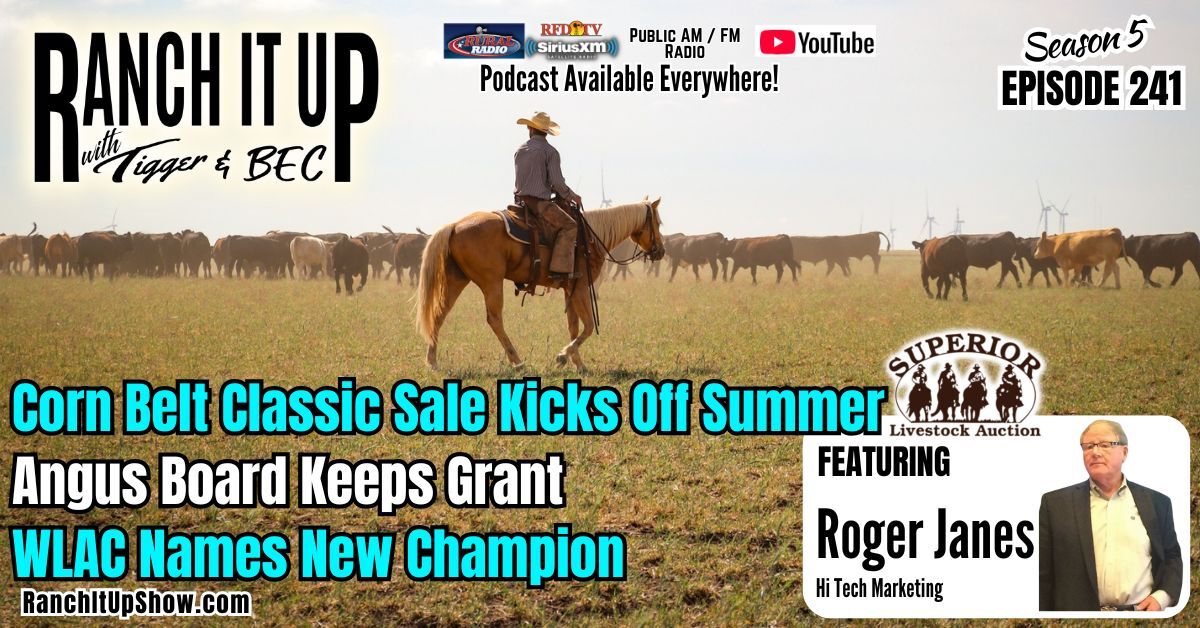
Ranch It Up Radio Show & Podcast
Corn Belt Classic Kicks Off Summer Sales, Angus Board Keeps Grant, WLAC Names New Champion
00:27:00
Loading summary
Transcript26 lines
- [00:02]
A
We are selling feeder cattle. The Corn Belt Classic from Superior Livestock is right around the corner. Crew, let's Ranch it up. Good day everyone and thanks for riding with us on this all new episode of the Ranch it up radio show. I'm Jeff Tigger Earhart. A big thank you goes out to our partners ranchchannel.com Wolf cattle Jorgensen Land and Cattle Superior Livestock Trans over Genetics Axio to Animal Health bringing us Multi Men in Lactopro the American Galva Association Imogene Ingredients Bringing Us Pharma 10 Westway Feed Products Medora Boot and Western Wear Allied Genetic Resources and Allied feeding partners livestock market.com equinemarket.com auction time.com the Tri State Livestock News, RFD TV Wrangler and this fine radio station, Cow Country News. You know the cow stuff. A quick update on the American Angus Association Association's acceptance of the $4.85 million grant from the Bezos Earth Fund, the Livestock Efficiency Research proposal, and a petition that was being circulated encouraging that the dollars be returned. Well before the petition closed, the Association's board voted to retain the funds. Now we have the link of the full statement from the American Angus association regarding this decision in the show notes@ranchitupshow.com for this episode. You can read that and check it out at your leisure. Now let's move on and talk about marketing those feeder cattle. But before we get into that, let's recognize an integral part to facilitate true price discovery, and that is the Livestock Auctioneer. Well, champions have been crowned once again. Let me tell you all about the World Livestock Auctioneering Contest held annually through the LMA, the Livestock Marketing Association. Now, in June of 1963, the Livestock Marketing association held the first annual World Livestock Auctioneering Championship. The purpose to spotlight North America's top livestock auctioneers to salute their traditionally important role in the competitive livestock marketing process. Auctioneers from the United States and Canada came to the Cosmopolitan hotel in Denver, Colorado to show off their auctioneering talent. 23 contestants sold the same 20 head of cattle over and over and over again. The contest was held at the hotels until 1967 when it traveled to its first LMA member market. Since then, the World Livestock Auctioneering Contest has been held at member markets around the United States and Canada. Recent locations include Missouri, Oklahoma, Texas, Utah, Virginia and West Virginia. The championship consists of three stages, the qualifying event, the semifinals and the finals held each June in conjunction with the LMA annual convention. Contestants competing for the World Championship title must be 18 years old, employed as a livestock auctioneer and Sponsored by a livestock auction or dealer business who share in the favorable publicity generated by the winners. And this year's champion from Rimby, Alberta, congratulations goes out to Dean Edge. Guaranteed open for you. 235, 236. Now, in addition to being named the 2025 World Livestock Champion, auctioneer Dean Edge received 6,000 DOL dollars in cash, a one year use of the world championship truck belt buckle, a leather briefcase, a bronze WLAC sculpture, a world championship ring, custom engraved original Henry rifle, a golden gavel award and a money clip. So again, congratulations goes out to champ Dean Edge from Rimby, Alberta. And next year it will be in Deadwood in Seine, South Dakota. Looking forward to it. We are going to be all over what feeder cattle sell for this summer. And k off the sales from Superior Livestock is the Corn Belt Classic held at South Sioux City, Nebraska. And joining us today to talk about the cattle selling is Roger James. Roger owns and operates High Tech Marketing and he's a rep for Superior Livestock. He's been in the business of buying and selling cattle for 46 years and been with Superior Livestock for 38 of those 46 years. Roger, thanks for coming back on the program with us. You've seen it all when it comes to buying and selling feeder cattle. Let's talk about the Corn Belt Classic coming up next week. How many cattle will be selling on the Corn Belt Classic from Superior Livestock? Let's start there.
- [05:11]
B
Actually it's a two day sale now. 105,000 cattle June 17th. We'll start out with region three, four and five, six feeder cattle and region one and two feeder cattle. And then we'll go into the dairy beef cross and go into Region 5 and then Region 3 on, on the, on the calves and then sell breadstock on the very first day. And then on the 18th, which is Wednesday, we will sell a region four cabs, region two cabs. That's the one that everyone pays attention to. That's those good Montana cabs that we put on every year. And so it's 105,000 cattle. It'll be a couple, couple of nice days and people are excited about the prices and people are excited to, I think, come to South Sioux City, my old stopping grounds.
- [06:00]
A
Well, how can we not be excited about the prices, right?
- [06:04]
B
So that's correct. But you know, ever since I was a little guy, you know, in my 50, in the 50s, my dad had always talk about parody and you know, everybody says, boy, this market's hot, this market's wild. But I tell you what, maybe this market is where it's supposed to be with, with the tractor tires, a thousand to $25 a piece and everything else. I think maybe we're just catching up. But, but I do, I do believe that part of the reason we're coming off, you know, some, some drought areas the last, you know, two or three years where people had a sell off and, and then they couldn't keep any, any heifers back because of the high price hay bill. So I, I think we got just as much beef on the market because these guys are making them bigger with the price of corn, which is about half of what it was two years ago, but it's still the cheapest thing on the market. When you think about a $2 bottle of water and you think about a $15 $1 boneless ribeye on the barbecue grill, that's pretty cheap eating.
- [07:07]
A
We need to take a quick break. When we come back, we're going to talk more of the corn belt classic from Superior livestock crew. You're listening to the ranch it up radio show and keep it parked.
- [07:17]
C
Are you looking for true price discovery for your feeder cattle? Look no further than Superior Livestock Auction. The next video sale is the week in the Rockies, July 7th through the 11th. But deadlines are coming up fast. Cattle need to be cataloged by June 20th, and the videos need to be submitted by June 27th. Again June 20th for the catalog and June 27th for the videos. Any questions? Reach out to your Superior livestock auction rep or call Superior livestock customer service at 800-422-2117. Selling cattle the superior way we run.
- [07:55]
A
A lot of high milk producing mama cows in our herd. Mitch Kenobi of Norfolk dealt with scours in his herd so bad that we sent samples off to South Dakota state and Kansas State. Heard about Farmatan? As a producer, I know it's our job to limit our inputs. But when it comes to Farmitan, dad and I don't blink an eye. It is a must for every calving season. Adding Farmitan to your livestock's nutrition this fall will rid your new herd of scours in the spring. Go to Farmitan. Call Joe Knop at 340-3323. Attention cattle producers. Boost your herd's trace mineral status with axiota Animal Health's Multimin 9D. This injectable solution delivers essential trace minerals known to support cattle health and reproduction. Don't settle for less when it comes to your herd health. Trust Axiota Animal Health to keep your cattle in prime condition. Visit your local Supplier or veterinarian to learn more about multi min 90. Multi min 90 because healthy cattle mean a healthy cattle battle. Welcome back to the Ranch it up radio show. The most information packed into a 30 minute program that you can find. It's your all things ranching newscast. And so glad to be hanging out with y'. All. Questions, comments, concerns, criticisms, rants, it doesn't matter. Give us a call or text. 707 Ranch 20. That's 707-726-2420. Our email, ranchituphowmail.com and prowling around social media at Ranch it Up show. We are back with Roger James with high tech marketing and he's also a rep for Superior Livestock Auction. We're talking about the upcoming corn belt classic, June 17th and 18th. The corn belt Classic kicks them off, right? I mean kind of the summer sale season for Superior.
- [09:41]
B
That's the first big one and usually and of course I started there at the CCD stockyards, I don't know, back in 1969 and was there 40 years till it closed in 2002. I've been with Superior for I think my 38th season now. So. But that's the one that starts, that's the one that everybody watches and it kind of sets the trend for the rest of the marketing season.
- [10:03]
A
So let's talk trends a little bit for the rest of the marketing season. Everybody, everybody asks you this, Roger, but maybe, maybe I should start this by saying how many cattle are you representing there that are going to be at the Corn Bell Classic?
- [10:16]
B
Oh, golly. I've got my biggest share of the cattle come out of Montana. I have about 7,000 of those. I got a partner in South Dakota, North Dakota, lives in Iowa. Reps in that North Dakota, South Dakota region probably have 3,4000. And I've got some dairy beef cross cattle out of Iowa. Six, seven loads of those. So I would say close to 10,000 head. Oh God. Quite 10 of sale. So yeah, good representation.
- [10:43]
A
What are you kind of you thinking is gonna, is gonna happen this summer? I everybody 7,000 head from Montana you were talking about. They all ask you that. What are you kind of watching going forward through the summer? Do you feel like these markets have a lot of strength to them or do you feel like these markets have a lot of emotion to them? Because emotion can be a very dangerous thing when it comes in this marketing game. You know that it is.
- [11:08]
B
And you're exactly right. What, what I have seen, this is the first time in 46 years where I've Seen the cattle feeder and the rancher make money and also the back runner at the same time. Usually you're robbing Peter to pay Paul where, you know, a couple years the ranchers in the positive side and then the next year he's on the downside. This year since, I don't know, I, since golly, December, January of this year, we're, you know, everybody's kind of making money. So it's, it's a good thing. And as far as the trend, as long as corn, I, I look at probably three things. I look at the April fat cattle futures. I look at the new crop, our old crop, September corn, which is just about 20, 20 cents above the support level in December, which would be the new crop corn, which is about 25% over the support level. So there these guys are going to feed them, they've made money. And it's just like everything else, you, you go right back to where you, where you made the money.
- [12:14]
A
Now when we look at the other side of this and I'm just going to kind of pick on pairs a little bit. I've been really watching what pairs have been going for. You have too. And I mean, it has been incredible what pairs are going for, you know, ringing the bell, some of them at 5,000 bucks. And then as soon as I report on that, somebody sends me a message and says, oh no, at my barn here and here, they sold for this. So when I start looking at those pear prices and if we are in a rebuilding phase of our cow herd and I gotta lay into some of these pairs or say I want to pick up some of these really good replacement heifers that are going to be on superior because there's going to be a lot of, lots of them too that can fit into a lot of programs. And I'm starting to look at these prices. You, you know where I'm going with this, Roger? I mean, there's always two sides of a coin. I mean, if you're, if you're selling your loving life right now, but if you've restock, you're trying to figure out how you're going to, you know, pencil these things out.
- [13:12]
B
Well, I think for the most part the average rancher is probably retaining his numbers. I don't think he's growing that much. I think the emotion of the market, some of these guys are buying some of these breathable type heifers on the commercial side to think they'll work. But again, you know, I would say, you know, you've seen maybe, you know, Somebody needs three or four heifers to put in these herd. You can get up to 48 to 5,000 for the most part. They're at averaging from 38 to 4,000 mo. And you take a. A calf weighing 500 pounds, bringing $2,000, you gotta. You got half of that investment back in the first year. And over. What do you call armorization? Over? You know, I think a heifer is seven years and a cow is five years. It's still a pretty good bet.
- [14:00]
A
And, you know, really where I'm going with this is a guy just, just exactly what you did, Roger. You need to go through your own numbers with that. And I mean, you need to figure out what your own costs are and of course, your own kind of financial plan. But, you know, there's always those two sides of the coin that everybody looks at not. And I got to bring up those topics. So let's talk a little bit about program cattle. Are you seeing demand for, for program cattle? I know that's kind of a general umbrella, but for specific kinds of cattle that if they're under this management, if they've used this vaccination protocol, are you seeing premiums? Well, I guess I shouldn't say that because the Classic hasn't been here yet. But. But are you. Are you kind of looking that there could be potential premiums to be made for those types of cattle, NHTSA or something like that?
- [14:51]
B
I think that that's been a niche market ever since it was developed. But as, as the demand grows for that type of beef, you know, the premiums are increasingly all the time. But when you get the, the level of the feeder prices at this level, it's a little hard to get any more out of it, you know what I'm saying? So we may see kind of a leveling off on the, on the program cattle, but that has grown in the last year. The dairy beef cross cattle has grown in the last few years. So.
- [15:22]
A
Right.
- [15:23]
B
I think the first thing they're looking for when they invest in a, you know, $22 to $2,400 ball and calf, he's looking for a healthy calf that's got all the vaccination protocols that you can offer. Number one, they don't want one to lay down and have a loss. So that's the first thing they look at. So there'll be a premium if they're very well vaccinated. You know, like I say, from the 24, 34, 34 plus back 45 to back 60. What I'm saying, that's the first thing they look for is number one. Number two, they look at the quality of the cattle and the efficiency in that deal that they convert. Every pound of grain they put in that animal is most efficient that they can. And then the genetic side of the thing, what kind of grid can I get back if the market is, say, too well, in Yankton, South Dakota the other day, I think the non implanted cattle was 248 to 253, with an average probably around 230. Those cattle have got to continue to perform. And the genetics is what these Montana cattle have. And the cattle that Superior represents for the most part has got that genetic capability to get some grit back to that feeder who's looking for a premium on top of that cash bid that he will receive when he markets them.
- [16:43]
A
So guys have, if they have questions, maybe they haven't sold on Superior before, because you know this about me, Roger. I believe in people having options and having a number of different, you know, arrows in your quiver, tools in your toolbox, what you want to throw on the darn thing. So, guys, maybe if they haven't sold on Superior before, what would you say? Encourage them to, you know, find their local rep, get a hold of you, or, you know, or you can help get in contact with somebody and just start those conversations, you know, because after the Corn Belt Classic, you know, it's going to be a big run and it's going to be tight in terms of deadlines, and I'm going to make sure I share all those of deadlines when they need to be cataloged and when the videos need to be in and all that. But is that your recommendation is just get on the phone, call somebody, Right?
- [17:31]
B
Absolutely right. You need to, you know, first of all, you have, you have a program. You're a cow calf producer, you got a program. You're either in the Angus breed or the crossbreed or whatever. You have a program, okay? So you need a vaccination program to keep those cattle healthy. You also need a marketing program to merchandise those animals. You know what I'm saying? So, yes, the demand is there. And that's another thing we haven't talked about is the demand for this beef. And you know, it's reasonable. You know, I, I was the first time I go into a Hy Vee or Hy Vee or a Heb or a Costco or whatever, I look at the price of those boneless rib eyes, and at 15 to $16 a pound, that is the most reasonable product you can buy. To feed your family.
- [18:18]
A
The corn belt classic June 17th and 18th from superior livestock Auction. The Week in the Rockies sale is coming up July 7th through the 11th. Catalog deadline is June 20th. The video deadline is June 27th. Head to superior livestock.com if you have questions. It is time for a quick break. When we come back we talk the numbers. We talk hay and cattle for sale and lots more of the cow stuff right here on the Ranch It Up Radio show Galvi and Balancer Producers Seed stock and Commercial add genetic technology from the American Galvie Association. They provide genetic tools to both seed stock and commercial producers. From being a part of the world's largest genetic evaluation and providing some of the most accurate EPDs in the industry to offering a wide variety of DNA tests, the AGA delivers its members and customers tools for success within the beef industry. Head to galvi.org for more information from the American Galvie Association. Livestockmarket.com we hear from the crew@livestockmarket.com every week. Bulls, cows, bred heifers, open replacement heifer, heifers, cow calf, pears, feeders and stalkers. Horses, pigs, goats, sheep, showstock, hay and straw and even alpacas all listed on livestockmarket.com private treaty, online auctions and on site auctions. Buying or selling. Gauge the market. Do some research. Check out livestock market.com and don't forget they brought you auction time.com and equinemarket.com looking for the best way to raise beef whether on pasture, crop residue or in a dry lot? Choose Westway Feed Products. Westway Feed Products boost forage utilization, efficiency and sustainability. Find your nearest rep by calling 800-875-17 or visit westwayfeed.com stay connected with the crew from Westway Feed Products on Facebook, Instagram, LinkedIn and TikTok. Call 800-875-17 or go to westwayfeed.com today. Welcome back to the Ranch it Up radio show. That time in the program we check in with Kirk Donsbach, Stonex Financial Incorporated. Recap of the markets from last week. Kirk numbers what do you got for us this week buddy?
- [20:36]
D
Good morning Tigger and all your listeners out there. As of Friday, June 6th, August feeders closed the week at 310. That's up $11.32 and a half cents on the week with the CME feeder index up $6.86 at 306.16 I left the basis at a negative $3.84. That is fairly normalized with that much time left in August. June like cattle closed the week at 226.025. That's up 1055 on the week with cash starting the week trading in the south at 225 and then ending the week at 235. In the north they traded 240 to 244. That left the five area weighted average up $5.63 at 234.16 and the basis versus June futures that positive $8.70 thirteen and a half cents. June expires June 30th, so futures or cash definitely have some work to do before expiration. Choice boxes were down $1.26 on the week at 365.08. That is the one concerning point of this week's report. Weekly slaughter was 582,000 head. That's up 105,000 head from last week which was a holiday shortened week and 20,000 head below the same week. Last year. Dress weights were steady at 872 pounds which is 25 pounds higher than this week last year. The combination of higher till weights and lower slaughter numbers has yearly production at 2.8% less than this week last year. To wrap this up, September corn closed at $4.33. That's up 10 cents on the week. The charts look very corrective.
- [22:10]
E
Hey all Mark Van Zie with LivestockMarket.com coming up this Wednesday, June 18th we have an all class cattle and hay online auction. Bidding opens at just $100 a head. No reserves. All lots will sell. This week's Featured lot is 20 Angus, Red Angus, Charolais and Hereford cows. They're four to seven years old, 1200 pounds. They're five to seven months. Bred to Black Angus and Charolais bulls from Rafter LF Cattle Company in El Dorado Springs, Missouri. Featured haylots include 170 large round brome bales selling on 534 bale lots. It's 4x5 net wrap from Agrivision Asset Management in Newton, Kansas. 200 small square alfalfa bales selling on 825 bale lots. First cutting poly twine it was cut pre bloom. There's lots of leaves, nice tight heavy bales. It was put up dry and there's loading and Delivery available from RR Equipment in Milford, Nebraska. 104 small square alfalfa bales selling on four 26 bale lots. This is wire tie first cutting 60 pounds stored inside no rain from Cobes Auction in David City, Nebraska and 80 small square prairie grass bales selling on four 20 bale lots this is also wire tied from Cove's Auctions. Bidding is currently live, but all lots will sell the morning of Wednesday, June 18th at 10am Central Time. Do you got cattle to sell? Regular online cattle auctions first and third Wednesday of every month with hay sales every Wednesday on livestockmarket.com and auctiontime.com what.
- [23:37]
F
Causes bulls to fail breeding soundness exams even though they were good last year hey hey. I'm Shay Wanner and I host the Casual Cattle Conversations podcast. Jennifer Kozol and I had a conversation about how to set bulls up for success. Here's a small portion of our conversation. Sperm morphology is the most common reason that a bull will fail a breeding soundness exam. So we'll talk about reasons that the bull has abnormal sperm morphology. We can have abnormal thermoregulation. So the bull's testicle likes to be 3 to 5 degrees, 3 to 5 degrees Celsius lower than body temperature. So that needs a cooled environment for proper sperm production. The other thing is is that we can talk about stress. And stress comes in many different factors, but we can think about stress. Just like us, when we're stressed out, cortisol rises. But cortisol is an inhibitor of testosterone, so when we have high cortisol levels, testosterone is going to decrease, which means that our testicles are not going to function in appropriate manner. Stress can look like hierarchy stress like you got a young bull getting the crap beat out of him by an older bull. That's one stress, nutritional stress going through a blizzard. He's going to be nutritionally stressed and he's going to be environmentally stressed. So he's not only colder than he would like to be, but he's also also may have a decrease in nutrition if we're in the heart of that blizzard. The other kind of flip side of that is prolonged heat stress can be one as well. So stress can kind of come in lots of different flavors. Listen to the full story by searching for casual cattle conversations on your favorite podcast player. Happy Ranching folks.
- [25:25]
A
And now that's going to wrap it up for today. A big thanks goes out to our crew. Roger James with High Tech Marketing and Superior Livestock Kirk Donsbach, Stonex Financial Incorporated mark vanzie with livestockmarket.com and Shea Wanner with Casual Cattle Conversations. A big thank you goes out to our partners, ranch channel.com Wolf cattle, Jorgensen Landon Cattle, Superior Livestock, Trans Ova Genetics, Axiota Animal Health bringing us Multi Min and Lactopro the American Galvie Association Imogene Ingredients bringing us Farmatan Westway Feed Products, Medora Boot and Western Wear, Allied Genetic Resources and allied feeding partners livestockmarket.com equinemarket.com auction time.com the Tri State Livestock News RFD TV Wrangler and this fine radio station and crew. So glad you all came with us one more time as we Ranch it Up. Be sure to follow and like us on Facebook at Ranch It Up. Show our email ranch it upshowmail.com and you can can call and text us 24 7. That phone number is 707 Ranch 20. That's 707-726-2420. Spread the good word and join us again next week where it's always Tigger and Beck approved. Stay Ranchy and Ranch it Up.
- [26:52]
D
Sat.