← Ranch It Up Radio Show & Podcast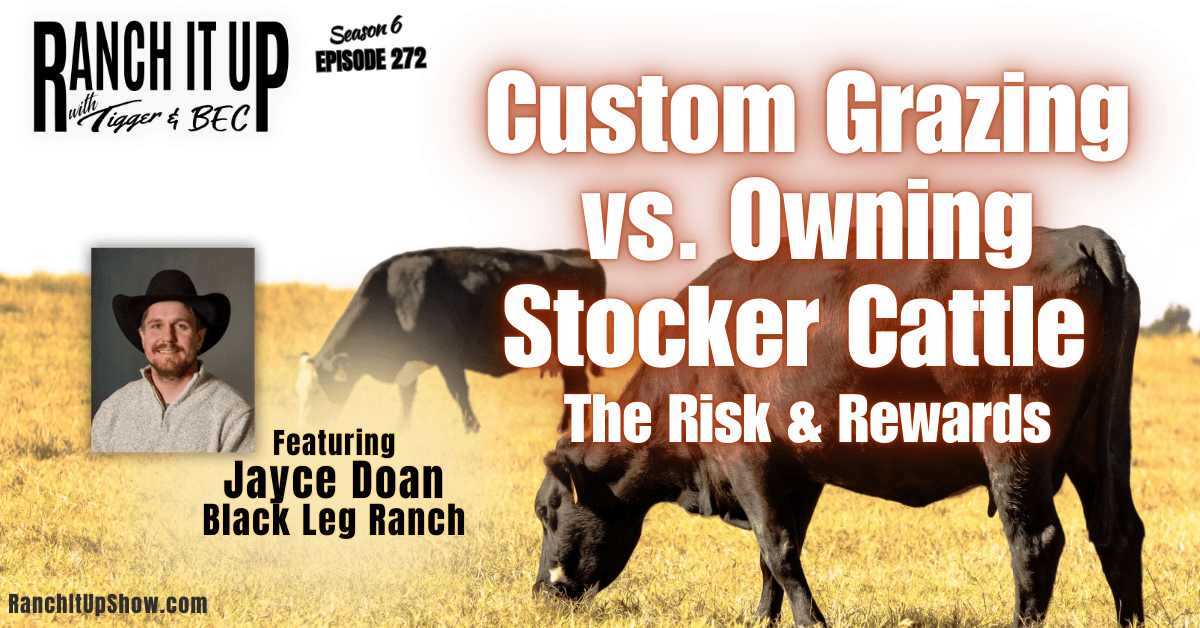
Loading summary
Transcript50 lines
- [00:02]
A
Diversifying your ranch income. Custom grazing versus grazing your own yearlings. Let's deep dive this one crew. Let's ranch it up. Good day everyone and thanks for riding with us on this all new episode of the Ranch it Up radio show. I'm Jeff Tigger Earhart. A big thank you goes out to our partners for today's episode. Ranchchannel.com the absolute premier listening service to find your next herd bull, commercial, heifers and the products. And you need head to ranch channel.com Ellingson Angus and their annual Real World Genetics production sale coming up February 7th at the ranch in St. Anthony, North Dakota. 1240 head will sell Ellingson Angus Pharmatan by Imogene ingredients reduce well heck pert near eliminate scours with Pharmatan Clear Springs Cattle company and their annual bread for balance sale Simmental and Simangus Genetics and at the ranch February 13th in Starbuck, Minnesota livestock market.com they brought you tractor, house and auction time. Check out their timed auctions along with all the listings of cattle, hay, horses, sheep, you name it. Livestock Market.com and the all new sales series found on Ranch Channel.com bringing you the stories behind the operations, the vision behind the genetics and the focus to elevate your herd. The all sales series Cattle Battle. Last week we brought you a great feature about winter grazing with Jace Doan of the Blackleg Ranch in McKenzie, North Dakota. In case you missed that episode, you can catch it by heading to ranchitupshow.com in the archives of past shows. Now Jase is back again today sharing more of how they utilize grass, soil, health, cattle resources. I'm talking to keep the ranch progressive, profitable and forward thinking. Talking custom grazing for customers versus grazing your own yearlings. The pros and cons Another potential enterprise in addition to the cow calf pairs. In fact, Beck and I have really looked at this option for the past few years.
- [02:22]
B
This may not be the time of the year that somebody should be considering that or does consider that. And I'm going to say it is exactly the time when somebody should be considering said strategy that because based on moisture that we do or we don't get could greatly alter our plants. So I think now is a great time to actually be strategizing about what could be done.
- [02:46]
C
No, I agree it's always better to be prepared early for the upcoming season. And I mean since we had such a tremendous fall and stuff, we're kind of ahead of the ahead of the curve as far as just moisture in the ground and everything. And it looks like this snowpack's gonna, I mean we keep getting moisture and stuff and so grass looks to be in really good growing condition for next year starting already.
- [03:14]
B
And so your outfit has had experience in both realms, grazing yearlings and custom grazing.
- [03:21]
C
Yeah, so we're still cow calf operation. I mean we still have our cow herd and calve out all them cows and stuff. But when I came back from college, dad is obviously older and stuff and kind of running himself ragged. And custom grazing has always been the risk free per se strategy of, of how to make everything work. And I thought we were leaving money on the table by not running our own yearlings or, or you know, whether that be more cows or whatever. I just thought that with custom grazing you're kind of at a set price and it is what it is, but there's no risk. But I thought that we were leaving money on the table and that was very apparent with like a year like this year where the market took off and I mean we made exponentially higher than we would have. Custom grazing.
- [04:10]
B
And that is kind of the danger right there. I was just going to say that, you know, custom grazing is a locked in price, right? It's, it's rent. It is what it is. It's going to be what it's going to be. And is that kind of how your program was, was set up in your experience that when people do custom grays and there's a million different ways a guy can skin a contract, right? I mean it doesn't matter, just like share cattle, there's all sorts of different ways. But is it basically you charge so much per head per day? End of discussion.
- [04:42]
C
Yeah, it is, but it is not a rental basis. You know, a rental basis, you collect your check, they bring the cows and you don't see them again until they load out in the fall. Whereas custom grazing, it's more easy to grasp the concept of like in a feedlot sense where you're custom feeding, you're out there every day, you're feeding them animals, you're, you're charging a daily rate and you're the one taking care of them. That's basically what custom grazing is for us. They bring the cattle to us and we're managing them all summer long versus a rental deal where you just collect the check and, and kind of turn a cold shoulder to them.
- [05:21]
B
So were you running both scenarios at the same time where you were running grass cattle and you were custom grazing?
- [05:28]
C
I guess we, we still are. I'm still custom grazing quite a few head of Cattle for some different outfits. And then for the last three years, I started buying all these yearlings. And on top of that, all we still have all the cows. So kind of three different scenarios, plus the buffalo. So four. Four scenarios.
- [05:47]
B
Well, I love the opportunity to be able to diverse and have different income streams is really what we're talking about here. Like you said, cow calf and running yearlings and custom grazing, because, you know, we've ran the numbers too, the last few years and woulda, shoulda, coulda, right? I mean, I mean, that's been the scenario where the risk versus reward, it comes down to an individual basis, is how much risk are we willing to put out there based on the price of those cattle? And what a lot of this comes down to is when we start talking about running grass cattle in the spring and we start penciling this thing out, it is really what type of or amount of risk are we willing to throw out there versus the amount of reward in terms of income that we could potentially receive? Is that kind of what it comes down to when you're running these grassers?
- [06:42]
C
It is. But if you have all your bases covered, there's a lot of ways to mitigate risk to where as long as you have a live animal to market at the end of the year, you shouldn't have any risk on the table. And so, like in my scenario, I work backwards. I figure out what my grass is going to cost me throughout the year, because even though we might own our land, that grass isn't free. There's an opportunity cost of what you could rent that out for or custom graze it out for or whatever. So I charge myself fair market value, probably above fair market value. And then, you know, if I'm throwing these animals in my own feedlot and feeding them, what that costs, what trucking costs, what shots cost, what insurance costs. And so say I have $500 in expenses and I can insure those animals through like an LRP program, livestock risk protection program, and they're going to be at minimum, kind of insured for like $2,300 ahead. Well, if I have 500 in expenses, I know that I can buy that animal for 1800 bucks. And you know, there's a few different factors. Obviously they need to gain to. To be able to add value and everything. But as long as you have a live, marketable animal at the end of the year, you should not have any risk because at the very minimum, you're going to break even while paying for your grass. That would have been a set Cost that had you rented that out or custom graze it out would have been the same exact cost. So you're not out anything. And if the market takes off like it did this year, then that's more money in your pocket. So to me it's a win win scenario.
- [08:29]
B
And when you say cover your bases, the bases in your opinion, was it the vaccination program, maybe there's some nutritional supplement out there, the trucking, the opportunity cost of having the grass, is that what you meant by covering your bases?
- [08:47]
C
I mean having some sort of risk protection. So whether that's puts LRP some sort of contract at a later date, that guarantee not necessarily even guarantees you because LRP doesn't guarantee you a price but it sets a floor at what that animal should be worth based on the feeder calf index. And so you should have some sort of a floor locked in price that hey, if the market crashes I'm not going to lose everything and I'll at the very minimum break even. That's what I mean by covering your bases. Just some sort of risk protection to where you're not hung out there to dry.
- [09:25]
B
So when you started working with LRPs and all of this makes makes sense to me and I guarantee it makes sense to everybody listening. But when you start throwing LRPs in there, why is it that sometimes people get a little nervous of that if.
- [09:37]
A
They haven't used it before?
- [09:39]
B
Have you noticed that, that some guys.
- [09:41]
A
Well, how does that work?
- [09:42]
B
I get a little nervous because they're, they're afraid all of a sudden. Just like on T shows where there's going to be a margin call and they got to pay a bunch of money or something like that. Is it just basic misunderstanding of how to use it and how it works?
- [09:56]
C
Yeah, I think so. I mean if you're having to pay margin calls that could become very detrimental for somebody. But LRP is just a set price that's government subsidized and so. And you pay it at a later date. So I mean it sets a floor based on a per head price. And I guess some people are probably just skeptical about how the whole system works but becoming well versed in that is really kind of an opportunity for your operation. And, and it doesn't even have to be with grass cattle. It can be for unborn calves.
- [10:34]
B
Absolutely.
- [10:36]
C
And whatever. So it's probably just yeah a little bit of obliviousness to, to how the program works. But since it's government subsidized it's very good because it's, it's a little bit cheaper than buying puts or anything like that. The one benefit of buying a put is you can get out of that contract. Whenever buying lrp, you bought it and you are stuck with that until it expires.
- [11:00]
A
Jase, just hold tight. We have some additional questions for you so let's take a break and the Ranch it Up radio show will be back after this.
- [11:09]
B
Crew.
- [11:10]
A
This is Jeff Tigger Earhart. Check this out. Coming in 2026, RanchChannel.com proudly launches the Sales Series, your inside track to the world of livestock and ranching excellence. From elite bulls, heifers and horses to the land and equipment, products and programs shaping the future of agriculture. We bring you the stories behind the operations, the vision behind the genetics and the focus that can elevate your herd. Whether you're building, expanding or fine tuning your ranch, dive deeper into the innovations and livestock programs changing the game. The Sales Series only on ranch channel.com where smart ranching starts.
- [11:53]
D
Hi, I'm Chase Keller. Little about farmertan products on my operation here I feed farmer tan products year round have for two or three years now and I have not had to treat a single calf for scours. Haven't lost the cap of scours. I believe fully in farmertan products and helping my profitability on my operation.
- [12:15]
A
For more information go to pharmatanusa.com get ready for the Ellingson Angus Real World Genetics Annual Production Sale. Join us Saturday, February 7th at the ranch in St. Anthony, North Dakota for an outstanding offering of 1,240 Angus bulls, heifers and cows. Check out this lineup. 355 yearling 18 month old bulls, 50 registered bred heifers, 600 commercial open heifers, 180 commercial bred heifers and 50 coming 3 year old cows all bred for calving. Ease growth and profit driven performance while maintaining longevity, disposition and efficiency. These cattle are ranch raised, data backed and ready to go to work for your program. Attend in person or bid online at DV Auction or Northern Livestock Video and and all sale information from videos to catalogs is available@ellingsonangus.com and ranch channel.com Ellingson Angus Real World Genetics welcome back to the Ranch It Up Radio Show. We're talking with Jace Doane from the Blackleg Ranch, Mackenzie, North Dakota. Custom grazing versus Grazing your own yearlings.
- [13:29]
B
I'm asking a lot of these questions for myself to add to my knowledge base here too.
- [13:34]
C
Sure.
- [13:35]
B
When you're managing those Kiev's, those grassers, are you running them on a hot wire?
- [13:42]
C
A lot of times I am. Yearlings are really easy to train on electric fence, but I despise electric fence with a passion. And I mean, it just. We have a lot of miles strung around and inevitably something's grounded out that you just cannot find. And so you're dealing with many, many miles of fence. You got to consistently go around, might not be hot enough. And once some cattle start getting out, then it's hard to get them trained to stay in.
- [14:08]
B
It is. Yeah. Yeah.
- [14:09]
C
If I could do everything with barbed wire, I would in a heartbeat. Now, electric fence is obviously way cheaper.
- [14:15]
B
And a lot of that grass management, to my knowledge, a lot of it is based on water, water positioning, how you can rotate those, those calves through pastures, if you can, the types of grasses that are out there at the type of year. If you're grazing, you know, early in the, in the spring versus very, very late into the fall, even into the winter. So is that correct that a lot of, you know, just how you're gonna move and try to put gain on those calves is, is just based on a lot of the environmental factors and it's a learning as you're going, constant improving type of scenario?
- [14:55]
C
Yeah, for sure. And, and I mean, I'm by no means an expert at any of it, but trying to get average daily gains up is always a challenge. And if you can kind of understand what grasses are out there and what the animals are, are kind of needing or lacking at certain times of the year will definitely be beneficial. And I mean, my, my daily gains aren't where I think they should be, but we're trying to keep making leaps and bounds by that. And a lot of times we'll turn cattle into a pasture and it might have a bunch of cattails in there. And you're like, well, there's no way them, the animals are going to eat that, and that's the first thing they eat. And so, you know, it's. It's just kind of crazy if, if you can understand what, what plants are out there and what has the protein. And then obviously you're with hemming them down a little bit and intensively grazing, you're able to kind of force them to eat some things for the benefit of your grass, to, to improve the, your range, I guess, to improve the diversity of your range.
- [15:52]
B
Why would you look at implementing the custom grazing situation when we can talk about not leaving money on the table grazing yearlings, and we can talk about cell grazing our cow calf pears, and we can talk about different management practices to start cutting Those costs, right? Pushing that calving date back a little bit, watching our body condition scores, all of these wonderful management tools. So let me ask you this. Why then implement something like custom grazing?
- [16:23]
C
Basically, it's a road that if, if you're not comfortable taking some risk, or maybe you don't have the equity to take risks to put up as collateral or whatever, it's a good alternative for that, or you don't have time or you have a second job and you're trying to float, you know, different, different income streams and it's just quality, it comes back to quality of life. I guess custom grazing is probably the easiest solution for utilizing your grass, getting it, getting it eaten and still putting money in your pocket. So I mean, I don't discount custom grazing at all. It's just for me there's not a lot of pride, which cattlemen are all really prideful and it's probably to our fault. But if I look out on my land and I see a whole bunch of cattle that I don't own, they have somebody else's brand on. To me as a young kind of progressive producer that's, that's really excited and passionate about the industry, that doesn't give me a lot of pride, I guess, seeing somebody else's brand on those cattle. So I think custom grazing is just the best way to probably minimize, minimize your risk. Honestly, land rent would be the easiest solution because you just turn, somebody pays you and they, they run them cattle and that's that. But custom grazing, you're kind of the one managing them. So it's a little more work and it's maybe.
- [17:54]
B
Sorry, I don't mean to cut you off, but it's maybe managing something that is a little bit more conservative type of income stream.
- [18:02]
C
Yeah, for sure, for sure. And like why we got into it was dad lost his hired man of probably 30 years. He had died and dad was old and my other, my older brothers were off at college and weren't around to help. And so what's the easiest way to. And we didn't have the cow numbers ourselves and dad didn't want to bite off more than he could chew with, with buying grass cattle or whatever. Or maybe he wasn't interested that time, but custom grazing just looked like the easiest way for, to minimize your risk to create income and create a better quality of life.
- [18:38]
A
Jason with the Blackleg Ranch, from winter grazing to custom grazing to owning your own yearlings, the Blackleg Ranch continues to find ways to maximize profit and pounds per acre. If you have questions for Jase and you want to hear more details, reach out to us anytime by calling or texting the hotline or 707-726-2420. That's 707-Ranch 20 in the email ranchituphowmail.com and now here's the news making the headlines. Texas Agriculture Commissioner Sid Miller on Tuesday warned livestock producers to remain villagent after Mexican authorities confirmed a new case of New world screwworm about 215 miles south of the Texas border. The case involves a seven year old bovine and marks the third active screwworm case reported in that area. Mexican officials said the animal had no known history of movement outside of that particular area. Miller urges ranchers, particularly those along the Texas border, to inspect livestock daily and closely monitor open wounds. The Texas Department of Agriculture said it is coordinating with the USDA and Animal Health Partners and is asking producers statewide to report any suspected screwworm infestations without delay. For more information and updates on New World Screwworm, it is available at screwworm.gov and on a global scale, Brazil overtook the United States as the world's largest beef producer in 2025. That according to market estimates, after output surged well above earlier forecasts and helped ease tight global supplies that had pushed meat prices higher. Brazil was already the world's top beef exporter, shipping nearly $17 billion worth of beef in 2025. That's based on government trade data. While official production figures are not due until February, analysts have steadily raised their estimates as Brazilian producers sent more cattle to slaughter to capitalize on strong export demand from markets including China and the United States, where domestic beef supplies have been constrained. If certain estimates are confirmed, 2025 would mark the first year Brazil surpassed US beef production. Crew, you're listening to the Ranch it Up radio show and it is time for a quick break. When we come back, we've got the market numbers and data and more of the cow stuff as always. So keep it parked and we'll be back right after this.
- [21:09]
E
Ranchchannel.com I'll give you just a few seconds to head there on your phone ranch channel.com your farm and ranch network on demand bull sales, Western events, product information right at your fingertips on the ultimate cowboy friendly platform. Want to follow up to date markets ranchchannel.com no need to dig for information on all these different websites. It's all right there on ranchchannel.com y' all are loving it now, aren't you?
- [21:37]
F
Attention cattlemen seeking profit driven genetics that help your bottom line. This is Travis Wolfe from Bred for balance Starbuck Minnesota. You are invited to our annual sale February 13th, 1pm at the ranch selling 130 Simmental and Simangus bulls and 65 females. There's a three year breeding soundness warranty on the bulls. To view or request a catalog, visit breadforbalance.com and bid online at DV Auctions. Hope to see you February 13th in Starbuck, Minnesota.
- [22:05]
G
If you're buying or selling cattle, make your first stop. Livestockmarket.com Bred cows, heifers, pears, bulls and frozen genetics. Even feeder calves. You'll find them all@livestockmarket.com Livestock Market features private treaty sales, online auctions and live production sale bidding. You'll also find horses, sheep, goats and hay. Check out the free Livestock Market magazine wherever you pick up Tractor House House and download the Livestock Market mobile app today.
- [22:41]
A
Welcome back everyone to the Ranch it up radio show. It is that time in the program we check in with Kirk Don's box, Stonex Financial Incorporated. So Kirk, recapping numbers from last week, what do you got for us buddy?
- [22:52]
H
Well good morning Tigger, all your listeners out there. As of Friday, January 9th March feeder futures close the week at 354.55. That's down $1.47 and a half on the week. For the chart watchers out there. They will note that that was a weekly reversal. So started at a price, went higher and closed below the opening on that Monday. The CME feeder index was up 1768 on the week at 367.90. That's where we get all the historical new highs in the sale barns. Very high cash prices that left the basis at a positive 730 versus January futures. That is a little wide. So we either need cash to settle down to futures or futures to rally and close that basis up a little bit. February live cattle closed a week at 233.775. That's down 242 and a half on the week with cash trading 232 to 233 in all areas. The five area weighted average was up 99 cents at 231.42. That left the basis versus February futures at negative 235 and a half. Choice boxes were at 566 on the week at 355.63 with the choice select spread at 346. That's very concerning kind of indication of demand for the choice meat out there and 346 is a very low number. Weekly slaughter was 553,000 head. That's 79,000 head above last week, which was a holiday shortened week, and 38,000 head below the same week last year. Dress weights were down 2 pounds at 894. That's 12 pounds above the same week last year. Yearly production with the lower dress weights and the lower slaughter came in down six tenths of a percent at 5.2% this week last year.
- [24:37]
I
Want to know what really makes ranch employees stick around?
- [24:40]
C
Hey. Hey.
- [24:41]
I
I'm Shea Wanner and I host the Casual Cattle Conversations podcast. I recently visited with Kane Wellnitz about employee retention on ranches and in ag businesses in general. Here's a portion of our conversation.
- [24:54]
J
Ag people won't always tell you they're unhappy. We are really good at suffering. We are really good at working all day and not complaining. And that can be an issue, right? Especially as an employer. You're like, I need to know your problems. I need to know what's frustrating you. And so the biggest thing I've learned about hiring people is telling them that up front. Like, hey guys, you need to call me, get ahold of me if you don't like something, let me know that there's a problem. And that is honestly communication. You know, let's get on top of the problem before it becomes a problem where you want to leave. That's my biggest issue. It's really expensive to hire people. I would much rather keep people than have to hire more people.
- [25:34]
I
Ready to tune into the full conversation? Check out the casual Cattle Conversations podcast on your favorite podcast player as soon as you're done listening to the Ranch it Up radio show.
- [25:43]
A
And now that's going to wrap it up for today. A big thanks goes out to our crew. Jace Doane from the Black Leg Ranch, Kirk Donsbach, Stonex Financial Incorporated and Shay Wanner with casual cattle Conversations. A big tip of the hat goes out to our partners for Today's episode, ranch channel.com Ellingson Angus and their annual Real world genetics production sale Pharmatan by Imogene Ingredients Clear Springs Cattle Company bringing us the bread for balance sale livestock market.com and the all new sales series and crew. So glad you all came with us one more time as we ranch it up. Be sure to follow and like us on Facebook at Ranch it Up. Show our email ranchituphowmail.com and you can call and text 24. 7. That phone number is 707 Ranch 20. That's 707-772-6-2420. Spread the good word and join us again next week where it's always Tigger and Beck approved. Stay ranchy and ranch it up.