Loading summary
Transcript160 lines
- [00:00]
A
It's tax season, and at Lifelock, we know you're tired of numbers, but here's a big one you need to hear. Billions. That's the amount of money and refunds the IRS has flagged for possible identity fraud. Now here's another big number. 100 million. That's how many data points LifeLock monitors every second. If your identity is stolen, we'll fix it, Guaranteed. One last big number. Save up to 40% your first year. Visit lifelock.com podcast for the threats you can't control. Terms apply.
- [00:31]
B
I think we're starting up. I'll let you guys tell me what you see.
- [00:38]
C
I see Steven.
- [00:39]
B
Thank God.
- [00:41]
D
Gms.
- [00:43]
B
All right.
- [00:45]
E
Yeah.
- [00:46]
B
Victory is mine. Yeah, we have locals. How's YouTube looking? Let's see. I don't see anything on YouTube.
- [00:53]
E
YouTube is there.
- [00:54]
B
Oh, it is. Okay.
- [00:55]
E
I'm forgiven by believing in Jesus Christ Prize. Who died for me and rose again.
- [01:02]
B
All right, good. Welcome in, everybody.
- [01:04]
C
Welcome, Goldie. Welcome, sgv. Hi, Tom.
- [01:08]
B
You can see we have a foursome today. We have Jack Posobic joining us today. One of our.
- [01:16]
C
See us yet? They might. Do they see the.
- [01:18]
E
I don't think they see us.
- [01:20]
B
Oh, they just hear us so far.
- [01:21]
D
Well, I think the.
- [01:22]
C
The screenshot of Scott might be showing.
- [01:27]
E
Interesting.
- [01:29]
B
It's always fun. Let's see. Let me take a gander.
- [01:35]
D
Notice there's a. It says 12, 22, 24 for some reason.
- [01:41]
B
Oh, my God. I can't.
- [01:46]
E
It says Trump in Panama Canal. Did we take over?
- [01:50]
B
I redid all that anyway. Maybe I didn't hit save. I don't know. But can the locals see us or hear us?
- [01:58]
E
No.
- [01:59]
B
I'm gonna start over. Wait, let me hit play.
- [02:02]
C
I think they can hear us at least, but they. I think they're looking at Scott's head.
- [02:07]
B
Why? You guys, I'm gonna start over.
- [02:09]
E
Is your sharing of a clip.
- [02:12]
C
If you want to, like, stop sharing your screen, maybe we'd come back up.
- [02:16]
B
I'm. I am sharing a screen.
- [02:19]
C
Well, I'm assuming that's what the Rumble studio. There we go.
- [02:21]
E
There you go.
- [02:22]
B
Oh, my Lord. So now can they see?
- [02:24]
C
Yes.
- [02:25]
B
Yeah. You guys, day two. Day two.
- [02:28]
E
I mean, it takes time. It takes time for it, too.
- [02:32]
C
All right.
- [02:35]
B
Yeah. Yeah. All right. That being said, I think we have enough time to go right into the sip clip. So you guys grab your vessels. It's a good one. Here we go.
- [02:47]
F
Today we'll have a very special simultaneous sip. No, today will not be a normal simultaneous sip. It's a special one. So today we're going to have a simultaneous sip for our men and women in uniform who have protected us so well so far. And we're active in Iran, well, actually active in Iraq. And this time we're gonna drink to them. So this will be your very special simultaneous sip for the military as a thank you and show respect. Get ready. 1, 2, 3. Uh huh. Special military simultaneous sip. It was as good as I thought it would be. Quite good. Quite good.
- [03:36]
B
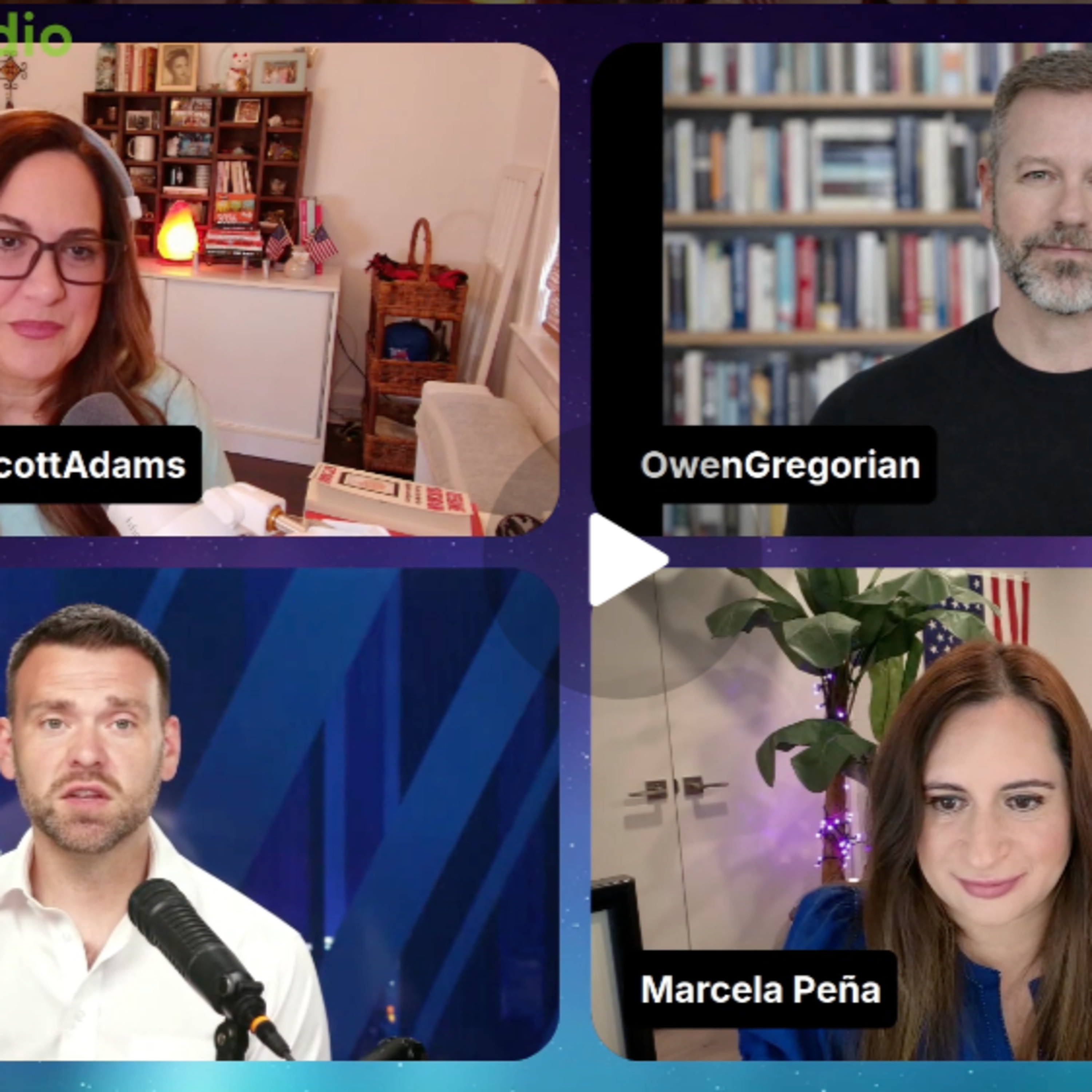
How fitting was that? Welcome to the Scott Adams School, everybody. I'm Erica and I want to introduce our special guest professor today. We have Jack Posobec in the house, one of our favorite people. Jack, we were talking before the show that we would love for you, for those that might not know you, if you could give some background about who you are and where they can find you. And that way they'll understand better your. Your presenting today.
- [04:10]
D
Wait, I know I will, but I just have to ask. He just said, he said Iran. How did. Was that? That was December. Was that what it was?
- [04:20]
B
No, ignore that one. That, that was a whole other thing. Yeah.
- [04:24]
E
Wow.
- [04:25]
D
I was, I was, I was listening because you mentioned before, you said you primed me, right? So you use priming. And you said there's a coincidental sip today. I said, okay, we'll be going with this. I grabbed my blackout coffee cup and then he said, we're active in Iran.
- [04:40]
B
And I'm like, I know, is that crazy?
- [04:45]
D
And then, but then he said, oh wait, I mean Iraq, but you know, it's that like Freudian. Or maybe he knew something. Maybe he knew something.
- [04:53]
B
Maybe.
- [04:53]
D
And then of course, I guess we did in June have the Iran issue.
- [04:57]
F
But.
- [04:57]
D
Wow, that was, that was probably wild,
- [05:00]
B
I don't know, seven or eight years ago, that one. I know, it was so random. It was just a coincidence.
- [05:06]
D
But. But yeah, so for my background, so yeah, you guys might have seen me with Turning Point USA or the show I do called Human Events Daily every day. And we run humanevents.com that's the old human Events magazine that we're bringing back for the digital age. And prior to all this, originally from the Philadelphia area and joined the United States Navy, served as a U.S. navy intelligence officer in places like East Asia and in Guantanamo Bay, and have been a lifelong fan of Dilbert from before I could even understood, understand, you know, what, what any of it was because I didn't know what office culture was. And then eventually I, you know, I guess in my, my twenties, like college era, when I finally got into you know, working in offices, internships, that kind of thing. And I said, and then, and I said, oh, this is what it's about. Got it right. And just been here ever since and always followed Scott back from the periscope days and 2015, 2016 even. Remember I was still in the intelligence community in 2015, 2016 and I would be on my break pulling up his blog even before he was doing the Periscope. So just kind of been a student ever since.
- [06:24]
B
And the whole Poso family, right. Would listen to Scott. And didn't you say at one point like a family?
- [06:31]
D
I'm sure some of them are probably listening and sipping right now. My mother, my father, Tanya, Tay, my brother Kevin, my kids, you know, when, you know, if they were around, if it was the weekend or something, I mean we were all. The whole Poso family would, would listen in and still does.
- [06:47]
B
We love the Poso family. Shout out to Tanya. You go girl. That is amazing. So listen, before we get into the whole nitty gritty, we, we are going to just start off with a story that we need to delve into because I don't believe it's true. Marcella, what you told me about flying cars.
- [07:07]
E
Yeah. So it turns out there's flying, there's electric air taxis that are about to take flight in 26 states. The Federal Aviation Administration approved eight pilot programs that will allow a handful of companies, including Archer Aviation, better technologies. Just very different startups for flying taxis. The three year program which will span 26 states for now is designed to ensure US companies lead the way in the next generation aircraft used for personal travel. The pilot program known as Advanced Air Mobility and Electric Vertical Takeoff and Landing integration Pilot program say that fast was announced last year by President Trump in an effort to speed development of the futuristic aircraft. So you're going to be able to take off Its Evtol eftol companies have emerged in recent years. You can do this. And I think the Secretary of Transportation posted this on X yesterday or two days ago and it's very Trump, very, very golden age.
- [08:28]
B
I like how it's a pilot program.
- [08:31]
D
It's a pilot pilot program. It's a pilot pilot program.
- [08:35]
E
Take your Uber. But over the air I think they're
- [08:39]
C
starting out with cargo and medical type stuff. But it looks like they are prepping. One of the companies says they're prepping for the LA Olympics in 28 and they're doing some stuff in the New York Port Authority and Texas. So depending on where you live, you might start seeing some flying Cars.
- [08:57]
D
Are these drones or are they, are they piloted passengers?
- [09:04]
E
Piloted aircraft. They look sort of between an aircraft and a helicopter. So they're very. The big.
- [09:14]
C
Yeah, it's basically. It probably looks like a really big drone. It has like the, you know, vertical takeoff and landing sort of thing and it's electric so it's not, you know, fuel. So that's probably the other big thing is that it's taking place with just electric power.
- [09:30]
B
Oh my Lord. What do you think, Jack? Are you getting in one of those?
- [09:34]
D
I want to know which cities are running the pilot program so I can try to avoid those cities for the remainder of the program. Look, I remember when the. So I would go out to Phoenix for. Yeah, I see it. It's a Dallas, Austin, San Antonio, Houston and the Port Authority of New York and New Jersey, so. But also 12 concepts across New England and we're also seeing something Louisiana, Mississippi, so down Gulf of America by the way. And you know, so it's quite, quite a few spots. It might be hard to avoid all that. But I'm just, I was gonna say that I remember when I would go out to Phoenix a lot for Turning Point usa and I know I still do and they were the first city I think outside of California to get the self driving taxis and the Waymos and boy, I did not trust those things and I just still don't. I really don't. No, not at all. You should and you should. Here's, here's what it is though. I think when you're in the city, they're actually not too bad because I've, I've seen them, you know, just kind of spotted them and this one time I remember I was really, I just had one of those nights like you know, when you travel sometime and you, you just have like a, like a dead night, you're just nothing's going on and you. But you have to be somewhere in the morning and I happen to be driving behind one of the Waymo. So I just kind of followed it for like, for like an hour. Just started driving around Phoenix to see what the Waymo would do. So I was monitoring the situation and this and it drove kind of like I would describe it to like a little old lady, like following a little old lady around town and you know, very timid, very, you know, stops for everything. Drive drove very slowly under, you know, under the speed limit in most cases or like just you know, kissing the speed limit. And that was in the city. However, there was something interesting that I noticed that outside of the City because once you get outside of Phoenix, it becomes desert very quickly. That's where it seemed to start to have problems because I guess when you're in the city, all the sensors that are around the these waymos and they've got sensors and viewers all over the thing, so it doesn't have blind spots the way that a human would, but it requires that sensory input. It's just sort of my view on it. And so it requires all that constant sensory input. But once you leave the city and you're surrounded by desert, you don't have, have any sensory input. And especially at night, you're losing a lot of that. And I'm, I'm sure it has some kind of a night vision capability, but the, the thing that I noticed is that it would bang u turns like right in the middle of the road and you know, not even at an intersection. And kind of almost like I had to slam on the brakes because I guess it got some pickup request immediately. This is a couple years ago, it may have gotten better, but I noticed became a little more erratic outside the city.
- [12:33]
E
So my brother, I do have to disclose my brother is the chief safety officer of Waymo, Marty Supina.
- [12:40]
D
Tell him my findings and I'll let
- [12:44]
E
him know your findings. But it's improved. So anything safety wise or Waymo is run by him. So I do believe in him quite a lot. He's PhD in aerospace and all sorts of things. But anyways, so I do have to disclose that. But in regards to how safe it is now, it's improved quite a lot, just like Tesla has. So. But test it out.
- [13:07]
C
You know, Marcel is also big on the full self driving. She's got a Tesla and she's putting it in Mad Max mode.
- [13:14]
D
Know that? Yeah, no, that was just, that was my view is that inside the city it seemed very, very safe. But that, and so if you were just going from point to point in the city, it was like, oh, this is fine, this is totally fine. But then I noticed that outside the city it got a little, it felt like it was a little looser.
- [13:30]
B
Right. Like all of us get on an open road. Yeah.
- [13:33]
E
He would tell you that it's taken time to get to a certain state, which at first they were not on the freeways to get to that level of confidence that they wanted because they don't want any accidents, anything like that.
- [13:49]
B
All right, so Jack, I have a quick question.
- [13:52]
D
I haven't, I've never heard of anyone, you know, having a big problem with them because I imagine if you did that, you know, it'd be all over the news.
- [13:58]
B
Yeah.
- [13:59]
E
Somebody said, I live in the future. I'm like, yes, you are.
- [14:02]
B
You're our future gal for sure. And I want to go back to the 80s, but whatever. So can I pivot for a second? Because I do want to get your Take, Jack, on what's been happening in New York City with Mom, dummy. With these protests, with these bombs and, you know, all of it. And I. So I used to go to the city all the time. It's not far from me, and I stopped going in a long time ago, and now it's just eroded so much more. I don't feel like it's safe. I don't know if you have any insight or any kind of news update you could give us. What's happening there.
- [14:45]
D
Well, what's been horrifying, at least to me, is hearing, you know, this story, because like I said, I'm from the Philadelphia area, and I guess these two. I guess we'll call them ISIS bombers, because that's what they were. Right? They were ISIS bombers and teenagers from. Not New York themselves, but they conducted this attempted bombing in New York outside Gracie Mansion. Clearly, Gracie Mansion is under some kind of targeting right now. Whether that's because people don't like Mandami or because they view him as a. As a supporting the war in Iran or something like that, I'm not exactly sure. But it's become this focal point for a lot of things that are going on. And these two jihadis out of Newtown, Pennsylvania, which drove over the bridge of George W. George Washington Bridge to conduct this attack. It's blowing my mind. Because if anyone knows anything about Newtown, Pennsylvania, I mean, this is like, I had a tweet up yesterday to try to find a way to use that visual persuasion that Scott would talk about to say, all right, I have this certain view of this area and the sense of it. But if I. If I talk about the square footage of the houses and I talk about the, you know, the. The idyllic scenery, it doesn't quite get there. And I said, you know what? This is like saying that there's an ISIS cell in Gilmore Girls, and, you know, you've got to pick something that's sort of a, you know, a target where people know that, okay, this is a suburban area. It's a women's show. It's something that just was so jarring that you can't. You almost don't want to be able to accept it. That triggers that sort of cognitive Dissonance. And that's exactly what it's like. So everyone in my family, you know, group chat, is sharing all these, you know, updates and images, and there was, I guess they had a storage facility, and the storage facility had some bombs in it or explosive material that the SWAT team and the bomb squad were going in and. And imploding, you know, to safely detonate. And it's just something that. It seems unbelievable because, again, you're talking about an area that's basically like the town in Gilmore Girls where, like, you know, you. You would come. You know, we're not from there. You know, my family was from, I guess, the other side of the tracks from. From Newtown. But, yeah, we did.
- [17:06]
C
We.
- [17:06]
D
We. We ended up okay.
- [17:07]
C
And.
- [17:08]
D
And because we. Listen to Scott.
- [17:09]
B
That's right.
- [17:10]
D
And the. The truth of the matter is, though, is that because, you know, we've had so many of these migrants from, I guess, these one families from Afghanistan, the other family is from Turkey, that you just have this element that's come in to places like that that are now willing to pledge allegiance to isis, even though they grew up in just in one of the best places in the entire country.
- [17:35]
B
Oh, yeah. It's horrifying. Oh, and did you want to jump on that story at all?
- [17:39]
C
Well, I mean, I think it is scary that, you know, these things could be anywhere, and places like Newtown probably don't have the same kind of law enforcement or capability to deal with things like that where they would be able to detect these things. Not that it would necessarily be easy anywhere, but, you know, it is kind of scary that these. I don't know if you want to call them sleeper cells, but, like, you know, potential sleeper cells could be just anywhere in the country, and you just never know where they're going to pop up. And then we had the other story recently with Toronto. I think the US Embassy got shot at in early in the morning, and fortunately, nobody was hurt. But they're starting to suspect that might be some kind of sleeper cell activity there, too. So it seems like it may be spreading.
- [18:21]
B
I think it is.
- [18:22]
D
I feel like. I feel like. I'd love to hear Scott's analysis of the phrase sleeper cell. Right. You know, because it's. Is that really the best name for it, a sleeper cell? Are they sleeping all this time or are they planning. They're much more of a. They're much more awake than asleep.
- [18:39]
B
They're lying in wait.
- [18:41]
C
I mean, on the one hand, I'm kind of surprised we haven't seen more of it. Because if there's any time where these sleeper cells would come awake and do what they're supposed to do, now seems like it would be the time. And you would almost seem like, it would almost seem like you would be seeing it all over the place right now. And so I, you know, on one hand, I'm kind of happy that, you know, maybe that means the FBI really has a lot of a good handle on things and they've already taken care of a lot of the threats and that they're able to prevent some of these things. But, you know, I'm still waiting to see what, what comes next because it just seems like the, the conflicts is still going on. And I, I have to imagine some of these people are still out there.
- [19:23]
E
You know, wasn't there a recent news story about Iran trying to talk to sleeper cells with the transponders, Radio transponders?
- [19:34]
C
Yeah, it's a, like a shortwave radio that they detected. And I don't know if they know what it is or if it is some kind of activation cell, but that was the speculation was that this shortwave radio, like mathematical code or something, was potentially some kind of activation signal.
- [19:52]
D
That was, that was. I'm just trying to put my Scott Adams hat on here. I think that's one of those stories that he would say I'm going to put low confidence on. That seems a little. Because it seems too on the nose. It's one of those things that just seems too on. You know what I mean? I, I don't know. It just, it's whenever I see these stories, I always kind of like in the back of my head, just, even when I'm, you know, prepping for my shows or if I'm doing hits on, on, you know, another network. I think, you know, I think what would Scott say about this? And it's, it's like I can't turn it off because he's just. Would do this every day. So you're going through something, you say, nope, two on the nose.
- [20:28]
C
I mean, I would tend to think you don't need a signal, right? Like everybody knows what's going on there.
- [20:35]
D
They know, you know, go, go do stuff, create mayhem, create chaos. And in fact, one of the things that we saw after, you know, we haven't gotten the, you know, the story yet, but they were saying that because the leadership in Iran was decapitated and lost their communications ability, that they had this plan on the books where the local commanders would, of the IRGC and these militias would just take, would just take Charge themselves. And so they were conducting attacks and they hit this Azerbaijani pipeline that I guess fueled Israel, and the oil was being used for the idf. And, and so, and then, you know, the president later came out, President of Iran later came out and said, hey, that wasn't approved by, by us. That was something that the local commander did. But, you know, the point being is that he didn't need to be told to do that. He just, he just went and did it because you sort of, you know what you have to do. That's, that's kind of the whole point of having a sleeper cell.
- [21:28]
B
Well, I, I want to say, speaking of Iran, we might as well get into Iran. Everyone's favorites subject not so. Okay, Jack, I need your help because I like many people that watch Scott's Scott Adam school, so I really ride the fence on everything I'm hearing about this war. So, you know, first I want to say I want us to win it no matter what, we're in it. I love our military. I love our country. I want only the best outcome. I want people to be safe. We've already lost service members. Many are injured. That's first and foremost. But I am very upset hearing about, obviously about this school that was hit with these young girls. It doesn't matter who hit it. I'm upset about it. The other night, everybody said, oh, Trump just made a speech. It's going to make you feel better. It'll reassure you it didn't. And a lot of the other of the other friends on here are also feeling like, you know, their MAGA supporters, they are absolutely his base. They are extremely turned off right now. They're not trusting in Trump and they're pivoting away. Not that like you maybe vote for a Democrat, but they are very unhappy. And I really feel like this is yet another thing that's splitting apart the base. And, you know, besides all the other BS that's been happening, but it's another thing splitting apart the base. I have not seen you be in favor of, you know, I don't see you going hard in one direction either. I mean, I feel like you're fairly measured on this whole thing also. But what can you say to us? Because, you know, maybe help me understand, like, if you were going to try to talk to me, I'm so unhappy about it. And I don't feel like I recognize this President Trump. He's unrecognizable to me. I don't feel like the things that he campaigned on or the things that I really thought were in his core are what he's doing now. I feel like there's too many Lindsey Graham's in his ear or Sean Hannity's in his ear or Netanyahu in his ear. You know, I'm just like, is this, you know, is this worth it for America? How far does it go? And I'm very jaded by the whole Iraq war, even though history doesn't repeat. But like, what are we doing? Tell me, tell me your thoughts so other people that feel like me can understand.
- [24:09]
D
Yeah, no, sure. And I totally, I totally agree with where you're coming from. I totally understand where you're coming from. I hear it all the time as well. We do. So when on my show we're doing emails every day almost. We're, and we're listening to all sides. We're trying to get people in who are totally supportive and want the maximalist, hey, we want regime change. We want full on freedom for the Persian people. And then other people who come in and you know, remind us of. And I've tweeted out some of these old clips of Charlie Kirk from last, I guess June, it was when this, you know, the last Iran strike came up. And Charlie and, and myself, by the way, at the time were very much out there publicly saying that a long scale regime change, war, long scale regime change, war is not going to be in America's interests. However, when President Trump went in, made it about the nuclear program, made it about striking the nuclear sites in and out, it was, I mean, it was really one strike because Israel had already conducted the ground war, or, excuse me, the air war prior to that and had ceded the ground is what I'm trying to say. Prior to those, those strikes, Operation Midnight Hammer, it was in and out, it was one and done and was over. And President Trump himself has come out and said short term engagement. He's, what did he call it? A excursion. Short term.
- [25:31]
B
An excursion.
- [25:32]
D
Excursion.
- [25:32]
B
Thank you.
- [25:33]
D
Excursion. Excursion. That would, I'd love to hear Scott's analysis on the word excursion. But where, where he's sort of acknowledging, I think, this, this sentiment and he's acknowledging that this is, you know, he's, you know, what's an excursion? Right. An excursion is a departure from the norm. And he's, he's acknowledging that it's a departure from the norm and acknowledging that he wants it to be short term and could go longer. It hasn't even been two weeks yet. I'm reading the chat and so February, you know, February 28th, last day, February is when it started and then comes up further to. So it's been two weeks now and the US has been conducting these attacks. And I suppose the maximalist argument that you could make. When I say maximalist, I mean if you're super pro war, probably the best argument for that is that Iran actually is weak right now. And this would, and if Scott were here to give the argument on that, he would say, well, this, if you were ever going to do it, this would be the time. If you were ever going to do it, if you were ever going to hit them, you would wait. And as their proxies have been decimated in, in terms of southern Lebanon and Hezbollah, Hamas has been reduced by far because of the war in Gaza and now there's a ceasefire there, but their ability to strike back has been completely minimized to the point where they haven't even really been able to do anything to Israel in the last two weeks. And that if you were ever going to, to strike, you would also do it at a time when who's Iran's biggest military partner is Russia. And what's Russia up to right now? Well, they're totally bogged down in, in Ukraine. So if you're looking at all these, all these pieces, you would say this is the best possible time we're ever going to have. We're not going to have a better possible chance to do this and see what happens. And what did, what did Scott always say that Trump likes to do? He would say that Trump likes to shake the box. Remember, shake the box. And it was, we're going to shake the box and see what happens. And he's done that very successfully in a couple of times with the military. So Operation Midnight Hammer shook the box in and out. Was able to hit the nuclear, was able to hit the nuclear sites. Done. Then what was the next one? Venezuela shook the box. And what happened? Maduro was gone. He got a great outcome out of that with the Dele Rodriguez coming up as the new leader. And I remember one of the, one of the last things I ever actually said to Scott, one of the last conversations we had was this conversation about it wasn't on, on the show, but just, just over text. And I had tweeted this as well, so it's not like a private thing, but that I said, you know, is it really regime change if you only take out one guy? Right. Because the regime. So it's sort of like a CEO, new CEO move that Scott used to talk about, where the regime and the leadership and the government are largely still in place, the infrastructure of that are still in place. But at the same time, you, you don't get into the Iraq problem, the quagmire, the civil war, the expansive war which engulfs the entire region, engulfs Gulf, if you will. And that was obviously a very positive outcome for the United States. So the idea here would be that Trump is trying to shake the box again when it comes to Iran and seeing if he can get that same type of outcome. Now, two weeks in, we have not gotten that same type of outcome as Venezuela because Iran, of course, is a very, very different. Just, it's just a different beast. It's a totally different beast. It's a revolutionary country. It's a country that has a lot of depth in terms extra molas and extra. Apparently they've, I mean, I keep trying to think of what Scott would say. Oh, it turns out they had an extra Khomeini too. So they've got a, you know, they've got a extra Khomeini just sitting there on the bench. So we, we've regime changed Khomeini for Khomeini. And how much of a trade is that anyway? Because the father of course was almost 90 years old. And so you figure that the son was probably more involved with the day to day operations than the dad was because of his age and actually not too dissimilar from the situation in Saudi Arabia where the, the crown prince is, you know, has, mbs, has pretty much been running the place for almost the last 10 years while his father, King Salman is, you know, not again, really involved in the day to day operations. And so what do you think, what
- [30:08]
C
do you think about Musaba Khomeini? You know, I've heard that he was potentially wounded in one of the attacks. He didn't show up to his own succession rally recently. So that could either mean that he's still wounded or that he's just, you know, trying to stay safe in a bunker somewhere.
- [30:25]
D
You know, I was, I was thinking about this before I came on because I knew I would be coming on the Scott Adams school today. And I would say, I think, I think I would, I would have to rate his persuasion skills as quite low because if you don't show up to your own, your own succession ceremony, then have you really succeeded? Have you really taken over if you don't even show up to your own inauguration? And so I probably the persuasion, persuasion skills at least in terms of the international audience would be quite low. That being said, you know, he doesn't need to persuade the international audience. He only needs to persuade the people of Iran. And one thing that I have noted on a couple of my own media appearances is that we just, we in people, the Persian people coming out and protesting and taking over and, and trying to overthrow the regime. Like we saw in, in, I guess it was December, January, or, you know, Tiananmen Square, 1989, China kind of situation from Beijing. So we just haven't seen that. And of course, they have a lot of reasons to not do. 30,000 reasons potentially to not do that, because the IRGC was extremely brutal in their crackdown of the Persian people.
- [31:45]
B
Jack's got a little glitch. He's a little glitchy.
- [31:48]
D
Am I glitching? What am I.
- [31:49]
A
What's.
- [31:50]
B
You're freezing a little bit and cutting out, but that's okay.
- [31:56]
C
So the, the, the propaganda that I've been reading about Masaba, and again, this is, everything about this is propaganda on both sides. But apparently he's, he was treated for impotence in the UK at some point and was unable to get a wife because of that. And the opposition, the opposition just came out in the story I saw today saying that he has the charisma of a boiled potato. I thought that was great.
- [32:20]
D
Persuasion, it's good persuasion, but at the same time, it reminds me of, because you see this in the UK tabloids like Daily Mail, and it, it, the problem is, it reminds me of all the times they told me that Putin had died over the last four years, that, you know, Putin's got cancer and Putin's dying and he's got a, you know, a stunt double that's actually going up there for him. And, you know, and what do we hear? That Trump was just on the phone with Putin the other day. And so I, I, it's in terms of, of attempted persuasion. The attempt is good, but I, I think the, the worry is that the British have tried this so many times with the Russians already that, that it isn't quite as effective because you can only do, you can only use that so many times if you don't actually have anything to respond to. But it could be true, which is also funny.
- [33:10]
B
So apparently the UK is the place to go if you're suffering from erectile dysfunction. That's what I've heard. And the other thing, I wouldn't know. I know. Wouldn't know. Owen, no one would accuse you of that for sure. But Jack, I want to go back to one thing because this is what I, I keep asking and I see other people saying it. So when we did Midnight Hammer and we went in and hit the nuclear facility, then why wasn't that enough?
- [33:44]
D
Right? So, I mean, again, this is something that the administration has. Has to be able to answer. And their messaging on this has been. And it's been mixed. It's certainly been mixed to say, because you have some people saying, well, this is all about, you know, by the way, Pete Hegseth came out and Secretary Hegseth said that this isn't about regime change, that it's all about missiles and drones and the Navy and hitting those sites. But then you have Witkoff and Kushner coming out and saying that, well, we think that their research reactor could have been used to stockpile enriched uranium. Then there's another story, and I think I want to say Elon posted it this morning. Or, you know, I saw it going around where they were saying that it looked like Iran was digging up the uranium from those sites, because apparently in those hits from Operation Midnight Hammer, the uranium was so deep in these underground bunkers that even though the entrances to the bunkers were destroyed with this, with the reinforced concrete and everything that they had built, that the uranium is actually still underneath all of the rubble that is deep down. And so it's something where, you know, people would love to see that, you know, that direct explanation coming out. I tend to think that the explanation is more that, you know, has to do with the weakness of Iran right now and the ability, the opportunity rather than. Rather than that. And, you know, I'm not saying that these. That the threats aren't there. Certainly there were threats, but I think. I think you also have to put in the opportunity at the same time, because the opportunity was there. So when it comes to the threats, look, the White House has been very clear that they say that this was a. That Iran was threatening the United States. It was their view that it was. That they were threatening the United States president. And the president himself has said he believed that Iran was about to attack the United States. And he's certainly stated that publicly. So, you know, and of course, Marco Rubio had his. His moment where he said that. That actually Israel did it. And, you know, what did he say? Israel is going to attack Iran, and therefore we have to attack at the same time, because Iran would, you know, would respond and hit the US Forces that had already been amassed in terms of the two aircraft carriers that they had sent over, as well as the US Bases in the region. But, of course, you know, that's kind of a circular argument, they wouldn't be able to respond if you hadn't deployed all the aircraft carriers.
- [36:11]
C
So how would you rate the persuasion on our side and on the Iranian side?
- [36:18]
D
I would say that we haven't seen the best game from either side at this point. That while the US has had mixed persuasion in terms of this, because it's just true, the message, there have been different messages that have been sent out. But on the Iranian side, they keep trying to do this. You know, we're responding and we will have the furious response and the epic promise we'll respond. But at the same time, what do you see? You or what do you not see? You don't see the leader coming out, the new leader and taking the podium. And, you know, and we all know why. We all know why he's not going out there, right? We don't need to answer. We don't even need to ask that question because we all know why. And then the responses to their attacks, I mean, okay, you know, throw a couple of drones at the Dubai airport, you throw a couple of things at Qatar, they hit, I guess, three ships going or that were on their way through the Strait of Hormuz that were going to try to shoot the straight. And we've got this whole tension about the Strait of Hormuz and the, which I, you know, I can explain from a Navy perspective, but, you know, it really comes down to the straight Hormuz whole thing comes down to this where if you have a 200 million dollar cargo, because that's how big these super tankers are in terms of the oil and oil prices being the way they are, are you really going to take the chance that that straight is not mined? Are you really going to be wearing this with your $200 million cargo and say, I'm going to take that gamble. No, you're not. Of course nobody is. And that's, that's going to be able to persuasion play. But in terms of their persuasion of we're the, you know, we are the, the victim and they are the, you know, you know, they're. But, you know, we're also fighting back hard. I don't know. And then Israel, of course, is using as always, the David versus Goliath paradigm. And, you know, Israel always, you know, goes this way and say, you know, we are the smaller country, they are the bigger country. We have the technological advantage, which of course, David had a technological advantage over Goliath, but at the same time, they are so much larger than us and we are under attack and we have to be able to survive. So that's, that's Israel. And what, what is that?
- [38:26]
C
Right.
- [38:27]
D
That's the high ground play. The high ground play is always that this is existential for us rather than anyone else, and it is existential for Israel, but it's not existential for the United States. And that's why you see the polling for this where it is in the U.S. yeah.
- [38:42]
B
So what? Oh, go ahead.
- [38:44]
C
Well, like, do you see a path to a great outcome for Trump and for the United States and the midterms? Is there a way it could go that would be like a really great victory?
- [38:55]
D
Well, I'll say this. You know, there's a lot of people pointing out all the ways that it could go wrong, and certainly there's lots of ways it could go wrong. Obviously, there's no, there's no question about that. But there are also ways that it could go right. And I would just caution anyone who's, you know, dooming and blackpilling, as the kids say, to, you know, to, you know, take a pause for a second and say, well, guys, Venezuela turned out pretty well for the president. And it was seen as so successful that he brought it up at the State of the Union. He had the Medal of Honor ceremony. He, you know, he had, you know, he had a huge, absolutely, you know, really, absolutely successful moment there. And he was given that success. And so the American people do love success and they do love a win, as anyone does in, you know, in terms of victory. So the question is, when can we get that victory? Does it drag on? And the White House understands this. The White House absolutely understands that America doesn't, you know, doesn't want another Iraq or Afghanistan. They don't want to see troops on the ground. President Trump has said, you know, and here's, by the way, I can actually explain. This is something that a lot of people misunderstand. I think that, and I think because of hearing Scott is doing describe it so many times, I feel like I understand Trump's move here better because people will say, well, Trump must be for boots on the ground, because every time he's asked, he says we might do it right. And the question is, does he actually mean that he's for it, or is it because he wants to keep the threat of boots on the ground open as a potential option, because the minute that he says we're not going to put boots on the ground, then suddenly you say, oh, well, I'm, I'm not going to have boots on the ground anymore. So I don't need to worry about it. So you're losing in terms of persuasion there. So this is a persuasion play by Trump to be able to say, we could put boots on the ground. We could have a draft. We could do this, we could do that. And that isn't. Now, obviously, it doesn't play well with the domestic audience, because nobody wants to hear that. And then you have. You have Lindsey Graham, which I will say, though I do think that Lindsey Graham has.
- [41:14]
C
Is.
- [41:14]
D
People say that Lindsey Graham is a divisive figure, but I disagree that Lindsey Graham is actually a uniter. I mean, you look at what he said about the people of South Carolina. Carolina. That the boys and girls of South Carolina should go over to the Middle east and fight. And what Lindsey Graham is doing is uniting the American people against Lindsey Graham, because Lindsey Graham is. And, and I'll use a little of what I said yesterday on tv that Lindsey Graham is gesture gooning for war. And he doesn't actually care where the war is. It could be a war in the Middle east, it could be a war in Europe, it could be a war in Eurasia, it could be a war in Latin America. But Lindsey doesn't care because Lindsey Graham is just going to jester goon for it. And that is his job. And he'll even. He starts gesture gooning for the next war before we've even finished the last war.
- [42:01]
B
Yeah.
- [42:01]
D
Ukraine war is still going on. Iran just got started. And now he's talking about Cuba. He doesn't even mind.
- [42:07]
B
I know. Right to Cuba. But all right, so it's like you
- [42:11]
D
have to finish your proxy war before you have your next one. It's like dealing with children.
- [42:14]
B
What's next? What's next? So, all right, so a couple of things. I think that the persuasion based on this conversation. Yes. Always keep your options open. You know, that was like when Biden's like, oh, well, if we do anything, it'll be very small. Like a very small little attack. I forget he was talking about Afghanistan or wherever it was, but I was just like, oh, you idiot. But I think the two forms of persuasion. So one on our end. Yes. It would be like, you know, we'll hit you 25 times harder. You know, boots on the ground is an option, you know, and that he's. He's saying for Iran, it's nothing to do with us, like, wanting to hear that that's for the benefit of Iran to be worried. But then I was thinking all about it this morning, like you were saying, with the ships having to Come through. I'm not sending my ship through. Like, I don't know if there's a mine, you know, that's going to blow it up. And I don't know. I, I don't literally don't know how our Navy protects them from that, because you're like a sitting duck on a ship. So I think that the, the thought of the mines, the underwater minds, is very persuasive.
- [43:24]
D
And that's a huge persuasion play, too, because that's the whole idea. You don't know where the mines are and can you find them. And of course, we have technology. We have sonar and we have eod, you know, Navy techs, and we have, you know, little remote controlled robots that can go and check for it. But at the end of the day, you know, do you trust it? Do you trust all of it? And everybody's waiting to see if anyone will actually go, you know, who's, it's, it's this, it's this great question of who's, who's going first? Who's going.
- [43:54]
B
My other question is, did we supply the weapons to Israel for this war?
- [44:04]
D
I mean, in general, yes. I mean, the US Is the largest supplier of military hardware to Israel. Israel also has their own domestic war, military industrial complex. And so, you know, they certainly have, you know, have their own domestic supply. But when it comes to the air interceptors, when it comes to Iron Dome, when it comes to fighters, this type of thing, that those are predominantly US Supplied.
- [44:31]
E
Not for free. I mean, they paid for it.
- [44:34]
D
No, not for free. No, not for free. But. But they're. Yeah, they're purchased from the US and so.
- [44:38]
B
But does that, I'm assuming then, that that takes away from, like, our own inventory slash stockpile.
- [44:49]
D
This, of course, is Iran's great strategy of a war of attrition. And they think that they can beat the US With a war of attrition and go in and say, well, every time you fire a missile interceptor, you know, you've got to spend, you know, a couple of million dollars to be able to do that, a couple of million dollars to be able to backfill it. Every time you fire a Tomahawk missile, you're spending millions of dollars. But if Iran sending in a $25,000 drone or a $35,000 drone, that they can mass produce the Shahad drones, and Russia uses them called Garands. And by the way, the US Is now using them, too. We call them the Lucas drones. But it's all, it's all kind of the same idea there. They're actually nicknamed the Dorito because they sort of have that triangle, triangle shape like a Dorito from the Ukraine war. And then they're kamikaze drones that just fly in and blow stuff up. And point being is, is that if you've got a lot of those, you can saturate air defenses. And you don't need to get all of them through, but you just need to get a couple through. And so it's a favorable cost analysis for Iran and Iran's proxies in Iraq and other spots because they're able to keep your air defense and all of the air defense in the region. So the Gulf allies, Qatar, Dubai, uae, Saudi, to be able to. And, and Kuwait, you know, to be busy while they're doing that. It also, by the way, it also makes. You have to fix your, you know, it happens. It happens. You have to fix your air defense in one spot. So anytime that air defense, which is limited, is fixed in one spot because that's what Iran's doing, it's trying. It's a sort of a, you know, forcing you into prevent defense. If you're talking about, you know, like a, like a basketball game where you have to be able to defend in every zone at the same time, because you never know where the Iran strike is going to come next. And this is why, by the way, the US Is talking about pulling some of the air defense out of South Korea, because these systems, which are already in place, because we just don't have that many of them. So, you know, it's sort of a question of if we're not going to put boots on the ground, if we're not going to have these special operations missions, which, you know, certainly still, I wouldn't put it past Trump to, to launch a special operations mission. Obviously, high risk, you know, high risk, high reward. That's what we've seen with President Trump in the past, willingness to do this. But again, you know, if, if you're talking about an air war, the question is, you know, who's going to run out of arrows first and whose arrows are more, more expensive.
- [47:21]
B
Yeah. Marcella, did you want to jump in at all?
- [47:24]
E
Well, I figured out the war. No, I, I figured out the.
- [47:31]
D
Well, I've been sitting here the whole time for two weeks now.
- [47:35]
E
No, I figured out the way that the filter that Scott would have on Trump is Trump is running this war like a CEO would run it. A lot of confusion came from yesterday and the day before where we have Secretary Hex said we have Trump President Trump speaking. And he was like, yeah, we're, we're done. We're done. We are like, it's going to be short. We're going to get out of there. But at the same time, Secretary Hex said yesterday was like, today will be the hardest hit day for Iran. Sort of like, well, we're not done. The way I see it is that Trump is, is acting under the filter of a CEO, where you're setting up your deadlines with giving them high deadlines. Like, like Elon would say, we're building this in 10 days, and then everybody hurries to do it in 10 days, but obviously it can't be met. So I see that the dilemma in people is that they don't understand Trump. They're like, he's ending the war, but then he's not ending the war. So one thing that I would say is look at him as a CEO. This is not Afghanistan. This is not Iraq. One of the main things that I have to highlight is that the war has been fought very well. Our militaries technologically so advanced compared to in the past. Even then it was advanced, but now it plummeted everything. And I think I find it interesting that the, and Jack talked about it just now about how you don't limit yourself. You don't say, oh, we're not going to put boots on the ground, because then your enemy knows, okay, there's not going to be anybody on the ground. So the fact that Trump is changing, always changing, he is the main thing that keeps our enemies from knowing what is next. And I think that's also important. So he's playing the CEO of like, for the troops. He's playing the CEO mindset of like, let's give them a short deadline and they'll come through. Because if you tell us, oh, it's going to take two years, it's going to take two years. Have you ever had that in your life where you're like, oh, I'm going to buy that house in three years. And then it takes longer than three years to do it. But when you give yourself a smaller deadline, you do, you, you try to meet it, but he's got to be
- [50:17]
B
done before the midterms. I mean, this is, you know, this is going to, I cannot think of anything more scary besides this war of having Democrats return to power. And the independents are so turned off. And the MAGA base is very, it's already, it was already turned on. Soon.
- [50:36]
E
They'll be turned on soon.
- [50:37]
B
I don't know.
- [50:38]
C
Let me Let me ask, let me ask, Jack, your opinion on, like, if Iran does not surrender in the next several weeks and if we have to stay there and this is going on, some people are estimating till September, some people are thinking longer. If the war is still going on, does that, in your mind mean a complete failure and is that going to mean a disaster in the midterms?
- [50:59]
D
Well, here I wanted to sort of answer that question in the context of what Marcel was saying because, because I do think that's right. I do think this is the CEO move, and I do think that President Trump is using that as his, you know, as leverage, right? He's, he's willing to say, look at me, I will risk the midterms. Look at me, I will risk Congress. Look at me. Maybe I am crazy, right? Because it's a negotiating tactic, because it's a tactic to say that he, that he wants Iran to come to. Back to that negotiating table, back to that deal table. And we know that I think Witkoff had said yesterday that he was, you know, still working on getting in touch with Iran and that Iran does want to talk again. And so you're seeing a lot of this public posturing from both sides, right? Of course. And if the, if the Iranian regime is going to stay in power, they have to be able to sell a win to their people as well, you know, and they'll certainly say, well, you know, it's a win for us because we, you know, they tried to take us out and they couldn't. And whereas Trump could come out and say, well, we got a great deal with them. This is what we're going to do in nuclear, this is what we're going to do on the Strait of Hormuz. This is what we're going to do in terms of oil and come out with, you know, with, with him being able to say that this was victory. And what I think he's doing again, is shaking the box and keeping the box in a shaken capacity until he gets a favorable outcome that he can bring home and say, look what we did. This was the victory condition for the United States. And that's why he's being even a little nebulous about what exactly that victory condition is. Because we've seen him do this so many times, right? We've seen him do it. He wrote a whole book about it. The reason he called Art of the Deal Art of the Deal is because it's a reference to Sun Tzu, the Art of War, where it is warfare by deception. It is warfare by Negotiation and using trickery and persuasion and all of these things to try to achieve the greatest outcome that you can get without ever revealing what your true, what your true goal is. So you might say, I'm going to, you know, I'm going to totally decimate it and I'm going to do all this. And which by the way, he said about North Korea in the past, and then a couple, a couple weeks after that, or a couple, you know, a couple months after that, I guess he's shaking hands with Kim Jong Un. So you could totally see one of those situations as well. And, you know, it's, it's not something that we should count out when it comes to Trump because these are things that we've seen him do when he's in negotiation mode.
- [53:33]
B
Right, I agree with that. I just, you know, I always try to bring it back to the people that really don't follow the news that closely or aren't on X or don't understand. You know, like everybody here, I always say, is super smart already because they're followers of Scott's amazing persuasion and thinking, so we already have a leg up. But okay. And I, you know what, I want to represent Sophia right here. Okay. Because Sophia is a die hard maga. And I might say was, you know, she wrote it's not okay to get to the golden age by killing the innocent schoolgirls. These things are going to have to be addressed and it's heartbreaking.
- [54:16]
E
They were addressed by Trump and he said that it wasn't them.
- [54:19]
B
No, he doesn't know, you know, that that was not an answer that was satisfactory. And it's a big deal. It is a big deal. And, you know, if it was a mistake or an error, you have to own it at this point. And also I think Lindsey Graham needs to just shut up and somebody needs to publicly tell him that because it's disgusting. So a lot of us have war fatigue. We're not into it. You know, he's the peace president and I get it, Jack. Like, I do see the amazing things he's doing, like with Venezuela and he wants to do Cuba. But it also turns other people off because they're like, how are we just going in and being like, we're going to take over and we're going to do this. So a lot of people are not, you know, dug into the details and yeah, the school was hit twice. So a lot of people are not dug into the details. Like maybe the people here are, or we could be persuaded or we could understand a little Bit deeper. So I am worried about the everyday person who's, you know, going to, you know, CBS News or MSNBC or whatever, and they're just hearing some spin. The independents are like, really turned off and maga's really turned off. So I don't know. I feel like the, the people in MAGA that are more excited are the establishment slash MAGA base, not the America First Patriot base. So that's that. My. The messaging. I'm worrying about the messaging and getting real answers. But I understand the game he's playing too, because he's talking to Iran. I get it. Like, I get that. But the people are not happy. I don't know.
- [56:01]
D
And in response to the situation with the girls school, it's. It's really become a persuasion battle. I was talking with this with some friends last night where you go down the rabbit hole on some of these and, you know, New York Times is out. It was a Tomahawk. It's definitely a Tomahawk. And then you go to, you know, some of the other. The other side, and they'll say, Matt Tardio had a long thread about it saying, well, Iran has, you know, they don't have Tomahawks specifically, but they do have one missile that's very similar to a Tomahawk that's. And perhaps from grainy footage, it could look like that. And he gives his reasons for why he thinks it's not a Tomahawk. And the one, I think the most persuasive to me on that was that the travel, you know, the flight path would have taken it if, if it came in on that angle, would have taken it over land in Iran, which would have been much harder on the very first day when they still had all of their air defense. It would have been much easier for Iran to be able to shoot down. Then, then the path would be totally wrong. It would have come, I guess, the other way around if it had it hit water. But. And I've. I've looked or you know, come over water. And so I've looked at, at all of that and it's, it's one of those things where it's. It's almost like Schrodinger's. Schrodinger's Tomahawk at this point, because both sides are making really, really strong points. And overall, overall, there's no question, by the way, that it's. It's horrible. It's one of the most horrible things that I've certainly seen. And this idea that, you know, I think someone said there the grossest thing I think that I've heard someone say was that perhaps Iran did this themselves. Like, like they would kill a bunch of their own kids to, to do something like this. Where, by the way, you know, in, you know, when you look at this, you have to figure that, well, presumably that if these are the girls of that area and that that school is next to the base, then probably a lot of the parents and grandparents who of those girls live in that area and probably work on the base and are possibly even IRGC officials or related to the irgc. The idea that they would go and kill their own children, it just, it's, I mean, I think it's silly. I think it's ridiculous. And what was the other one that. Oh, well, they, and I've seen people saying, well, why did they put their, you know, their school so close to the base? Well, I know another country that puts schools very close to bases as well. And a country that even has schools on bases and that country is called the United States of America because pretty, you know, having been in the military, pretty much every base, you know, large base that we have that sustains a large population, has elementary schools, has daycare centers, has in some cases high schools. When I was at Gitmo, we had a high school there. We have other high schools there. I do see someone in the chat saying, why were they in school? And that is because, actually the answer to this, because in, in Iran, Friday is their holy day and then Saturday is actually their Monday. So that's, that's why they were school in, you know, in on a Saturday. And persuasion wise, of course, the, yeah. So anyone who's been in the military in the US Knows that our bases have lots of schools on them. That's not actually something that's different for countries to do. It's just, just not a, you know, like an Iran thing. It's just a normal thing. And it's something where as well, I think that, you know what President Trump's probably his most high level response would be is to say, well, they killed 35,000 innocent people first and I'm trying to end a brutal regime that has been killing their own children and killing, you know, mass killing protesters. And as horrible as this is, we're trying to liberate the country. So it's, it's terrible, it's horrible. It's, it's, it's, there's, there's no question about that. And it has, it does have to be addressed 100% and investigation is still open and it's something that I think needs to be addressed, but it also, in an interesting way, it creates a situation where you almost could find agreement between the US Government and the Iranian government, where you could see President Trump because he's talked about children a lot and protecting children. The first lady as well, of course, this is a huge initiative for her. If you saw her movie that just came out, you know, this is almost something where both sides could agree, you know, to. To come out and say that, you know, that children should never be caught up in something like this and perhaps creates a situation where you might even find common ground.
- [60:34]
B
I agree. All right. So, Marcella, Mad Granny was upset with me because I cut you off mid sentence. So if I did that, I'm sorry. I think I did. But I wanted to get a question out to Jack about. About that.
- [60:46]
D
So, you guys, I am trying to read the chat. It is. It is very fast, but I am. Because the comments are popping. But I am trying to follow.
- [60:54]
B
Well, we've hit our hour, but, Jack, that being said, I hope you could come back with us frequently because it's so valuable to all of us to get your expertise on this, and we're learning a lot. And obviously, you're an amazing student of Scott Adams, and we know Scott's smiling down watching you here with us today. I know he would love this. I know it. So, you guys, listen, I always keep it to an hour so our guests can plan their days, too. And I appreciate you guys being here. The chat is always respectful, and I appreciate that. And, Jack, we really appreciate you being here, and we look forward to you coming back over and over and over again. No pressure.
- [61:39]
D
Happy to do it. You know, it's something where I. I think Scott's influence has been so incredibly valuable to. To me, to my life. Listening to him has definitely helped me to make certain decisions and make certain, you know. You know, when I. When I come to that. That crossroads in my life about, you know, which way should I go? Should I stay in the military? Should I, you know, come out and try to do this stuff publicly? You know, that was a big decision point. And, you know, back in those days, I wasn't. I didn't know Scott personally and, you know, later got to know him, but, you know, it was. It's always been something that was incredible to me. And so these. These lessons are so much bigger than just news lessons. They are life lessons. And I hope everyone understands that, that these tools aren't something that you can just use in the news. Business that you need to do this in terms of your. Your entire life and just. Just read the books. You've got to read Scott's books because. And I would say just read all of them. I think they're all good. I think they're phenomenal. And, and, and, yeah, just. Just use those tools and, and go back lose or think and how to fail and everything. Just everything.
- [62:54]
B
And I just want to give a shout out from my mom to you because she's your biggest fan. So, mom, if you're listening, I told Jack again in person for you. So thank you. Jack.
- [63:03]
D
We love our moms. We have the best moms. I do the best.
- [63:08]
B
Oh, and Marcella, I love you guys. Thank you so much. And to everybody in the chat, we will be back tomorrow with our. Our special guest. We have Brian Rommel coming on tomorrow, our AI man of mystery. So make sure you're here tomorrow. And Jack, thanks again. And shout out to the Poso family. We love all of you.
- [63:29]
D
All right, I really appreciate that.
- [63:31]
B
Oh, thanks. All right, guys, we will see you tomorrow. Closing sip. To Scott, as always, Scott, we love you and we miss you and everybody, please be useful today. To Scott.
- [63:41]
C
To Scott.
- [63:41]
E
To Scott.
- [63:43]
D
To Scott.
- [63:45]
B
Bye, guys. Thank you.