← Real Coffee with Scott Adams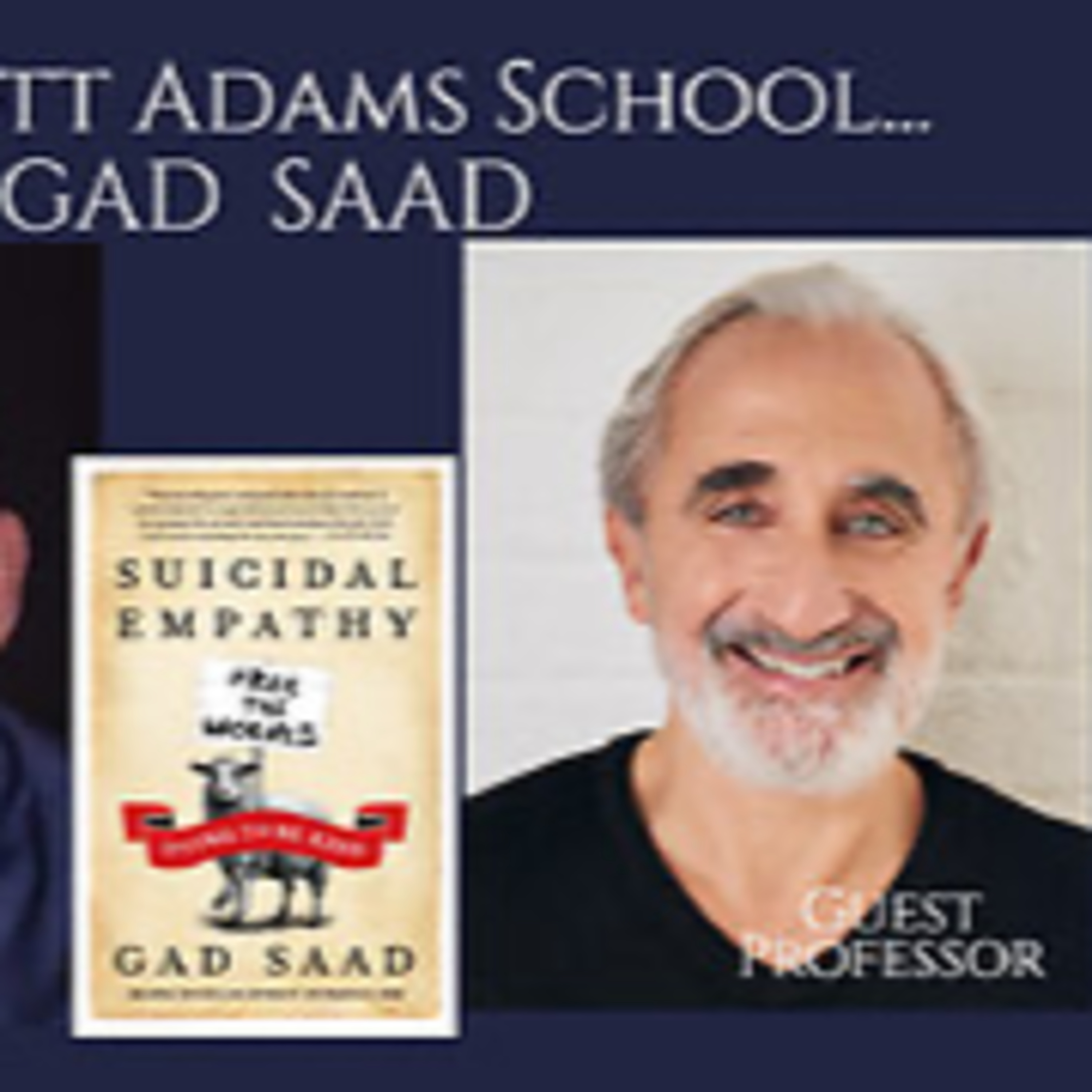
Real Coffee with Scott Adams
The Scott Adams School - 05/21/26 GAD SAAD! Suicidal Empathy #1 on the NY Times Best Seller list
01:03:44
Loading summary
Transcript108 lines
- [00:00]
A
Guys, can you see him yet? Oh, we're live.
- [00:04]
B
Good morning, everyone.
- [00:05]
C
Hi, everybody.
- [00:08]
A
Dr. Gad Sad. Can I call you Gad, Please? Okay. I love this image of you because this is the background and the face I've been listening to for so many years. And to be talking to you is such a dream. I have so much to say, but I'm going to try to reign some of it in. But. But, you guys, are we so excited. Hooray.
- [00:29]
B
Yeah. Do people call you Dr. Sad? That sounds like a Marvel comic villain.
- [00:33]
C
Oh, I. I insist that my wife calls me Dr. Sad in the bedroom.
- [00:41]
A
Oh, she is a good sport. Oh, my gosh. You guys, welcome in. It is May 21, 2026, at the Scott Adams School. Imagine Scott right now. He is looking down and just beaming. So we can't do anything without doing one thing first. So everybody, get your vessels, get your liquids. Here we go.
- [01:06]
D
Because we've learned that coffee is even healthier than we thought. How about that, huh? Yes. The recent science New York Times reports says that coffee is really, really good for you. So not only do we have the delight of the simultaneous sip, but we're all going to be healthier in a moment, those of us having coffee. And all you need to participate is a cup of mug or a glass of tanker, gels or stein, a canteen, jug or flask, a vessel of any kind. Fill it with your favorite liquid. I like coffee because it's so healthy. And join me now for the unparalleled pleasure, the dopamine day of the day, the thing that makes everything better. The simultaneous sip. Go. Yes. Science confirmed. I feel healthier, don't you? I think you do.
- [02:06]
A
I do. And there's a doctor in the house, so. Gad, first of all, he just mentioned the New York Times. Might I mention the New York Times as well?
- [02:17]
C
Do it.
- [02:18]
A
Okay. Well, congratulations. You are a number one New York Times best seller for suicidal empathy. Congratulations. I have a little clip. Hang on.
- [02:32]
C
So much. Hold on, I'm gonna put you on speaker. One sec. Go. Hey, this is Eric. Am I speaking to number one one New York Times? Oh, my God. Yes. Yes. Number one on the New York Times list.
- [02:58]
A
Oh, my gosh. That is so fun. I love that joy. How did that feel?
- [03:03]
C
You know, it's. It. It. I told my wife, after I said I never let out such a heartfelt, visceral scream of complete existential happiness. It was really. It was such a wonderful feeling, a truly episodic memory in my life's trajectory. It was beautiful.
- [03:22]
A
Oh, I'M so happy that you caught it on video and that we got to see. I can only imagine that that's the dream, right? You write this book and it's your, your blood, sweat and tears and then this is the result.
- [03:32]
C
Exactly. Actually. So I had texted my, you know, my HarperCollins team because they say that we're going to contact you between 4 to 6pm and we don't know exactly when will happen. It depends when the New York Times emails us and communicates with us. And so I was on the elliptical, not elliptical, on the stationary bike outside. That's why I was in my gym clothes. And so I texted him, I said, before you call me, text me to let me know so that my family can, can actually record the moments. I was so happy to have thought of that because we would have lost that moment. Now it is recorded in the annals of my life.
- [04:17]
A
Well, the chat is congratulating you. They are thrilled for you as we are. Owen and I are really, we're almost both almost done with your book. I love it.
- [04:27]
C
Thank you.
- [04:27]
A
It's the exact topic I really wanted. And, and by the way, for if anyone's never read any of Gad's books, they're amazing. And what you need to know is he's really funny and he's got a really funny, dry, sarcastic sense of humor. I hope you don't mind that description, but I find myself laughing out loud all the time because you just like sneak in these little dry one liners and I love. Keeps us paying attention, you know, it's, it's, it's.
- [04:58]
C
Thank you for saying that. I often tell people that when people approach me on the street. Probably the number one, you know, fan statement I get. I mean, yes, there's all the professorial stuff and the fancy intellectual stuff, but they say you are the funniest guy we've ever met. And that really actually means a lot to me because I'm in the business of trying to persuade people about a set of ideas. So depending on whom I'm speaking with, I will alter my modality. So sometimes you have to be professorial, sometimes you have to be sarcastic. All possible weaponry I'm willing to use if I can get to persuade you.
- [05:45]
A
Absolutely. It's a great hook for people that are worried. And I mean like with a title. Scholar, Declaration of Independence, center for the Study. You're not expecting humor?
- [05:57]
C
For the study of American freedom.
- [05:59]
A
Oh, sorry. For the study of American freedom. Hello. Oh my gosh. Right? So I'm like, okay, I don't know what that means, but it's important.
- [06:07]
B
Well, and I don't know how much you followed or knew Scott Adams, but he was very into persuasion and hypnosis, and even in his writing he made extensive use of that. And so I'd be interested to know, like, how do you go about trying to make your writing persuasive?
- [06:24]
C
So I think it's first, I never had the pleasure of meeting Scott. Of course, I was familiar with some of his work and I knew of him, but we never actually interacted with one another, regrettably. Look, I think good writing is good storytelling, right? So academic writing should be a form of storytelling, right? So what I try to do in my book, certainly in my trade books, meaning the books meant for the general public, is I try to mix and strike a balance between, you know, academic writing where, you know, everything is very referenced. I'm using psychological theory, psychiatric theories, evolutionary psychology, history, political science. But I always try to infuse it with personal narratives because those are the sticky parts that people can remember. Right. I could talk to you about the dangers of parasitic taxation as I do in chapter seven of the Source of Suicidal Empathy. But if I then tell you how parasitic taxation affected me personally now, it really hooks you. So it really is a fine balance that you have to try to achieve in threading that needle.
- [07:42]
A
Oh, you do it so. So well, the reason. Oh, and by the way, I don't want to forget you're moving to America, to the U.S. right?
- [07:52]
C
I am, I am. So this past year I was a visiting scholar at the. Forgive me for saying it again, but it's always nice to.
- [08:01]
A
I love it.
- [08:02]
C
So this year I'm a. I'm a scholar at the Declaration of Independence center for the Study of American Freedom at Ole Miss. Starting next year, the SADS will be coming over to. To America where I'll be the Distinguished professor of said center.
- [08:20]
A
I mean, that's so much more intimidating. I'm nervous now and to my earlier
- [08:27]
C
point, I will expect my wife in the bedroom to say, hello, hair. Distinguished Professor.
- [08:34]
A
Oh, yeah, yeah. Good luck with that. Let us know how that goes. That conversation.
- [08:39]
B
We'll be curious what motivated the move? Are you. Is it mostly because of what was happening in Canada that you wanted to leave, or was it more just about the position that you got?
- [08:47]
C
It's a bit of both. So, number one, while, and I don't say this just to be courteous to my long standing university, I really mean it that while Concordia has been a wonderful place, I spent 32 years there. I became a professor in 1994. There's sort of an end to every story. Ole Miss was offering me very little teaching where I could spend most of my time writing. My values are much more aligned with American freedoms. I tell people that I'm American in spirit. That does. That's not a slight on Canada. But you know, Canada is much more of a socialist country. It's much more of a suicidally empathetic country. So while there are many features of Canada that I loved, I didn't like the taxation, I didn't like the big welfare state, I didn't like the whack a mole of the Tall Poppy syndrome. Every time somebody tries to stand out from the rest of the people, then there is somebody who's whacking you down, whether it be your institution or the government, because we should all be equal. It's unfair that Gad Saad writes best selling books and makes a lot of, you know, gets a lot of attention for that. Let's, let's steal everything from him and give it, you know, to Gazan refugees who will be out to kill Gad Saad. So let's use Gad Saad's royal book royalties to then bring in people who wish to kill Gads out. So I didn't like that. I didn't, frankly. I never acclimatized to the weather even though we came to Canada in the 1970s. So you think that I might do
- [10:25]
A
it to it, you know, from Lebanon, Right, from Lebanon.
- [10:28]
C
I'm Mediterranean. Southern California is the type of environment that my genes are, you know, prepared to withstand. And so for all of these varied reasons, I think it was the right time. And then here comes Ole Miss. They offer me this dream position where I could spend all my day talking about freedom, teaching about freedom. So it was a no brainer.
- [10:50]
A
That is amazing. Yeah. I was going to say, I remember just watching you through the pandemic and just how everything was so crazy. And I would watch you and Viva, I forget which other Canadians are up there, but I'm like, oh my God, you know what is happening up there? And just terrible. And, and even also what not, I'm not mad at Canada personally, but you know, even what you see happening with Jordan Peterson and you know, it's, it's crazy. Like you used to think Canada was so simple and like they never bothered anybody and you never even really thought about Canada, which is kind of a good place to be. But now it's just amazing what's going on in Canada. We talk about it a lot on the show. But you said, you said the magic word, suicidal empathy. One of the reasons I was so excited about this book in particular, I was trying to think back, you know, my first feeling of this suicidal empathy and seeing it everywhere was immediately after 911 here I live on the Jersey shore. I can see New York right here across the water. And the smoke came over my house for two weeks and we lost lots of friends and people we knew and it was unbelievable. So. And then immediately I was being told, you can't. Not like the people like, you know, who are doing this. Like, you can't, you can't lump everybody in together. You can't say. And I'm like, well, I'm not, I'm not saying all of anybody's bad, but don't tell me I can't be upset with the people that did this or say something about it. And then I started to learn more about how this particular group of people, I'm just like not naming names in general because, you know, whatever you want to think, but this particular group of people have a, you know, a lifelong plan to take over the world. And you know, it's a, as Scott would call it, a slow moving disaster. He used to say, don't worry, it's a slow moving disaster. And when we can see it, we're really good as Americans in adjusting and, you know, pivoting and whatever. But I feel like this suicidal empathy, which you can explain in one second has created, you know, Ilhan Omar and well, I mean, the names go on and on. So they've now planted themselves all over the country in positions of power and people are still like, no, no, no, you can't say anything bad about these people. So could you explain? A lot of people were a little confused with the title. It's not quite about suicide, although it is. But if you could explain what it means.
- [13:25]
C
Right, wonderful. And so I'll explain what suicidal empathy is and then I could link it to some of the issues that you just raised. So empathy is a wonderful virtue to possess. We are a social species. As a social species, it makes sense for us to have the social lubricant of empathy, because for you and I to have a meaningful conversation, I need to put myself in your mind and vice versa. That's called theory of mind or cognitive empathy. So the book is certainly not as many of the hit pieces that are starting to come out on me, is not an attack on empathy per se. As a matter of fact, as an evolutionary Psychologist. I fully recognize that empathy is an evolved evolutionary based trait. So empathy is great. But like Aristotle explained to us several thousand years ago in his Nicomachean Ethics when he talked about the golden mean, too little of something is not good, too much of something is not good, and much of life is about finding that sweet spot. In his case, he was talking about courage. So if a soldier is not in the least bit courageous, if he's cowardly, that's a bad thing. If the soldier is so courageous that he starts engaging in reckless behavior, then he's going to quickly die. The optimal level of courage is some intermediate point. Well, I argue that that exact same principle applies to empathy. Too little or no empathy could be that you're a psychopath. That's what typically psychopaths exhibit. Little to no empathy. Too much empathy, when it hyperactivates, when it hyper fires in the wrong situations, targeting the wrong inappropriate targets of your empathy, you have the perfect cocktail for suicidal empathy. Now why do I use the term suicide? And here I'm going to draw a historical and cross cultural comparison with Japanese society. So in the samurai culture of Japanese society, where it's very much based on honor and shame, where you never want to lose face, if a samurai were to engage in an action that brought him or his group shame, the only way to seek redemption and penance, penance was to commit seppuku, which is self disembowelment. Right. That's the only means by which I could regain lost face. Well, I argue that the west is committing civilizational seppuku, civilizational suicide by dysregulated empathy.
- [16:11]
A
Wow. Oh, and did you want to, I know you had a question in there.
- [16:15]
B
Well, yeah, I mean, I think as I've been reading through your book, you point out that like liberals seem to be more susceptible to this idea or this, you know, disorder, whatever you want to call it, than conservatives. And that I think you also point out that women are more susceptible to this than men. And my question about that is really just like why? Why are they more susceptible to it? Is it that they're blind to it? Like they just don't see what's going on? Because that's at least in my personal experience, that's kind of what I see where like at one point I was talking to a woman that was in a job search and I was pointing out this was maybe five or so years ago, I was like, oh, have you seen any of this DEI stuff come up where they're asking you to either like make A DEI statement or do this other stuff, which is right. Right in line with your suicidal empathy idea. And at first she was like, oh, no, I don't see any of that. That's not happening. And I'm like, no, it really is happening. And I provided some evidence. And then, you know, and I, and I even pointed out, I'm like, you have, you know, white male sons. Aren't you concerned that they're going to be basically discriminated against? And eventually her response was, well, we did discriminate against black people, so we should be doing that.
- [17:26]
A
Wow.
- [17:26]
B
And I just, I couldn't fathom how a mother would not have the instinct to protect her own sons from discrimination.
- [17:36]
C
Yeah, I mean, that's, that's a great example. But as depending on where you are currently in your reading of the book, I've got many more hallucinations, many more hallucinatory examples than the one you provided. Let me share a few just to amass a collection of such stories. A Norwegian man, indigenous in the sense that he's a white Norwegian. Right. Not a Somali Norwegian. Right. So a Norwegian man is sodomized by a Somali immigrant. Now, because the Scandinavians are very, very kind and much more enlightened than us, they don't believe in long prison sentences. So after he served a few years in prison, he was going to be deported back to Mogadishu. The guy that was raped by the Somali sodomizer felt a complete existential angst and guilt because if he were to be deported, he wouldn't be able to maximally flourish for to his full potential in Mogadishu. Well, I'm here as your resident evolutionary psychologist to tell you that our emotional system did not evolve to empath, empathize with our sodomizer. So that's story one. Let me give you, let me give you a few others since, you know, as I said, storytelling is a good way to demonstrate a phenomenon. A woman is gang raped in Germany by a bunch of men who are speaking Arabic and Farsi. When the police comes to interview her to get a better sense of who the perpetrators are, she lies and says that they're speaking in German because she's incredibly worried that if she tells the truth, which is that it was Arabic guys and Iranian guys who were raping her, and then that might marginalize noble Middle Eastern men. Story three. And then I'll see the floor. Back to you, a very enlightened, super progressive, to your point, white liberal woman who wanted to squash the antiquated stereotype that black Men ever commit any violence because there is no, there is absolutely zero epidemiological evidence that any black man has ever committed any violence. So she decided to go to Haiti to demonstrate that, you know, in Port au Prince, in the Haitian capital, it's just everybody's in love and walks around singing John Lennon songs. Well, she was sort of slapped by reality when a Haitian man took her to the rooftop and raped her violently all night. And she was surprised that he would continue with his rape when she told him that she herself was a BLM supporter and a Malcolm X scholar. That didn't stop him from raping her. But then she concluded at the end of the rape, when she wrote her essay post rape, that she was very thankful for the experience because his rape demonstrated how evil white supremacy had forced him and taking out his rage on her. So when a Haitian man rapes a white woman in Port au Prince, Haiti, it's, it goes back to the white supremacy of the United States. There's your suicidal empathy, you guys.
- [21:09]
A
It's real. This is real. So I, you know, I want to, I know somebody asked, I think Andy asked, you know, how does, how does, so how does this start? How does suicidal empathy start? And then I'll go with my next question.
- [21:21]
C
Yeah, great question. So it's a one, two punch of my earlier book, my 2020 book, the Parasitic Mind, and then suicidal empathy. And let me explain why it's a one, two punch. We are both a thinking and feeling animal, right? Our cognitive system is important, but also we have an emotional system. So this idea that it's reason versus emotion, one or the other, is silly. We've evolved both systems to help us navigate through the world. Now, if I wish to completely hijack your ability to engage in critical thinking, I have to do two things. I have to parasitize your cognitive system that was the parasitic mind. But then I also have to parasitize your affective system, your emotional system, hence the suicidal empathy. Okay, but that all sounds a bit professorial and abstract. So let me give you a concrete example. Cultural relativism is a parasitic idea that I discuss in the Parasitic Mind. Cultural relativism purports that it is wrong to ever judge other cultural beliefs and practices. That would make you racist. That would make you a cultural colonizer. So if another society wishes to engage in female genital mutilation of five year old girls, shut up, racist. If they wish to engage in child brides, shut up, racist. If they wish to engage in honor killings, shut up, racist. So cultural relativism renders you impotent to make such judgments. And now you see how that parasitic idea is going to lead to suicidal empathy. So now, if I am an immigration policymaker, I've already been infected with cultural relativism as a parasitic idea, then I don't wish to say, hey, wait a minute, not all incoming immigrants are equally congruent with our values, because that would be racist, as I learned through my indoctrination of cultural relativism. Therefore, come on in, everybody. All immigrants are equally likely to assimilate within the American experience. So my internalizing and being parasitized by cultural relativism led to my open border, suicidally empathetic position.
- [23:43]
A
So the next book title could be Sticks and Stones may Break my bones, But Names will never hurt me. And it's so crazy to me how people are so brainwashed into not wanting to be called a name. It's none of your business what other people call you if you know who you are, is my theory. So, you know, if I'm not running around trying to be hurtful and racist or I'm, or whatever is or ism there is, and I'm just speaking from what I see without blinders or being brainwashed, you know, I don't really care what you call me because shutting our mouths is creating what we're seeing around us now. And it's not good. And, you know, so I feel like, you know, is, is it, what do we need to do? What do we need to do as a culture? And how do people become unafraid to speak? Their lives really depend on it. Our future, your kids, futures, your grandkids, the America that we grew up in is not going to be here. And it's not a slow moving disaster anymore. As Scott would say. The train has left the station and it is barreling. So what do we do? Gad, I don't know what to do.
- [24:54]
C
Yeah, perfectly perfect setup for my response. Thank you for that. In the last chapter of the Parasitic Mind, I have a call to action. But the one that I think resonated most with people, again, part of sort of my using a particular type of powerful phraseology is I said, activate your inner honey badger. And the reason why I specifically chose the honey badger, because of all animals that exist, the honey badger has been ranked officially by animal behaviorist and zoologist as the fiercest, most ferocious of all animals. Now, for those of you who don't know, the honey badger, the African honey badger is the size of a, you know, medium to small to medium sized dog, but if it comes across a bunch of adult lions, the adult lions go, I'm sorry, sir. I didn't mean to interfere with your day. Let us cross to the other side of the African savannah so that we don't disturb you, sir. Now, how could it be that such an animal can, you know, elicit such respect from so many different supposedly ferocious animals? Well, because it walks very tall, right? So it may be small, but it's the tallest, biggest, baddest of all animals. So when I tell people, activate your inner honey badger, I'm not imploring, imploring them to be violent or physically violent. I'm saying, stand tall and defend your principles. The reason why, you know, hashtag, men too can menstruate. Hashtag, men too can bear children. The reason why this astonishing departure from reality could flourish. So that today we have debates at what as to what constitutes male or female, when until 15 minutes ago, the 117 billion people that had existed on Earth. That's an actual real estimate. They seem to know perfectly well how to navigate the very difficult conundrum of what constitutes male or female. But 15 minutes ago, after I took my progressive biology course at Oberlin College, I lost that ability. But our ancestors knew exactly with whom to couple, to reproduce, but we no longer had that. Well, the reason why you were able to be so parasitized by that is because most people, because they suffer from pathological cowardice and pathological apathy, just nodded their head to be nice and get along and said, yeah, yeah, of course men, too, can menstruate. So activate your inner honey badger means don't be a coward. Now, that doesn't mean you have to be impolite. That doesn't mean you have to be unkind. But your professor says something insane, raise your hand and challenge them. You're at the bar and your friend says something that's insane, politely challenge them. Look, I just had a very intense thought. Three hour or however long it was, appearance on Joe Rogan's show where, you know, Joe and I go back many years, we're very good friends. We were talking about a very difficult subject about Israel and so on, and a lot of issues were raised, and yet we had the difficult conversation and then we hugged it out at the end. So you don't have to be disagreeable to have difficult conversations. Don't be a coward.
- [28:34]
A
Yes, and also, you know, so I've been put into situations where, you know, somebody's like, oh, so and so is no longer a woman. Now she's a man. And I'm like, listen, whatever, but, like, I don't want to play the game, so I'm going to stay in reality, and you guys can bend over backwards to accommodate this person's issue. I'll be polite, but I'm not going to call her a he. I'm not going to pretend she's a male. I'm. I'll do my best to not have any. Anything happen. But I think what we should know is that just because somebody else is delusional doesn't mean you have to play that game. That would be. That would make you delusional. So. You know, I remember before my father died, I was trying to explain to him this pronoun thing. My father was. I mean, you don't even have to be very intelligent, but he was a very intelligent man. And I was like, well, dad, you know. No, that person says there are they. He's like, what do you mean? And I'm like, I can't. I can't do this to you. I can't. I don't even want to explain it to you. It is so stupid. And I just. I just never, because I'm a normal thinking person, could never go along with any of this stuff. And I'm glad to see that, you know, most people that were, you know, falling that way, we're like, whoa, wait, you know, and they came back to center. Thank God. Owen, I'm sure you have a hundred questions. I could talk.
- [30:02]
B
I kind of want to return to what I was asking about before. Like, you know, one of the things Scott would sometimes say when someone was saying something insane was, you know, are they stupid, lying, or brainwashed? And I kind of have that question about the suicidal empathy. Like, do you think this is an intentional thing, that people are trying to brainwash people to destroy our country? Or do you think it's just rooted more in the evolutionary psychology where, you know, people are just, like, valuing the social, you know, the. The social approval aspect over all the other things to the point of pathology, or. Or are they even aware of it? Like, do they. Are they thinking this is really what the truth is, or do they know that they're lying? Like, what do you think about that?
- [30:47]
C
Yeah, so it's a bit of both, but a lot more of the parasitic infestation. That's not willful. But let me explain both. So, for example, if you are the Muslim Brotherhood, then it is a willful attempt to hijack your capacity to think. Right. The Muslim Brotherhood, among many other Islamic Groups. So that kind of goes to your earlier question when you talk about Ilhan Omar and so on. The Muslim Brotherhood said, we're going to conquer the west by three means, by the womb of our women. Right. We just, we produce more than you. Right. Demography is destiny. Number two, by hijra. Hijra is the Arabic word for immigration. How wonderful it is that then the west adopts an open border policy. Thank you, West. And then number three, we, by using your miserable freedoms against you. So then in that case, that's the willful part that you're talking about a nefarious group that understands that there is a frailty in the architecture of the human mind, certainly of the Western mind. And then they use that. But the more general reason why people can be parasitized is actually because of a fundamental frailty in, in the architecture of the human mind. And let me explain what I mean by that. So in the old days, 300 years ago, in various areas all over the world, but certainly, let's say in the Northeast, this was a very good way to organize the neighborhood. If you thought that Linda was a potential witch, let's grab her and throw her into water. And if she ends up drowning, oops, I guess she wasn't a witch. But if she does, if she does swim, then that proves that she is a witch. But then that parasitic idea, we were able to vanquish it and defeat it, but then new parasitic ideas came up. So the, the uniqueness of the current reality that we're facing is that there's a bunch of parasitic ideas that were spawned on university campuses because it really takes intellectuals to come up with some of the dumbest ideas. And these ideas, once they converge to a tipping point, led to the destruction of the edifices of reality. Right? So, and now let me explain why I use the parasitic framework to, to. To understand how people could be so removed from reality. The field of parasitology is the study of host parasite interactions. So, for example, a tapeworm is a parasite, but that ends up in your intestinal tract. On the other hand, a neural parasite, which is a subfield of parasitology, is when the parasites that infest you have to end up in your brain, altering your neuronal circuitry to suit their interests. And the classic example I give, but there are many, many others. A wood cricket abhors water, right? It wants nothing to do with water, but when it is parasitized by a hairworm, the hair worm needs the wood cricket to jump into water, merrily commit suicide, hence Suicidal empathy, because the hair worm can only complete its reproductive cycle in water. So once, once that hairworm is. Has parasitized the hapless wood cricket's brain, it is now just a vehicle for the best interest of the neuroparasite. So now let me link that specifically to a human context. And I actually verbatim, you know, covered that conversation in the. In suicidal empathy. So there's a street interviewer, you know, these are the guys that go into the street and intercept somebody. And he is interviewing. He intercepts a woman, I think it was in Manchester, England, at a Free, free Palestine, free Gaza stuff. And he says, oh, you're here for free, free Palestine. She goes, yes, yes, you know, Palestine, Palestine. She's British. She's got nothing to do with Palestine. Yeah, yeah, yeah, keffiya, right? And he says, oh, do. Do you know what they do to, you know, gay people in, in Gaza? She goes, I do. I'm queer myself. He goes, oh, you're queer, but you support Gaza? Do you know what they would do to you in Gaza? She goes, yes. What do you mean? They would kill you? She goes, yes. He goes, but you still support them? She goes, absolutely. Just because they would kill me doesn't mean that they shouldn't be deserving of my support. There's your wood cricket. Right, so. So that person is not somebody who is at the World Economic Forum meeting at Davos evil. She has been infected by an ideological neuroparasite. So to conclude, yes, there is in some cases willful manipulation of the human mind, but in most cases, it's parasitic ideas that lead to suicidal empathy.
- [36:07]
B
Oh, my gosh. You know, Scott would often tell us that when he was young, he thought, like, when he was a kid, he thought people were maybe 90% rational and 10% irrational. And then when he was training hypnosis, he learned that it's the opposite. We're 90% irrational and 10% rational. And I think he's also told us that emotions are much stronger than any kind of rational argument in terms of persuasion. So it seems, if you're, you know, if your argument is that the parasitic mind was more about the critical thinking, but the suicidal empathy idea is more about emotions, that the suicidal empathy might be much more powerful of the two.
- [36:47]
C
And that's why, that's why. Forgive me for interrupting you. It's very rude of me. That's why it's the instant number one New York Times bestseller to your point.
- [36:57]
B
Yeah, and. And I, I guess my question is, like, if, if we're trying to persuade, you know, a liberal or somebody who's been infected. Are there emotional arguments that you would suggest using to try and use that same technique to counter it?
- [37:13]
C
There, there are, albeit again, it's a false dichotomy to draw a distinction between reason and emotion. Both of these systems have evolutionarily rational signatures. The problem arises when you invoke the wrong system in the wrong occasion, right? If I'm, if I'm cutting through a dark alley because It'll sa me 20 minutes of walking to get home and I notice that there are a bunch of young men loitering in that dark alley, I will have an affective response, right? An emotional response. My heart beat will go up, I might start perspiring, my breathing will become more shallow, my blood pressure will go up. All of these are autonomic affective, emotional responses that make perfect evolutionary sense. If I were trying to do well on a calculus exam, I shouldn't be invoking my affective system. I should be invoking my cognitive system. So these are not, you know, systems intention. The challenge in life is to invoke the right one in the right situation. But to answer your question more directly, the way that I would try to convince the person who is suffering from suicidal empathy would be to actually give them examples that demonstrates how their empathy calculus is now broken. So let me give you one such strategy. In experimental philosophy, there's the classic trolley problem. The trolley problem is where you're trying to test people's ability to engage in trade off calculations, right? So here's an example of a trolley problem. The trolley is barreling down towards three of your biological children. Now you can pull a lever, and if the lever is pulled, it diverts the trolley to hit five random strangers. Now you can see the tension here, right? Five is a bigger number than three. So if the calculus was simply do that which minimizes the, you know, the number of people dead, then everybody would pull the trolley. But if you recognize that we've evolved an evolutionary calculus that engages in these rational calculus trade offs, then it wouldn't make you Hitler to say, well, sorry, but I would probably jump and save my biological children first. So what you have to do is explain to the suicidally empathetic person that empathy is beautiful, but it has to be constrained by an evolutionary, evolutionary relevant calculus. I know that sounds very fancy and professorial, but that's the only way to do it. And the reason why I use the trolley problem is because it is a vivid storytelling. Even the degenerate Imbecile who suffers from suicidal empathy would be hard pressed to say, I wouldn't save my three biological children. And therefore, through a mean, a Socratic mean, I have cornered you into realizing that we don't have an infinite well of empathy. We have to engage in trade offs.
- [40:32]
A
I love that. And also the other thing that just really gets me are these awfuls, as Michael Malice would say, taking up for everybody else's issues. It's so insulting and so, so degrading and embarrassing. And as a white woman, I'm just like, go away, go home, go do your job, stop worrying about everyone else's stuff. And, and you know, and that goes for, you know, the whole thing with, you know, black people can't get IDs to vote. Like, don't be ridiculous. Like, how are they supposed to. So, so with suicidal empathy, you know, it reaches as far as things like, I am very worried about Islam personally. That's just me, E. Where's my sign? That's just my opinion not to upset anybody. But you know, also as close as, you know, we definitely have an issue with, you know, groups of black people that are running amok right now destroying cities and towns. It just happened five minutes down the road from me. It's happening everywhere. And we have to stop being afraid to be called a racist because we're pointing out a problem. And if you, like they always say, if you can't talk about the problem and you can't, you know, narrow down to what it is, how are you ever going to fix it? So with something, I mean, this is not what you were expecting, but with something like this issue, because I just see like when the summer comes, this like increases when the weather is warmer and everybody's rowdy. So how do you stop whatever they're calling them? What are they calling these, you guys, like teen something? Teen takeovers. Teen takeovers, right. Like, oh, oh, it's just teenager takeovers. They're violent, they're wild, they're jumping on people's cars. There's fights, there's stabbings, there's this, there's that. How do we call it out without people being afraid to call it out? And how do we stop something like that?
- [42:35]
C
Right. Well, first, if you forgive me for putting you on the spot, the fact that you said, I don't want to offend anybody, I don't want to upset anybody. You have to get rid of that reflex. Right.
- [42:47]
A
And thank you for pointing that out because I've also. You're right. I, as I was Saying it, I kind of felt it. Because I've also made a commitment to do my best. I have to remember not to do a pre qualifier before I speak.
- [42:59]
C
Exactly. Look, in one of the chapters of Suicidal Empathy, I talk about forbidden knowledge, right? Forbidden knowledge is the fancy term for what's called a consequentialist ethics. So again, forgive me for using some professorial terms, but I think it's worthwhile for your audience. There are two types of ethical systems. There's what's called deontological ethics. This would be an absolute statement. So if I say it is never okay to lie, that would be a deontological statement. If I say it is okay to lie to spare someone's feelings, for example, I always joke, although I'm being serious, if you wish to have a happy, long lasting marriage, if you ever hear the following question, do I look fat in those jeans? Put on your consequentialist hat very quickly and say, no, sweetie, you've never looked more beautiful. I might be lying because maybe my spouse has put on a bit of weight, but I care very much about her feelings. I want to elevate her. Therefore, I might engage in a small white lot. Now, for many things in life, it perfectly makes sense for us to be consequentialist. That's okay. But there are certain principles that have to be deontological by definition, right? Presumption of innocence in the judicial system has to be deontological. Freedom of inquiry has to be deontological. Freedom of speech has to be deontological. So forbidden knowledge is where you're using a consequentialist ethic for something that should be deontological. Meaning, let's not do the research on this phenomenon or highlight the empirical reality of this phenomena, because if we do so, it might further marginalize this community. So don't say that some immigration groups are less likely to assimilate within the American experience than others, because that is hurtful. Don't say that the youths that are engaging in these teen takeovers. By the way, in the early 90s, that phenomenon used to be called wolfing, because they descend to you on wolf. So don't say that that teen takeover tends to have people of a certain skin. You, because that seems racist and white supremacist. You know what? Truth is more important than your hurt feelings. And I have zero bigotry in my heart. But the most fundamental ideal that I seek to ascribe to, well, there are two ideals, freedom and truth. So if the truth hurts your feelings, then f Your feelings.
- [45:39]
A
I agree. Thank you. I hope. I hope everybody can take that and feel that, and I think that's great advice. Owen, what question did you want to get in?
- [45:48]
B
Well, so I know you mentioned in your book that women are more empathetic than men, generally speaking, on average, statistically. Do you think part of the reason that some of the suicidal empathy is getting so much traction in the United States is that we just have a lot more women in positions of power and that they're able to set policies and things like that?
- [46:09]
C
I mean, certainly in some institutions, the rise in suicidal empathy in those institutions is because of the greater feminization of those institutions. So, for example, in academia, we now have instead of the epistemology of truth, which should be. Epistemology means philosophy of knowledge, right? So instead of having an epistemology of truth, which is what you would expect in a university that adheres to the scientific method, we now have an epistemology of care. What the f does epistemology of care mean? Right? I mean, the distribution of prime numbers is the distribution of prime numbers, irrespective of your bullshit hurt feelings. Right? So therefore, now that epistemology of care arises from the infantilization and feminization of the university. So in one sense, what you're saying is true, but it's. I don't want to put suicidal empathy only on the broader shoulders of womanhood. Right. Because there's a lot of also castrated men who are suicidally empathetic. So it's a one, two punch. It's the feminization of our culture that increases the likelihood of suicidal empathy. But it's also the fact that we have pathologized half of humanity called. Oh, what is that word I'm looking for? Oh, men. So by castrating and pathologizing men as a form of toxicity, right. I mean, it's toxic masculinity. You end up with the perfect cocktail for suicidal empathy.
- [47:47]
B
Yeah. And I mean, part of the way I look at it is the. The, you know, there's this oppressor victim thing going on with liberals kind of elevating the victim and wanting to essentially be the victim and looking for the oppressor that's out there, whether it's real or not, and kind of choosing which groups are demonized, which groups are better. They have the whole intersectional thing where the more different things you have, you can maybe elevate your status as a victim, which is so bizarre to me, but it seems real. And it seems to me like that's One of the big underpinnings of this is that when you elevate the status of a person based on being a victim, they see they can get status points with that and they're trying to kind of compete to be the biggest victim. And then on the other side of that, they're trying to also give those status points out to the biggest victims rather than merit or achievement or, you know, people who are actually accomplishing things. And it seems so backwards to me, but I guess I still don't understand why that happens, by the way.
- [48:47]
C
But to your point about victimhood, in Parasitic Mind, I talk about the homeostasis of victimology. So a homeostatic system is one. So for example, the thermostat in a hotel room is a homeostatic system because you set the bar, you know, the temperature that you'd like it at. And then the homeostatic system either, you know, start, you know, activates the heating or the air conditioning to reach that level. So applying that principle to victimology is, look, we need to have a set level of victimology in order to adhere to the narrative that the United States is a transphobic, Islamophobic sithic on stolen land, white supremacist society. And because we need to reach that homeostatis level of victimology, if we can't come up with actual examples, then no problem, you'll just manufacture them. Jussie Smollett. You'll just manufacture them. Senator Chief lies a lot. Elizabeth Warren. Right, so, but now here's the interesting part. One of the questions I often ask is how is it that you could be so outspoken, Professor Saad in academia and you've yet to be canceled. And here's one of many reasons why it's not easy, thank God, to cancel me. It's because I outscore all the bullshitters in real victimology. I'm the king of holding the card of I'm a childhood war refugee who escaped execution in the Middle East. So your bullshit story about what might have happened 300 years ago to the Navajo when they fought whomever that might be very nice and it's part of your intergenerational history. And. But I don't need to invoke 300 years ago what happened to my ancestors. I escaped execution, my parents were kidnapped by Fatah and tortured. My grandparents escaped Syria, my brother in law's family escaped Alexandria, Egypt. So it becomes very difficult when someone wants to play the victimology game with me, to outrank me. So they usually run away and I use their calculus to defeat the idiot.
- [51:10]
A
And it seems like the more boxes people check. Blue hair, you know, used to be a man, now I'm pretending I'm a woman, like the worse it is. And I'll say it again, I, I love using my woman card on here. But as the only woman on this panel right now, I think women are messing up a lot of things.
- [51:30]
C
And how do you know I'm not a woman?
- [51:33]
A
Because I know, because I'm not stupid. I mean, look at that face, that man right there. But seriously, I think women are really messing up a lot of things. And, you know, everyone laughs at me. Some people get mad at me in the chat. But I was just like, I always say, like, I'm happy to give up my right to vote if it means all women can't vote because it's so crazy. So, you know, if anyone's afraid to say it, I think women really are a pain in the ass. And I think that they're afraid, afraid of like not keeping their friend group and being popular and it's like that petty. And then I think for the women out there, like the queer British woman who's okay with, you know, she'd be killed if she went over to Palestine, you know, they just, they're just lost. They're lost or lonely. They probably grew up on social media and they don't have any real friends or connections. And that's why I'm also all for bringing back mental institutions. Like, where do they go? We need to put these people somewhere. They need help. Because I don't know how you fix this. It is really broken. And I don't know how, you know, people are going to start out breeding Islam, for example, if we keep, you know, I, I mean, it's, it's an obvious calculation to just feminize men. And is there anything worse than a male feminist? No. So I don't know.
- [52:54]
C
And I. Can I share with you, please? So I had a theory that I first proposed in the parasitic mind, which exactly applies to what you just said about the feminization of men. And forgive me, can I use an F word? Because it's an actual zoological scientific term.
- [53:12]
A
Absolutely.
- [53:13]
C
In zoology there is something called the sneaky fucker strategy. And the sneaky fucker refer. I mean, the, the fancy scientific term is kleptogami. Kleptogami. Forgive me for the phone. Let me just close this. Kleptogami refers to the stealing of mating opportunities. Now let me explain what that means. And this, by the way, was a theory. That was developed in the 1970s. And then I took that theory and then used it to explain male feminists. Okay, so bear with me. So in many species, there are multiple types of males. In that species, the fancy term would be multiple male phenotypes. There is the usual male with the typical secondary sexual characteristics. He looks like a male. But then there's another type of male that mimics female morphology. So when the.
- [54:10]
D
The.
- [54:11]
C
The sneaky comes along in front of the big male, he dupes the big male into thinking that he is a female, who then goes around and surreptitiously mates with the females, unbeknownst to the male that was guarding the females. And so, for example, you see that in some fish species. So because I'm well aware of many animal behavior, you know, as an evolutionary psychologist, that was my epiphany. I said, aha. Male feminists are engaging in the sneaky strategy.
- [54:47]
A
So There you go, 1,000%. And we've seen people get in trouble for this too. And even, you know, they've been, you know, I don't want to say charge. I don't know if they were all. If they were charged, but people that are male feminists have been accused of being abusive to women. So. Yes. So they're sort of like the sneaky honey badger of men.
- [55:09]
C
Look, I'm so kind. I'm empathetic. You don't have to really be threatened by me because I wear a glove and I cry when I put the gas into my car because I know that I am participating in the rape of mother Earth. So someone as empathetic as me, you don't have to worry. Slip into that lingerie and let's watch a movie together. You're safe with me, sweetie.
- [55:33]
A
That's right. So true. And the honey badger story also reminds me. I feel like Greg Gutfeld is the honey badger of late night. He's. He's small, but he's tall and he's confident and he's dominating. And that's immediately who I thought of when you were talking about that and all those other loser late night hosts. And then you got Greg. Go, Greg. Oh, my gosh, you guys, we have five minutes left. We have four minutes left. Who's counting? Oh, and go ahead, sneak in some questions.
- [56:02]
B
Well, I wanted to mention. I did really, I was very amused by your new term for. For rape that you. You called it undocumented lovemaking. I thought that was hilarious. And I guess the question, or, I don't know, the statement, maybe it's More of a comment. But, you know, it seems like you do that what I would call embrace and amplify. And that's something Scott Adams would teach us as one of the persuasion techniques that it's often better to mock people and to use that embrace and amplify just to make it seem ridiculous. And I think you're very brilliant at that.
- [56:38]
C
Oh, you're very kind. Thank you for the sweet words. That's specifically why, to your point, that's why dictators, they will first go and kill off the satirists. The one with the sharp tongue, the one with the venomous pen. Because my biggest threat as a dictator is the guy who, through his very surgical satire, can eradicate all my facade and bullshit. I don't have to go after the tall guys with big muscles. Those are easy to handle. But the guy with the sharp tongue, I've got to get rid of him. So that's exactly the point that you're making.
- [57:17]
A
Well, ladies in the chat, you know, and men too, if you feel like it. Yes or no. I mean, are you more attracted to a man with witness, you know, that can stimulate your brain, or a man that can. I mean, is it the wit? Yes or no? Like, what's the most attractive quality? I'm just gonna watch, but we can. We can keep talking. But for me, I don't get the live chat.
- [57:40]
C
It's not updating on mine.
- [57:42]
A
You know what? You're probably better off, but I'll give you the results. We're an unruly bunch.
- [57:49]
B
The final question I have is I learned about Jonathan Haidt's moral foundations theory, and he talks about how there's these six dimensions like care, fairness, loyalty, authority, sanctity, and liberty. And he points out that liberals really only care about the first two, care and fairness. And then maybe it's a different theory, but I've seen the statistics that, like liberals, care more about what's far away rather than what's close to them or the people far away. And do you think those are the factors that are really causing liberals to sort of fall prey to the suicidal empathy?
- [58:22]
C
I mean, in part, there are other factors. I mean, the liberals or the Democrats or the progressives, I mean, literally call themselves the party of empathy. Right? Barack Obama was colloquially referred to as the empathizer in chief. Right. He talked about the empathy gap. So, yes, I'm an admirer of Jonathan Haidt, and I know him, and his moral framework is a good one. But it's certainly not the only framework that can explain suicidal Empathy. But I would. I would add to the point of. What were the two. It was fairness. What was the other one?
- [59:00]
B
Care.
- [59:00]
C
Care. Okay, well. And I hope that Jonathan, if he ever hears this, won't be upset. Or Steven Pinker's. What I think they suffer from, while they are perfectly lovely people who do great academic work, they've got zero hunter honey badger abilities. So. So while they can do the pontification, the professorial stuff, they cross their legs in a very just 100. Therefore, that's not what wins the battle. What wins the battle is knowing when to use which modality. I can tuck my children to bed with the infinite love that I possess for my children. But if you come at me in a dark alley, I'm going to fight you to the death. If you try to mug me or rape me, it didn't change who I am. I'm inherently a nice, sweet, affable person. But depending on the situation, I could be loving or I could be the honey badger and brutal. The problem with folks like Steven Pinker and Jonathan Haidt is that they ascribe to the care part. They're always about politeness and niceness. I am as polite and as nice as anybody else in the right circumstance, but I'm an MMA fighter in the other circumstance. If we could inject into into them this little thing called testosterone, they would be better warriors and would be better at joining me and actually fighting this stuff rather than always crossing their legs.
- [60:40]
B
Maybe we can try and replace the SSRIs with testosterone.
- [60:43]
C
Indeed. Exactly.
- [60:45]
A
I love that. Well, we promised we'd stick to an hour. I just want to let everybody know, if you aren't already following Dr. Gad. Sad. What is wrong with you? But he also shares food photos, he loves animals. And I'm sorry you lost your beautiful baby recently. Your. Your dog. Oh, my God. This man loves dogs like nobody's business. And, oh, I've been watching you with your animal photos for a thousand years.
- [61:10]
C
Dogs are godly.
- [61:11]
A
They are.
- [61:12]
C
That's all of our noble virtues that we aspire to have and none of our faults.
- [61:17]
A
They're perfect, right? That's right. They're perfect. Don't tell my cat. Okay? So anyway, so please follow him. Also your exercise journey. You love soccer. Like, you're funny.
- [61:28]
B
He.
- [61:28]
A
He has it. He's the whole package. So please, you know, if you're. You're like, oh, my gosh, he's so intellectual. Just go. You're going to learn so much and love him. Owen and I thank you so much. Marcela in the chat. Marcela, thanks for hanging with the chat today. She's our other host. We so appreciate you coming on. We know Scott would be so thrilled seeing what's happening here and that he is. Did you enjoy being on with us today?
- [61:55]
C
I absolutely love that. I love the free flowing conversation. You're both delightful. Even though I didn't get the pleasure of seeing Owen move, but I was, I was enamored with by your beautiful voice and so thank you so much for having me on.
- [62:12]
A
Oh, we appreciate. We hope you'll come back and join us again one day. And as we thank you and as we say goodbye, we always give our thanks to Scott, Scott and to Shelly that they allow this show to go on and continue and that, you know, Scott wanted us all to stay together and keep moving forward, which I think we're doing beautifully. And we're going to just have a closing sip. To Scott, everybody, in the chat, thank you so, so much for being here. We'll be back. Yeah. Cheers to Scott, you guys. We'll see you tomorrow morning. To Scott.
- [62:41]
B
Be the honey badger.
- [62:42]
C
Thank you.
- [62:43]
A
Be the honey badger.
- [62:44]
C
Cheers. Should I log off?
- [62:48]
A
I can kick you out nicely. Thank you.
- [62:53]
B
Bye, guys.
- [62:53]
A
Bye.
- [62:54]
B
Bye.
- [62:57]
A
Aw, Owen, we're still live. Don't we love him?
- [63:01]
B
Yeah, it was great.
- [63:03]
A
Thanks, Mindy. There's my friend Mindy. He's so great. So you guys, thank you so, so much. I hope you enjoyed Gad sad as much as we did. Marcela, thank you so much for hanging in the chat with the locals. All right, so we'll be back tomorrow. It's fun day Friday. Tomorrow already. Owen, Owen, are you going to wear like a fun outfit tomorrow for fun Friday?
- [63:27]
B
I could see if I could pull that off, maybe. We'll see.
- [63:30]
A
Love it. All right, you guys, my nose is itching and it's time to go. Love you guys so much and we'll see you in the morning. Bye, guys.
- [63:39]
B
Bye, everyone.