← Real Cool History for Kids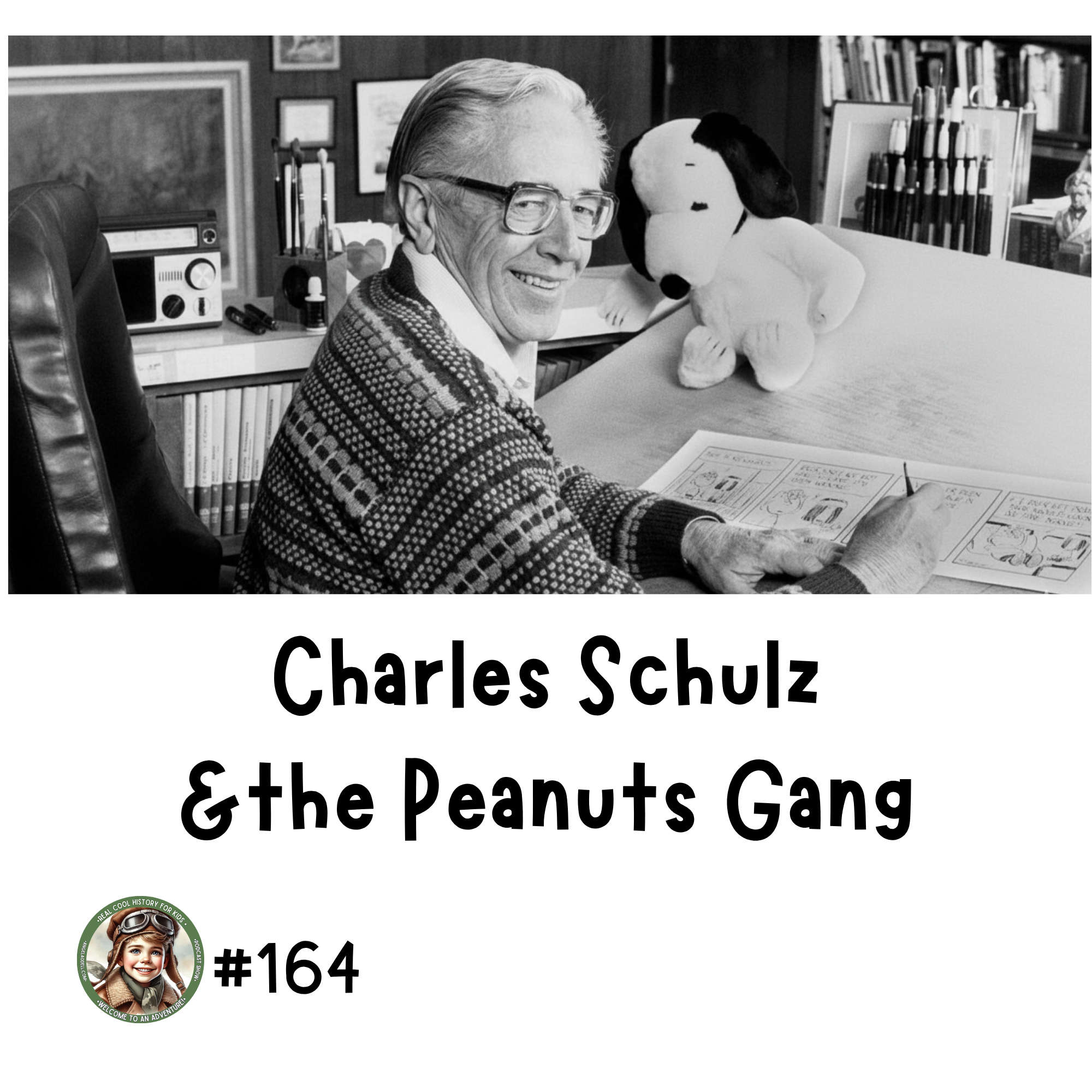
Real Cool History for Kids
Charles Schulz and the Peanut Gang (a special episode for Liam Martin)
00:15:31
Episode 164: Charles Schulz and the Peanut Gang (a special episode for Liam Martin) For more information and resources, visit the show homepage at angelaodelll.com.
Loading summary
Transcript1 lines
- [00:00]
A
Foreign. This is Angela Odell, and you are listening to Real Cool History for Kids, a podcast show featuring history told from a distinctly biblical worldview perspective. Welcome to an adventure. Welcome to episode 164 of Real Cool History for Kids. This episode is for Liam Martin, who wanted to hear the story behind the comic strip Peanuts. Hey, Liam, this one's for you. Charles Monroe Schultz, often called Sparky by his family, was the creator of the Peanuts comic strip, the home of Charlie Brown, Snoopy, Lucy, and Linus. Let's step back in time to see how an ordinary boy from Minnesota, which is my home state, grew up to make the world smile and laugh with his witty drawings of some kids and a dog. Charles Munro Schultz was born on November 26th of 1922 in Minneapolis, Minnesota and grew up in St. Paul. From the very beginning, his life was tied to cartoons. Just two days after he was born, an uncle gave him the nickname Sparky after a funny horse named Sparkplug in the comic strip Barney Google. Of course, no one knew at that time that that little baby, nicknamed after a cartoon character, would one day become the most beloved cartoonist in the world. As a boy, Charles was shy and quiet, and he loved to draw. He filled his notebooks with sketches of anything and everything around him. He especially loved could copying characters from the Sunday comics in the newspaper. His father, Carl, was a barber who ran a small shop, and his mother, Dina kept their home. They noticed Charles's love for drawing and encouraged him. I want to stop here for just a moment and talk to you guys about something. It's really, really important, and it's actually a very big part of why what Charles Schulz's life was really about. Have you ever considered how drawing and creating reflects God's character? The Bible says in Genesis 1:27, so God created mankind in his own image, male and female. He created them. That means every person is made to reflect God's character because God is creative. He gave us the ability to to be creative, too. So the next time you draw or design or build something, stop and consider how that is part of your made in the image of God DNA. I just want you to think about that, okay? So Charles skipped a grade in school. He was advanced academically, but it also made him younger and smaller than the other kids. He often felt really left out and overlooked and unsure of himself. These feelings would later become part of Charlie Brown, the little boy who never seemed to win a baseball game, but kept trying anyway. Even though school wasn't always easy, Charles artistic talent shone when he was 15, something really exciting happened. He sent a drawing of his dog Spike to Ripley's Believe it or not, and the drawing was published in newspapers across the country. Imagine just how thrilling it would be to be a teenager and seeing your artwork in print for millions of people to see. That moment gave Charles confidence that maybe, just maybe, his dream of becoming a cartoonist could really come true. After high school, Charles wanted to learn more, so he took a correspondence course in cartooning. This meant he mailed his lessons back and forth to his instructors. Because there weren't computers at that time, he couldn't use an online platform or email. He worked hard to improve his skills, but just as he was beginning to move forward, the world went to War. In 1943, Charles Schultz was drafted into the US Army. During World War II, he trained as an infantryman and eventually became a staff sergeant leading a machine gun squad. It was dangerous and frightening work, and although his unit took part in operations in Europe, Charles said that he was thankful that he had never had to kill another man in battle. Even though he was quiet and shy, his service taught him responsibility and courage and leadership. The war also shaped his outlook on life, giving him the gentle humor and humility that would show up later in Peanuts. When he returned home after the war, Charles was determined to chase his dream. He worked briefly as an art instructor and drew cartoons for small magazines, including ones published by by the Church. In those early cartoons, you can already see his style of simple lines and round heads and everyday situations. In the late 1940s, he created a small comic strip called Little Folks for a local newspaper. It included characters that looked suspiciously like the ones we know today. There was a little boy with a round head and even a dog that resembled Snoopy. Charles hoped a larger syndicate would pick it up. But when it finally happened in 1950, the syndicate decided to change the name of his strip. Instead of Little Folks, they called it Peanuts. Charles didn't like that name at all. He thought it sounded silly and it didn't fit his characters. But he had no choice. On October 2, 1950, the first peanut strip appeared in seven newspapers. No one could have guessed how quickly it would grow. At first, it was just a simple strip about children, but readers connected with it. The kids in Peanuts felt real. They weren't superheroes or fairy tale characters. They were just ordinary kids facing the same struggles and the same joys that readers recognized in their own lives. Charlie Brown became a lovable underdog. Snoopy the Beagle became famous for his wild imaginations. He wasn't just a dog. He was a pilot, a writer, and a dreamer. Linus carried a security blanket everywhere, but he often spoke words of wisdom and bossy, outspoken Lucy set up her psychiatry booth where she gave her five cents worth of advice to anyone who would listen. Over time, Charles created more than 17,000 Peanuts comic strips. At its peak, Peanuts appeared in 2,600 newspapers and reached 355 million readers in 75 countries. Oh my goodness. The strip was translated into 21 languages. Just think about that. People all over the world laughing at the same jokes, smiling at the same characters, and feeling the disappointment for Charlie Brown when life let him down. Foreign hey guys, I'm going to take a quick break right here in the middle of our story about Charles Schulz to give a shout out to a recent podcast reviewer. This family didn't leave their name, but this is what they said about real cool history for kids. We love, love love this podcast. Mrs. Odell has become our friend and a part of our family. She goes with us on road trips and also travels with us throughout our shorter city drives. She has cultivated a love for learning for all of my kids and has given us great conversation starters. Thank you for the energy you pour into our family and your listeners. You guys, thank you so much for that review. Your encouragement and love mean so much to me and I'm so happy your family is enjoying the podcast show. I also want to remind all of you that we have a Patreon platform for just $8 a month. You get printable activity packets to go along with the podcast episodes and our this Week in American History blog posts that we're doing every single week of 2025. Make sure you guys all stick around for this episode's birthday shout outs at the end of this episode. Own thanks. Now let's get back to our story. One of Charles Schultz's proudest achievements came in 1965 with a Charlie Brown Christmas, a television special that almost didn't happen, but would go down in history as an all American Christmas classic. Network producers thought it was just too unusual. They didn't like the jazzy music, they worried about using children for the voices, and most of all, they didn't want a passage from the Bible in the middle of the show. But Charles Schulz stood firm. He insisted that Linus's speech from the Gospel of Luke telling the story of Jesus birth had to stay. That moment became one of the most powerful in television history as millions of viewers heard the true meaning of Christmas read straight from God's word. The Bible says in Exodus 35:35 that God filled His people with skill to do all kinds of work as engravers, designers, embroiderers and weavers. In other words, God gave people gifts of creativity in many forms. For Charles Schulz, the gift came in the form of a pen and a blank sheet of paper. With those simple tools, he created a world that brought comfort and laughter and even the story of Jesus to people everywhere. You guys are used to hearing my voice, bring you stories about history and encouragement to be the best you ever. Well, today I want you to think about the creative gifts God has given you. I believe every single human on the planet has some type of creativity locked inside of them. So what's your gift? How can you share it with the world and bring glory to God? Because that's what it's really all about. Bringing God glory. Although Charles Schulz became the most successful cartoonist of his time, he remained humble. He worked in his studio every single day personally drawing and every single comic strip. He never let anyone else write or draw Peanuts. And that dedication kept his characters honest and true because they were always drawn from his own heart. And by the end of his career, Charles Schulz had received the love of generations. His characters had inspired books and plays and TV specials and even a Broadway musical. Children dressed up as Snoopy for parties, and adults carried around coffee mugs printed with their characters. Peanuts wasn't just a comic strip. It became part of everyday life for many people all over the world. In December 1999, Charles Schultz announced that he was retiring because of health problems. He drew his final comic strip in January of 2000, ending with a note to his readers thanking them for following the adventures of his characters. On February 12, 2000, the night before the farewell strip was printed in newspapers, Charles Schulz passed away peacefully in his sleep. It was almost as if he and his characters had said goodbye together. And now it's time for this episode's birthday shout outs. Happy birthday to Scipio ishizu who turned 7 on October 1st. Happy birthday to Harper Barnhart who turned 11 on October 2nd. Happy birthday to Pearl Corvamaker who turned 2 on October 2nd. Happy birthday To Madeline Gilbert who turns 10 today on October 6th. Happy birthday to Jonah Yount who turned 11 on October 3rd. And happy birthday to Emmy Bernard who is turning 5 on October 13th. Happy birthday to each and every one of you from the Real Queen. History for Kids Family. Remember to keep exploring, keep asking questions, and never forget. History is full of real people real adventures and really cool stories. I'll meet you here soon for the next episode of Real Cool History for Kids. Until then, with the help and the grace of Jesus, our Savior, be the best you ever.