← Real Cool History for Kids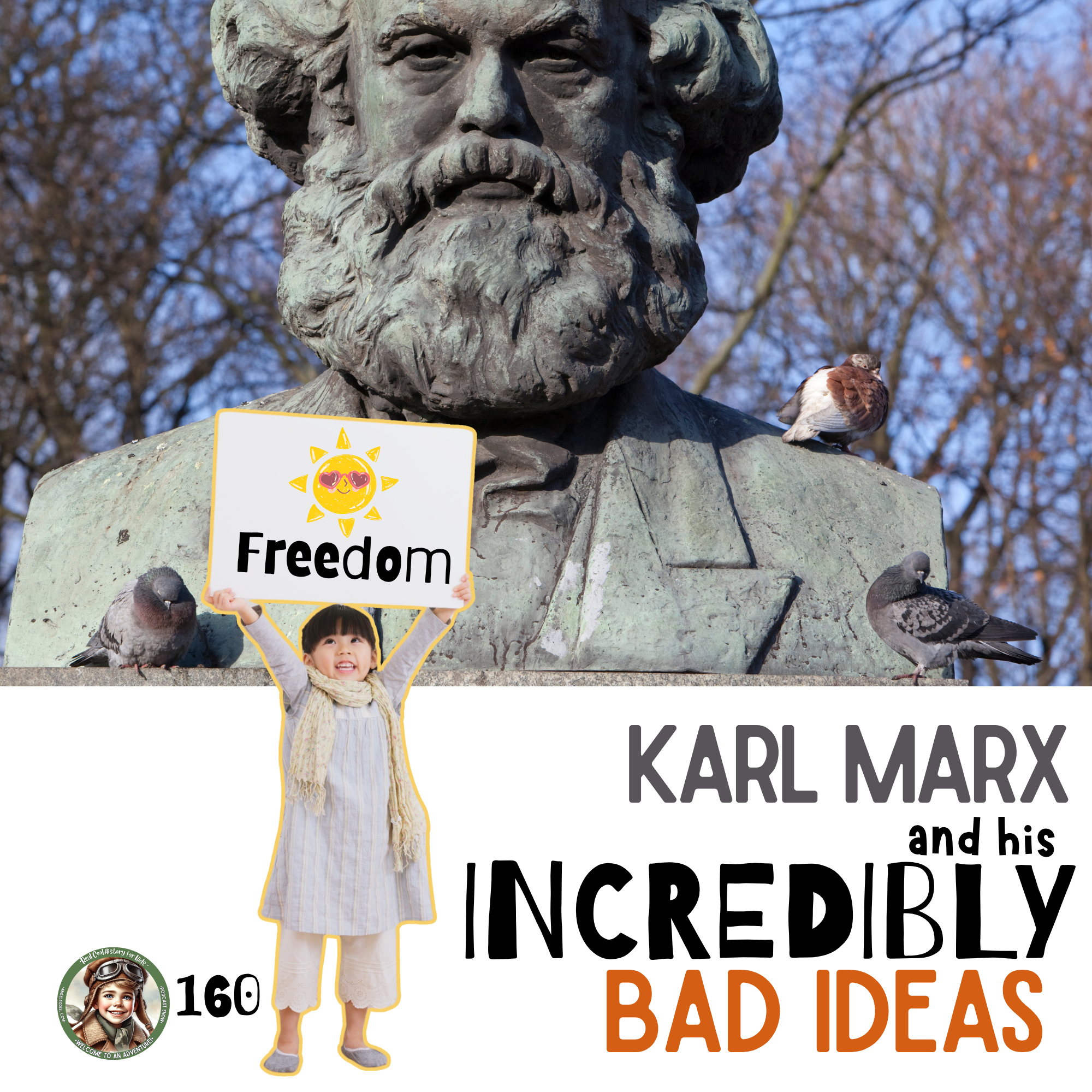
Real Cool History for Kids
Karl Marx and his Incredibly Bad Ideas (a special episode for Jude Speer)
00:15:55
Episode 160: Karl Marx and his Incredibly Bad Ideas (a special episode for Jude Speer) Join our Patreon and visit our shop!
Loading summary
Transcript1 lines
- [00:00]
A
Foreign. This is Angela Odell, and you are listening to Real Cool History for Kids, a podcast show featuring history told from a distinctly biblical worldview perspective. Welcome to an adventure. Welcome to episode 160 of Real Cool History for Kids. This episode is for Jude Speer, who wanted to hear the story of Karl Marx. Hey, Jude, this one's for you. Hey, you guys. I need to apologize beforehand for my voice. I have a cold, so I kind of sound funny. So sorry about that. I'm just going to do the very best I can. Okay? Our story about Karl Marx. Who is Karl Marx exactly? And why do people still talk about him today? Karl Marx was born in Germany in 1818. His father was a lawyer and his family was Jewish. Although before Carl was even old enough to remember, his father converted the family to Christianity. Why? Why did he do this? Well, not because he believed in the Bible or in Jesus, but because he didn't want to lose his job. At the time, the government didn't allow Jewish people to work in certain jobs. So Karl Marx's dad made a decision based on what he thought was practical and smart. But that decision had a really big impact on his son, Carl. Carl was a bright, curious boy who loved to read and learn. But he grew up without a strong faith in God, which later shaped his ideas. As he got older, he actually started to hate religion and anything to do with God. He believed that the idea of God made people weak and faith got in the way of progress. In fact, one of the most famous things Karl Marx ever said was that religion was like a drug that made people feel good while they were being treated unfairly. He also said that religion was like. It was a crutch for weak people. That's pretty harsh, isn't it? But you know what? There's more to his story. Karl Marx became a writer, philosopher. He spent a lot of time thinking and writing about how society worked. He believed that the world was divided into two groups of people. The rich people who owned businesses and land, and the poor people who had to work for them just to survive. He didn't think this was fair. And instead of believing that people should treat each other kindly or. Or fairly because it's the right thing to do. Like the Bible teaches. He believed that people would only do what was right if the government forced them to. Marx worked together with another man named Friedrich Engels, and they wrote a short book called the Communist Manifesto. That book said that all people should share everything and that no one should be allowed to be richer than someone else. But in order to do that, people would have to give up their private property, their personal freedom, and eventually even their belief in God. The system that Karl Marx believed in is called communism. And although it might sound fair to say, let's just share everything and make sure everything is equal, the truth is that Marx's ideas led to some really bad and sad things happening in history. In countries that tried communism, millions of people were hurt or killed because the government took total control over every part of life, including what people were allowed to believe. And I told you a story about a man who smuggled Barbara Bibles into communist countries back during the time that there was what we call the Iron Curtain, right? That was back in episode 135. I told you the story of Brother Andrew, the Bible smuggler, and how he risked his life to bring Bibles and Christian books into communist countries. He had to do that because the people in those countries were not allowed to have Bible Bibles. That's a very, very sad thing. The countries that tried communism, millions of people were hurt or killed because the government had complete control over their life. Karl Marx himself didn't live to see any of this happen. He died in 1883 in London. He spent much of his life writing and studying. Studying. But he was often sick, poor and unhappy. He didn't have peace or joy, even though he convinced himself he was right about what he thought about society. So why are we talking about him on this podcast? Why is it important for us to learn about this man, this extremely unhappy man with profoundly bad ideas? Well, because history matters, right? And the ideas of one person, especially if those ideas are shared and followed by a lot of people, they can change the whole world, for better or for worse. So that's why it's important to learn about him. Hey, guys, I'm going to take a quick break right here in the middle of our story about Karl Marx to give a shout out to a family of recent podcast reviewers who say this about Real Cool History for Kids. We are a homeschool family and absolutely love listening to your podcast. For fun and as a history resource, please keep making them. Sincerely, Gabriel Eden, Caleb, Adeline, Samuel, Selah, and Ruby. Thanks you guys for your awesome review. I'm so glad that your whole family is enjoying the podcast, you guys. I want to remind everyone that we have a Patreon platform. And for just $8 a month, you can get access to amazing library, a growing library of printable resources to go along with the episodes of Real Cool History for Kids. Plus an exclusive activity Packet that goes along with our weekly blog series, this Week in American History. This episode is made possible in part by the World Story series. I wrote this series and Master Books published them. If you are looking for homeschool curriculum from a solid biblical worldview perspective and designed for everyday life, check out master books@masterbooks.com okay, let's get back to our story about Karl Marx. Earlier in history, there was a time called the Enlightenment. That's just a fancy word for when a lot of smart people across Europe started thinking very hard about how to make the world a better place. They asked big questions about science and freedom and government, and some of their ideas really actually helped move society forward. But many of these thinkers also made some really serious mistakes. Instead of asking, what does God say about that? They said, we don't need God at all. We can figure out everything by ourselves. Because knowledge comes from the mind of man, not God. They were trying to get wisdom without the one who is wisdom. I actually created a podcast episode all about the Enlightenment that's in episode 37. So if you want to check that out, I highly encourage you to do that. And that brings us back to Karl Marx. Marx read the writings of these Enlightenment thinkers. He saw how they tried to push God out of the picture. He took that even further and built a whole belief system called communism that tried to replace God with government. He didn't just say, let's help people, he said, let's do it by getting rid of religion and making the government the most important thing in people's lives. But the Bible says in Exodus 23, you will not have other gods before me. When we put anything, even good sounding ideas like fairness, in the place of where only God belongs, it never works. In fact, it always causes pain. Marx wanted people to share. He wanted everything to be equal, but he thought he could force that to happen. He refused to believe that humans without salvation are lost and broken and sinful and they cannot fix anything permanently. He believed people didn't need Jesus or the Bible to find peace and hope. But that's not how peace works. True peace, the peace that God brings, is the result of his work and it doesn't depend on our circumstances. Isaiah 26:3 tells us, you will keep in perfect peace those whose minds are steadfast on you because they trust in you. Peace doesn't come from rules or revolutions or government. It comes from trusting in God who made us and came to earth to die for our sins. The Bible also tells us in James 4:10, humble yourselves before the Lord, and he will lift you up. But Karl Marx didn't want to humble himself before God. He thought human thinking was smarter than God's word. He believed the answers were inside people, not from God's mind or his word. But that path, following our own way instead of God's, never leads to joy. And you can see that is what happened to the people who followed Marx's ideas. Karl Marx believed people were just part of a system and that everything, including religion, was about power. He didn't see people the way God sees them. It's easy to see how that way of thinking led to very hard and unhappy lives for the people who lived under the communist systems. When you take away faith and hope and love, what's left? Just rules, right and force and fear. In a communist country, the government controls almost everything. Remember when we talked about that? Where you live, what job you have, and sometimes even what you can say is all controlled by the government. People can't freely choose their leaders, start their own businesses or even own their own property. They can't worship God openly or share their faith without risking punishment. Communism takes away the free will that God gave people. In a free society like ours, people can make many of their own choices. We can vote for our leaders. We can start a business. We can decide where to live. We can decide if we want to go to college or if we don't. And most importantly, we can decide to worship God. And we can do so freely. We can read the Bible, we can talk about Jesus, and we can choose how to live our lives. When you compare the two, you can see that freedom is so, so precious. And true freedom is found in Christ. Galatians 5:1 says, it is for freedom that Christ has set us free. And now it's time for this episode's birthday shout outs. Happy Birthday to Baker McClintock who turned 5 on July 27th. Happy Birthday to Millie Hicks, who turned 3 on August 4th. Happy Birthday to Leah Foley, who turned 7 on August 7th. Happy Golden Birthday. Happy birthday to Jed Logan who turned 11 on August 8th. Happy birthday to Matthew, who turns 11 on August 12th. Happy birthday to Briggs Belcott, who is turning 10 on August 12th. Happy birthday To Grace Corzine, who is turning 9 on August 15th. And happy birthday to Noah Corzine who is turning 9 on August 15. Happy birthday to all of you from the Real Cool History for Kids Family. Remember to keep exploring and keep asking questions, you guys. And never forget, history is full of real people, real adventures and really cool stories. I'll meet you here soon for our next episode of Real Cool History for kids. Until then, with the help and grace of Jesus, our Savior, be the best you ever.