← Real Cool History for Kids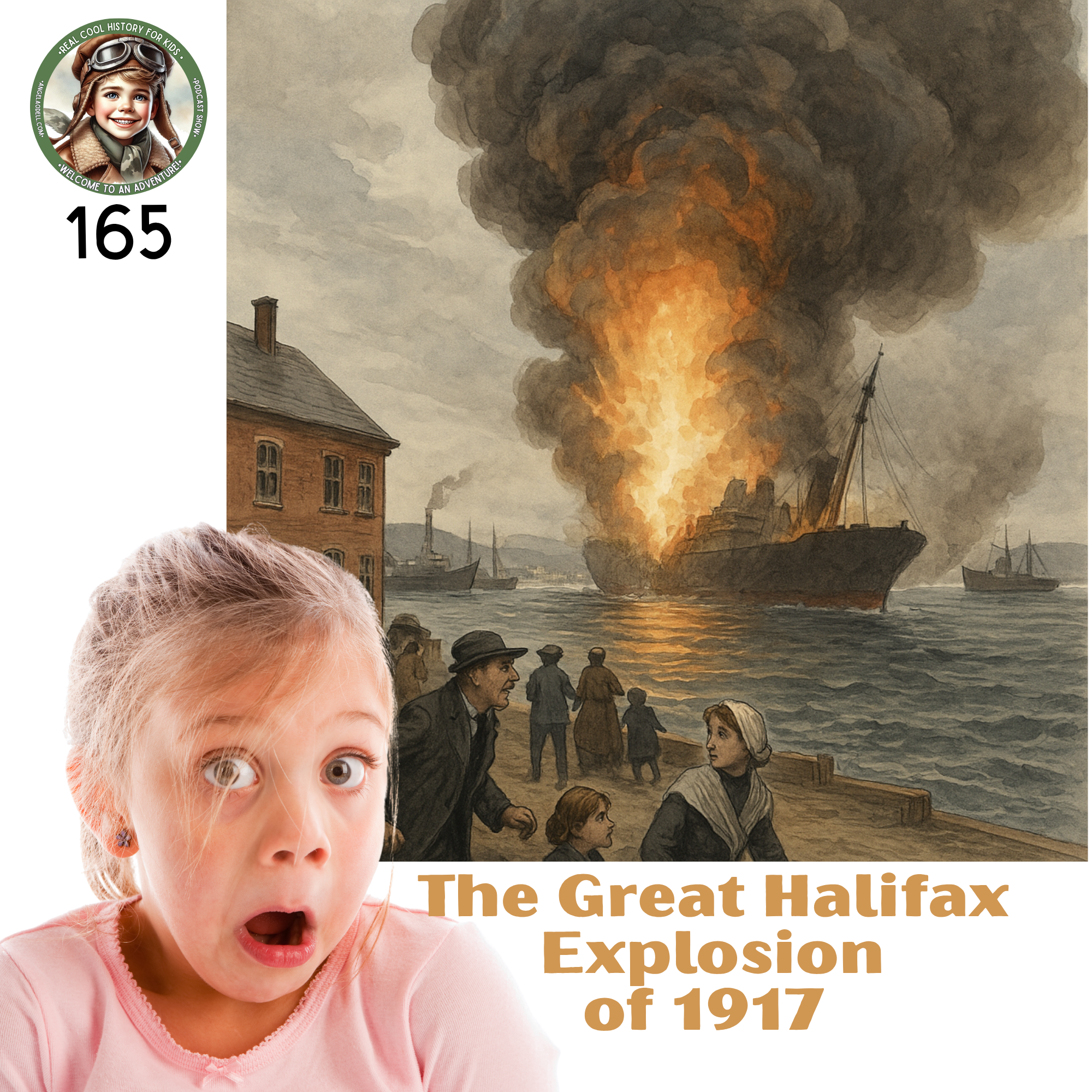
Real Cool History for Kids
The Halifax Explosion of 1917 (a special episode for Eden and Griffin Tanis)
00:16:18
Episode 165: The Halifax Explosion of 1917 (a special episode for Eden and Griffin Tanis) For more information about Real Cool History for Kids, visit the show at angelaodell.com.
Loading summary
Transcript1 lines
- [00:00]
A
Foreign this is Angela Odell, and you are listening to Real Cool History for Kids, a podcast show featuring history told from a distinctly biblical worldview perspective. Welcome to an adventure. Foreign welcome to episode 165 of Real Cool History for Kids. This episode is for Eden and Griffin Tanis, who wanted to hear the story of the Halifax explosion. Back in episode 72, I told you guys the story of the war to end all wars. This is one of the names World War I was called because at that time, people thought it would settle all disputes once and for all. Well, we know that this didn't happen because there was a second World War a couple of decades later. And I've made lots of episodes about that second World War because that is the one in which Hitler was trying to take over the world. Well, in today's episode, we're going to head back to World War I or the Great War or the war to end all wars But World War I to the morning of December 6, 1917, in the peaceful port city of Halifax, Nova Scotia. During the war, Halifax was one of the busiest ports in the world. Ships carrying food, supplies and soldiers to Europe came and went every single day. The harbor was noisy with whistles blowing and cranes clanking and children walking to school and fishermen hauling in their nets. You get the picture. It was noisy and really, really busy. Well, that morning, two ships were entering the harbor from opposite directions. One was a Norwegian steamship called the SS Imo on its way to pick up relief supplies. And the other was a French cargo ship named the Mont Blanc, loaded with a very dangerous cargo. It had almost 3,000 tons of explosives like TNT and picric acid and benzol on board. You know what we could kind of think as the Mont Blanc as basically a floating bomb. Well, as those ships approached an area known as the Narrows, which got its name from being very narrow, they tried to pass each other in the harbor. Both captains signaled, but the messages were misunderstood. The SS Emo was traveling faster than it should have been, and it didn't stay in its own lane. The Mont Blanc tried to avoid it, but it was too late. At 8:45, the two ships collided. The crash tore a huge hole in the Mont Blanc's hull. Barrels of Benzel spilled across the deck and out into the water, and within minutes, the vapors ignited and the ship caught on fire. The crew of the Mont Blanc knew exactly what that meant. They shouted warnings to anyone who could hear them, and then they quickly lowered lifeboats and rowed toward the shore as fast as they could. But on land, people didn't realize the danger. They saw the burning ship drifting toward the docks and thought it was just another fire at the harbor. Curious town folk gathered to watch. Some even walked down toward the water for a better view. Well, something unimaginable happened next. At 9am The Mont Blanc exploded. The blast was so powerful that it flattened more than a square mile of Halifax's north end. In that instant, the entire city seemed to lift into the air and then come crashing down again. Houses and factories were reduced to splinters. Windows shattered. 20 miles away. 20 miles away. And a wave of hot air and smoke rolled through the streets. The explosion created a shockwave so strong that that it was heard more than 100 miles away. The blast threw a huge cloud of smoke and debris nearly two miles up into the sky and caused a massive tidal wave surging as high as 60ft above the normal water level. Oh, my goodness. Sadly, nearly 2,000 people lost their lives that day, and about 9,000 more were injured. Thousands of homes were destroyed. Among those who died was a telegraph operator named Vincent Coleman, but not before he became a hero. Vince worked at the railway station near the harbor, and he knew that a passenger train carrying hundreds of people was speeding towards Halifax, unaware of the burning ship. Instead of running for his own safety, Vince stayed at his telegraph key and he sent a message to stop that train. Hold up the train. Munitions ship on fire and heading for Pier 6. Goodbye, boys. Seconds later, the explosion destroyed the station. But Vince's message saved every passenger on that train. Hey guys, I'm going to take a quick break right here in the middle of our story about the Halifax explosion to give a shout out to one of our podcast reviewers, Louisa, who said this about Real Cool History for kids. Thank you so much for making Real Cool History for kids. I love listening to it on long car rides. Thank you for making history. So much fun. Sincerely, Louisa. Thanks, Louisa, for your awesome feedback. I'm so happy to hear how much you are enjoying the podcast show. Hey everyone. I wanted to give a huge thank you to all of our Patreon members. You too can help us keep Real Cool History for Kids on the air by joining our Patreon community. There are several membership levels to choose from, including our new birthday shout out memberships. This episode is also made possible in part by the America Story series written by me and published through Master Books, provider of homeschool curriculum written from a distinctly biblical worldview perspective for everyday life. Now let's get back to our story about the Halifax explosion. In the moments after the blast, Halifax was silent. Then came the cries for help. People stumbled through the streets, covered in dust, searching for family members and friends. Many were injured by flying glass. Entire neighborhoods had vanished. Doctors, nurses and soldiers worked tirelessly to help the wounded. Schools and churches became emergency hospitals. Volunteers bravely dug through the rubble with their bare hands to rescue the survivors. The very next day, the temperatures dropped and snow began to fall. It made rescue work even harder. But no one gave up. From all across Canada and the United States, help began pouring in. One of the first cities to respond was Boston, Massachusetts. As soon as word of the disaster reached Boston, doctors and nurses and volunteers packed a train full of medical supplies and set off for Halifax. They traveled through heavy snow and reached the devastated city two days later. Their quick response brought so much hope and healing to the wounded. This act of kindness created a lasting friendship between Nova Scotia and Boston. And Every year since 1971, the people of Nova Scotia have sent a huge Christmas tree to Boston as a thank you for their help after the explosion. In the months following the explosion, Halifax began to rebuild. Entire neighborhoods were redesigned and reconstructed. As the people of Halifax rebuilt their community, they cared for the orphans and they provided shelter to the homeless. And. And they comforted those who grieved. Investigations were held to find out what had caused the disaster. At first, the French ship Mont Blanc was blamed completely. But later, after appeals to higher courts, both the Mont Blanc and the SS IMO were found equally responsible for the collision. It was a tragic accident made worse by confusion and miscommunication, which happens many, many times. When something horrible happens, everybody sees things differently and thinks something else happened. Today, more than 100 years later, the memory of the Halifax explosion still influences the city's identity. There are memorials throughout Halifax and including the Fort Needham Memorial bell Tower overlooking the site of the blast. And each year on December 6th, people gather there for a moment of silence at 9:04am, the exact time the explosion occurred, to remember those who lost their lives and honor those who helped rebuild. The Maritime Museum of the Atlantic in Halifax holds artifacts from that day. Warped metal, broken clocks stopped at 9:04, and pieces of the ships themselves. And even though the Halifax explosion was one of the worst disasters in Canadian history, it also revealed the incredible courage and kindness of ordinary people. And it shows how communities can rise from the ashes when they stand together. When we study events like this, you guys, we learn that history is really about people. People who choose to be brave, to help others and to rebuild even after terrible, terrible loss. As I was telling you guys this incredible story. I kept thinking about the power of courage and selflessness. Remember the telegraph operator, Vince, who chose to stay in the telegraph office long enough to send a message to the approaching train conductor? Well he could have run and perhaps saved his own life. Instead he chose to give his life to save the passengers on that train. I think this is absolutely amazing and it reminds me of John 15, verse 13, which says there is no greater love than to lay down one's life for one's friends. And isn't that just incredible? And even though Vince did not know all the people on that train, even though he could have probably escaped with maybe just some injuries and he could have gone back to his family, he didn't. He chose to stay and he chose to send that message, that last message. And it saved all of those people on that train. Can you just imagine how grateful all the families of those people on that train, how grateful they were that Vince had done that for them and saved their family members lives. It's an incredible, incredible story, isn't it? Absolutely amazing. And now it's time for this episode's birthday shout outs. Happy birthday to Remy Jones who turned 6 on September 16th. Happy birthday to Parker Phelps who turned 5 on October 17th. Happy birthday to Beatrice Hansen who turned turned 5 on October 19th. And happy birthday to Louise Hansen who also turned 5 on October 19th. Happy birthday to Ezra McDonald who turned 4 on October 19th. Happy birthday, Jake Steiner who is turning 11 on October 22nd. Happy birthday to Toby Lundgren who is turning 6 on October 23rd. Happy birthday to Gray Barnhart who is turning 8 on October 24th. Happy birthday to Michael Colucci who is turning 13 on October 24th. Happy birthday To Kathryn Joyce who is turning 4 on October 25th. Happy birthday to Emerson Wilson who is turning 7 on October 25th. Happy birthday To Sammy Bernard who is turning 7 on October 27th. Happy birthday to Ruby Young who is turning 9 on October 28th. And happy birthday to Benaya Patrick who is turning 9 on October 30th. Happy birthday to each and every one of you from the Real Cool History for Kids family. Remember you guys to keep exploring, to keep asking questions and never forget. History is full of real people, real adventure and real cool stories. I meet you here soon for our next episode of Real Cool History for kids. Until then, with the help and grace of Jesus our savior. Be the best you ever.