← Real Cool History for Kids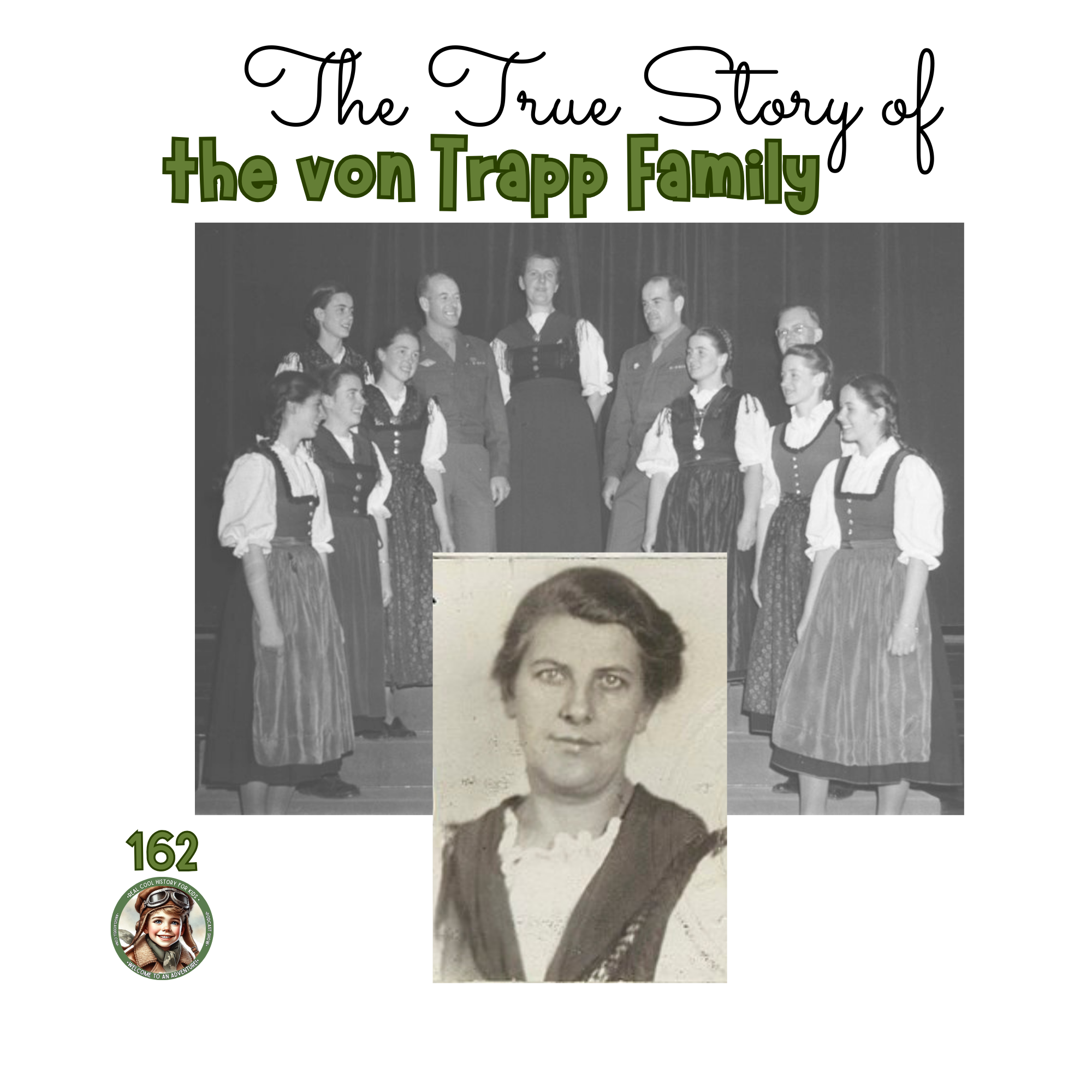
Real Cool History for Kids
The True Story of the von Trapp Family (a special episode for Rosalie Cody)
00:16:11
Episode 162: The True Story of the von Trapp Family (a special episode for Rosalie Cody) Join our Patreon and visit our shop!
Loading summary
Transcript1 lines
- [00:00]
A
Foreign. This is Angela Odell, and you are listening to Real Cool History for Kids, a podcast show featuring history told from a distinctly biblical worldview perspective. Welcome to an adventure. Welcome to episode 162 of Real Cool History for Kids. This episode is for Rosalie Cody, who wanted to hear the true story of the von Trapp family. Hey, Rosalie, this one's for you. You guys, I am super excited to tell you this story because the Sound of Music, the movie based on the story of the von Trapp family, is one of my all time favorites. And I've watched it literally dozens of times. I'm not joking. Dozens. The Sound of Music is just. Well, it's just a really great classic movie. I love everything about it. And what makes it even better is that it happens right at the beginning of World War II, which is one of my favorite periods of history to study. In the movie, Maria, played by Julie Andrews, twirls and sings in the Austrian hills. And the von Trapp children march in line to the sound of a whistle. And the family climbs over the Alps to escape the Nazis. I mean, it's just amazing. But guess what? The real story of the von Trapps is even better than the movie version. And today we're going to explore it in this episode. But before we do, go grab your globe or world map if you can. Now, let's find the continent of Europe. Remember, it's across the Atlantic Ocean from the United States. Okay. Did you find Europe? Okay, now let's find the boot shaped peninsula of Italy hangs down into the Mediterranean Sea. Okay. Do you find it? Awesome. Now move your finger up and to the right until it rests on a country that shares that top right border with Italy, that is Austria. And this is where our story begins. Okay, so let's head back to Austria in the early 1900s to meet the real von Trapp family captain. Georg von Trapp was a national hero during World War I. He commanded submarines for the Austrian navy and became famous for his courage. He was serious, disciplined, and deeply devoted to his country. After the war, Georg married a young woman named Agatha Whitehead. Her grandfather was Robert Whitehead, the. The man who invented the torpedo. Georg and Agatha had seven children. Rupert, Agatha, Maria, Werner, Hedwig, Johanna and Martina. Their big villa near Salzburg was full of music and laughter. But sadly, in 1922, tragedy struck. Agatha became very sick with scarlet fever and sadly, she died, leaving Georg alone with their seven children. Their once lively villa grew quiet and sad. Georg was a loving father, but he was strict. After his wife died in the Movie Captain von Trapp, played by Christopher Plummer, blew a whistle and made his children march, which actually really upset several of the real von Trapp children because they didn't like how this made him seem so mean. He had not been like that in real life, and they didn't like that part of the movie. In 1926, everything changed for the von Trapp family. The local convent sent a spunky young woman named Maria Gutiera to the von Trapp household to be the tutor for one of the girls, little Maria, who had been ill and had fallen behind in her studies. So. So she didn't come to be a governess to seven children. She came to be a tutor for one. That's different between real life and the movie. Maria Kuchera had grown up an orphan, and now she was training to become a nun. I can imagine Ms. Maria Kuchera was probably pretty overwhelmed when she came to the von Trapp family home with their seven children. But something unexpected happened. She fell in love, but not with the captain, with the children. The captain fell in love with her first. But Maria later wrote that she fell in love with the children first. Their laughter and trust had melted her heart. She found so much joy in singing with them and taking them on hikes in the hills and filling their house with laughter again. Oh. Over time, her relationship with the Captain von Trapp grew too. Maria said she came to love him more than anyone else before or since. In 1927, Maria and Georg married and she became the stepmother to the seven children. She and Georg eventually had three more of their own, Rosemary, Eleanor and Johannes. Life was joyful again, but it was not easy. The worldwide Great depression of the 1930s had shaken their fortune and their villa was expensive to maintain. Maria suggested that the family use the gift God had given them, their voices. So the von Trapps began singing together, not just for fun, but as a way to survive. They sang Austrian folk songs and sacred hymns and even classical music. Their voices blended into beautiful harmonies. In 1936, they entered the Salzburg Musical Festival and won first place. Before long, they were performing across Austria and Europe as the Trapp Family Choir. But dark clouds were gathering. In 1938, Nazi Germany marched into Austria in what they called the the Anschelists. Suddenly, the von Trapps were living under Nazi rule. Captain von Trapp was offered a high ranking position in Hitler's navy, but he refused. He would not serve the Nazis or Hitler. The family was also pressured to perform at Nazi events, and again they refused. By now, their money was gone. Their home was at risk and the Nazis were watching them closely. The von Trapps made a very brave decision. They would leave Austria. Now in the movie, the von Trapps sneak away in the dark and climb up over the mountains into Switzerland. But the real story was different and took even more courage. One summer day, the von Trapps quietly packed their bags, picked up their instruments, and walked to the train station in broad daylight. To anyone watching, it looked like they were going on vacation, but in reality they were leaving behind their home and their country. Forever foreign hey guys, I'm going to take a quick break right here in the middle of our story about the von Trapp family to give a shout out to a recent podcast reviewer, Drew, who says this about real cool History for kids Dear Mrs. Odell, my name is Drew, I am 8 years old and I love your podcast. I haven't listened to all of the episodes yet, but so far my favorite is Dolley Madison Saves a Painting. Thank you for all of your hard work. Sincerely, Drew. Thank you so much, Drew for your awesome review. I am so happy that you're enjoying the podcast show. I want to remind you all that we have a Patreon platform for just $8 a month. You get all kinds of great resources to go along with the podcast episodes and a printable packet of activities to go with the weekly this Week in American History blog posts we produce every week in 2025. Also, starting in October, the Birthday Club membership will be moving to the Patreon platform, so keep tuned for more details about that. This episode is made possible in part by the World Story Series, history curriculum and audiobooks created by me, Angela Odell, and published through Master Books, a leader in homeschool curriculum written from a biblical worldview perspective and designed for everyday life. Now let's get back to our story about the von Trapps. From Austria, the von Trapps traveled to Italy and then to London. Then they boarded a ship to cross the Atlantic Ocean to America. When they arrived in America, they had almost no money, very few belongings, and they spoke only just a little English. Everything was new and uncertain. But they had their voices, and even more importantly, they had each other. And they trusted that God would guide them. And he did. In America, life was hard. At first. The family had to adjust to a whole new culture. But when they sang, people listened. The Trapp Family Singers toured across the United States, performing religious songs, Austrian folk music, and classical pieces. Audiences everywhere loved the family's music, and then Maria often spoke between songs, telling funny stories that made people laugh. By the 1940s, the Trapp family Singers had become famous. They traveled across America and then South America, and they shared their music with thousands of people. After years of constant travel, the von Trapps wanted to find a place that felt felt like home. The rolling green mountains of Vermont reminded them of Austria. So they bought land near the town of Stowe and opened a music camp. Later, they built the Trapp Family Lodge, a guest house where visitors came from all around the world to meet them. Even today, that lodge is still run by Georg and Maria's youngest sons, son and daughter, and their families. Now let's take a moment to look at how the real story is different from the movie. There are several key differences. Places where the movie industry took creative license. First, in the Sound of Music, the children were young, with the oldest being 16 year old Liesel. But in real life, the original seven von Trapp children were already young adults when they left Austria. Rupert, the oldest, was already a doctor. Also in the movie, Maria and Georg are just returning from their honeymoon when they decide to take their family and escape. In real life, they had been married for more than 10 years and had three children by the time they left. In the movie, the family sneaks over the Alps to escape the Nazis. In real life, they left by train. And the music? Well, the family didn't sing show tunes like Do Re Mi and all of the fun songs that they sing. In the Sound of Music, they sang folk, sacred and classical works in rich, disciplined harmonies. They were very much like a choir. The details are different, but I have to say the spirit of the story is really the same. The movie is based on the same themes that are true in the real story of the von Trapps. For example, their story is about courage. Captain von Trapp stood firm against the Nazis even though it cost him everything. This is true in the movie as well. And it's about love. Maria loved the children first, and her love for Georg grew into a lifelong devotion. This is also true in the movie. Maria loved the children and then realized the captain was in love with her, which scared her and made her run back to the abbey for a while. And it's about faith. The family trusted that God had plans, and he guided them through danger and uncertainty in a new life. This aspect of the von Trapp's life is depicted in the movie when Maria says, when God closes a door somewhere, he opens a window. Well, today, the von Trapp's legacy lives on through their music and their lodge in Vermont and the generations who continue to share their story. Their lives remind us that faith, family and courage are treasures far more valuable than wealth or fame. The Von Trapp story shows us that when we hold fast to what is right, even in the hardest times, God can use our lives to bless others. And now it's time for this episode's birthday shout outs. Happy Birthday to Cassia Burke, who turned 7 on July 19th. Happy birthday to Juliana Rogers, who turned 12 on September 4th. Happy birthday to Wesley Burke, who turned 1010 on September 5th. Happy birthday to Poppy Crystal, who turned 7 on September 6th. Happy birthday to Kylie Yoder, who is turning 6 on September 13th. And happy birthday to Sky Cordiner who is turning 12 on September 17th. Happy birthday to each and every one one of you from the Real Cool History for Kids family. Remember you guys to keep exploring, to keep asking questions and never ever forget. History is full of real people, real adventures, and really cool stories. I'll meet you here soon for our next episode of Real Cool History for Kids. Until then, with the help and grace of Jesus our Savior, be the best you ever.