← Rebel News Podcast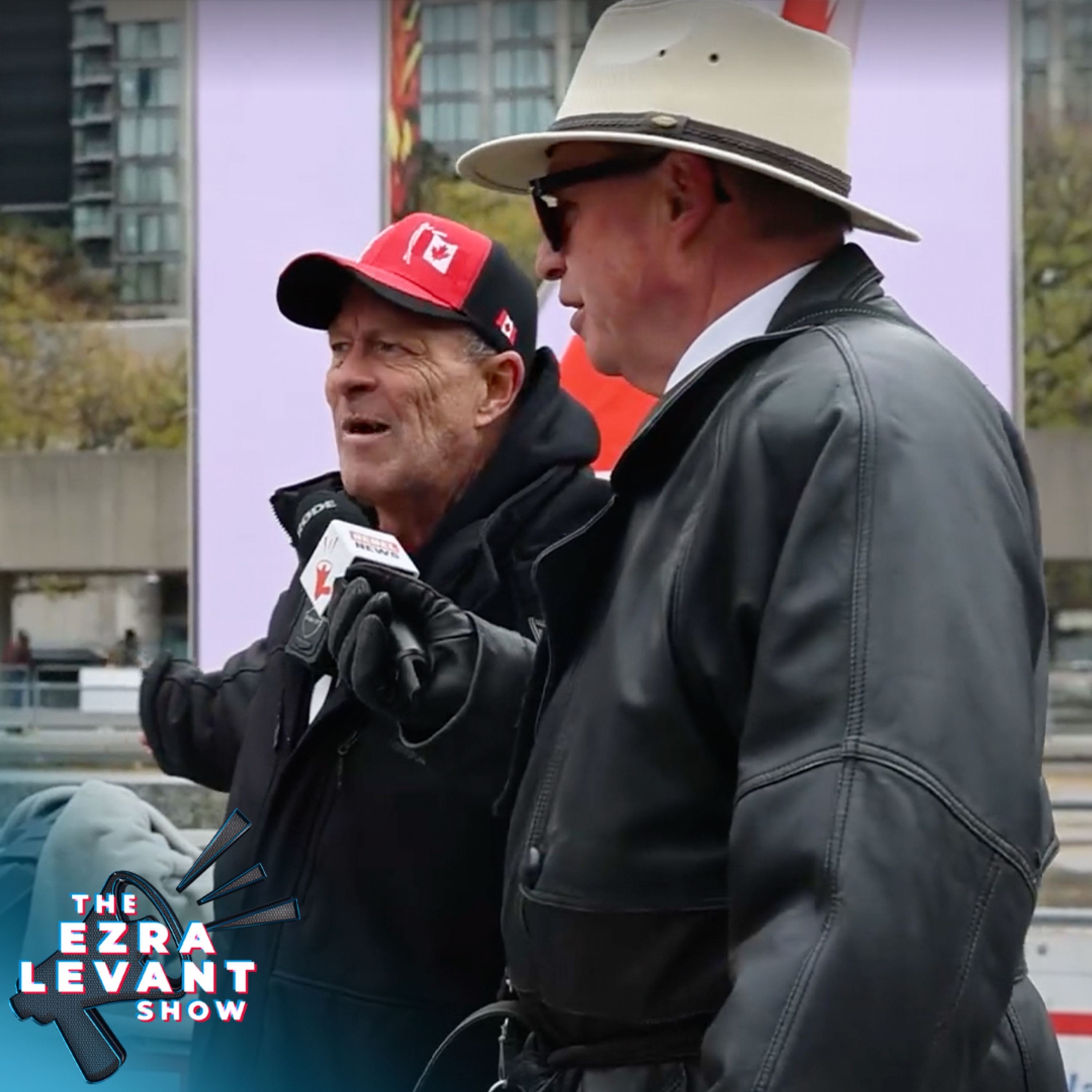
Rebel News Podcast
EZRA LEVANT | Are radical activists erasing Canada's identity?
00:32:37
Tonight on The Ezra Levant Show, Ezra focuses on the effort to erase Canadian history: removing Sir John A. Macdonald from the $10 bill, tearing down statues, and now, even silencing our national anthem.
Loading summary
Transcript35 lines
- [00:00]
A
Hello, my friends. Why did a Toronto police officer turn off a PA system at Toronto City hall yesterday that was playing the Canadian anthem? I'll give you a long answer to that short question. That's next. But first, let me invite you to become a subscriber to Rebel News plus, and I really want you to see this officer in action. Rebel News plus is the video version of this podcast. Just go to rebelnewsplus.com click subscribe. Eight bucks a month. You see the visual content, but you also support Rebel News to keep us strong because we take no government money. And it shows.
- [00:39]
B
You're listening to Rebel News podcast.
- [00:51]
A
Tonight. They took John A. MacDonald off the $10 bill, they tore down statues, and now they're turning off our anthem. It's November 18th, and this is the Ezra Levant Show. Shame on you, you censorious bug. I'll never understand why they took Sir John A. MacDonald off our $10 bill. Actually, of course, I understand why they did. Justin Trudeau and, and the Liberals, and much of academia, much of the media, they want to delete our history, denigrate our great leaders, revise our national story, accuse our country of genocide. That's the particular slander against Sir John A. What was odd to me was who they put on the $10 bill instead. Viola Desmond. She was a black woman born in Nova Scotia. And in 1946, when she was in her mid-30s, she went to a movie theater that was racially segregated. She didn't realize that actually there weren't signs, apparently. But when the proprietor told her to move, she didn't want to move. And so she was arrested. Actually, there was a trial for tax evasion, if you can believe it, because the seat she wanted needed an extra pennies tax or something like that. The last judge to hear the case was clearly sympathetic to Desmond, but said that the lawsuit was brought on the wrong grounds or something. The judge said, quote, there might have been an opportunity to right the wrong done. This unfortunate woman. So that's the story of Viola Desmond. She wanted to sit on the main floor of the theater. She was told that was for white people only. She was arrested and that was upheld in court on a technicality. Obviously, we don't believe in racial segregation, though it was obviously pretty widespread, pretty much everywhere in the world back in 1946. And that's it. That's the end of the story of Viola Desmond. I mean, she moved to Montreal later, and then she moved to New York to live out the rest of her days. She was brave to stand up to the theater. And she really, though, wasn't a campaigner or that political. It was that one incident in her life at the theater, and then she was done. Now, I'm glad she stood up for her rights that one night. I'm sorry, she lost the lawsuit over one penny in taxes owing, if I understand the story. Cor, but that's the entirety of her public notoriety. In fact, she left Canada altogether and moved to the United States. That's a good woman, from all I can tell. But I'm sorry, that's just not equivalent in accomplishment, in historical importance to the founding father of Canada himself, the first prime minister, the man who guided Canada into confederation and then guided it in its early days, including great feats like building the Canadian Pacific Railway. It's just not equivalent. Again, I'm sorry that Viola Desmond was moved to a different seat for a racial, racist reason. I'm sorry she had to go to court, though her lawyer, in the end, didn't charge her and the judge, as you heard, was sympathetic. I think the fact that Viola Desmond was chosen to replace Sir John A. MacDonald is, in an ironic way, a wonderful testament to how friendly and welcoming and tolerant Canada is and has been. If that is the worst case of racial persecution you can find, if they scoured the history books for a civil rights hero fighting against injustice and that's what they settled on, well, I'd say Canada's a pretty great place if that's our worst moment as a country. Now, there have been other moments, like interning the Japanese in the Second World War, but again, it's not even comparable to some of the grave racial or ethnic cleansing of crimes around the world. Now, I happen to know, as you do, too, that in fact, Canada was the destination for so many black people in the Underground Railway, runaway slaves or free black men and women coming up to Canada. So, in fact, not only were we not a blemished country, we were the place everyone tried to get to, to get away from slavery. I got nothing against Viola Desmond. Like I say, in that moment, she did the right thing. But she really wasn't, say, like Martin Luther King, Jr. Who made an entire life out of serving and freeing black people. And in the end, he was assassinated for it. She ended her days, naturally, in New York. Decades later. She was chosen not because she is a powerful figure in history. She was chosen for the opposite reason. To replace a powerful figure in history on our $10bill, to deracinate our country, to pull it out by the roots, to undo our past, to Smear our past to recast our past as embarrass. And every time someone looks at the $10 bill now and sees her instead of our actual national history, you know why there's a war on against Sir John A. MacDonald. He's torn down everywhere by governments mainly, sometimes by mobs. Here, in this case, they were tearing down Queen Victoria outside. The man, the Manitoba legislature. By the way, that statue is still down and it will actually never go back up. Just this week, some four years after the vandalism, they've announced a new plan for a new statue. Who will it be? Will it be a Founding father? Will it be Queen Victoria? No. Let me quote the newspaper. The Manitoba government is looking for design teams to help build a new statue on the front lawn of the legislature. Wait for it. The government announced plans a year ago to have a monument of a mother bison and her child erected in the spot where the statue of Queen Victoria had been torn down by protesters. And in 2021. Got it. A bison. Like I say, tear down the real past. Tear down our leaders, our heroes. Queen Victoria, one of the most powerful women in history. You want to put a woman on a $10 bill? Put Queen Victoria on there. I mean, not just a queen, an empress. No, they would prefer a bison. And all the meaning that has, like I say, tear down the real past. Recreate a fake past or a meaningless past. If you have read 1984 by George Orwell, you'll know the phrase. He says, who controls the past controls the future. Who controls the present controls the past. Think about that. Destroy our history, make it a void, and then fill it up with whatever you want. That's how you control the country. That's what the stripping down of Sir John A. And Queen Victoria is all about. That's what the ridiculous renaming of young Dundas Square in Toronto into Sankofa Square is about. That's what renaming Ryerson University into Toronto Metropolitan University is about. Destroy the past so you can control the future. Anything can fill the void that you've just left. By the way, Defame Christian churches by falsely claiming they were part of a genocide. Falsely claiming that there are hundreds of children buried in mass graves. A complete hoax.
- [08:04]
C
You're about to be a parent. What was it like going through the unmarked graves I met? I don't want it to be about me. That's the important thing. So, of course, it hit differently. It hit differently being a parent, for sure. But again, it's not about me. It's about indigenous communities and it's about what we've got to do for them. And it's about what this means, that a country killed its own people. So it's not about me being a parent. It's about indigenous people being denied justice, being denied dignity.
- [08:59]
A
What does Jagmeet Singh care about our past? He wants to control the future. And it suits him to defame Canada's past, especially Christian churches. More than 100 churches have been burned or vandalized. If that were mosques, we'd be under martial law again. The government would be on the warpath. But it's just churches. So what? And into that void, destroy history, destroy religion, pour anything. Environmentalism, Palestinianism, anti Semitism, wokeism, transgenderism, whatever you want to put into people's minds and hearts instead of our real history and truth and patriotism, because you've destroyed those all. Which brings me to this quick moment yesterday, when Toronto's pro Hamas mayor hoisted the Palestinian flag at Toronto City Hall. And here's Muhammad Faqi, a Hamas supporter who actually hoisted the flag too. Zohan Mandani became mayor of New York City in part because of people born outside of America who brought their anti Americanism or at least their tribalism with them to New York. New York is about 36, 37, 38% foreign born in Toronto, that number is much higher.
- [10:53]
D
Toronto place in our country, it's in many respects the best of Canada because it's all of Canada in one place. As you know, virtually half of the people in the greater GTA were born outside this country. You wouldn't know. You wouldn't know because they quickly become Canadian. We're enriched by them. And that's true of our country as a whole. It's always been true of our country. And of course, you know, Toronto, a center of finance, of culture, of business. Huge entrepreneurship here. So there's so many things that make Toronto unique, relatively unique. The sum of them all being together in one place, I guess, but the nature of it. And the genius of Toronto is the genius of Canada.
- [11:40]
A
But there were some Canadians who attended yesterday to counter protest the Palestinian flag raising peacefully. They didn't go stomping through Muslim neighborhoods like the pro Hamas thugs did to Jewish neighborhoods, terrifying homeowners.
- [11:56]
E
Her population is dwindling by the second genocide. No more.
- [12:06]
A
Oh, yourself.
- [12:08]
E
Public is public. You don't own it. This is not. We're gonna stand here.
- [12:14]
A
We're. Guys, just, just, just go.
- [12:21]
E
You teach your kids how to kill babies?
- [12:23]
A
Yeah.
- [12:24]
E
A Zionist.
- [12:25]
A
Zionist. The pro Hamas folks love to shout at Jews, shout insults, shout threats. They often have a PA system. No permit, of course. No police house, of course. They just shout anti Semitic tirades at people. But look at what happened when one old stock Canadian turned on a PA system to play Canada's anthem.
- [13:08]
E
Excuse me, don't touch my property, first of all.
- [13:12]
A
That's all.
- [13:13]
E
Canada, you just disrespected.
- [13:15]
A
Do you understand that?
- [13:16]
E
Do you understand what you just did? You disrespected our country, ma'.
- [13:21]
A
Am.
- [13:24]
E
Glorious and free. There's no amplifying. We stand on guard for thee, O Canada. We stand on guard for me. God bless Canada.
- [13:52]
A
So just turn it off. You're just going to do that? You're just going to turn off the anthem? On whose authority? Under what law do you do that? What law could possibly allow a cop to turn off someone's Canadian anthem but zealously protect pro Hamas supporters, many in masks, by allowing them to have their PA system to scream at Jews? By what law? They're waving the Palestinian flag not because it's a country. It's not. They're waving the Palestinian flag precisely because it's anti. It's anti Israel, it's anti Canada, just like they are. I don't think they actually really even care about Palestine as a country. Trump has offered Gaza a new future, just like Bill Clinton did, just like half a dozen peace proposals has done, just like the United nations did back in the 1940s. I don't think they actually care about another Arab or Muslim country. They're already more than 50 of them. This isn't really about making another state for the Palestinians. I think it's about destroying a state, Israel and in Canada. I think it's about destroying our country, too. Our history, our beliefs, our heroes as well. Stay with us for more. Well, I first heard of the nudge unit of the British government during COVID times where the government was trying psychological tactics to nudge Brits to make certain decisions in their lives. It was different than an ad. I've always found it odd when governments take out ads, especially for monopoly services about which you have no choice. But this was different than an ad. This was using certain ways of phrasing from a psychological, almost a scient way to get people to do what the government wanted, even if it was against their individual interest. I don't know if it worked. I don't know how many people do what the government says, but I think it's got to be a certain number. Otherwise the nudge unit wouldn't be nudged. Well, imagine my surprise when I learned that here in Canada we have our own government nudge unit too. And the story is covered in a Justice center report published by the justice center for Constitutional Freedoms that reveals the existence of something I had never heard about. Apparently there's something in Ottawa called the Impact and Innovation Unit and they follow behavioral psychology such as nudge theory. Joining us now via Zoom from Calgary is the president of the justice center, the organization that has published Manufacturing Consent Government Behavioral Engineering of Canadians, written by veteran journalist Nigel Hanaford. John, great to see you again. You're the boss of the Justice Center. This isn't a lawsuit you're filing, which is what we normally talk to you about. This is a revelation. This is exposing a manipulative psychological weapon that has been aimed at Canadians. Am I right? Yep.
- [17:30]
B
The government fixated, created its message already that the vaccine is safe and effective so get vaccinated. That was designed and developed before the testing had even been completed. And so it was very much in a vacuum of knowledge. There's no conclusive evidence that the vaccines were safe or effective. But this message was put out by the Impact and Innovation Unit which is in Ottawa, part of the Privy Council Office, which sits at the apex of the federal bureaucracy and it's an organization with a large budget. In the report on their own website, it says since 2017 the impact and Innovation Unit has experienced rapid growth with 28 active or completed outcomes funding projects worth over $725 million spanning economic, environmental and social policy. So these are behavioral scientists that are not merely just providing information about government programs, but they are pushing Canadians to behave in certain ways like feeling enthusiastic about rolling up your sleeve to get injected with a substance for which no long term safety data was in existence.
- [18:51]
A
You know, I think the word brainwashing is what comes to mind. Propaganda, certainly. Here, let me read one sentence from your press release today. IIU again, that's this Impact and Innovation Unit techniques include emotional framing, using fear reassurance or urgency to influence compliance with policies such as lockdowns, mask mandates and vaccine requirements. What are some of the others? You say this has been going on since 2017, so it predates the COVID mania. What other issues? I presume global warming. Teaching us to be afraid of global warming is probably the number one. What else would be in there? Accepting mass immigration, accepting crime on our streets. I'm trying to think of the kind of press to digitation that the government would hire these psychological manipulators for.
- [19:50]
B
Well, definitely the thesis that mankind controls the world's climate, which is Very much subject to debate, but you can expect the Impact and Innovation Unit to swing into. If the government were to impose the 15 minute prison districts or 15 minute cities, other things where they want us to change our behavior and they want us to accept the violations of our human rights or fundamental freedoms of expression, association, religion, conscience, travel, mobility, so on and so forth. If they want us to accept and obey and comply with all the measures that violate our charter rights and freedoms, you can see this coming on the climate front for sure. In fact, some of the documents that I have seen that are publicly posted online, they talk about, you know, climate change and they've got the thesis that, that mankind controls the climate. And so don't be surprised when we get millions of our tax dollars spent on nudging us to obey whatever the government has in mind for us in the name of saving us from the climate holocaust that, that of course, we should all be very afraid of.
- [21:09]
A
Yeah, you. I just can't believe that this sum of money here. And again, this isn't polling, this isn't regular advertising or sponsorships. This is psychological nudging, which I think by nature has to be somewhat deceptive. If people knew that the government was being overt about manipulating us, we'd be resistant to it. I mean, that's why advertisements in a newspaper are marked ads. So they don't trick anyone. So people know, oh, they're trying to persuade me, I can have my guard up. As opposed to, if you read an editorial, you think, okay, this is genuinely the view held by the newspaper. There's a reason why ethical news companies have tell me or sell me. And there it's clear which one you're getting. But it seems to me, and again, I, this is the first I've heard about this nudge unit, that it only works if it's sort of under the radar. If it tricks you. If someone said, excuse me, this is a message from the government, take your jab, well, then you would, you would discount it. You'd say, okay, that's their point of view. But if it came in more subtly, if it came in emotionally, if it came in in a hidden way, then it would be a kind of trickery. That's what I imagine it's like. Is that correct?
- [22:30]
B
Yeah. This is not like a poster you might see in a washroom recommending that you should not drink alcohol while you're pregnant. Okay? That's pretty straightforward and it says who it is and the message is obvious. But this was about crafting messages to alleviate anxiety. When Once the vaccine was made available to the public and initially it was voluntary, immediately there were reports, you know, 13 year old boy in Wisconsin died two days after a second dose. People all over the world, we had people dying shortly after getting injected with COVID vaccine. And so the government was asking what kind of messaging is most likely to reduce public anxiety about adverse events following vaccination. And so this is manipulative to get people to behave in a certain way as opposed to merely providing objective information. It's also interesting, they did not change course once it became quite clear that there were adverse impacts from the vaccine, it was full speed ahead with the same message. It's safe and effective, you need to get vaccinated. They were not going to be influenced by the reality of what was actually emerging on the ground.
- [23:51]
A
You know, in your report you have three recommendations and it makes sense because if you participate in a psychological experiment, let's say at a university, if there's a professor who wants to do some test on you, there's all sorts of ethical obligations that surround that. You have to, there has to be informed consent, you have to know who you know. There's a lot of things you need to get someone to sign off on before you can do an experiment on them. And that's even on very beneficial positive experiments. I think one of my favorite social psychological experiments of all time is called the Asch conformity test or the Milgram experiment. These are actually somewhat troubling that they get people to test their conformity and their obedience. Stuff like that has to. You have to tell people that you're part of a test, you have to disclose things to them, otherwise it's a form of abuse. And we got some of these rules frankly after the Holocaust, after the Nazi doctors trials in Nuremberg where you cannot run experiments on people without their consent. So let me read to you the three recommendations from your report and then maybe you can expand on these. Number one, Parliamentary oversight of all behavioral science uses within federal departments. Ensuring elected representatives retain oversight of national policy. Two, public disclosure of all behavioral research conducted with taxpayer funds. Creating transparency of government influence on Canadians beliefs and decisions. And finally, independent ethical review of any behavioral interventions affecting public opinion or individual autonomy. Ensuring accountability and informed consent. That's that informed consent we were just talking about. So I take it none of these things are there now?
- [25:45]
B
No sunlight is the best disinfectant. I mean if you get transparency, typically in many situations that's going to immediately get rid of half of the problems or more than half of the problems. If you just have transparency. So if our tax dollars are going to be spent on behavioral science and nudging us to comply with violations of our Charter, rights and freedoms, that needs to be fully disclosed, publicly disclosed. I mean, it's a great start already that this report is based on publicly available information that you could find on the Internet. So there is a partial disclosure already, but it be needs to, needs to go further and there needs to be parliamentary oversight. This is the Privy Council office. It's at the apex of the federal bureaucracy. But that bureaucracy is or should be accountable to Canadian citizens and taxpayers.
- [26:46]
A
Let me ask you one last question. Because privacy historically has been something that the left at least sometimes claims to care about. And I think right now of the United Kingdom, where there's something called Big Brother Watch, and that's actually a left wing group run by a left wing leader. And I admire what they do. By the way, here in Canada, there's a few accountability groups sort of on the left. I think I put Democracy Watch in that category. I'm not sure how effective they are. Do you have any allies in this, like for example, the Canadian Civil Liberties Association? Is there anyone on the left, even the Green Party or the NDP or the block, who cares about privacy? Or are they all in with the surveillance state and the nudge state?
- [27:37]
B
Fortunately, and I can't say too much about the Canadian Civil Liberties association on some of their issues. I mean, they were terrible on embracing the government narrative during lockdowns and vaccine mandates. To their credit, they were ferocious, outspoken opponents against Bill C2. And there's lots of individuals, law professors, organizations, Canadian Civil Liberties association, that were very critical of Bill C2, which is the Strong Borders act, but which should be called the Strong Surveillance Act. So much so that the federal government has now put put Bill C2 on the back burner. And so some of the worst provisions of it, like giving Canada Post the right to open letter mail without a warrant, creating this brand new Authorized Access to Information act, which would give federal government officials, not just police, but many government officials, would have access to warrantless searches of computers and cell phones. There was such a big outcry against Bill C2 across the spectrum, including groups that you might call left wing groups, that the government has actually put Bill C2 on the back burner and they've taken out the core provisions about immigration, refugees and borders, put that into a Separate Bill Bill C12, which they're going to fast track. And they may well get support from the Conservatives on it. And the really bad parts of Bill C C2 about increasing the surveillance state have been put on the back burner, and that's because we've had it. Across the political spectrum, there has been opposition to the surveillance state and I'm truly grateful for that. I would hate it, you know, if the conservatives and libertarians are the only ones against the surveillance state would be a sad state of affairs. But I think on this issue, it is across the board that we have support for the free society on this issue.
- [29:36]
A
I'm glad to hear it. You know, we have to dig a little deeper into those issues. Myself, I have not yet read C12, so I'll have to brief myself on it. Perhaps it's the kind of thing that Rebel News should be doing a campaign about. I'm going to take a look at it. Thank you for flagging it. Well, listen, great work and we know the author, Nigel Hannaford, who did it, so I look forward to tucking into it. I think it's important that we reveal how our government manipulates us. This is different than a regular poll or a regular campaign ad. This, I think, is a psychological manipulation. And frankly, it might actually be legally unethical for psychologists to do. We'll have to find out. John, keep up the great work.
- [30:21]
B
Thanks for having me on your show.
- [30:22]
A
All right, there you have it. John Carpe. He's the boss over at the Justice Center. The essay the study is called Manufacturing Government Behavioral Engineering of Canadians. The author is Nigel Hannaford. Stay with us. Your letters to me next. Hey, welcome back, you, letters to me on the global warming conference In Belem, Brazil, Cat 101 says maybe that's why they picked that spot, to show how bad it is and you were helping them. No, I think they picked Brazil because it's a little bit exotic. It's a lovely destination. The Amazon is sort of mystical. They were staying in luxury cruise ships off the coast or in luxury hotels just dumping everything on the half of the city that's poor. At least that's what Sheila reports. Rory Zettler says how much of our budget goes towards contributions to these various organizations? They collectively seem to find themselves quite entitled. Oh, big time. The amount of money that Trudeau and now Mark Carney sloshes around the world. And I think it's a form of money laundering. I mean, don't tell me any of it is tract to fight carbon dioxide to fight climate change. It's so nebulous how much of that is just ending up in the pockets of political supporters or corporate grifters or third world dictators, Tony Wadzinga says, and the fraud climate Elizabeth May needs to be called out for her BS. Elizabeth may cry she could not be a cop. 30 that's what they call the meeting just so she could vote for Carney's generational debt. All because the Carney UN Paris climate fraud. Yeah, I. You know what? Stephen Gilbeau actually jetted all the way down to Belem, Brazil, even though he's not the environment Minister. He's got nothing to do there, no purpose to be there. He just loves the free trips. We will never know the amount of money that was just torched or pocketed by these schemes. I'm glad Trump's against him. Well, that's our show for today. Until tomorrow, on behalf of all of us here at Rebel World Headquarters, to you at home, good night and keep fighting for freedom.