← Rebel News Podcast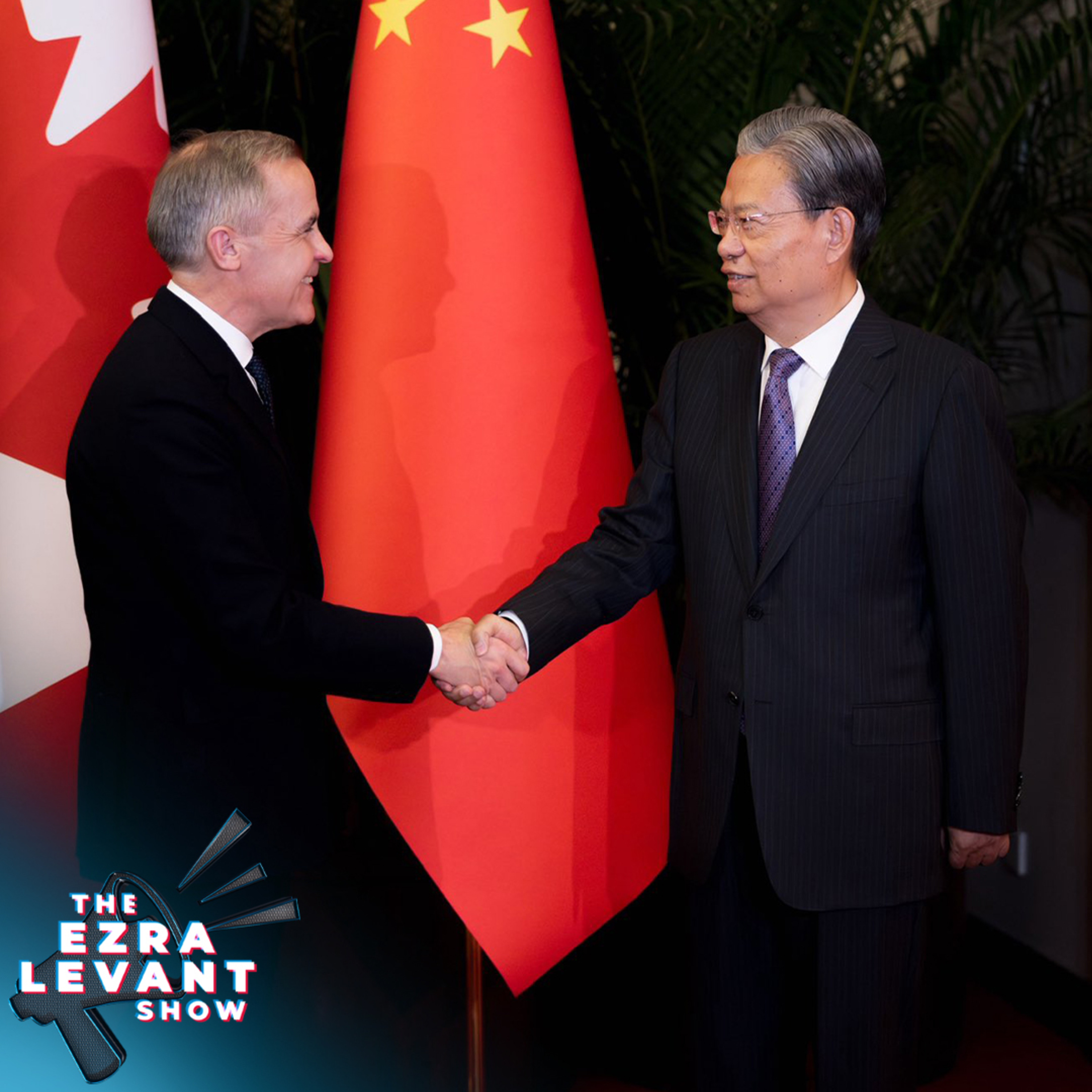
Rebel News Podcast
EZRA LEVANT | Carney threatened Netanyahu — now he bows to China's Xi
00:42:43
Tonight, Ezra highlights how Mark Carney and his cabinet colleagues are on yet another international junket. Private jets, five-star hotels, rubbing elbows with global elites ... all while Question Period passes largely ignored. Parliament’s workdays have never been so few. China, the World Economic Forum, Qatar: the anti-American tour is in full swing. Listen to audio-only versions of RebelNews+ exclusive shows like the daily Ezra Levant Show, the Gunn Show, and audio versions of our DAILY livestreams along with other Rebel News long-form videos and interviews.
Loading summary
Transcript29 lines
- [00:00]
A
Hello, my friends. Big show today. Mark Carney and his cabinet go to China and call for a new World Order. I'm not kidding. We'll play for you the videotape. Also a discussion with our friend Mark Morano, who's going to the World Economic Forum in Davos too. But first, let me invite you to become a subscriber to Rebel News plus. That's the video version of this podcast. Just go to rebelnewsplus.com, click subscribe. Eight bucks a month might not sound like a lot to you, but it sure adds up to us. Foreign. Tonight, Mark Carney threatened to arrest Benjamin Netanyahu, but he's getting on his knees to meet China's xi Jinping. It's January 15th, and this is the Ezra Levant Show. You fighting for freedom. Shame on you, you sensorious bug. Oh, hi everybody. I am in our Toronto studio, but I'm recording this on my laptop because there's such a huge snowstorm and the snow is so high that a lot of our staff are unable to come in. It's not that I have any special powers, it's just my car has a little bit more clearance, so I was able to get over the snow. So forgive me for our sort of homemade way of recording today, but we have my monologue letters and an interview with Mark Morano, who's gonna be at the Davos World Economic Forum for the first time. So we're gonna show him around a little. Anyways, I wanna talk a little bit about Mark Carney's trip to Communist China. He and his cabinet ministers are on yet another junket. I swear he never stops. It's what he likes to do best in life. Private jets, five star hotels, hobnobbing with the global elites, lots of conferences, not really doing anything, but lots of meetings and photo ops. Has he actually done anything? Can you name one thing concrete that he's achieved in his nearly year as Prime Minister? And I can tell you one thing, he hates doing grubby things like having to answer questions in question, period. He's got one of the lowest number of work days of any parliament in recent memory. He just doesn't really care about Parliament. That's too democratic. He's busy going to con conferences, though. On this trip alone, he's going to Communist China, the World Economic Forum, where he used to be a board member, and Qatar, the strongest supporter of terrorism in the world. If Iran falls, it'll really be the last refuge for all the scoundrels. I call it an anti American tour, wouldn't you? China, World Economic Forum, Qatar. I mean, I think that's our, our new policy. We have a new foreign policy. I don't know if, I don't know if you know that. It just is new and different. There was no election about this. Carney did not give any indication about this in the election. There was no vote in parliament, not even a debate. Here's Anita Anand, the foreign minister who sounds a little bit like Kamala Harris here. She sort of makes Melanie Jolie look smart by comparison. She's just sort of announcing that we have a new foreign policy. Did you know that? Here, take a look. This is a new government with a new prime minister, a new foreign policy and a new geopolitical environment. In this moment of economic stress for our country, it is necessary for us to diversify our trading partners and to grow non U. S trade by at least 50% of over the next 10 years. The work that we will continue to do is to diversify supply chains while.
- [04:01]
B
Continuing to stand up for Canadian interests at every turn.
- [04:05]
A
New government, new foreign policy and we're diversifying exports and supply chains. We're literally trying to replace our supply chain as in the parts that we put together into manufacturing or we think China would be a better supplier than the United States. Is that a good idea? Her job is to stand up for Canadian interests and she says she's going to do that there. But I really don't think she's standing up for Canadian interests. I don't think that China fits with Canada's interest, not economically, not democratically. They have massive industrial espionage activities here. They basically destroyed Nortel, our our national champion and took all the secrets and made Huawei. They steal things from our Ebola labs. They infiltrate our democracy. The Communist Party of China is in no way in Canada's interests. I think Anita Anand just is looking at the money and the anti American opportunities. And I'm not the only one to think this. And you don't have to be a right winger to think this. You take a look at a couple of journalists who were traveling with Mark Carney and Anita Nan. So you know they were regime journalists even they were saying, hey, how come we have to have burner phones? You know what I mean by that? Not your real laptop, not your real cell phone, just something you use for the few days you're in China because it'll be totally hacked by Chinese spies because that's what they do here. Take a look at that question.
- [05:35]
C
Can I just ask a general question about Investing in China.
- [05:38]
A
There's a ton of experts we've spoken to in the business community in Canada who are gun shy about investing in China. Joint ventures aren't so such.
- [05:46]
C
It's China win. It's not Win win.
- [05:48]
A
We're using burner phones for the first time when we covered this because China spies on journalists and businessmen. China intercepts communications. Is China really the right kind of partner for Canadian industry?
- [06:01]
B
Listen, we've been clear eyed, we're eyes wide open. We know this, but there's been investments by Canadian companies for years. Here tomorrow, meeting with Maina Magna, one of the biggest car auto parts companies in the world. They have 30,000 people working here. We're meeting with Manulife, we're meeting with bmo. These companies have been in China for years now. Obviously we're having these conversations with the Chinese government. If they're going to invest in our country, they need to make sure that our companies are able to invest and have access to stability and have access to a form of certainty. And so that's what we're working on. When we engage with China and we engage with businesses like Tim and I have been doing. We put everything on the table to address these risks. And that's why this visit is so important. And it's been a focus of the Prime Minister.
- [06:55]
A
Yeah, so they went to Melanie Jolie for that. Tough question. And did you hear there was a what she said, but it was just sort of a classic one. Yeah, we know they're terrible. We have clear. We're clear eyed, our eyes are open. But hey, did you know that we have Canadian firms trying to get rich in China? Okay, I know that's true, of course. Jean Kret Chen has been in China for more than 20 years trying to get rich. And I'm sure he has, but isn't this junket supposed to be about getting China to invest here in Canada to make jobs and wealth here in Canada? How exactly does Anita and Ann stand up for Canadians? Is it like this? Take a look at this tweet. She said, I don't know if you heard, but a Canadian was murdered in Iran. A Canadian democracy activist murdered by the Iranian ayatollahs. And this is what our foreign minister said. I have just learned that a Canadian citizen has died in Iran at the hands of the Iranian authorities. Has died. It's pretty passive language. You mean was killed? Was murdered even. No. Has died. Did he die of old age? Our consular officials are in contact with the victim's family in Canada. And my deepest Condolences are with them at this time. Peaceful protests by the Iranian people, asking that their voices be heard in the face of the Iranian regime's repression and ongoing human rights violations has led the regime to flagrantly disregard human life. The violence must end. Canada condemns and calls for an immediate end to the Iranian regime's violence. Okay, are you going to threaten to arrest the ayatollahs like you said you would arrest Benjamin Netanyahu? Are you going to declare sanctions on Iran? What are you going to do other than just put a little tweet? It was so gross. You can see the capitulation in real time. But I think the classic moment today was Mark Carney sitting in a meeting with Communist officials and pledging allegiance to the New World Order. That's literally the phrase he used. And you can see that Saskatchewan's Premier, Scott Mo, is seated right next to him. And Mo is thinking, oh, my God, am I on camera as he's saying this? Take a look. I don't know if you know this, but Canada's new foreign policy, and it's called the New World Order. Take a look. Mine is the first visit of a Canadian prime minister to China in nearly a decade. The world has changed much since that last visit. I believe the progress that we have made in the partnership sets us up well for the New World Order. Yeah, it wasn't always this way. I mean, there was a brief moment when Carney was running for office and it wasn't in the bag yet. And he said things, I'm going to call them lies about China that I think he thought would win Canadians over. And then he could reveal his belief in the New World Order. Like here he is saying that the biggest security threat in the world to Canada is China. He said this. Take a look. Well, we're in a security section, I think we didn't have a chance to talk about anything internationally. I think the biggest security threat to Canada is China. China, you say? Yeah, he doesn't say that anymore. Or he's willing to accept it as a price. For what? There's no Chinese investment. There's no Chinese money coming over here. China takes. It doesn't give. It's not a generous country. It's a communist dictatorship. Here's a couple of more. Mark Carney, Cabinet ministers talking about selling energy and other things to China. Try to make sense of this. Take a listen.
- [10:48]
B
And so that is why Tim and I, obviously, with the prime minister supporting the prime minister, have met many businesses today, maybe in natural resources, energy Maybe in clean tech, maybe also much more in manufacturing. And the goal was to see what type of investments could be made in Canada and how also can Canadian companies export to China. Because it's important to remember ourselves, China is the third biggest investor in Canada with $50 billion invested in 2024. But also China is our second biggest client in the world because it is our second biggest market where we export. I think a lot of people in the auto sector right now, I'm thinking obviously of auto workers have been preoccupied when hearing what is happening south of the border and the different comments regarding the capacity of Canada to continue to export autos cars across North America. And so that's why my team and I have been working on a new auto strategy, because our goal is to make sure that we favor auto production in Canada. We need to make sure that we continue to have a very strong auto sector. There's 125,000 people working in the sector with direct jobs, indirect, it becomes 400,000 people involved in the auto sector. And at the same time, we're trying to attract a lot of investments from Korea, from Germany. And also we're looking at different partners around the world. And so these are ongoing conversations, and that's why we'll have more to say tomorrow.
- [12:36]
A
What we heard loud and clear is China is looking for reliable trading partners, trading partners that don't use energy for coercion. China is already a major consumer of Canadian energy. Like we heard when I was in the UK like we heard when I was in Germany. Germany, like my colleagues have already heard in Japan, in Korea. The world wants more of what Canada has. Canada has the lowest carbon intensity LNG in the world. And we are decarbonizing our barrels and more aggressively looking to decarbonize our barrels than any other country in the world. That's consistent with the values of many of our trading partners, including the Chinese. They want more of what we've got. There's actually some points in there that have meaning. Tim Hodgson, that's the Natural Resources Minister under Carney, says that China wants to buy some oil where there's no political coercion. What does that mean? Well, he's talking, of course, about the United States because the United States has sanctions on Iranian oil and Russian oil. And Trump just announced a couple of days ago that any country still buying energy from from Iran will have a 25% tariff added to them. So who possibly could Tim Hodgson, Carney's natural Resources minister, be talking about talking about America because Trump, now that Trump has Taken control of Venezuela's oil. Between Venezuelan oil in the hands of America and Iran being tariffed, China is being surrounded. This is Trump's way of isolating China and Russia, frankly, by stripping these oil reserves. Tim Hodgson is going to China and say, hey, hey, hey. We will be your secret exit. We will be your way out of this problem of political coercion through oil. Let me say that again. Mark Carney's cabinet minister is saying to China, we, unlike the Americans, will let you buy our oil. We're not going to put tariffs on things. You can get it from us instead of America. Boy, good luck with that. Then it goes on and gets a little weird where Hodgson talks about reduced carbon being some selling point. Have you ever heard any kind country in the world, let alone a totalitarian regime like China, say will only buy your oil if it has lower carbon? No one else in the world is crazy like that. No one talks about that made up stuff. Certainly not China, which is the world's largest emitter of carbon dioxide. If you care about that sort of thing and most people don't, certainly not China. The idea that China really cares and agrees with this self delusion is quite something. But look, what's the reason they went to China? I think the main reason they went to China was to tweak Donald Trump's nose. I think they went to China to give the perception that they're going to replace America as Canada's economic engine. So I think it's about two shows. One to propagandize to Canadian people that they can find a substitute to America and the other is to target Trump and irritate him to keep the back and forth battle of words going. So anti Americanism continues to grow so Carney can be reelected. I think that's what's going on here. But let me show you a chart of Canadian exports by country. I got to tell you, we really don't export a lot to China. Look at the chart here. We export $550 billion worth of stuff to the United States. And then sort of tied for second and third place are China and the United Kingdom at 20 billion each. So America is at 550 billion and China and the UK are 20 billion each, and Japan is 10 each. You know, Anita Anand and Melanie Jolie talk about doubling exports over the next decade. Okay, let's say you managed to double exports to China. So it's not 20 billion anymore, it's 40 billion. Okay, congratulations. The United States is still at 550 billion. There's literally no way to make up your losses. And what are the big things that America buys from Canada now? Automobiles, which is why Ontario's worried, and oil. Those are the two biggest exports by far. Well, China doesn't want our cars. Our cars are too expensive for them. They have their own auto industry. They want access to Canada's auto market. And China gets some of our oil right now, but it can't really get a lot more because no one can, because there's the tanker ban, there's all these activists stopping new pipelines. So the two things that we could use some help on, energy exports and auto exports, they're not going to go to China. One because they don't want our cars, and the other is they can't get our oil. I looked at how much we import from China and we do about triple buying of stuff from them than they do from us. And that's obviously true. To go to any Walmart, go to any store of any sort, go to your computers. I mean, you don't have to. It doesn't have to be, you know, low quality stuff, high tech stuff. Your Apple iPhone is made in China. Absolutely it is. We buy three times more stuff from China than they buy from us. China is not helping us. This is just a pouting tour. You know, Carney's doing this a lot and I think it's going to catch up with him. Donald Trump's a really busy man and his attention is on many things in the world. Right now it's on Iran. It wouldn't surprise me if this weekend he attacks Iran. He seems to do these attacks on Fridays and Saturdays. He's focused on that. He's focused on Russia and Ukraine, he's focused on the midterms. He's got a lot of things on his mind. I don't think he's following Mark Carney closely and I think that is very lucky because look at this. The other day, Mark Carney called up Lula, that's the communist President of Brazil, and they had a conversation on the phone and Mark Carney told Lula that what Trump did in Venezuela was illegal. Now, I guess you can have a debate over this. The American contention is that Nicolas Maduro was an illegal usurper. He lost the election, he had no legal right to be in the President's mansion. And more to the point, he's a narco terrorist and an indicted criminal who has to go on trial. That's their case. They said they weren't invading. They just snatched the narco terrorist and now they're dealing with the Venezuelan regime that remains. Mark Carney disagrees and he told that to Lula. And Lula was so excited to hear this anti Americanism coming from Mark Carney that he publicized it online. Okay, well maybe he was exaggerating, right? Maybe he was just weaponizing what Carney said. But no, you can see underneath that. Canada's embassies gave the thumbs up and amplified it. They're so excited that Lula sees Mark Carney is on his side, not Trump's side. How's that helping us? Foreign affairs and diplomacy are about one thing only promoting Canada's national interests. Anita Nan says that, but she doesn't mean it or to understand it. There's a hard nosed saying in diplomacy sometimes that a country has no permanent friends, only permanent interests. That's probably not true if you're dealing with like minded countries like Canada and the United States. We're really inseparable. It's like Siamese twins. There's no difference between us in terms of we share the political, cultural, linguistic history and we just so much in common. Whatever differences we have are, are trivial. But how is what they're doing in China and Qatar in the World Economic Forum? How is that pursuing our interests? You'll never win over, you'll never succeed in our permanent interests of prosperity if you keep poking at the United States and sucking up to their rival China or the World Economic Forum and the globalists. So you'll never replace the Canada US Relationship is what I'm saying. And you would never want to. Every other country in the world would love to be next to the United States. You don't have to have a defense. That's our shame. We're slackers, we're free riders, but they protect us. You have access to the world's greatest market. Heck, you can scoot across the border and get cheap gasoline and cheap milk. There's a million reasons why we're the luckiest country to be next to them. Trump will be gone in three years plus one week. By the way, you don't need to hate America. You shouldn't. You shouldn't hate Trump either. But even if you do, he's going to be gone in about a thousand days. Mark Carney is trying to whip up anti Americanism as a permanent feature of the Canadian psyche. That is wrong. I think this is going to continue under Carney. Canada was anti Israel and pro Hamas. Canada was praised three times by Hamas. Now Canada's murmuring pro Maduro comments. Going to China to talk about a New World Order. Canada is going in a direction that was never approved by the people, not even a debate in the Parliament. I think, though, that Carney could win another election right now on anti Americanism. I think the media has helped with that with their Trump derangement. But every year I think Canada gets weaker because of this and I think that's going to accelerate soon. Stay with us for more with Mark Morano next. Well, as you probably saw, saw with our video announcing our editorial plans, I'm headed back to Davos, Switzerland, along with my colleague Abi Yamini, who's coming all the way from Melbourne, Australia. And we're each coming with a trained videographer. Lincoln J is affiliated with me and Benji Chung with abhi. And it's a fun job. It's like going fishing. You never know what you're going to catch. We wait outside the inner sanctum, the World Economic Forum, for when the vvips walk out amongst the peasants and we do our best to identify them quickly and scrum them. We've had good luck every year we've done it. It's a very exciting kind of journalism, even if when we finally catch us an oligarch, they don't have a lot to say. I'm excited to hear that an old friend of mine who follows these globalist beats will actually be in Switzerland at the same time. You'll be delighted to hear that it's Mark Morano, the boss of ClimateDepot.com and he joins us now. Mark, great to see you. Normally we see you at the global warming conferences, but this time you're coming to the World Economic Forum. Have you ever been to the World Economic Forum before?
- [23:29]
C
No, never been to Switzerland or Davos before. So I'm looking forward to it, even though I wrote a whole book on it. The Great Reset, Global Elites and the Permanent Lockdown. But it's all part of the same agenda. And Donald Trump is expected scheduled to go and he gave a great speech. I think it was 2019, just laying waste to the World Economic Forum, particularly their climate agenda, comparing them to fortune tellers of old based on the old climate agenda and the climate models. So I hope in Donald Trump shows up this year and just does what he did to the United nations back in September of 2025 and just ripped them. I mean, yeah, incredible section just on the climate agenda. It was phenomenal and I expect something similar next week in Davos.
- [24:14]
A
Yeah, I'm excited about it, too. I mean, Trump really is going right into the heart of darkness. Klaus Schwab is sort of the anti Trump Larry Fink, the head of Blackwater, sort of taking over now from Klaus Schwab as he's. Schwab has been engulfed by scandals and he's probably time hit for him to retire anyways. But there's still a lot of things going on. A lot of masters of the universe are there from Canada's point of view. Our prime minister Mark Carney was on the board of the World Economic Forum for years. Chrystia Freeland, our finance minister, was on the board for years. Justin Trudeau was a World Economic Forum young leader. So when people say, oh, you're exaggerating the power of these globalist institutions, I say no. They may not have formal power, like they don't pass actual laws, they don't have police or armies, but they're a think tank that gets injected right into the veins of politicians and business people and cultural elites around the world. Like all of a sudden you start hearing everyone say the phrase build back better at the same time. That's cooked up in Davos. Mark, I'm really glad you're coming because I think you're sort of a kryptonite to these people. At least I hope you will be.
- [25:30]
C
Yeah, I'm looking forward to it. You know, I think most people pre Covid and I credit COVID lockdowns and the mandates and the vaccine mandates and the stay at home orders, all that with this rise of climate skepticism, which is the reason, you know, in the United States, CNN's reporting where lower climate skepticism, more climate skepticism, same levels we had in the 1980s. That's how low people just don't care anymore. They lost by COVID lockdowns, the appeal to authority. And I think the World Economic Forum was front and center along with the World Health Organization. The idea that you can't question this, you're anti science denier, you know, don't question the science. I believe in science. Because of that. You had people like RFK Jr. Basically say, I'm no longer going to talk about climate change. It's been hijacked by the World Economic Forum for totalitarian control of society. I think that in some ways we owe a debt of gratitude to Klaus Schwab and the world because no one had heard, I mean the phrase, I think great reset began in 2014. It wasn't until June of 2020 when Klaus Schwab penned that article where he called now is the time for a great reset. And then they all, of course, Justin Trudeau and every world leader parroted that phrase ad nauseam. But what they didn't realize is that corporate sort of melding of government and politics and governments and the melding of corporations and governments turned off the public globally so much. This led to of course the truckers rebellion. It led to I think Donald Trump's reelection in 2024 by such an overwhelming margin. It's the reason people don't trust institutions anymore. We don't trust public health, we don't trust government science, we don't trust, you know, the world health. We don't trust World Economic Forum. And the fact that Larry Fink is now the co chair and head of IT is kind of a dark episode because this is a guy ahead of a blackrock. This is a guy heavily invested now in AI. I don't actually know your personal views or your views on AI, but I, you know, I still can't get the words of Yaval Harari out of my head. The World Economic Advisor, World Economic Forum advisor about useless eaters and how we're going to need psychotropic drugs and, and video games to keep us all occupied once AI takes over all the jobs. I look at AI as is fraught with danger and I think Donald Trump just in the last couple weeks in a lot of pushing. I was on Fox News over the weekend. The Fox News hosts are now saying that AI data centers are equivalent to solar and wind farms out there. They're almost like a virtue signal to this future that we don't really want. And, and they're sucking down all the power. So this is what I think is really going on behind the scenes here is the sort of billionaire oligarch corporation. They're going to be pushing this sort of AI, the idea as to displace the masses, which is you and I, that's part of it. They're looking for a post climate agenda and they're going to be continuation I think at this summit of that merging of climate into public health. This is why again just to repeat, you go back the doctors in 2020 Australian university wanted to have climate listed as a cause of death on death certificates. You had the Canadian doctors for the first time ever about 3 or 4 years ago list climate change as a, you know, as a condition. On your diagnosis you diagnosed medically first medically diagnosed case of climate change. And then of course you have this whole net zero hospital push. You have the American Cancer Society fretting over the carbon footprint of cancer care. You have do doctors with carbon footprint climate that they're going to be Talking to people. So that is where I think they're trying to do with climate. They now know my headline at Climate Depot is Axios Mainstream Media calling about the total collapse of the climate agenda in the us there's no pushback even from the usual suspects. Bernie Sanders is silent, AOC is, and they can still fight back. They're fighting Trump on immigration, but they're not fighting them on climate. It's just been utter silent silence as that whole agenda collapses. So I think this is a really pivotal World Economic Forum meeting next week because they've got to figure their new strategy. They have to regroup. They've been beaten, battered and scarred and they need to come up with new ways to deceive the public. And I think one of it is to go stealth on climate. And I think there's going to be all touting this AI, which is a serious double edged sword for humanity.
- [30:02]
A
I think I share your view on AI. I did a big show on it the other day where I outlined some of my worries, you know, that climate is over. When Bill Gates, one of the worst climate fear mongers, says, well, it's not that important anymore because he wants his data centers, which have a lot of missions. So that's over. But you know, I'm very excited that you're coming to Davos and stuff. That's the town in the Alps. It's a few hours train ride or car drive up from Zurich and, and what you'll find interesting, and our viewers know this, is that this is a Lovely Ski Town 51 weeks of the year. But for the other week of the year, the World Economic Forum takes over everything. By the way, the rents and hotel rooms go up in price at least 10 times, sometimes 20 fold. And the main street of Davos, this is so interesting, it's turned into like a movie set, like all the shops and cafes for that one week shutdown and they're remade into like a pavilion for BlackRock, a pavilion for Meta, for OpenAI. So you walk down what was once beautiful downtown Davos, there's still a few restaurants and shops open, but maybe only 10%. The other 90% have been transformed into these little propaganda kiosks for the different companies. And you can sort of get a read for the pulse of it by what they're talking about. And, and AI for sure is the number one thing. And just walking by and hearing snippets of people talking as they walk by you, it was so clear to me, Mark, that stopping Trump was their most important goal. A couple years ago. And so their secondary goal was stopping Elon Musk. And that really hasn't changed. They're going to try and do it through AI if they can remove any human accountability or responsibility and teach the machines to silence us and censor us and monitor us. That's what I'm afraid of. I mean, I look forward to your direct observations when we get there because you'll have a unique take. By the way, on the main street last year I encountered a guy giving away chocolate bars made with bugs. He was that, you know, you will eat the bugs. It was for real. He was giving them away and he wasn't being very conspicuous about what was in it. Some people just didn't really hear what was in it and they took one.
- [32:32]
C
To eat for free.
- [32:33]
A
Other people, when they heard what it was, they said, no thanks. Others said, sure. So there's little quirky things that I'd love to get your feedback on. Hopefully we can connect in Davos, because I would just love to see your reaction being in that weird Disneyland for globalists. It's like a movie set. That weird globalist Disneyland. I want to see your first reaction. I can hardly wait to see your face.
- [32:55]
C
Yeah, I mean I'm, I'm a veteran of course at these UN climate summits, 24 are the last. 22 are the last 24 summits going back to 2002. But they don't have the sort of power and wealth that you're describing that comes from the world economic reform. And what's interesting is the current co chair head Larry Fink has basically already thrown the entire climate agenda under the bus. It was April 2024 when he said solar, wind, power, AI. We basically need nuclear and fossil fuels. And lo and behold, that's part of the reason that Bill Gates flipped himself. That's why Mark Zuckerberg is now trying to get nuclear power plants that's solely devoted to powering his AI. Bill Gates is trying to get Three Mile island nuclear power plant to power his AI. Suddenly you have all of these climate activists now embracing fossil fuels and nuclear, something that never would have happened. And I think this is why the corporate media globally is shifting. You can now read the BBC and Bloomberg. I have articles up from Bloomberg News talking about today Ezra Sweden is now abandoning climate goals. And not only that, but they went so far in this article from Bloomberg News, mainstream corporate news from a child of Michael Bloomberg, one of the biggest climate activist funders in the world, saying that the Fridays for future that Greta Thunberg had started way back in 2000. I think it's 18. I have to look it up. 20, 18 and 19 is now down to one or two kids. They called it, quote, deflated. There's no passion left for climate, even in Greta's home country. Of course, Greta abandoned it. I like to joke that the one great contribution of Greta going to Israel was that she became a hypocrite because she violated her no fly pledge after the Israeli government sent her back home on an airplane. And you saw that picture of her sitting on the plane involuntarily.
- [34:52]
A
I did see that one.
- [34:54]
C
That's funny.
- [34:55]
A
Hey, let me ask you this. You mentioned that the reason you're over there is that there is a counter conference, like an antidote in Zurich, which is a few hours away. As I mentioned to you, just before we turn on the cameras, we're going to be pretty busy hunting for oligarchs on the streets of Davos. But tell me a little bit and tell our viewers about what's cooking in Zurich. You guys are putting together an alternative conference. Maybe we could. I don't know if we're able to send someone down there because we, we got to do what we do in Davos. But give us a minute on what you're actually up to in Zurich.
- [35:30]
C
Yeah, I'm one of the speakers at it. They say they're trying to get Nigel Farage or get many EU Parliament members and they're going to have a counter summit every day, Monday through Friday of next week during the same time the Davos is going on. And I'm giving my speech is going to be on update to the Great Reset. My speech is titled the Great Rejection. And I'm going to talk about everything that's happened post Covid and how all of the things the World Economic Forum pushed has turned against them and the public's turned against them. Not to say that the World Economic Forum is losing or going to lose because this is the most powerful people on earth. Presidents, prime ministers, corporate leaders, billionaires. But how they all these missteps and how we can fight back and how they're of course, what's happened to the climate agenda. But this is going to be the cream of the crop of European government leaders and European think tank leaders all coming together, and a lot of them from America as well, to basically how we fight The Great Reset 2.0, which will be happening in Davos. And a lot of it is going to be under the stewardship of Donald Trump. We're expecting him to go and just literally eviscerate the World Economic Forum as he did the U.N. i can't guarantee that's going to happen, but I have a good sense that that's going to happen.
- [36:42]
A
Yeah. I mean, by the way, Europe is totally obsessed now with America and sovereignty of other countries. A lot of them were apoplectic when Trump took out Nicolas Maduro, the dictator of Venezuela. They're upset with his ambitions in Greenland. And of course, I don't know if you know this, but every year at Davos, the Ukrainian government has a pavilion where they make the case for standing with Ukraine. So there's all sorts of global geo military politics. It's not just the climate stuff, it's not just the AI they there are. I mean, Ukraine has been a big issue over there. So he may. It wouldn't surprise me if Trump talks a lot about his vision for NATO and for the world and America's new Monroe Doctrine. So it's not, it will hopefully be a counterpoint to some of the ideologies of globalism and climate alarmism. But you never know what he's going to talk about. But it could be about censorship because the Americans are really on a tear in Europe, smashing them for their intended use of AI, which is of course censorship. Have you been following that at all? Because I mentioned AI is a big deal there. But censorship and AI go hand in glove. And the World Economic Forum. Give me one minute on your thoughts of censorship and what the Trump administration has been doing in saying, especially in Europe, to push back against censorship of American social media companies.
- [38:11]
C
Well, yeah. What happened first with JD Vance when he was first sworn in, he went to Europe and condemned their censorship. And actually, surprisingly, our 60 minute CBS here in the United States had a great interview. I'm sure you saw it with the three European, I want to say bureaucrats. But you know, talking about how the censorship and what's legal and what's not and how liking post.
- [38:31]
A
Right.
- [38:32]
C
That's been a huge battle. They're trying to essentially come out after censorship via through the EU to Americans. And I think that will be a big part of what Donald Trump talks about. And AI again, it's just a scary technology that is so easy to be misused. Because when you have the world's billionaires all backing this up, like we I'm in Virginia, which is the number one state for AI data centers in the country. That's where I live, state of Virginia, outside of Washington D.C. we have politicians who they get elected. We're going to stop the data says we're going to and they don't get stopped. And when you think about, you know, these are look like Soviet era architecture. They're big, endless, eight football fields long, all concrete, windowless buildings. You first of all get the sense that within five to 10 years they're going to end up not needing these data centers because there'll be a technological advance. You're going to end up a blight on the landscape already, but they're going to have these abandoned data centers. But anyway, all this is going on and I think one of the driving forces is for global censorship, and particularly the us, the EU bureaucrats to help impose that.
- [39:38]
A
Well, we'll keep our eyes filled. I hope we have a chance to bump into each other. For sure we will in Davos. If we can get down to Zurich to see you in action, we will too. Mark, great to catch up with you. Thanks for taking the time.
- [39:48]
C
Thank you, Ezra. I appreciate it.
- [39:50]
A
There he is, Marc Morano, the boss of ClimateDepot.com. we always see him at the global warming UN conferences. It'll be fun to have him at the World Economic Federation. Stay with us. Your letters to me next. Hey, welcome back. Your letters to me. Fed up says about the Sam Cooper interview about China and Carney. It is interesting to see that Canadians are concerned mainstream media driven about a Trump takeover, but show no concern about communist China infiltrating Canada. You're so right. And real infiltration, like packing school buses to send voters to nominations. Crazy stuff. Threatening Joe Tay with a political bounty. Just madness. Marie Perrin says tell China no billion dollar ferry deal unless tariffs are removed from Canoa. Hey, that's a good point. But normally in negotiations, you don't agree to pay a country a billion dollars for their ferry and then ask for something in return. That's Canada. Just showing we have no art of the deal. We have no clue how to negotiate with friends or enemies. And that's why Donald Trump so infuriates us. We just don't know how to deal with them. And Mark Carney was supposed to be the guy who did. He doesn't. Grizzlehead says PetroChina is trying to gain full control of the Grand Rapids pipeline. Canada and Alberta cannot let this happen. This is why we don't want Chinese investment. Well, Stephen Harper put a stop to Chinese investment in the oil sands. But then Justin Trudeau and Alberta's Premier Rachel Notley put an end to all investment in the oil sands. So they're on their back right now. It would be really weird if Mark Carney supported the new growth of the oil sands as a favor to China as opposed to his hatred for Alberta. Carney and Trudeau hate Alberta, so they stopped the oil sands. Wouldn't it be crazy if Carney loved China more than he hated Alberta and allowed the pipeline to go? Trouble is, that takes years to do, and China needs the oil now. Jojo Pag says I could see Trump going with a team to the World Economic Forum meeting in Davos. It'll be interesting to see this. Trump has gone before and he's given a speech before. He's gone right in the lion's den and sort of told them what's what. And I think Davos, they sort of love having him, even though he really criticizes them. Think about what it means to have Donald Trump come and speak at your conference. It means your conference is the most important place in the world. So it's very interesting he will be there speaking, and I look forward to hearing what he has to say. Well, that's our show for today until tomorrow, and hopefully our team will be back despite the snowstorm. On behalf of all of us here at Rebel World Headquarters, to you at home, good night and keep fighting for freedom.