← Rebel News Podcast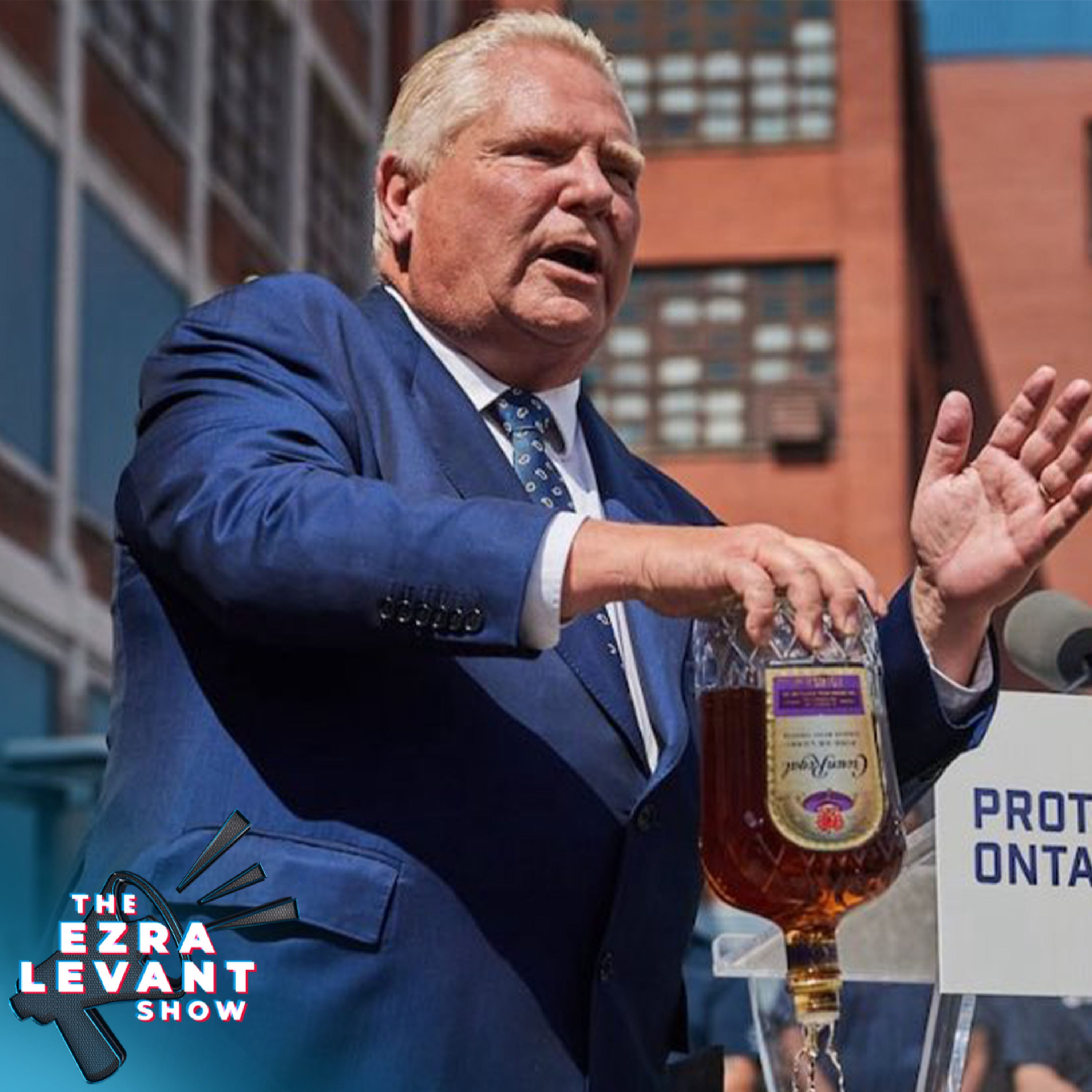
Rebel News Podcast
EZRA LEVANT | Doug Ford's booze ban proves gov't monopolies never work
00:46:40
Despite claiming sobriety, Ontario Premier Doug Ford is strangely fixated on alcohol policy, with his U.S. booze boycott contradicting the reality of rising prices.
Loading summary
Transcript37 lines
- [00:00]
David Menzies
Tonight, what are the political booze rules in the province of Ontario in terms of what gets on the shelf and what gets taken off? Well, it's kind of like that Meryl Streep movie. It's complicated. It's Friday, October 10th, 2025. I'm David Menzies, and this is the Ezra Levant Show. Freedom. Shame on you, you censo. You know, for a guy who says he doesn't drink alcohol, Ontario Premier Doug Ford seems downright obsessed over booze, doesn't he? It all began with a weird obsession going back some seven years ago, in which Ford promised on the campaign trail that Ontarians would be able to buy a can of beer for a dollar. Buck a beer. Buck a beer. Buck a beer. Ford promised I'd buy that for a dollar. Yeah, and how did that turn out? Well, I think buck a beer in Ontario lasted for all of two weeks. Then the price soared. Gee, today you can't even buy swill like Bud Light for a buck. Even to a guy like me, that's cold. But really, given all the problems facing Ontarians then and now, you know, like unemployment, a record deficit in debt, school boards being infiltrated by Marxists and Islamists, and so much more. Were Ontarians ever really all that obsessed about getting a can of suds for a loony? Give me a break already. But from promising cheaper alcohol products, Ford these days is all about banning certain booze from the shelves of of his bloated booze monopoly. That would be the Liquor Control Board of Ontario. But make no mistake, the LCBO is indeed all about control. Ontario isn't Alberta, which has enjoyed a fully privatized system since 1994. That was the right move then. It's the right move now. Of course. I mean, there is a role when it comes to the government in alcohol, and that role is to tax and regulate the product, not to warehouse and retail the stuff. Still, with Ford going on a booze banning jihad, one wonders if the LCBO will have any liquor left to control in the months ahead. And disturbingly, the booze banning has nothing to do with quality control or sales figures and everything to do with political grandstanding. This trend kicked off in 2022 when Ford ordered the LCBO to yank Russian vodka off the shelves. This was due to the ongoing war between Russia and Ukraine. Three years later, well, knock me down with a feather, these two nations are still at war. Golly, Ford wasn't able to intimidate Vladimir Putin to sue for peace. Shockers. But at least Ford scored A PR photo op. And Doug Ford loves photo ops almost as much as he loves his cherished cherry cheesecake.
- [03:36]
Doug Ford
If I wasn't Premier, I'd open up a Cheesecake Factory. That, my friends, is the Premier's cheesecake Friends. Stay safe, stay healthy. And these are some of the fun things you can do when you self isolating.
- [03:51]
Phil Demer
Oh.
- [03:55]
Doug Ford
I haven't had one of these in years.
- [03:57]
David Menzies
Yeah, what a fun thing to do when being quarantined. Sit around all day eating garbage. But these days, Ford orchestrating booze, banning photo ops as opposed to, oh, I don't know, doing something tangible. It's getting a tad boring, wouldn't you say? Case in point, earlier this year, all US Liquor products, ranging from California wines to Kentucky bourbons were also pulled from LCBO shelves as a result of the ongoing tariff tiff between the US and Canada. But let's think about this for a moment, shall we? What was taking $1 billion worth of bought and paid for inventory off the shelves of the lcbo? What was it supposed to achieve? These products are now taking up space in a warehouse somewhere, which is being paid for by Ontario's ever beleaguered taxpayers, of course. Thanks, Dougie. Whatever happened to your old, albeit brilliant slogan, respect for taxpayers? I mean, even if you agree with banning US booze, why not sell off the existing inventory advising customers that when this stuff is gone, it's gone? Oh yeah, what am I saying that would eradicate that stupid photo op of LCBO staffers yanking us hooch off the shelves? So take that Donald Trump. You know, this is the very reason why monopolies, especially government run monopolies, are both odious and egregious. Indeed, selectively playing politics and banning certain boos thanks to country of origin is an example of an abusive monopoly. And because the provincial government owns and operates the LCBO monopoly, all this booze canceling qualifies as abuse of regulatory authority. Someone really ought to sue. And please don't tell me that if I love Kentucky bourbon so much, I can just take a day trip and cross the border to, say, New York State or Michigan and pick up a bottle in the US of A. There's just one hitch to that strategy. Cost. Remember when I went to a Detroit liquor store last month? Folks like a rube, I actually declared my bottle of Booker's Bourbon at the Detroit Windsor BO border crossing. Spoiler alert. I found out that honesty is not the best policy. Check it out. Now, as you can see, this is the bourbon of choice. When I come to the US bookers. It's expensive. It's 120us but you can't get this at the LCBO because of Doug Ford's photo op of removing all American booze from the lcbo. In fact, you can get even the cheapest bourbon, because anything from Kentucky, anything from California, that is product non grata. So I'm going to do the honest thing. I'm going to declare this at the border. Wonder what the penalty will be in terms of taxation, tariff, customs, however you want to call it. Now, here's the other thing. This is Zyn. Yes, it contains nicotine, but certainly not as much nicotine as what's allowed for sale in Canada. And by the way, there's been recent studies showing that Zyn, the consumption of which helps those with Parkinson's disease. But Health Canada does not approve this. So what does that mean? Is it more than paying a customs fee? Is it actually getting this confiscated? Even though Tobacco Classic is sold in Canada? We're gonna see when we cross the border about an hour from now. Well, folks, we just emerged from the Detroit Windsor Tunnel, and we told the truth, that we had a bottle of bourbon, a package of Zyn. Oh, did we pay a price? Let's start with the Zyn. As you can see, this is me consenting to voluntary confiscation of the Zinn. The other option was to go back to the United States and use it there or give it away there. But given that it's a 699 item, well, you would pay more in the toll to do that. So I had no choice but to give it away. And by the way, they told me they're going to destroy it. And the reason is that Zyn is 6 milligrams of nicotine. The limit is 4 milligrams of nicotine. Now, you can get higher nicotine in Canada, but by prescription. So you see, it's the federal government hand in hand with Big Pharma. Big Pharma wants its cut. It doesn't want you getting the high nicotine product from the convenience store or the liquor store. So there you have it. Here is what the taxman wanted for declaring the bourbon. We'll start with $6.57 in duty. Oh, that's not bad. Oh, but wait. Then we have the GST HST component. That's $22.45. And, oh, well, you hear this one. The provincial liquor markup fee, $103.45. So the grand total, $132.47. So let's pretend we're in a chronology where the US and Canadian dollar are on par. I paid more in provincial markups, GST, HST and duty than what I paid for the actual bottle. 132, 47 versus 120. So I guess at the end of the day, I want to meet the jokers who coined the phrases honesty is the best policy and crime doesn't pay. And as for you, Premier Ford, you force me into this position, you won't allow me to buy a bottle of bourbon at your Crown Liquor monopoly. You know what? To quote Mike Elbows Up Myers, you really are a fat bastard. Yeah, I won't be making that mistake ever again. But now comes word that Doug Ford isn't quite done yet with the booze banning. And the latest threatened booze ban is really the most illogical one of all. You see, Ford is threatening to delist all Diageo products from the LCBO come February. Diago owns Crown Royal, and the Crown Royal bottling facility in Amherstburg, Ontario, which is near Windsor, is slated to close early next year. Diageo, it should be noted, is a booze behemoth. In the fiscal year ending in June 2025, it had more than US $20 billion in revenue. But when the Amherstburg plant is shuttered, 160 workers will be given their pink slips. This will be a debilitating blow for this town of 25,000. By the way, how is this even happening? I mean, isn't this why Mark Captain Canuck, Carney, Ford's newest best boyfriend in Ottawa, was elected in April. He was going to save the day and end the tariff dispute and make Canada great again. Or something like that. However, it looks like elbows up has been replaced with knees down. But never mind. For its part, Diageo says the closure of the plant has nothing to do with the ongoing tariff tiff. Marsha McIntosh, Diageo's president of North America Supply, said the following in a statement, quote, this was a difficult decision, but one that is crucial to improving the efficiency and resiliency of our supply chain network. End quote. Now, I did reach out to Diageo's media relations department for further comment, but I never heard back. I also paid a visit to the Crown Royal plant last month, but employees told me they had been instructed not to speak to the media. Naturally, the upcoming closure did not go unnoticed by Premier Ford and shockers. You guessed it, Ford staged a photo op, this time pouring a large bottle of Crown Royal down the drain.
- [13:27]
Doug Ford
So you know something? I found a bottle and I don't even drink of crown oil. Right. I see that Crown Royal. I saw it at home. So this is what I think about Crown Royal. That's what they could do. And I think everyone else should do the same thing. Start supporting companies that make whiskey here by Ontario people. That's what we need to do is support each other. You know something? I gotta make this even come out quicker, because it's not coming out. I know Mayor Barry wants to lie on the floor right now.
- [14:03]
Phil Demer
No.
- [14:03]
Doug Ford
Thanks, but no. I wish I could get the soap coming out quicker, but I'll stand here.
- [14:07]
David Menzies
Until it's all nice. What's more, a blustery Ford threatened to play hardball with Diageo should the closure go through as scheduled. Which is to say, all Diago products would be delisted from LCBO stores. That's a big deal. In addition to Crown Royal, Diageo produces more than 200 brands of booze, including Johnnie Walker Scotch, Captain Morgan Rum, Tangeri Gin, Bailey's Irish Cream, and Guinness beer. Ford says the LCBO is Diageo's biggest customer, with sales of its products at the LCBO amounting to more than 740 million per year. So far, the company has not reversed course and intends to close the Amherstburg facility in February as planned. Now, I'm of two minds about Ford's strategy here, folks. The announced closure is, of course, horrible news for this town. And I very much feel for the Crown Royal employees who will be out of a job in the months ahead if the closure indeed goes through. Windsor already has a staggering 11.2% unemployment rate. Where will these workers find jobs? But by the same token, in the bigger picture, I wonder, just what are the rules when it comes to those alcohol products that get delisted in Ontario? Not due to lack of demand, but rather due to politics. Well, let's start with Crown Royal, which is as Canadian as you can get. Crown Royal whiskey is distilled and aged in Gimley, Manitoba. There's also a bottling facility in Valleyfield, Quebec as well. The ingredients in Crown Royal, such as corn, rye and barley, are grown in Western Canada by Canadian farmers. Also, the Canadian headquarters and the warehouse operations of Diageo are. Are situated in the Toronto area. So if Ford goes through with his threat, this is going to affect everyone from farmers in the prairies to bottlers in Quebec. Last time I checked, those folks were still carrying Canadian passports. Oh, and here's another thing. Last time I surfed the LCBO's website, it was stocking some 176 products from China. 176. But why? China has an egregious human rights record. China is conducting a genocide of its Uyghur people. China has delivered a debilitating hit on Canuck canola farmers by slapping Canadian canola seed with a 78.5% tariff, not to mention a 100% duty of on canola oil meal and peas. And let us never ever forget that the People's Republic of China was responsible for the COVID 19 pandemic which killed millions of people and cost the world's economy untold trillions of dollars. So why does this communist dictatorship get a free pass at the lcbo? Why the hell are we doing business with these people when we don't need to? If Ting Sao beer is pulled from the shelves, well, too bad. So sad. Pick up a six pack of Labatte Blue or choose from hundreds of other brands that are domestically produced. You know, products that are bottled in Canada with Canadian ingredients and made by Canadian workers. Now, I did reach out to the Ontario Ministry of Finance which oversees the lcbo. And but like all ministries in Ontario under Ford these days, they are under a gag order and will not comment to the independent media. Pathetic. Gee, maybe we need to rebrand this province as the Democratic People's Republic of Ontario. And perhaps get Doug Ford fitted for a crown. At least that would amount to some truth in advertising. Then again, perhaps Doug Ford, like his former Ontario based best buddy Justin Trudeau, also has a level of admiration for China. End quote. Or maybe, just maybe, China makes the world's finest cherry cheesecake. If that's the case, you think Doug Ford is going to rock that boat. But the booze brewha in Ontario tells you all you need to know about the Ford PCs. They are all sizzle and no steak. They certainly aren't conservative. It's disgraceful. It's sad, it's nonsensical. It's self defeating. And in the meantime, I'm praying every day that Ontario doesn't end up getting into some sort of stupid dispute with Scotland. Because if Doug Ford declares the Yank Scotch from LCBO shelves, well, in the immortal words of Bugs Bunny, of course you know this means war.
- [19:49]
Marineland Jingle Singer
I know in Ontario where the sea lions kiss so the story goes it's amazing shows and friendship code. Everyone love Marina Land you'll be spinning, diving and soaring high I want a coastal ride we'll fly into the sky now you know what to say when you leave here today Everyone loves Marina.
- [20:16]
David Menzies
Yes, that was then and this is now, if you were to revise the theme song for the now defunct park known as Marine Landing Game Farm, I would say Everybody Hates Marine Land would be more appropriate. And a new low was reached earlier this week with Marineland basically telling the government that either pay up or we're going to kill off the remaining stock of beluga whales. It's unbelievable. Once upon a time, Marineland was a thriving theme park, but now they're selling off the land, the. They're selling off the thrill rides and they were trying to sell off their marine mammal stock, namely sending the belugas to a similar park in China until the federal government put the kibosh on that. So where do we go from here? Well, folks, joining me now is Phil Demer. He is a former trainer of Wales and at Marineland in Niagara Falls, and he is now a whistleblower and very much a thorn in the side of the people who are operating this now defunct park. Phil, thank you so much. Welcome to the Ezra Levent Show.
- [21:41]
Phil Demer
Thanks for having me.
- [21:42]
David Menzies
Well, Phil, first of all, let's begin with the, you know, the decision by the federal government where they blocked Marine Land from sending these whales to China. Now, a lot of people are saying if you do so, you're committing those whales to a death sentence, or at least misery in those apparently polluted and cramped tanks. But others are saying that was the right call because it'll just be more of the same in China. Where do you weigh in, my friend?
- [22:20]
Phil Demer
I think in the balance of things, the decision to send them to China would have been responsible. The facilities in China are for the most part way newer. In fact, many brand new. The specific facility called Chime Long Ocean Kingdom in China where Marineland was intent on sending the belugas, they have some of the world's largest tanks and the quality of the water is really good and obviously the life support systems are up to date. Etc. The minister ultimately made the decision because in the spirit of the law that we passed in 2019 called Bill S203, it basically ends marine mammal captivity in Canada with the caveat that exporting the animals can only be approved if it's in the interest of the animal as well, in that law was a breeding ban. Now in China, they continue to do performances. So, you know, trainers will enter the water, etcetera, with the beluga whales and as well they breed whales. So she really sort of hung the bulk of her rationale on the idea of stopping that. But the reality for these whales is the only options for Them is sideways. So it's another tank at another place. Again, I stress that most places have better conditions than marine land, but a question of the animal law, oversight and enforcement comes in, you know, comes into play in those considerations. But that said, when you've got 30 whales to deal with and only so many facilities in the US and only so many facilities around the world that can take them, by eliminating some of the better facilities in the world, you really narrow the options to not much better. So much is left to be seen on where this goes, but I think that's a decision that's going to be revisited.
- [24:12]
David Menzies
So Phil, assuming the government doesn't flip flop on this decision, as you said, there are options. What are the options? For example, I understand there are some sanctuaries out there. Is that viable?
- [24:28]
Phil Demer
There are not sanctuaries out there. There are proposed ideas, there are theories, none are operational. One tried in Iceland but unfortunately it wasn't working out and so it's taken more steps back than forward. And the proposed one in Nova Scotia is merely a theory. They do not have the landowner's approval. So call them a painting on the wall and a fancy presentation, but there's no viability, no realistic chance of sending them anywhere. That's a proposal of that nature. And frankly that would take years and years and years and years. And many of those sanctuaries have already been claiming that they would be ready for years and years and years and years. And you know, with using the Nova Scotia sanctuary proposal as an example, they started saying in 2019 that they would be ready the following year to get animals. Well, 30 whales of just about 30 whales have died in that time and there's been exactly zero progress. So as many whales have died since the proposal of this sanctuary idea than there are remaining and there's been zero progress on that front. So really when I stress that the only options remaining are sideways and perhaps north in the sense of being a little bit better, is that there are facilities in the us there's six of them that still have belugas in captivity. They don't do performances, so it's for the most part display only. And I don't want to be quoted, but I don't think they're breeding them. I know that SeaWorld has an in house policy that they stop breeding their orcas. I can't be certain that that's extended to their beluga whales, but I've not heard of a Beluga whale born in the US recently in a long time. Now one of the issues with The US is they don't want to do business with Marine Land because they had only years ago sent five beluga whales to Mystic Aquarium, three of which died within weeks and months of that facility receiving them because they were, they were sick animals. Another one was on death's door but recovered. And a number of years ago Marineland also had to sue SeaWorld to get back one of their loaner orcas. So in the U.S. marineland has a rather tarnished corporate name, so no one really wants to affiliate. But I do see a scenario where if the government does seize the animals, maybe those facilities will come to the table to discuss caretaking those animals or taking them and adhering to the spirit of the Canadian law, which is not to breed them or use them for entertainment. And maybe some of those whales can find themselves a home in the US but outside of that, there's not much more.
- [26:58]
David Menzies
Phil, What I'm sure you hear this chorus of voices that are saying, well for goodness sakes, just release them back into the wild. I'm not a marine biologist expert by any stretch, but I'm assuming an animal like a beluga whale, years in captivity being fed hand to mouth this free willy fantasy if you will, it just isn't viable that that would indeed be a death sentence for these belugas as well. What say you my friend?
- [27:32]
Phil Demer
Side of doing it really, really responsibly. Responsibly, which is, which would be very arduous, very expensive, it would require infrastructure and etc. Etc. It's not something in the interest of the animals. Those animals need to remain under human care. And again, even if we were to take approximate steps in trying to re release into the wild, it would take years and years and years and not all the animals would be candidates, not all of them would, would be successful at it. For context, two of the remaining beluga whales at Marineland were actually captured from the wild. The rest have been born in captivity. So they've only ever known captivity. Captivity has compromised them not only in their instincts but in their physical being. They are different whales now with different sets of needs. And if we're going to accommodate those, those needs, they need to remain under human care.
- [28:21]
David Menzies
Phil, what do you make of that? I thought shocking announcement by Marineland where they said to the government, pay us because these whales, it costs a million or two to feed them every month. Pay us or we kill them. It was basically a extortion and B, I understand that if you're going to euthanize an endangered animal unless it's very sick or injured. That is illegal. I understand belugas are on the endangered list. So is Marineland suggesting they're going to break the law.
- [29:03]
Phil Demer
So Marine Land, as I stress in prior conversations with you, is full of bluster. This is another one of Andrew Burns specialties. So I've just endured 13 years of litigation against them in trying to get a walrus removed from Marineland. And it was much of the same as much of the same bluster. At the end of the day, Marineland sits on 700 acres of prime real estate. There's tons of money here to fuel the trust fund which is going to go to the heirs. A Marine Land is simply very upset because it was a lucrative deal to China. They wanted that money, they didn't get it. And so now because they didn't get their way, they're stomping their feet. So this is just another one of Andrew Burns means of operation. It's how he's always operated. It's threats, it's bluster, it's building fences, it's putting up fights, it's filing lawsuits, but it's rarely actually ever addressing the criticisms or the, or the, or the, the issues at hand.
- [30:00]
David Menzies
And Phil, can you tell our audience briefly who is Andrew Burns? I understand he's a lawyer that got involved with the estate of the original Marineland founders. But what is his agenda? We have reached out to him, by the way, in our coverage. He doesn't return our calls or answer our emails. So can you give our audience a little description of who Mr. Burns is?
- [30:30]
Phil Demer
So Burns, he came across my radar when I was sued by Marineland. My girlfriend was sued, a number of us were sued, a number of whistleblowers, Marineland whistleblowers specifically were sued. And this is how we came to learn of, of Andrew Burns. So his job, he's known as what you call a cleaner. So people with reputation and lots of money when they engage in activities that seem to, that have the risk of, of tarnishing that public reputation, then Andrew Burns enters the scene and he's a cleaner. He's there to get rid of your problems and sort of clean that up. And so he's been brought up, he's been brought in as a cleaner for Marineland. And again, this started back in 2012. And over the course of the 13 years, Marineland of course became defunct. Poor management decisions, just general poor decisions as a whole. Ignoring critics and suing them rather than actually listening to what it is that we had to say. And now Andrew Burns interest With the fact that the owner's dead, the owner's wife died, the firstborn was dead, and now there's only an adopted son and that son's daughters that remain as heirs. His job is to do what he can to, you know, protect the trust. While. I mean, I hate to say it, but evidently padding his own pockets as well.
- [31:51]
David Menzies
And really, Phil, is that what this is all about? It's about the almighty dollar. Because to go to those US Facilities to give the whales to them, that's what it means. They give the whales there. I understand. They don't buy whales. They don't have the resources to buy whales. I don't even know what the going price of beluga whales are these days. And is there a reluctance by the likes of Mr. Burns to simply give up these whales? Because I imagine there's some people that just look at them as commodities, much like the land at Marine Land, much like the thrill rides that they're now selling off.
- [32:31]
Phil Demer
That's right. They're an asset. They have value. But there's a risk to that asset being that if they aren't sold for top dollar, there's, you know, there's the risk of the cost of keeping them. So that's what's going on here. This is a money issue again. Marineland has inordinate amounts of values in the land that they sit on. Andrew Burns, his role is to preserve that value. And because this deal that would otherwise have been lucrative for Marineland fell through, he's angry. He's angry, so he wants to. He wants to blame everyone.
- [33:00]
David Menzies
But Marineland, Unbelievable. And, folks, I should tell you that my cameraman, Lincoln J. And I, we did go out to Marine Land to try to get answers. It looks like there's a gag order on their employees. Here, check it out. Do you work at Marineland? Okay, is there anyone here that can talk to us, Sir?
- [33:21]
Phil Demer
Nobody will talk to.
- [33:22]
David Menzies
And what happened after our report aired? Well, they erected a giant fence around the Marineland parking lot so you could never get that close. However, fences don't thwart drones. And we had drone photography of Phil, what I consider to be squalid conditions. The water didn't look clean. The tanks are certainly too small, I think. And again, I'm not a marine mammal expert, but they look too small to contain these whales. And, you know, the longer this goes on, I mean, when we first visited it, it was in July. Here we are in October. I think these animals are suffering and it's just not right. If I'm to ask you to look into your crystal ball, proverbially, what is going to happen to the belugas, the dolphins, the seals, the bears, the elk, the deer, all these animals that still remain in this abandoned park?
- [34:28]
Phil Demer
My guess is the marine mammals will be spared. They will be sent and shared amongst a number of facilities around the world. That'll be that resolved. There's not going to be any euthanasia as a cost savings measure of any healthy animals. That's a last, that's an absolute last resort and only in the case of dire medical problems. So that's not happening. The dolphins certainly are not. You don't hear Marineland talking about euthanizing the dolphins because the dolphins have a far more popular brand out in the public and there would be a far greater response than that of the belugas. So they're very tactical in the way that they, in the way that they used sort of their, their threats. But I can't vouch that the, that the bears won't be euthanized. I certainly can't vote that the deer won't be. I can't vouch that the bison haven't already been because they've disappeared and we can't get a sense exactly of where they've gone. So the land animals are certainly, certainly in trouble. But why they're still there is a bit of a mystery if you know it's costing money to feed them as well. So, you know, the whole of it is a bit of a mystery on exactly what's going on back there and just to the extent of what it is that their plans are with the array of animals they have. But I do stress that when it comes to marine mammals, there's just too much demand. And I think the fallout is such that anyone that has anything to do with any harm to these animals, and implicitly if anyone does, participates in the euthanasia. That's a cloud that will follow every single individual veterinarian employee or anyone that has any hand in doing that for the remainder of their lives. That's a solemn promise not just from myself, but from the inside of their own souls. So none of that's going to happen. I'm always trying to rest. People assured of that don't buy the bluster. But, you know, they are in an awful predicament. And so what becomes is on everyone's mind. But we certainly hope that in the end it is in the interests of the animals.
- [36:20]
David Menzies
And Phil, you know, I discussed this with you when I met you outside Marineland for Our follow up report. You know, I hadn't been to Marineland in decades, but as a child I remember going there. It was a rite of passage if you're going to Niagara Falls, along with the cheesy haunted houses on Clifton Hill and of course the magnificent falls themselves. And you know, it was a fun experience. But I guess is there more of a realization that this is really an act of cruelty to these majestic animals, that despite being those beautifully produced ads, you know, that ran in the 70s, 80s and 90s, that it really was not a good experience for the animals? You trained whales there. Can you give us some insight into why maybe this is just wrong, not just for Marineland, but for all the seaworld like parks around the world to continue to do this?
- [37:20]
Phil Demer
Well, there was a time, as you stated, when there was the Marineland jingle in everyone's hearts and minds. I heard it 14 times a day while I worked there. But most ontarians sort of feel the same way when they turn on the tv. But that industry controlled the message. They told us why Marineland had to exist. They told us all the positive effects on the animals. The animals look like they're smiling, they look happy when they're jumping, etc. Well produced commercial goes a long ways. Well produced propaganda does. It wasn't until the Internet sort of made its way into the collective conscience. It wasn't until cell phones had cameras that people were suddenly all journalists in a way. And you know, once you started putting drones up especially and offering a vantage point and started talking to whistleblowers, you know, people like myself, former trainers in the documentary Blackfish, it sort of sealed the fate of these, of these facilities because we know now that they were operating entirely under a guise of education. And it was all lies and deceptions. The animals that we've come to learn in all of this do not thrive in captivity. In fact, their lives are cut in half or less. We know that when you separate animals from their natural environment, it compromises them when you take them away from their family. And you know, especially in the case of whales who are social animals that lived their entire lifetimes with their families, these are really, really, really damaging practices that we've engaged in. The level of cruelty, I think it's still off the map, off the chart for our actual understanding. But I think there will come a day when we look back at this and we'll consider ourselves quite brutal for the practice.
- [38:57]
David Menzies
How sad. And you know, these are sentient, intelligent animals. So it's heartbreaking to hear that Philosopher, tell us about yourself. You were a trainer of these whales in Marineland. What was it that made you go from a trainer at Marineland to a whistleblower?
- [39:17]
Phil Demer
So when I started, to be fair, it wasn't really my objective to be an animal trainer. It wasn't, wasn't high on my interest on the list of to do lists in my life. But I did have an attractive diploma in audio engineering and multimedia post production and they have, as you know, quite a production, including sound and lights, etc. So I got my job sort of by accident, you know, I had a scuba license at the time. So, you know, all of a sudden they saw me as someone that could, you know, work with the animals but also work with the sound, work with the stage, the show production, as well as, you know, do some of the daily grind such as cleaning up the tanks, etc. So I went in there ignorant, not knowing what to expect. I expected that a place like Marineland that is as celebrated as it was back in 2000 when I started, that the people that I would be working for knew what they were talking about. I assumed I'd be going to a place that knew what they were doing. But frankly, what I found even, especially on day one was everything was largely improvised, the facilities were awful, the animals. I was gutted on day one of what it actually was. But I stress that I'm a company guy. I admit a level of ignorance in that I didn't exactly know what I was doing there. Everyone else seemed to be jumping around with a certain step in there, certain, you know, kick in their step. And so I just fell in line and did the, and just went for it, right? This is the job, this is what's expected and this is how it goes over the course of my many years. You go from scrubbing buckets to getting a little closer to the decision making, you know, you beat you, you now work closer to management, etc. I started designing the shows for that matter, training the animals, training the trainers to train the animals, training the trainers to performing the shows, doing the soundtracks for the shows. And eventually I was having to make decisions in the interests of the animals, be their voice and so start sitting in boardroom meetings etc, and you're offering perspective of what the animals need and everything's being shot down, et cetera, in the interest of profit or whatever, you sort of get a better sense of the way things are. Well, well, in the year prior to my quitting, we had a water disinfection unit break, it's ozone generator and so the chemical ozone works in conjunction with chlorine, so it mitigates its use. So you don't have to use as much chlorine if you're using the healthy combination of the two. Well, as you can attest, just as anyone else has ever been in the hyperchlorinated pool, the effects of high chlorine are awful. Well, if you're a marine mammal, it's significantly worse because there's no reprieve from that water whatsoever. So in 2011, we had a disinfect or a breakdown in the water detection confection unit. The ozone generator broke. And because Marineland only operated six months out of the year, we used to close during the winter. There was. There was complacency in actually fixing the issue. And the more we complained as trainers and maintenance employees and veterinarians, the more defiant the owner became. Mornings I would show up to work and there would be a pungent smell of chlorine, as if someone dumped a barrel the night before. And as soon as I saw the animals, I knew that in fact this was the case. You know, I witnessed animals whose eyes were bleeding. I witnessed a male sea lion bark in such pain and his eyeball projected out of its eye socket due to the wear of the damage that the chlorine. I watched dolphin skin slough off in chunks, sea lion's fur come off walruses, they had inflamed chemical burns. It was a real veritable nightmare to work there. And it occurred to me that so long as I stay quiet or protect Marine Landing, that I'm not getting anything done in house. I gotta go fight outside these walls. And that's what was my inspiration, was I gotta try to put a stop to the suffering. I quit. In the immediate response, Marineland dumped the water finally. It took months for that to happen. It took me to quit my job for that to happen. But to be fair, from that moment on, obviously my relationship with Marineland was not great. And my being knowing the inside and out of that place, I kept a close eye on them. And here we are, 13 years later. They sued me for millions of dollars for my advocacy. Of course, they sued me for plotting to steal a walrus, was there. That's right. And so much of Marineland's bluster that they're existing in now, the whole like, hey, we'll kill these whales if you don't give us money. Money. I endured that for 13 years. But in the end, Marineland was forced to move those walruses. And I suspect that at the end of all of this blustery campaign of Marineland, they'll be forced to move their marine mammals as well.
- [43:51]
David Menzies
Well, Phil, that's certainly heartbreaking information you're giving us regarding the chlorine issues and the effect on the animals lives. And I think you've adroitly outlined the whole issue of marine land. We're just running out of racetrack. So one last question. I think it might be the most important question. It's the chronology moving forward. These whales, as far as I can tell from our own drone footage, it seems they spend the entire day just swimming in circles in cramped containers. Perhaps water that isn't as clean as it should be. If there is going to be a transfer of these belugas to those US facilities and there won't be a cash transaction, of course, when will this be done? Because Marineland hasn't opened its doors since last summer.
- [44:45]
Phil Demer
Correct again. There's a permitting process that requires, you know, some due diligence and approvals, et cetera, at the federal level. There needs to be a lot of conversations with those facilities which I don't know that they're necessarily being engaged just yet. I know the government, provincial and federal and Marineland all had a sit down a couple days ago to consider things. I know that the heat's being turned down on the rhetoric, so you won't be hearing of any more of these threats, that's for sure. But timeline wise, those animals are going to be there for a while yet. Every scenario that exists in terms of a resolve for them still requires them to be in there for longer than I'd certainly hope. But you know, the reality is, even if we were to, even if we were to jump on trying to find a resolve right now, there's going to be months into years that those animals could very well still be there.
- [45:40]
David Menzies
Unbelievable, Phil. And in the meantime, as you said in the days, weeks, months ahead, these animals continue to suffer in, well, inappropriate conditions. Let's leave it at that. Phil, I want to thank you so much for making time with us. If you hear anything about any move that Marineland is going to make, we'd love to hear from you. And I know you've paid a price. They've gone after you lawfare wise to try to sue you into silence, but you're not bending the knee. Phil, I want to thank you once again. Have a wonderful Thanksgiving.
- [46:18]
Phil Demer
Thank you kindly. We'll talk again soon.
- [46:20]
David Menzies
Sa.