← Rebel News Podcast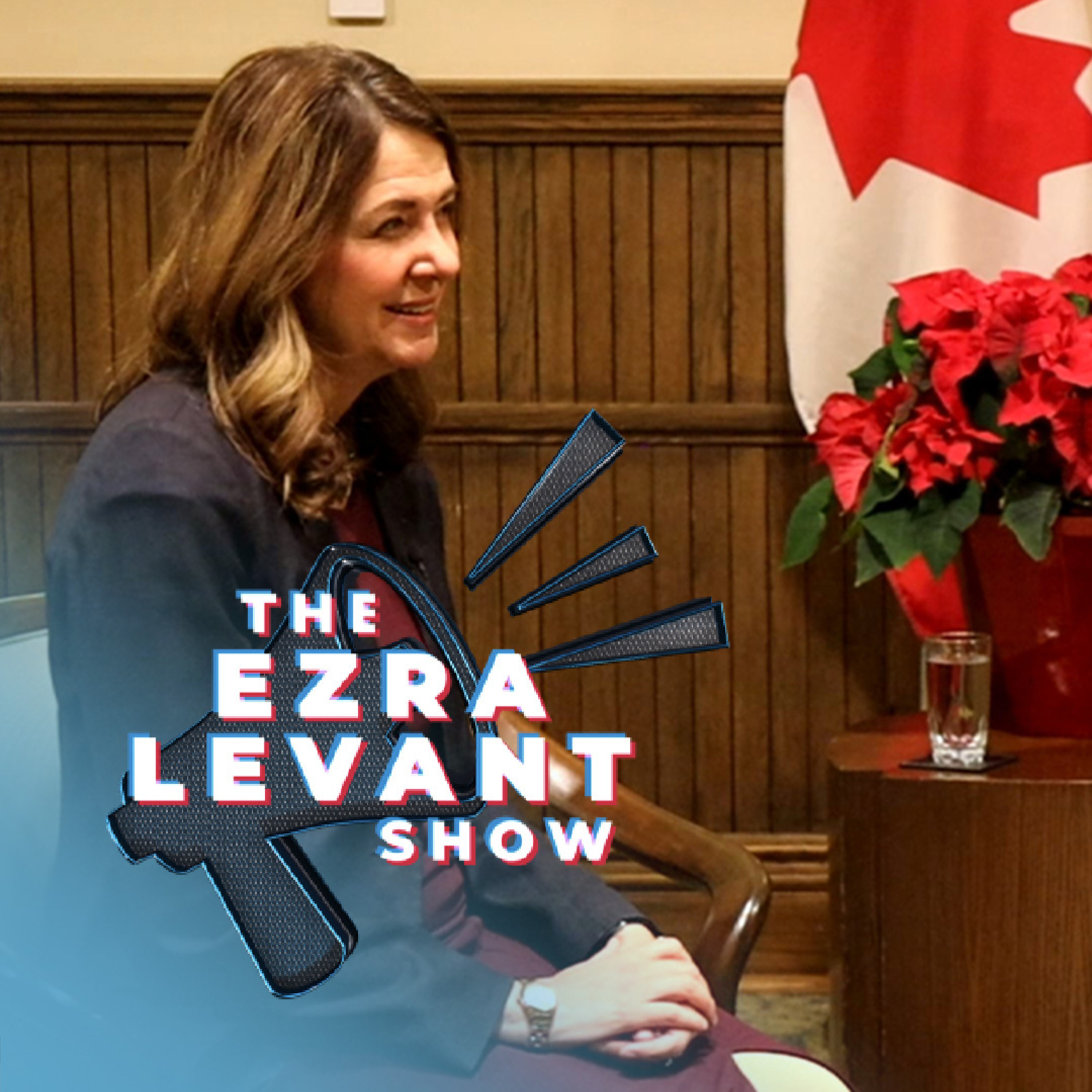
Rebel News Podcast
EZRA LEVANT | Pushing back against Ottawa overreach: A feature interview with Danielle Smith
00:51:29
Tonight, on The Ezra Levant Show, Ezra catches up with Alberta Premier Danielle Smith. Speaking candidly, Smith began with the controversy surrounding Skate Canada’s threat to boycott Alberta over her government’s stance on women’s sport. She argued that sport bodies are drifting into ideological politics while ignoring the voices that matter most: girls and women who want fair and safe competition.
Loading summary
Transcript85 lines
- [00:00]
Ezra Levant
Hello, my friends. Oh my God, what a show. Today I interview Danielle Smith and Sheila Gun Reed interview Scott Mo. The first, the Premier of Alberta. The second, the premier of Saskatchewan. Holy smokes. Oh boy. I'm thrilled about it. I really want you to see it too, not just hear it. So to see it you need what we call Rebel News plus, that's the video version of this podcast. Just go to rebelnewsplus.com and click subscribe. It's eight bucks a month, but not only do you get great video content, you keep us strong and independent. We don't take a dime from government. And it shows A one on one sit down with the Premier of Alberta. Oh boy, did she say some interesting things. It's December 18th and this is the Esther Levant show.
- [00:42]
Shame on you, you sensorian bug. Oh, hi everybody.
- [00:55]
I flew to to Calgary last night to sit down for a one on one interview with Danielle Smith, the Premier of Alberta. I guess I could have done it over zoom, but I just think that when you're with a person, in person, you have a better connection. And we chatted a bit before and after and I like it. I'm a fan of hers. I think you know that I've known her since we were actually in university together. Believe it or not, it was her and me and Nahid Nenshi, formerly the mayor of Calgary, who's now the leader of of the opposition out there. It's funny, we were all sort of in the same year and knew each other at ufc. Anyways, we're all grown up a bit more now. I want to play for you the interview in full. And I think it's. We start off talking about Skate Canada. That's a amateur skating association that gets money from the federal government and they've decided to boycott Alberta because Alberta only lets girls into girls sports. By the way, there are no transgender athletes, male to female, in figure skating that we know of. This is just an attempt by the federally funded skating organization to embarrass and attack Danielle Smith. It's a partisan thing. It's super gross in sport. That was my first question. Then I think the most interesting part of the interview was about immigration. I'll let you see what she says for herself. Then we ended by talking about the memorandum of understanding for oil and gas. Anyways, I really enjoyed my question. Quick visit to Alberta. I came back on the first flight this morning. Huge blizzard out there. And whenever there's a big beautiful blizzard in Alberta, I mean, I grew up there. I love the blizzards. And I also love the chinooks. That's the warm wind that comes in and warms everything up. I keep thinking about, hey, I was told that global. I was promised global warming. What's with all this global cold? Anyhow, without further ado, here's my interview with Alberta premier Daniel Smith.
- [02:46]
Premier, great to see you.
- [02:47]
Scott Moe
Merry Christmas.
- [02:48]
Ezra Levant
Thanks for meeting with us.
- [02:49]
Danielle Smith
Yeah, Merry Christmas. Nice to see you.
- [02:51]
Ezra Levant
Before I talk about some heavier things, what is going on with Skate Canada? Frankly, they've got a lot of gall saying they're going to boycott Alberta. Tell me about it.
- [03:01]
Danielle Smith
Well, I'll just say that boxing Canada has not taken the same view. And curling Canada has not taken the same view. I think that they've taken the view that they want to make sure that girls and women have the opportunity to participate in sport without having to face athletes that were born male. I think that Skate is going to find that they're on the wrong side of this issue. Even the IOC is talking about creating new rules. I guess we'll see them in the new year. And I think they should rescind their policy because what it really should be about is creating an environment for girls and women to participate in sports safely and fairly.
- [03:34]
Ezra Levant
Do you know if there's been any other reaction from other places? I mean, for example, has there been a move to have Skate Canada reconsider or to set up an alternative competitor to Skate Canada? Because, you know, they have a monopoly right now on who gets to go to the nationals and Olympics. But there could be a sex segregated version of Skate Canada. I bet you it would get popularity in Alberta, Saskatchewan. You know, they should watch out what they're doing. They're getting involved in politics.
- [04:04]
Danielle Smith
It's true. You know, I mean, we wanted to create options for everybody to participate, but the reason we have girls and women's divisions is because we recognize that girls and women have different levels of skill, agility, strength, strength, endurance. And that's part of the reason why we have those categories. If there were no biological difference between men and women, we wouldn't have created girls and women categories in the first place. So I think that they are putting themselves at risk of having a competing organization. What I would like to see is what are the girls and women who are represented by that organization? Board. What do they feel about it?
- [04:38]
Ezra Levant
I don't think I'm going to guess that this was. They're funded by the Fed. So I'm guessing this was an instruction by the feds to take a shot at you. I bet they didn't actually consult their own members or even their own board.
- [04:48]
Danielle Smith
And it shouldn't be that way. The people who most matter in these circumstances are how are the girls who are competing feeling? How are the women who are competing feeling? How do they feel if they're standing on a podium and somebody has won just to edge them out because they were a born male athlete? That's what we're concerned about. And so we'll watch to see how it goes. I've just been pleased to see that curling and boxing has not taken the same view. And we'll watch and see what the IOC thinks about all of this in the spring.
- [05:15]
Ezra Levant
Right on. Hey, I want to ask you about some comments you gave earlier this week about immigration. And I remember your speech at the UCP convention a few weeks ago when you talked about immigration, that was one of the largest responses from the crowd in applause. Tell me some of your latest ideas. You were thinking that newcomers maybe have a waiting period before they can get into social services. What are your ideas?
- [05:37]
Danielle Smith
Well, I guess a couple things I'd say is that I think that the federal government destroyed the historic consensus we've always had in Canada. We used to have an enviable immigration system based on points bringing in professionals, giving extra points for people who had degrees and could speak one of the official languages, and they blew that up. That we received a very large number of temporary workers, refugees, family reunification, international students, pretty much everyone but the economic migrants. That had always been the source of its success, and we're seeing it. It has brought our public services almost to the brink of collapse. That's one of the challenges that we faced in our education system is we went from having a stagnant enrollment in our system to having a net new 85,000 kids added, 96,000 of which speak English as a second language or English language learners, which is double what we saw three years ago. It's put enormous pressure. People are seeing the pressure in being able to get a doctor or nurse practitioner. They're seeing a pressure on buying a house, getting rent. The price of everything is going up, and they're frustrated. When I was going around with the Alberta Next panel, we heard of parents and grandparents saying, my kid or my grandkid has applied for dozens of jobs, even at McDonald's and Tim Hortons and can't get one. So what we have asked the federal government to do, and it looks like they're bringing, they're curtailing many of those programs. We've been supportive of the changes that they've made particularly on the temporary foreign worker program. But the federal government's irresponsibility has put huge costs onto our taxpayers. And so what I've looked at in the uk, Keir Starmer, he's having this conversation about whether you have to work for five years before you are able to receive social services. I believe that's their first, their current policy. They're talking about waiting, making a person wait 10 years. And so you should come to Alberta because you have a job, you should be a taxpayer first. And then if you want to stay and become a permanent resident, that's when you can bring in your wife and your kids and you can start on the pathway to permanent citizenship. We believe that those who are not here in a permanent status should be treated like tourists. And as a tourist, you don't go to somebody else's country and say, pay for my childcare, pay for my education, pay for my health care, pay for my long term care, give me a pension. We have to get back to something approaching a consensus around immigration again. And so that's what we're going to be looking to Alburns to see if they want to give us a mandate to do that.
- [07:57]
Ezra Levant
I think part of it is that people see obviously bogus refugees and bogus temporary foreign workers who are not specialists that we can't get, not seasonal crop pickers like people see that all these different categories, the diploma mill, fake school students. I think part of it is people feel taken advantage of completely. I was talking to Michelle Garnermple of the Federal Conservatives, who's their immigration critic, and I said to her, there's all these people who, their visas have expired and they have not been asked to leave. I said, would you support mass deportations or remigration? And to my surprise, she said yes. Even if the numbers hundreds of thousands or perhaps millions. That word remigration, I've seen it used in the States, they're talking about it in the uk. Do you think that perhaps it's time that Canada say to those who've overstayed, time to go home?
- [08:53]
Danielle Smith
Well, the first step is making sure that you're not bringing people here who don't have a job to come to. So I think that's one part of it. The second part is for those who are here and have a job and have a pathway to permanent migration, let's just be compassionate and find those permanent residents, give them permanent residency status so they can start on that journey. But anyone who doesn't have a job doesn't have prospects Absolutely. Why would they stay? It's not good for them. It's not good for the taxpayer. It doesn't allow for them to have to be able to pay for the things that they're going to need to support themselves and their families. It seems to me that we've got to get back to the kind of system that works not only for us as the host country, but also for the person who's coming here. And I can tell you that I think that there's a lot of those newcomers, the immigrant citizens who came the right way and did things properly and followed the rules. And I think they're just as frustrated to see that there have been a lot of rule breakers and they want us to do something about it. So we'll find out. We're going to very likely put this to a vote in the new year, and we'll see what Albertans have to say about it.
- [10:00]
Ezra Levant
And how would it go to a vote? There be a bill, for example, to restrict benefits? Is that what you mean?
- [10:06]
Danielle Smith
I'm thinking of a referendum. I think that if we're going to do something as dramatic as assert our rights under section 95 of the of the constitution, that we need to get a mandate from the people.
- [10:15]
Ezra Levant
That's incredible. Are there any other issues that you propose to put to a referendum?
- [10:19]
Danielle Smith
We'll be making a decision as a cabinet and caucus next year about which ones they'll put forward. But I would say that immigration emerged as probably the number one issue that I heard about.
- [10:27]
Ezra Levant
I'm going to make a prediction right now that that gets at least 80% support.
- [10:31]
Danielle Smith
Right? Yeah. And some of our town halls, people started off feeling really concerned about what we were talking about initially. But as they heard the arguments, when we did a straw poll about whether people thought we should take more control over immigration, some of the rooms were unanimous.
- [10:43]
Ezra Levant
Wow.
- [10:43]
Danielle Smith
Yeah.
- [10:44]
Ezra Levant
I want to be respectful of your time, but I think the big issue, and I know we talked about this a few weeks ago, was the memorandum of understanding, which is a funny word because it's not a contract, it's not an agreement, it's a plan to talk further. I'm talking about the proposed oil pipeline. Has there been any interest by potential investors by oil companies who say, yeah, we'll take a slice of that? Because when I first looked at it, I thought, boy, I see the costs and they're all front end loaded. And boy, between the carbon capture and the industrial carbon tax, they're not making it easy. Has there been any nibbles? Has Anyone taken it up?
- [11:26]
Danielle Smith
Well, I can tell you that when we started off, we wanted to get rid of the emissions cap because we knew that there was nobody who was going to invest in expanding production as long as that was hanging over their heads. In fact, businesses were talking about, will we have to shut in production by 2035? And the clean electricity regs. We had no one wanting to build natural gas power plants in Alberta, which is the bread and butter of our power grid. And so that was very alarming to us. So getting concessions on those two things have already had an immediate impact. We've already heard that Enbridge is talking about expanding their line. We've got Trans Mountain talking about expanding their line. We've got Southborough talking about how to use the Keystone assets to build a new pipeline to the U.S. do they.
- [12:07]
Ezra Levant
Think, does that look like it's going to move?
- [12:09]
Danielle Smith
I think that the Americans really want it. All the conversations I've had with the US Is that they want to see more Canadian oil going down to the US Gulf Coast.
- [12:18]
Ezra Levant
I saw Donald Trump tweeting, saying he wants to retake the oil companies that were nationalized by Hugo Chavez. So I think he's going to topple Venezuela. They're a competitor to Alberta.
- [12:30]
Danielle Smith
They. They are. But, you know, I guess the way I look at it is we're a far more stable partner. We do already have the existing lines where we're responsible for, you know, 4.5 million barrels a day, most of that going to the United States. A lot of it is the type of heavy oil that their refineries are tooled for. And so it seems to me, like, why not work with the friend that you. That you have, that. That wants to work with you? And he. And that's the argument that we're making. We've got a lot of friends in the US that are making that argument on our behalf. But it is also a demonstration of why we can't be reliant on a single trading partner. And it is why we've been talking about how we might get this bitumen pipeline to the northwest B.C. coast. Every person I've spoke with over the last number of years, they said that's the one that got away. If of all of the projects that were being proposed at the time, the one that really made the most sense to do would have been Northern Gateway, maybe a different port, Maybe it makes more sense to have it at Port of Prince Rupert, because it's more of a direct straight line to get to those Asian markets. But we feel that with the consortium we've got at the table, we've got every major pipeline company represented there giving us the very best technical analysis. When we put forward our proposal, we'll have a better idea of the costs, we'll have a better idea of the indigenous partnerships, and we'll have a better idea of what the pathway will be to get to a yes. If it looks like it's on the major project list on that two year Runway, I suspect we will have a proponent step forward at that time.
- [13:56]
Ezra Levant
You know, it's interesting to me to see the Premier of British Columbia almost pout when Nutrien, a company in Saskatchewan, decided to export its minerals through the United states rather than B.C. he was sort of disappointed. And part of me thought, well, you were just going to probably oppose it anyways. And it reminded me that, you know, there are other ways to get out. And the Keystone XL is another way to get out. And you don't have to deal with the BC premium. You don't have to deal with really out of control land claim issues like there's some indigenous title. I think. Let me ask you this. Has there been anything from the Trump administration or the company that suggests they're willing to flip on Keystone XL because that was partly built, 800,000 barrels a day and you don't have to deal with all those troublemakers on the West Coast?
- [14:48]
Danielle Smith
Well, I can tell you that there are active conversations between Southbow and a partner in the States United. And I think that that's the best way to do it is that they can find a pipeline partner in the US And I think that there's a lot of enthusiasm for that idea. And we should look at that as a win too, because remember, we have something called the Alberta Petroleum Marketing Agency. We can actually do deals internationally ourselves by holding onto those barrels all the way down to the Gulf coast and then selling them, whether it's gas to Poland or whether it's going through the Panama Canal and selling our bitumen to Asia. It's a longer route, but that's how the Americans sell theirs. And so I think we'd get an advantage and it'd be better if we had a different route going through the northwest B.C. coast. But I would also look at it as an interim measure if we were to get some of those other pipeline expansions built. And I think that that would be a win for not just us, but for the entire country.
- [15:43]
Ezra Levant
I know you got to run, but I got one last question for you. I was surprised last week to see an Announcement of a project that I hadn't seen proposed, that hasn't gone through environmental regulations, that doesn't have a private sector, like it's got public money. I'm talking about a train from liberal Montreal to liberal Ottawa. It's going to be this crazy white elephant, probably close to $100 billion.
- [16:08]
Danielle Smith
Yeah, I think so.
- [16:08]
Ezra Levant
And it was just ta da, we're going to do it and no negotiation and there's going to be government money. And I thought Alberta gets mous and maybes and taxes and a lot of disparaging comments even by. There's a lot of Liberal MPs who are trash talking the MOU, by the way. And then just, you know, if you're a liberal from Montreal and Ottawa, you get yourself this white elephant free gift. I just. What do you make of that? What do you think of that?
- [16:35]
Danielle Smith
I think they're two different things. I think that major projects should be revenue generating projects. I don't think that that was going.
- [16:41]
Ezra Levant
To be a revenue generating project paying for this train.
- [16:43]
Danielle Smith
Oh, now you've hit a source. But I mean, you have to look at it from Albertan's perspective, why the MoU is a good step but not sufficient. We still send $26 billion more in tax revenue to Ottawa through various taxes, big trains, I guess, than they send back here. And we're still having deficits which are really problematic for us. And meanwhile you see not only equalization transfers to Quebec go up, but also these kinds of major projects. It's very frustrating for western Canada and it's very frustrating for Alberta in particular, which pays a lot bill. But it's also another reason why we've got to try to find a way to have Ottawa take less. What we really need in the country is for each level of government to have the tax revenue that they need to fund their social services rather than this tax and transfer game which we always know is going to be used for politics. So a little bit frustrating. But we've got our own passenger rail plan that's going to be coming out in the new year and we hope to find some private sector proponents who are willing to build big, big pieces of it and maybe we'll show them the east how it's done.
- [17:44]
Ezra Levant
Right on.
- [17:44]
Great to see you. Thanks for meeting with Rebel News. We always love to connect with you.
- [17:47]
Danielle Smith
Yeah, my pleasure. Good to see you.
- [17:50]
Ezra Levant
Well, what do you think?
- [17:51]
I don't know if I've heard that.
- [17:53]
News before, that she's going to have a referendum next year on a massive Change to immigration. Now immigration is a federal jurisdiction, as you may know. It's the federal government that sets the numbers and has the standards. But Alberta could say, well, we run the hospitals, we run the schools, we run the welfare and, and you can't get any of that unless you've been in this country for five years or 10 years. I think she said 10 years. If I don't, if I'm remembering correctly. That's incredible. And that would basically cause the non productive migrants to move to, you know, places like David EB's BC or Doug towards Ontario. Very interesting. I think would actually cause some copycat changes in other provinces and we would get immigration reform from provinces as opposed to from the feds. Anyway, very interesting. I was very glad to have the sit down with her. And that was me in Alberta with Premier Danielle Smith. But let me leave you with this. The day before our chief reporter, Sheila Gunn Reed had the same sort of sit down with the Premier of Saskatchewan, Scott Moe, who was so friendly to Rebel. And I guess one of my points is in Saskatchewan, in Alberta, it's perfectly normal for the premiers of those two great provinces to have one on one heart to heart conversations with Rebel News. It's only the weird, censorious, you know, mean girls in Toronto, Ottawa, Montreal that turn up their noses at Rebel News. It's really weird. There really are two Canadas, aren't there? Anyhow, let me close with Sheila Gunn Reed's very interesting chat with Scott Moe. I'll come back on the other side though and say goodbye.
- [19:35]
Sheila Gunn Reid
Sheila Gunn Reed for Rebel News. I'm here in Regina, Saskatchewan and I am standing in one of the most beautiful legislature buildings that I've ever seen in my entire life. I'm about to sit down with Saskatchewan's Premier Scott Moe to discuss firearms, carbon taxes, pipelines, immigration, sex, safe spaces and more in an end of the year interview wherein we will discuss his number one issue facing Saskatchewan in 2026. Take a listen.
- [20:06]
Premier, you were all but wiped out in the cities in the last election. I know one of the key focuses of your party convention was to rebuild the trust of those conservative voters that I think you lost because those people still vote conservative federally. So I guess it's a two part question. What happened there and how do you get the trust of those people again?
- [20:35]
Scott Moe
So yeah, you're right, we lost some seats this last election. And when you look across the province of Saskatchewan, you know, we have a number of communities that are going, but we do have our two largest centers, Saskatoon And Regina. And we have some work to do in those two centers. We do have, I think there's 17 cities now in the province, which is a lot more than we had just a few years ago. We have representation in 16 of those 17 cities, but admittedly more work to do in light of this last election in our two largest centres, in particular in the suburban areas of those two centres. And we, you know, some of that work is policy work that the government needs to do. Some of that work is party work that we need to do in engaging on the party side as well. And you saw as we talked the last time we hosted the largest convention that the Saskatchewan Party has ever hosted this particular year. And then I would say some of that work as well is on myself as leader and on our ministers and on those that are speaking on behalf of our party and the government in the, you know, the tone and the engagement that we bring in that policy development and working more closely with people across the province so that the policy that we're bringing forward is not top down policy, but they have a voice in that policy along the way. And I'll give an example of just that we'd introduced on the last day of the Legislative Assembly Compassionate Care Intervention act. That is introduced on that last day for a reason. There's been much consultation that the minister of justice and others have led in getting that bill to where it is today. Legal consultation, consultation with the enforcement agencies with families which are really driving that particular bill. Now the text of that bill is available for a number of months before we go into spring sitting. People can see it, they can read it and they can phone up their MLA or they can talk to someone in government and have their input on that bill. As we head into the spring session, we need to get that bill right so that it is supporting those individuals that unfortunately have fell to a life of addictions in their family, wants to reach out and provide them an opportunity for a recovery lifestyle. And so that's one example of changing the tone in how we're introducing a pretty significant piece of legislation and I would say a necessary piece of legislation as per the family's voices in Saskatchewan that, you know, maybe we would have taken a different approach a couple of years ago and that's maybe an example of how we've changed that approach. This, you know, post that last election and the results that we saw just.
- [22:55]
Sheila Gunn Reid
Staying on the campaign and it's something I wish I had the opportunity to ask you about previously, but in the middle of the campaign there was Some controversy. And I'm not even sure if controversy is the right word because it felt like it was coming from a certain activist group and then the media. But the people that the policy was intended to help were pretty in favor of it. And that was protecting girls and women's spaces, particularly in schools, from boys who may look to use their private spaces. You backtracked on that. And I'm wondering if there's. There has been consultation or space to reconsider that policy. I mean, Alberta is doing this and they haven't taken their foot off the gas pedal. And it's one of those 80, 20 dinner table issues where it cuts across most political backgrounds. Would you be willing to reintroduce policies that would protect women's spaces, even if it meant putting on a collision course with federally funded activists?
- [24:07]
Scott Moe
So are you referring to the bill on parental rights?
- [24:10]
Sheila Gunn Reid
Well, in the middle of the election campaign, the women was controversy that came out around boys using women and ladies girls bathrooms in schools. And you know, there was some talk about introducing legislation to protect those spaces for girls. And then you backed right off.
- [24:28]
Scott Moe
Right, right. The. Yeah. So I'll go back to the bill on parental rights and the introduction of that of which and then this again gets to, you know, some of the discussion around tone of how the government is moving forward with whether it be policy or legislation or whatever that might be. And you know, we had talked about that bill about the use of washrooms. Whether it be in schools or in public spaces. The majority of people are pretty clear on what they want to see in that. In that space moving forward as far as a government policy, whether it's provincial, municipal or even, you know, recreational facilities in, you know, in rural communities, for example, where I live, you know, the majority of people are pretty clear on that space where the tone changed. And I'll come back to the bill on parental rights is that bill had a high degree of support across. Across families in the province. That being said, that support I think lessened when you have to use tools like the notwithstanding clause in order to ensure that the courts aren't able to overturn a piece of legislation or policy that's being introduced by a duly elected government. In this case, it's the Saskatchewan Party. In Alberta, it's a ucp. But we've seen the notwithstanding clause used the most and literally dozens of times in Quebec, where it largely has been used in the entirety of Canadian history. You know, and I'll just go back to that notwithstanding clause. It's a necessary tool. It's part of the constitution to ensure that when there is a collision of rights or a collision of discussion that the notwithstanding standing clauses there so that so that duly elected governments today, and I would say into the future, have the ability to represent their citizens. And so, you know, as we go back, whether it's conversations around the usage of washrooms in public spaces, whether it's the bill on parental rights of which we had a special session and introduced, and ultimately the tool we had left after there was a decision by Justice Court here in Saskatchewan was to use that tool to enact that policy on behalf of Saskatchewan people. You know, getting back to, you know, the performance of this government in the last election, there's a conversation and a consultation and a tone that this government, I think, and what we're attempting to do is to, you know, strike that tone differently on the policy development that we have moving forward. And so, you know, those conversations are ongoing with respect to, you know, where this government goes in these various spaces. And they're sensitive conversations. They're very sensitive conversations, but it doesn't mean we shouldn't have them.
- [27:05]
Sheila Gunn Reid
I guess. That takes me to my next question, which again seems to be a sensitive topic for a certain part of this country, that immigration and the unconstrained immigration out of all Ottawa has really been downloaded onto the provinces. When you look at it, it's a cost of living crisis, it's a housing.
- [27:27]
Crisis, it's a health care crisis, it's an education crisis.
- [27:31]
Is Saskatchewan looking at any means by which to take control of the amount of immigration or temporary foreign students, temporary foreign workers coming into the province?
- [27:44]
Scott Moe
Yeah. So there's a number of pockets of immigration. The provinces have some degree of control over a portion of it. And then largely it's federal, but even in that, in that provincial portion, it is federally governed, as it is largely seems to be in the federal jurisdiction. I would say this about immigration more generally. And it has changed in the last decade and it is time for us to have a look at our immigration policies across the nation. And I think some of that work is starting to happen. There's more that needs to happen. To answer your question, yes, Saskatchewan has repeatedly asked to have more decision making power, more jurisdiction in this space. You know, first to at least have as much as the province of Quebec has and then to go actually further and have as much as the province of Quebec is asking for moving forward. I don't know whether the federal government will do that, but we certainly as a nation and I think as Canadians need to look at our immigration policy nationally if it's not going to be the provinces making, you know, an increased number of those decisions. And here's what I would suggest that it needs to be based on any immigration policy needs to be based on economic immigration almost exclusively. There's going to be some refugee status. There's concerns I think around some of the asylum seekers that are coming into. And Quebec has a great concern in this space. But I think we as Canadians need to as well. And there's your student visas, your federal work permits and your provincial work permits. It needs to have an economic focus to it. And here's why it's good for the immigrant to know that they are coming to a job, hopefully to a job that is going to, you know, allow them to aspire to maybe even more than they were able to aspire to wherever in whichever country they're coming from. Second, if that immigrant has a family and they have a job, they're going to be able to provide for that family in whichever Saskatchewan or Canadian community where they reside. Third is it's going to be good for the community if someone comes with their family, they have a job, they're a contributing member to the community, contributing member to the industry of which they're working in. That's a positive for everyone around involved. But most importantly for that immigrant and his family, for the community where they reside in Saskatchewan or Canada. And ultimately I would say that's going to be a strength for Saskatchewan and our province or any province and the nation of Canada. All of that being said, when you get outside of the parameters of that very focused economic migration or economic immigration, that's where you start to get large numbers that may not be contributing economically in that way to their community and ultimately to the province and not to then the services that, you know, we talked about before, the healthcare, the housing, all of these challenges that we see happening in community after community across Canada, not exclusively due to, you know, a larger proportion of non economic migration into our nation, but I think in fairness a part of that is what has contributed to some of these concerns.
- [30:36]
Sheila Gunn Reid
Next question on firearms. Now Saskatchewan has been really leading the way and I say this as an Albertan, you really have been and doing innovative things like creating an agency and then not funding that agency, agency to assist in the or to license organizations that want to be involved in Mark Carney's gun grab. Now your latest policy proposal to help insulate firearms owners from potential criminality by storing and securing those firearms.
- [31:09]
I've seen some criticisms of this insofar as well, you're the government. Yeah, I'm going to give the government my guns. That seems like a problem. And now the federal government has them all in one spot. So are there any fail safes or have you considered fail safes in that legislation to prevent the feds from just going, okay, thank you. You have them now? We do.
- [31:33]
Scott Moe
This is going to become challenging. I see just this morning this implementation is delayed until next year. I suspect that's because the minister is finding some challenges in the operations of, you know, what I think is a severely flawed plan and not a plan that is in any way indicative of the wishes of at least western Canadians. And I would say, you know, more largely, I think you'd find Canadians that aren't supportive of this policy the first time it was trying to be introduced a number of years ago and even now. So a lot of our policy in Saskatchewan is reactive to protect, you know, hunters and firearm owners rights in this province. And so we are only able to go so far in this, in this space as it is for federal jurisdiction. But there are a number of things that we are doing to protect as best we can firearm owners in this province. And so I would first say, yes, we have a. You can't, no one is going to come get the firearms in Saskatchewan if you have a firearm that's deemed illegal. That's the first piece is you need a provincial permit in order to go collect those firearms. And that permit allocation department in the government of Saskatchewan is unfunded and will not be funded in the foreseeable future. Second to that, the legislation or the discussion we had around assessing the value of those firearms first, when they're deemed illegal, the value of those firearms is going to decline. And we don't want individuals, if they're going to turn those guns in voluntarily, to experience that decline because of federal policy, they should actually be paid for what the original value of that firearm is. And so that is protecting firearms owners that may want to turn their gun in. I don't suspect that'll be very many in Saskatchewan. But herein lies the trouble, and herein lies the challenge that we don't have a solution for as of yet. When the letters go out, if they do in the new year, if the government, federal government, actually moves on this policy, you don't have to turn your firearm in in Saskatchewan because no one's going to come get it. However, the letters will very clearly state that with the implementation of this, this legislation federally, that you're now participating in A criminal act as per the federal government. Now I suspect at some point there'll be a government that changes its policy and so it won't be a criminal act forever. It would be my suspicions, however, for the time being that may be a problem for some individuals that are in professional careers and we wanted to protect the value of their firearms should they choose to do something different. And then actually if we can store them provincially until such time that the policy might be changed by a future government and then they could be returned to those individuals as well. This is I think most important actually for, you know, there are some firearms that are family heirlooms. They're not just a tangible value. They actually have a much greater value to, you know, the individuals in that family. And we want to protect those guns from being taken away as well. And so if we can store them for a period of time of when they can rightfully maybe this policy change and they can be return to that family, we're going to do what we can to do that.
- [34:36]
Sheila Gunn Reid
Now I want to talk to you about the canola tariffs which are treated far different than the steel tariffs despite the value of the canola industry. I suspect that's because the Kearney government knows there are no votes to gain or lose out here if they treated the canola industry fairly.
- [34:57]
Danielle Smith
But if you.
- [34:58]
Sheila Gunn Reid
Given that we are seeing the complete and total collapse of the electric vehicle industry. Ford is, you know, committing to end the EV F150. Do you see an end to the liberal tariffs on Chinese EVs that Western Canadian farmers are paying the price for?
- [35:23]
Scott Moe
Yes, and I just don't know when. And the sooner the better. And the challenge with the EV tariff with China and we would promote removing it all. However, I would like to know what the President of the United States is going to say about that, if we should do it. As you know, that is an indirect consequence of the former Prime Minister, as I say he should not be named, and his policy of putting 100% tariff on EV cars coming from China. With the Biden administration, we have three trading partners right now that are relevant to Saskatchewan and Canada. Our largest trading partners, United States, China and India. We have tariffs or market access issues with all three of those most significant economies in the world and export based destinations for our province. In fact, about 40 billion of our 45 or $50 billion of exports in this province are going largely to those three markets.
- [36:16]
Danielle Smith
So.
- [36:16]
Scott Moe
And then the rest will go to markets around other places around the world. So this is a problem and there are Direct consequences to the decisions that we make and indirect consequences to those decisions that we are making. And I would say, actually, and this might surprise you a bit, is our Canadian government has to do better with respect to not pitting industries against industries and do better in representing essentially where the value is and where the jobs are in these industries across Canada. And also understanding which industries are operating under, you know, some degree of market protection or subsidy, because I would say those are not sustainable moving forward and which ones are not. And when you look at Saskatchewan agriculture or Western Canadian agriculture, we are not operating under any protection, subsidies or anything of that nature outside of some of the supply managed industries. And there's conversation coming, I'm sure, there with the United States. However, the grain and the beef industries in our province and in our nation are among the most efficient in the world, operating without subsidies. And we can compete in any country around the world given a fair environment, a fair trading environment. When you look at some of the manufacturing industries and what's happening in other countries around the world, I think it's fair to say that we're struggling to be competitive in that space. And so we need to shift. We need to shift with respect to how we are supporting the industries and which industries are actually going to be, you know, employing Canadians. And in our case, we're concerned about Saskatchewan and Western Canadians are going to be employing the people that we represent 3, 5, 10, 20 years out. And I think that's going to look different in Canada than what it does today. And that's maybe a statement that no one has said publicly yet, but it's one that I think maybe we've all been thinking about.
- [38:02]
Sheila Gunn Reid
Yeah, I mean, wouldn't it be great if we just let Algoma build Canadian pipelines?
- [38:09]
Scott Moe
Yeah.
- [38:09]
Sheila Gunn Reid
Wouldn't that be something?
- [38:10]
Scott Moe
Yeah, that would work. That would work.
- [38:11]
Sheila Gunn Reid
Now, I want to talk to you about what we call in Alberta the sort of elephant in the room, and that is the separatism issue. Now, I don't think that the separatist sentiment is quite as high in Saskatchewan as it is in Alberta, but I think it is a thing here. And, you know, I think it was probably a conscious choice to not discuss it at the SASK Party convention, but I've seen polling that shows that it's anywhere from 25 to 33% of people in Saskatchewan have some form, whatever that means, of separatist sentiment. And I would suspect that every single one of those people is within the Saskatchewan Party. So what, how do you deal with that? Do you do you take the Daniel Smith approach and say, you know, it's not for me to decide, it's for the people of Saskatchewan to decide, or do you try to contain it?
- [39:13]
Scott Moe
All of those things. And I would say just first of all, one of the very founding principles of this party is to build a, you know, strong Saskatchewan, strong province within a united Canada. Given the last 10 years of where we have seen these policies being imposed on us as a province by the former prime minister and his government, that has been very, very challenging. And, you know, myself, I have felt, you know, these feelings of frustration, if you will, as we see policies that are impacting industries that are employing people and have built our, our communities in Saskatchewan and Alberta and Manitoba and British Columbia for, you know, not decades, but over a century. The oil industry, the mining industry, we see now using that technology in Saskatchewan, and lithium, helium industry, we have, you know, uranium, we have potash, we have copper. Now an expansion of all of those industries with new mines that are in the hopper and are attracting investment today. And so to have those industries that are employing Saskatchewan people hindered, there's a lot of frustration that pours out. And from myself as well, you've seen over the course of the last decade. That being said, you know, and I talk about, you should I hear people talk about Saskatchewan and, you know, separating these sorts of things. And I'm not sure exactly what we gain in that with respect to market access. I'm not sure what we exactly gain in that, in us being able to access in a more freeway, you know, a northwest port, whether it be for Saskatchewan and Alberta oil or whether it be in the more port capacity for, you know, the grain products and the potash products that are going through the port of Vancouver. We're seeing now that Saskatchewan companies and industries are actually making that investment outside of Canada to access the world, most notably in Washington and the port of Oregon in that space. And, you know, that's one of our largest concerns actually from this province is how do we actually sell our food, fuel and fertilizer to those 160 countries around the world. And so I take actually a little bit of a different view in that sphere with the current prime minister. And I won't agree, and I don't agree with the current prime minister on a number of things. And I think that will become evident in the weeks and months ahead, however, where we can agree what we're trying to do is to bring things forward to a point of resolution. And you I'll back up to. We had A Western Canadian, Western premier's meeting and a first minister's meeting in Saskatoon. And the language coming out of that meeting was about a port to port quarter opening up European and Asian markets. That's a good thing for Western Canada. Manitoba is all over the potential LNG going to the, you know, the Churchill port, if you will, accessing those European markets. I think the people prime minister supportive of that, that's Alberta, British Columbia and lng that would be finding its way that way. But if you're supportive of that concept, and I would say the Premier of British Columbia signed on to that concept at that meeting, if you're supportive of that concept, it also means getting the value of, of Alberta oil, largely a little bit of Saskatchewan oil getting out to that northwest port. And if we're not able to do that, we have larger troubles than, than any talk of separation is going to rectify. We have to have a larger talk about how us as Saskatchewan and Alberta, both of us on different products at times actually ensure our economic independence moving forward. If we are going to be stymied and not have access to Canadian ports, we have a much larger challenge to talk about than us just separating. We have to talk about how are we going to be economically independent years into the future, which is, I think a bit of a different discussion. And as Canadians, I hope, and as a Canadian, I, I don't think we want to go into that discussion on where Saskatchewan and Alberta are, you know, actively looking at partnerships that are going to allow us to get our products to market because we're not able to get them to a Canadian port. That would be a sad day for us as Canadians. I think the Prime Minister in fairness, has identified that this is an area where the federal government needs to do better. And I would point to, although not perfect, I think from both sides, the recent MOU that was signed with the Province of Alberta, and I know there's folks that can poke holes in that or quit cabinet on both sides of that discussion. But I think it is an example of coming together a province and the national government. We haven't seen this in over a decade where we're focusing on agreeing where we can agree and moving forward in those spaces that's different than anything we've seen in a decade. And I would say that's a positive for this discussion. At the very least, I hope we're able to build on that. But at the end of the day, we have, you know, we have an oil industry that's creating value for, for Albertans and I would say for Canada, Canadians through, through the equalization payments that flow across this nation, which is another flawed discussion. And we have industries in this province that are, you know, expanding and expanding greatly and we're going to need additional port access and we can't have, you know, a British Columbia government standing in the way of us, you know, creating Canadian value in other provinces.
- [44:13]
Sheila Gunn Reid
I just want to push back on that for a second premier. And I know, I realize we're running out of time, but is that you. You point to the MoU, but is that MoU worth anything when the Liberals voted against the wording of it, when a motion was introduced by conservatives drawing from the language of the MoU? So I mean, we can point to the MoU all we want, but it appears to be just theater. So I guess my question to you is then, what's the or else? What's the or else if the federal government doesn't meet its obligations within the confines of confederation?
- [44:51]
Scott Moe
Yeah, I noticed that vote in the House as well, and it struck me as odd and maybe some political cover internally on, on the, on the various parties that were involved in it. You know, here's what I think the MOU provides us in the short term, the ability to open up the discussion on expanding the TMX pipeline that is there, opening up the discussion around, expanding the, the capacity immediately. And I think we can get to that discussion a lot quicker than we can even get and find a route and do all of the consultation that necessary on a new, on a new line. However, that work needs to be happening simultaneously. The other opportunity I think that the MOU provides is to open up and I think the United States of America, from the conversations I've had with various secretaries down there, is open up and really advance the discussion around the KXL pipeline as well, which is going to provide all of us in Western Canada, whether it be the oil sands, whether it be British Columbia oil or Saskatchewan oil, a higher degree of egress capacity both to the coast and to the world and to those Asian markets, but also to the United States as well. So I think that's the short term gains that the MOU actually opens up. And those discussions have been somewhat stagnant recently and now they're very much in the short term, I think, realm of possibility. But while those two discussions are happening and action is happening in those space to create some additional egress capacity, we also need to be doing the work, and it's years of work, as we know, to advance that Northwest pipeline again. If we truly want to, as the prime minister says, advance beyond the Americans for our export markets, if we truly want to become one of, you know, an energy superpower or we want to become one of the strongest economies in the G7, which are all Prime Minister Carney's words, there is no path forward without advancing the egress capacity for that we have for the energy industry. There's no possibility of us achieving any of those goals, those aspirational goals that Prime Minister Carney has set, without in a large way increasing that egress capacity, increasing the mining capacity that we have, all of the things that are creating wealth and consequently are funding the entire equalization system that we have in this nation.
- [47:08]
Sheila Gunn Reid
Last question, Premier. Number one issue facing Saskatchewan in 2026.
- [47:14]
Scott Moe
What is it I would say for us locally in Saskatchewan is, and we're very focused on this is improving healthcare, specifically improving people's access to a primary care provider and the time that we have to a surgery now we're doing all right relative to other provinces in that space. However, that isn't the goal. The goal is to actually deliver a healthcare system in this province that the people of this province come to expect. So there's other issues. Affordability, cost of living, what's happening in our education sector with respect to our K3 outcomes, community safety, a significant issue. And we're very much working alongside with Alberta on the recovery oriented system of care, increasing enforcement, taking the drugs away from those individuals that have this poisonous substance in our communities, and it's literally killing our friends and family members. And it's awful and it's changed and we need to change how we approach it. But I would say the number one issue for us in this province and back to not just our urban centers, but every family across Saskatchewan is do I have access to a primary health care provider and do I have access to a surgery if I need it in a timely manner? And we're going to have the answers to those questions over the course of this next year. We have a base of hiring that is happening in the healthcare system now. You're going to see in the next number of months going into the next year a very open discussion. You're seeing some of it in Alberta recently too, but a very open discussion about delivering healthcare in a very innovative way, a different way, and always putting the patient at the very center of that discussion and the service that that patient expects and is able to be provided. So that's maybe not the answer you expected with the, you know, the broader, you know, economic headwinds that we maybe have and how Saskatchewan is, you know, managing our way through all of those, you know, advancing our economy. So we're able to make these investments. But it is actually a space where, you know, this government and the cabinet that meets in the room next to us here are very, very focused on. And that's, like I say, that isn't probably what you expected, but it's a focus that this government has.
- [49:18]
Sheila Gunn Reid
Premier, thank you for taking the time to speak with me today. And Merry Christmas.
- [49:22]
Scott Moe
Hey, Sheila. I'd just say thank you as well. You attended our convention.
- [49:25]
Sheila Gunn Reid
I did.
- [49:26]
Scott Moe
Thank you for, for that. Thank you for what you do as well with Rebel News and just being a voice. There's many of us, as Canadians don't agree on everything, but there's a large number of things that we do agree on. And it's good, I think, in. Even in the realms of the media that's being reported that we have different voices in that media reporting from different perspectives. And I think that's a very, very important. And I think Rebel News, you know, brings one of those perspectives to the. To. To the people in, in whether it be Saskatchewan, Alberta, across Canada. But with that as well, I wish you and your family a merry Christmas, a happy New Year, and all of your viewers very Merry Christmas. And I hope that each of them have some time to reflect and, and just, you know, reflect on why they can be thankful this season. I know that's how I'm going to spend my Christmas.
- [50:14]
Danielle Smith
Thank you.
- [50:15]
Scott Moe
Thank you.
- [50:17]
Sheila Gunn Reid
Many of the bold conservative ideas that are being adopted in other places across the country are born here in Saskatchewan. That's why it's so important for us to keep a careful eye on what happens here to help offset the cost of our journey here. Please go to rebelfieldreports.com what do you think?
- [50:38]
Ezra Levant
I was really happy to see Sheila there. She's an Albertan at heart, of course, but I think Alberta and Saskatchewan, well, they're twins, right? They were born on the same day, September 1, 1905. There's so many similar things about them. I think Sheila is sort of an honorary Saskatchewan at heart. I'll say. Anyways, big week for Rebel News. Interviewing big shots. That's our show for today. Until tomorrow, on behalf of all of us here at Rebel World headquarters, to you at home. Good night and keep fighting for freedom.
- [51:07]
Danielle Smith
You fighting for freedom.
- [51:11]
Ezra Levant
Shame on you, you censorious bull.