← Rebel News Podcast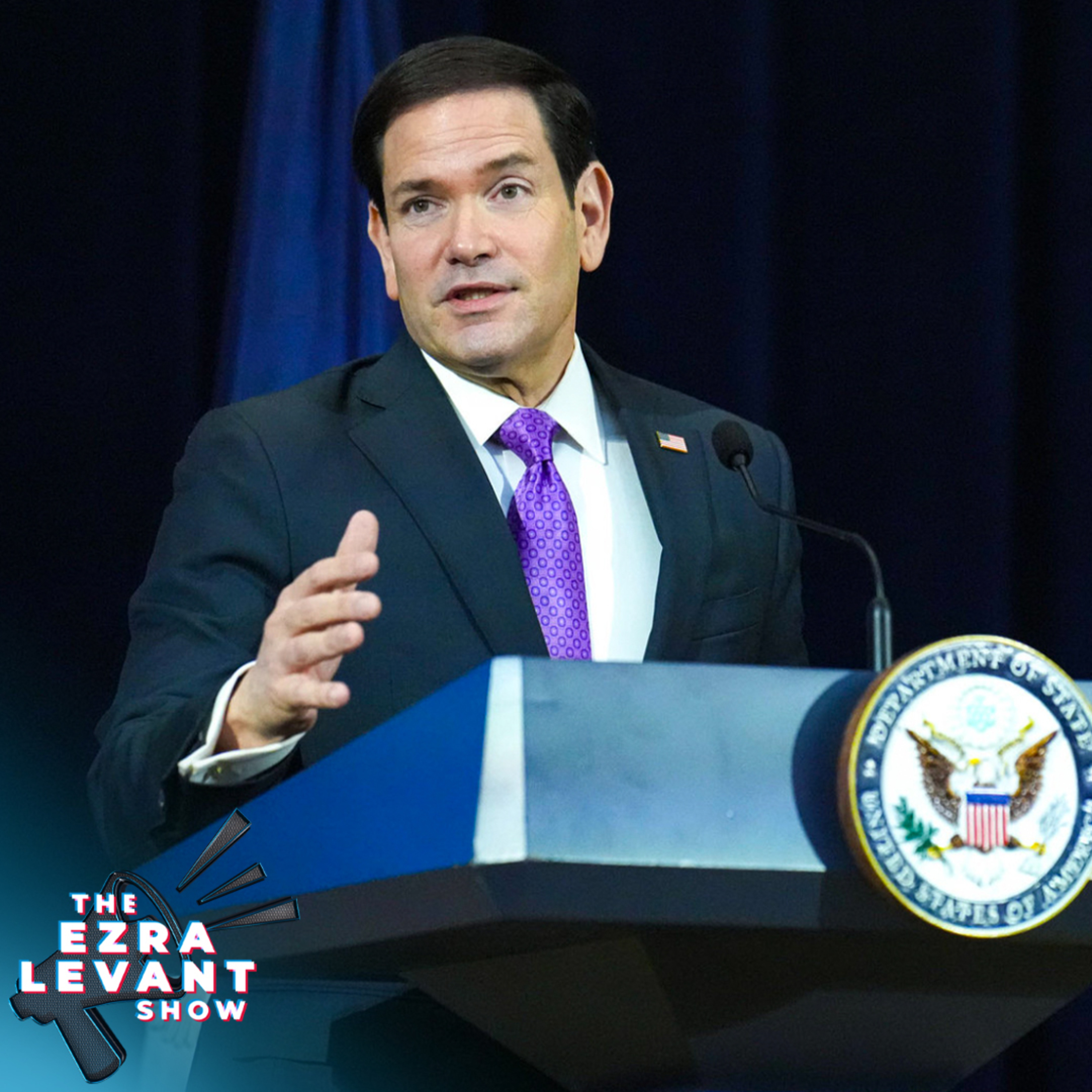
Rebel News Podcast
EZRA LEVANT | The U.S. finally names left-wing terrorism — will Canada ever catch up?
00:46:01
Canada shows little appetite for cracking down on anything — foreign gangs operate freely, Antifa operates freely, and Iranian money flows freely.
Loading summary
Transcript41 lines
- [00:00]
A
Hello, my friends. An astonishing new venture by the U.S. state Department. They are cracking down on left wing terrorism like Antifa, and they want the rest of the world to join with them. Will Canada. I'll take you through Secretary Marco Rubio's speech, but first, let me invite you to become a subscriber to Rebel News. Plus, I'm going to show you about 10 video clips today. I want you to see them, not just hear them. Go to rebelnewsplus.com click subscribe. Not only do you get that great content, but you support Rebel News because we take no government money. And it shows.
- [00:41]
B
You're listening to rebel news podcast.
- [00:52]
A
Tonight, America announces its plan to take on left wing terrorism, something Canadians have long endured. It's July 17th, and this is the Ezra Levant Show. Shame on you, you censorious bug. You know, I've told you on more than one occasion that our reporters are attacked quite frequently, more than any other news organization in Canada. And what's the most frustrating about that is the police, who are often right nearby, do nothing. We've seen that at the Hamas protests in Toronto. We've seen that with Antifa. A terrible case when Alexei Lavoie was standing right near police in Montreal who stood by as she was physically attacked. And it's typically people on the left. I've never heard of right wing violent attackers in Canada. I've just never heard of it even once. It's ubiquitous on the left. I mean, just the other day, I don't know if you saw this, the Nova Scotia premier was swarmed. People stomped on his car, jumped on his car, smashed it. And I understand there's only one charge, and it was later dropped. We saw that a few months ago when there was a Christian pastor performing a singing prayer ritual in a Montreal church, and there was an extremist from Antifa who threw incendiary devices in the church. Just walked right out. And we later discovered that Gabriel Lepage actually works for the Canadian forces. It's crazy. By the way, more than 100 churches in Canada have been vandalized or torched, including major cathedrals, even in the heart of Toronto. Oh, and there's a synagogue. And then there's transgender violence. Here's Jonathan Yaniv in one of his many freakouts against Rebel News journalists. Will you be pleading guilty?
- [02:54]
B
What? No, don't touch me.
- [02:56]
A
Don't touch me. Stop. Go away from me. Here's another. My iPhone. Yeah. And police don't dare lay charges against him. They actually did, finally, because he's transgender and so he's politically acceptable. The other day, the shooter in Montreal a couple weeks ago, not only was he a horrific person, but his manifesto outlined how he was a leftist, a Marxist, he praised Mao and Stalin by name, and yet the regime media covered that part of it up. Every single act of violence I've just described to you for the last few minutes has been a left wing act of violence in Canada that has either been ignored or even supported in some way by the regime. Well, it's been the same way in the United States too, but now they're doing something about it. Secretary of State Marco Rubio invited 60 senior officials from different countries around the world. I understand that Canada just sent a junior staffer, though. Here is Secretary Rubio talking a little bit about, well, I guess first principles, about why he cares about tackling left wing terrorism and violence.
- [04:13]
B
So let me start by saying that the, the most essential duty of the state, the first responsibility, frankly, of any government of any kind, is the protection of its people. It's the protection of its country. This is a sacred obligation that should transcend all political and all ideological divisions. It is why, for example, we have militaries, it's why we have intelligence agencies, it's why counterterrorism bureaus exist, why police forces exist. Keeping our people safe is the reason why every country represented here has all of these things.
- [04:47]
A
Now, that probably sounds so obvious. Why even waste time saying it? Well, yeah, these days you have to say obvious things if you can believe it. Even the definition of a woman is controversial. So to restate basic facts is always a good thing. And everything he just said there is actually being undermined by the left. I mean, it is a core principle of the left to get rid of borders, to get rid of military, to get rid of police, to get rid of the idea of citizenship. I'll let him speak some more. Here's the next clip.
- [05:16]
B
We are all very well acquainted as of now, of course, by now, with what has been described as traditional terrorist threats. For 25 years, the term counterterrorism, at least in the west, has meant first and foremost the fight against radical Islamist extremism. And there's a very poignant reason for that. On the 11th of September in the year of 2001, 19 men murdered 3,000 people here in my country. Then that same enemy struck Europe, murdering nearly 200 commuters aboard trains in Madrid in 2004 and 52 more aboard London buses and the underground in the following year. The entire architecture of Western counterterrorism was rebuilt from the studs around the singular traumatic event that made sense at the time. Our job was to keep our people safe. And the realm of terrorism, the specter of global jihad, was the premier threat to their safety.
- [06:19]
A
So he's very cognizant of the threat of radical Islam. By the way, you'll never hear a Canadian politician say the phrase radical Islam. They don't dare say that. But in addition to fighting Islamic extremism, there is a new threat. And Secretary Rubio calls it a blind spot. Take a look.
- [06:38]
B
For far too long, however, our counterterrorism doctrine has had a blind spot. A blind spot when it comes to extremist violence from the political left. Even today, the very idea that far left terrorism could be a serious threat is treated as a right wing fever dream, or worse, as a dangerous fascist conspiracy. It's treated this way by many in the press, by many in academia and our universities, and by many of our legacy institutions. A whole industry grew up in our countries around the study of extremism. We have think tanks and fellowships and journals and consultancies with the unspoken understanding among them that the only kind of political violence that was a true threat to our system. Sorry, that only one kind of political violence was a true threat to the system. A bomb planted by a neo Nazi group was a nefarious and murderous act of evil. It is. But a bomb planted by a Marxist revolutionary, well, that's just merely a tragic excess of idealism. Perhaps it means. Perhaps its means were misplaced or overzealous, but its ends were virtuous and just. That's the implication of how they treated.
- [07:53]
A
I think he's so right about that. You can find a hundred professors who'll talk to you about the threat of the proud boys, or about incels or the manosphere, or even saying how working out is a gateway to being right wing. Where's the same scholarship, pseudo scholarship on the hate groups on the left? I mean, we recently saw a indictment of the Southern Poverty Law Center. They're actually funding fake hate hoaxes and they were darlings of the establishment. I think we have the same situation in Canada. We ignore threats on the left and we have this whole pseudo academic industry to do it. Here's some more.
- [08:35]
B
It is why, during those George Floyd so called George Floyd riots and the summer of 2020, as criminals and extremists burned and looted their way through America's great cities and nearly brought the country to its knees, city governments all across the country simply refused to prosecute the people conducting these acts of Violence and terror. It is the reason for the now infamous image, maybe you all recall this, of a news anchor from a very prominent agency. A news anchor standing in the neighborhood, consumed in flames. Meanwhile, the crayon on the bottom read that the protests were mostly peaceful. This was something worse than a double standard. Left wing violence was not just excused. It was treated as sacrosanct. A protected class unto itself. That era has to end.
- [09:32]
A
You know, it was crazy. George Floyd. George Floyd was a local police matter. And I'm not going to get into the details of it, but can you imagine? All around the world, leftist politicians took a knee. It had nothing to do with the United Kingdom, it had nothing to do with Canada. And it was all about undermining the authority of the state and giving license to violence, which is absolutely what happened mainly in the United States. But there were some riots in Canada too, in Montreal in particular. And to this day, we give a pass to left wing violence, like the aforementioned Gabrielle Lapage. Here's more from Secretary Rubio.
- [10:08]
B
The coalition in this room today includes political leaders and experts and law enforcement officials from more than 60 countries across the world. You have come here from a wide range of governments, parties and political persuasions. Some of your governments and ours disagree publicly sometimes. We disagree sharply about trade, about energy, about immigration. You did not come here today because you have been persuaded on every single aspect of the American view of the world. You came here. You are here because two weeks ago a 72 year old woman was burned on over 80% of her body in her own home in Greece. And she died, executed by a firebomb because her daughter dared to stand for office. You are here today because for five days this winter, the lights went out in Berlin. The longest blackout in the city since the Second World War. Sparked by an attack that left tens of thousands of households without power in the freezing cold and left an 83 year old woman dead. You are here and you came because a month after that Berlin Blackout, a French 23 year old succumbed to traumatic brain injuries, beaten to death on the streets of Lyon by a group of far left militant thugs. You are here because your political leaders are being attacked and stabbed and shot in your streets. Because your businesses have been bombed, because your railways have been sabotaged, because your police officers have been beaten and burned. You are here because this is real and it is getting worse. And it can no longer be denied and it can no longer be ignored, because it is time to crush this evil forever.
- [11:59]
A
That is a good recitation of the resurgence of left Wing violence. I think there's a bit of a collusion between Islamist violence and antifa Communist violence. Not just in Europe, but in Canada too. And violence is a tool of the left. I don't know if you remember this, but just weeks before his election, former Brazilian President Yair Bolsonaro was stabbed. I mean, assassination is a tool of the left. All right, here's more.
- [12:26]
B
The simple fact is none of this that I've just described is new. Far left political terrorism is not a recent day modern novelty. It is not a fiction manufactured by conservative politicians. For most of the modern era, it was in fact the dominant form of, of political violence. Every one of our friends here from the nations of the Western hemisphere, remember, remember the decades of kidnappings and bombings and assassinations and executions. The violent terror of the Tupamaros, of the Monticeros, of the farc, of the eln. You remember the inhuman savagery of Peru's Shining Path. The Maoist fanatics who massacred the peasant villages of Peru, hacking pregnant women and newborn infants to death with axes and machetes. You remember the tens of thousands of Marxist guerrillas trained to kill in Castro's terrorist camps.
- [13:27]
A
I love to hear that kind of freedom fighting come from a Latino. Of course, Marco Rubio is a descendant of Cubans who. That island prison, I believe it will be free before the end of the year. Frankly, I had thought it might be even by now. As you might recall, we sent two of our reporters, Efron Monsanto and Alexa Lavoie, undercover. I mean, we didn't disguise their identity, we sent them there as tourists, but they documented the terrible state of that country because of communism. So it's nice to hear a man with the moral authority of a Cuban American talk about freedom in Latin America. America. Now, Secretary Rubio goes on to rehearse the history of US domestic terrorism. And then he says this.
- [14:15]
B
And today we face a new wave of this old evil. Here in the United States, the share of left wing terrorist attacks and plots has risen to levels not seen in decades. In Germany, far left violence has jumped by more than 40% in just the last year alone. In Greece, more than 80% of radical violence is now driven by far left and anarchist actors. These, these are not abstract statistics. Americans have seen what those numbers mean. An all out assault on our immigration officers. Sniper attacks, explosives, armed ambushes. A transgender shooter opening fire on Catholic elementary school students as they pray. His gun marked with slogans like where is your God now? A health care executive executed in cold blood in the streets Multiple assassination attempts on a sitting president and the murder of the greatest conservative activist of a generation, a man who happened also to be a husband and the father of two young children, shot and killed while speaking to a crowd of students.
- [15:24]
A
That's a great point. When you have these organized gangs that hunt ICE agents, what is that but a domestic terrorist cell? You know, we have that sort of thing in Canada too, I believe, and police turn a blind eye. Here's some more.
- [15:40]
B
This is a distinctive and unique evil. It has always been driven by a hatred above all else, a hatred for civilization itself. It is a revolt of the worst against the best, a revolt of the weak and the cowardly against the strong and the good. It is perpetrated by those who cannot build, who cannot create, who cannot achieve great things and take their revenge upon the world for their own inadequacy by seeking to destroy those who can. This is what radical leftism is. It may wear various different slogans and ideologies across place and time. They can call themselves anti capitalists or anti imperialists or communists or anarchists or Marxists, but the fundamental character is always the same.
- [16:29]
A
You know, he's so right about what motivates the hard left. He's theoretically right. He's aesthetically right. When the left says they want to demolish the west, they really mean that. It's not just a phrase. And the trouble is that seeps into our government in Canada. We've stripped Sir John A. MacDonald off the $10 bill. We've torn down his statues and those of Queen Victoria. We call Canada Turtle island to denigrate it and erase its roots. We do land acknowledgements or call citizens settlers. We talk about a genocidal state. That's what they say about Canada. If they say about Canada, of course they'll say it about Israel. These people want to undo our very country, and they mean it. You got to hear this part.
- [17:16]
B
It is a poisonous resentment cloaked in the language of equality and justice, liberation, an overwhelming need to tear down what greater men have built, to wreck what is beautiful and what is right on behalf of people who are only filled with ugliness and have nothing else to offer the world. Through violence and through terror, they once again seek to impose their ugliness on all of us. The old dogma was wrong. The old dogma was wrong. None of this is driven by idealism. It is not utopian. In fact, it is the opposite. One of the criticisms you sometimes hear of communism, for example, is that it sounds good in theory, but it never Works in practice, that's actually not true. Communism does not sound good in theory. The world it envisions for all of us is small, flat, gray, leveled of all exception, drained of all that is good and noble in the human soul. The world it envisions is a world without courage, A world without creativity or ambition. A world without heroes or glory or great causes to strive towards, without a world without miracles, without myths, without men who rise above the rest to do incredible and extraordinary things. And the world communism envisions is a world without God. For these architects of revolutionary violence, the towering achievement of our civilization, for them it's an unbearable humiliation. A reminder of what they cannot do and a reminder of what they cannot be. So they choose instead to destroy. They attack pipelines, they attack railroads, they attack power grids and laboratories. The physical embodied symbols of power and invention and achievement. This is the nature of the terrorism we face today. They despise the west because the west is great.
- [19:22]
A
He's so right on that. And by the way, you know, I remember growing up I tried not to insult people by calling them communists because, you know, most of the people I knew on the left were not communists. They were maybe liberals. And it almost sounded too much to call someone a communist. It sounded jingoistic. Communism is back. Big time Communism and violence. I'm talking about even assassinations. Luigi Mangione accused of murdering a healthcare executive. There is a fashion on the left to this kind of communist violence. When I was in London reporting on some of their big anti Israel marches, there were communists there. I mean, there were third world anti Semites, but they were white British communists. There are communists and of course they make common cause with any and every other revolution. That's what, that's how you can understand things like queers for Palestine. We all know that in Gaza if you're gay, you would be thrown off the top of a building and killed immediately. So why on earth would there be such a thing as queers for Palestine? Well, every revolution is part of the same revolution to undermine the West. It's interesting to hear. I was going to say Elon Musk. To hear Marco Rubio talk about great achievements. And when I think of great optimism and technical prowess and achievement, I think of Elon Musk, the indispensable man. I mean, the guy wants to go to Mars for heaven's sake, and it looks like he might achieve it. To be inspired by building and fraternity is very different than the victimology and the loathing and the grievance culture of communism. That's what communism is. It says you must pit yourself against others. Labor and capital must be at war. And when they export this Marxist theory to race or gender, it's the same thing, men and women. Men are always oppressors. Women are always the oppressed. Whites are always the oppressors. Minorities are always the oppressed. That's the communist way of looking at the world. And it's left nothing but misery in its wake. Here's a little more.
- [21:30]
B
And they work alongside hostile foreign states that share their mission, like Iraq's Iranian proxy networks who are increasingly intimately tied to leftist militant groups around the world. The Cuban regime's sprawling intelligence and ideological network helped to build the far left in our country and in our hemisphere. And it remains inextricably linked to the far left groups and movements across and beyond the West. Today's far left terrorists can raise money in one country, they can host their communications in a second country, they can receive training in a third country, they can recruit militants in a fourth country and then together strike a target in a fifth country. And so we have no choice but to confront this menace together. We will either cooperate across our borders or the terrorists will continue to exploit the gaps between them.
- [22:26]
A
I think that's a good point. And do you doubt that Canada is in the thick of it? I mean, we know there are some people in Canada's security establishment that talk about the influence of 700 Iranian agents here. We know there's Chinese involvement. I mean, of course there are eight. And I think, you know, Mike Colling, Mike Cole, rather the alderman for that part of Toronto where there's the weekly Hamas protests. He says, and I think he has some thesis and police evidence to back him up, that that is not just some normal crime or some organic protest, that is an action of a foreign government. If you're Iran, if you're North Korea, if you're China, of course you're going to whip up protests and riots and division in the West. That's good news for you. And by the way, look at that. There's George Soros son in Canada. What's he doing here? George Soros himself was a trader, was a hedge fund manager, was an investor. That's what he did. And with his profits, he meddled in politics. His son Alex does nothing but politics. What is he doing in Canada? Who is he funding in Canada? What an incurious media. We have that. That passed without comment. Here's some more from Secretary Rubio.
- [23:45]
B
Under President Trump, for the first time, the United States is building the Infrastructure, the Partnership and the strategy to defeat the scourge of far left terror. The President signed National Security Presidential Memorandum number seven, outlining a comprehensive strategy to investigate and disrupt antifa terror networks and their allies. Last November, the State Department designated four violent far left extremist groups as foreign terrorist organizations. And there will be more designations soon.
- [24:18]
A
That's very exciting and hopefully good things will come out of this conference. There were other speakers too, including Stephen Miller of the White House. I guess what I'm curious is will Canada go along with this? I mean, we know that Doug Ford and Mark Carney and Wab KANU and the whole regime media love to be anti American and they love to do the opposite of what Trump is doing. If Trump says the sky is blue, they'll say, no, it's actually pink, just to spite him. What do they do here? I think two things. First of all, they'll disagree with him because they have Trump derangement syndrome. And secondly, they like having antifa. It's their street teams, it's their enforcement arms. It's how they get back at Rebel News. So I don't think they're going to crack down on him. And not just for reasons of ideological sympathy, but I think in general, Canada doesn't crack down on anything. We're allowing foreign gangs to run rampant. Of course we're allowing antifa, and of course we're allowing Iran and others to spend money here. And why on earth would that change? Trouble is, if we don't change, well, America just might harden the world's longest undefended border order. Stay with us. More on this subject with Karima Saad. Well, I understand that Canada did not send anyone of a high level to Secretary of State Rubio's conference. And that's too bad. But I think that Canada, the Canadian journalistic establishment, the Canadian government establishment, very much wants to keep domestic violence, domestic political violence as something that the left accuses the right of doing. And I think they very much want to turn a blind eye to left wing and antifa violence. That's my own opinion. And you know, I do go out there into the world sometimes. I'm at these street protests and I do see things you might even remember once I was arrested. But someone who has made a specialty of going out on the streets and covering protests, many of which turn handsy, is our friend Karima Saad from Protest Mania. And she joins us now via Zoom. Karima, great to see you again. And I'm always delighted to see you because I know that you have the pulse of the protest beat. I don't know how you do it, how you sort of know where to go, but you're always there filming what's going on on the streets. I think you've revolutionized journalism because frankly, a lot of the bad behavior you cover is the kind of thing that the regime media wouldn't want to shine a light on.
- [26:58]
C
Yeah, it's hard to disagree with that, Ezra. And you know, I think back to some of my early coverage during the anti mandate demonstrations and there was one instance where small kerfuffle, a lady hit me with her sign. It was shocking to me at the time. Now in retrospect, it was kind of one of the minor incidents that I've encountered. But the situation was covered on global news and you know, in a fair bit of detail. And it was presented as political violence, which I think was a fair characterization. And yet there has been no real coverage or interest, at least in the legacy outlets of what is a very clear pattern of political violence from people who profess to be progressive. So there is a discrepancy there. And you know, I. I don't really see much to address it. There's not a political will or appetite.
- [28:07]
A
You know, I remember way back when, and we're talking, oh, almost 20 years ago now, when Occupy Wall street was a thing and it had a certain resonance. That's where we heard the phrase the 1 percenters, because it's true a lot of banks were bailed out using taxpayers money. But that's an American story. On the Canadian side, we actually didn't have any banks that failed. And there's various things you could credit for that. But the movement was in Canada too. They didn't call it Occupy Wall street, they called it Occupy Toronto. And I went down there. I remember going down there and just really talking to whoever I could. It was very quickly apparent to me that these were not organic protests. They were organized by people who do this for a living. And not only did I see the professional hand behind this protest, I started to see literally the same folks at any protest around town. The same folks at Occupy were at a meeting against a mining company, they were at a meeting against pipelines, they were at an Idle no More. That was an indigenous branch of Black Lives Matter, sort of the same template. And, and pretty soon I realized that it's the same prose all the time. You're out there almost every day. Is it the same thing? Is there some cadre of organizers and you see them just everywhere you go,
- [29:40]
C
Not Only is there that level of organization. I would wager that some of the same individuals I'm encountering are ones who you met back during the Occupy Toronto phase of things. And if you were to ask the protesters, in fairness to them, part of, you know, the worldview that they hold is the various issues that they are protesting about are all interrelated. And so if you care about Palestinian rights, then you must care about indigenous rights and you must care about safe supply and you must also care about pipelines and so on and so forth. And, and I think that there is, you know, within that an excuse that is built in for some of these more professional activists who, who cloak themselves in that interconnectedness between issues. And even a step further, sometimes there are positions that are irreconcilable and you'll see people at both of those demonstrations. So I. There's absolutely a pattern that has, what has kept my interest in covering the protest circuit, understanding these recurring characters and, you know, what their motivations are and how they interface with genuinely people in good faith who show up to demonstrate and may not always appreciate or understand what led to the rally or protest that they are at.
- [31:26]
A
Isn't that interesting? You know, I'm thinking back to when I went to Hamilton for a anti pipelines protest and I met a different gaggle of professional activists that they all actually sort of lived together in what they called a collective. And it was, I'm not gonna call it a gang, but they were sort of a, let's say a club. And that's what they did. And it was interesting to me to see sort of the hierarchy not just there, but in other protests I've attended. They were sort of the university educated, polished, well heeled bosses. And then there were, I'm gonna call them the pawns on the chessboard. People who would risk arrest, people who would literally be on the street. Some of whom I think were in some states of arrested development, some of whom were, had mental illness, some of whom were perhaps had been homeless. And this was a way to get some money, get some food, get some social community. I mean, I'm not going to say the lady's name, but I met someone who, her way of fitting in was to sleep with the guys. I'm sorry to say. That's just. I just really realized that some of the people who were out there were sort of victimized, they were pushed forward. They were. And I think it might be the same today. I'm not out there in the same way you are. I saw this in particular, when I was looking at the protest against oil pipelines. Tell me what it's like, do you sense that sort of like it's a club of people or, or there's some people who are maybe being taken advantage of and weaponized.
- [33:04]
C
There are definitely different roles within the protest circuit. On occasion you will see the more well polished people run afoul of the law. But typically, as you've pointed out, that's not the front lines. I have observed a level of exploitation and taking advantage of people who are vulnerable by whatever, for whatever reason based on their status. Right. And you know, I've seen people be arrested after being incited by kind of their comrades. So yes, that, that is still a feature of this. And I've seen youth put in those positions. You've mentioned people who are homeless or precariously housed, people who suffer from addiction, people who, you know, seek out this type of chaos and confrontation and are all too eager to be on those front lines. So yeah, I think everything, you know, that we're talking about is not necessarily apparent to the average Canadian who tunes in to the their broadcast. And maybe if it's covered at all, they're just getting a few second snippet of what's happening on the ground. But the granular details really matter here.
- [34:38]
A
Now I was watching very carefully Secretary of State Marco Rubio's comments and he talked about how it's not just police and legal immunity to some of these left wing groups that engage in violence. It's sort of an academic and a journalistic immunity that there's lots of studies and lots of academics looking at right wing radicalization, but not a lot looking at Antifa, for example. And when Antifa does commit violence, it's just, oh, those kids are at it again. Like it's a. And in Canada, I think we're even worse than that. There's, there's a professor named Barbara Perry who has dined out for years on her allegation that there are 300 hate groups in Canada. But bizarrely, she refuses to name who they are. I think she's telling a porky. I don't think that's true. I think she, she maybe counted 300 people nationwide who go to right wing protests and maybe made a typo once and is sort of stuck with her. Like it's the reason I mentioned Barbara Perry. And there's something called the Canadian Anti Hate Network. It's such an industry, but they only point their eyes in one direction. They only hunt for real or imaginary dangers on the right, they never examine antifa, for example, they never speak out. I remember when our friend Alexis Lavois was attacked in Montreal by antifa. Not a word from the anti hate types. There's something really weird about an academic field that only looks for violence and hate on the right when it's so prevalent. I think on the antifa left. What do you think?
- [36:21]
C
I think those are activists who are practicing or performing as professors, as opposed to people professors who are, you know, motivated primarily by being inquisitive and having questions and trying to get to objective answers. If you already have the answer before you start, naturally the research will look a certain way. And you know, anyone who has done statistics or kind of even more qualitative research can say that information, depending on how you present it and what parameters you use, can tell a story. And it is very narrative driven. I think you also have in Canada this phenomenon of, let's say these movement type professionals are all supporting one another. So you have, for example, a paper that is published and then it is cited in a newspaper article, and then that newspaper article is cited in something else. And it's kind of we copy paste and it reinforces, has anyone actually looked into it? The example of 300 hate groups is a good illustration of what might be missing, the substance that isn't there. And if I'm not mistaken, there have been efforts to uncover and an active resistance like litigation in order to keep this all private. So the lack of transparency, I think is an issue. And it's also an issue where federal funding that happens to align with the narrative that is being promoted is subsidizing all of this work. So it becomes this mutually reinforcing, almost impenetrable, because if you are outside of whatever the orthodoxy is and those boundaries are constantly shifting, you are ostracized.
- [38:44]
A
Boy, you said a lot of thoughtful things there, for sure. One of the things we try and do here, I mean, listen, rebel news comes from a very clear ideological background. But we have a saying, follow the facts wherever they lead. So if it is a fact that someone who calls themselves conservative behaves badly, we have a duty to report it as we see it. I mean, you want to change your theory to adapt to the facts, not the other way around. Whereas I think a lot of these professors are pseudo academics and they're there to, you know, only to reinforce their existing beliefs. But I think the funding is a big part of it. And I think that's one of the things that Marco Rubio was talking about in the States. Yesterday. Cause all of these things take money either to pay individual organizers to do things like transportation or lawyers. If they get in a pickle, there is a lot of money behind it. And I think Rubio wants to root around. And the fact that they had their Treasury Secretary there was very interesting because that's not normally, you know, a very foreign affairs type position. But it sounds like they want to use some of the same tools that they used the financial tools that they might use, sanctions against Russia or tracking down terrorism money. Sounds like they're going to use some of the same tools to go after funding of Antifa. I think that could touch what's going on in Canada, because I think Antifa is fairly active up here. What do you think?
- [40:16]
C
I mean, we've already seen maybe a more unconventional route to tackle the SPLC and the work that it's doing or purporting to do. So, yes, this follow the money appears to be the approach the Trump administration is taking. I wouldn't be surprised if in. In constricting or constraining some of these financial entities who are fueling this, that there are effects on Canada. For example, things like Code Pink have started to show up in Ontario and that, you know, has links to what's happening in the States and possibly foreign funding as well. You have sometimes nationwide demonstrations, including the no Kings, no Tyrants. Right. We had to rename it a little bit since Canada does in fact have a king. You know, the Draw the Line, I think also has some US connections and some of the NGOs that are operating in this space. You know, it's not always clear where the money's going, coming from, especially if there are no reporting obligations. So some of this is just by what's publicly available. But organizations like the Tides foundation are actively supporting, whether directly or through subsidiaries, people who are active in Canada in this scene. So, yes, if this happens, there is a chance that it will affect what we see on Canadian streets.
- [42:05]
A
Well, it's going to be very interesting and it may be maybe I'm reading too much into it that no senior Canadian officials were there. Maybe they were just sort of taking notes and going to report back. But I'm not going to call it a snub. I'm not going to look for some reason to politicize the choice of who went. But the thing about having a border with the United States is if we have dramatically different policies with regards to crime or things like that, the ease of going across that border might change in the future. And I hope it doesn't. Karima, Great to catch up with you. What's the best way that viewers can follow you? I like to follow you on Twitter because I'm a Twitter guy. What's the best way for people to see what you're up to?
- [42:49]
C
Yes, easy to find on Twitter arimarules, but really, if you Google Sad Lawyer Toronto, you're going to come across my pages and visit protestmania.com for the latest
- [43:00]
A
protestmania.com that's exactly what it is. Great to see you. Thanks very much for taking the time with us.
- [43:06]
C
Thank you.
- [43:07]
A
Right on. There she is. Karima sad protestmania.com stay with us. Your letters to me next. Hey, welcome back. Your letters to me. These are on inky Mark, the 78 year old man from Dauphin, Manitoba who was arrested for having collectible guns. Free but not eight six eight says RCMP are absolutely corrupted. My home was broken into. I had 30 plus firearms stolen. The police never even went after the criminals, but they came after me initially for arms trafficking and insurance fraud. I was never charged with. But after seven years the court ordered the police to return my firearms. After the court case, I signed off with the lawyer with things are good. Two months later I got a letter in the mail from my lawyer saying I had been given a five year firearms ban. This after they held a court session where I was not even notified. Remember, I was told by my lawyer that it was over. You know, that's a very frustrating story you've told there. And the very fact that they're focusing on Inky Mark rather than on the gangland shootings tells you everything you need to know. ADG 2025 says the footage of past class well behaved society is nice to see compared to the today. Absolutely nothing nice, classy or behave now. Yeah, those old timey newsreels from the 50s, 60s, 70s, even early 80s. I really want to go back to that Canada. It's, it's not that I'm just nostalgic. Canada worked better. It was more harmonious, it was more free. I don't know, I just think that we're careening into a bad place. Chippy chick said Olivia Chow read a chapter out of Justin Trudeau's PR pamphlet. Yeah, I mean I'm just Olivia Chow. She just goes dancing I think. I don't think she has a policy cell in her brain. Her Marxist staff run the city. And like I say, like we talked about, they are absolutely in league with those who are calling for the decline and decay of the West. They love it. They love tearing things down. Remember, they renamed an area called Young Dundas Square. That's like the Times Square of Canada. They stripped the names because Dundas apparently wasn't abolitionist enough. There were no slaves in Canada. There were a handful of slaves in Canada. Most of them were indigenous people owned as slaves by other indigenous people. And to rename the heart of Toronto because you accused Toronto being anti black genociders is just outrageous. Well, that's our show for the day. Until next time, on behalf of all of us here at Rebel World headquarters, to you at home, good night and keep fighting for freedom.