← Rebel News Podcast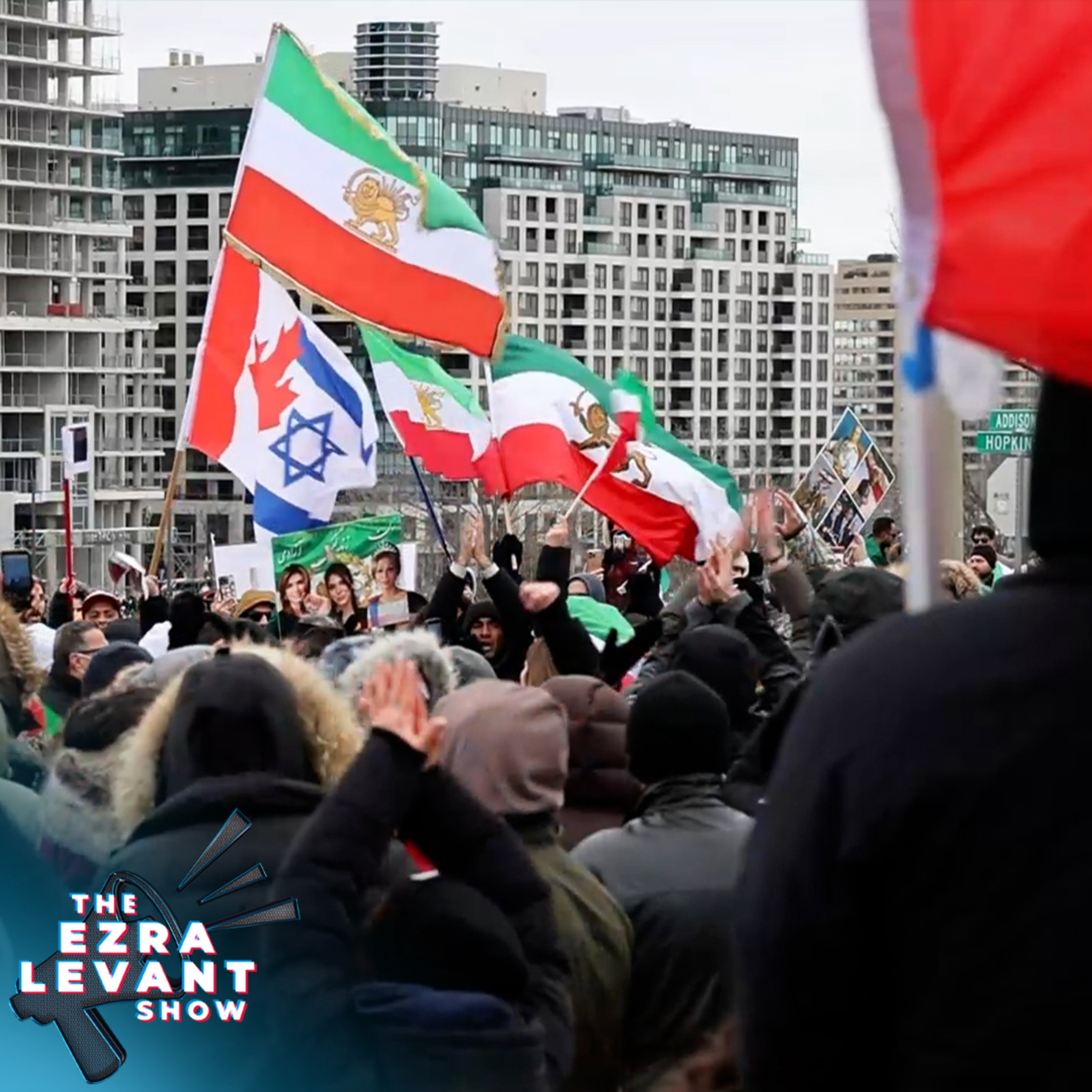
Rebel News Podcast
EZRA LEVANT | Will the people’s revolution bring down Iran’s Ayatollahs?
00:37:08
Listen to audio-only versions of RebelNews+ exclusive shows like the daily Ezra Levant Show, the Gunn Show, and audio versions of our DAILY livestreams along with other Rebel News long-form videos and interviews.
Loading summary
Transcript33 lines
- [00:00]
Ezra Levant
Hello, my friends. Big feature interview with Dr. Daniel Pipes about Iran today. Boy, are things heating up over there. Also want to talk to you about a Swedish pop star who says she hates the immigration police in the United States. Oh, and by the way, can I please get a visa to the United States? I wonder if there's a conflict there. But first, let me invite you to become a subscriber to Rebel News Plus. That's the video version of this podcast, not only to get great video content, but you help keep Rebel News strong because we rely on you. We don't take any government money, and it shows. Tonight. Will the people's revolution get rid of the Ayatollahs in Iran? It's January 13th and this is the Ezra Levant Show.
- [00:55]
Dr. Daniel Pipes
You fighting for freedom.
- [00:58]
Ezra Levant
Shame on you, you sensorist. Oh, hi, everybody. I can hardly wait to show you my interview today with Dr. Daniel Pipes of the Middle East Forum. He's an expert in Iran and we'll have a about a half hour conversation with him. But first, I want to show you something that I saw the corner of my eye on social media. Zara Larson is a pop star from Scandinavia. I had never heard of her until yesterday. I confess, she's a bit of a big deal, though. She's got 9.8 million followers on Instagram. And one of her comments, very, very thoughtful, was to say, I effing hate ice. ICE being the, of course, immigration police in the United States. It was a weird rant in that she sort of had a list, as you can see. She said she loves criminals. I mean, I guess Jesus said that too. He loves the sinners, hates the sin. But she said she loves abortion and she loves welfare. Well, that's not the same as loving the sinner, but hating the sinner. I don't really understand what she was trying to say, and I don't think it was particularly deep, to be honest. She had no love for ice, though. In fact, she said she hated it. So I think it wasn't particularly erudite and not very intellectual. Now, she got a lot of flack for it, but obviously she got a lot of attention. And instead of thinking, well, maybe I should recalibrate, she doubled down. She warmed to her theme and she gave her opinions from over there in Sweden or wherever she is about ice, the American police who are fulfilling Donald Trump's electoral mandate of deporting illegal criminals, people who come into the country illegally. She said about ice, quote, they're criminals, too. Killing, kidnapping, violent, hateful ones. So she said, I didn't know she was an expert in things, but I do know from poking around her website that she is about to begin a US tour, a concert tour, and she's starting in some very Democrat blue antifa cities of Portland, Seattle and Oakland, perhaps the three most left wing cities in the United States. Now, the thing about attacking the immigration police, the thing about attacking the immigration Department of the United States is it's odd to do that right before you're going to need to apply to the immigration department in the United States to go on a big rock and roll tour, as she is. Should Secretary of State Marco Rubio, who's in charge of visas, should she let Zara Larson in? I mean, do you doubt for a second that she will use her concerts as an opportunity to radicalize young people against police? Do you really think she's not gonna. She's having the time of her life poking the bear in America. I mean, I guess one cheeky approach for the US Government would to be to let her in and do her concerts and for ICE to use her concerts as a kind of honey pot to attract bad guys or people who have to be deported and have a massive ICE presence at her concerts to sweep up the lawbreakers. I mean, of course American citizens have the First Amendment and that allows them to express their feelings, including if their feelings are hatred for their country, like Tsar Larson feels. Foreigners may have that freedom of speech too, but they don't have the right to enter the United States to express it. I think we take for granted that people can just express their hatred of America, especially celebrities doing it, because Americans never push back, they never do anything about it if you say how much you hate them. In fact, some Americans cheer when you say you hate America. Same thing with Canada, by the way. I mean, if we're tearing down statues of Sir John A. MacDonald and calling Canada a genocidal country because of a fake claim about a particular residential school. It's tough to muster any outrage when someone else says we're evil, right? Especially we've been saying it about ourselves falsely. But still, is America just supposed to accept all of this? Some millionaire from Sweden calling ICE police murderers and kidnappers as a thought exercise? Imagine if a singer were about to embark on a 20 city concert tour of France, but started off by telling her 10 million followers how evil France is and how much she hates French police. Well, actually, come to think of it, France probably would allow it. It's a bad example, but I think Trump is starting to push back on this stuff. Not at the petty level of a pop star, but at a more serious level of everyone around the world taking America for granted, knowing America is very powerful, but knowing that America is slow to anger and will accept a lot of guff. It reminds me of this rant in a movie by Christopher Walken. Oh, I don't know. This is about 20 years old. Can I play for you a clip that's about a minute and 40 seconds long? Christopher Walken, who's a great actor, very dramatic style and very unique sound of his voice trying to rev up someone. It doesn't matter the context, but just listen to this talk and think, if you would, that the United States is the lion they're talking about.
- [06:48]
Christopher Walken (clip)
You watch those nature documentaries on the cable?
- [06:52]
Dr. Daniel Pipes
Yeah.
- [06:53]
Christopher Walken (clip)
You see the one about lions?
- [06:56]
Ezra Levant
Yeah.
- [06:57]
Christopher Walken (clip)
Look at this lion. He's the king of the jungle. Huge mane out there. He's laying down under a tree in the middle of Africa. He's so big, he's so hot. He doesn't want to move. Now the little lion cubs, they start messing with him, biting his tail, biting his ears. He doesn't do anything. The lioness, she starts messing with him, coming over, making trouble. Still nothing. Now, the other animals, they notice this and they start to move in the jackals, hyenas, they're barking at him, laughing at him. They nip his toes and eat the food that's in his domain. They do this and they get closer and closer and bolder and bolder, till one day that lion gets up and tears the shit out of everybody. Runs like the wind, eats everything in his path. Because every once in a while, the lion has to show the jackals who he is.
- [08:16]
Ezra Levant
Yeah, everyone has been nipping at the lion and the lion hasn't done anything in a long time. How often does our country poke at the lion, insult the lion, mock the lion? Anti Americanism is actually becoming part of the Canadian identity again. Donald Trump, I think, is having his lion moment. He just ripped off the head of a hyena called Venezuela and he's threatening to do it to Cuba and to Colombia and to Iran and in a way, to Greenland, to America. Seems to be sick of having people take it for granted and taking liberties, like telling your 9.8 million followers on Instagram that you effing hate them. Oh, but can I please now do a concert tour in your country, which is a privilege. I think it would be a great symbol if they said no to this anti American Swedish singer right before her concert tour. Don't you stay with us for More. What a contrast. The protest against the Iranian ayatollahs, thousands, millions, I think, rising up, it's hard to tell because Iran has cut the Internet and in some places cut electricity to their own people to try and stop information from getting out. I understand that Elon Musk's starlink provided a possible solution, but the Iranians are trying to jam that. It really is a battle, a battle that Donald Trump, the President of the United States, has joined, at least rhetorically, encouraging the Iranian people to rise up and to take over the institutions of Iran. That's the latest tweet as I read this. He's tweeting about Iran on at least a daily basis. And there are reports that may be unrelated that the US Are moving certain military assets closer to Iran. Now, it could be for other reasons, and I don't want to speculate too much, but Trump had tweeted over a week ago that if the Iranian regime harms its own people, if it shoots its own people, that it may face a military response from America. There are reports that Iran has in fact killed up to 20,000 of its own people. So it certainly crossed Donald Trump's red lines. One of the differences between this protest and the protests, well, I suppose on the situation in Gaza is the lack of Western leftist and populist and student support. My point being, when Israel was fighting against Hamas in Gaza, you had tens of thousands, sometimes over 100,000 people marching in the streets of London. Other Western capitals, even Toronto saw tens of thousands marching essentially for Hamas, not just for Gaza. You saw all sorts of public intellectuals or at least celebrities standing with Gaza. But what a contrast now where you see very little support from elite society, very little support from the left. It's a fascinating contrast. Joining us now to talk a little bit more about the Iranian protests, what their future might be, what American involvement might be, and what we can learn about the reaction in the west is our friend Dr. Daniel Pipes, the founder of the Middle East Forum, who joins us now from the United States, although in the past he's joined us from very exotic places, including, of course, in the Middle East. Dr. Pipes, great to see you again.
- [11:57]
Dr. Daniel Pipes
Thank you, Ezra. Delighted to be here.
- [11:59]
Ezra Levant
You know, on Saturday, in my own city of Toronto, up to 40,000 people marched in the streets. There's a large Persian community here in Toronto, and they were marching for freedom. There were Canadian flags. It was non violent. They were not wearing hijabs or masks. It was such a refreshing change from the smaller pro Hamas protests this city has seen. There's a lot in that alone. Why don't you give us your status report? Because things are really are evolving on a daily basis. What's the latest as we talk right now?
- [12:33]
Dr. Daniel Pipes
Well, you went over it yourself. The number of deaths is going up substantially. The regime is using its other means, such as control of the Internet, the electricity, to try and control the protest, the rebellion, the revolt, the revolution. The United States is evolving in directions that are somewhat unpredictable. As you mentioned, troops are being moved to the region. The President has canceled prospective meetings with the Iranian regime. He has spoken very ferociously about the end of the regime. I would say after close to half a century, it looked like the Islamic Republic of Iran is about to fall. I think the chances are well over 50% that it's going to fall. Besides the revolutionary activity is the harrowing economic circumstance. Let's just let me point out one fact. Water. Water is in short supply. People aren't charging on their taps and finding a hiss and no water. This will drive people onto the streets. This will drive people to say, down with the dictator, down with Khamenei. So I think this is different. And generally there's a consensus that this time is different. It may not happen this time, but we're getting closer and closer to the end of the regime.
- [14:13]
Ezra Levant
I find that Iran is sometimes inscrutable to the West. That's a phrase sometimes used to describe China. But Iran's negotiating style, their statements are a little bit hard, I think, for the Westerner to grok what they react to, what they don't. But I've got to think that Donald Trump's startling raid over Caracas, Venezuela, 2 hours Total time on the ground where they seized Maduro and his wife without suffering a single casualty, while dispatching about 100 Cuban and Venezuelan bodyguards, defying high tech radars provided by China. I've got to think that that really landed with with all sorts of American enemies around the world, from Havana to Tehran. And I mean, Israel was able to penetrate a lot of Iranian airspace. Imagine what America could do if it unleashed all its technology. What do you think Iran thinks? What do you think Iran thinks of Trump's statements? I mean, I find Iran's messages hard to understand. What do you think they think?
- [15:24]
Dr. Daniel Pipes
Just one footnote. The Israelis not only were successful in the air, but they also managed to assassinate a number of leaders, military, political and scientific. In Iran. They had deep knowledge of what was going on there, which must be frightening for the leadership. I think the leadership is scared. There are reports, one that Khamenei is got a plan B to escape to this, to Russia. There are reports that the military, the gc, the Islamic Republic Guard Corps is thinking about getting rid of Khamenei and replacing him with someone who's more competent. In other words, there are reports that there is turmoil within the leadership. They're just reports. Nothing is for sure. But it does make sense that they are in crisis. They have a population that's rising up against them. And not only rising up against them, but calling for the son of the last Shah to replace the Hitollah as the leader of Iran, at least interim leader. I mean, how much more humiliating can it get almost a half century later to have the population which once rose up against the Shah now calling for the Shah son to take the place of the Islamic Republic? I think they're in crisis. In short, they are in turmoil and they don't quite know which way to go.
- [16:53]
Ezra Levant
You know, one of the most interesting things about the Venezuelan affair, if I may, is that there are no Americans on the ground. I mean, I'm sure there's some CIA and some special operatives on the ground, but it was not an invasion. It was a two hour snatch of of the boss. And America is now working with the remains of the regime to affect change, basically by saying if you don't do what we now ask, release political prisoners, reform how you make and sell oil, wink, wink, nudge, nudge, we'll knock you out too. And so he's actually working with the husk of the Maduro regime. Maduro's son was there when Maduro's deputy was sworn in. I mean, it's sort of incredible. Trump is using the body of Maduro's dictatorship to do his reform. And it's so clear he just doesn't want another Afghanistan or Iraq with 100,000Americans on the ground with an attrition rate of, you know, people dying every week. Iran is even bigger. Sorry, go ahead.
- [17:58]
Dr. Daniel Pipes
The United States and its allies did something absolutely extraordinary in the aftermath of World War II in countries like Germany, Italy and Japan. It nation built, it reconstructed those countries with enormous success. All three are democratic and prosperous. This became the default, this unique, unprecedented act. No one ever done this before. No one had a Marshall Plan or its equivalent to Japan of helping the defeated foe come back. This became the default. This just became what Americans did, whether it be in Panama or Kuwait or Afghanistan or Iraq. But the difference was, well, there are many differences, but most importantly, Japan, Italy and Germany were world shaking aggressors. And we had Defeated them in a world shaking war, Iraq and Afghanistan or nothing like that. And so Americans didn't have the same energy, same will to impose a new regime, a new order in these countries. And so they failed. Trillions of dollars were spent, thousands of lives were lost to no effect. The Taliban are back in Afghanistan, Saddam Hussein is not back, but it's pretty wretched in Iraq. So there's a great disillusionment in the United States with this old pattern going back to 1945. And what Trump did in Venezuela was invent something new, startling. I mean, I was shocked when he dissed the opposition leader. I couldn't believe my ears. But he had his team, came up with an idea, an alternative, which you just described, of working with the regime, not getting rid of it, not taking over, not bringing in the opposition, but working with the old team. Now, there are pluses and minuses to this. The minus is obviously that it's still a despotic, repressive regime. The plus is that you don't need an American led occupation of the country with all the problems. And again, Venezuela is not a world shaking enemy and so the energy isn't there. Maybe this is a new approach. However, looking at Trump's tweets, it seems like he's abandoning the Venezuelan approach when it comes to Iran and he's talking about the opposition taking over and that could imply an American role, an American occupation, who knows? So we have this new approach in Venezuela. Will it be followed in Iran or are we going back to the one.
- [20:45]
Ezra Levant
I was startled when Trump did not go with the democratically elected opponent to Maduro in Venezuela. And he explained it in half a sentence. He said, she doesn't have the authority and respect of the country. She can't pull it off. And I think he's probably right. Even though I was rooting for her, as many were in Iran, it's different because you're not going to work with ayatollahs who are religious zealots, who are true believers in. It's a theocracy. You're not going to be able to work with theocrat too if you couldn't work with theocratic one. They're not persuadable in the way that a narco terrorist might be. I don't think so, at least. And that's what's interesting. I mean, I know some people want the son of the Shah back in, others are a critic of him. Do you think he has the wide appeal in Iran that he could hold it together? I mean, he hasn't been in the country in a very long time. He's sort of a government in exile and someone's. Yeah, you know, some would say he doesn't have a connection. I think Trump is right. You need a strong leader. America doesn't want to send in, like, a Governor MacArthur like he did in Japan after the Second World War. Is the Shah the guy?
- [21:57]
Dr. Daniel Pipes
Well, the Shah has. The Shah's standing has risen enormously in the last weeks and months. He is now being proclaimed as the new leader in Iran. There are people on the street, thousands of people calling his name out. So. So he is no longer just some exile in the United States. Now, should we go with the old idea of replacing the regime with a new one? He is the obvious person, and in that case, I hope that he has a meeting with Trump and gets the support. Political, symbolic, military, economic, and so forth. If not, I think I disagree with you. If the crew in Venezuela who are profoundly anti American, I mean, the new leader is the daughter of a man who kidnapped an American businessman and died under torture as a result. She hates the United States. If she's willing to work with the United States, why not some random Ayatollah or some leader of the irgc? I think it's equally possible, I think also that the regime ideology in Iran has desiccated, much as, say, in the Soviet Union it had, or in China has, or in Venezuela it has. It's just a kind of dictatorship at this point. So maybe, maybe they could be flexible. I wouldn't discount it.
- [23:26]
Ezra Levant
One of the things I saw, again, it's hard to know what is a hope that someone has written as a fact. It's hard to know what's propaganda or not. I mean, it's a war, really. But I read that many mosques are being attacked and torched by the Iranian people. I understand that the Iranian people are quite secular compared to their theocratic leadership, that they have, you know, have grown wearisome of religion being used as a cudgel on everything from how women dress to foreign affairs. Is it true that ordinary Iranian democratic protesters are torching mosques? What does that say about the religious center of Iran? What is the typical Iranian in terms of religion these days? Secular.
- [24:16]
Dr. Daniel Pipes
The grand irony of the Islamist rule over Iran, again close to half a century, is that it has hollered out the religious institutions and religious practice. The mosques are empty. There's a general sense, if this is Islam, what the government is purveying, I don't want it. There's a substantial conversion to Christianity by substantial, I mean about 1%, which given that converting to Christianity is by joining the enemy, like becoming a traitor, is a very significant number. So, yes. And one sees, by the way, a similar development in Turkey. It's only half the time, only a quarter of a century that since the Islamist rule has taken over. And it's not nearly so violent as in Iran. But you see the same emptying out of the mosques and the same hollowing out of religious faith. It doesn't work. There's no better way to destroy your faith than by making it the ruling authority. Doesn't work.
- [25:27]
Ezra Levant
I started out by mentioning that in Toronto, which is a large Persian community, up to 40,000 were on the street. And that was underreported by the Canadian media. The CBC actually said hundreds, which was absurd. Even if the 40,000 number is high by 50%, there's no way it was hundreds. I have a hope that if Iran falls, some of the anti Israel, anti Western radicalism on the streets of the west will dissipate. Some of these professional protesters that have encampments, anti Semitic encampments at universities two years ago, that that'll dry up now. Maybe Qata will be there to fund it. But I think that a lot of the anti Semitism we see has been artificially propped up by Iran through money, through social media schemes and bots. Am I kidding myself? Would the fall of Iran turn off some of the energy to the anti Western protesters?
- [26:30]
Dr. Daniel Pipes
Let me say yes and no. I think the fall of Iran has enormous consequences for the Middle east and for radical Islam. The modern era of the Middle east began in 1979 with the takeover by Ayatollah Khomeini. The collapse of his regime will end that period. And this will have many ramifications, both practical and ideological, in Muslim majority countries. I would argue that Muslim majority countries have already for 15 years seen a decline in Islamism as indicated by many, many polls and votes like however, in the west, which is what your topic is, I don't see that declining. I don't see Islam declining. I don't see the leftist Islamist alliance declining. I don't see the anti Semitism declining. I don't think Iran is terribly important in our context. You mentioned Qatar. I would add Turkey, Malaysia, Pakistan. There are many countries that are still fomenting trouble in the West. So Iran is just one of many here in the West. It is, however, very, very important and uniquely important when it comes to the Middle east and the broader majority countries.
- [27:54]
Ezra Levant
Do you think that peace with Israel is possible for Iran. I think there used to be a warm friendship. There was a pipeline between the two countries of oil, if I recall. Is it possible that Iran in its new future can maybe join the Abraham Accords? Or as the Shah's son said, the Cyrus Accords, named after the great Persian king who let the Jews go a couple thousand years ago.
- [28:23]
Dr. Daniel Pipes
No pipeline. There was ship born oil trade with Israel. Yes, it's certainly possible. But the great question ahead for everyone is will there be a single authority, whether it be the current Tusk, as you called it, or the Reza Pahlavi overseen interim government, or will there on the other hand be anarchy, chaos, civil war? If it's the former, then I can see a change in relations with Israel that even under the current regime. The tusk, the tusk, but even more so should be replaced. But I worry that the chances are more substantial that the country will descend into. Let me point out one particular fact that tends not to get noticed. Iran, like China, like Russia, is an empire. We in the west tend to think of empires as the British, the French, the Portuguese, the Spanish, as overseas empires way off in the distance, you know. But there are also land. Ethiopia would be another one, which we tend not to see because we think of these as countries, but they're not. And in the Iranian case, about 50% of the population is Persian speaking, Shiite. Rest of the country is Turkish speaking, Kurdish speaking, Balut speaking and so forth. And they don't want to be part of, in large part, they don't want to be part of Iran. So should there be a chaotic situation following, I can well imagine that Kurz, Azeriz, Baluch and others will say we want to be part of this country, we want out. And that would create even chaos. I'm perfectly sympathetic to them, but I worry about the chaos and even the potential civil war. War or civil wars that will follow.
- [30:14]
Ezra Levant
Last question. I know that Donald Trump really took the Abraham Accords seriously. He deputized his own son in law, Jared Kushner, to be the point person on that file. And whatever you think of the details, they got it done. I think Trump felt really motivated for that. He wanted to do the deal of the century, the hardest deal possible. In many ways he did. Does Trump have a guru on Iran? He's got negotiators, but does he have someone with a real vision for it? I imagine that they always hoped Iran would get weak, but it's happened quite quickly, especially after Israel dispatched Hezbollah and Hamas and then the 12 day war. Who is whispering in Trump's ear?
- [30:58]
Dr. Daniel Pipes
I wish I knew. It appears to me that it is amateurs like Witkoff and Kushner who are doing this. I do not know of any Iran specialist who is whispering in Trump's ear. Maybe I just don't know. And maybe there isn't one.
- [31:20]
Ezra Levant
Well, by the way, if it was the same amateurs who handle Venezuela, I think they're doing a pretty good job. Maybe all the professionals on the Iran file are of the Obama mindset. There are people who thought Iran was the future and they should yield to it. So I suppose having amateurs do it in some ways is probably better than the professional Iran industry in Washington, D.C. maybe that's a counterpoint on that. What do you think?
- [31:48]
Dr. Daniel Pipes
There's a long American tradition going back to the King Crane Commission after World War I, so a century and more of looking to amateurs as being more capable than experts. And while I agree with you, experts have made many mistakes, I do get nervous when a real estate mogul like Steve Witkoff becomes the key player in such a complex situation as this. It's been pretty good the last few weeks. I got a compliment then. But I. I am nervous.
- [32:26]
Ezra Levant
Well, everyone's nervous. The Ayatollahs, I think, are the most nervous. I think the Iranian people are nervous. The Iranian exiles, including here in Canada, are nervous because it is a mighty and massive country. As you say, it's an empire. It's a historic civilization going back thousands of years. It's got 90 million souls. Like that is a large country. It's not like it's four times as big as Venezuela. Like, it is enormous. And, of course, there's oil, which is of great value to China, Russia and others. So I think that we're in momentous times. If you had to. If I pressed you to say, you told me that you thought that there's a greater than 50% chance that the Ayatollahs would fall. That's quite a statement. If I had to ask you when and you had to answer, how soon would you give the regime?
- [33:17]
Dr. Daniel Pipes
January.
- [33:19]
Ezra Levant
All right, well, we'll find out soon enough. Listen, great to catch up with you. We're certainly in new territory, and the whole world is riveted by it, even if some of the regime media aren't reporting it. Thanks so much for joining us today.
- [33:32]
Dr. Daniel Pipes
Thank you for inviting me, Ezra.
- [33:34]
Ezra Levant
It's our pleasure. Dr. Daniel Pipes is the founder of the Middle East Forum. Stay with us. Your letters to me next. Hey, welcome back. Your letters to me. The first one is about the ban that the UK is considering for the social media platform X, formerly called Twitter. Prospector James Marshall says ban X but not TikTok. This literally makes me laugh out loud. We are fully infiltrated by Chinese government. You're right. You know What? I downloaded TikTok on my phone a few years ago, and then when I heard about all the spyware and malware that China was spying on you, I deleted it. But then I downloaded again because it's just such a culturally important place. You can see how the world is infiltrating the minds of American and Canadian and British kids. I want to be on TikTok because I want to see what's happening to our teenagers. I see Niagara Falls of anti Western, anti Jewish, anti Christian, anti history propaganda, just absolutely destroying our people. Imagine. And that's because it's a Chinese company and they know exactly what they're doing. Imagine taking on X, owned by the leading businessman in the United States. Chalky says Starmer, that's the Prime Minister of the uk, tolerates rape, gangs, grooming gangs. They're ruining women in children's lives. And he tolerates that. But he cannot tolerate an AI photo of himself in a bikini. His rent was just too much over the top. What's really wrong is that he doesn't want the people to know what's going on on the outside world. Yeah, you know, I actually haven't seen anyone use AI to put me in a bikini, and I would probably be embarrassed by it. There's no doubt about it. But I think the key point is every AI system can do that. That's the power of AI it's terrifying. Soon you'll be able to make videos of. You can pretty much right now make videos that look like someone saying and doing something terrible. And, you know, it's very hard to tell the difference between that and a deep fake. But going after only X or Elon Musk sort of gives the game away, doesn't it? Engine Kid said. Ezra, please do a segment about Scott Adams, who died this morning. He was a hero to so many. He was outspoken against the WOKE agenda, and he was canceled because of his words. He was inspirational and an artist, author, lecturer, hypnotist, comedian, teacher, podcaster, writer and author. You're so right. And I wasn't a regular follower of his, but every once in a while I would read something and I thought, oh, my gosh, that is such a unique way of looking at the world. I remember following him when Donald Trump, in his first term, was reaching out to Kim Jong Un of North Korea, and he made a video for Kim Jong Un and. And Scott Adams took you through it sort of section by section, showing why it was so persuasive. And Scott Adams was very thoughtful in how he analyzed political influence and persuasion. I found him very useful, and he was politically incorrect, and they. They tried to destroy him for that. I think he was all those things you listed. And I never had the chance to meet him, but I was, like you, a bit of a fan, so thank you for remembering him. Well, that's our show for the day. Until tomorrow, on behalf of all of us here at Rebel World Headquarters, to you at home, good night and keep fighting for freedom.