← Rebel News Podcast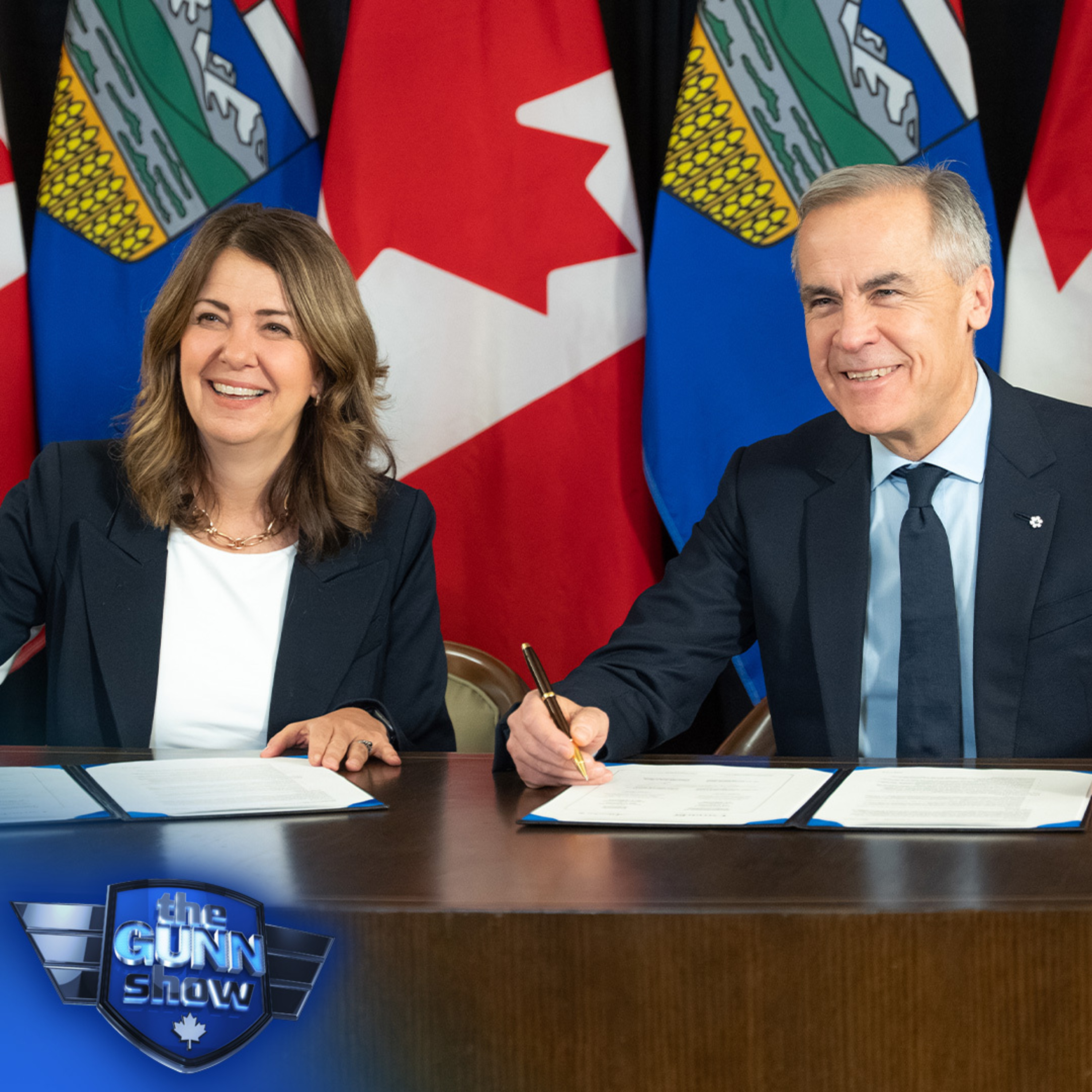
Rebel News Podcast
SHEILA GUNN REID | Alberta's 'pipeline deal' with Mark Carney
00:14:29
On this episode of The Gunn Show, Kris Sims from the Canadian Taxpayers Federation breaks down the premier’s new Memorandum of Understanding with Mark Carney, a deal being sold as the long-awaited path to a B.C. pipeline. But for now, Albertans aren’t getting a pipeline.
Loading summary
Transcript30 lines
- [00:00]
A
What does Premier Smith's memorandum of understanding mean for Alberta taxpayers? I'm Sheila Gunn Reed and you're watching the gun show.
- [00:26]
You know, I read a lot of government documents. Part of my job is actually to understand what government policy means when applied to your life. What the consequences, unintended or otherwise, are for everyday people just trying to live their lives. And I know what I read in that memorandum of understanding between Premier Daniel Smith and Prime Minister Mark Carney.
- [00:57]
I know that that memorandum of understanding requires an increase in the industrial carbon tax for Albertans on the promise of potentially nothing.
- [01:13]
There is no obligation for a pipeline to be built before we start paying that enhanced industrial carbon tax. Now, perhaps I'm getting something wrong, but I don't think I am. So I invited my friend Chris Sims of the Alberta Taxpayers Federation to come on the show and fact check me. Double check my work. Here she is. Take a listen.
- [01:49]
Joining me now is my good friend and good friend of the show and good friend to taxpayers everywhere, Chris Sims from the Alberta Taxpayers Federation. Chris.
- [01:59]
Let'S talk about the gorilla in the room. And that is the memorandum of understanding with the Prime Minister on the potential for a pipeline where a private sector company has not even remotely proposed anything yet. It is my opinion that Daniel Smith is engaging in one last Hail Mary to try to get a pipeline done. My concern is I think Alberta is giving a lot away without a guarantee of something in return. Give me your analysis.
- [02:40]
B
I'm with you. I'm very concerned. But I wanted to start with the positives first. If they happen, okay, I'm going to try. If. Because I can see, I can see the premiere is working. I can see that she's trying to maintain hope and keep moving forward. And I appreciate that. As someone who's probably more cynical than she is, I appreciate that she is trying and she is trying to get a good deal for Alberta. That said, if it, if it happened, if it actually came true, okay, magic sparkles occurred and it all came true. If we got the production cap lifted, if we got the west coast tanker ban lifted, if we got a pipeline actually built out to the west coast in order to ship our stuff over to Asia, if. And this part got missed, I find a lot, the green energy regulation things that were strangling the building of natural gas power plants, right. If all of those things went away, that would be amazing. Like straight up, that would be great. That would be very good for Alberta. Frankly, I'd be happier if they were talking about getting gas fired power plants up and running so that all of us can have less expensive electricity bills and cheaper electricity in our homes and in our barns and in our workplaces rather than pumping this whole AI thing. But I digress. That's me. I was raised on Terminator movies, so I, I get it. So if, if all of it came true, that would be great. I'm concerned that the devil's in the details here. And one of the big details is what Prime Minister Mark Carney stomped out and said to all of the media cameras that were waiting for him right after he signed. And that's where he said basically that, oh, yeah, that carbon tax that's here in Alberta, that's going to be six times higher. Thanks very much. And so that was a problematic, as the kids say. And then when I saw economist Jack Mintz, who's no slouch, came out in the Financial Post right away, and I'm paraphrasing him, but I spoke with him on my show and I'm paraphrasing, but he basically said, yeah, Carney is taking what is currently known as the tier program industrial carbon tax here in Alberta, and he's adding up how much it costs now for carbon credits and carbon taxes, blah, blah, blah. And he said, yeah, that's around six times. And he was really raising the alarm bell. Dr. Mintz was saying that if they layer on all of these carbon taxes and all of these complicated carbon credit systems with the sequestration and all this stuff, that it would make the production, the production of a barrel of oil much more expensive. He said all combined, it could be as high as $10 extra US per barrel. And for folks who are listening outside of Alberta, that's a huge hit. Okay, if you suddenly make the production by 10 bucks a barrel US higher here in Alberta, that kind of prices us out of the market. And the reason why we talk about oil and gas so much isn't just because it provides great jobs for so many people and provides stuff that we all use. It's tied directly to the budget of Alberta. Like the government of Alberta, the revenues go up and down based on the price of a barrel of oil. So this is why this is so essential. So I am, I'm doing my best to take a page from what Premier Smith said in her last speech at the agm, which I thought was very good tone when she said, and she quoted Ronald Reagan saying, trust but verify. We've had the rug pulled out from under us before. We're going to be really cautious. I think that's the better Tack to take.
- [06:37]
C
I am under no illusions. This agreement is just the first step in this journey.
- [06:43]
A
This.
- [06:43]
C
There is much hard work ahead of us. And the federal government must earn back the trust to Albertans as we move through the next stages of this process.
- [06:59]
After all, the people of Alberta have, of course, had the rug pulled out from under them too many times to count over the past 10 years. So I will take the advice of a great US President, Ronald Reagan, who said, when dealing with a former adversary who Trust but verify, and on behalf of Albertans, I will be verifying and holding Alberta or Ottawa accountable. As you know, every step of the way, you can absolutely count on that.
- [07:29]
B
Rather than look here at all the fireworks. Everything's happy. Don't look at the details. The details matter here.
- [07:35]
A
Right? And you know that six to ten dollars a barrel per oil in additional production costs, that's a lot easier for the big five players like CNRL and Murray Edwards to absorb, given their involvement in the heavily subsidized carbon capture project, the Pathways alliance, then the juniors and middle of the road producers. This sort of additional cost can make their projects and their investments completely unviable. And that's my concern in all of this, is this can become a damper to anybody but the big five.
- [08:15]
B
Yeah, it's. It's one of those things that once you live here and work here and like get around in the industry and stuff, you start to understand. I think a lot of people who are outside of Alberta might be thinking, oh, well, you know, if the oil companies are in favor of this, this must be a good thing, right? For their product. They want to get their product out to the port, they want to move their stuff through pipes. You'd be forgiven for thinking that that sounds logical. But as my friend Franco Tarrazano pointed out in his book, those big oil company guys and gals, they were on stage when former NDP premier Rachel Notley announced her consumer carbon tax. Right, she created a brand new one just for the province of Alberta, but under this notion of a social license. And if I'm taking her at her word, okay, let's just say for argument's sake, she really wanted a pipeline. And I'm taking her at her word. It sounds so similar. Sheila was making the argument she was making, Notley was making the argument then, listen, folks, we want to get a pipeline built out to the west coast, and in order to do that, we have to pay a price.
- [09:22]
A
A carbon tax. Like literally, it's the same argument. I thought we left the flawed idea of Social license in the dustbin of the Notley era. And we've resurrected it and I hope we haven't.
- [09:35]
B
I really hope. Okay, this is my hope. This is my hope. I hope that they have Carney signed on to these promises of lifting the production cap, getting, you know, approving, approving, approving, like for realsies, a pipeline being built out to the west coast without using taxpayers money. They have to get private people coming in here willing to build it and getting that tanker ban suspended and all of those good things. I really hope they're able to do that while really whittling down that carbon tax, that industrial carbon tax hard. Because I'm hearing from some proponents, Sheila, and I don't, I don't know if this makes sense because I'm not in the industry. Dr. Mintz told me yesterday that it doesn't make sense to him. But I'm hearing from some people who are around industry saying, listen, this is not the same as a consumer carbon tax. We can whittle this thing down to where it's basically oil companies passing monopoly money back and forth to each other in a closed circle without cost to consumers and without cost to the government taxpayer. Just trust us on this. We just need to get the checkbox. I don't know if that makes sense, but that's what I'm hearing. People tell me Mint said that it doesn't make sense to him as an economist, but they, I'm really hoping that they're able to get that carbon tax level way down while still getting all of the good stuff done.
- [11:02]
A
Yeah, I've, I've just about had it.
- [11:04]
D
Over the past week with conservative insiders telling me that I'm not bright enough.
- [11:10]
A
To understand what I absolutely just read.
- [11:12]
D
I find that irritating is all get out. Because I can completely understand what I just read and it feels a lot like not least social license. And the Conservative Party federally just got cut off the knees on this issue.
- [11:27]
A
Because they're out there in the House of Commons saying this industrial carbon tax is just a shift upstream so that the people no longer see it as a line item. They just see that things cost more and they don't really understand why. And they no longer see carbon tax as a line item on their natural gas bill or their electricity bill, thus insulating the liberals from the political fallout. They're hammering that issue in the House of Commons and then their greatest ally in the fight against carbon tax just sort of decided that she's going to concede the first ditch to the liberals in the Battle.
- [12:05]
B
And this was it. Remember during the election when Carney kind of laughed at the idea of axing the tax and he said, we're going to change the carbon tax. This is what we've been warning about now here for ages. Of course, of course. And so this is where it gets really frustrating when you're looking around saying, guys, come on. Like, this is a hidden carbon tax. He warned the entire time that he was going to change the carbon tax and strengthen it. Like, speaking of books, please, folks, if you have not read this book, it's important that you do.
- [12:39]
A
Take it out of the library. Don't buy it.
- [12:41]
B
Thank you. Take it out of the library. Borrow it from a friend. You know, I'm not telling you to love it or like it or endorse it. Like, come on, we're all adults. Let's read stuff that helps us understand what's going on. Prime Minister Mark Carney, when he was the UN Special envoy on blah, blah, blah, all these issues, he wrote this book, and in it are chapter after chapter of things like carbon taxes, various forms of them. He quotes Greta Thunberg in earnest repeatedly. This book was endorsed by Bono. Okay. Carney just wrote this a couple years ago. And so this is where I'm trying to see the good parts of, like, actually get. I am. I'm. I'm trying to be.
- [13:22]
A
I know you are.
- [13:26]
D
I know you are.
- [13:27]
B
Yeah.
- [13:28]
A
I look at this pipeline proposal without a private sector pipeline proposal involved yet, and I look at the tangibles here. Russia isn't doing this. OPEC isn't doing this. The Americans aren't doing this. So if you were a private sector pipeline company, and the American ethos right now is drill, baby, drill, and you're looking at Canada and it's like net zero plus 600%, potentially more in upstream carbon taxes, why would you invest here? Why? You know, I guess the proof is in the pudding.
- [14:06]
B
It's one of those things where I'm glad you pointed out the United States, and I know we're in a tussle with US President Donald Trump, and we're in the middle of a tariff war, and we just saw Algoma Steel. I just hate seeing those stories.
- [14:21]
A
By the way, Algoma Steel could have made a heck of a lot of pipelines for Western Canada, but we're not a serious country.