← Rebel News Podcast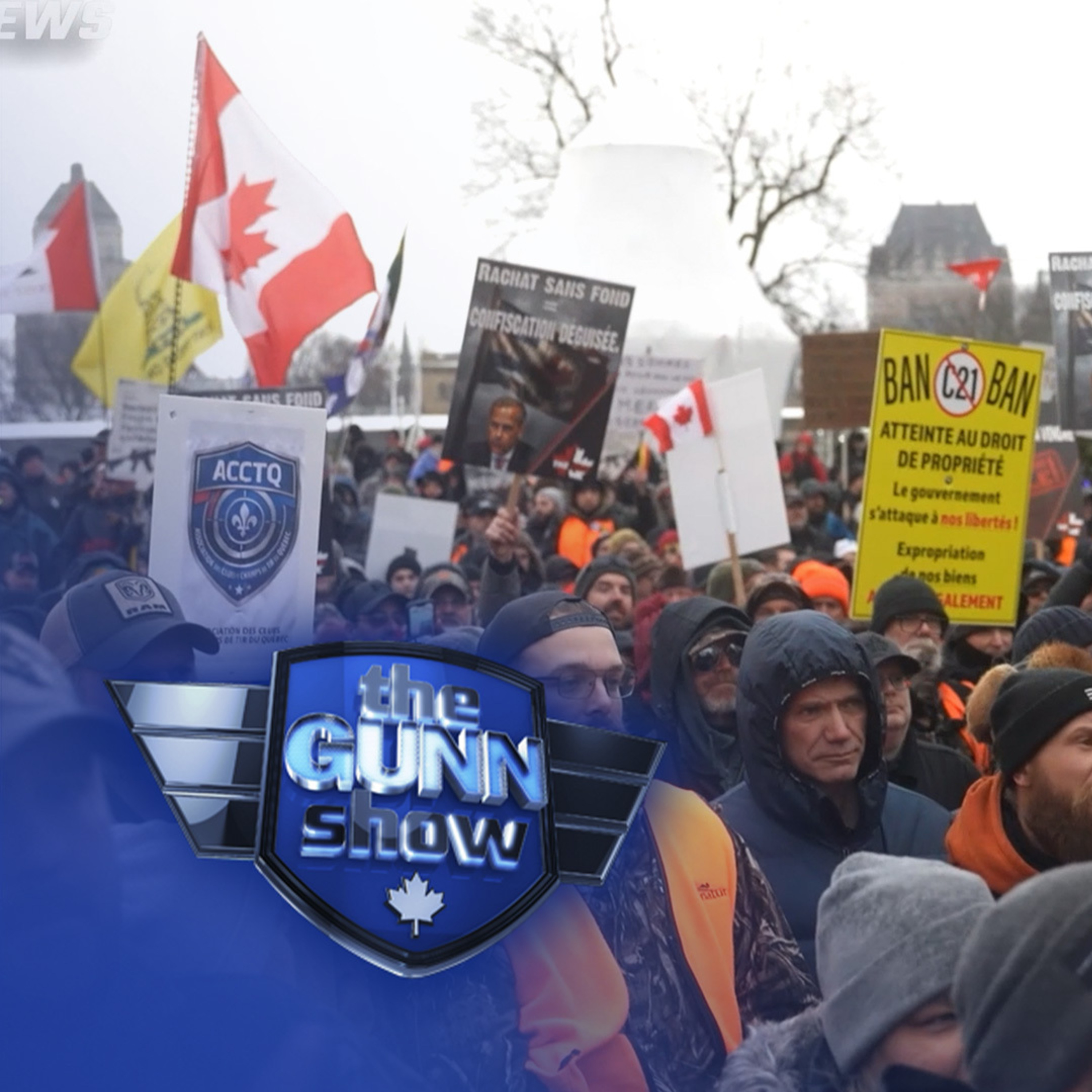
Rebel News Podcast
SHEILA GUNN REID | Thousands rally in Quebec against Carney’s gun grab
00:36:30
Peaceful, law-abiding firearms owners gathered in Quebec this week to send a message to Mark Carney’s Liberal government: enough is enough. Listen to audio-only versions of RebelNews+ exclusive shows like the daily Ezra Levant Show, the Gunn Show, and audio versions of our DAILY livestreams along with other Rebel News long-form videos and interviews.
Loading summary
Transcript59 lines
- [00:00]
Sheila Gunn Reid
Thousands of law abiding firearms owners demonstrate for their rights in Quebec. I'm Sheila Gunn Reid and you're watching the gun show. Last weekend in Quebec City. Thousands of some of the safest people in the entire country protested the Liberal government. Now that's been happening, it feels like constantly, since at least early 2020. But this time it was a little unusual in that it was licensed law abiding firearms owners in Quebec protesting the Liberal government's most recent gun grab and their own government's collaboration in it. Our own Alexa Lavoie was there to document the Canadian Coalition for Firearms Rights organized event last weekend in Quebec City and give voice to the people who simply want to be treated fairly under the law and who think that some snatching the guns lawfully acquired by some of the safest people in the country, well, that's not going to do anything to make Canadian streets any safer.
- [01:36]
Gary
So joining me now in an interview
- [01:38]
Sheila Gunn Reid
we recorded yesterday morning is my friend, my colleague, one of the hardest working people I know, Alexa Lavois.
- [01:56]
Alexa Lavoie
Why you drove all the way here in Quebec? Yeah.
- [02:00]
Gary
To support the Quebec firearms owners. They're licensed, they're legal, they're not criminals. Quebec government, they're very closely connected to the liberals and there's a lot of liberal supporters that are in Quebec and the federal government wants to appease the Liberal supporters. It's all politics, Gary, in a sad degree. He's been on record saying this is all politics, that it won't work. And he's right, it won't work to
- [02:28]
Alexa Lavoie
redo this from like scratch.
- [02:30]
Gary
Right.
- [02:31]
I would have a very different approach.
- [02:33]
Alexa Lavoie
We came to Quebec first because the government of Quebec has signed a deal to help the federal government take firearms from their own people instead of from criminals. They're going to take the guns of law abiding Quebecers. Quebecers do not deserve this. They deserve better from their government. So if the gun grab starts in Quebec, let's see it end in Quebec.
- [02:54]
The importance of doing this in Quebec is really because Quebec is where the problem sort us started and this is where we want the problem to end.
- [03:03]
Gary
So joining me now is my friend and colleague, Alexa Lavois, and she's here to talk about a massive pro firearms rights rally that took place in Quebec of all places. As a Westerner, sometimes I think that all of our problems related to firearms rights comes from lobbyists in Quebec. But there is a huge pro firearms community in Quebec and they are just like the rest of us, tired of being scapegoated by the Federal government for the federal government's inability to deal with crime in this country. And Alexa Lavois was there to document it all. Alexa, thanks for joining me on the show today. Tell me about the protest. Who organized it? How many people were there?
- [03:51]
Alexa Lavoie
It was organized by ccfr, mainly the part from Quebec and with the help of the rest of the CCFR team. A lot of people were there, I think thousands of them, maybe two, 3,000. I don't have the exact numbers, but I know that there were some bus organized to all drive to Quebec City. And I was actually surprised to see the number of people there. And I saw families, I saw woman because most of the time people are seeing as this kind of woman, mainly with men. But no, I was kind of surprised. It was really a mix. Young woman that likes to go with their father and go to just doing some shooting sports. It was actually like a really beautiful day. I even saw a goat,
- [04:55]
Gary
protest goat. You know, just to put a pin on what you said about young women being at these rallies. The single largest demographic, the the fastest growing demographic of firearms owners in this country is young women. Young women are getting more and more interested in the shooting sports. And you know, if you are a young woman in Alberta and you have a criminal break into your house, you don't have to presume the benevolence of that criminal inside of your house. You can use your firearm to defend yourself and not be prosecuted. But that's an Alberta centric thing. But I understand why more young women would be getting into the shooting sports given that crime seems to be out of control in this country.
- [05:47]
Alexa Lavoie
Yes. And this is, I think there is also the side of we are demonizing and diabolizing firearm owners. And when you are doing this, you are creating a little bit that the Streisand effect, that more you are doing this, more people will actually go to the other side and try to say, hey, why are they doing this? Why not trying? And you know, I'm pretty sure that a lot of them fall in love with this sport. And you know, I think it's, I love it. I've been there like a couple of times to do like some sport shooting and I actually enjoyed it. And you know, I think it's just because when you try to hide something, you are creating the opposite effect.
- [06:39]
Gary
Oh for sure. That's my advice to most people is if you've got a liberal, open minded friend, take them to the gun range because it's fun. It's really fun. It will change their attitude on Firearms rights. And you know, you hear from the federal government all the time that you know, we have to keep women safe so we have to get guns off the street. Firearms are the great equalizer for a smaller woman versus a larger male criminal. But also if you look at the CCFR itself, it's, it's a women led organization. No offense, Rod Gaka, we love you. But Tracy Wilson is with the ccfr. We know her, we love her. She's one of the strongest fighters for firearms rights in this country and even in Quebec. Their director, Sophie Band, she's the Quebec director of the Canadian Coalition for Firearms Rights. And so this is really a, a, a movement that features women prominently and it sort of cuts through that garbage on the other side that says, you know, we've, we've got to take the guns away from everybody to keep women safe. And the, the women are saying, yeah, don't do that to us. We like that.
- [07:55]
Alexa Lavoie
But the main problem in all this situation is because of the mainstream media for sure. Why I'm saying that, I don't know. I think it was the Toro literally say our weapons are not for sale when it was actually our guns are not for sale by modifying their slogans to bring weapons instead of guns. And also just before the gathering there were some journalists questioning the mayor of Quebec trying to portray all the people as dangerous individuals and kind of questioning the mayor saying like you're not scared, you're not concerned that they are going to be protesting or gathering in front of the National Assembly. Why, why are you trying to portray them as dangerous individual when they are just going to peacefully gather to ask the government to remove themselves from the buyback program and to not cooperate with Ottawa. I don't know if you saw also, but our Public Safety Minister Yann Lafren did publish couple of days before the gathering that it was just for facilitating the buyback program. The people wanted to actually subscribe to it. But they say that they will not allow Ottawa to have access to the registry and that no one will come to confiscate their guns. But the thing is some people actually say on, on the ground that probably is a mistake on his side because it's a federal jurisdiction. So if they decide to send the RCMP to grab the guns, the province have nothing to sell.
- [09:54]
Gary
Right? Well, I mean Alberta has something to say about it, Saskatchewan has something to say about it, Yukon has something to say about it. But we really haven't heard all that much from Quebec. So Sophie Blonde says that she's been in contact with the Quebec public safety minister and she feels that he is listening to her and that's a really big step. But Quebec is the only province that has agreed to participate in the buyback wholeheartedly. Other provinces own have said, the hell we're participating in this. Our police have better things to do than go after people who are vetted every single day. And you know, if firearms owners in this country were a problem, you'd already know about us. There's 2.2 million of us. But Quebec has agreed that they will go along with this. So even if Quebec doesn't turn over its own provincial registry information, the federal government does hold information on who has restricted firearms that have moved to prohibited like the ar. And they also just generally have a list of who has a pal and or our pals. They could go door too if they wanted to do to. And Quebec said, yeah, okay, that's fine with us.
- [11:17]
Alexa Lavoie
Yeah. And it's so funny because usually Quebec would be the last province to follow what Ottawa is saying, but for this one, Quebec was the only one saying, yes, why not? They literally took the money and sold the firearm owners, the people who actually are complying to the law, who are the most, you know, responsible citizen. And they know they can't do any mistakes. They know that they need to be a really, really responsible. And we are going full speed and we are punishing them.
- [12:02]
Gary
Yeah. And I saw some criticism of the rally from the likes of Paulie Sisuviant, which is Natalie Provo, who's a Liberal mp, that's her old organization. And you know, when they elicited Natalie Provo to run for the Liberals, I knew that they would be rushing head first into the gun grab and not backing off from it. But they were critical of the, of the rally going forward, even though the rally was planned well in advance because of the Tumblr Ridge shooting. Paul, I'll just read you the statement from Paulie Siant. They said it's shameful that in the wake of this tragedy, pro gun groups are choosing this moment to continue their campaign to prevent the removal of assault weapons. There's a 410 on the list that are commonly used in mass shootings and have been banned for public safety reasons. Oh, they're banned, but we still have them, so it's not a public safety issue. You prohibited them from us, but we still have them in our possession and we're not killing people with them.
- [13:08]
Sheila Gunn Reid
To her credit though, Sophie Belen said,
- [13:10]
Gary
we stand in solidarity with British Columbia. We are all affected. And that is precisely why we're here. Because what happened in British Columbia should never happen again. It's a failure on the parts of government and legislation. It's a mental health issue, not a problem with legal weapons. And we've talked about this before, why did those firearms stay in the house of the Tumblr Ridge Shooter, where the Tumbler Ridge Shooter, who was not the owner of those firearms, had access to them after dozens of points of contact between that family and the rcmp, including an arson on the family household while
- [13:48]
Sheila Gunn Reid
the Tumbler Ridge Shooter was under the
- [13:50]
Gary
influence of psychedelic mushrooms. Like why those guns were ever in that household is beyond me. And hopefully one day we have a national inquiry into the several layers of failure that took place there. But it absolutely has nothing to do with people like me who have their firearms properly secured. And if firearms rights are going to be infringed because the police and doctors and the school and perhaps Chat GPT failed to do their job in Tumblr Ridge, now is the time to see stand up and say, it wasn't us, we're not the problem.
- [14:29]
Alexa Lavoie
And this is something that people were actually bringing to me on the ground. It's like all the regulation and legislation, at one point we, they were able to see that there were a lack of enforcement of the regulation and legislation that they are already in place. So you're lacking proper check of what you already put in place. But instead of saying, we will enforce it and we will make sure that the legislation and the regulation that are already in place are actually applied properly, oh no, we are just going to go further and just remove the guns from the legal guns owner. So this is actually one of the big problems is like instead of doing things properly, they are just saying, but we don't have actually enough resources. We're just going further and just remove the gun. So it would be easier and we don't need to put more resources to enforce regulation and legislation.
- [15:38]
Gary
Right. Quebec is participating in the firearms buyback to the tune of $12.4 million. That money could go a hell of a long way in staffing up police services or cracking down on crime. Hiring more crown prosecutors to make sure that people are shoved through the legal system in a timely way. Instead of having their cases time out and then having them walk free, I think that would go, or maybe let's secure the border. Why don't we try to do something like that? Because that's where all the illegal firearms are ending up in the hands of gangs.
- [16:19]
Alexa Lavoie
I'm Sorry, but this is Akwesasne. And Akwesasne, there is a really few desire from our law enforcement and our government to crack down on a native land. But the thing is the. We know where is a problem, but because we don't want to go over there by what fear, we prefer to go against and chase the people who comply to the law.
- [16:48]
Gary
Right. Because they know we'll follow the law. We're the path of least resistance. And that's what lazy lawmakers do. They take the easy way instead of doing the thing that they need to do to keep communities safe. $12.4 million could make a dent in some of the violent crime happening in Quebec. But the Quebec government has said that it is better spent harassing nice people who just want to target shoot or hunt with their families and subsistence hunt because groceries are so expensive, thanks to Mark Carney's spending habits. Tell me, what is some of the feedback you're getting from the people on
- [17:27]
Sheila Gunn Reid
the ground that you talk to?
- [17:28]
Alexa Lavoie
A lot of them were saying, like, we are not criminals. We, we actually comply to the law. We are so responsible. So now on October 30, we are going to be deemed criminal because we don't want to give our guns, guns that we actually did all the steps to be able to own a firearm. A lot of them, they say, like, you know, we don't understand. They don't address the issue. They are taking the least resistance path. A lot of them were saying, like there is a rise on mental illness. Don't understand with the rise of mental illnesses in Canada and the fact that there is a problem with illegal gun smuggling at the border, why in this whole world, why it's the one person that they are going against and not the 99% of the problem. And so a lot of people don't understand. They say that people should stand up because it's not, because you are not interested into firearm, that you should not be actually concerned that maybe what would be next, what they will actually ban after, what they will actually coerce you to give up. Like what is it your car? Because your car is polarity. Is it your boat? What is next? So a lot of people were saying, like people should rise at this moment. People should be aware that this is like a violation of the rights that people have and that they, they are not the problem. They are not the problem of this situation in Canada with the crimes.
- [19:32]
Gary
Right? We, we're not the problem. You, we've never been the problem. And if we were the problem, you'd all know about it by now because there's too many of us. But you are right this. Even if you aren't a firearms owner, are you just going to sit there and watch while your fellow Canadians are scapegoated for crimes they didn't commit? Are you just going to sit there and watch and do nothing while a group of people are targeted by the government even though they didn't do anything wrong? Because yes, it will be you next. Like they're, they're banning some of these firearms simply because they look cool. Yeah, People should care even if they aren't firearms owners, because you should care if a group of your fellow Canadian citizens are being scapegoated for crimes that they didn't commit or that their property is being confiscated for no reason whatsoever. They're not criminals. And if you don't care about that, then like, I can't help you because it could be you next for something that you didn't do. One of those firearms on the order in Council is a 410 bird gun. Like a tiny bird gun. You would not use this for duck hunting. And it's only on there because it looks cool. So to put this into context for other people, maybe you have a black car and it looks really cool and it looks fast, but it might not be fast. And then the government comes along and bans it because you might one day drive it fast, even though it doesn't have the capacity to drive fast. That's what's happening to firearms owners right now. And they're losing family heirlooms that way. They're losing parts of their family history. So even if you don't care about firearms, maybe you care about property rights, but maybe you care about fairness and fair treatment at the hands of the government under the law. And right now that's not happening to the firearms community.
- [21:26]
Alexa Lavoie
Yeah. And people need to understand that whatever the type of gun they shoot, you can actually kill someone. Whatever the type of gun. Okay. This is just because aesthetic.
- [21:42]
Gary
Right.
- [21:42]
Alexa Lavoie
Bring people to want to remove some gun that looks scary for the population. Okay. But at the end of the day, all guns can actually cause harm. So this is not a problem with guns at the end of the day, it's a problem because the, the guns look scary. And so a population that is misinformed. We don't know that there is so many level of regulation and restriction and there is a lot of safeguard for the people who actually own a gun in Canada. A lot of people will agree saying like, well, you know, less gun in circulation in Canada. But the thing is you're going to remove the one person that is not the problem. You will still have like 99% of guns circulating in Canada who is used to commit crimes. So you need to start questioning yourself like what do you want your government to do to stop the crime or to punish law abiding citizen? Because both don't go together. You know that legal guns is being used for 1% of what? Homicide and suicide? 1%.
- [23:08]
Gary
Right.
- [23:09]
Alexa Lavoie
The 99% is not being addressed. And this is all politics. They think that by using that and being a big show and saying like, you know, we are doing something regarding the guns, we are going to remove part of it. They think that since the population is misinformed they would gain vote. That's it, that's up.
- [23:36]
Gary
Well, and you talk about the population being misinformed and that's true. I think a lot of people who don't know about guns don't have a clue about the hoops that we have to jump through. So who then would be informing the public? The public safety minister who also doesn't know anything about firearms laws, including the hoops we have to jump to to be through, to be able to own them. And you know, when you say it's all political. That is true. They don't. They being the Liberals, they don't stand to lose any votes by stepping all over the firearms community to appease misinformed urban dwellers in places like Montreal because firearms owners by and large don't vote for gun grabbers. So I mean, there's no political cost to the Liberals to doing this. Unless Liberal voters start caring about the rights of other people and start caring about the cost to do this when the funds could be ending up in the hands of police to help them do their jobs. I think that's, that's where things will change. Alexa, thanks so much for giving voice to the firearms owning community in Montreal and for reminding me out here in the west that not everybody is a crazy person in Quebec and in Montreal that for the most part we're all the same. We're just all tired of the Liberals stepping all over our rights. And it's a good gut check. And it's one of those moments of national unity when you see people just like yourself in an exotic city like Quebec standing up to the federal government. It was good for me to see that and I appreciate you for doing
- [25:27]
Alexa Lavoie
the work and you know, it's part of our heritage also, for sure. You know, we are hunters in the past we were hunting. We, we always been hunter. We are a Nordic country.
- [25:46]
Gary
We're founded on the fur trade. We were founded on the fur trade. Let us not forget that this is who we are. And erasing this is erasing a part of our hunting heritage. And, you know, leave it to the people who pull down statues to be perfectly open to doing that again too. Alexa, thanks so much. I know you got a story to get to, so I'll say bye. Bye.
- [26:08]
Alexa Lavoie
Bye.
- [26:16]
Sheila Gunn Reid
Well, as always, the last portion of my show belongs to you at home because without you there's no Rebel News. So I better care what you have to say about the work that we do around here. If you want to send me viewer feedback on the show today, I sure would appreciate it. Send it to Sheila Rebel put gun show letters in the subject line. So I know exactly why you're emailing me, but don't let that be the only way that you provide viewer feedback to us. In fact, if you share the free clips of the show with your friends, which is very helpful in building our subscriber base, encourage them to leave comments on YouTube or rumble or wherever you're finding those free clips of the show. Now, I don't always take viewer feedback on just this show. I take it on all the work.
- [27:06]
Gary
Right.
- [27:07]
Sheila Gunn Reid
So Alexa and I in our interview we touched briefly on Tumblr Ridge and the shooting there and how the left and the anti gun activists have been using the Tumblr Ridge tragedy to push forward a gun control agenda, but also also to silence gun rights advocates as though we're the problem in Tumblr Ridge when it is very clear that there have been many failings of the systems there, from the education system to the medical system to the rcmp, the justice system, mental health care, and even AI to a certain extent, a lot of balls were dropped for the Tumblr Red shooting to have happened. So the other day on the live stream, which is every day at eleven Mountain one Eastern, Alexa was on the show with me there and we were talking about how the liberals are really focused on blaming AI ChatGPT in particular for what happened in Tumblr Ridge. And I think there's a lot of blame to go around, including how a family with so many points of contact with the RCMP had firearms in the household after they had been taken once. And you know, there are some unclear details about whether not or or not the firearm used in the shooting was one of the firearms returned by the RCMP to that household. But it's I'm of the opinion that there should not have been firearms in that household given the severe mental health crisis unfolding for years inside of that house. Now, is that an RCMP failing? Is it a family failing?
- [29:01]
Gary
Is it both?
- [29:05]
Sheila Gunn Reid
I think there as kid a get as I said, I think there's a lot of blame to go around, but I wanted to look at your comments on a clip of the livestream where Alexa and I discussed this. So Charlene Miller 7, 059 my spouse is the only person in my home with keys and access to our gun safe. He's the only person with knowledge of where the keys are and I'm good with that.
- [29:25]
Gary
Okay.
- [29:25]
Sheila Gunn Reid
If that's how you set it up in your family, that's fine. Ma', am, if you're home alone that though I would like you to have access to that firearm safe. Having them properly secured is a minimum requirement next to being owned by a properly licensed owner. Yes, storage requirements are strict and important. In fact, sometimes I think they're a little too strict given
- [29:55]
Gary
your
- [29:57]
Sheila Gunn Reid
inability to get to them quick enough to defend yourself. But in particular, when you have other people in the household who should not have access to those firearms, proper security of those firearms is so important. And you know, it's a family decision to decide who has access to the gun safe. And if in your family you don't want access to it, well, then that's your business.
- [30:22]
Gary
But
- [30:25]
Sheila Gunn Reid
I'm not sure that that happened in Tumblr Ridge. If it did, okay. But I still have questions about why those firearms were ever returned to that family. Arnold Anderson, 1501 says, I find the liberal government so corrupt and incompetent that this event doesn't surprise me at all. Incompetent because they gave back firearms to a family that obviously had no right to any type of weapons. And corrupt because the government will use the same event to say this is why we need to remove legal firearms owner's guns. Yes, you know, and here's the thing, and I said this in the clip, so I think it's obvious that the shooter was not the licensed owner of those firearms, the household. And it I should note it is unclear if he used those firearms to commit the crimes, but a responsible firearm
- [31:26]
Gary
owner
- [31:29]
Sheila Gunn Reid
would not petition the court to have those firearms back in the household. Just given the gravity and the danger of what was unfolding with dozens of points of contact with the RCMP mental health crisis and the fact that the shooter burned the family home while on psychedelic mushrooms the year prior, really there was a lot going on. I'M not sure that. Well, I am sure that if I had a similar scenario unfolding in my household with one of my children
- [32:01]
Gary
that
- [32:01]
Sheila Gunn Reid
I would have those firearms back in the home just for the safety of everybody involved, I would store them elsewhere. If they're mine, I would petition the court to have them back and then have them somewhere else where I knew that they were safe with someone who cares about securing firearms the same way I do. And I'm not sure that happened in Tumblr ridge the Imaginarium Network 5621. We'll see. Independent inquiries have a way of petering out in Canada and also being completely not independent. You know, we see friends of the federal government appointed to head these independent inquiries or people holding the independent inquiries. And then the inquiry goes the way that the government wants it to go, wink, wink, wink. And then that person gets a sweet appointment with the federal government. That's what happened to Justice Marie Hogue with, with her inquiry and that. So that was the foreign interference inquiry and then with the Public Order Emergency Commission, it was a friend of Justin Trudeau's family that went skiing together headed to adjudicate the independent inquiry. And then, you know, everything came up the exact way the government wanted to. But when a real judge in a real court looked at it and then another set of justices, justices and another real court looked at it. Yes, the Emergencies act was illegally invoked on the citizens of Canada. Although you know, the inquiry found that everything was just fine and dandy. It's funny how things work out that way. Hilda Harkin writes too many mentally ill lunatics on the loose. The justice system is too easy on them. Yeah, yep, that's for sure. I, I don't even have anything to add to that.
- [34:21]
Gary
We've got to make asylums cool again.
- [34:25]
Sheila Gunn Reid
Gerald tells MA7055, the liberal I guess government is very corrupt along with the bcndp. Yeah, they wouldn't want any of the fingers of blame pointing at the them, would they? And Warren Fabian 6681 says gender affirming pharma are part of the problem. Also, children need a proper environment and parental guidance to thrive. Yes and yes and yes. Today's kids are often left to their own electronic devices. Yes, also a huge problem. His brother is also a weirdo to be watched. His brother was just arrested on a Canada Canada wide warrant for breaching his conditions because he was out on release for the crime of attempted homicide out of Grand Prairie, Alberta. So there's a lot going on in that family a whole lot. But yes, you are right. And the more we know about children's exposure to screens early, especially short videos, the more we should take the screens away from the youngsters.
- [35:38]
Gary
For sure.
- [35:39]
Sheila Gunn Reid
Gender affirming pharma also a problem. SSRIs on the developing brain also a problem. There's a a lot of blame, as I keep saying, to go around in Tumblr, Rich, and I just, I don't know if it will ever be properly assigned when it's easiest to assign it to chat GPT and me, as in me, a licensed firearms owner. Well, everybody, that's the show for tonight. Thank you so much for tuning in. I'll see everybody back here in the same time in the same place next week. And as always, don't let the government tell you that you've had too much to think.
- [36:20]
Gary
It.