Loading summary
Transcript213 lines
- [00:01]
Progressive Insurance Announcer
This episode is brought to you by Progressive Insurance. Insurance isn't one size fits all. That's why drivers have enjoyed Progressive's Name youe Price Tool for years now. With the Name youe Price Tool, you tell them what you want to pay and they'll show you options that fit your budget. So whether you're picking out your first policy or just looking for something that works better for you and your family, they make it easy to see your options. Visit progressive.com find a rate that works for you with the name your Price tool, Progressive Casualty Insurance Company and affiliates Price and Coverage match Limited by state
- [00:31]
Narrator/Host
law, scores of black veterans aren't getting the medical treatment or compensation they need, all because of their race.
- [00:40]
Reporter Bayard Duncan
We're doing this lung testing like this and it's not scientific and it's hurting patients.
- [00:45]
Al Letson
I have seen white veterans get more
- [00:48]
Reporter Bayard Duncan
benefits and if they basing it upon color of a skin, that's not right
- [00:52]
Al Letson
because we are all veterans.
- [00:54]
Tania Russell
We are banned from talking about anything that has race in it.
- [00:59]
Narrator/Host
To hear all episodes of the Race Equation from the New England Journal of Medicine subscribe to Intention to Treat
- [01:07]
Jane Butcher
Want to make a lasting difference to Reveal and Protect Independent Journalism Right now, it won't cost you a thing. Hi, it's Jane Butcher from Boulder, Colorado. I've spent my life fighting for justice, which is why I'm a longtime supporter of REVEAL and the center for Investigative Reporting. I'm stepping up to protect the future of fearless independent journalism, and you can too, by joining CIR's Legacy Challenge. Just let Reveal know you're going to include them in your legacy plans, provide some basic information, and here's the really exciting part. A generous donor will contribute up to $10,000 now to fund Reveal's essential reporting in honor of your gift. Your legacy gift of any size makes an impact not just in the future, but right now. If you'd like to join me or want to learn more, please reach out to giftsevielnews.org again, that's giftsevealnews.org the Legacy Challenge is only available for a limited time. Stand up for the Truth Today
- [02:19]
Al Letson
from the center for Investigative Reporting and prx, this is Reveal. I'm Al Letson. A few years ago, reporter Bayard Duncan was out for a run in his neighborhood in Oakland, California, when he noticed smoke coming from the side of the road.
- [02:34]
Reporter Bayard Duncan
I think I could immediately smell like a smoky smell. I round a corner and all of a sudden I see this giant plume of smoke.
- [02:43]
Al Letson
It's an enormous brush fire going up the edge of the highway embankment, and it's growing, getting closer to homes and a gas station.
- [02:51]
Reporter Bayard Duncan
And the flames were shooting way up into the air, probably 30 or 40ft up into the air. And the fire was spreading really, really fast. And you know, when you see something like that and first responders aren't there yet, you're catching it not too long into when it started. And so because it was that big, I was pretty freaked out.
- [03:12]
Al Letson
So Bayard does what a lot of people would do. He calls 911.
- [03:17]
Reporter Bayard Duncan
And I get what I recall being sort of like an automated recording that essentially says, nobody can pick up the phone right now, so please hold.
- [03:28]
Al Letson
Every second on hold feels like a minute.
- [03:32]
Reporter Bayard Duncan
Like most people, I had called 911 probably a handful of times for different emergencies here and there, but never in my life had I ever basically gotten the response of like, sorry, you can't get through, you gotta wait. And I thought that was wild.
- [03:46]
Al Letson
Eventually, Bayard gets through. The dispatcher tells him multiple people have called about the fire and help is on the way.
- [03:53]
Reporter Bayard Duncan
I think we think of 911 culturally as a promise to the public. You know, if you call in your moment of need, somebody's going to pick up and they're going to pick up quickly and they're going to send help as quickly as they can. And so to call this number and get a hold message essentially was flabbergasting to me. I didn't even know this sort of thing could happen. And so I felt a combination of panic and outrage.
- [04:19]
Al Letson
I guess that experience got Bayard thinking, how widespread is this? Are a lot of people calling 911 and ending up on hold? The national standard is 15 seconds. 90% of emergency calls are supposed to be answered in that time. There's no federal agency that oversees the thousands of dispatch centers across the country. But that 15 second answer time has widely been adopted and the city of Oakland has fallen short for years. Today, in partnership with type investigations, we're looking at the country's 911 system, the people behind the phones, and why 911 is often less reliable than we'd like to think. Bayard starts in his own backyard.
- [05:08]
Reporter Bayard Duncan
In the months since I started reporting, I'd heard a lot of stories about people getting stuck on hold. With 911, it's been kind of like finding hay in a haystack. I wanted to know, could the issue really be as common as it seems here? So as a sort of non scientific test, I decided to go out around where I live in the Laurel district. I am on my front porch, about to head up the street to this nearby business district in my neighborhood. It seems like every single person has their own experience being put on hold for 911. I'm just gonna walk around my neighborhood and just ask local business owners what their experience is, if they have one. So here goes. First, I stop into the pharmacy, where I meet an employee named Seven Lindsey. She tells me she called 911 when the store was being robbed last year.
- [06:05]
Tamara DeFrance
In the midst of them stealing, they also were assaulting one of my workers. I probably was on hold for two to three minutes before I actually spoke to someone that day.
- [06:16]
Reporter Bayard Duncan
Then I head a few doors down to the martial arts studio.
- [06:20]
Gus Lisama
They didn't have a gun or anything, but they did have a crowbar and a knife, and I ended up punching one of the guys out.
- [06:28]
Reporter Bayard Duncan
This is Gus Lisama. He's an instructor here, and he tells me about the time he was attacked by two guys on his way to work.
- [06:35]
Gus Lisama
It was a couple blocks away from my house. You know, it's kind of like a bad area.
- [06:39]
Reporter Bayard Duncan
Put them both together. Jack on hook, right roundhouse, cross on cross, left roundhouse.
- [06:44]
Gus Lisama
Multitasking. A car pulled up right next to me and a couple guys came out, and I didn't really think about it until they tried to grab my bag. As soon as I got away from them, they took off. I automatically called 911, was put on hold, and it took about 20 minutes before they finally contacted me.
- [07:04]
Reporter Bayard Duncan
Next to the bakery where I meet the owner, Charles farrier.
- [07:08]
Al Letson
I called 911 to try to explain
- [07:11]
Reporter Bayard Duncan
to them that my car was missing. And they had me on hold for,
- [07:16]
Al Letson
like, at least 20 minutes. And I was like, okay, this is ridiculous.
- [07:25]
Reporter Bayard Duncan
After my walk around the neighborhood, it felt like a crisis was coming into focus, But I still wanted a clearer picture. So I posted on the Oakland subreddit with the headline long wait time with 911 here in Oakland. Over a couple days, the Post got dozens of comments some people wrote about long wait times for police to get to them. But to be clear, what I'm looking into is a few steps before that call answer times. The first step when you're waiting on hold for a dispatcher to just pick up the phone. More than 30 of the comments on my Reddit post were stories like that of being put on hold in some pretty alarming situations. One commenter claimed they couldn't get through for 15 minutes after they saw someone throw a Molotov cocktail at a children's center. Another said they were left waiting on hold when they saw someone in a wheelchair weaving in and out of highway traffic. I wasn't able to verify all of these stories with public records, but I did reach out to a bunch of the commenters, and that led me to one home near Oakland's west side. Hey, how are you?
- [08:37]
Gina Chang
Good.
- [08:38]
Caitlin Ditta
How are you?
- [08:39]
Reporter Bayard Duncan
Good. Thanks for making some time to chat with me here. Caitlin Ditta saw my post on Reddit and responded with her own experience. She's in her mid-30s, and she's lived in Oakland for the past decade.
- [08:49]
Caitlin Ditta
I'm a therapist in a high school. I work for a nonprofit doing mental health therapy with teens. I really like it.
- [08:56]
Reporter Bayard Duncan
Caitlin's 911 call happened back in 2023, just a few weeks after she'd had her first baby. She had a pretty serious hemorrhage right after the birth, and the heavy blood loss required immediate attention.
- [09:08]
Caitlin Ditta
But in that moment, I felt taken care of and like I was in good hands and it was okay.
- [09:14]
Reporter Bayard Duncan
She was treated at the hospital, and she was able to go home a few days later, but the doctors warned her it could happen again, and if it did, she needed to get to the hospital immediately.
- [09:25]
Caitlin Ditta
Having the baby kind of, like, overshadowed all of the stress in that moment. It was just kind of like an interesting thing that happened during my birth. That happens to a lot of people. And we came home from the hospital, everything was feeling really normal.
- [09:40]
Reporter Bayard Duncan
A couple weeks later, on the 4th of July, Caitlin is just getting home from a barbecue with her family.
- [09:46]
Caitlin Ditta
I was sitting on the couch right there, and suddenly I just felt like a rush of something coming out of me. I just remember thinking, like, please don't be blood. Please don't be blood. Like, I was just hoping it was something else.
- [10:01]
Reporter Bayard Duncan
It wasn't. She runs to the bathroom and yells for her husband.
- [10:05]
Caitlin Ditta
I'm like, you call 911, I'll call 911. And we're both calling, and I remember at one point having, like, both phones in my hand. No one was picking up. So I think I kept hanging up and calling back, hoping I would get to someone. I was like, where are the people who are supposed to pick up?
- [10:22]
Dispatcher Hannah Thomas
Like, where are they?
- [10:24]
Reporter Bayard Duncan
Postpartum hemorrhages like Caitlyn's can be fatal. It's critical to act fast. Eventually, her husband gets through.
- [10:32]
Caitlin Ditta
Felt like every second counted because there was blood pouring out of me.
- [10:37]
Reporter Bayard Duncan
Firefighters get there first. They stay with Caitlin and her husband until an ambulance arrives to take them to the hospital. Meanwhile, 911 operators start calling Kaitlin's phone back. You've reached Caitlyn Ditta. I can't take your call right now. When she doesn't answer, they leave a message. Hi, this is 911 2. I'm going to call and hung up. If you have an emergency call back at 777Kaitlyn was ultimately taken into emergency surgery and had to stay in the hospital for a few days. She ended up okay. But today when she thinks about what happened to her, she can't help but wonder about other situations where seconds on hold could have way bigger consequences.
- [11:12]
Caitlin Ditta
What if someone has a heart attack? I don't know. I just think of. I'm sure there are stories of people who were in a life or death situation and those seconds could have saved their life. Like I think about it all the time.
- [11:23]
Reporter Bayard Duncan
She's right to think about it that way. Getting CPR quickly can double or even triple someone's chances of surviving after cardiac arrest. There have been stories like Caitlin's unfolding in Oakland. For years, the city has been one of the slowest in California, consistently reporting long 911 hold times. For 11 out of the past 12 years, it's fallen short of the 15 second national standard.
- [11:48]
Caitlin Ditta
It just illuminates like a glaring difference in where you live, the care that you will get or response you will get from 91 1. Which sucks because I like where I live.
- [12:02]
Reporter Bayard Duncan
A lot of Oaklanders accept that this is just the reality of our city. Yet every few years something happens that makes the problem impossible to ignore. Oakland emergency number 19 HI6 and Jeffers.
- [12:15]
Dispatcher Hannah Thomas
A police officer just got stabbed by a homeless person.
- [12:18]
Reporter Bayard Duncan
In 2019. Police officer Danny Chor was leaving work when he saw someone in the Oakland PD parking lot. When he approached her, she attacked him with a knife, stabbing him several times. The profusely bleeding officer used his cell phone to call 911 and his repeated
- [12:35]
Gina Chang
calls failed to connect.
- [12:37]
Reporter Bayard Duncan
Both Officer Chor and Another bystander called 911 and couldn't get through. Ultimately, Officer Chor was taken to the hospital where he got life saving care. But his experience was highlighted in one of several recent grand jury reports and audits, all looking at the problems with Oakland's 911 system. In 2023, things got so bad that California threatened to withhold state funding from the city's dispatch center. And year after year, these reports point to the same issues. There are simply not enough dispatchers to field calls fast enough. And the hiring process for new dispatchers has been Too slow. Nearly a full third of Oakland911 callers in 2024 waited more than a minute for an answer.
- [13:23]
Janani Ramachandran
I have people coming up to me. They're like, oh, wait, you're a city council member, right? Oh my gosh, can you do something about the 911 system? And this might be at a party at 10 o' clock on a Friday night. And. And these are the kinds of things that everyday residents want to communicate to their elected leaders.
- [13:40]
Reporter Bayard Duncan
That's my Oakland City Council member, Janani Ramachandran. She represents District 4, a few miles east of downtown. Like many Oaklanders, she has her own personal experience with waiting on hold during an emergency.
- [13:53]
Janani Ramachandran
I called 911 kind of in the first few months of my term in 23 to report an accident that had occurred right in front of where I was driving, and I was on hold for eight minutes.
- [14:06]
Reporter Bayard Duncan
That's like listening to the entirety of Led Zeppelin's Stairway to Heaven from start to finish. Anyway, after taking office in 2023, Ramachandran began hearing from people in her district that they were applying for dispatcher jobs and not getting a response.
- [14:20]
Janani Ramachandran
Oakland residents, incredibly qualified people that I knew were applying to these jobs and not even not getting through, not getting a response. Which is why my first year on council, this was something I took on and did a deeper dive than any other issue.
- [14:38]
Reporter Bayard Duncan
Ramachandran got the records, and what she found shocked her. The city had ignored a year's worth of applicants.
- [14:45]
Janani Ramachandran
Between April 2022 and April 2023, there were a thousand applications sent in for this job. Of 911 dispatcher, zero of those thousand applicants were ever contacted for a whole year. And you could apply on our website to the 911 dispatcher job, but that went into a black hole. And no one from the HR department that's supposed to process those applications ever did their job. And I'm told that it was a human error.
- [15:19]
Reporter Bayard Duncan
That same year, about half of 911 callers in Oakland had to wait longer than 15 seconds, sometimes much longer. Oakland's HR department eventually admitted to the error and made internal changes so it wouldn't happen again. The city has since streamlined its recruitment and hiring process to make sure every open job gets filled. I reached out to Oakland Police and human Resources about all of this. They didn't respond to my questions. To be honest, before I started reporting on this, I hadn't really thought about what an overwhelmed dispatch center looks like. So I paid a Visit to Oakland's 911 Center. Okay, nice to meet you.
- [15:59]
Gina Chang
I'm Gina. I'm manager.
- [16:01]
Reporter Bayard Duncan
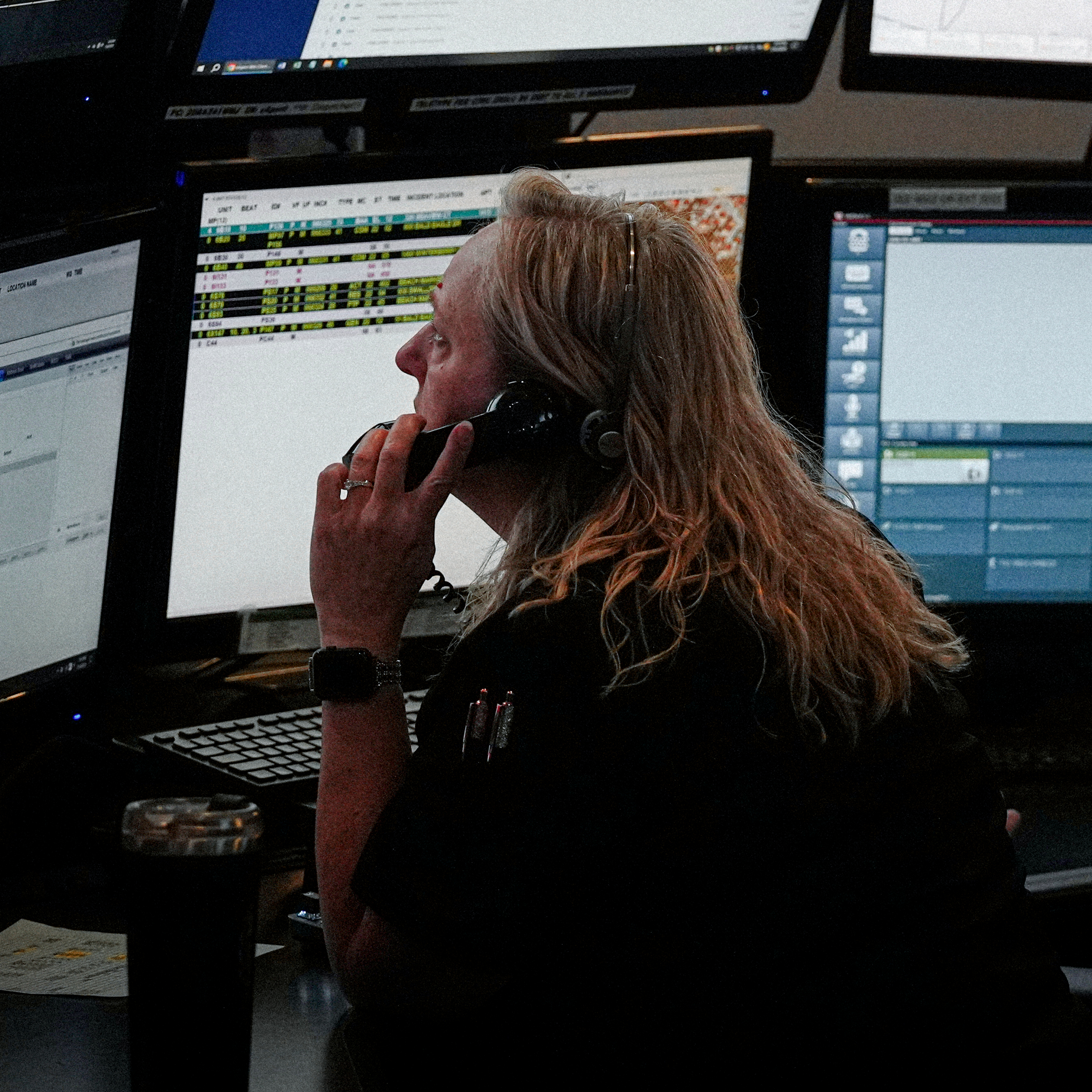
The center is in a low slung concrete building out by the airport. There I meet Gina Chang, the communications manager. She's responsible for the center's day to day operations, its procedures, budget, and more. She guides me through a maze of cubicles where dispatchers around us speak into headsets and toggle between big video screens
- [16:21]
Gina Chang
in the complaint unit where the 911 calls come in. This is where the triaging happens. This is where the interviews, the pertinent questions are asked.
- [16:28]
Reporter Bayard Duncan
Gina's from Oakland and has worked in dispatch for more than 15 years. She's been here for all of the center's recent ups and downs, and she's the perfect person to explain what's going on on the other side of the phone. When we sit together in the conference room, I start out with some questions about Ramachandran's key issues. Staffing and hiring. Are you able to fill all the positions that are open or are there vacancies?
- [16:53]
Gina Chang
We still have vacancies. We have the support from the city to do continuous hiring, so the job is posted until all vacancies are filled.
- [17:03]
Reporter Bayard Duncan
So hiring is picking up great. But how is this affecting answer times? Do you have a sense of where the answer times are now or where they were in 2025 compared with previous years?
- [17:14]
Gina Chang
In 2024, we concluded a year at 53% of all 91 calls answered within 15 seconds.
- [17:20]
Reporter Bayard Duncan
Remember, the national standard is 90% of all calls answered in 15 seconds. So 53% isn't even close. Last year, they got up to 72% of calls, which is a big improvement. And new data show it's holding steady into this year, but that's still pretty far from the standard. Now, as part of this reporting, I have spoken to a number of Oakland residents who have faced delayed answer times when it comes to calling 911. And they're in situations that are obviously like emergency situations. So I'm wondering, what advice do you have for people knowing that maybe an Oakland resident's call might not get picked up immediately?
- [17:59]
Gina Chang
If you call 911, don't hang up. Don't hang up and keep calling back. They'll actually extend your wait period because you go in the hang up queue and then you get a callback and that, you know, manual process by a dispatcher. If you stayed on the phone, you'll be the next person to be answered.
- [18:13]
Reporter Bayard Duncan
On my way out of the dispatch center, I notice large projector screens. One of them has a running digital timer on it.
- [18:21]
Gina Chang
So those are our projectors. And then we have a call answering pending screen right here. You see that there's no one call pending. Usually due to staffing, they may hold a little longer, but we try to get them under the 15 seconds.
- [18:36]
Reporter Bayard Duncan
How long is this one pending for?
- [18:38]
Gina Chang
That's a minute and 19 seconds right now. It's also at relief time, which is the odd hours right now. So we're doing a change in shift. So that may delay during that few minutes of shift change.
- [18:51]
Reporter Bayard Duncan
A minute and 19 seconds and counting. I felt a pang of that same outrage from years ago when I was looking at that fire by the freeway and waiting on hold. Is it just us? Is this an Oakland problem or is this a nationwide problem? To answer that, I asked for records from the hundred largest cities in the country. And as they responded, I began to see the full picture. And it's not a pretty one.
- [19:26]
Al Letson
Up next, Bayard starts crunching the numbers and starts uncovering the signs of a 911 system that's in the throes of its own emergency.
- [19:35]
Hannah Thomas
When something goes wrong, we have to consider what the cost is. People can die if I don't do my job correctly, and that's not a clerical consequence.
- [19:44]
Al Letson
That's coming up on Reveal. Don't go anywhere.
- [19:54]
Progressive Insurance Announcer
This show is supported by Odoo. When you buy business software from lots of vendors, the costs add up and it gets complicated and confusing. Odoo solves this. It's a single company that sells a suite of enterprise apps that handles everything from accounting to inventory to sales. Odoo is all connected on a single platform. In a simple and affordable way, you can save money without missing out on the features you need. Check out odoo@odoo.com that's o d o o dot com.
- [20:26]
Al Letson
Hey, hey, hey. Listen, we've been working on an episode about the 250th anniversary of American independence, and we'd like you to be a part of it. For a chance to have your voice appear on the show, leave us a voicemail letting us know what patriotism means to you at this moment in our nation's history. We want to hear from all kinds of people, young, old and from all across the political spectrum. To leave us a voicemail, just call 415-321-1776. Again, that's 415-321-1776. Thank you, and we look forward to hearing what you have to say. From the center for Investigative Reporting and prx, this is Reveal. I'm aletson.
- [21:15]
Reporter Bayard Duncan
Okay. And tell me exactly what happened.
- [21:18]
Narrator/Host
Okay.
- [21:18]
Reporter Bayard Duncan
Stay in the line with me. My partner's gonna get the ambulance started right away.
- [21:21]
Caitlin Ditta
What is a good callback number for you?
- [21:23]
Al Letson
Dane County's 911 dispatch center in Madison, Wisconsin has a lot of your typical office features. Gray walls, drab carpeting. Much of the lighting here comes from the multiple screens in front of the 911 dispatchers. They sit clustered in cubicles with a narrow walkway cutting down the middle.
- [21:41]
Johnny Leonard
Kind of tight quarters. I mean, it's smaller than a lot of people think for like all of 911 and dispatch for Dane County.
- [21:47]
Al Letson
Johnny Leonard has been the deputy director here for a year and a half. In a hallway leading into the dispatch area, he points to the communication center's logo. Under a silhouette of the state capitol building, there's a quote. I will answer the call.
- [22:03]
Johnny Leonard
Obviously a little bit of a play on words, right? We've got actual calls that are coming into the communications center. But it's also that someone really has to answer that call to public service and say, I know what I'm subjecting myself to, right? And our every day is somebody's worst day. Like if someone is calling here, they're probably not going through a good situation, right?
- [22:24]
Al Letson
Dispatchers in Dane county face the same challenges as many dispatchers across the country. Stress, burnout, bureaucracy, and in a lot of places that can lead to callers being left on hold. But not often. In Dane county, answer times are very,
- [22:39]
Johnny Leonard
very good for us. I believe the stats that I saw for last year, 92% of the time we answered a 911 call in 15 seconds or less.
- [22:48]
Al Letson
For the past five years, its dispatchers have been able to beat the national standard, which is picking up 90% of 911 calls within 15 seconds. Reporter Bayard Duncan has spent the last year learning about the failures of the nation's 911 system that leave callers waiting on hold. He talked to Dane county dispatchers to better understand what's working for them right now and why success still feels precarious. Here's Bayard.
- [23:20]
Reporter Bayard Duncan
Staffing at the Dane County911 center for Johnny is always a chess match, strategizing to never be over or understaffed. But of course, there's always something he and the dispatchers can't anticipate.
- [23:33]
Johnny Leonard
It can be as simple as a rollover accident on a busy street, right? If you get a well traveled road and now with cell phones and there's a bad accident, you're going to get 10 to 20 calls all on that same incident. And that's every call taker in our center occupied on that one incident.
- [23:49]
Reporter Bayard Duncan
But they do what they can. Johnny says he and his team are always watching for events that will inevitably lead to higher call volumes. The weather, University of Wisconsin Madison football games or big music festivals. There are always at least 15 dispatchers working at peak hours, 10 when call volumes are lower. I had already learned from my reporting in Oakland that understaffing was contributing to slow answer times. Was this how Dane county was hitting the 15 second standard? Simply having enough people?
- [24:20]
Johnny Leonard
We are over 90% staffing, which is really, really phenomenal for this industry. Unfortunately.
- [24:25]
Reporter Bayard Duncan
A couple months after we spoke, Johnny told me the center was actually able to get fully staffed up. He credits some creative recruiting strategies and a lot of referrals from current dispatchers. Still, understaffing is widespread in the world of 911. A recent survey of almost 1400 dispatch professionals found that over 80% of them worked in centers that were understaffed. And Johnny says being well staffed is never a guarantee.
- [24:52]
Johnny Leonard
I could get a resignation email tomorrow where someone putting in their two week notice. On average, it's going to take me about eight months before I could fill that person's vacancy. From posting the recruitment to going through the hiring process to background classroom training on the job training, it's going to take a long time to actually fill that role.
- [25:12]
Reporter Bayard Duncan
And while Johnny or any other dispatch center is filling open positions, it's not like 911 calls are going to stop. And the more calls a center gets, the bigger the strain on dispatchers. Which makes sense, right? It's a little bit like the iconic conveyor belt scene in I Love Lucy where Lucy and Ethel fall behind while wrapping chocolate. Listen, Ethel, I think this, I think we're fighting a losing game. 911 calls, of course, are not a question of stuffing chocolates in your mouth. But the same dynamic holds. Throw more calls at a dispatcher and it'll be harder for them to keep up. I wanted to see how this was playing out around the country. I knew it would be impossible to get data from the thousands of dispatch centers in the US So I decided to start with the hundred largest cities asking for their staffing levels and their call answer times from 2021 through 2025. So far, I've heard back from almost 60 cities. Their responses, like the whole system, really are a patchwork. Some keep different data than others, which is fair since they have no national requirement to follow. But I was able to figure out some important stuff. Some cities had stellar answer times every year, like Fort Worth, Texas, Cincinnati, Ohio, and Lexington, Kentucky. Others started slow but caught up by 2025, like Austin, Texas, Wichita, Kansas, and San Jose, California. But many were not picking up calls fast enough. I'm going to tell you about them, but first, let's start the clock with a little hold music. So I found 23 dispatch centers coming up short of the 15 second standard in 2025. And they're in big cities like Los Angeles, Chicago, Portland, Minneapolis. By the way, that was 15 seconds of hold music. In an ideal world, a 911 call would have been picked up by now. I also wanted to know how many calls were left on hold for a minute or longer. So I added up all the calls from the cities that sent me this data. For 2025. The total came out to nearly 400,000. To break that down, that means on average, every single day last year, more than 1,911 callers waited on hold for at least a minute. And of course, this is only 20 cities. This is a serious, almost comical undercount. Okay, that was 60 seconds since we started playing the hold music. That amount of time can make all the difference in an emergency. One thing I heard about again and again when talking about call answer times was understaffing. It's a huge problem nationwide, and it's tied to a whole constellation of other problems. First is funding how much any given city or county government has set aside for its911 center, which can be tied to politics or unstable grant funding. This unpredictability, along with the trauma and emotional weight of answering emergency calls all day, it leads to burnout, which leads some dispatchers to quit. And when they do, understaffed dispatch centers turn to mandatory overtime, making the job that much harder for the dispatchers who stay.
- [28:52]
Hannah Thomas
It's already a high stress job, so people burn out and people leave, which causes greater vacancy, which means the people that are left have higher rates of trauma and ptsd. And so the vicious cycle of burnout continues.
- [29:07]
Reporter Bayard Duncan
That's Hannah Thomas, a dispatcher I met in Madison. She's been with Dane county center for almost 12 years, which is pretty unique. A lot of people don't even make it through the training to become a dispatcher.
- [29:18]
Hannah Thomas
It's one thing to take a couple of calls or do a year or two in this line of work, but how do you continue to re traumatize yourself on purpose in a job that has so much stress and trauma? And I feel like that is A much harder skill to learn that I've had to grow to appreciate over the years compared to when I first started.
- [29:37]
Reporter Bayard Duncan
Well, tell me your secrets. How. How do you do it?
- [29:41]
Hannah Thomas
I certainly have had my share of ups and downs. I actually was diagnosed with PTSD several years into this job. What's really helped me is actually a couple of things. One of them is seeking mental health support. One of them is making sure that I have a life outside of the job.
- [30:02]
Reporter Bayard Duncan
Even though 911 dispatchers are often the public's first point of contact in an emergency, in many states, they're not considered first responders like police, EMTs, or firefighters. Instead, they're classified as administrative workers, basically secretaries. So they often don't get comparable benefits in pay, retirement, and mental health treatment. For years, one of the government's key arguments for keeping dispatchers labeled as secretaries has been that they don't administer actual care because they interact with the public over the phone. And in a way, it checks out. Dispatchers generally aren't asked to go to the scene or put themselves in physical danger, but it's serious for their mental health. A 2022 survey from the U.S. marshals Service found that dispatchers reported suffering from substantially higher rates of anxiety, depression, ptsd, and suicidal ideation than police and firefighters. Some researchers believe this is because of the repetitive exposure they get to traumatic situations. 191 1, Industry Group estimates that dispatchers across the country coach callers through CPR around 320,000 times a year. This is something dispatchers share with first responders. They're asked to save lives. Hannah has, and I was able to get the audio from one of the calls where she did. Heads up. It's distressing, but it ends well.
- [31:36]
Dispatcher Hannah Thomas
91 1. What is the address of the emergency? Help me.
- [31:40]
Caitlin Ditta
Ah.
- [31:40]
Dispatcher Hannah Thomas
Help. Meaning 91 1. Think my husband's dead. Okay, tell me exactly what happened.
- [31:45]
Reporter Bayard Duncan
The woman explains that she found her husband on the floor and his face is purple. Hannah tells the caller to put her on speaker.
- [31:53]
Dispatcher Hannah Thomas
Listen carefully. I'm going to tell you how to do chest compressions. Make sure he's flat on his back on the floor. You need to do that until help can take over.
- [32:01]
Reporter Bayard Duncan
Hannah counts out loud so the woman can follow her while she does the chest compressions. Meanwhile, Hannah's also communicating with the paramedics.
- [32:09]
Dispatcher Hannah Thomas
1, 2, 3, 4. They're coming as fast as they can. 1, 2, 3, four. Keep going at that pace. You're doing good.
- [32:18]
Reporter Bayard Duncan
After about another minute of chest compressions, an ambulance arrives. Hannah is able to direct the paramedics to the caller, and they take over. Together, they're able to save the caller's husband. Hannah was given a lifesaver award for this call. They are what they sound like. Dane county dispatchers earn them. Each time they save someone's life, Hannah has earned five.
- [32:41]
Hannah Thomas
It represents to me these little windows we have into these people's lives where for one moment, they needed help right now and called 911.
- [32:54]
Reporter Bayard Duncan
Every year, Dane county holds a banquet where dispatchers can meet the people they saved. Around a decade ago, Hannah got the chance to do this, to meet a couple she'd helped.
- [33:03]
Hannah Thomas
And they told me about how they had planned a trip to Hawaii with their kids and their grandkids. And it was so cool because here they could have been planning for his funeral. I can't even tell you how much that meant to me to actually meet somebody. From one of these calls.
- [33:27]
Reporter Bayard Duncan
Dane county has given out more than 100 lifesaver awards. These little glass plaques, they're mounted in rows on a wall near the dispatch floor. They also give out stork awards for dispatchers who help callers deliver babies over the phone.
- [33:41]
Hannah Thomas
We really are the first first responders, and people forget about that until they need us. We control outcomes. We have the ability to make a difference. Recognition isn't about ego. It's about sustainability of the job as well as public safety itself.
- [33:59]
Reporter Bayard Duncan
The banquets and lifesaver awards are nice, but for years, Hannah and other dispatchers have been fighting for a different kind of recognition. To be classified like first responders, not administrators. That reclassification, she says, could lead to things like better mental health care because
- [34:18]
Hannah Thomas
it would properly recognize our job as a high stress job and provide better mental health resources for it. In Wisconsin, moving to a protected class would also move our retirement age up.
- [34:31]
Reporter Bayard Duncan
Instead of working till she's 65, if Dane county dispatchers were categorized with first responders, Hannah could actually retire at 50. Right now, it's up to each state to decide whether to classify their dispatchers as first responders. Many states, like Wisconsin, haven't. But if there were a federal reclassification for dispatchers, that could help fast track it.
- [34:53]
Hannah Thomas
For every state, people can die if I don't do my job correctly. And that's not a clerical consequence. We need the federal reclassification to go through so that we can hopefully get the rest of those states on board who have maybe been a little more hesitant.
- [35:10]
Reporter Bayard Duncan
Hannah and her colleagues are part of a growing movement of dispatchers who are pushing Congress to take up Their cause. That's where I went next.
- [35:24]
Al Letson
Coming up, Bayard follows a group of nine one dispatchers in D.C. as they make their case on Capitol Hill.
- [35:30]
Reporter Bayard Duncan
Unfortunately, my boss was called away to a vote and won't be able to join.
- [35:35]
Matt Sanger
That's pretty disappointing. I'm really shocked that the congresswoman would not take time to be here. I, you know, I pay her salary after all.
- [35:44]
Al Letson
From dispatcher to lobbyist. That's next on Reveal. From the center for Investigative reporting in PRX, this is Reveal. I'm Al Letson. It's February 2026 in a banquet hall at the Ritz Carlton near the Pentagon. There are hundreds of 911 dispatchers from across the country here for conference, ready to make their case to lawmakers.
- [36:17]
Matt Sanger
So welcome to Washington. How many of you are here for the first time?
- [36:22]
Reporter Bayard Duncan
Just raise.
- [36:23]
Matt Sanger
Wow, that is huge.
- [36:27]
Al Letson
In the eyes of the federal government, dispatcher jobs are categorized the same way as receptionists or bill collectors. For the past seven years, these dispatchers have been fighting to get the job reclassified, putting them alongside first responders like police and firefighters. This year, it feels like they have a real shot.
- [36:49]
Matt Sanger
We stand on great authority here. It is in striking distance that we can reclassify. I'm not kidding. So just go look.
- [37:01]
Al Letson
That's Matt Sanger. He's a lobbyist here to teach these dispatchers how to navigate politics on the Hill. They'll be speaking directly to some members of Congress who. And before that happens, they need to practice their talking points. There's a role play exercise showing what a good meeting with lawmakers should look like. And then there are examples of what not to do.
- [37:22]
Reporter Bayard Duncan
Thanks for coming in. Unfortunately, my boss was called away to a vote and won't be able to join. But I'm glad to meet with you all.
- [37:29]
Matt Sanger
Hmm, that's pretty disappointing. I'm really shocked that the congresswoman would not take time to be here. I, you know, I pay her salary after all.
- [37:40]
Al Letson
The dispatchers will be asking lawmakers to support the Enhancing First Response Act. Unlike the many bills before it, this bill has already passed the Senate. Now they want to make sure it doesn't die in the House. The problems facing the 911 system may be complicated, but the bill's supporters say reclassification is one thing that could improve dispatchers working conditions. Reporter Bayard Duncan joined the dispatchers as they prepare to walk the halls of Congress and fight for the future of their work. Here's Bayard.
- [38:18]
Reporter Bayard Duncan
The organization that brought us all here is nena, the National Emergency Number. Association. They're the group that sets the industry standard that 90% of 911 calls should be answered in 15 seconds. It's the measuring stick I've been using and pretty much everyone else uses for how effective 911 is across the country. After a few speakers, everyone breaks for coffee. People's conference lanyards have their name and city, and I notice a large group from Michigan. So I walk up and ask if anyone would be open to talking to me.
- [38:52]
Tania Russell
Okay. My name is Tania Russell. I'm a commander with the Detroit Police Department.
- [38:56]
Jamar Rickett
My name is Jamar Rickett. I'm executive manager with Detroit Police Officer Department 9117.
- [39:00]
Reporter Bayard Duncan
After the trainings today, Sania and Jamar will head up to Capitol Hill to put what they've learned into practice. Have you ever been to the Hill before?
- [39:07]
Tania Russell
I have not.
- [39:08]
Reporter Bayard Duncan
Have you?
- [39:09]
Jamar Rickett
No.
- [39:10]
Reporter Bayard Duncan
Me neither.
- [39:12]
Tania Russell
I'm not worried about it. I'm very vocal, but vocal in a good way. But, yeah, I look forward to the conversation. And I look forward to challenging questions.
- [39:22]
Reporter Bayard Duncan
One of those challenging questions is at the root of this whole, whole reclassification issue. Why should dispatchers be treated the same way as firefighters or police officers, jobs that can require running toward danger? Saniya, who's worked for Detroit PD for more than 20 years, has an answer.
- [39:39]
Tania Russell
They are really the face of the Detroit Police Department and the face of every police department. It starts with 911. And so I really think that we need to give credit to those people because they are heroes. They're the heroes of behind the badge.
- [39:51]
Reporter Bayard Duncan
Jamar, a former cop himself, agrees.
- [39:54]
Jamar Rickett
Our telecommunicators have a rigorous training course. It almost mirrors what a police officer or firefighter goes through. We have countless, countless times where they have actually instructed a person over the phone to provide cpr. We've had childbirth where they have actually given instruction to safely bring a child into the world. We have stroke protocols, and they have to maintain these certifications. So it's not a one and done.
- [40:21]
Reporter Bayard Duncan
I went looking for opposition to reclassification, and I have to be honest, it was pretty hard to find. One state agency in New Mexico opposed it over a simple logistical concern, not knowing how many dispatchers the change could apply to. And I found a conservative think tank in Idaho claiming that if dispatchers were reclassified, it could open the door for many other public employees to try to get the same retirement benefits as police and firefighters. More commonly, I found critics who raised concerns about the cost. Changing dispatcher status at the federal level would be cheap, basically negligible the problem for them was how much more cities and states could end up paying in salaries, benefits, and earlier retirement. That said, many first responders, police and fire departments support this change. And there's always been bipartisan support for bills that would make it happen. By the end of the day, everyone at the conference has gotten a full on crash course in lobbying. They've been drilled on the finer points of the Enhancing First Response Act. They've gone over Capitol Hill geography. They were told to dress warm and go easy on the acronyms. The next day, I catch Jamar outside a congressional building as he's on his way to a meeting with a lawmaker. It's freezing and we huddle in a doorway to avoid the wind. How are you feeling ahead of this meeting?
- [41:51]
Jamar Rickett
A little nervous, but I had a meeting previous to this, so definitely know what to expect and excited to kind of push the agenda.
- [42:01]
Reporter Bayard Duncan
It's a packed day, all leading up to an afternoon sit down with Rashida Tlaib, the Democratic representative from Michigan. Tlaib's aide invites us to sit down. Welcome to the chaos of the Hill.
- [42:14]
Narrator/Host
Well, so we'll get started. Absolutely.
- [42:16]
Reporter Bayard Duncan
The congresswoman is running late, but the Michigan crew gets the sense that they're already on the clock. So Cindy Fell, a communications center manager who's lobbied before, gets right down to business.
- [42:27]
Narrator/Host
I've been coming here a bunch of years and this is the closest that we've come to getting a bill passed for 911 telecommunicator reclassification.
- [42:35]
Reporter Bayard Duncan
One by one, each member of the group gives their testimony. Jamar is up fourth.
- [42:40]
Jamar Rickett
I am a retired police captain, so I was classified as a first responder. But during my career, I also had the opportunity to be an actual call taker and a dispatcher. So I've seen them from both sides of the spectrum and I can tell you those are both first responders.
- [42:59]
Reporter Bayard Duncan
Talib arrives in the middle of Jamar's speaking time and quietly takes a seat to listen. When he finishes. She looks confused about the status of the bill.
- [43:08]
Gina Chang
Why, who's opposing it?
- [43:09]
Narrator/Host
I don't think there is enough opposition. Yeah, I'm not quite sure where the.
- [43:14]
Hannah Thomas
Okay.
- [43:15]
Reporter Bayard Duncan
Yeah. Because we rarely get, I mean, you guys get. Got the bipartisan support already. The co leads are. Yeah. So I'll ask why it's being held. Yeah. And it just, it's past September.
- [43:23]
Tamara DeFrance
That doesn't make any sense. Why it hasn't moved.
- [43:26]
Reporter Bayard Duncan
What looks like a wave of relief washes over the Michigan team. Sunia is feeling energized so she keeps going.
- [43:33]
Tania Russell
Our dispatchers and call takers are really functioning as a first responder. And so to say that you're just administrative. We're more than administrative. And to give them the
- [43:45]
Tamara DeFrance
cause.
- [43:45]
Tania Russell
I'm Sally.
- [43:45]
Reporter Bayard Duncan
No, it's kind of hard to hear, but that's Talib jumping in to say, you've already convinced me. After the meeting, Tlaib walks everyone out and gives them candy from a huge plastic bowl in the hallway. I overhear Cindy say it was the best meeting. You said that was the best one so far.
- [44:08]
Narrator/Host
Yeah, absolutely. Sometimes the energy is missing because they're so. It's not on purpose because they're so busy or maybe they're so over tasked with different topics, whatever. And that she had all of the energy and she was present in the moment, like it was just.
- [44:22]
Tania Russell
She's very familiar with the issues in Detroit. She knows we're passionate about 911, we're passionate about getting this done, make sure we maintain morale. And so I think that she appreciated that as well.
- [44:32]
Reporter Bayard Duncan
And plus, you got snacks.
- [44:33]
Tania Russell
And we like the snacks. We always like snacks. We keep our fingers crossed.
- [44:37]
Reporter Bayard Duncan
We feel good, but.
- [44:40]
Tania Russell
We feel good. Yeah, we feel good.
- [44:43]
Reporter Bayard Duncan
Spirits are high and people begin breaking off to get ready for the post lobbying happy hour. The feeling in the air is we can get this bill passed. I head to another part of the Capitol to catch up with one more group of dispatchers from California.
- [44:59]
Tamara DeFrance
This my first time lobbying. I think it's up my alley. I'm always advocating for the right thing, so this is the right thing to do.
- [45:08]
Reporter Bayard Duncan
Tamara DeFrance has been a dispatcher for more than 20 years, most of them in Los Angeles. I meet her outside the office of California Congresswoman Norma Torres, a Democrat who actually knows Tamara personally.
- [45:21]
Tamara DeFrance
She's one of our co workers. When I started, she worked there and she was instructor. I remember working with her on graveyard and she was a mayor and an instructor. It was just very inspirational.
- [45:35]
Reporter Bayard Duncan
She was doing. Wait, she was a dispatcher and mayor at the same time?
- [45:38]
Shalonda Young
Yes.
- [45:39]
Reporter Bayard Duncan
I didn't know that. How did that work?
- [45:41]
Tamara DeFrance
I don't know. That's why it was so inspirational. She was doing a lot. She was doing it all.
- [45:48]
Reporter Bayard Duncan
After leaving her mayoral seat in Pomona, California, Torres was eventually elected to her position in the house in 2014. She's been fighting to reclassify dispatchers ever since, introducing bills year after year. Torres work is informed by her experience on the job. Long hours, traumatic calls, things Tamara can relate to.
- [46:10]
Tamara DeFrance
You could take a call, you know, that lives with you for, like 20 years. You don't forget. Like, I can recite calls verbatim.
- [46:18]
Reporter Bayard Duncan
Do you have a call that made a particular impression. Impression on you that you recall or just the whole.
- [46:24]
Tamara DeFrance
Several. I get several calls. I've had calls dealing with young women who've been kidnapped and sex trafficked. I've had calls where people have been shot on the phone with me. I've had calls where suicidal calls. I've listened to someone take their last breath after being hit by a train, you know, and some of these calls I've taken, like 20 years ago, so.
- [46:50]
Reporter Bayard Duncan
But you still remember them.
- [46:51]
Hannah Thomas
Yeah.
- [46:52]
Tamara DeFrance
And you still get emotional even talking about them.
- [46:56]
Reporter Bayard Duncan
In the hallway outside of Torres's office, people are massaging their feet and taking a moment to close their eyes. It's the last meeting of the day for the Los Angeles group. When Torres finally arrives, she's greeted with a round of hugs. She ushers everyone inside.
- [47:11]
Narrator/Host
I skipped introductions only because I knew.
- [47:13]
Reporter Bayard Duncan
I know all of you. I've worked with many of you. This meeting is much more casual than the others I've been to. Torres doesn't need a presentation on the bill she's been trying to pass for years.
- [47:26]
Narrator/Host
Let's get the public educated about what you do. You cannot continue to be this unrecognized, invisible workforce because that is costing resources for your communities. We have to put all our eggs into getting the reclassification.
- [47:45]
Reporter Bayard Duncan
Torres explains. They're up against the clock. The bill has until basically the end of the year to clear the House. If it doesn't pass, the clock resets and they have to start again.
- [47:56]
Narrator/Host
This is where we have to find an opportunity. If the bill does not move by itself, we have to just include that language in another bill.
- [48:06]
Hannah Thomas
Yeah.
- [48:07]
Narrator/Host
So how's work?
- [48:08]
Dispatcher Hannah Thomas
Tell me.
- [48:13]
Reporter Bayard Duncan
The rest of the meeting is stories and gossip. The dispatchers have done all they can. The bill's future is out of their hands. In a day or two, they'll be back at their desks answering emergency calls again. Just because the bill has bipartisan, bipartisan support doesn't mean it will pass. And if reclassification does pass, nobody expects it to fix dispatcher burnout or long911 hold times right away. Like so many issues with the nation's public infrastructure, there is no silver bullet. Reclassification is more like what one advocate called an arrow in the quiver. It isn't everything, but it's one thing. There is another way to get dispatchers reclassified. It could be done without an act of Congress through the Office of Management and Budget, or omb. Today the office is run by Russell Vogt. You might know him as the architect of Project 2025. His office did not respond to my request for an interview, but I was able to get a hold of a former director.
- [49:17]
Shalonda Young
I got the pleasure of getting to deal with most things the government deals with because ombuds touched a lot of the federal government.
- [49:26]
Reporter Bayard Duncan
Shalonda Young was the OMB director from 2021 to 2025 under President Biden.
- [49:31]
Shalonda Young
You can wake up having discussions about how we get military equipment to Ukraine and go to sleep talking about how we ensure women and children get access to WIC funding. So it sat at the crux of a lot of moving balls every day.
- [49:48]
Reporter Bayard Duncan
One of the things OMB is responsible for is defining labor categories. This helps them generate national data about the country's workforce and around every 10 years, OMB assesses these labor categories and changes them as needed. Last time this happened for dispatchers was 2018. The next potential reclassification will be in 2028. Shalonda says this issue was on her radar. She toured a dispatch center with Congresswoman Norma Torres and she considered reviewing the classification early.
- [50:18]
Shalonda Young
I did think it was within our purview to make sure we were doing this in a timely fashion. So for me, the question was, do we move up the schedule?
- [50:29]
Reporter Bayard Duncan
But they didn't move it up. I read Shalonda some of the government's 2018 language, claiming that dispatchers weren't giving actual care, talking callers through procedures, or offering advice. Now, in my reporting, I've actually spoken with quite a few dispatchers who have administered CPR over the phone, who have delivered babies over the phone, who have conducted hostage negotiations, talked to people contemplating suicide. And I wonder how you think about this sort of apparent disconnect between the government's classification and the work that's actually being performed.
- [51:03]
Shalonda Young
Look, I was not there in 2018. I remember having a similar debate amongst military when we started having drone operators on whether this distance mattered. So it is a legitimate conversation to have. I think we have more data around how, you know, people who may not even be at the scene still suffer from some of the lasting effects of having to talk through these issues. And I think that that will inform how we look at the classification of 911 operators today.
- [51:44]
Reporter Bayard Duncan
Shalonda admits dispatchers have a point.
- [51:47]
Shalonda Young
I thought the process for reclassification should have started earlier than we had on the books.
- [51:58]
Reporter Bayard Duncan
I spent a year digging into the world of 911, poring over answer time data, interviewing experts and dispatchers and listening to harrowing emergency calls. I was looking for accountability, a clear solution to all the problems I'd uncovered, someone or some agency responsible. But there is no single entity to blame, and there's no single solution waiting to be put into action. Fixing the issues with 911 actually means wading through many tangled bureaucratic messes all at once. It's no wonder dispatchers themselves have taken on this work. They know an emergency when they see it, and while they handle this one, the calls will keep coming.
- [52:46]
Al Letson
Our lead producer for this week's show is Steven Rascone with field production help from Phoebe Petrovic. Jenny Casas edited the show. The story was produced in partnership with the nonprofit Newsroom Type Investigations. Sasha Balenke provided editorial support. Kate Howard was the executive producer for this episode. Melvis Acosta is our fact checker. Victoria Baranetsky is our general counsel. Our production manager is the great Zulema Cobb. Score and sound design by the dynamic duo Jay Breezy, Mr. Jim Briggs and Fernando My Man Yo Arruda. They had help from Claire C. Notemullin. Taki Telenides is our Deputy Executive producer. Our executive producer is Bret Myers. Our theme music music is by Cameraado Lightning. Support for reveals provided by the Riva and David Logan foundation, the John D. And Catherine T. MacArthur foundation, the Jonathan Logan Family foundation, the Robert Wood Johnson foundation, the park foundation, the Schmidt Family foundation and the Hellman Foundation. Support for reveal is also provided by you our listeners. We are a co production of the center for Investigative Reporting and prx. I'm Al Letson and remember there is always more to the story.