Loading summary
Transcript30 lines
- [00:01]
A
People think, well, if he said it in public, it can't be illegal. It is illegal. This is the most corrupt administration, not only in American history, but more corrupt than I could ever have imagined a president would be able to get away with. To the extent that he has, it's shocking to me.
- [00:21]
B
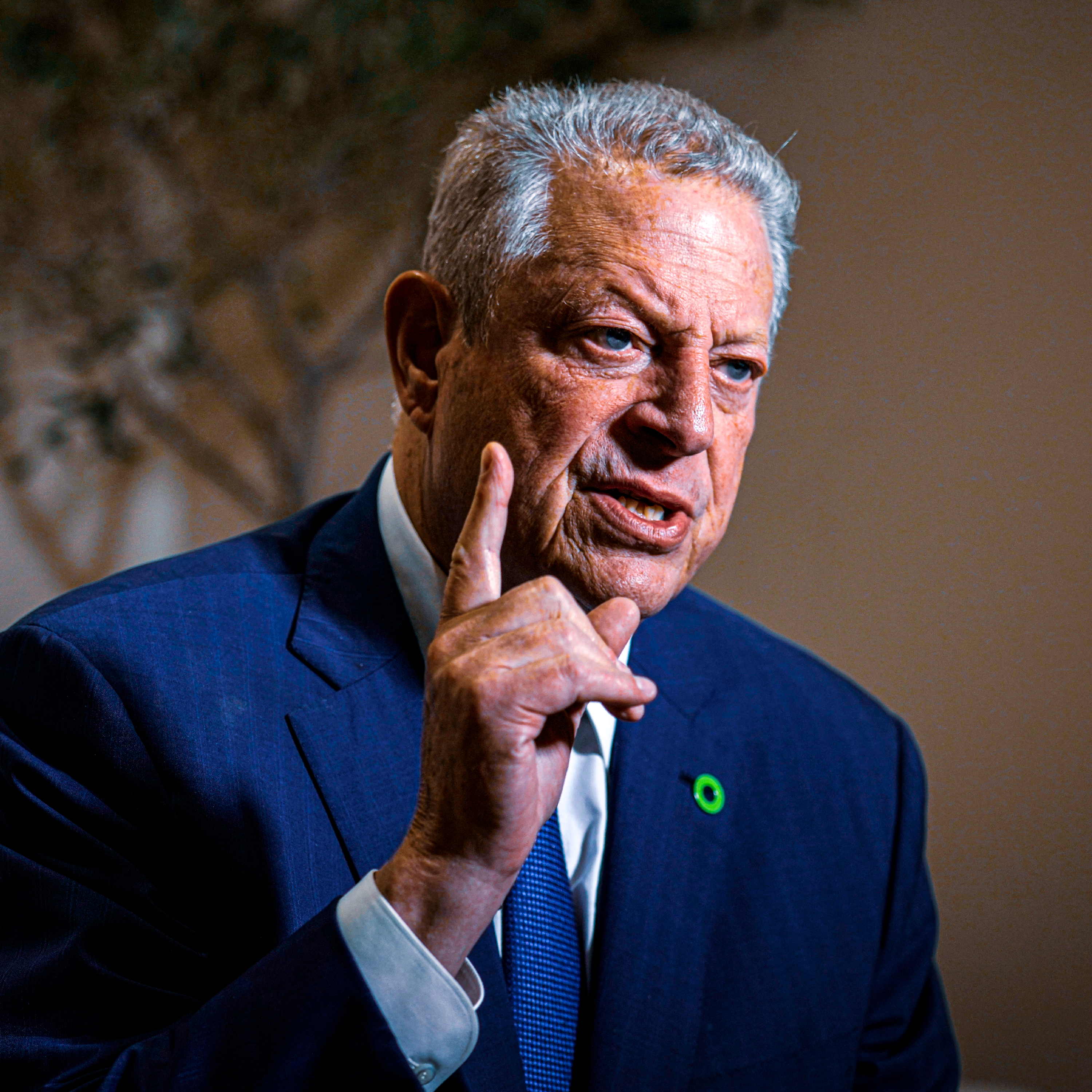
On this week's More to the Story, an unfiltered interview with former Vice President Al Gore. The founder and chairman of the Climate Reality Project rebukes the Trump administration for its cozy relationship with the fossil fuel industry. And he condemns the president's decision to brush aside decades of war planning in attacking Iran. It was a lively conversation. You won't want to miss it. Add a little curiosity into your routine with TED Talks Daily, the podcast that brings you a new TED Talk every weekday. In less than 15 minutes a day, you'll go beyond the headlines and learn about the big ideas shaping your future future. Coming up, how AI will change the way we communicate, how to be a better leader, and more. Listen to TED Talks Daily. Wherever you get your podcasts, This is more to the story. I'm Al Letson. Few political figures occupy the sort of space in American history. Azal Gore, a longtime Tennessee congressman before becoming vice president. Gore, of course, lost the presidency in 2000 to George W. Bush after a highly controversial decision by the Supreme Court. But in the years that followed, Gore didn't slink into history. Instead, he worked to sound the growing alarm of climate change, most notably with his documentary An Inconvenient Truth, which came out 20 years ago. A year later, he won the Nobel Peace Prize. Today, he's still at it, and in many ways more adamant than ever that now is the time to act on global warming, especially as the Trump administration rolls back environmental protections and condemns climate science. As you'll hear, he's got a lot on his mind. Mr. Vice President, it is a pleasure to meet you.
- [02:21]
A
Well, thank you, Al. The pleasure goes both ways here. Thank you for having me on.
- [02:25]
B
Thank you. Like, when I think of you, I tend to think I feel like, you know, you are a figure that has been in, in my life for a very, very long time. And I mean that as in, like, I'm old and I've been around.
- [02:44]
A
It sounds like what you're really saying is I'm old and you're right.
- [02:48]
B
You know, listen, like, we're both owls. I mean, we can share in the age, right?
- [02:52]
A
There you go.
- [02:53]
B
I think that your way back when you ran against George W. Bush, that it was somewhat of a turning point for The United States of America. It just feels like we started moving down this track that brought us to where we are today. And I'm just curious if you think about that in the same way.
- [03:16]
A
Well, I try to stay focused on the future. But I will tell you this, Al, that what you've just said is something that surprisingly large, large number of people say to me all over, that there was a kind of a fork in the road of some sort, and that that was a turning point of some significance. But as for me, do I think about that a lot? No, I do not. I think about the future. I think about the opportunities we have to set things right, to get on the right track. And I'm optimistic that we will.
- [03:54]
B
It's been 20 years since your documentary An Inconvenient Truth came out, highlighting the dangers of climate change. And towards the end of the movie, you say we have everything we need to fight climate change, save perhaps political will. But you know what? In America, political will is a renewable resource. When you look at what's happening in the country today, do you still believe that?
- [04:19]
A
Yeah, I do. Sometimes the time frames, the time cycles take a little bit longer than we're comfortable with. But I do believe in the resilience of American democracy. And I say all the time that political will is a renewable resource. It is. Look at the special elections this year. I think Democrats have won all of the ones that were contested. Really? Maybe there was one that was too far gone, but the average swing has been 13 percentage points. And this is the kind of cycle that is a 250 year cycle. This is not a temporary phenomena. And it means that the chances are that in seven months, the elections this fall will give the House of Representatives back to the Democratic Party and even could give the Senate to the Democratic Party. The odds are almost even as people are calculating them now. And I think that's a sign of political will being renewed. I think that the odds of a Democratic president in the 2028 election are also quite high because of the same trends and the same underlying resiliency. But to me, the issue is, what do we do after that? You know, Trump didn't come out of nowhere. He is sui generis. He's unique in so many ways, but he didn't come out of nowhere. We had seen the weakening of our democracy for quite some time, and we have seen the intrusion of big money in our politics. Not just in a way that justifies a slogan inveighing against it, but it is really critical now. The rise of hyper Inequality and the incomes and net worths in our society has been accompanied by the growing transfer of some of that wealth into political power and efforts to, you know, the broligarchs want to buy up mainstream. There are now six times as many public relations agents as there are journalists in America. It is a far cry from the kind of Democratic conversation that we had in the first decades and centuries of our founding, where real conversations in real life among people who discuss the issues from formed the kind of the foundation of democratic opinion. Now it's so manipulative, and the people with these huge sums of money have an asymmetrical ability to manipulate, and they're using that now to shut down access to information, cutting down science research, going after universities, going after law firms. I mean, I press my own buttons these days. Al, I'm not even letting you ask a second question. I'm sorry.
- [07:35]
B
No, no, no, no, it's good. I'm curious because when I look at the political situation that we're in right now, the thing that comes to mind for me is that in order to change the trajectory of the country, we would need an executive branch that moves in the way of, like, fdr, like, sweeping change. And I'm curious if you think that the establishment, the Democratic Party establishment, has the will to do that type of change. Do you think when the Democrats, if they take over the House and the Senate, if they get the executive branch, that they are going to be willing to do that type of sweeping change in order to move us forward?
- [08:19]
A
Well, I hope so. I'd like to give you a confident assurance that that'll be the case. I hope it'll be the case. The extent to which Democrats are capable of playing the role you've just asked me about is directly connected to how much energy and passion comes up at the grassroots level. You know, there's this autocratic kind of hunger out there on the part of some of the Trump supporters. Some of them got wheeled into this without really intending to endorse his whole agenda. But there is a feeling on the part of some that we do need a king. We do need an autocrat. Well, the hell with you. We do.
- [08:58]
B
We're Americans when it comes to the environment. And I think in a lot of ways, your movie An Inconvenient Truth for a lot of people, put the urgency behind climate change and what was going on with our environment. That was 20 years ago. And it feels like we've moved in stops and starts and stops and starts. And now we're somewhat. I would say, at a deficit because of the rules that the administration has laid out, like they're basically trying to get rid of renewable energy. And I'm just curious, do you think that we have missed the window of opportunity to make change when it comes to the environment?
- [09:46]
A
No, not at all. I think, unfortunately, our country, the United States, has missed an opportunity to play a leadership role. And I think that missing that opportunity is going to cost us a lot of jobs and economic progress. However, for humanity as a whole, for the world as a whole, no, the progress continues to move forward. We have a point of view here in the United States that is understandably kind of influenced heavily by what Donald Trump is raging about every day. And some of the compliant news media that will report what he tells them to and won't report what he doesn't want them to. We get a skewed opinion of sorts. He wants to stop renewable energy projects here. Well, they're going forward anyway. Although he just agreed to pay a billion dollars to one of the giant oil companies to pay them to stop developing an offshore wind farm. But that's an outlier. Let me just give you the facts, Al. You could say that the tide has gone out where the hunger for new climate policies is concerned. Trump has killed that in the U.S. but the U.S. has been one of only 195 nations to sign the historic Paris Agreement. Only one country has withdrawn from that. And as one of my European friends said, you know, last I checked, 195 minus 1 does not equal 0. And what he meant by that was, look, the rest of the world is still moving forward. Here's an example. If I asked you, I don't want this to sound like a trick question, but I ask people a lot. What? If you look at all the new electricity generation installed worldwide last year, how much of it do you think was renewable? And a lot of times people will say they know I'm looking for a large number. So they'll say something, what, 30%? Did it get as high as 40%? Well, the answer is 93%. Yeah, exactly. And the reason for that is it is by far the cheapest electricity in the history of the world. The expansion is just unbelievably rapid. And it's all over the world. Now. Here's a second market. Now, electricity generation is the big, biggest market for burning fossil fuels. Unfortunately, they're still, you know, using coal plants and gas plants to make electricity. But that's beginning to be, that's turned a corner. China's emissions have seemed seem to have peaked. But the second biggest market is transportation, cars, trucks and planes. And the, if you look at the cars today, the last month for statistics I have, is that in December, of all the new cars sold worldwide, 29%, almost one third, were electric vehicles. And that's from a standing star just a decade ago. And some countries, like Ethiopia, are banning fossil fuel vehicles, gas and diesel, and they're going 100% EVs. And by the way, Al, this recent tragedy unfolding in the Persian Gulf with the shutting down of the Strait of Hormuz, and my hearts go out to the families of the soldiers who've been killed and all those who've suffered. But if you look at the impact on the prices for fossil fuels, and then you remember the impact on the price for fossil fuels when Russia launched its sadistic invasion of Ukraine, and when you look at the mechan, the mechanics behind the takeover in Venezuela, all of those events reinforce the general feeling in the world these fossil fuels are too risky. The price volatility is crazy. It suddenly goes up. You have an interruption of supply in places like Southeast Asia that depend more on the Persian Gulf, oil and gas. They're shutting down the economy partly one day a week. So far, they're going through a lot of changes, keeping the thermostats at 79 degrees. Well, fossil fuels are not reliable and of course, they're dirty as hell. And when you burn them, you create all the greenhouse gas pollution that is causing the climate crisis. And that's the focus of this training in Nashville May 1 and May 2, climatereality.org, i want to encourage people to sign up for it. We really need the help of grassroots activists. And that is part of the answer to your question, can the political will be renewed? Hell yes, it can be. And for those who want to participate in that renewal, come to the climate reality training. Be a part of groups and networks that operate in real life, not just checking boxes on the Internet somehow, but get out there with your neighbors and your pals and make your feelings known. It makes a huge difference.
- [15:05]
B
Let me ask you this. When I think about renewable energy and where we are as a country, I think about President Trump's disdain for renewable energy and how he has really shut that down. And I think that there is somewhat of an echo chamber that backs him up in media, right leaning media, that they are telling their listeners and their viewers basically that renewable energy is not great, it doesn't work. And I think that that is a large portion of the voting public. How do you crack that wall? How do you get them to understand that moving towards renewable energy actually is A, a national security issue because as we're seeing in the Strait of Hormuz that, you know, getting oil in and out, we're at the mercy of other countries. But B, it's also better for the planet. How do you break through that wall of resistance?
- [16:06]
A
Well, first of all, let me just digress for a moment, Al, and say that as somebody who worked in the West Wing of the White House for eight years and served on the National Security Council, served on the Intelligence Committee, before that served in the armed forces, I can tell you that all of the war gaming, all of the planning scenarios involving Iran going back at least 47 years, since the seizing of the hostages, of the overthrow Khomeini, every analysis has started with the Strait of Hormuz. What are we going to do about that? Well, here's the reason I bring that up. When the chairman of the Joint Chiefs of Staff, who from all reports, a very competent, good guy, I don't know him personally, when he said, according to the news media reports to the president, you know, wait a minute, before we launch this attack on Iran, what are we going to do about the Straits of Hormuz? You know, that's been the number one question for all the war games and plans for 50 years almost. What are we going to do about that? President Trump said, don't worry about it, they'll surrender before that comes into play. Well, that was an astonishing mistake that of the kind that you really do not want the president of your country to make because it has put us in a terrible situation. But I would ask those who listen to Trump say that windmills scare the whales and cause cancer and all this and that the climate crisis is a hoax, I'd ask you to stop and think and ask this question. Could he be just as wrong about that as he has been in attacking Iran without a plan for the Strait of Hormuz? Could he be just as wrong about that as he was when he threatened to invade Greenland? Part of an ally that had the highest percentage of combat losses per capita in defending us after 911 as any country? And I could go through the list, what I'm saying is I think that people who are part of President Trump's base, God bless them, I know so many who were just so frustrated that prices going up and the immigration problems that just spun out of control and so many other things, I understand they wanted some relief, but I, I hear them now saying, wait a Minute he told us prices were going to come down. He told us we would not get into any more foreign, forever wars. He told us inflation was, was going to subside. He told us the economy was going to really boom. None of those things have come true. You know, he told his investors back when he was a businessman, a lot of pleasant stories, too. But he had to declare bankruptcy six times. People have forgotten about that because he went on television on that show, but playing the role of a huge successful businessman. But in any case, I believe that the efforts of the fossil fuel industry to pull the wool over everybody's eyes and pretend that this climate crisis isn't real, of course, are doomed to fail. I mean, people understand that the problem is that the polluters have captured control of the political process to an unhealthy degree. You've seen the videotapes where Trump met in the campaign, met with all the fossil fuel leaders and he said openly, you give me a billion dollars and I'll get rid of all, everything that you don't like. Well, you know, you've heard the phrase he says the quiet part out loud. That's part of his technique. People think, well, if he said it in public, it can't be illegal. It is illegal. This is the most corrupt administration, not only in American history, but more corrupt than I could ever have imagined a president would be able to get away with. To the extent that he has. It's shocking to me.
- [20:21]
B
When we come back, Vice President Gore on what keeps him optimistic about America's future.
- [20:26]
A
I grieve the insults and atrocities that our current president is getting away with. I am deeply concerned that he may be able to do some lasting damages to some of our, you know, practices and norms. But I still believe we're going to see ourselves through.
- [20:48]
B
But first, we want to remind you that there is a really easy way that you can can keep up with all the work we're doing here at Reveal. You can sign up for our free newsletter. Just go to revealnews.org newsletter to receive your weekly email reminding you about all of our good reporting. We have to stay connected now more than ever. Okay, more with the Vice President in just a moment. Stay with us. If you are a fan of our investigative work, we think you'll enjoy the podcast Master Plan, winner of the 2025 National Press Club Award for Audio Journalism. With the help of never before reported documents, Master Plan's new season, the Kingmakers exposes how a small network of lawyers and loyalists spent 40 years creating the conditions for Donald Trump's all powerful presidency. If you want to understand the world we're living in today, subscribe to Master Plan on Apple Podcasts, Spotify or wherever you're listening now.
- [21:51]
A
I'm Victor Sweezy, host of the Land in Between from the Global Reporting Center. Join us on a trip to the Republic of Georgia, a country at the crossroads of the EU and Putin's Russia. From the tear gas filled streets of the capital to the manicured gardens of a billionaire oligarch, I'll take you to a critical moment in Georgia's history and explore what it means for the future of our world order. Subscribe now wherever you get your podcasts.
- [22:25]
B
This is more to the story. I'm Al Letson and I'm back with Vice President Al Gore. What are your thoughts about the Supreme Court?
- [22:35]
A
Well, I've had my own run ins with the Supreme Court, Al. I think that it's important that Americans respect the rule of law and the basic framework of the Constitution, which for almost 250 years has given the Court the authority to interpret the law as against the Constitution. So I always stand by respect for the Supreme Court. But I have been shocked at some of the behavior of a few Justices on this Supreme Court, which unfortunately have raised questions in people's minds about the appearance of conflict of interest. Taking lavish gifts from multi billionaires, taking free vacations in the company of huge billionaires that have an interest in cases before the Court. I think it's pretty shocking and I think that they did themselves proud in the tariff decision. I think they found a little backbone there. But I was disappointed yet again that the oral arguments when this case about mail in ballots came before the Court. And you can sometimes predict from these arguments how the Court's going to go. And it sure looks like they're going to change the long standing policy that a mail in ballot tax has to actually be received by the election Commission and not just postmarked before the election. I don't know if they'll change all the tax forms. It's always been that way. You get the postmark in there, that's the thing. But to answer your question, I have been both concerned and gratified by this Supreme Court overall concerned because I think that they have allowed partisanship to get out of control. But I limit my critical comments, Al, because I do not want to undermine the degree of respect for the rule of law and our courts interpreting the rule of law in the process of saying what I think they've done wrong. And overall I think that this administration is likely to obey it to keep its commitment to enforce orders of the court. Many orders have not been enforced. They have actually apologized for not doing so in many cases. For what's that? For what that's worth. But high profile cases, I think that we can conclude confidently that they will obey orders from the Supreme Court.
- [25:27]
B
I'm curious, in this time period that we're in now, for some people, the word patriotism has almost become a dirty word. How do you define patriotism today?
- [25:42]
A
Well, I think it's the same as it's always been. Love of our country, respect for it, symbols, a feeling of common cause with all fellow Americans. But I get the question you're asking because there's been a determined strategy by the Republican Party to capture the symbols of patriotism and try to make people believe that they are symbols of a partisan form of patriotism and that they are the only keepers of the American flame. What comes to mind is that picture of Trump hugging the flag on the edge of the stage when he walked into an event. That's unseemly. When I was in the United States army in Vietnam, before I went there, like all soldiers, I had instructions on how to show your respect for the flag. You don't do that. You don't do that. Of course, he never was. He had bone spurs. I understand that. But. But I respect and appreciate the Democrats who are aggressively finding ways to recapture the association of the. With of the Democratic Party with patriotism. I think of James Talarino, for example, in Texas, where not only classic American patriotism, but also the Judeo Christian tradition. Why is that suddenly interpreted by so many as a conservative set of ideas? When Jesus told us to care for the poor, and how you treat the least of these is how you will be judged in your care, in your attitude toward Jesus Christ. And every faith tradition has some basic principles that are very similar, as you know. And to try to take the Christian faith and make it a Republican weapon, I think it's very, very offensive and dangerous to the church, not only to the government.
- [27:57]
B
So I think of myself as somewhat of a skeptic of the idea of America in the sense that, like, you know, I'm a black man, I was raised in the south, and I feel like what I understand about America, what I've always understood about America from a very young age, is that where we are as a country is the true reflection of what America is. Because a lot of the things that I'm seeing right now, I saw growing up, I saw police officers treating the black kids that I grew up, myself included, like second class citizens all the time. I grew up watching a whole lot of, for lack of a better term, a whole lot of injustice, mostly around race in the small community that I grew up in, in the South. And I'm just curious, I hear a lot of people saying this is not us when you're watching the ice raids that were happening in Minneapolis and Chicago that are still happening today. And I'm just curious, like how you square that. Like, as someone who was working in the White House, making major decisions about this country and has been involved in politics since the 70s, how do you look at this America today?
- [29:20]
A
Well, of course, it's very troubling to see a lot that's going on today. I never would have believed that any president would do even one tenth of the atrocious things Donald Trump has done. But let me go to a higher level and try to deal with the deeper question you're asking. Of course, you were intimately familiar, I know, with Frederick Douglass piece on what does the 4th of July mean to me. But he went on in that speech to recall, to place America as it was at that moment. And your question is, what do I think about America at this moment? He placed America in that moment in a historical continuum. And he took his listeners back to the day of our founding in 1776. And he said with great pride as an American, he said the crowned heads of Europe shivered and shook and the millions who were in servitude or in circumstances that felt like servitude, they cheered, their hearts were lifted because the appearance of America in that moment, and of course, here we are in the year of our 250th and a birthday. The fact that he was able to appreciate the true significance of that, but he placed his moment in that context and said to his listeners, you know, we're going to continue this evolution, this progress, and it's too slow. Of course it is. And there are fits and starts and, you know, two step forward and one step back and all of that. And there's always required a certain degree of faith that we are going to make the next two steps forward. And, you know, I'll just close by saying that there's an old saying that the antidote for despair is action. And Joan Baez first said that back in the 1960s when there was a struggle against the Vietnam War and other things besides. And so to answer your question, I feel that we are in a perilous moment. I grieve the insults and atrocities that our current president is getting away with. I am deeply concerned that he may be able to do some lasting damages to some of our, you know, practices and norms. But I still believe we're going to see ourselves through one final point. In order to do so, we have to pay attention to, to the conversation of democracy. That's and how people can individually participate. It's not going to happen by itself. You know, renewing the American spirit and renewing American will requires active participation. That's why again, I want to urge people. May 1st and May 2nd, come to Nashville, Tennessee. Sign up with the Climate Reality Project, climaterealityproject.org We will give you all of the very latest scientific facts about the solutions of the climate crisis, what's been causing it and what's still causing it, and network you with people who are of like mind, give you new communications and persuasion skills and invite you to be a part of this greatest challenge that we've ever faced because we're challenging the conditions that are conducive to human flourishing and we're now in the process of undermining them rapidly. But we have all the solutions we need to fix this. But we need your participation.
- [33:25]
B
Former Vice President Al Gore is the founder and chairman of the Climate Reality Project. Vice President, thank you so much for coming on and talking to me. It really was an honor.
- [33:38]
A
Well, I'm a big fan of what you're doing and keep it up, Al. We Als have got to stick together and thank you for having me on.
- [33:47]
B
That was former Vice president and founder and chairman of the Climate Reality Project, Al Gore. If you like this episode, you should check out a recent reveal episode. A new year, a new war. It's all about what comes next for Iran after the US Israeli attack and who gets to decide. Lastly, a reminder. We are listener supported. That means listeners like you, you can help us thrive by making a gift today. Just go to revealnews.org gift again that's revealnews.org gift and thank you. This episode was produced by members of the Justice Society. Josh sanburn and Carl McGurk. Allison James west edited the show Theme music and engineering help by Fernando Mame man yo Aruda and Jay Breezy. Mr. Jim Briggs, I'm Al Letson and you know let's do this again next week. This is more to the story. From prx.