Loading summary
Transcript239 lines
- [00:01]
Narrator/Host
This episode is brought to you by Progressive Insurance. Do you ever find yourself playing the budgeting game? Well, with the name your price tool from Progressive, you can find options that fit your budget and potentially lower your bills. Try it@progressive.com, progressive Casualty Insurance Company and affiliates. Price and coverage match limited by state law. Not available in all states. A corpse explodes inside the Vatican. A papal doctor who hides behind lies and illicit photographs. For decades, the scandal surrounding Dr. Ricardo Gailazilisi lay buried in shame and silence. It's a staggering story, one that takes in a foiled plot against Hitler inside the Vatican. Occult fixers, pseudo scientists, corruption scandals and a chain of events stranger than fiction. Now, after years of archival research and work with declassified records, the full truth is coming to light. Spanning Nazi occupied Rome to the shadowy dawn of the Cold War. Ricardo, the man who Blew up the Pope is a true crime investigation grounded entirely in documentary evidence. It blends history and espionage to reveal one of the strangest scandals. The Church tried to forget the desecration of Pius XII and the betrayal that followed. Listen to Ricardo, the Man who Blew up the Pope.
- [01:23]
Caller/Listener
Where?
- [01:23]
Narrator/Host
Wherever you get your podcasts.
- [01:28]
Al Letson
Hey, It's Al. And 2025 has been a brutal year for public media. I gotta tell you, it is not easy to produce fearless journalism at a time when truth itself is under siege. The one thing it takes is community. That's you. Your support, your time, your willingness to listen, share and engage. That's what keeps our reporting alive and thriving. Every time you tune into our work, you're part of the community that says, yes, facts matter. Yes, power should be challenged and yes, independent voices are essential. Right now, we need that community to step up for us and donate. We've got a big year end fundraising goal and we need you on board if we're going to get there. This show just cannot exist without listeners who care enough to help us pay the bills. Listeners like you. So I'm asking you, can you help? Any amount works for us. Just text give to 88857 reveal. That's give to 888-577-3832 and we'll send a donate link or visit revealnews.org 2026 thank you. From the center for Investigative Reporting and prx, this is Reveal. I'm Al Letson. Robyn Marty was on national television when Roe v. Wade was overturned in June 2022.
- [03:09]
Robyn Marty
It was Friday and I was asked to do a live segment with CNN Headline News.
- [03:17]
Nina Martin
You want to bring in Robyn Marty? She's director of. Of West Alabama's Women's Center. Robyn, good morning. So you are in Alabama. If this happens, if Roe v. Wade is overturned, how does that impact your facility there today?
- [03:31]
Al Letson
Right, so at the time, Robyn was running an abortion clinic in Tuscaloosa, the West Alabama Women's Center. Abortions were already extremely restricted in the state, and the clinic was performing almost 40% of them. Robyn is calling in from her home office, but see, CNN has her on a split screen with the protesters gathered outside of the Supreme Court.
- [03:56]
Robyn Marty
So, in Alabama, we have a law that is on the books that states that all abortion is illegal. And our understanding is that that means that the moment that the court says Roe v. Wade is gone, we will immediately stop all services in order to.
- [04:11]
Al Letson
The Alabama law that would go into effect if and when Roe fell would make abortion illegal in virtually all circumstances. Under the law, anyone performing an abortion could face up to life in prison.
- [04:25]
Robyn Marty
My biggest fear was that there was going to be a ruling, and I wouldn't know right away. And so I wouldn't stop the staff, and everybody would get in trouble. Sorry, I'm distracted by Twitter because I'm watching for updates. So one of the lawyers I was working with promised me that she would text me as soon as a ruling came down. And so here I was talking to cnn, and I could feel my phone going off. If they have already taken the pill, they are fine. If they are in the waiting room waiting to receive the pill, we will not be able to give it to them. And then I felt it go off again. And I'm literally still talking to CNN as I flip my phone over and see it's two texts. The first one is. And the second one is stop. Because she told me that she was gonna text stop at me when I needed. And I actually have to go because the Supreme Court just overturned Roe v. Wade. And I need to tell my staff.
- [05:21]
Nina Martin
Okay, we are still working to confirm this, but we do know the Supreme Court has issued a major abortion ruling. We are getting information that the Supreme Court indeed has overturned Roe v. Wade.
- [05:34]
Robyn Marty
It was chaos after that. Everything was pure chaos.
- [05:39]
Al Letson
Almost immediately, Robyn and her staff shift their focus to getting their patients out of Alabama.
- [05:46]
Robyn Marty
We had reached out to a clinic in Atlanta and already had prearranged that we were providing traveling money for the patients that would have to go.
- [05:56]
Al Letson
But that same day, Robyn gets a call from a state lawmaker who tells her that has to stop too.
- [06:02]
Robyn Marty
He's like, robyn, if you try to get those patients somewhere else, they're going to come after you. They're going to come after you for criminal conspiracy.
- [06:11]
Al Letson
This lawmaker was warning Robin about an Alabama criminal conspiracy law from 1896. It says if something's illegal in Alabama, you can't help someone do it in another state. He warned that the state's attorney general, Steve Marshall, could use that law to prosecute anyone for helping someone leave Alabama for an abortion. Even giving information could be considered helping.
- [06:37]
Robyn Marty
And what this means is that if we have a patient who comes in who is pregnant and they say, I want to get an abortion, I know that you can't do that here. Where can I go? We can't tell them because according to the attorney general, that would be the start of a criminal conspiracy.
- [06:55]
Al Letson
Marshall's threats against abortion helpers sparked an epic legal battle with implications for some of the most basic American rights. The right to travel, the right to free speech, the right to give and receive help. Today we're bringing back a story from reveal's Nina Martin. For more than three years, she's been following how Alabama abortion advocates have adapted to one of the strictest anti abortion policies in the country. Nina picks up the story with the hard decisions Robins clinic had to make in the days after the Supreme Court's decision in the Dobbs case.
- [07:33]
Nina Martin
I meet Robyn a couple of days after Donald Trump's second inauguration. We're in a cluttered back office at the West Alabama Women's Center. In those first weeks after Roe fell, the clinic basically went dark.
- [07:48]
Robyn Marty
The staff had to keep the lights off. I actually ended up sending them home to make calls from home because there were people coming to the doors.
- [07:56]
Nina Martin
Robin's clinic had been targeted before. Back in 2020, West Alabama women's center had hired a new abortion doctor and the state medical board immediately came after her license. For almost seven months, the doctor couldn't offer abortions or any medical care at all. So Robyn was taking the criminal conspiracy threat seriously. It was crushing for her and her team, but it was much worse for their patients.
- [08:24]
Robyn Marty
I remember I was sitting at that desk back over there and one of our medical assistants came in sobbing. She was on the phone with somebody who was asking for an abortion. And the patient was like, where do I go? Tell me where to go. And she was like, we can't do that because of Alabama law. And the patient apparently said, well, then I guess I'm just going to get in a car and wrap it around a tree then, and hung up.
- [08:58]
Nina Martin
The criminal conspiracy threat added a new level of paranoia to every interaction with A patient, even if all a patient said they wanted was information, because what if the patient was actually an anti abortion activist?
- [09:13]
Robyn Marty
We can't trust a patient. We can't assume that the patient who is talking to us is really in crisis, really needs information because it could always be an auntie who is just trying to get us on the record so that they can file something against us. On the other hand, this is also making it so that patients can't trust their doctors because we've seen the people who are not able to find out where they can go when they need an abortion for medical reasons. This has destroyed the doctor patient relationship.
- [09:50]
Nina Martin
The center reopened after a few weeks, but in a way that wouldn't risk anyone going to jail. The staff now offered all kinds of reproductive care, prenatal visits, some gender affirming care, everything except abortions and no specific information on how to get one. Meanwhile, Alabama's Attorney General Steve Marshall was making it clear his office really would go after abortion helpers down the Mississippi.
- [10:22]
Caller/Listener
To the Gulf of Mexico.
- [10:24]
Jeff Poor
Welcome back to the Jeff Poor show.
- [10:25]
Nina Martin
At FM Talk 10 5.
- [10:27]
Jeff Poor
Thank you very much for staying with us on this Thursday morning.
- [10:30]
Nina Martin
In August of 2022, Marshall made an appearance on the Jeff Poor Show, a conservative talk radio show out of Mobile.
- [10:39]
Jeff Poor
Always pleasure to bring on my next guest. Very kind to come on. Attorney General Steve Marshall joins us. General, good morning. How are you? Good morning, Jeff. Good to be with you. Good to be down on the coast.
- [10:49]
Nina Martin
Jeff Poor digs into the recent Dobbs decision and the rumors that Marshall will use the criminal conspiracy law to prosecute people helping abortion patients get out of state.
- [11:00]
Jeff Poor
Is that really something that is on.
- [11:02]
Nina Martin
Your radar that needs to be cleaned.
- [11:04]
Jeff Poor
Up or that it really is part.
- [11:06]
Nina Martin
Of the law up?
- [11:08]
Jeff Poor
We don't keep, we keep losing him here.
- [11:13]
Nina Martin
Anyway, so Jeff Poor asks a version of this question about three separate times, but Marshall's phone connection keeps dropping.
- [11:22]
Jeff Poor
So we got you again there, General. Yeah, Jeff, and I think I understand your question. Let me see if I can sort of approach a little bit.
- [11:30]
Nina Martin
Marshall makes clear he's not planning to go after abortion patients.
- [11:34]
Jeff Poor
You know, there's nothing about that wall that restricts any individual from driving across state lines and seeking an abortion in another place.
- [11:43]
Nina Martin
However, he would use the conspiracy law against people helping them go out of state.
- [11:49]
Jeff Poor
If someone was promoting themselves out as a funder of abortion out of state, then that is potentially criminally actionable for us. And so one of the things that we will do in working with local law enforcement and prosecutors is Is making sure that we fully implement this law.
- [12:07]
Nina Martin
And he gets specific singling out groups in Tuscaloosa. That's where Robin Marty's clinic is, and that's where the clinic's former owner was based, the yellowhammer abortion fund.
- [12:19]
Jeff Poor
There's groups, and we've seen groups out of Tuscaloosa, for example, that at one point in time and talked about it. I don't know that they're doing it now, but if they are promoting this as part of their services, we clearly will be taking a look at that.
- [12:33]
Caller/Listener
He got on a radio station and said, well, we're also looking at that group out of Tuscaloosa that helps people get out of state. We're from Tuscaloosa.
- [12:46]
Nina Martin
Janice Fountain is the executive director of yellowhammer. The first time I talked to her was the summer of 2024.
- [12:53]
Caller/Listener
I'm sorry, I'm also. It's summertime. My kids are home. Hey, when someone totally understand you're supposed to be taking a napa.
- [13:01]
Nina Martin
Yellowhammer was founded to help people figure out where to get abortion care and to help them pay for it. Anything from travel costs to childcare to the abortion itself. They're the only abortion fund in Alabama. And before dobbs, they were getting up to 100 calls a week. Then when it became clear that the supreme court was going to overturn roe, abortion funds around the country began planning to send more and more women out of state. Yellowhammer had already been doing that for years.
- [13:34]
Caller/Listener
So we're expecting to have to, like, ramp up what we did in terms of getting people out of state. But with the threat from the attorney general of criminal conspiracy, we got legal advice that said, hey, don't do anything around abortion at all. And we were like, that's not completely aside from what we set out to do.
- [13:54]
Nina Martin
And as Janice points out, a lot of things are illegal in Alabama. Casino style gambling, recreational marijuana, selling sex toys. But the only targets Marshall was talking about for this conspiracy law were abortion helpers.
- [14:10]
Caller/Listener
Like, people go smoke weed in Cali, and it's not like, oh, did you smoke weed in a different state? Feel like as soon as we offer tips as people get out of state, then it's like, well, maybe you should go to prison for that.
- [14:20]
Nina Martin
Like, with Robin Marty's clinic, Yellowhammer's abortion related work had to stop.
- [14:26]
Caller/Listener
And then we kind of landed on having to provide first amendment protected information in a really third person way.
- [14:33]
Nina Martin
All yellowhammer was allowed to do was give people links to news articles or to websites that talked about abortion. In abstract ways, but never to think explicitly.
- [14:43]
Caller/Listener
This is what you need to do to advocate for yourself in this moment and this is how we can help.
- [14:47]
Nina Martin
But the reality is that people just stopped calling. They were afraid of getting prosecuted for asking for help. And if anyone did call Yellowhammer, this is what they heard.
- [14:59]
Kelsey McLean
Thank you for calling the Yellowhammer Fund. Due to changes in state law that took effect on June 24, 2022, we have temporarily suspended our abortion funding program.
- [15:12]
Nina Martin
Eventually, abortion advocates decide they've had enough. Yellowhammer and the West Alabama Women's center decide to take the attorney general to court.
- [15:25]
Caller/Listener
Up next, like, hey, do y' all want to sue for that? And we're like, yes, yes we do. Please, where do we sign our names?
- [15:31]
Al Letson
And Nina follows how abortion activists in Alabama are adjusting to the changing legal landscape. You're listening to Reveal.
- [15:41]
Jeff Poor
Foreign.
- [15:51]
Josh Sanborn
This is Josh Sanborn, producer at Reveal. This episode is made possible by support from nrdc. The Trump administration is gutting environmental protections on a scale never seen before. It's eliminating protections for endangered wildlife, opening wilderness to oil and gas drilling, and sacrificing the safety and beauty of the planet that future generations will inherit. What we stand to lose can never be replaced. But the Natural Resources Defense Council is fighting back, leveraging the full power of the law to defend our environment. Backed by 3 million supporters, NRDC's team of over 700 lawyers, scientists and advocates has blocked harmful oil and gas pipelines, stopped toxic mines and protected endangered species through hard hitting lawsuits. They won nearly 90% of cases filed during the first Trump administration and they continue to win, including a recent case defending climate science. Now, as their caseload grows, they need your support. Join the movement that's defending our environment for future generations. Donate@nrdc.org reveal and your gift will be matched five times.
- [17:00]
Jeff Poor
Foreign.
- [17:08]
Al Letson
Hey, it's Al again. And before we get back to the show, I'm just following up on my request from earlier. You know the one about how we need your donations before December 31st to ensure that we can keep bringing you investigations like this in 2026. We need you please. Before you grab another cup of coffee or start scrolling on your phone, just text the word give to 88857 reveal. That's 888-577-3832 or visit revealnews.org 2026 and thank you. From the center for Investigative Reporting in prx. This is Reveal. I'm Al Ledson. Today we're re airing an episode about Alabama's strict anti abortion laws. Two months after the Dobbs decision that ended the federal right to an abortion, Jamila Johnson found herself on a long train trip through the south and Midwest.
- [18:12]
Jamila Johnson
I took a ride with black activists from Louisiana, Mississippi and Tennessee on the Amtrak to Chicago. With 40 hours, you don't have a lot to to do but to think.
- [18:25]
Al Letson
Jamila is a civil rights attorney and the trip was a part of something called the Black August Freedom Rides. It was meant to trace the journey that people from southern states with abortion bans would have to take to get abortion care. For many, the nearest accessible clinics were in Illinois.
- [18:43]
Jamila Johnson
And I thought about how hard travel was and how hard that was going to be for people who'd never left the states that they'd lived in, who didn't have a car in their household that they could take for a journey like this. In some ways, that radicalized me.
- [19:00]
Al Letson
In no place were the hurdles to care greater than in Alabama. Not only was abortion illegal, but the state's attorney general, Steve Marshall, was threatening to prosecute anyone helping people get abortions out of state.
- [19:14]
Jamila Johnson
I was going to do anything that I could to stop the law from making it harder for these people who needed to take these journeys. So by the time I left on my like Amtrak ride home, I had an interview at Lowering Project and I started in December.
- [19:34]
Al Letson
The Loring Project is a law firm focused on reproductive justice issues. And when she started there, one of Jamila's first cases was the Yellowhammer Abortion Fund lawsuit against Steve Marshall.
- [19:47]
Jamila Johnson
What we saw in Alabama was something we hadn't seen in other states, which was an immediate effort to get on the airwaves and tell people that the helpers would be prosecuted. No other state did that happen in in this way and as quickly and as forcefully as happened in Alabama. And the lawsuit is the result of that.
- [20:11]
Al Letson
The lawsuit is the asked the court to block prosecutors from going after groups like Yellowhammer if they help people get abortions out of state. Marshall argues that an 1890s era conspiracy law makes that help a criminal offense. Jamilla and her colleagues argue that this kind of abortion help is protected by the first Amendment and the fundamental right to travel. No abortion helper had been charged yet with criminal conspiracy and the goal was to make sure that never happened.
- [20:42]
Jamila Johnson
I mean, by the Attorney General's logic, the attorney General could extend it to friends, family, neighbors.
- [20:51]
Caller/Listener
Like the.
- [20:52]
Jamila Johnson
The chill and the threats are all meant to stop people from calling not just Yellowhammer Fund, but calling their mother.
- [21:04]
Al Letson
Alabama's laws and policies often start out seeming extreme compared to the rest of the country, but they end up being bellwethers. As reveals Nina Martin explains, Steve Marshall's threats against help are part of that same pattern. And they're happening in a place where help is often in short supply.
- [21:26]
Nina Martin
The thing about Alabama is what starts in Alabama doesn't stay in Alabama. A good example is the state's near total abortion ban. When it first passed in 2019, it was the most restrictive abortion law in the country since Roe V. Wade. Today, 11 other states have similar laws on the books. Another example is fetal personhood, which is now a major part of the national conservative playbook. Alabama's Supreme Court was the first to embrace the idea that fetuses or even embryos should have the same legal rights as anyone else. When I started reporting in the state more than 10 years ago, I went to investigate yet another policy that at the time was far out on the legal fringes. And one of the people I spoke with was a district attorney in northern Alabama, a younger, more media friendly Steve Marshall. Okay, great.
- [22:26]
Kelsey McLean
We should be good to go.
- [22:27]
Caller/Listener
I would love to just kind of.
- [22:28]
Jeff Poor
Have you take me through to the.
- [22:31]
Caller/Listener
Extent that you have patience for that. Yeah.
- [22:33]
Jeff Poor
No, no, no, no. I mean, this is a. This is an issue that's very important to me, so that's not a problem.
- [22:39]
Nina Martin
At the time, I was covering sex and gender issues for ProPublica. I spoke with Marshall for almost two hours. That's a really big difference from today when he hasn't given me an interview or even acknowledged my calls and emails. Back then, Marshall was approachable. He and excited to talk to me about how he was trying to solve what he saw as a major problem in his jurisdiction, Marshall County.
- [23:05]
Jeff Poor
And I did not change my name to be the same as the county. That is completely fortuitous.
- [23:12]
Nina Martin
Local doctors were calling his office reporting numerous cases of premature babies. They believed the babies were being born that way because their mothers were using illegal drugs during pregnancy at that point, mainly meth.
- [23:28]
Jeff Poor
We kind of had a powwow with our hospital staff, with OB GYNs, with pediatricians, to say, you know, from a public health standpoint, a law enforcement standpoint, are there ways that we can discourage and deter this behavior?
- [23:47]
Nina Martin
Marshall found his answer in an existing law nicknamed the Meth lab law. Passed in 2006 during the height of the state's meth epidemic. The law made it a form of child abuse to expose kids to places where controlled substances were made or distributed like meth labs. The punishment was up to 10 years behind bars and up to life in prison. If a child died. Steve Marshall's innovation was to use this law to prosecute new mothers to whose babies tested positive for illegal drugs. The argument was, in Alabama, a fetus is considered a child. So a womb with drugs in it is basically the same as a meth lab.
- [24:33]
Jeff Poor
Typically, if baby's positive mama is going from hospital, once she stabilized, to jail, with a jail to treatment order.
- [24:42]
Nina Martin
So new mothers would be sent from jail to a drug treatment program, and the baby would go to a relative or foster care. The goal after treatment was to drop the criminal charges and return kids to their moms. But this process could take years, and it didn't always work out.
- [25:02]
Jeff Poor
We wanted to find a mechanism through both the criminal justice system and social services to get mama clean, get kids safe, and hopefully encourage a reunification of that family.
- [25:15]
Nina Martin
Back then and still, Alabama was by far the most punitive state in the country towards pregnant women who use drugs. Steve Marshall was by no means the most aggressive district attorney in Alabama on these cases. When I spoke to Marshall, he seemed proud to be one of the first prosecutors in the state to use the law this way. And what I most remember from my interview with him was his suggestion that punishment could be a form of help.
- [25:44]
Jeff Poor
You know, kind of the term of art is coercive treatment, if you will. I think coerced treatment, and that's kind of what drug court is, is coerced treatment. In that you kind of got this carrot and stick approach.
- [25:56]
Nina Martin
His argument was that by throwing women in jail, separating them from their newborns, threatening them with prison, you were helping them because you were forcing them to get treatment for their drug problems.
- [26:08]
Jeff Poor
You know, I think we feel pretty comfortable about what we're doing, and we feel very much that we are treating people fairly.
- [26:15]
Nina Martin
After I talked to Marshall, I spoke with a lot of women around the state about this idea of help, including some who'd been arrested under the meth lab law. What they told me was Alabama was all stick and no carrot.
- [26:30]
Al Letson
No.
- [26:30]
Nina Martin
Mostly these women told me about the enormous barriers to basics like health insurance, childcare, food, and housing. It was the first time I had thought about help as a reproductive justice issue. But that idea has animated Yellowhammer Fund's executive director, Janice Fountain. From the very beginning, I don't think.
- [26:51]
Caller/Listener
The state wants its constituents to have agency or autonomy. I think folks that are too tired, too worn down, can't fight back. And then they don't organize as much. They don't realize where the state is, like, screwing them over like Steve Marshall.
- [27:09]
Nina Martin
Janiece was Born in rural Alabama, in her case, a very small town outside Tuscaloosa. After her biological mother lost custody of her and her siblings, she was mostly raised by her aunt and ended up in Birmingham for college. She's 34 now with kids of her own, and a lifetime of experience has led her to believe that the state can't ever be counted on.
- [27:33]
Caller/Listener
I think my entrance to reproductive justice work was through my own, like, struggle. I was actually incredibly angry when I came into the work, maybe even traumatized.
- [27:44]
Nina Martin
In her mid-20s, Janiece was juggling multiple jobs at once. As a cashier at Whole Foods, as the manager of a pizza restaurant, and of course, as a mom.
- [27:53]
Caller/Listener
I was working, like, at least 50 hours a week, and I had my son, my oldest son, and I just could not float. Like, I could not feed myself. I was, like, only feeding him. I was, like, borderline homeless and eventually sleeping on someone's floor. And I thought, man, the general thought, right, is that you just have to work and then you have what you need. But here I am working and not able to sustain myself, but also not able to get state assistance because I was earning too much money.
- [28:19]
Nina Martin
Janiece needed food stamps, but didn't qualify. In Alabama, you have to be far, far below the poverty line to be eligible for programs like welfare. Around the same time, Janiece was trying to leave her marriage, and then she discovered she was pregnant.
- [28:37]
Caller/Listener
And I knew, like, if I carry out another pregnancy, because he and I already have four between us, I'm going to stay. Like, there's going to be another newborn in the house. I'm going to make sense of it in my head. I'm going to say, it's easier and I'm going to stay in the household.
- [28:50]
Nina Martin
Janiece reached out to Yellowhammer. She was asking for something she never really expected to get help paying for an abortion retroactively.
- [29:00]
Caller/Listener
And I was like, hey, I need abortion care. And I, like, waited too late to have y' all pay for it. Can y', all, like, assist me, just make up for the money that I lost? They're like, actually, yeah, that's fine. I was like, wait, really? That was definitely pivotal for me to be able to leave, because if I would have carried another pregnancy, I would have still been still in there.
- [29:19]
Nina Martin
This whole traumatic period really underscored something that Janiece has thought about a lot in her reproductive justice work. Getting an abortion didn't solve all the other problems she and her family were going through. For that, she relied on a tight group of Friends.
- [29:35]
Caller/Listener
We had a group chat at some point where we would literally passing $20. I'd be like, well, I'm going to make it to next week. Here's the $20. And Shaquille would be like, oh, I already sent that to Vanessa for next week. You know, we were literally passing it around.
- [29:49]
Nina Martin
Janice can't exactly explain how this thing she was doing with a handful of friends morphed into an actual nonprofit. But expanding beyond her small circle seemed really important. She named it Margins Women Helping Black Women.
- [30:05]
Caller/Listener
People don't care about black women. They just don't. It's just like, well, who's coming? No one's coming. I feel that if we don't create what we need, it won't exist. And I think some of it is almost understandable because I don't think people in the state that don't have our lived experiences can properly advocate for us. But there's just the reality that they also don't want to.
- [30:28]
Nina Martin
At first, it was just Denise and some volunteers operating out of the back of her Nissan Pathfinder, doing things like pop up pantries and diaper giveaways. Regardless of how they discovered a need in their community, they would try to find a way to help, no strings attached.
- [30:45]
Caller/Listener
My son, my oldest, was like, mom, somebody stole my backpack. And I'm like, what? And he was like, well, they took the, the contents out, but they like took the backpack. I was like, oh, so they really just needed a backpack? And he was like, yeah, but they stole my backpack. And so I was like, well, we just need to just give out backpacks and if that's what folks need.
- [31:08]
Nina Martin
So they started a backpack drive. Crowdfunding on Facebook. Margins has kept doing them for six or seven years now.
- [31:15]
Caller/Listener
I just wanted to affirm, especially for my son. At the time, it was just like, yeah, we could be upset, but what use is it? You have someone at school that needed a thing. Like, let's just figure that out.
- [31:28]
Nina Martin
The more Janiece and her friends kept doing this, the more they realized they could do it on a bigger and bigger scale. Early in the pandemic, when the Birmingham schools went remote and the buses stopped, thousands of kids couldn't get their free school lunches. And for a lot of them, those lunches were their only full meal of the day. So Janiece called together some friends and they started making lunches out of her kitchen and delivering them around the city. She got very good at going on Facebook and guilting people into donating. She says she raised tens of Thousands of dollars this way.
- [32:06]
Caller/Listener
And my kids help with lunches sometimes. They're like, oh, this is what we were supposed to do. I'm like, yes, this is. This is how life is supposed to be. And now they, like, give away everything out of my house every chance they get. They're like, we have to feed the neighborhood. I'm like, not today, please. I literally see myself sudden, like, taking, like, full groceries outside. I'm like, wait, like, at least let me go back to the grocery store. He's like, no, they need to eat.
- [32:26]
Nina Martin
This idea of helping each other in a very direct roll up your sleeves kind of way became familiar to a lot of people during the pandemic. Mutual Aid Janiece had a different term, Family justice.
- [32:40]
Caller/Listener
I think people view some of the facets of, like, family justice work. It's just like, okay, that's not my work. Or like, that's not the same, or it's not reproductive justice work, but it is.
- [32:51]
Nina Martin
Reproductive justice includes the right to make choices to have or not have children. And if you do have them, to raise those children in safe and supportive environments. Family justice is about giving people the support they need to do that. For Janiece and Margins, that meant giving rides, buying groceries, paying rent and utility bills. And Janiece was running all this programming, still raising money on Facebook, holding down various jobs, and taking care of her kids. It was a lot.
- [33:26]
Caller/Listener
I was. Oh, my. I was organizing so frantically. It was so unhealthy. I ended up in hospital twice from, like, really bad stress and anxiety. You know, you ever like, everything's fine, everything's fine, and then you're like, you have iv and you're like, I went too far.
- [33:41]
Nina Martin
Then at some point in 2020, she was offered a job as Yellowhammer's first ever family justice coordinator.
- [33:49]
Caller/Listener
Yellow Hammer Fund eventually was like, hey, we see you doing all that work. Do you want to get paid for it? And I was like, no way. Because I was like, working at a pizza place. It was like 12 bucks. I was like, no way.
- [33:59]
Nina Martin
They wanted her to scale what she'd been doing at Margins. But now for all of yellowhammer's clients. Well, when you started doing family justice with yellowhammer, did it feel really, like, different from what other abortion funds were doing, as far as you could tell?
- [34:15]
Caller/Listener
Oh, absolutely. And even with well meaning people, I think trying to meet more needs than just an abortion. Who says that could be rough too? I think it's an inconvenience for folks and I think people would rather just kind of like, do what feels like they can just keep, you know, training them out. Like, people got to abortion next, next, next.
- [34:33]
Nina Martin
But at Yellowhammer, they begin offering wraparound services, the kind of extra support Janice knew from experience that people needed.
- [34:41]
Caller/Listener
I know we had one person seek an abortion that was like, sleeping in their car, but they were, like, so content because they got their care. They're like, oh, back to my car. And we were like, wait, what do you want a room? And they're like, oh, well, I was going to be fine because at least I got my abortion for a while.
- [34:56]
Nina Martin
They're doing it all, helping people get abortions, figuring out what other support they need, and then giving it to them. That is, until June 2022. Roe is overturned, and Steve Marshall is threatening to prosecute them. Suddenly, Yellowhammer's abortion work has to stop. The organization has to reinvent itself. They need a new leader to steer them through the vast changes ahead. Head and Yellow Hammer's board asks Janice.
- [35:28]
Caller/Listener
Hearing the board say, like, well, you're best suited to, like, help us survive a pivot of this nature. I was like, oh, yeah, no, no, absolutely. I don't want to do that. Sounds terrible. And they're like, janice, come on. I was like, well, I complain about this literally all day, every day. Maybe I should. So I got a therapist. And then I said, yes.
- [35:49]
Nina Martin
Now, Janese's family justice work isn't just a piece of what Yellowhammer does. It's at the center of everything they do.
- [36:01]
Al Letson
Up next, as Yellowhammer ramps up its family justice work, Janice's staff hits the road.
- [36:07]
Kelsey McLean
We have safer sex kits, and then we've got birth control. We've got formula as well as diapers. We've also got teddy bears for kids. And you if you know any kids who would like a teddy.
- [36:17]
Al Letson
What Yellowhammer's transformation looks like, plus a ruling in the lawsuit that changes their work all over again. You're listening to REVEAL. From the center for Investigative Reporting in prx. This is Reveal.
- [36:43]
Caller/Listener
Al.
- [36:43]
Al Letson
I'm Al Letson. On a cold morning this past January, reveals Nina Martin went on a little road trip through rural west Alabama.
- [36:53]
Nina Martin
Hello. Hello. So nice to meet you in person.
- [36:57]
Al Letson
In the car is Yellowhammer abortion fund's health care access director, Kelsey McLean.
- [37:03]
Kelsey McLean
We're covering quite a bit of mileage.
- [37:05]
Al Letson
Today, and Shaquilla Sumlin, Yellowhammer's family justice organizer.
- [37:09]
Nina Martin
Shaquille is in the front seat signing a lot of, like, postcards or flyers or.
- [37:15]
Shaquilla Sumlin
Yes, these are the flyers. We stick in the doors and let them know that we will Be in their neighborhood and win.
- [37:20]
Nina Martin
Oh, cool.
- [37:21]
Narrator/Host
Okay.
- [37:22]
Al Letson
The flyers have a drawing of a bus with a turquoise roof and shocking pink rims. Big bright flowers are spray painted along the sides. It's the Repro Raven, Yellowhammer's roving headquarters. Headquarters. It's kind of an embassy for the family justice work that has become the center of the organization's mission.
- [37:41]
Shaquilla Sumlin
We definitely like to build personal relationships with the communities that we serve. So we do go out and meet them pre bus tour, trip stop, so we can make sure we're addressing what they need.
- [37:54]
Al Letson
The week Nina visits, Yellowhammer is launching its first bus tour of 2025. The Repro Raven will return loaded with free supplies and information for getting even more free supplies for anyone that needs them.
- [38:08]
Shaquilla Sumlin
And we do a whole safe sex kit, which includes some condoms, some pregnancy testing, some lube and ec.
- [38:15]
Al Letson
EC is emergency contraception, the morning after pill. They also give out baby diapers, sizes one through six.
- [38:22]
Shaquilla Sumlin
We also have adult diapers on there. A lot of the convenience we go to. They're every elderly people living there as well. And food everywhere we go. No matter where we pop up at, we bring food too.
- [38:35]
Al Letson
This canvassing, the bus, they're all part of yellowhammer's transformation over the last few years as the organization fights the state's attorney general in court. They're suing to protect the right to help people get out of state abortions. But in the meantime, their other work can't stop. Nina tagged along as Yellowhammer set out to visit almost 50 communities in 50 days to let them know help is still available.
- [39:02]
Nina Martin
Kelsey McLean has been at Yellowhammer since 2019, when they could still offer abortion support. She made most of the travel and financial arrangements for yellowhammer's clients.
- [39:13]
Kelsey McLean
We're headed to, oh, I completely went the wrong way. To a few different public housing communities that are near Tuscaloosa or like in that general region of the state.
- [39:24]
Nina Martin
Now she's in charge of mapping out this whole outreach tour. First she had to identify all the public housing in Alabama, which, to be.
- [39:33]
Kelsey McLean
Very clear, that was the hardest part of this whole thing. Like there's no database. You can just go to and like put in your zip code and it tells you every possible, you know, section 8 or public housing community options available to you.
- [39:44]
Nina Martin
And like, Kelsey estimates the tour will cover up to half of all the public housing communities in Alabama. Could you talk about the need to do the kind of canvassing in person that you're doing?
- [39:56]
Kelsey McLean
Yeah, we, we know there's areas of Alabama that straight up just don't have broadband access, period. You have to know we exist to know, to reach out to us. Right. And yeah, we just want to make sure, like, no matter how you find information out, that you know how to find out about this.
- [40:14]
Nina Martin
Shaquilla Sumlin came to Yellowhammer through its executive director, Janice Fountain. She's one of the original group of friends who inspired Janiece to start her nonprofit Margins.
- [40:26]
Shaquilla Sumlin
It was about eight years ago, and we were working at Whole Foods in Birmingham. We were both very dirt poor, and so a lot of the things we needed we weren't getting. And we pass around $20 back and forth for three and four weeks. You get the 20 this week, I'll get the 20 next week. And we kind of built it up from there. So that's how we got started in the community.
- [40:48]
Nina Martin
Shaquilla is a city girl, and this part of west Alabama is pretty new to her. She says it's even harder to be poor in these rural areas than in a place like Birmingham. What are the things that people don't have? Like, what kinds of help are they not getting from the government or even other organizations?
- [41:08]
Shaquilla Sumlin
I think the better question is, what are they getting? It's hard to get food, it's hard to get childcare. For you to even be able to go out and try to get your own resources. It's just a lot that they're not getting.
- [41:22]
Nina Martin
We drive past big stretches of farmland, lots of trees and churches. No grocery stores or pharmacies, no buses, nothing that looks like a doctor's office or a clinic.
- [41:36]
Kelsey McLean
Which I keep calling Phil Collins in my head. It's a town. Phil Campbell.
- [41:41]
Robyn Marty
Campbell.
- [41:42]
Nina Martin
After 90 minutes, we reach our first stop, Phil Campbell, a little town named after an 1880s railroad manager. Should I go ahead and park?
- [41:50]
Kelsey McLean
Should we go ahead and get out and do this.
- [41:53]
Al Letson
This thing?
- [41:55]
Nina Martin
The public housing in Phil Campbell is a collection of identical one story brick apartments scattered across a dried grass lawn.
- [42:03]
Caller/Listener
So this does look like a older housing community, too.
- [42:07]
Shaquilla Sumlin
From the people that I have noticed, it looks like there might not be a lot of kids out here.
- [42:12]
Nina Martin
Shaquille heads toward one of the few houses with toys on the front porch.
- [42:17]
Caller/Listener
Perfect.
- [42:17]
Nina Martin
Someone opens the door, catching her by surprise.
- [42:20]
Caller/Listener
I'm just gonna leave a flyer in your door.
- [42:24]
Shaquilla Sumlin
I'm with a Yellowhammer friend, and we're going to be in your community on 123 with all these free things right here.
- [42:30]
Caller/Listener
All right?
- [42:31]
Shaquilla Sumlin
If you know anybody else, let them know, too.
- [42:33]
Nina Martin
It only takes a few minutes to hit all the houses and then we're on our way to the next towns. By the end of the day, Yellowhammer has left flyers in dozens of screen doors. A couple of days later, it's time to return and hand out the supplies promised on the flyers.
- [42:58]
Al Letson
The party bus.
- [42:59]
Kelsey McLean
The party bus.
- [43:01]
Nina Martin
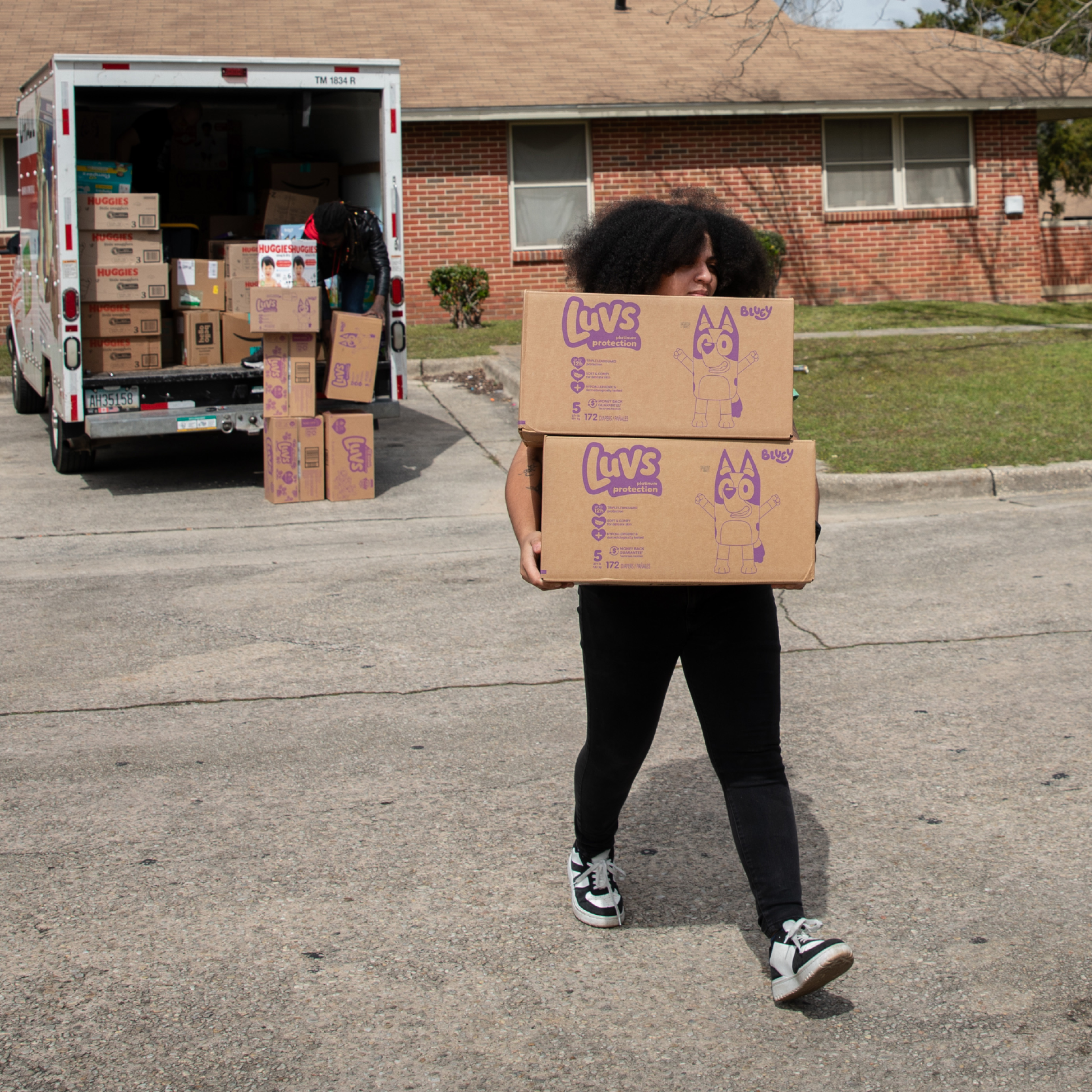
The first stop is a public housing community outside of Tuscaloosa called Crescent east. The repro Raven used to be a food truck that sold shaved ice. Now inside, it resembles the back room of a small supermarket. Kelsey and the Yellowhammer crew have already set up in front of a police substation near another official looking building. Both are locked and empty. In front of the bus, they've laid out the free food. Coffee, hot chocolate, and donuts. At first, it's pretty slow, but soon people are coming in by twos and threes. Some teenage boys take safer sex kits and a few girls grab birth control pills. Diapers are the most popular item.
- [43:49]
Kelsey McLean
So we've got tampons and pads. We've got formula as well as one through six size diapers. We have safer sex kits that have like a little of everything folks would need. And then we've got birth control for folks. It's like over the counter. Birth control you can take daily. We've also got teddy bears for kids, if you know any kids who would like a teddy.
- [44:14]
Robyn Marty
Okay.
- [44:14]
Nina Martin
About 40 minutes in, supplies are running low. It's time to start thinking about packing up.
- [44:20]
Caller/Listener
If not, I'll take up 5 in diapers for my little cousin.
- [44:24]
Nina Martin
Then a white van from the Tuscaloosa housing authority pulls up around the corner. A guy gets out and has a quick conversation with the ravens driver, Jake Sanford, and takes down his phone number. The housing authority guy came. What is that? Is that just like a normal thing?
- [44:40]
Kelsey McLean
Oh, I don't know.
- [44:41]
Caller/Listener
Yeah, right there.
- [44:42]
Shaquilla Sumlin
I don't know.
- [44:44]
Nina Martin
They're calling to yell.
- [44:45]
Caller/Listener
About what? I'm not exactly sure. I guess the fact that they didn't know we were coming and they're about to call me and tell me to leave. They're. I guess they're upset that we're here doing this.
- [44:53]
Nina Martin
But Yellowhammer didn't talk to anyone at the housing authority before their visit. In a lot of ways, their policy is ask forgiveness, not permission.
- [45:03]
Caller/Listener
Hi, I just missed the call. This is Jake.
- [45:05]
Robyn Marty
Hello.
- [45:06]
Jeff Poor
How are you?
- [45:06]
Caller/Listener
I'm good. How are you?
- [45:07]
Nina Martin
It's someone with the housing authority of Tuscaloosa.
- [45:10]
Jeff Poor
We're trying to see what's going on.
- [45:12]
Caller/Listener
Out there in Crescent. We're just out here. We've got a bus and we're just giving out some diapers and some coffee and some donuts for free. Okay.
- [45:21]
Jeff Poor
And we don't have a problem with that, but we definitely need to know.
- [45:24]
Caller/Listener
What'S going on on our properties before.
- [45:26]
Jeff Poor
It actually take place.
- [45:28]
Caller/Listener
Okay?
- [45:28]
Nina Martin
Jake apologizes. She says it's no problem. She appreciates what they're doing. Jake says they'll call before they come next time. And everyone starts getting ready to leave. But soon after the call, a big black car slowly rolls past. Yep, there goes the police again. Going by, just up and down. But they don't see stop. And the repo Raven starts pulling away. Ready for the next town.
- [45:54]
Caller/Listener
We are going to Aliceville, Alabama. It's about an hour from here. Oh, we got somebody. What's up, brother?
- [46:04]
Nina Martin
It's a preacher from a local church waving Jake down, hoping for some diapers for his grandkids.
- [46:10]
Caller/Listener
What size you need? Four and seven. All right. I just got the fours.
- [46:14]
Nina Martin
Is that okay? Jake leans out of the bus and passes a box through the preacher's car window.
- [46:20]
Caller/Listener
You all are a blessing. Keep doing what you're doing if all possible, and because it really helps the families and God bless you all.
- [46:32]
Nina Martin
Yellowhammer's Repro Raven tour goes on for eight weeks. Kelsey says hardly anyone they meet asks about abortion, and the Yellowhammer folks don't bring it up. Pretty much everywhere they go, they get the same reception from residents. Curiosity, followed by gratitude. But the authorities are a different story. Kelsey says a few times during the tour, local law enforcement showed up where the Reaper Raven was parked. One of those incidents happened in Vil Campbell, the little town where Kelsey and Shaquilla canvassed at the start of the tour. Here's Kelsey a few days later, describing what happened.
- [47:10]
Kelsey McLean
We pulled up pretty immediately. People started coming up to the bus. We had music going like we usually do. About 45 minutes in, two guys in a housing authority work truck came rolling by and said, y' all gotta go.
- [47:24]
Nina Martin
So Kelsey heads over to the main office to talk to the person in charge.
- [47:28]
Kelsey McLean
And she kind of cut me off and said, well, we got complaints. It's a disturbance. And I was like, oh, is it the music? Because we'll just turn the music off. Like, that's. We just do it so people can find us. And she said, well, we don't allow soliciting. And I said, well, ma', am, we're not soliciting anyone. We're sitting here with a free resource, and they are soliciting us for the resource. And she said, if you don't leave Now I will call the police.
- [47:52]
Nina Martin
The Phil Campbell Housing Authority declined to comment for this story. The Yellow Hammer crew drives to the nearest supermarket. The store manager lets them set up in the parking lot. But pretty soon, a police officer shows up asking if they have permission to be there. He tells them the housing authority called.
- [48:11]
Kelsey McLean
And the cop pulled off at that point. And then I see him drive by again about 10 minutes later, real slow, eyeballing us the whole time. And so I go, y', all, we.
- [48:20]
Nina Martin
Gotta get out of here.
- [48:21]
Kelsey McLean
Like, this doesn't feel safe anymore. This feels like we're being surveilled.
- [48:25]
Nina Martin
Kelsey says the police car follows the Repro Raven to the edge of town. Because of incidents like this, the Raven stops canvassing in advance. They start just showing up, hoping people find them.
- [48:37]
Kelsey McLean
It was such a good picture of what we're fighting against. Like, we do this work because the government won't do it. And literally, to see people panicking so aggressively about a group doing free resource distribution, and it has me thinking through a little bit more about how we really stay safe, because what's going to happen is we will not be back to Phil Campbell.
- [48:59]
Nina Martin
As the tour is winding down, the Yellowhammer staff is still waiting for a resolution to their biggest clash with authorities, their lawsuit against Attorney General Steve Marshall. It will determine whether or not they can return to their other mission, helping people get abortions. At the end of March, Yellowhammer executive director Janice Fountain gets an email from their attorney. The ruling is in.
- [49:26]
Caller/Listener
I was like, y', all. She sent the. She sent the order. You gotta get on zoom right now. Get on your zoom. I was, like, reading it as I was summoning everyone. I was like, wait, sounds like we won. We. We won. This is a win.
- [49:36]
Nina Martin
Wait.
- [49:38]
Caller/Listener
I was like, where's the gotcha? There's no gotcha. We actually won. Wow.
- [49:44]
Nina Martin
In the ruling, the judge dissects Steve Marshall's interview on that talk radio show when he singled out groups out of Tuscaloosa. Using Marshall's logic, the judge says prosecutors could go after Alabama residents who organized bachelor parties in Las Vegas. The ruling says the right to travel to expressive conduct to help is all protected by the Constitution. It's a clear victory for yellowhammer, the West Alabama Women's center, and the other organizations in the case.
- [50:16]
Kelsey McLean
I remember initially when we got the news, I almost didn't believe it. Like, I was like, what?
- [50:21]
Caller/Listener
Like, no, like, we.
- [50:23]
Nina Martin
We won one.
- [50:24]
Kelsey McLean
Like, this is wild.
- [50:29]
Nina Martin
Earlier that day, Kelsey had gotten an email about an abortion patient who urgently needed funding. Without a ruling, in their favor. Yellowhammer couldn't risk it.
- [50:39]
Kelsey McLean
I needed the lawyer on the call to tell us everything was good. I really did. But, you know, Jameel was just like, yo, no, you can do it. You can fund abortions. And I was like, no, wait, we've got someone literally that needs funding right now and can we do it? And when she said yes, that was when it, like, hit me.
- [50:54]
Caller/Listener
Like, hit me, hit me.
- [50:56]
Kelsey McLean
I think it wasn't going to be real until I had sent my first email saying, like, yes, we can fund that abortion. And then that was real.
- [51:04]
Nina Martin
After the ruling, Marshall lays low. His office tells news outlets that he's weighing his options, but they don't file an appeal. Since winning the lawsuit, Yellowhammer has helped more than 325 patients, paying out more than $100,000 for abortion care without fear of jail time. But yellowhammer's victory doesn't mean the right to travel for an abortion is safe around the country. What started in Alabama has been spreading. Idaho and Tennessee have passed laws making it illegal to help minors cross state lines for an abortion. Though Tennessee's law has been blocked, lawmakers in several other states have tried to do the same thing. Missouri's attorney general is suing a planned parenthood affiliate for allegedly helping minors there get abortions out of state. And the right to access abortion across state lines is under attack in other ways. Legal battles are raging over telehealth abortion care. Anti abortion groups are fighting on multiple fronts to criminalize sending abortion pills through the mail. Interstate battles over abortion care have become one of the biggest reproductive rights issues of the post Dobbs era, one that is sure to end up before the supreme court. So even with the lawsuit victory, it's clear the fights aren't over in Alabama or really anywhere around the country. And what Yellowhammer has been through has lessons for other abortion rights groups in other states.
- [52:38]
Kelsey McLean
I think the biggest learning experience is just that we've got to, as an abortion rights movement, stop being just about abortion rights and it going no deeper than that. And I think that is why we ended up with the dobbs to decision, why we ended up with it being acceptable to legislate and restrict abortion into oblivion.
- [52:55]
Nina Martin
But for now, Yellowhammer is back to business, including reactivating their abortion fund hotline.
- [53:01]
Kelsey McLean
Yeah, I'm still getting it worked out. Our call system is wild, but for sure when they call, they will hear.
- [53:07]
Nina Martin
A message saying, thank you for calling the Yellowhammer fund. Please listen carefully to the following options as our menu has recently changed. The updated voicemail makes clear yellowhammer isn't cutting any of their services, just adding back abortion support. Press 1 for abortion funding or assistance with abortion funding. And they've also added a new tagline, one that sums up their entire philosophy of help. Thank you for calling. And remember, no one should need.
- [53:43]
Al Letson
You can read more of Nina Martin's reproductive rights coverage@revealnews.org and motherjones.com our lead producer for this week's show is Anianci Diaz Cortez. She had help from Steven Rascone and Michael Schiller. Jenny Costas edited the show. Editorial guidance from Marianne Segadi Mazak, Sarah Solaji and Ruth Marai are our fact checkers. Legal review by Victoria Baranetsky. Our production manager is the great Zulema Cobb. Score and sound design by the dynamic duo Jay Breezy, Mr. Jim Briggs and Fernando My Man Yo Arruda. That help from Claire C. Note Mullen. Our executive producer for this week's show is Kate Howard. Our theme music is by Camarado Lightning. Support for reveals provided by the Riva and David Logan foundation, the John D. And Katherine T. MacArthur foundation, the Jonathan Logan Family foundation, the Robert Wood Johnson foundation, the park foundation, the Schmidt Family foundation and the Hellman Foundation. Support for Reveal is also provided by you, our listeners. We are a co production of the center for Investigative Reporting and prx. I'm Al Edson and remember, there's always more to the story. Okay, so the credits are over and you're still here. I bet it's because you're hoping for that phone number that you know will allow you to donate to your favorite investigative journalism podcast with your favorite investigative journalism host. Well, my friend, here you are. Just text the word give to 88857 REVEAL. That's 8885773832 or visit revealnews.org 2026. Your support really does make a difference and your favorite investigative journalism podcast host thanks you.
- [55:48]
Caller/Listener
From prx.