Loading summary
Transcript42 lines
- [00:02]
A
There are many ways we could lose our democracy, but the most worrisome way is through political violence. You see, because the political violence is what would make the Democratic backsliding you're so used to hearing about irreversible.
- [00:19]
B
On this week's More to the Story, University of Chicago political science professor Dr. Robert Pape. We examine the rise of what he calls violent populism in the US and why President Trump January 6th pardons could be the most consequential decision of his second term. Stay with us.
- [00:42]
A
Every idea starts with a problem.
- [00:44]
B
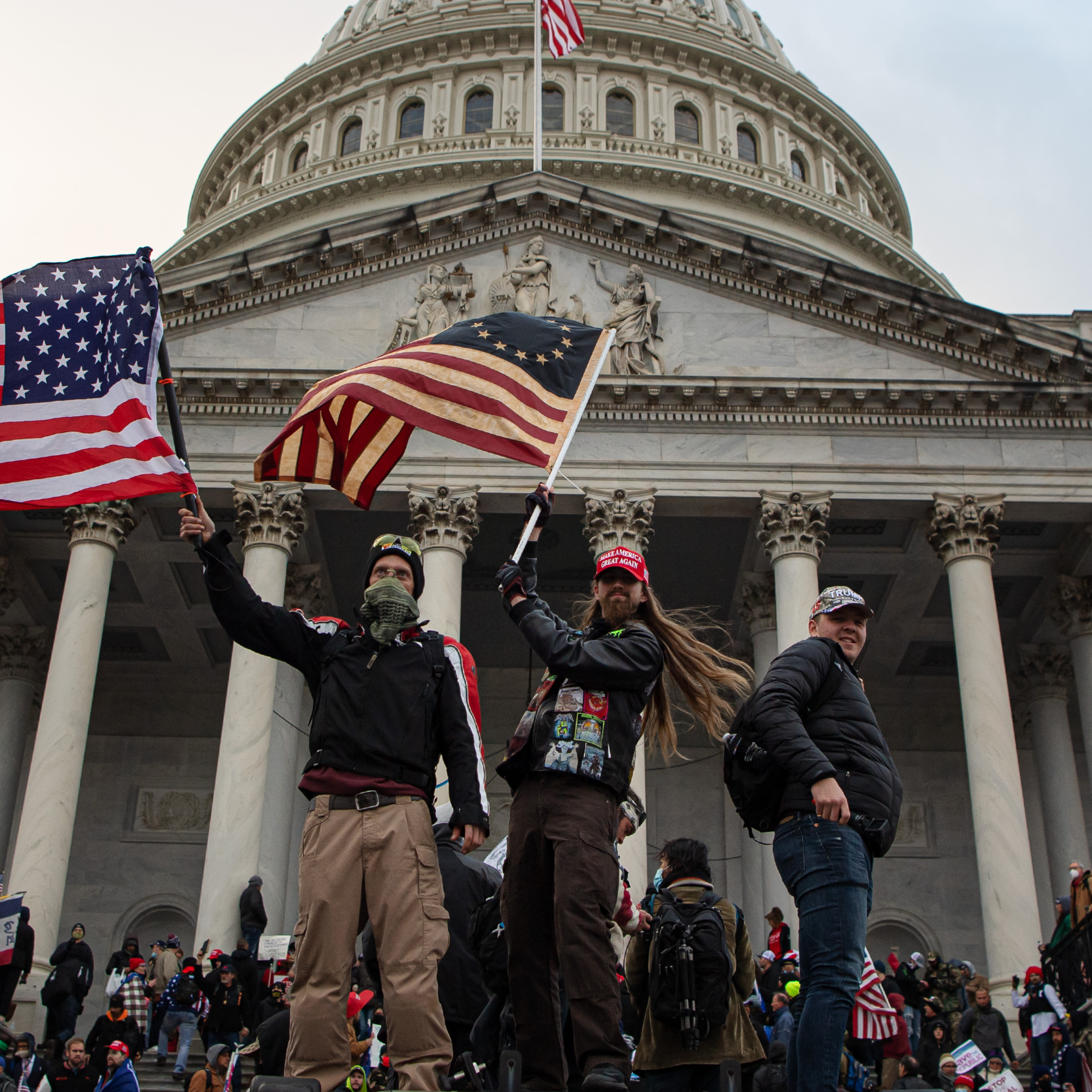
Warby Parker's was glasses are too expensive. So they set out to change that. By designing glasses in house and selling directly to customers, they're able to offer prescription eyewear that's expertly crafted and unexpectedly affordable. Warby Parker glasses are made from premium materials like impact resistant polycarbonate and custom acetate, and they start at just $95, including prescription lenses. Get glasses made from the good stuff. Stop by a Warby Parker store near you. This episode is brought to you by Progressive Insurance. Fiscally responsible financial geniuses, monetary magicians. These are things people say about drivers who switch their car insurance to Progressive and save Hundreds of Visit progressive.com to see if you could save Progressive Casualty Insurance Company and affiliates. Potential savings will vary. Not available in all states or situations. What can cheating scandals teach us about the world? I'm Patrick Redford and I've spent my career writing about all kinds of rule breaking. That's what my new show Only if youf Get Caught is about. Why did the WNBA hand out its largest ever fine to an owner for letting his players fly private? What does the Varsity Blues admissions scandal say about the future of higher education? What can the Lance Armstrong saga teach us about the anti trans panic? Only if you get caught comes out October 21st. Find us wherever you get your podcasts. This is more to the story. I'm Al Letson. It's been five years this month since insurrectionists invaded the nation's capital and a year since President Trump pardoned them. Since then, the country has witnessed a number of violent acts targeting politicians, legislators and activists, both Democrat and Republican. The rise of political violence in the US Is real and something my guest this week studies extensively. University of Chicago political science professor Dr. Robert Pape is one of the nation's leading experts on American political violence. He's set himself apart by conducting deep research on the violent actors themselves, where they're from and what's motivating them. And he argues that that violence has sparked an entirely New political era in America. Bob, how are you today?
- [03:08]
A
Oh, I'm great. I'm terrific. This is just a great time to be in Chicago. A little cold, but, you know, that's Chicago.
- [03:17]
B
I was about to say great time for you. I'm a Florida boy, so I was just in Chicago. I was like, let me go home. So, Bob, I thought I would kind of start off a little bit and kind of give you my background into why I'm really interested about the things that we're gonna be talking about today. Right after Charlottesville happened. When I look back now, I feel like it was such a precursor for where we are today. And also, I think in 2016, I was looking back and it felt like, strangely, it felt like Oklahoma City, the bombing in Oklahoma City was a precursor for that. Ever since then, like, I've just really been thinking a lot about where we are as a society and political violence in America, the origins of it, which I think are baked deeply into, you know, the country itself. But I'm also very interested on where we're going because I believe that leadership plays a big role in that. Right? And so when you have leaders that try to walk us back from the edge, we walk back from the edge. When you have leaders that say charge forward, we go over the edge. And it feels like in the last decade or so, we've been see sawing between the two things.
- [04:39]
A
So let me just say that you are quite right that political violence has been a big part of our country. This is not something that is in any way new to the last few years. And that's also why you can think about this when you talk about 2016, going back to 1995 with the Oklahoma City bombing here, and thinking about things from the right and militia groups and right wing political violence, because that in particular from the 70s through 2016, even afterwards, of course, has been a big part of our country and what we've experienced. But I just have to say a big but here, it's not just the same old story, because starting right around 2016, it would have been hard to know this in 2016 and even really 2017, 18 and 19, you were there right at the beginning of a new layer, so to speak, of political. Political violence that is growing. It's not that the old layer went away, which is why it's been a little bit, I think, mystifying and confusing for some folks. And that's folks who even cover this pretty closely, like the Southern Poverty Law center and the Anti Defamation League and so forth, because it took a few years before they started to see that there were some new trends emerging, growing political violence. It was getting larger. The old pro profiles of who was doing the violent attacks were starting to widen. And in many ways that's scarier and more dangerous than if they're kind of narrow because we like our villains to be monsters who are far away from us and they couldn't possibly be living next door to us. Whereas the closer they come, the more edgy it feels. So what you're really experiencing there is the very beginning of where I date, the beginning of our shift to the era of violent popul. Yeah, we're in a new world, but it's a world on top of the old world. The old world didn't go away.
- [06:57]
B
No, no, no. It feels like the old world is really the foundation that this new house of violence has been raised around. Like, you know, all of that, like that happened in the past was the foundation. And then in 2016, 2017, some people would say 2014, in that timeframe, it began to, the scaffolding began to go up and then Trump gets into office and then suddenly it's a full blown house that now all of America is living in.
- [07:29]
A
Well, if you look at the attacks on African Americans, on Jews and Hispanics, except for going all the way back to the 1920 race time, except for that these large scale attacks have clustered since 2016. Then we have the Tree of Life synagogue in 2018. That's the largest attack killing, mass killing of Jews ever in the United States. And then we have August 2019, the attack at the El Paso Walmart, killing more Hispanics in a day than has ever been killed in our country. So there's a pointed wave, if you see what I mean here. And race is certainly playing a role. So when you say, how does this tie to the old layer or the existing layer? One of the big foundations here is absolutely race. What's really sad and really tragic is in this new era of violent populism that I, that's a term I like to use because it's, it's not just the same old, but it's not quite civil war in this new era. We've seen things move from the fringe where they were bad, but happened more or less rarely, to more the mainstream where they're happening more and more. And our surveys show this people feel very fearful right now. And there's actual reason for that. That's not just media hype. There have been more events. There's. We see them and they are Real. We really have a time here that people are, I'm sorry to say, concerned. And there's reason to be concerned.
- [09:14]
B
Yeah. As you say that, the thing that pops up in my mind is the fact that, you know, white supremacy, which I think for a long time held sway over this country. And then, you know, I think that white supremacy in a lot of ways, always held onto the power. But, you know, there was a time where being a racist was not cool and looked down upon. And so racism, while still evident, still holding people down, it's built into institutions, all of that. I'm not saying that racism was a way. I'm just saying that, like, expressing it openly is now in the mainstream. I mean, we just heard President Trump recently talking about Somalis.
- [09:59]
A
Absolutely.
- [10:00]
B
In a very. I mean, just straight up, there is no difference between what he said about Somalis than what a klansman in the 40s in front of a burning cross would say about black people. Like, zero difference.
- [10:14]
A
Yeah. So, Al, the reason I think we're in this new era, because I think you're right, you're putting your finger on the mainstreaming of fringe ideas, which we used to think would stay under rocks and so forth. And white supremacy clearly fits that bill. But what I think is important to know is that we are transitioning for the first time in our country's history from a white majority democracy to a white minority democracy, and social changes like that in other countries around the world. So I've studied political violence for 30 years, and many countries around the world, big social changes like that often create super issues with politics, make them more fragile, and often lead to political violence. Now, what's happening in our country is that we've been going through a demographic change for quite some time. America up through the 1960s was about 80%, 95% white. As a country, there was ebbs and flows, to be sure. Well, that really started to change bit by bit, drip by drip in the mid-1960s, whereas by 1990, we were 76% white as a country. Today, we're 57% white as a country in about 10 or 15 years. It depends on mass deportations. And you can see why then that could be an issue. We will become truly a white minority democracy for the first time. And that is one of the big issues we see in our national surveys. That helps to explain support for political violence on the right. Because what you're seeing, Al, is the more we're in what I call the tipping point generation for this big demographic shift, the more there are folks on the right and most of them Trump supporters, MAGA supporters, who want to stop and actually reverse that shift. Then there, of course, once knowing that there are folks on the left, not everybody on the left, but some on the left that want to keep it going, are actually accelerated a bit for fear that with the mega crowd, you won't get it, the shift will stop altogether. These are major issues and things that really rock politics and then can lead to political violence.
- [12:51]
B
Talk to me a little bit about January 6th when that happened. I'm sure you were watching it on tv.
- [12:59]
A
Yeah, yeah.
- [13:00]
B
What were you thinking as all of it was kind of coming into play?
- [13:03]
A
Well, so I was not quite as surprised as some folks, al. So on October 5th in Chicago, I was on the talking head show in Chicago. It's called Chicago tonight. So on October 5, 2020, that was just after the Trump debate where he said to the proud boys, stand but standby. Well, the Chicago folks brought me on TV to talk about that. And I said that this was really quite concerning because this has echoes of things we've seen in Bosnia with some other leaders that a lot of Americans are just not familiar with but are really quite worrisome. And I said what this meant was we had to be worried about the counting of the vote, not just ballot day, the day of voting. And we had to be worried about that all the way through January, the certification of the election. But you made a point earlier, Al, about the importance of leaders. This is part of the reason why it's hard to predict. It's not a precise science. Political violence. I like to use the idea, the analogy of a wildfire when I give talks, when we have wildfires, what we know as scientists is we can measure the size of the combustible material. And we know with global warming, the combustible drops, dry wood that could be set afire is getting larger. So, you know, you're in wildfire season. But that's not enough to predict a wildfire because the wildfire is touched off by an unpredictable set of triggers, a lightning strike, a power line that came down unpredictably. Well, that is also a point about political leaders. So it was really we I did see some sign of this that Donald Trump said to about the proud boys stand back and stand by and that no other president had said anything like that ever before in our history. Let's be clear. And because of my background studying political violence, I could compare that to some playbooks from other leaders in other parts of the world that said even I wouldn't have said, oh yeah, we're 90% likely to have an event because who would have thought Donald Trump would have given the speech at the Ellipse, not just call people to it. It will be wild. His speech at the Ellipse. Al made it W.
- [15:32]
B
When we come back, Bob talks about discovering a flicker of optimism in his research.
- [15:38]
A
Every survey we've done, 70 to 80% of Americans abhor political violence. And that's on both sides of the aisle.
- [15:48]
B
But before we come back, listen, it's too early to break those New Year's resolutions. Come on, it's early January. So while you're still trying to eat better and exercise more and more and finally learn how to crochet. Wait, what do you mean? That's just me. Anyway, keep that resolution to share reveal with your friends. It's easy. Just tap those five stars, leave us a review and tell everyone about our award winning work that we do week in and week out all year long. Okay, we'll be back in a minute with more from Bob Pape. I'm Jeffrey Rosen, president and CEO of the National Constitution Center. A few years ago, learning about the forgotten meaning of the pursuit of happiness changed my life. When the founders wrote that famous phrase in the Declaration of Independence, they meant an ongoing commitment to self improvement and lifelong learning. This discovery inspired me to write a book and in my new podcast I explore the founders lives with the historians who know them best. Plus, filmmaker Ken Burns shares his daily practice of self reflection. Join me for the Founder's Guide to Happiness. This is more to the story. I'm Al Letson and I'm back with University of Chicago political science professor Bob Pape. You co authored a pretty remarkable study that looked at the political geography of January 6th insurrectionists. Can you break down the findings of that paper?
- [17:24]
A
Yeah. Yeah. So one of the things we know when we study as a scholar of political violence, we look at things other people just don't look at because they just don't know what's important. We want to know where did those people live, where they come from. And when you have indictments and then you have the court process in the United States, you get that as a fact. Now, it does mean I had to have big research teams. There's 100,000 pages of court documents to go through, but nonetheless, you could actually find this out. And we found out something stunning, Al. And it's one of the reasons I came back to that issue of demographic change in America. What we found is that first of all, over half of those who stormed the Capitol, the 1576 were doctors, lawyers, accountants, white collar jobs, business owners, flower shop owners. If you've been to Washington, D.C. al, they stayed at the Willard. Okay? I have never stayed at the Wilbur, so my University of Chicago doesn't provide that benefit.
- [18:29]
B
That is crazy to me because I think the general knowledge or what you think is that most of the people that were there were middle class to lower middle class to poor. At least that's what I've always thought.
- [18:48]
A
Yeah, it's really stunning, Al. So we made some snap judgments on that day in the media that have just stayed with us over and over and over again. So the first is their economic profile. Whoa. These are people with something to lose. Then we where did they come from? Well, it turned out they came from all 50 states, but huge numbers from blue states like California and New York. And then we started to look at, well, where in the states are they coming from? Half of them came from counties won by Joe Biden, blue counties. So then we got even deeper into it. And what's happening, Al, is they're coming from the suburbs around the big cities. They're coming from the suburbs around Chicago, Elmhurst, Schaumburg. They're not coming from the rural parts of Illinois. They're coming. That's why we call them suburban rage. They're coming from the most diverse, diversifying parts of America, the counties that are losing the largest share of white population. Back to that issue of population change. These are the people on the front lines of that demographic shift from America is a white majority democracy to a white minority democracy. These are the counties that will impact where the leadership between Republican and Democrat have either just changed or about to change. So they are right on the front lines of this demographic change. And they are the folks with a lot to lose. And they showed up. Some took private planes to get there. They really are. This is not the poor part. The white rural rage we're so used to hearing about this is well off suburban rage. And it's important for us to know this, Al, because now we know this with find of definitiveness here. So it's not like a hand wavy guess. Right?
- [20:54]
B
Right, right.
- [20:54]
A
And it's because it means you can get much more serious political violence than we're used to thinking about.
- [21:03]
B
Yeah. So what happens, like, let's say if circumstances remain as they are, I. E. The economy is not doing great, the middle class is getting squeezed and ultimately getting smaller. Right. The affordability thing is a real issue.
- [21:22]
A
What wins the first big social change that's feeding into our plight as a country is this demographic social change. There's a second one, Al, which is that over the last 30 years, just as we've having this demographic shift to a white minority democracy, we have been like a tidal wave flowing wealth to the top 1%. And we've been flowing wealth to the top 1% of the of both Republicans and Democrats. And that has been coming out of the bottom 90% of both Republicans and Democrats. Unfortunately, both can be poorer and worse off. Whites can be worse off because of this shift of the wealth to the top 1% and minorities can be worse off because of the shift shift. And you might say, well, wait a minute, maybe the American dream, we have social mobility. Well, sorry to say that at the same time we're shifting all this money to the top 1%. They're spending that money to lock up and keep themselves the top 1%. It's harder to get into that top 1% than it's ever been in our society. And so what you see is I just came back from Portland. Portland. What you see is a situation in Portland, which is a beautiful place and wonderful place where ordinary people are constantly talking about how they're feeling pinched and they're working three jobs just to make even lower middle class mortgages. I mean, this is what's happening in America and why people have said, well, why does the establishment benefit me? Why shouldn't I turn a blind eye if somebody's going to attack the establishment viciously? Because it's not working for a lot of folks, Al. And what I'm telling you is that you put this two together, you get this big demographic change happening while you're also getting a wealth shift like this and putting us in a negative sum society. Whoa. You really are. Now have a cocktail where you got a lot of people very angry. They're not sure they want to have this shift and new people come into power. And then on top of that, you have a lot of people that aren't sure the system is worth saving.
- [23:47]
B
I really wanted to dive in on the polls that you've been conducting. And one of those there seems to be a small but growing acceptance of political violence from both Democrats and Republicans. What do you think is driving that?
- [24:03]
A
I think these two social changes are underneath it, Al. So in our polls, just to put some numbers here in 2025, we've done survey in May and we did one in the end of September. So we do them every three or four months. We'll do one in, in January. I'M sure. And what we found is that on both sides of the political spectrum, high support for political violence. 30%. In our most recent survey in September, 30% of Democrats support the use of force to prevent Trump from being president. 30%. 10% of Democrats think the death of Charlie Kirk is acceptable. His assassination was acceptable. These represent millions and millions of adults. That's a lot of people. You see, what you're saying is right. We're seeing it. And I think what you're really seeing here is as these two changes keep going, this era of violent populism is getting worse. Yeah.
- [25:12]
B
I mean, so I've seen that Democrats and Republicans are accusing each other of using violent rhetoric. So in your research, what's actually more common, like in this modern area, like where we are right now, is it right wing or left wing on the violent rhetoric, but also like who's actually doing it?
- [25:32]
A
So we've had, just after the Kirk assassination, your listeners will probably remember and they can Google. We had these dueling studies come out almost instantly because they're kind of flash studies and they're by think tanks in Washington, D.C. one basically saying there's more right wing violence than left, and one saying there's more left wing violence than right. Well, I just want your listeners to know that if you peel the, like go under the hood. So my job is to be like the surgeon and really look at the data. Okay. You're going to be be stunned. Maybe not so stunned, Al, because you live in the media to learn the headlines and what's actually in the content are very different. Both studies essentially have the same, similar findings, although slightly different numbers. Okay. Which is. They're both going up. They're both going up. So this is not, it's really not the world that it was either always been one side or now it's newly the other. So the Trump administration's rhetoric, J.D. vance, is wrong to say it all coming from the left, but it's also wrong to say it's only all coming from the right. Now, what I think you're also seeing, Al, is that the politicians, if left to their own devices, rarely, I'm sorry to say, do the right thing. They cater to their own constituents. But there are some exceptions and they've been helpful. I think there's two exceptions I want to draw attention to one who's a Republican and one who's a Democrat. On the Democratic side, the person who's been just spectacular at trying to lower the temperature is Governor Shapiro. He's a Democrat. The Governor of Pennsylvania, Josh Shapiro has given numerous interviews public, where he has condemned violence on all sides. He's recognizing, as very few others are, that it's a problem on both sides. He personally was almost burned to death, only minutes from being burned death with his family here back in April. So he knows this personally about what's at stake. And he has done a great job, I think, in recognizing that here now, on the Republican side, we have Erica Kirk, and what Erica Kirk, of course, the wife of Charlie Kirk, who was assassinated, did, was at Kirk's funeral. She forgave the shooter. But let's just be clear, she's a very powerful voice here. Now, I think we need more of those kind of voices because, you see, they really are figures people pay attention to. They're listening to people like that. They have personal skin in the game, and they can speak with sort of a lens on this. Few others can. But we need more people to follow in that wake, and I wish we had that. And that can actually help as we go forward. And I'm hoping both of those people will do more and more events, and others who have been the targets of political violence will come out and do exactly, exactly the same thing.
- [28:40]
B
I want to go back a little bit to January 6th and just talk about those insurrectionists. So when President Trump pardoned them, what was going through your mind?
- [28:51]
A
That it was probably going to be the worst thing that happened in the second Trump presidency. And I know, I'm saying quite a bit, I know that he's insolvent every community under the sun many, many, many times. But the reason I'm so concerned about this, Al, is that there are many ways we could lose our democracy, but the most worrisome way is through political violence. You see, because the political violence is what would make the Democratic backsliding you're so used to hearing about irreversible. And then how might that actually happen? You get people willing to fight for Trump. And already on January 6, we collected all the public statements on their social media, video, et cetera, et cetera, in their trials about why those people did it. And the biggest reason they did it was Trump told him so. And they say this over and over and over again. I did it because Trump told me to do it. Well, now Trump has not forgiven them. He's actually helping them. They may be suing the government to get millions of dollars in, quote, restitution. So this is. This is going in a very bad way. If you look at this in terms of thinking you're going to Deter people from fighting for Trump. And now, of course, others are gonna know that as well on the other side. So it's not. Again, this is a very dangerous move. Once he pardoned. No president in history has ever pardoned people who use violence for him.
- [30:27]
B
Yeah, so you have the insurrectionist bucket, but there's another bucket that I've been thinking about a lot, and I haven't heard a lot of people talk about this, and that is that under President Trump, ICE has expanded exponentially. Like, the amount of money that they get in the budget is enormous, Enormous. I've never seen an agency ramp up a. Within a term like so much money and so many people.
- [30:57]
A
This has to become its own army.
- [30:59]
B
Right.
- [30:59]
A
And, Al, what this means concretely is we really don't want any ICE agents in liberal cities in October, November, December. We don't want to be in this world of predicting, well, Trump would never do X, he would never do Y. No, we've got real history now to know these are not good ways to think. What we just need to do is we need to recognize that when we have national elections that are actually going to determine the future of who governs our country, you want nothing like those agents who, many of them going to be very loyal to Trump on the ground. We should already be saying, look, we want this to stop on our October 1st to December 31st, 2026, and we want to have a clean separation, so there's no issue here of intimidation. And why would you say that? Because even President Trump, do you really want to go down in history as having intimidated your way to victory? So I think we really need to talk about this as a country, Al, and we really want a clean break here in the three months that will be the election, the run up to the election, the voting, and then the counting of the vote.
- [32:15]
B
In closing, one of the major themes of this conversation has been that America is changing into a white minority. The question that just keeps coming to mind to me is, as somebody who studies this, do you think that America can survive that transition?
- [32:35]
A
Well, I, I going to argue and I'm going to still a little nervous about it, but we are in for a medium soft landing. One of the things we see is that every survey we've done, 70 to 80% of Americans abhor political violence. And that's on both sides of the aisle. And I think in many way they're our saving grace. And it's why, Al, when we have public conversations about political violence, what we see in our surveys is that helps to take the temperature down because it's, you might worry that, oh, we'll talk about it, we'll stir people up and they'll go. It seems to be the other way around, Al. As best we can tell that there are 78% of the population that really, really doesn't want to go down this road. They know intuitively this just a bad idea. This is not going to be good for the country, for their goals. And so they are the anchor of optimism that I think is going to carry us to that medium soft landing here. I think could help that more if we have some more politicians joining that anchor of optimism. They're essentially giving voice to the 70, 80%. And if you look at our no Kings protests, the number of people that have shown up and how peaceful they have been, how peaceful they have been, those are the 70 to 80%, Al. And I think that gives me a lot of hope for the future that we can navigate this peace of. But again, I'm saying it's a medium soft landing. Doesn't mean we're getting off the hook without some more, I'm sorry to say, likely violence.
- [34:18]
B
Yeah, listen, I'll take a medium. I would prefer not at all. But the way things are going, I'll take the medium. Thank you very much, Bob. Professor Robert Pate, it has been such a delight talking to you. Thank you so much for taking the time.
- [34:33]
A
Well, thank you, Al, and thanks for such a thoughtful, great conversation about this. It's just been wonderful. So thank you.
- [34:39]
B
Appreciate it. Thank you. That was University of Chicago political science professor Dr. Robert Pape. If you like this episode, you should check out our More to the Story episode, How Trump's January 6th pardons hijacked history. It's my interview with the lead investigator of the Capitol Insurrection, Tim Hafee. I talk with Tim about how Trump's executive action action undid years of work by the FBI, federal prosecutors and Tim himself. Lastly, a reminder. We are listener supported. That means listeners like you, you can help us thrive by making a gift today. Just go to revealnews.org gift again, that's revealnews.org gift and thank you. This episode was produced by Josh sanburn and Carr McGurk, Allison Taki Telenides and edited the show theme music and engineering helped by Fernando my man Yo Aruda and Jay Breezy. Mr. Jim Briggs, I'm Al Edson and you know, let's do this again next week. This is more to the story. From prx.