Loading summary
Transcript117 lines
- [00:01]
Host/Advertiser
Are you working on your capsule wardrobe? Quince has you covered. Quince is all about elevated, effortless essentials that are designed for layering and mixing. They've got all the staples you need to build a timeless wardrobe that will last season after season. Quince uses the highest quality materials and the stitching fits and fabrics speak for themselves. I'm someone who doesn't want to spend a lot of time getting dressed. I'm looking for simple comfort that still has style. And the Quince oversized Mongolian crew neck totally fits the bill for me, taking me from casual work from home to a dinner out. So I'm excited to get a new version, a boat neck in rich burgundy that I'm sure will also quickly become a wardrobe staple. Refresh your wardrobe with quince. Go to quince.com reveal for free shipping on your order and 365 day returns. Now available in Canada too. That's Q-U-I-N c e.com reveal to get free shipping and 365 day returns. Quince.com reveal if your eyes are the
- [01:03]
Nicole Hannah-Jones
windows to your soul and your glasses
- [01:05]
Host/Advertiser
are the windows to your eyes, then it's pretty important to find your perfect frames. That's why at Warby Parker, we've made shopping for eyewear as easy and fun as can be. Peruse endless styles in our stores or use our app to virtually try on
- [01:19]
Nicole Hannah-Jones
frames and get personalized recommendations.
- [01:21]
Host/Advertiser
To find your next favorite pair of glasses, sleep sunglasses or contact lenses, or to locate your nearest Warby Parker store,
- [01:27]
Nicole Hannah-Jones
head over to warbyparker.com that's warbyparker.com
- [01:32]
Al Letson
from the center for Investigative Reporting and PRX. This is Reveal. I'm Al Letson. Every February for over 40 years now, I've been a part of black history celebrations. Whether it was a play in middle school, reciting the I have a Dream speech in high school, performing on stage as a young man, or making radio shows like this one. And in all that time, I never really reflected on the importance of the month. I mean, I'm black year round. We just put a spotlight on black Americans in February. But this year it seems especially important to highlight and remember black history. Because all around us, the nation's past is being rewritten. This week, President Donald Trump indicated he
- [02:18]
Nicole Hannah-Jones
plans to review the content of Smithsonian museums, claiming that the White House push
- [02:23]
Tremaine Lee
to apparently rewrite history is growing.
- [02:25]
Nicole Hannah-Jones
The Trump administration has ordered the removal
- [02:28]
Jelani Cobb
of signs was removed this afternoon by the federal government. Cruz dismantled plaques telling the stories of the nine enslaved people who lived in the President's house.
- [02:39]
Al Letson
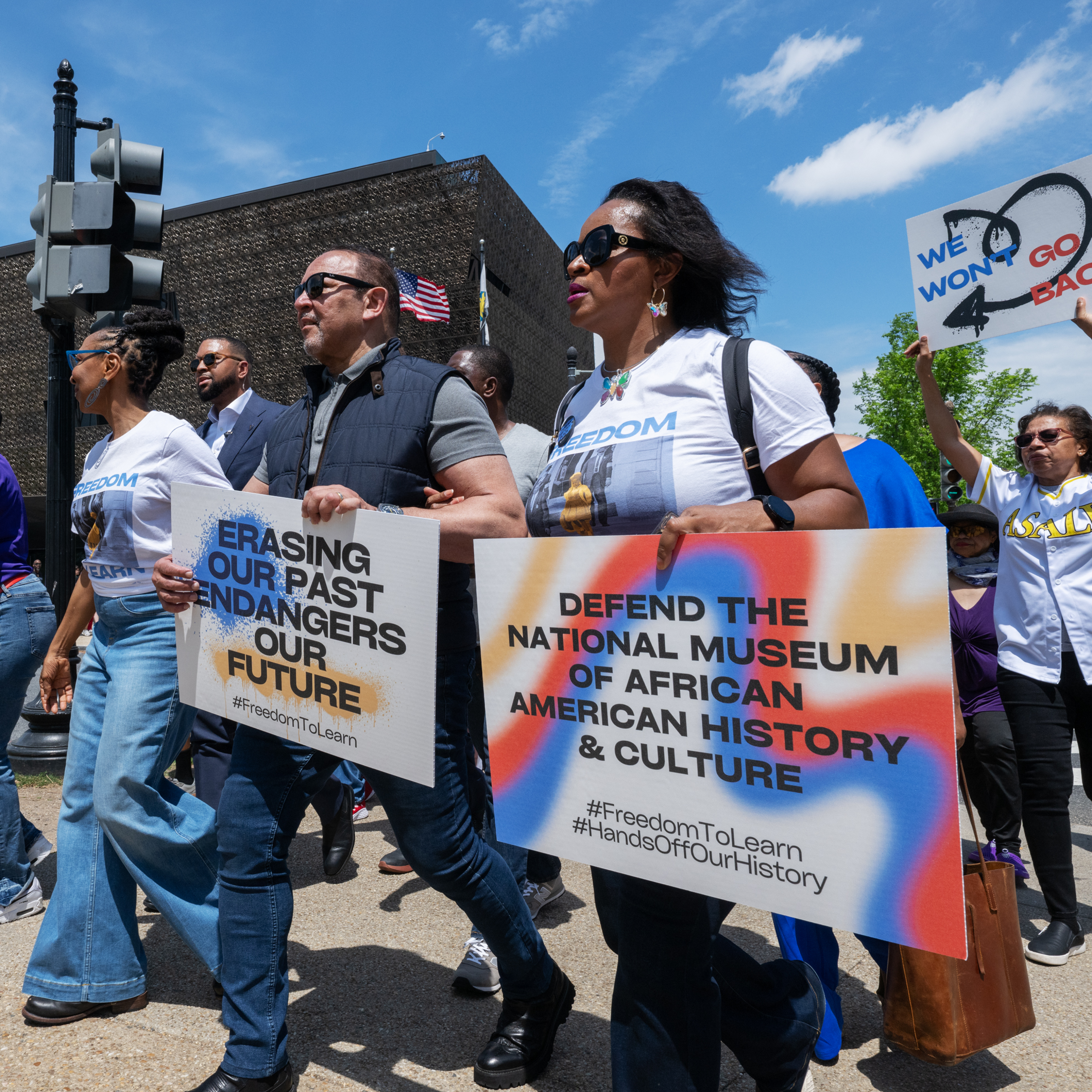
The Trump administration prefers a more sanitized version of American history that minimizes the black struggle and the impact African Americans have had on this country. A whitewashing of the truth. The historians, journalists and activists who fight to tell a more inclusive story face an uphill battle against what is arguably the most powerful bully pulpit in the world. Over the last year, I've had several conversations with black journalists about these issues as a part of More to the Story, our interview show that drops every Wednesday and we've collected a few of them for a Black History Month special. We start with my friend Nicole Hannah Jones, creator of the 1619 Project. That collection of essays and stories upended how we think about American history by placing the arrival of the first slave ship in Virginia at the center of our country's origin story. The New York Times project was lauded and became part of the curriculum in thousands of public schools. And that's when all hell broke loose. Today, Nicole says the Trump administration's efforts to rewrite and even erase black history make it impossible for us to grapple with the complexities of the history of our country. I think, you know, when the name Nicole Hannah Jones comes up, I think what a lot of people obviously think about is that, you know, you are a top tier journalist and I think about that too. But I think the thing that comes to mind for me, the is that you are very much a historian. You have studied the history of America and the world, but really specifically America and race and all of those subjects. Like that's kind of in my mind, your specialty. So as a historian, how are you processing this current moment that we're in right now?
- [04:39]
Nicole Hannah-Jones
That's a great question. And I actually have been thinking a lot about how historians will process and write about this moment when we're reading about where we are now 20 years from now, 30 years from now. And I think if we want to understand a parallel to what we're seeing today, we have to actually go back 100 years. So a lot of folks are saying that this administration is rolling back the 60s, but I'm like this administration is actually going back further than that. We haven't seen the federal government weaponized against civil rights in this way since the period known as the nadir, since the turn of the century. So how I'm thinking about this is that people my age and your age and even our parents age, we've not lived in this America before. And we are experiencing something that if you study history, it's not unpredictable yet it's still shocking that we're here.
- [05:46]
Al Letson
Yeah. You made probably one of the most monumental projects when it comes to journalism and the history of the United States, the 1619 Project, which I've told you personally, I've given you your flowers on it, because it's just an awesome endeavor. But I feel like in a lot of ways, you had to have paid a really heavy price with that because you put out this thing that is widely celebrated but also widely attacked. I wanna talk about the work, but I just wanna talk about the personal level. Like, how did you handle that? Cause, I mean, I've been on Twitter and five people have told me I'm a bad person. And I feel like the whole world is collapsing. You had a whole machine against you.
- [06:34]
Nicole Hannah-Jones
Yeah. You know, if I look back on that period, like, the height of the attacks, which also happened to coincide with COVID So, you know, like you said, there were a few months when the project first published, and it faced kind of your typical conservative outrage, which I was expected. And then it went away. And mostly the project was, you know, really, really well received. But then it came out that the project was starting to go into schools and that there was a curriculum and that educators were starting to teach the project. And that's when you started to see this, what became a really organized campaign against the project. So I. You know, I used to live on Twitter. I. Especially during COVID you know, we just had endless hours to scroll, and I was reading everything. And it was a really dark period for me. I did not initially handle it well. I was doing battle every day. Anyone who said anything about the project, I would argue against it. I sometimes, in a fit of rage, would tweet things that would become an entire Fox News segment that could be taken out of context or that honestly wasn't thoughtful enough. It took me a while to realize that I had become this symbol and that I was giving people ammunition against the work. So it was a dark time, especially when you have the most powerful man in the world targeting your project, when you have his family members targeting your projects. There were threats. Someone threatened to burn my mother's house down. People threatened to come burn my house down. But in the end, one, I survived it. And I learned a lot from that period. And some of my closest friends really helped me get through it, of course, and my family. I think the thing that finally clicked for me was a really good writer friend of mine was like, you've won, Nicole. Like, what are you out here fighting these fools for who no one pays attention to until you respond to them. And that's why they're baiting you. And the reason he was like, you don't have the president and all of these folks coming after your work because your work has not succeeded. And he said, the only one at this point who can discredit your work is you.
- [09:03]
Al Letson
I think about the work and all the collaborators on the 1619 project, the work that Ta Nehisi Coates has been doing. Imani Perry. I can just go on and on. It feels like all of that work is really a battle against the mythology of what people believe America is. I wonder, is myth stronger than truth?
- [09:28]
Nicole Hannah-Jones
I don't think that myth is stronger than truth, but I think myth speaks to the heart and truth speaks to the mind. And it's always easier to coerce the heart. I just think it's simpler. Right. Like myth speaks to emotion. Myth is like what we count on to explain ourselves to ourselves and to justify ourselves. You think of anything, a family mythology, a community myth, a national myth. So I think myth gets so tied up in identity the way that truth does not. Truth is just, you know, as best as we can discern it, it's just at its heart, a dispassionate accounting of the facts. But myth is about who we believe ourselves to be, and so we're always going to hold so much more tightly to that than we do the facts. I think truth is more important. I don't think that mythology ultimately wins, but I think truth is something that requires constant defending, and mythology is just easily absorbed.
- [10:33]
Al Letson
Yeah, because the base mythology of America is this idea that America was born through rugged individualism. And I think that that idea of rugged individualism is what most Americans carry in their heart, especially white Americans. When they hear that, they've had easier than, say, a black American. I personally think that the system isn't working for anybody. And so I understand why people feel like, wait a second, I worked hard to get here. It's just the disconnect. And understanding that other people might have had to work harder. And I don't know how you bridge that gap to making people understand that your work and your life is valid and what you're saying is valid, but also what other people have gone through is just as valid.
- [11:18]
Nicole Hannah-Jones
Part of the problem is mythology means we don't have to have complicated conversations.
- [11:23]
Al Letson
Absolutely.
- [11:24]
Nicole Hannah-Jones
And so you aren't even able to have that nuanced conversation to say, yes. And I say this all the time. I'm never arguing white people haven't worked hard What I'm saying is you have worked hard in a society designed to help move you forward, and other people have worked hard in a society designed to hold them back. And so you both can be working hard, but you're working hard is going to pay off more for you, even though now it's not really paying off that much. This is why we see Donald Trump running on this idea of economics, but enacting policies that are designed to stoke racial animus and polarization, and that he's enacting policies to make it impossible for us to grapple with the complexities of this society. If the first time that you ever heard that this nation was founded on slavery, that our systems of capitalism and politics were created around the institution of slavery, that there has been this long legacy of black Americans being systematically held back by law, that it wasn't just discrimination like the Irish experienced. Right. That this was an entirely different and singular system. The first time you ever hear that is when you're 35 years old and you hear something about the 1619 Project. Your response to that is going to be to reject that. Because if it were true, how could I just be hearing about that? And I've already established my entire view of this nation as this exceptional nation, this exceptionally free nation. We treat the founders as the demigods. Right? We deify them. We don't offer this complex history. And so it is shocking to people who. Who have always been the good guy in the story, who have always been the only people who have ever really moved this country forward to hear a different story. If you get that history earlier, then you don't personalize it the way that they personalize it when they get it older. So that's why the efforts are to restrict the understanding of that history. But the other big part of that is we as black people know we've never been able to think about ourselves in terms of just being individuals. Because of slavery and because of Jim Crow, it didn't matter what we did individually. Right. We were restricted from neighborhoods, from schools, from jobs, from opportunities simply because of our race. No matter how smart we were, how hard we worked, whatever our acumen or ambition was, white people have never had that experience. So just look at the way I was looking at the efforts to really rebrand the 1964 Civil Rights act as being a race neutral policy.
- [14:09]
Al Letson
Yeah.
- [14:09]
Nicole Hannah-Jones
And of course, it's not. Right? Like, the only reason it exists is because of structural racism. And it was designed to eliminate that racism against black Americans and help black Americans enter into all these areas that we had been banned from. But if you erase all that history and context, then you can just say, hey, man, if they even talk about race at all, that's a violation of this act. Because we have a society that doesn't acknowledge race. And when they're saying, get back to a colorblind meritocracy, they cannot tell you when that existed. No, I'm constantly confronted with white Americans who, because of this idea of rugged individualism, but again, in a society where race does not matter to you because race does not hold you back, so it operates invisibly, is that you only ever want to see yourselves as individuals. Now the problem with that is, is here we are right? And when you get to a society that only wants to see you as individuals, it also means we don't believe that we have an obligation to help anyone else outside of ourselves. So you see the gutting of social infrastructure, you see people who are struggling to pay student loans because once we stop believing that we owe each other something, we stop funding higher ed, we no longer fund public hospitals, we no longer believe in a social safety net. We don't feel that we owe anyone else anything because it's all about the individual. And now white Americans are also paying the price for that, except they're blaming the wrong people.
- [15:49]
Al Letson
When you look at your work and the long arc of history, what do you see as a way forward?
- [15:56]
Nicole Hannah-Jones
I mean like best case scenario or worst case scenario?
- [16:00]
Al Letson
Let's hear both.
- [16:02]
Nicole Hannah-Jones
I mean, best case scenario is that this is another one of those cataclysmic moments of, well, I guess that's best case and worst case scenario, actually moments of rebirth that when we look at the few times in this country where we actually started to work towards inclusive, multiracial democracy, they were at catastrophic moments. The Civil War, the deadliest war in the history of the United States. End slavery leads to our second founding. We have this brief period of reconstruction out of those fires where we get equality before the law, the 15th Amendment, the 13th Amendment, the 1867 Civil Rights Act. Black people start moving into government like we see what America could be. It only lasts 12 years. And then the next kind of catastrophic moment was created by the Civil Rights movement, which was a decades long movement that really came to a head in the 1960s. And out of that deadly and violent period, we get the Civil Rights acts and we get our next founding. And once again we see this potential and then we lose heart and we go backwards. And so we are in one of those backwards, catastrophic periods. But I think out of that, again is hope for rebirth, you know, out of destruction, you hope that there will be a rebirth that moves us forward again. But the problem with that is in every one of these periods of backlash, there's so much death, so much harm, and then decades to try to recover. And I just wonder how long are we going to have to, as black people and as a society, continue that cycle? Like, when will we actually try in a sustained way to become the country that we pretend we are?
- [18:07]
Al Letson
Nicole, it is always good to see you and always I love interviewing you because A, you're ridiculously smart, but B, you get deep with me. I love it.
- [18:16]
Nicole Hannah-Jones
I know. It's like a therapy session every time,
- [18:20]
Al Letson
every time we be good. Nicole Hannah Jones, thank you so much for coming to talk to me today.
- [18:26]
Nicole Hannah-Jones
Thank you, Al. As always,
- [18:35]
Al Letson
In a moment, we go back to the beginning of the effort a century ago to document the black history that is now under assault.
- [18:43]
Jelani Cobb
That first generation of black historians went through all manner of hell to produce the books, to produce the scholarly articles, to produce the speeches, to create a body of knowledge that redeemed the humanity of black people.
- [19:03]
Al Letson
You're listening to reveal.
- [19:14]
Host/Advertiser
Museums are more than places we visit on a field trip across the country. Museums protect our shared history, care for wildlife and collections, strengthen local economies, support job training, and spark curiosity in people of all ages. Right now, you can help make sure museums stay strong for future generations. Museum Advocacy Day is a national moment when people contact Congress to ask for continued support for museums and the federal agencies that fund them. Learn how to take action@aam-us.org and tell your representatives that museums matter to education, to communities, to the economy, and to our democracy.
- [19:57]
Tremaine Lee
I'm Brian Reed, host of Question Everything. We've got a story about a journalist
- [20:02]
Al Letson
covering an anti ice protest who ends
- [20:05]
Tremaine Lee
up behind bars for more than 100 days for doing journalism. And here's the twist.
- [20:12]
Al Letson
He was a Trump supporter.
- [20:17]
Nicole Hannah-Jones
I think he's a very intelligent man. I also think that he's very charismatic.
- [20:24]
Tremaine Lee
It's a story of real betrayal. Question everything from placement theory and kcrw.
- [20:30]
Al Letson
From the center for Investigative Reporting and prx, this is Reveal. I'm Al Edson. America can often feel like a pendulum. Just as political power swings in one direction, gravity seems to find a way to pull it back. Just look at the last 15 years or so. The country saw its first black president and the rise of the Black Lives Matter movement, followed by President Trump's election and the erasure of black history. And a resurgence of white nationalism. Few writers have charted these wild swings better than Jelani Cobb. Jelani is a staff writer at the New Yorker, dean of the Columbia Journalism School, and author of Three or More Is a Race Riot Notes on How we got here, 2012 to 2025. And he argues that to better understand our current moment, it's helpful to rewind to a defining incident that happened more than a decade ago, specifically the death of 17 year old Trayvon Martin and the ultimate acquittal of the man who shot him, which happened in the middle of the Obama presidency. Jelani, thanks so much for coming in to talk to me.
- [21:41]
Jelani Cobb
Thank you.
- [21:42]
Al Letson
Yeah, so tell me about that time when you started writing and reporting on Trayvon's death and like, how it evolved into where it is today.
- [21:51]
Jelani Cobb
That was a really striking moment, I think, you know, partly because of the contrast. You know, there was a black president. We had seen circumstances like Trayvon's for decades, centuries. We had never seen that in the context of there being an African American president. And the first thing that I ever wrote for the New Yorker was a piece called Trayvon Martin and the Parameters of Hope. And it was about exactly that contradiction. The fact that we could be represented in the highest office in the land that we could see look at Barack Obama and see in him a barometer of our progress, even though lots of things people agree or disagree with about him politically, but the mere fact that he could exist was a barometer of what had been achieved. And at the same time, we have this reminder of the way in which the judicial system can deliver these perverse outcomes, and especially when there are cases that, you know, kind of are refracted through the lens of race. And so at the time, I thought of Trayvon as, you know, this, you know, particularly resonant metaphor, but I didn't understand that he was actually the start of something, you know, much bigger, because Black Lives Matter is an outgrowth, you know, the phrase, the framing, you know, that language. Black Lives Matter came out of the aftermath of the verdict that exonerated George Zimmerman, who is the man who killed Trayvon Martin. And in a weird kind of bizarro world response, it was also Trayvon Martin's death was also cited as the impetus for Dylann Roof, who three years later killed nine people in the basement of the Emanuel AME Church in Charleston, South Carolina. And he said he had been radicalized by the Trayvon Martin case. And it went from there, really, both of those dynamics, those twin dynamics of this resurgence of white nationalism and this kind of volatile, you know, Christian nationalism and, you know, this very dynamic, resonant movement, you know, for black equality or for racial equality, and almost the kind of crash, you know, the path that those two were put on in that moment.
- [24:43]
Al Letson
So when Barack Obama was running for election, I just didn't believe it was gonna happen, like, until the day it happened. I was like. I mean, I was in disbelief. I was shocked. On the flip side, all the blacklash that we have gotten over the last. Ever since his presidency ended, and during his presidency, really all the blacklash, I was completely like, yeah, that's par for course with America. It's so unsurprising to me. I mean, you can just look back to Reconstruction and see how that ended to kind of understand where we're going.
- [25:22]
Jelani Cobb
You know, I like to think that before he was elected, Barack Obama knew something that nobody else in black America knew, which was, namely, that the country was willing and capable of electing a black man to the presidency of the United States. But after he was elected, I think black America knew something that at times it seemed like Obama did not, which is that people will stop at no ends to make sure that you are not successful. My father grew up in Jim Crow, Georgia, and, you know, he had the standard horror stories that everyone who grew up in Jim Crow had. And the message that he would give me is, never be surprised by what people are willing to do to stop you as a black person, especially if you make them feel insecure about themselves. And it seemed like as the Obama presidency unfolded, as the backlash intensified, you know, as he denied the unprecedented denial of a Supreme Court appointment, which, you know, was astounding, and the tide of threats, you know, against his life that the Secret Service was dealing with all of those things. When you pile it all up together, it begins to look like a very familiar pattern in the history of this country, especially as it relates to race.
- [26:53]
Al Letson
So the Black Lives Matter movement, you know, it was like the rebirth of the civil rights movement, so to speak. But right now, like, we're living in an era where Black Lives Matter signs are literally being demolished and black history. I'm a Floridian. I'm talking to you from Florida right now. And I could tell you that, like, the assuming on black history, specifically in schools is real. Do you feel like Black Lives Matter as a movement failed? Do you see us coming back from this as a country, like, being able to really talk about the history of this country? Cause it feels like we're just running away from it now?
- [27:34]
Jelani Cobb
I think that there's an essay that I'm going to write about this, about what black history really has been and what Black History Month really has been and why Dr. Carter G. Woodson created what he then called Negro history week in 1926 and became Black History Month in 1976 to mark the 50th anniversary. But they had very clear objectives, and these were explicitly political objectives that they were trying to create a landscape in which people would spend a dedicated amount of time studying this history for clues about how to navigate through the present. And you know that first generation of black historians went through all manner of hell to produce the books, to produce the scholarly articles, to produce the speeches, to create a body of knowledge that redeemed the humanity of black people and specifically made a case against Jim Crow, against disenfranchisement. And so they understood that history was a battleground and that people were writing a history that would justify the politics of the present. And so when you saw that black people have been written out of the history of the country, that slavery had been written out of the history of the Civil War, that the violent way in which people were eliminated from civic contention had been whitewashed and airbrushed, and that what you saw in the day to day was segregation, poverty, exploitation, the denial of the franchise, the denial of the hard won constitutional rights. There's a reason, for instance, that the first two black people to get PhDs from Harvard University, and those two were W.E.B. du Bois and Carter G. Woodson, they both got their doctorates in history because they were trying to create a narrative that would counterbalance what was being done. When I look at the circumstances that this field came into existence under, I am less concerned about what's happening now. I should say that what's happening now is bad. But I think that we have a body of scholars now. There are people who every spring a new crop of PhDs in this field is being minted and people are promulgating this history in all kinds of ways and so on. And so I think this is a battle that has to be contested and has to be fought and ultimately has to be won. But I don't lament about the resources and our ability to tell these stories.
- [30:32]
Al Letson
You're on faculty at Columbia University. I think there's a lot of hand wringing among journalists right now. Fact based reporting is being drowned out by misinformation and disinformation. What do you tell your students? How do you teach them in a time when journalism itself is under such threat?
- [30:51]
Jelani Cobb
Well, the thing that we teach is that this is indicative of how important journalism is. Powerful people don't waste their time attacking things that are not important. And so we are able to establish kind of narratives. And granted, we've lost a few rounds in this fight. You know that people not only have less trust in us, but they have more trust in people who are sometimes outright charlatans or people who are demagogues. And, you know, that is a real kind of difficult circumstance. But I also think that it's reminiscent of the reasons that Joseph Pulitzer founded this school in the first place. This school was established in 1912 with a bequest from Joseph Pulitzer's estate. Pulitzer understood at the time journalism was a very disreputable undertaking. And he had this vision of it being professionalized, of journalists adhering rigorously to a standard of ethics, and thereby winning the trust of the public. And that was part of the reason that people actually did win the trust of the public over the course of the 20th century. Now we've had technologies and cultural developments and some other changes that have sent those numbers in the opposite direction, which I also will say this is not isolated. People distrust government, they distrust corporations, they distrust the presidency. The distrust all of these institutions that used to have a much higher degree of public trust. And so my standard has been, or my approach to this has been, we should not ask the public to trust us. We should not anticipate ever regaining the level of trust we had once enjoyed. But I think that the alternative is that we now just show our work to the greatest extent possible. Sometimes we can't, because, you know, we have sources who can only give us information anonymously. But we should walk right up to the line of everything that we can divulge so that, say, don't trust us. Read for yourself what we did. If you wanted to, you could file a Freedom of Information act and get these same documents that we are citing in this reporting. We should try to narrow the gap between what we're saying and the degree to which people have to simply take us at our word.
- [33:21]
Al Letson
America has obviously changed over the last 10 years. How have you changed?
- [33:28]
Jelani Cobb
I think that I'm probably more restrained as a writer now than I was 10 years ago. I'm keeping my eyebrow raised and kind of like, hmm, where's this going? You know, I try to be a little bit more patient and to see that, you know, what the thing looks appears to be may not be the thing that it is. And at the same time, I'm probably more skeptical than I was 10 years ago. And I haven't given up on the idea of there being victory, of it being a better tomorrow. But I also think that it will exact a hell of a cost for us to get to that place.
- [34:12]
Al Letson
Jelani, it has been my pleasure to talk to you. I've been such a big fan of your work for so long. So I'm really excited that you came onto the show. Thank you so much.
- [34:21]
Jelani Cobb
Thank you. It was really great being here.
- [34:25]
Al Letson
When we come back, a very personal conversation about life, death and navigating journalism. As a black man in America, as
- [34:34]
Tremaine Lee
a journalist for, you know, my entire career operating on the edge of death and survival, Black death and survival in particular, and a family history packed with early death and violence. I had to engage with that in a way that I had never expected to fully.
- [34:51]
Al Letson
You're listening to REVEAL. From the center for Investigative reporting and PRX. This is Reveal. I'm Al Letson. At age 38, Pulitzer Prized, an Emmy award winning journalist, Tremaine Lee turned in the rough draft of his first book. And then the unthinkable happened. A massive heart attack that almost took his life. While recovering, Tremaine began to think deeply about the weight he's been carrying, the stories he's reported over the years about violence, the trauma that generations of black men in his family have endured. His near death experience transformed his writing and his book, A Thousand Ways to Die, the True Cost of Violence on black life in America. Tremaine, man, thank you so much for coming on, brother.
- [35:50]
Tremaine Lee
It's an honor and a pleasure to be here with you, man. So thank you.
- [35:52]
Al Letson
Before we go to the book, can you just talk to me about the weight of the heart attack and how it played out with your family. And I just want to hear about the personal journey through that because we're at that age right, where, you know, if you have kids, they're still needing your guidance. If you have parents, they now need your guidance. Work is crazy. The economy is going nuts. You're feeling crunched and you're just trying to get through the best you can. And then something like this happens. And, you know, I'm sure it has to change your perspective about life.
- [36:35]
Tremaine Lee
You know, it sounds cliche, but to think that in that moment I was thinking about everything that I would miss. My daughter, who was six years old at the time, was this beautiful little inquisitive girl who was like my buddy to this day. She's turning 13 this summer. And to think about, you know, not, man.
- [37:01]
Al Letson
Yeah, man.
- [37:01]
Tremaine Lee
Take you to think about not being able to walk her to school, the. The science project. She wants to be a journalist like us. So talking about the. The W's, the five W's, and having little conversations with her and seeing that she's beginning to piece an understanding together, and I would miss that. It just, you know, it brought me to my knees in so many ways, but it also coming out of that, that I did survive, that I did live. It was an opportunity to live more fully and more honestly. And so in the beginning, it was like, you know what? Let me get physically right because. Because it's going to take more than that to get me. That's going to have to, like, hawk me down.
- [37:43]
Al Letson
Absolutely, absolutely.
- [37:46]
Tremaine Lee
But there was another weight on my heart that I had never fully engaged with as a journalist for, you know, my entire career operating on the edge of death and survival, Black death and survival in particular, and a family history popped with early death and violence. I had to engage with that in a way that I had never expected to fully. But with this, it really forced me to acknowledge what was bearing down in my heart the stress of telling these stories of black life and death and survival and the spectacle of death, but also a family history going back a very long time to realize what we've inherited, but we never fully process as a young journalist, running and gunning and hanging out and drinking. And when I was single, we're dating and we're moving around and we're hitting the deadlines, and then after that we're hanging out, never fully engaging. What it means to carry this specific kind of weight that black people in this country have had to bear. The violence, certainly of the bullet, but the systemic violence that is necessary, that is a requisite for these ecosystems in which we experience that other violence to actually occur. And so it blew my mind in that, like, yo, what almost killed me was being black in America. And that changed everything.
- [39:04]
Al Letson
I think as we turn to talk a little bit more about the book, that being a black journalist, especially in the time that you're talking about in the time of Ferguson, in the time of Triple Martin, that reporting on it carried a weight for black journalists that I don't think we talk about enough, that I don't think. I don't even think we really acknowledge it. Because here's the thing about acknowledging that working in journalism is that as a black journalist, this is just the truth. You have to be better. You can't talk about, like, you're having trauma about this or that or the other thing. You have to just do the job because you talk about that type of stuff, you're not going to get work, you're not going to get the jobs, you're not going to be able to keep doing the reporting that you, that you feel is important. Because nobody does this type of reporting because they want to. We do it because we're called to do it, because we see, you know, Mike Brown and we see ourselves, we see our cousins, we see our brothers, our sisters, all of that. Like when I see Breonna Taylor, like, Breonna Taylor looks like she could belong in my family. So for me, it's like, I gotta tell that story. Cause if I don't, who will? And so you're drawn to it, but you also experience the trauma of it in a way that you can't really, you can't talk about really. Except with other black journalists.
- [40:42]
Tremaine Lee
I think it's like, that is. And you're right, we haven't fully talked about it. And all of us who, you know as black journalists who tell these stories, who are mission driven, who are purpose driven, right, who have the. Our North Star is telling the whole truth about how we experience this country. There is also this assumption or this perceived bias because we understand the experience so well. There has to be a bias. We have to have some jaundiced vision because we see it too clearly. And so you have to be so good, right? You have to be so sharp and you can't make any mistakes, right? Because you will find yourself without a job. No, it's a lot, man, but especially then because, you know, there was this emotional heat of the moment, but there was also this fire, right? So we're engaging with America tearing at its threads, right? And what it means to value black life. And people say enough is enough. And how do we cover that through the mainstream lens has never been easy. And I'm not sure we figured out a way to do it, except for to go out there time and again and tell the truth.
- [41:52]
Al Letson
You have this book that you finished right before this massive heart attack and then you, you dive back in to, to make your edits and, and to polish it up. But your experience just changed the whole trajectory of the book. Talk to me about that.
- [42:09]
Tremaine Lee
Yeah, man, more than that. When I first turned those, that 90,000 word manuscript in, it was really super rough. The book it is today is honestly about 25% of what it was into what it became. To go back in the initial premise, Million Dollar Bullets, the true cost of gun violence in this country in terms of actual dollars and lost dreams and hopes was forever changed. Initially, I was always going to hold the reader's hand a little bit and speak to my own experiences. My grandfather's murder in 1976 is this massive space in my life. It occupies a massive space in my family's life two years before I was born. Growing up, seeing my family's portraits of better days and, you know, people talking about his voice and his sense of humor and just how he moved to the world, I always knew that part. And so part of the storytelling was even your friendly neighborhood journalist who you've come to know telling these stories, has been touched by this thing. And here's what it cost my family. What I had less of an understanding of was that my grandfather's was not the first murder in our family. Going back to the rural South Jim Crow, Georgia in the early 1920s to discover that my grandmother, who was a baby at the time, had a 12 year old brother who was shot and killed in a sundown town where the men came together, and this is documented in the newspaper, came together in Fitzgerald, Georgia to outlaw black labor and black voting in this community in the late 1800s that spark my family's journey into the migration to Philadelphia first and then South Jersey, only to have a second of my grandmother's brothers shot and killed by a state trooper. And to for the first time look at those headlines where it says trooper's gun kills youth. As if this gun just hopped up and shot a black teenager right under these weird circumstances. And then 20 plus years later, my grandfather's murder, a prospective tenant, they owned an apartment in Camden, New Jersey and we're going to rent it to a guy. He disappeared after leaving a deposit, won his money back. My grandfather said, no, I'll see you in court. He came back and murdered my grandfather. Twenty years after that, my stepbrother shot and killed in Camden. A girl put a bullet in the back of his head. In the early 2000s, another cousin killed in Lang City. So the psychic residue of what's been passed down and me grappling with telling these stories that black families across the country experience in terms of the violence of police in the system and the violence of the community and the systemic violence again that binds us all, wraps us all up, this became so much more personal. And as you know, for a long time I was trying to be somewhat arm's length even though I was very close to telling these stories. Now it's time to drop all that and speak honestly about what I now know to be crushing down on me, which is the weight of this family history.
- [45:07]
Al Letson
Yeah. As you were talking about, just made me think about my own family history and think like, our stories are so similar. My great grandfather, the reason why my family ended up in New Jersey is because something happened to him in the South. And there are no records of it, but family lore is that he was lynched, and then that moved my family to New Jersey, and then all sorts of violent incidences happened there as well. And it just kind of seeps into you. And the funny thing for me is that I had no idea about any of that until I started reporting on a story. And I thought, let me look into my genealogy and just think about. And when I saw it all, I was like, wow. I am like, I am reporting on the story of my family and didn't even know it. Time and again, time and again, time and again. Like, you find yourself in these horrible stories, sad stories about people that look like you, and then you find out they are you. You know, it's like. And it's like heavy weight to carry. At Reveal, we worked on this series called Mississippi Goddamn. And I get choked up when I talk about it. I remember, God, man, I'm so sorry. I'm getting choked up. I remember feeling like it was going to kill me. My blood pressure was ridiculous. Like, I would check my blood pressure in the morning, and I thought to myself, like, it was. It was like, literally the blood pressure thing would tell me to go to the hospital because it was that high. But I couldn't stop because I had to turn in this story. I had to turn in this story. And I felt like I. And I did. I don't think this was wrong, but I felt like I owed this family and I owed the young man that I was telling the story about. Like, I had to finish it. But also, when I look back, I owe my children to be around if I can. But I couldn't see it then, you know, I just was like, of course not. You gotta get through this thing. Oof, man, I'm so sorry. But every time I sat down at that computer or to write these episodes and listening to this tape and looking at autopsy reports and all of that type of stuff and, you know, graphic photos of this young man's death, I felt like I had to keep doing it. And, you know, I mean, just to be honest, like, Reveal, especially at that time, was a very. You know, most of the people in that. In that workplace were white. And I had worked so hard and championed this story for so long. That, like, I was finally getting a shot and I knew I couldn't drop it. And just the. The amount of pressure and time it took. And then, you know, afterwards I realized, like, bro, you acting crazy, but carrying that.
- [48:17]
Tremaine Lee
Oh, my God, bro, that same feeling. And again, I feel like I'm looking into a mirror.
- [48:22]
Al Letson
Yeah.
- [48:22]
Tremaine Lee
The echo. I'm hearing an echo bounce from me to you and back to me. Those early days especially, there's nothing like arriving at a crime scene. Right. And seeing someone that looks just like you.
- [48:35]
Al Letson
Yeah.
- [48:35]
Tremaine Lee
Dressed just like you. Got some Air Force ones fresh just like you.
- [48:40]
Al Letson
Yep. Yep.
- [48:41]
Tremaine Lee
With their brain matter splattered across the pavement. Yeah. And the family. And that look in a mother's eyes.
- [48:50]
Al Letson
Yeah.
- [48:50]
Tremaine Lee
That could be your mother. There's zero things in this universe like that pain.
- [48:56]
Al Letson
Yeah.
- [48:57]
Tremaine Lee
And that we are the burden bearers of that. And we have to be. And we have always had to be. Ida B. Wells did not like this season either.
- [49:05]
Al Letson
Yeah.
- [49:06]
Tremaine Lee
Her blood pressure was probably through the worst.
- [49:08]
Al Letson
Absolutely.
- [49:09]
Tremaine Lee
But it's a reminder that we cannot report our way out of the pain. We cannot educate our way out of the pain. We cannot drink and hang our way out of the pain.
- [49:20]
Al Letson
No.
- [49:21]
Tremaine Lee
When you're a young man, you can't run around and have sex. You can't sex it away. We have to engage with it. And until we have those conversations about what it means to carry that weight. When you have to carry the weight. Because no one else will and no one will care when we die of a heart attack. Because it happens every single day.
- [49:40]
Al Letson
Yeah, right. No, absolutely. It's just that America's understanding of what it means to be black and how we see the world and experience the world, we haven't caught up. And journalism absolutely hasn't caught up.
- [49:57]
Tremaine Lee
Even among our friends and friends of the truth, there is an acceptable level of anti blackness in this country that is okay.
- [50:03]
Al Letson
It's okay.
- [50:04]
Tremaine Lee
Even among people who wish it'd be. It would be different.
- [50:06]
Al Letson
Yep.
- [50:07]
Tremaine Lee
But we've accepted it. It's part of. It's part of what this is. Right?
- [50:10]
Al Letson
Yes.
- [50:10]
Tremaine Lee
And so that's why I get to have an argument about whether the founders of this country. Right. These transnational human traffickers are white supremacists or not.
- [50:19]
Al Letson
Right. But the idea that my ancestors lives didn't matter. One of the things that our friend Nicole Hannah Jones talks about a lot is that, like, you can't have this history and it matter, and suddenly this history doesn't matter. Like, it just. It doesn't make sense.
- [50:39]
Tremaine Lee
That's Right.
- [50:39]
Al Letson
It doesn't make sense. You gotta own the whole thing, America. You just gotta own it.
- [50:43]
Tremaine Lee
That's right. You can't. Our friend Ta Nehisi Coates. You can't have the credits without a debits.
- [50:48]
Al Letson
Exactly.
- [50:49]
Tremaine Lee
It has to be. But also the idea that our existence and experience is kind of inconsequential.
- [50:55]
Al Letson
Right.
- [50:55]
Tremaine Lee
When we are foundational in all of the ways we were. The economy.
- [50:59]
Al Letson
Absolutely. We're our flesh. Exactly.
- [51:02]
Tremaine Lee
And the fact that we're still fighting to tell these stories. And you'd imagine a great nation would say, look how far we've come. And when we could do the right thing. We did certainly this founding with A, B, C or D. But we are such a great nation where. Look at the strides. The strides were made through bloodshed.
- [51:20]
Al Letson
Absolutely.
- [51:20]
Tremaine Lee
Sacrifice.
- [51:21]
Al Letson
Absolutely.
- [51:22]
Tremaine Lee
Come on.
- [51:25]
Al Letson
Tremaine Lee is the author of A Thousand Ways to Die. The True Cost of Violence on black Life in America. Tremaine, man, I feel like we just did a therapy session with each other.
- [51:36]
Tremaine Lee
We laughed, we cried, brother. We confronted all the things.
- [51:39]
Jelani Cobb
Exactly.
- [51:40]
Tremaine Lee
Thank you.
- [51:40]
Al Letson
Thank you, man. Good to talk to you.
- [51:41]
Tremaine Lee
Likewise.
- [51:44]
Al Letson
You can find my complete conversations with Tremaine Leigh, Jelani Cobb and Nicole Hannah Jones on our interview show, More to the Story, which comes out every Wednesday on the Reveal podcast feed. Our producer for this week's show was Josh Sanburn and editor Carl McGurk. Allison artist Cheriskis is our fact checker. Victoria Baranetsky is our general counsel. Our production manager is the great Zulema Cobb. Score and sound designed by the dynamic duo Jay Breezy, Mr. Jim Briggs and Fernando My Man, Yo Arruda. Taika Telenides is our deputy executive producer. Our executive producer is Bret Myers. Our theme music is by Camerado Lightning. Support for reveals provided by the Riva and David Logan foundation, the John D. And Catherine T. MacArthur foundation, the Jonathan Logan Family foundation, the Robert Wood Johnson foundation, the park foundation, the Schmidt Family foundation and the Hellman Foundation. Support for Reveal is also provided by you, our listeners. We are a co production of the center for Investigative Reporting and prx. I'm Al Letson and remember, there is always more to the story.
- [53:02]
Nicole Hannah-Jones
From prx.