Loading summary
Transcript39 lines
- [00:03]
Al Letson
As widespread hunger grips Gaza, there are people on the ground who are doing their best to feed the hungry.
- [00:09]
Abe Adrami
We want to provide good, quality food, decent food with dignity. We cook for our neighbors or friends. We're not some third party coming into Gaza to provide food. We are it. We are the Gaza people.
- [00:24]
Al Letson
Coming up on more to the story, I talk with Abe Adrami from the Gaza Soup Kitchen about what it takes to coordinate food aid for their 11 sites in the Gaza Strip. Stay with us.
- [00:42]
Lisa Schachter
Did you know you have the power to inspire future generations with the same impactful reporting you trust and believe in right now? I'm Lisa Schachter and I manage the Legacy Society program at the center for Investigative Reporting. When you include Reveal in your will or other legacy plans, you are passing along your values of truth and integrity. It won't cost you anything right now, and you don't need to be wealthy to make a difference. A gift of any size through your will or from your retirement plan, life insurance plan, or other financial account can ensure that reveal's meaningful, factual reporting continues for decades to come. For more information about making a legacy gift to Reveal or to notify us that you already have, give me a call at 415-321-1706 or send an email to giftsevielnews. Or again, that's 415-321-1706 or giftsrevealnews.org Please consider creating your legacy of truth today. Thank you.
- [01:52]
Al Letson
This is more to the story. I'm Al Letson. After Hamas staged an attack on Israel In October of 2023, killing more than 1200 Israelis and foreign nationals and kidnapping about 251, the Israeli government struck back. Gaza is a war zone, rubble, dust and death. Tens of thousands of Palestinians have died, and for those who survived, the situation continues to be dire. Finding basics like milk, bread and clean water is difficult, if not impossible. The ipc, which is a global initiative that measures food insecurity, says one in three people are going without food for days at a time and and that famine, like conditions are evident in most of the Gaza Strip. Gaza Soup Kitchen is one of many nonprofit organizations trying to help. Abe Adrami is a board member with the group. Born and Raised in Gaza, Abe now lives in the US where he helps coordinate the organization's food aid efforts. Abe, thanks so much for being here. What are you hearing from the people you know in Gaza right now?
- [03:01]
Abe Adrami
What I'm hearing is a call. You know, people are praying, God, let the judgment day start I mean, that's really a common prayer that people, let's just end this whole thing.
- [03:13]
Al Letson
Can you unpack that for me? Like, what do they mean when they say that?
- [03:18]
Abe Adrami
Pretty much saying, let the end of time happen. Let's, you know, as faithful people believe that, you know, this whole life will end one day and we all going to meet our creator and there'll be heaven and hell and all this stuff. And they're saying just let it happen now. And another thing, they often say those who were killed early in the war are the lucky ones. For example, I lost my oldest, one of my sisters, 72 years old, Halima, second week of the war. And it was a shocking when it happened. And now my brothers and other siblings are looking back at it and saying she was the lucky one. We're the one that's unlucky to go through this hell for the past two years. So that describes how bad things are happening. Everything is a struggle. Staying alive is a struggle. Finding food is a struggle. Finding drinking water is a struggle. I mean, just every minute of it is a brutal experience.
- [04:27]
Al Letson
When I hear you say that and that phrase, it makes me feel like the people of Gaza just have no hope anymore, that this is the status quo and it's going to remain this way.
- [04:41]
Abe Adrami
And that's very true. When the first things started going, people that's not their first rodeo. So they thought, okay, we've been through this, it's going to last for a month or two, get rebuilt again. And then things were getting worse and they thought, okay, maybe the world would wake up and intervene to stop the genocide. When the ict, for example, took the case and declared that the war must stop, that these are indeed war crimes and issue arrest warrants for Netanyahu and his defense minister, people thought that's the highest legal entity in the globe. Something must happen. Well, nothing happened since then. People will tell you this talk about human rights, this talk about Western democracy, this talk about the Geneva Convention is meaningless because none of those conventions and laws help stop the genocide.
- [05:46]
Al Letson
You call what's happening in Gaza a genocide. And I think there's a debate like a lot of people have been pushing back on labeling it as a genocide. What would you say to them?
- [05:59]
Abe Adrami
It seems to me the only. There are very few places in the world where that description is disputed and mostly in the American politics and to some extent some UK parliamentary, but the whole world, the United Nation, is calling it genocide. Amnesty International is calling it a genocide. And so, you know, even sa Israeli human rights organization recently called it a genocide. So all these legal scholars call on it. And I challenge anyone who's not even just any ordinary citizen. Look up the definition of genocide and see what's happening in Gaza and look me in the face and tell me this is not a genocide. There are two things, the actions and the intent. Israelis are not hiding their intent. As far as yesterday, they said, our intent is to force Gazans out and settle Gaza with more Israeli settlements. Their defense minister, before the war started, he said, we're going to shut water, shut medicine, shut food, shut electricity off Gaza. That's collective punishment. That's a war crime. So when you're talking about as of yesterday, 60,000 Palestinians got killed. Around 20,000 of them are kids, 70% are women and children. And there are thousands are still missing under the rubble. It's obvious that the Israeli government is using food as a weapon. And when you hear the peace talks and they say, well, Israelis agreed to let air drops happen, drop in food, or allow certain countries to supply Gaza with food, that tells you they're the ones shutting the borders from entering food. So you're talking about 2 million people who were intentionally starved by another country.
- [08:01]
Al Letson
I've seen a lot of talk about widespread hunger and the famine happening in Gaza right now. But a lot of times when I see the news coverage, they talk about the famine as in like this just happened, like there's nobody really responsible for it. Like it suddenly like Gaza is now in famine conditions. Can you speak to that specifically?
- [08:27]
Abe Adrami
Right. This is artificial. This is a man made starvation. People aren't hungry. They are made hungry by the siege and the Israeli bombing and closing the Gaza. It's mind boggling to hear my Jewish friends the slogan of never again. I love the slogan. I have several Jewish progressive friends who are great advocates of human rights and they're using the history of the Nazi and the Holocaust to make sure it doesn't happen again. Unfortunately, it's happening in Gaza because the irony is that you have thousands of people who are starving to death. And right a mile across the Egyptian border, there are miles and miles of trucks full of food. So that's really, it's extremely sad that the world is watching this live on tv, seeing the irony of you get food on this side, plenty of food, and right across the border there are thousands of people who are starving because the Israelis decide to use hunger as a weapon to subdue their population and force them to leave Gaza.
- [09:53]
Al Letson
I want to talk a little bit more about your organization and how it works. How many Food distribution centers does the Gaza soup kitchen currently have operating?
- [10:03]
Abe Adrami
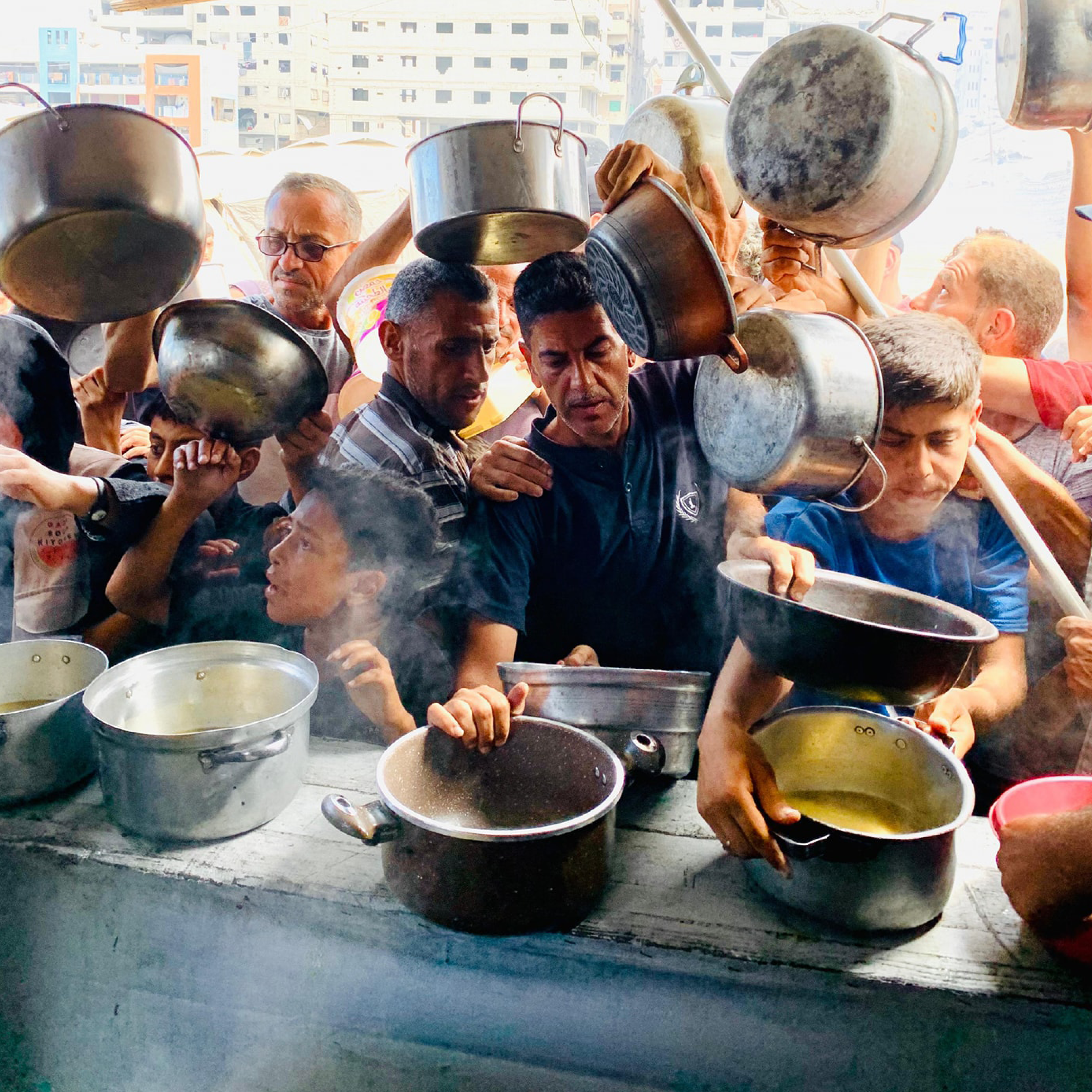
Currently we have 11 feeding centers. And the numbers change based on the situation. There are many factors. It's not your typical, you go to Christ's Kitchen and it's open and you get a meal and eat and leave. It's very hard. If you see the pictures, these guys either in a school that turned shelter for families or they're out in the street behind demolished and rubbles and they're cooking. In addition to those centers that feed the neighborhoods where they at, we have meal delivery to hospitals. We send meals to the staff and patients at the Ali Hospital and most recently to the children's hospital, Nasser Hospital. We also have a medical clinic that's staffed by a physician. And every once in a while we have a classroom for kids that gives some basic education and some entertainment services.
- [11:07]
Al Letson
And how many people are running them.
- [11:09]
Abe Adrami
Total employees averages between 60 and 65 people. Between the chefs and the workers that manage and let me just expand on this. The whole process is extremely difficult. I mean you collect donations here, that's the easy part. Try to get that fund into Gaza is very, very difficult because all the banks were forced to shut down. So there's no standing financial system in Gaza. So you rely on money exchangers, just people who have some money. And you go through, whether it's Egypt or Turkey, any third party to get that money into Gaza. So we try to talk with farmers, with people who providing what's left of ingredients and vegetables in Gaza about accepting money transfer like from a phone app to a phone app in lieu of cash. And we've been working for several months now, so there is trust, relationship or they'll accept the payment. And people sometimes realize they're helping their own communities so they'll help us get food one way or another. So that's just the cash part. Trying to find fire logs is a challenge. So you try to scavenger a few logs here and there and wood, often from houses that were bombed, try to find that wood because there is no propane, there is no electricity, no gas. So that's how you fire up the pots, is wood logs and then find chefs who can know how to cook. And sometimes the hardest part is how do you control the crowds? Because our motto, the three things we can never cross is one, we want to provide good quality food, decent food with dignity, and definitely treat people. I mean these guys who cook our neighbors, we cook for our neighbors, our friends. We're not some third party coming into Gaza to provide food. We Are it. We are the Gaza people. So those who cook are locals, the chef is local, Everybody that works. So that's the hardest thing sometimes is how do you control the crowds? Yeah, you're talking about hundreds of hungry people. And the lies extend so far. And initially the first few pots, everything goes well. Then those in the back start realizing there is only half a pot left. So, I mean, I may not get to fill my plate. So. And our instructions to these guys, and they know it, you can. If somebody is so hungry that they'll come attack and grab something, let him take it. He's not being ugly, he's hungry. So that's really the hardest part is finding enough food for these people and trying to feed as many people.
- [14:23]
Al Letson
Do you have any idea how many people you're able to serve each day?
- [14:27]
Abe Adrami
On average, each feeding center feeds about between 250 to 400 people, depending on the prices. And what. Because that $100 can buy you 100 meals if the prices are, you know, are decent. It may buy you 20 meals if the prices are high, but on average is somewhere between 250 to 500, give and take, depending mostly on the prices.
- [14:58]
Al Letson
Coming up, Finding basic food staples in Gaza can be deadly. Many have accused the U. S backed Gaza Humanitarian foundation for having particularly dangerous food sites.
- [15:11]
Abe Adrami
I talked to people, I talked to my sister the other day and she said, guess what? My son went walked several kilometers to the GHF site to get flour. And I said, why isn't that crazy? And she said, what were we gonna do? And I said, so what happened? She said, well, I don't know. She said, I'm still waiting. I'll hoping that he'll come back alive.
- [15:33]
Al Letson
More with Abe Adrami after this.
- [15:39]
Lisa Schachter
Hi, y', all, My name is Nadia Hamdan and I'm a producer here at Reveal. Reveal is a nonprofit news organization and.
- [15:47]
Al Letson
We depend on support from our listeners.
- [15:50]
Lisa Schachter
Donate today@revealnews.org donate and thanks.
- [16:03]
Al Letson
This is more to the story. I'm Al Letson and I'm talking with Abe Adrami from the Gaza Soup Kitchen. The UN says more than a thousand people in Gaza have been killed since May while trying to access food and that most of those Deaths, more than 760have been near distribution sites run by an organization called the Gaza Humanitarian Foundation. Let me ask you specifically about the Gaza Humanitarian Foundation. It's an Israeli and US Backed organization that was started this year and meant to replace UN efforts to distribute food. What are your thoughts on that group?
- [16:42]
Abe Adrami
Right. Gaza Humanitarian foundation is as close to humanitarian as the devil is close to enter paradise. I mean, it's Gaza Humiliation foundation in reality. And as recent as last week, a US ex military employee, he worked in Gaza, came out and blew the whistle on what's happening there and informed the world that actually these guys were shooting at hungry people. So people get killed, many get injured. It's a scam, it's really a trap where thousands of people get in. It's such a humiliating. If you look at the videos and the footage of showing people just piled up stuck between fences and those are starved people. Given the choice, you either stay home, die out of hunger, or you walk kilometers, several miles to get to the GHF feeding center and you may get killed there. So these are the choices. And I talked to people, I talked to my sister the other day and she said, guess what? My son went walked several kilometers to the GHF site to get flower. And I said, why isn't that crazy? And she said, what were we gonna do? And I said, so what happened? She said, well, I don't know. She said, I'm still waiting. I'm hoping that he'll come back alive. I mean, that's how bad the situation is. And it's just the whole thing is shady. You cannot feed people while drones are hovering over them and the bullets are flying over their heads. So that's really, it's a horrible thing that adds to the Israeli war crimes.
- [18:32]
Al Letson
What does the Gaza Soup Kitchen do differently to try and protect people seeking food?
- [18:37]
Abe Adrami
The thing is just like any organization or charity, when you go seek food at Christ's Kitchen or any place in the world that provide food, those who are given the food aren't carrying guns and aren't masks. So what really sets us apart as an organization is that we're purely local organization. Everybody that works in Gaza is part of the community. So when my brother goes and works in a feeding center, he's feeding his neighbors, he's feeding his friends in the neighborhood. So everybody knows everybody. Those who provide the food, the ingredients, those who light the fire, the chef that's cooking and responsible for the recipe is a local in the community. And that's what sets you apart. People trust our guys and our guys are part of the community. So not only we provide food, but we provide food with dignity.
- [19:37]
Al Letson
So recently, France, the UK and Canada announced support for a Palestinian state. I'm just curious, do you think there's genuine support, political theater or something else?
- [19:51]
Abe Adrami
It is way overdue. I mean, this should have been done many years ago. And ironically, even the US government for many years, throughout all these administrations, believed that the two state solution based on the 1967 border is the way to go. But yet when the issue is submitted to the Security Council to recognize the state of Palestine, the US government veto it. I mean, that's your own stand. Why don't you recognize Palestine as a state if you believe the two state solution is the way to go? So that's way overdue. Second is that there are two opinions. I talk to my family and friends and there are people who think, oh, that's great, you know, that's, you know, better, you know, late than never. So they think it's a good step forward. Others believe it's just a stunt, it's a fig cover, you know, for the Arab countries like Saudi and Bahrain and those countries to normalize relations with Israel because it would be very shameful on the eyes of their own people. You want to normalize relation with Israel was Israel is committing genocide in Gaza. So shame on you. So they're trying to show, well, actually we gained a lot of good things for the Palestinians. Look, we're working with France and Britain and Canada and all these countries to recognize Palestine as a state. About the same time we have to recognize Israel. Well, if you recognize Palestine as a state without further actions, it would be meaningless. What recognition would change the status of those hungry people in Gaza? What is the British and Canadian and French recognition would help those farmers who are losing their land in the West Bank. So based on that recognition, if they truly recognize Palestine as a state, then those Israeli soldiers carrying the guns and roaming the streets of Gaza become illegitimate. It becomes an occupying force of another land, of another country. Those countries need to put sanctions on the occupying force, just like putting sanctions on Russia or occupying another country that's called Ukraine. So that political recognition of Palestine as an entity has to translate into punishing Israel for occupying and subjecting Palestinians to all this brutal war and rewarding Israel. If the Israeli government agreed to this two state solution by opening borders with Arab countries and normalizing relationships. But the mere recognition itself, it carries symbolic, political, you know, good thing that's happening. But unless it translates to change the life on the ground, it would be. It won't be that important.
- [23:00]
Al Letson
Yeah, Abe, thanks so much for talking to me today and also thank you for your work in feeding people who are facing an extreme crisis right now.
- [23:11]
Abe Adrami
Thank you, sir. If I may add, and just something that I really share with American Jews and the Israelis themselves, I mean, we can continue to kill each other till the end of time or we can sit together and say how can we build a better future for our children, our grandchildren? It's not about Hamas and it's not about anything. It's everybody knows that the source of the issue is that there are people called Palestinians who are living under occupation and people throughout the world will pay a price, no matter how high to gain their freedom and get their dignity and have the right to self determination. How long would it take the Israelis to realize this? And the earlier and the faster we get to that point, see each other as humans, not as enemies, I think the closer we can get to a solution.
- [24:19]
Al Letson
Ava Dramey, Board Member of the Gaza Soup Kitchen thank you so much for coming on and talking to me.
- [24:24]
Abe Adrami
Yes sir, thank you.
- [24:27]
Al Letson
That was Abe Adrami from the Gaza Soup Kitchen. You can learn more about their organization@gazasoupkitchen.com before we go, I wanted to leave you with this message from Khalid Kadas who works in one of the organizations, Takiyas, or food centers that offer free food inside Gaza.
- [24:48]
Khalid Kadas
I need everyone to hear about Gaza Soup Kitchen because it's a really important project. The Gaza Souk Kitchen is a light that shines in the darkness. It cooks alive before food and serves dignity before meals. We are not just feeding people. We try to give him everything. We try to give him a food alive and dignity also. We try to give him a much of care. We are telling the world we are here.
- [25:33]
Al Letson
That was Khalid Kadas from the Gaza Soup Kitchen. After listening to this episode, you should check out an amazing story that our colleagues at Mother Jones just published in partnership with France 24. It's a video interview with retired U.S. army officer Anthony Aguilar recounting violence and chaos at food sites run by the American and Israeli group Gaza Humanitarian foundation, which you heard Abe mention earlier. We'll put a link in our show notes. Lastly, to keep up with everything we're doing here, sign up for our free newsletter by going to revealnews.org newsletter and we'll send you the latest from our newsroom in a weekly email. That's revealnews.org newsletter. This episode was produced by Josh Sanburn and Cara McGurk Allison and edited by Bret Myers. Theme music and engineering helped by Fernando Arruda and Jim Briggs. I'm Al Edson and this is more to the story from PRX.