Loading summary
Transcript60 lines
- [00:02]
Radley Balko
He is using these forces as basically the way an authoritarian uses a paramilitary force, right, to kind of carry out his own personal grudges, to inflict pain and violence and discomfort on people that he sees as his political enemies.
- [00:18]
Al Letson
On this week's More to the Story, investigative journalist Radley Balco we discuss how President Trump's immigration raids, the militarization of the police and and America's decades long drug war are all connected and upending America in the process. Stay with us.
- [00:37]
Progressive Insurance Announcer
This episode is brought to you by Progressive Insurance. Do you ever find yourself playing the budgeting game? Well, with the name your price tool from Progressive, you can find options that fit your budget and potentially lower your bills. Try it@progressive.com, progressive Casualty Insurance Company and affiliates. Price and coverage match limited by state law. Not available in all states.
- [00:59]
Jeffrey Rosen
I'm Jeffrey Rosen, President and CEO of the National Constitution Center. A few years ago, learning about the forgotten meaning of the pursuit of happiness changed my life. When the founders wrote that famous phrase in the Declaration of Independence, they meant an ongoing commitment to self improvement and lifelong learning. This discovery inspired me to write a book and in my new podcast I explore the founders lives with the historians who know them best. Plus, filmmaker Ken Burns shares his daily practice of self reflection. Join me for Pursuit the Founder's Guide to Happiness.
- [01:34]
Audie Cornish
The Assignment with me, Audie Cornish. The Oscars will be out like the Golden Globes will be out. There's a Super bowl coming up with Bad Bunny. Yeah, the start of the year. Every year is really a time where some of these water cooler moments kick off. People really need anything that's galvanizing or hopeful. You seem like you're embodying cringe right now. Yeah, it's weir to see the cringe process running course through me in real time. Listen to the Assignment with me, Audie Cornish. Streaming now on your favorite podcast app.
- [02:16]
Al Letson
This is more to the story. I'm Al Letson. If you live in an American city right now, it might seem unrecognizable. Just look at Minneapolis. Masked ICE agents are roaming the streets, dragging people from their homes, pulling them from vehicles, detaining them, even killing them. Earlier this month, an ICE agent shot and killed Renee Good, a 37 year old Minneapolis woman and US citizen as she was observing ICE in her community. President Trump has called Good a quote, domestic terrorist who attempted to run over the agent. But multiple videos show Goode appearing to drive away. Her death sparked protests around the country demanding that ICE and U.S. customs and Border Protection agents leave their cities. President Trump, meanwhile, has threatened to invoke the Insurrection act and send the military to quell the protests in the state. ICE and other immigration agents are operating in ways we've never seen before in this country. But their tactics and weapons are not entirely new. Investigative journalist Radley Balco has been tracking police militarization for decades and how it's tied to America's long running drug war. He's the author of Rise of the Warrior Cop and host of Collateral Damage, a podcast about the war on drugs. And he says how law enforcement is operating today is beyond anything he ever imagined.
- [03:45]
Interviewer (possibly Al Letson or another host)
Radley, how are you?
- [03:46]
Radley Balko
I'm great. Thanks for having me on.
- [03:48]
Interviewer (possibly Al Letson or another host)
So, Radley, I've been reading your work for an extremely long time. Not to age both of us, but I've been a big fan for a while. And the thing that kind of strikes me when I think back to the work that you've done is that where we are as a country and as a society feels like, I don't know.
- [04:11]
Al Letson
It feels like it brings together all.
- [04:13]
Interviewer (possibly Al Letson or another host)
The reporting that you've done over the years, the militarization of police departments, the drug war, all of those things. It feels like in this moment, when you take what's going on domestically and then also what's happening in Venezuela and other places around the world, it all feels like it's coming to a head right now.
- [04:32]
Radley Balko
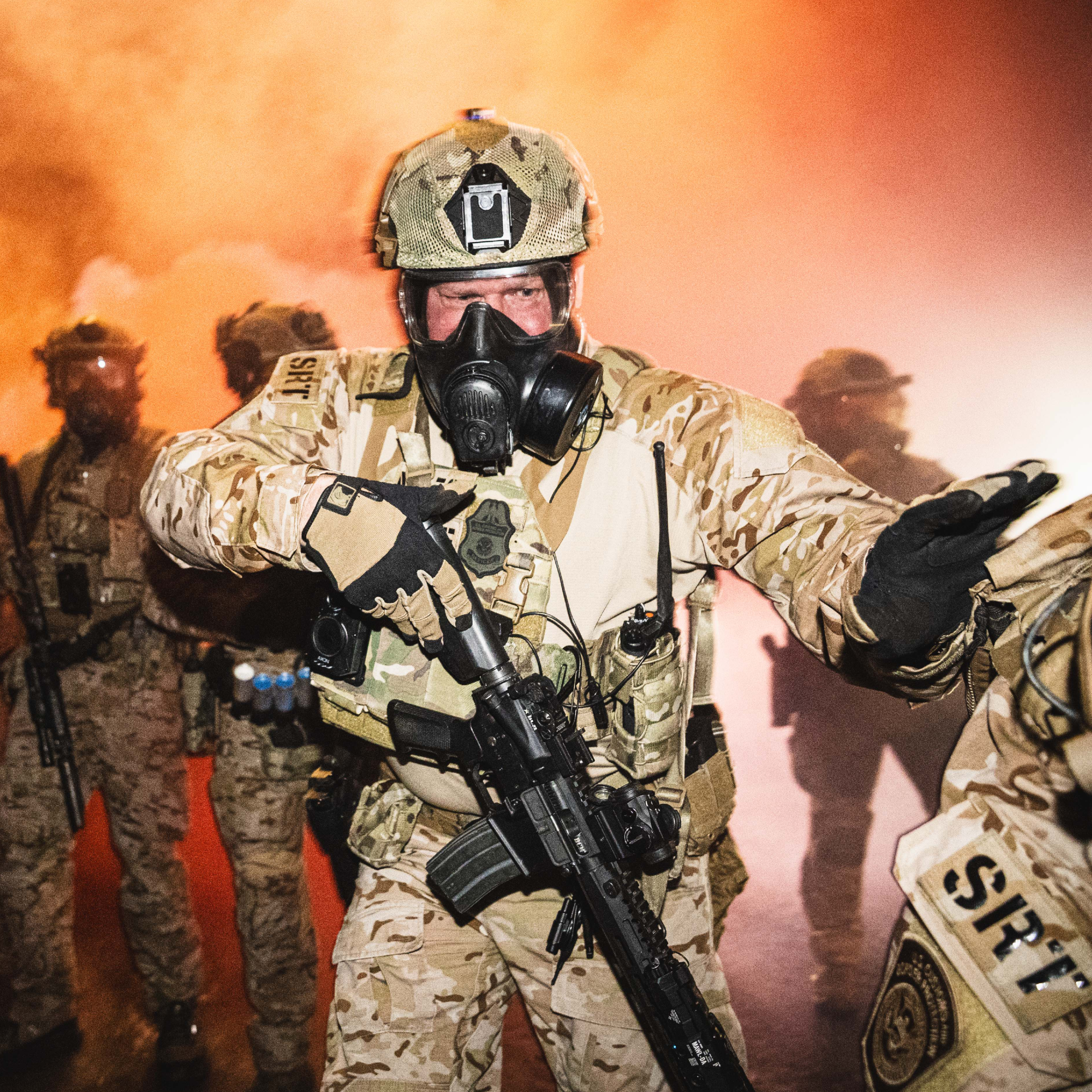
Yeah, it feels a little like a fever dream. One of my worst fever dreams. I was in Washington, D.C. when Trump first deployed the National Guard. I was there for a conference and a lot of people asked me, how does it feel to be right about all of this? In all humility, I don't think I was right about it. I think it's quite a bit worse than I ever imagined. Over the years when I've written about police militarization, when this has been, when I've debated this with other people, people from law enforcement in particular, there's always been kind of the shared understanding that law enforcement does still exist to protect the public, to promote public safety. Now, we could have sharp disagreements about the best way to do that and what sort of trade offs are necessary to do that. But what we're seeing now, I don't think that shared understanding is there anymore. First of all, previously the debate over police militarization was whether domestic police had become too militarized. There was always a shared understanding on both sides that we would never deploy the military for sort of routine domestic policing, that that's just not something that we do in this country. It's a principle that goes back to the founding. That's out the window, right? I mean, Trump wants to deploy active duty troops from the National Guard to Marines, which he did in Los Angeles, for everyday policing, for immigration enforcement and crime control. And that is never something where there's been unanimity on or even a consensus on. And then you look at what's happening now with ice, and Trump is sending these federal forces, hyper militarized, hyper aggressive, to cities with the pretty explicit instruction of punishing people that he disagrees with, punishing entire cities he disagrees with. He is using these forces as basically the way an authoritarian uses a paramilitary force, right, to kind of carry out his own personal grudges, to inflict pain and violence and discomfort on people that he sees as his political enemies. And there's a reason why groups like the International association of Chiefs of Police, the Minneapolis Police chief, law enforcement leaders around the country, are horrified by what they're seeing. And because nobody, even the people who I've had the most kind of virulent disagreements with over the years on some of these issues, nobody thinks that how Trump is using law enforcement right now is appropriate or consistent with the principles of a free society.
- [07:20]
Interviewer (possibly Al Letson or another host)
You described ICE as a paramilitary force that answers only to Trump and using weapons of war against its own citizens. And in the past, when you've been reporting on these issues, did you ever think that ICE would be the organization that becomes this? I mean, I've been reporting on the border for years, and I can remember being in the Sonoran Desert when Barack Obama was the president and they were calling him the deporter in chief and so forth and so on, and basically the way immigration and Border Patrol behaved, I mean, they were absolutely deporting a lot of people, but they didn't act like this. And now we have ICE, who clearly wants to put on a show, and it seems like they are only loyal to President Trump. And as you've said, they're using weapons of war against its own citizens, against the citizens of the United States. So I'm curious, in the long view of how you've been looking at these issues over the years, did you ever think that ICE would be the organization that did what it's doing right now?
- [08:30]
Radley Balko
So, you know, I think that we use ICE kind of as shorthand for these heavily armed kind of paramilitary forces that are wreaking havoc on these cities. It's actually, you know, it's ice, it's Border Patrol, it's hsi, it's even, you know, the FBI and various atf, dea, and I think it was about a month, maybe two months ago, there was a decision by the Trump administration that was fairly well reported at the time, but then it just kind of faded away. But that they were basically putting all immigration enforcement under Border Patrol instead of ice. And I think that was significant because Border Patrol has always been known as the kind of more aggressive of these agencies, the less disciplined. Their BORTAC units, which is kind of their equivalent of a SWAT team, are sort of notoriously aggressive. And there's also a long history of misconduct and abuse in Border Patrol and an unwillingness to hold those officers accountable. After the killing of Renee Good, a lot of people had pointed to some old coverage of Border Patrol agents who were putting themselves in front of cars, of people trying to get away, and then using that as an excuse to open fire on the driver of the car. And that was, I don't know if you could say it was a common policy, but it was certainly more frequent than it should have been, and there was not enough discipline when it did happen. I'm not surprised that this has all come under the guise of immigration. This has always been Trump's. I mean, from the time he stepped off the escalator and called Mexican immigrants rapists, this has always been the issue that he was going to use as a wedge. And eventually I think he saw it as a way to consolidate his power as executive. During the 2024 election, they were flat out promising to deport millions of people. And I wrote a piece back then that looked at what it would take to deport that many people. And it was clear that they were going have to assemble a deportation force that would be bigger than most countries, you know, entire military, and actually bigger than at least a couple of branches of our own military. It was clear that this was going to have to be a kind of society wide effort that they were going to have to, you know, warehouse people, they were going to have to commandeer transport to move people around. They were going to have to set up camps at the border for people awaiting deportation. I mean, this is going to be a probably one of the biggest people moving forced migration operations in world history if they do what they claim they want to do.
- [11:07]
Interviewer (possibly Al Letson or another host)
So what are the rules on use of force that ICE and Border Patrol operate under?
- [11:14]
Radley Balko
That's a good question. I don't think anybody knows the answer to it right now. They have rules of when they can use force, when they can use deadly force. After Renee Goode was killed, I tried to look up the DOJ and DHS policies on firing into moving vehicles. And it's pretty vague. There is a prohibition on firing into a moving vehicle for the purpose of disabling the vehicle. But it also explicitly says that the purpose of firing is to incapacitate the driver to wound or kill the driver. That then the policy kind of reverts to what the Supreme Court has said about the use of deadly force. That's different than a lot of domestic police agencies, particularly in larger cities, which explicitly bar officers from shooting into moving vehicles. Mostly because even if the driver is determined to kill you and is driving straight at you, killing the driver doesn't stop the vehicle. There's nothing about killing somebody that makes them push the brake. Right? I mean, the car's still going to be coming, going whatever direction it's going. And if you've made a mistake and the person isn't coming at you, one, you've just killed an innocent person. Two, you've just unleashed a vehicle going 40 or 50 miles per hour on the surrounding community without anyone at the wheel. So there are reasons why these kinds of prohibitions are in place. But, you know, most police departments also forbid officers from standing in front of a vehicle because one, it's dangerous for the officer, but two, it's illegal to flee police when they've pulled you over for a minor offense. But it's also not a capital crime. So if somebody wants to leave, you can apprehend them later. But it's not the sort of transgression that's worth putting an officer's life in danger and putting the person behind the wheel's life in danger. There's a case where ICE shot a woman in Chicago and falsely claimed that she had put pointed a gun at them. The officer that shot her later boasted in a text to his colleagues that I think what he said or what he wrote was five shots, seven holes.
- [13:05]
Interviewer (possibly Al Letson or another host)
So I did some reporting in Chicago when ICE was pushing into Chicago, and the one thing that I felt when I left, I was there for about a week, was a, that ICE and Border Patrol were being specifically brutal and they were doing it to put on a show, both I think, for President Trump and also to get any migrants that wanted to self deport to make them say, I don't want anything to do with this and go home. So, twofold reason. But I also think that that show ultimately is going to end in violence. That is violence from people watching this, watching their community be terrorized, and they get to the point where they can't Take it anymore and somebody strikes. That hasn't really happened yet, but I feel like it is in our future if we keep seeing these violent episodes by ICE and border patrolling communities. And then, B, I knew that something like Renee Goode would happen, because how could it not?
- [14:11]
Radley Balko
I mean, I think you're absolutely right on both counts. I think it was inevitable that when you have police officers who are creating confrontation and violence unnecessarily, when you are literally describing people who are following officers around, recording them on their cell phones, trying to hold them accountable as domestic terrorists, as this administration has done, when you are dehumanizing immigrants that these forces are seeking out and apprehending and detaining, it isn't the least bit surprising that at some point these officers are going to treat people like an enemy military, as something less than human that they can, whose lives don't carry the same value as other human beings. And I'm even more worried, I think, about your second point, which is the potential for a violent backlash. And while I think it's. I hope it's not inevitable, I do think it's understandable. I think it's hard to watch your community be torn apart like this. And they think you're right. I think we are going to see violence and confrontation. And the thing I find most scary, terrifying, horrifying about that is that I think that's exactly what this administration wants. I think they want violence because Trump has made it clear that he wants to invoke the Insurrection act and he wants to send in the military when a city like Minneapolis defies him, he wants to crack the whip. He wants to put his boot down on them. And the best way to do that and to get the courts to go along with that is to be able to cite actual incidents of violence that you need to now send in the military to suppress.
- [15:48]
Interviewer (possibly Al Letson or another host)
Yeah. And you can see the game plan unfolding with how they talked about Renee Goode. I mean, it felt like the speed at which they responded to Renee Goode and how they responded to Renee Goode was somewhat of a coordinated effort, but also very clearly. I mean, you can look at what they're doing with January 6th and see how they're rewriting facts and rewriting what we are actually seeing with our ey and telling people that what you're seeing is not actually true and that this is the narrative, that at least it is trying to make a justification for a bigger action from the administration.
- [16:28]
Radley Balko
So the day before Renee Goode was killed was the anniversary of January 6th. And that was the day that on the White House website, the Trump administration posted a just astonishing alternate history of what happened that day. And I think that was a glimpse into what was going to happen after Renee Goode was killed, which is that, I mean, the administration just came out from the very first statement that DHS put out after her death to ongoing comments from administration officials. Even as we're talking now, the lies are just brazen. They're easily disprovable. They are just almost comically exaggerated. And I think that that in itself is pretty scary because you don't lie like that because you're trying to cover something up. You don't lie like that to try to get away with something. You lie like that to make it clear that you can get away with anything, that you can do whatever you want. That's when you tell those kinds of lies you are telling the public. We can lie so egregiously and so brazenly that we know, you know, we're lying and we don't care. And that's really a new threshold. I mean, we've seen police agencies in the past after an officer kill someone. We've seen them give a, you know, really biased version of events. We've seen them go after the victim. We've never seen a police agency show the sort of glee and enjoyment and celebration of killing someone that we've seen from this administration. That also is a new frontier.
- [18:13]
Al Letson
When we come back, Radley talks about the surprising on the ground pushback he's seeing against immigration agents around the country.
- [18:22]
Radley Balko
The people, you know, the individual people who had the least amount of power are the ones that are doing the most right now.
- [18:29]
Al Letson
But before we come back, investigative journalism, like the work we produce, has never mattered more or been more at risk. But let me tell you one way that you can help make a donation.
- [18:39]
Interviewer (possibly Al Letson or another host)
It's easy.
- [18:40]
Al Letson
Just visit revealnews.org give or text the word give to 88857 reveal. That's 888-577-3832. Your contribution helps us bring you the kind of stories and conversations you rely on here at Reveal. Thank you.
- [18:59]
Interviewer (possibly Al Letson or another host)
Alright, back in a minute with more.
- [19:01]
Al Letson
From investigative journalist Radley Balco. This is more to the story. I'm Al Letson and I'm back with investigative journalist Radley Balco.
- [19:19]
Interviewer (possibly Al Letson or another host)
So state and city officials from Illinois and Minnesota are now suing the administration over the presence of immigration agents there, claiming that ICE's presence is unconstitutional and infringing on states rights. Do you think they have A case I do.
- [19:33]
Radley Balko
I think when you look at particularly what's been happening in Minneapolis over the last several days, the response after good. You have ICE agents openly referencing her death and threatening people who are engaging in activity that's clearly protected by the First Amendment. Again, the executive branch has ample authority when it comes to immigration enforcement, but it's not unlimited authority. We still have constitutional rights. And what they're doing in Minneapolis, and I think what they did in Chicago and Los Angeles as well, in targeting people specifically who are trying to hold them accountable is clearly unconstitutional. Now, whether the current US Supreme Court, if it makes it that far, is willing to enforce that, I think is a big question.
- [20:17]
Interviewer (possibly Al Letson or another host)
Has there been any kind of. I mean, have we heard anything from the Supreme Court with everything that's going on? Because basically, the ruling that came down from the Supreme Court allowed racial profiling to happen, which has been giving an energy boost to all the action that we're seeing right now. Has there been any indication from the Supreme Court that they might pull back a little bit?
- [20:44]
Radley Balko
That ruling about racial profiling was on the shadow docket. So it was a ruling on a temporary restraint on their ability to use those kinds of tactics to profile based on race, you know, accent and, you know, where the person was geographically. So we didn't really get a majority opinion on that. We did get a concurring opinion from Brett Kavanaugh that, you know, I found personally found bewildering, given how these things actually happen on the ground. But Kavanaugh basically said, you know, that it. It makes sense to allow this kind of profiling for immigration enforcement because, you know, that's. That's who and where the. The undocumented immigrants are. He also argued that using these kinds of tactics against American citizens and legal residents is just a minor inconvenience. And that led to a lot of mockery of what came to be known as Kavanaugh stops when ICE agents start detaining American citizens and legal residents, sometimes for days, sometimes for months. There was one case of a woman in Maryland who was just released because they didn't believe her birth certificate was real. Kavanaugh then, in a subsequent decision a couple weeks ago, added a footnote where he said that racially profiling and immigration enforcement is clearly illegal. So I think maybe the Kavanaugh stop thing maybe broke through a little bit, and he didn't like how it was being used. Here's the problem, though. How do you enforce any of this? Even if the federal courts say what ICE is doing is clearly illegal. There has to be a remedy. There has to be a way to enforce that. And right now, I'm not sure there is one. To enforce it criminally would require Trump's Justice Department to bring federal charges against these officers, which is never going to happen. To enforce it civilly would require you to be able to bring a lawsuit against federal law enforcement officers, and the Supreme Court has basically made that impossible. There was a decision in 2022 that sort of closed the door on the ability to sue federal officers for violations of the Constitution. You can sue state and local police under the Ku Klux Klan Act. They're protected by something called qualified immunity is often debated, but federal officers have basically absolute immunity. It is almost impossible to sue them for constitutional violations. The final way to maybe hold them accountable, or legally at least, would be for state and local prosecutors to bring criminal charges against them in state court, which would. Those cases would probably then get removed to federal court. That is still an option, I think, but it's extremely difficult. We're seeing this play out after the Renee Goud killing. It's still not clear exactly what's going to happen. It has happened before, but the. The federal government tends to fight it, and this administration, I think, will fight it especially hard. I guess just the last thing I want to say is there is one other way to hold these officers accountable, and that's through social stigma, shaming, public pressure. And this is, I think, the primary reason why we see the masks. That is kind of the last remaining way to hold these officers accountable for what they're doing. You see an ICE officer in one of these videos beating someone who you go to church with or who is your neighbor or, you know, you see at the coffee shop, and, you know, and social pressure, I think, can work, but by wearing the masks and by, you know, the administration refusing to make them take off the masks, they escape that last kind of remaining form of accountability. Now, they claim it's about safety, but, you know, police officers have gone without masks for basically the rest of our country's history.
- [24:22]
Al Letson
Right.
- [24:22]
Radley Balko
And that is. That's never been an excuse in the past.
- [24:25]
Interviewer (possibly Al Letson or another host)
What about the public, according to a lot of Gallup polls and opinion polls and so forth, that the administration is losing on this issue, that people do not like seeing what they're seeing across the country. Does that factor in with how this is working? Or does the administration. Are they at the point where they just don't care, like they have all the power? The fact that not only do they have the executive Branch, but basically he controls the Justice Department. And the Justice Department, unlike in previous administrations, where the Justice Department at least acted like it was separate from the executive branch, this Justice Department is in lockstep. They are Trump's Justice Department.
- [25:12]
Radley Balko
Yeah. So I think both things are true. I think that they don't care. And I think that as Trump continues to sink in the polls and realizes that, you know, he doesn't have to run for re election, I worry about how bad things are actually going to get. But I also think it's important that the public is turning against what we're seeing in these videos, and I think it's important that these communities are fighting back. I mean, I've been covering and writing about this basically since Trump was inaugurated the second time. And I've had to sit through a lot of really disturbing videos and done a lot of interviews with people who've been harmed and injured and people who've seen their communities ripped apart. And it's. It's difficult, but I think the. And it's not nearly as difficult for me as for the people actually experiencing it. But the part where I get invigorated and I get hopeful is watching the way that these communities are fighting back and the way that they're standing up for one another and the way people are sticking up for their neighbors, people who they may not need to stick up for just in terms of it doesn't affect them personally, but they see an assault on their neighborhood is assault on them. They see assault on the people that. That they might not share a background with, but do share a community with as an assault on them personally. And I think that the way that people, individuals, neighborhoods, have rallied, have organized, and have fought back is really inspiring. And it's an anecdote to the way that I think institutions, the media, universities, law firms have caved this administration. I think it's inspiring that. That the people, the individual people who had the least amount of power are the ones that are doing the most right now.
- [26:51]
Interviewer (possibly Al Letson or another host)
I want to roll back just a little bit and talk about a little bit about how we got here. The militarization of the police is connected to the drug war. And your podcast Collateral Damage is all about the war on drugs in America and the innocent people who've gotten caught up in it and sometimes killed. Can you take me back to the beginning of the war on drugs? Like, when did that start?
- [27:16]
Al Letson
And when do we start seeing the.
- [27:18]
Interviewer (possibly Al Letson or another host)
Militarization happen around that?
- [27:20]
Radley Balko
So the modern war on drugs, I mean, you could trace it back more than a century to the Harrison Narcotics act in early 1900s. But I think the modern war on drugs goes back to the Nixon administration or the modern incarnation of it. And Nixon, when he ran for president in 1968, ran on this, this really sort of explicitly racist platform of appealing to white suburban voters who didn't like hippies, didn't like the civil rights movement, didn't like the riots that they were seeing in the cities. And so there was this very sort of explicit appeal to people who were sick of all of those groups. And the way they did that was by going after illicit drugs. And the thinking was you can kind of lump all of these groups together by, you know, going after, you know, marijuana and LSD and cocaine and heroin. Nixon really, you know, he declared an all out war on drugs. He introduced the no knock raid sort of becomes popularized in this campaign. For my book, Rise the Warrior Cop, I actually interviewed the campaign staffer who introduced that idea to the campaign. So, you know, Nixon gets elected, we get no knock raid bill for federal officers. They start kicking down doors all over the country. They start getting the wrong house, People get injured, people get killed. A really interesting thing that happens. Congress actually repeals the no knock rate at the federal level. There are hearings and there's a little bit of sort of shame and regret for how far they had gone and maybe they had gone too far. That was kind of the last time we would see that sort of shame.
- [28:52]
Interviewer (possibly Al Letson or another host)
What a time.
- [28:53]
Radley Balko
Right? So the no knock raid comes back in the 80s and has kind of been with us ever since. We saw some pushback after George Floyd and the death of Breonna Taylor, but for the most part, it's not been a policy that's ever been in real jeopardy ever since. I'm going to fast forward a lot now up to the Trump administration. And one thing that they've done and that they learned from the first time around is to get rid of the people that have that kind of sort of allegiance to basic democratic principles. I think what's happened in the Trump administration is that immigration has basically replaced the drug war as the existential threat that we need to, to be willing to suspend basic civil liberties to defend against. And drugs really were a problem in the 80s and 90s. Right. Crack really did kill a lot of people. I don't think the trade offs were worth it. And I think that the government went way too far.
- [29:44]
Al Letson
Yeah.
- [29:44]
Interviewer (possibly Al Letson or another host)
There's also an argument to be made that the government was also responsible for drugs being that bad in the 80s. That it wasn't just that drugs suddenly got bad. It was like, you know, when you're playing both sides of tends to get messy quick.
- [30:01]
Radley Balko
Absolutely. But, you know, again, you know, crack did kill a lot of people. There was a massive spike in violent crime that was fueled by, you know, turf wars as crack became a more popular drug. And again, I think the government contributed to a lot of those problems. But you can't even say that about immigration, right? I mean, immigrants are less likely to commit crimes, and particularly violent crimes than native born people. There was a surge in migrants during the Biden administration. There was not a sur. Surge in crime. In fact, there was a surge during the pandemic, but it started coming down in 2023, dropped dramatically in 2024. There was no evidence that cities that took in more migrants had more violent crime or even property crime than cities that didn't. There's no evidence that sanctuary cities have more crime than cities that cooperate with immigration. This was all a fantasy. This is all a false narrative that Trump and his supporters created specifically for the purpose of fear mongering to get him elected, but then now also to enable him to consolidate power and to kind of enforce his will and his agenda and basically smite his enemies. There is no crisis this time. It is all made up.
- [31:09]
Interviewer (possibly Al Letson or another host)
I'm curious, when it comes to the war on drugs and Venezuela, was there a credible drug threat from Venezuela to the United States?
- [31:21]
Radley Balko
Not really. I mean, they initially tried to claim that they were bombing these boats because of fentany, the number of overdoses from fentanyl. They had to correct that when people showed that no fentanyl comes from, not only is it not produced in Venezuela, it doesn't even pass through Venezuela. So then they switched to cocaine and claimed that this was to stop cocaine. Well, cocaine's been around forever. The idea that all of a sudden there's an emergency when it comes to cocaine overdoses was always ridiculous. Some cocaine is trafficked through Venezuela, but even most of that goes to Europe. It doesn't come to the United States. A good percentage of the boats they bombed, including the boats they bombed early, were in the Atlantic, not the Pacific, which means they weren't actually headed to the US Mainland. I think most of them were. The first couple at least, were headed to Trinidad. I mean, none of the justifications for this ever made much sense. They also, I mean, you could just go through point by point by point, all the ways in which this was just, just blatantly illegal, both domestically, internationally. But not to put too fine A point on it, but there's no execution, there's no death penalty for drug smuggling. Right. We don't do that to people we capture in the US who are smuggling huge amounts of drugs. These people, the people that they bombed in these boats, we know from reporting that's been done since, tended to be fishermen, laborers. People who did this for a few hundred bucks on the side. Not only were their lives valueless to the Trump administration, they were also valueless to the cartels. I mean, bombing these boats didn't do a damn thing to the cartels. They'll replace those people as quickly as they hired them. And the amount of drugs that they destroyed also is a rounding error for any major cartel. I don't know why they did it. Maybe it was sort of a prelude to Trump's removal of Maduro and attempt to take over the oil fields of Venezuela. I don't know why they did it, but it was lawless, it was illegal under both domestic and international law. It was almost certainly a war crime. Well, it wasn't a war crime only because we aren't actually at war with Venezuela, but they insist we are. So if we are, then it was a war crime.
- [33:30]
Al Letson
Right.
- [33:32]
Interviewer (possibly Al Letson or another host)
I'm thinking a lot about America's history in Central and South America and how the United States government played a part in all the migration that we have seen from these areas. So, like, when we have a lot of migrants showing up on the border or sneaking across the border, a lot of that is on American intervention, like the things that we have done in the past. And I'm just curious if you think that, like, what's happening in Venezuela right now will ultimately, down the road, five, ten years from now, turn into us seeing more migrants on the border because of what we've done.
- [34:15]
Radley Balko
I think it's inevitable. I mean, I think Reveal Itself has had two or three really good episodes about that history, about how US Foreign policy in Central America has created the migrant crises that we've seen over the last ten years or so. Maduro was a dictator. He should not have been in office. He clearly lost the last election. He was brutal. He cracked down on his opponents, suppressed dissent. But. But you can't decapitate the leadership of a country without consequences. And Trump insists that we're going to be running Venezuela for years to come. We can't do that. We tried to do that with other countries, and it's been disastrous.
- [34:53]
Interviewer (possibly Al Letson or another host)
As we're talking about all of this, I think that there are a lot of people whose point of view or whose hope is that President Trump leaves office and we get a Democrat in office and things begin to change. But it seems to me that there's just so much that has been done that I don't know how a Democratic or even a non maga Republican candidate would come in and untangle all of these. Cuz you've got the issue of the executive overreach, you've got a mess over here with immigration where they've let go of all of these judges. You have to rebuild that infrastructure. Got what Musk did with Doge and you've got to rebuild that infrastructure. It's just a big mess. And I'm just curious, do you have hope that we can untangle and pull some of this back? As somebody who's been reporting on these issues for a long time, I don't.
- [35:56]
Radley Balko
Think we have any other choice. I mean, I think we have to do what we can. There's that anecdote after the Constitutional Convention that you hear over and over again where Benjamin Franklin is leaving and woman comes up to him after the convention and says, do we have a monarchy or a republic? And Franklin famously says, a republic if you can keep it. And I've always wondered if Franklin could see what was going on right now, if he would sort of be like this guy, really. We knew that it would be difficult to keep it, but you're going to give it up for this guy. But I think we have to. It is not going to be easy. But what we need is we need people who are as devoted to democratic ideals, the cause of the Constitution and constitutional protections, and the kind of basic principles that make this country the good that it is. We need people as dedicated to all of that as the Project 2025 people were to destroying all of that. We need people who can think creatively. We need people who have studied how power works and how you can put limits on it. It's daunting. One of the questions I keep asking myself is if we get a Democratic president or a reasonable Republican president, should they use the very abuses of power that Trump has been utilizing and that the courts have largely sort of looked the other way on to undo the damage before they impose those limitations? Right. I mean, we're going to have to purge the federal government of all these people that Trump has put in there with the explicit purpose of corruption, enforcing his will, tearing down basic protections and institutions. Those people are gonna have to be removed. And if you follow kind of the traditional norms of civil service protections, it would be hard to get rid of those people.
- [37:51]
Al Letson
Yeah.
- [37:52]
Interviewer (possibly Al Letson or another host)
Radley Balco is the host of the podcast Collateral Damage at the Intercept and former Washington Post opinion writer. Radley, thank you so much for talking to me about all of this. It's really interesting.
- [38:03]
Radley Balko
My pleasure. Thanks.
- [38:08]
Al Letson
That was investigative journalist Radley Balco. You can read his excellent reporting on his substack, it's called the Watch.
- [38:15]
Interviewer (possibly Al Letson or another host)
And don't forget to check out his.
- [38:16]
Al Letson
Podcast Collateral Damage from the Intercept. It's all about the decades long drug war in America and the innocent people who've lost their lives because of it. You can find it on your favorite podcast app. You should also check out our recent Reveal episode, Lessons from Trump's War on Chicago. I recently traveled to the Windy City alongside producer Ashley Kleek to get a firsthand account of how ICE terrorized the city's neighborhoods and how its residents fought back. Lastly, a reminder. We are listener supported. That means listeners like you, you can help us thrive by making a gift today. Just go to revealnews.org gift again, that's revealnews.org gift and thank you. This episode was produced by members of the Justice League Society, Josh, Sam burn and Carl McGurk. Allison James west edited the show, theme music and engineering, helped by Fernando my man, Yo Aruda and Jay Breezy. Mr. Jim Briggs, I'm Al Letson and.
- [39:09]
Interviewer (possibly Al Letson or another host)
You know, let's do this again next week.
- [39:11]
Al Letson
This is more to the story.
- [39:34]
Interviewer (possibly Al Letson or another host)
From prx.