Loading summary
Transcript48 lines
- [00:02]
Tim Murphy
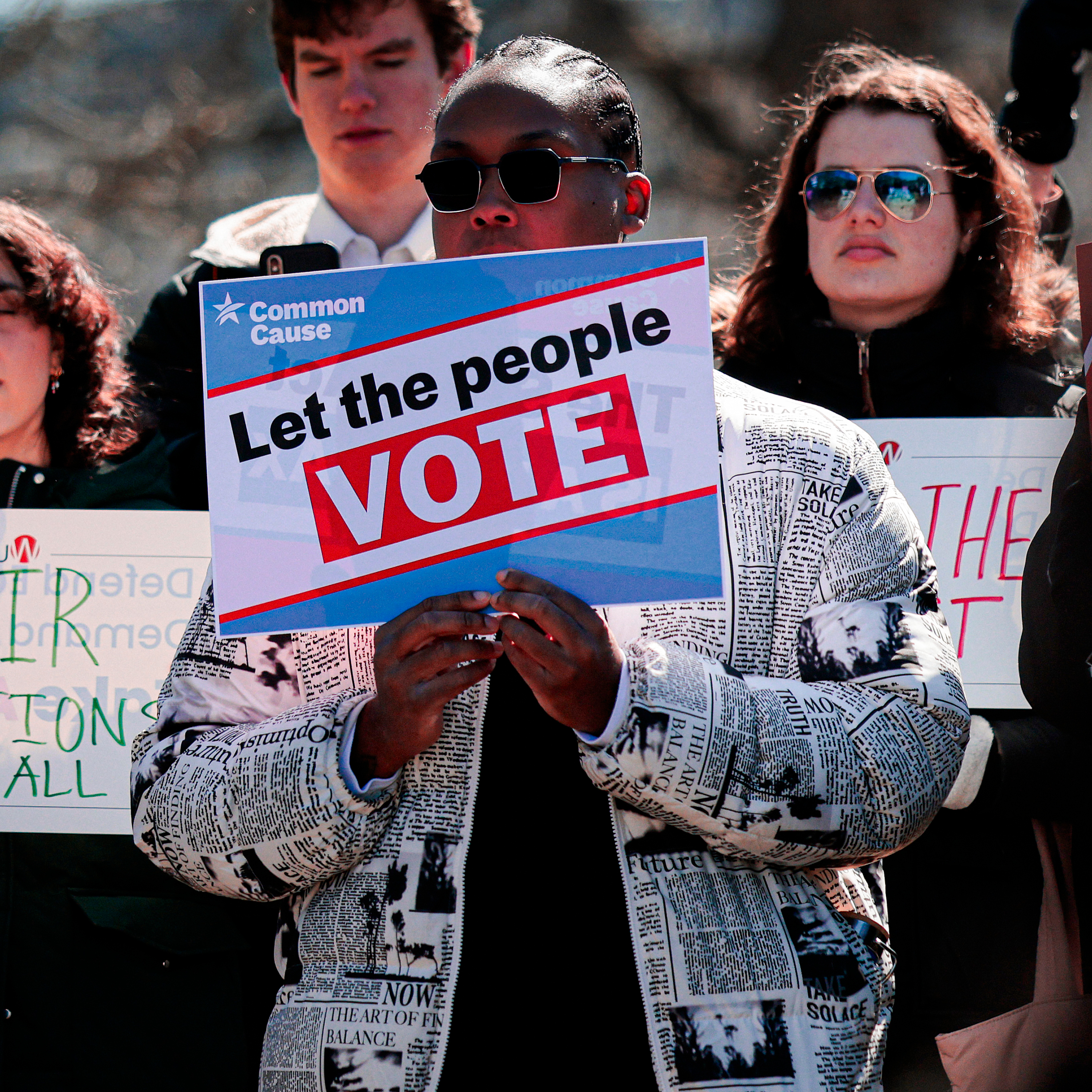
What the Supreme Court did in its decision on the Louisiana maps, where it effectively gutted the Voting Rights act, is that it invited Southern states to go back to the drawing board en masse, redraw their maps specifically with an eye toward eliminating black opportunity districts that were a part of the Voting Rights Act.
- [00:26]
Al Letson
Midterm primary elections are happening all across the country and this election cycle is both momentous and uncertain. Coming up on More to the story Mother Jones reporter Tim Murphy on the races to watch and how the crippled Voting Rights act is reshuffling the electoral map. Stay with us.
- [00:48]
Sponsor/Advertisement Voice
This episode is brought to you by Progressive Insurance. You chose to hit play on this podcast today. Smart Choice make another smart choice with Autoquote Explorer to compare rates from multiple car insurance companies all at once. Try it@progressive.com, progressive Casualty Insurance Company and affiliates. Not available in all states or situations. Prices vary based on how you buy.
- [01:10]
Tim Murphy
Scores of black veterans aren't getting the medical treatment or compensation they need, all because of their race. We're doing this lung testing like this and it's not scientific and it's hurting patients.
- [01:23]
Al Letson
I have seen white veterans get more benefits of and if they basing it upon color of her skin, that's not right because we are all veterans.
- [01:32]
Tim Murphy
We are banned from talking about anything that has race in it. To hear all episodes of the race equation from the New England Journal of Medicine subscribe to Intention to Treat Want
- [01:45]
Jane Butcher
to make a lasting difference to Reveal and protect independent journalism? Right now, it won't cost you a thing. Hi, it's Jane Butcher from Boulder, Colorado. I've spent my life fighting for justice, which is why I'm a longtime supporter of Reveal and the center for Investigative Reporting. I'm stepping up to protect the future of fearless independent journalism and you can too, by joining CIR's Legacy Challenge. Just let Reveal know you're going to include them in your legacy plans. Provide some basic information, and here's the really exciting part. A generous donor will contribute up to $10,000 now to fund Reveals Essential Reporting in honor of your gift. Your legacy gift of any size makes an impact not just in the future, but right now. If you'd like to join me or want to learn more, please reach out to giftsevielnews.org again, that's gifts@revealnews.org the Legacy Challenge is only available for a limited time. Stand up for the truth today.
- [03:04]
Al Letson
This is more to the story. I'm Al Letson. Primaries are underway, but even as voters are going to the polls the electoral map is shifting under their feet. Last month, the Supreme Court narrowed a key provision in the Voting Rights act that for decades had allowed states to take race into account when drawing up electoral maps. That decision set off a mad scramble by GOP state legislatures to alter their maps ahead of November's midterm elections to gain an electoral advantage that could disenfranchise black voters. It's also supercharged a redistricting fight that began when President Trump urged states to change their maps to mitigate possible losses in Congress. Add to this rising gas prices, an ongoing war, stark divisions within both political parties, and the President's bluster that Republicans should, quote, nationalize the midterms. It's all a bit head spinning, which is why I invited Tim Murphy onto the show. Tim is a correspondent for Mother Jones, who, among other things, reports on national politics. Tim, how you doing this morning?
- [04:14]
Tim Murphy
Hey, thanks for having me. Doing great.
- [04:15]
Al Letson
Okay, so let's talk about one of the biggest stories when it comes to congressional races, and that's redistricting. Some states have been drawing new voting lines, doing gerrymandering. I mean, all of this got started, gerrymandering has been going on for, you know, a very long time. But this, this new wave that, that has taken over the country got started when President Trump asked Texas to redraw their maps in an effort to save the midterm elections. And it has rippled throughout the whole country. Blue states are redistricting now, and it's just like an all out war, basically. So can we talk a little bit about that? How's that all playing out? And what's going to be the net benefit for the Republican or the Democratic Party?
- [05:07]
Tim Murphy
Yeah, it's a race to the bottom, but it's not a very even race. So typically, maps are redrawn by state legislatures after the census. Sometimes they're redrawn several times as a result of court challenges. But as you mentioned, what happened last year was something that I have not seen before, which was Donald Trump just telling Texas, give me five seats. And Texas coming up with a kind of a fake, you know, legalistic argument for why they needed to, you know, that got the ball rolling. California responded with its own maps. Now, one of the interesting distinctions here is that Republican legislatures are just doing this. They're just taking maps that in the case of Texas and others they themselves had drawn, saying, actually, we can't have these maps coming up with maps that, you know, eliminate many more Democrats. And moving on with that. Just kind of by fiat, Democrats have done this in California and in Virginia. But in order to do them, they've taken it to the voters. Right. So they've had a referenda in California and in Virginia to say, like, actually we can do this. So there's a bit more popular buy in in that process. Even if that ultimately wasn't enough. In Virginia, the Supreme Court struck down the Democratic maps after the electorate voted on them. It's a blow to the party's chances this fall. It makes the margin for error just a little bit smaller. But how serious of a blow it is will depend on how much they're able to expand this map nationally. But what the Supreme Court did in its decision on the Louisiana maps, where it effectively gutted the Voting Rights act, is that it invited Southern states whose maps had been sort of curtailed or restrained by the provisions of the Voting Rights act, to go back to the drawing board kind of en masse and redraw their maps, specifically with an eye toward eliminating black opportunity districts that were, as a part of the Voting Rights act, supposed to kind of guarantee that black communities would have a say in who the representatives were.
- [07:17]
Al Letson
It feels like this was always the plan, though. I mean, John Roberts has been trying to get rid of the Voting Rights act since before he was a part of the Supreme Court. And then he gets into the Supreme Court, becomes the chief justice, and then Trump appoints several Supreme Court justices who are basically going to hand down this type of sentence, especially under the leadership of John Roberts. So this is something that we could, I mean, people did predict 10 years ago, and now here we are.
- [07:49]
Tim Murphy
Yeah, I mean, this is a half a century long political project. You could see this coming down the pike. You could see this in John Roberts earlier career. And this is something that Southern states in particular have been cognizant of when they draw their maps. Alabama only added its second Democratic seat very recently in response to a court challenge. Louisiana's map, the one that was just stricken down as unconstitutional and is now back hastily to the drawing board, was kind of overdrawn in a way so as to make it more susceptible to a court challenge. So this is not something that came out of left field. It's striking the timing of it. The Supreme Court previously said it was actually too late to intervene on Texas's gerrymander. And then with a much shorter timeline where the Louisiana primary was already underway, they said, hold up, wait, let's go back. These maps don't work. You can start over.
- [08:49]
Al Letson
Right. And so with the Supreme Court doing that, it caused the Governor to delay some primary elections. It sounds like a real mess. Can you kind of walk me through that?
- [08:59]
Tim Murphy
Yeah. You know, currently there are two Democratic leaning House seats in Louisiana's congressional delegation as a result of this court ruling. Governor Jeff Landry has canceled the primary that was about to happen and sent the Louisiana legislature to draw up new maps reportedly so that they could comply with this ruling. Now it's worth noting that states use unconstitutional maps all the time. It's sort of the nature of redistricting and courts that these cases can take years and years and multiple election cycles to play out. And in that period, you're just kind of using a map that doesn't truly pass muster. So there's not actually anything really unprecedented about Louisiana's maps not fully complying with the Constitution. What's kind of unprecedented is how quickly they just immediately went back to redo things. And it's not just Louisiana now, it's Alabama is looking to get rid of two Democratic districts of the two Democratic districts. And Tennessee is proudly planning to go nine nothing Republican by getting rid of the historically Democratic district based in Memphis.
- [10:20]
Al Letson
So it's an all out assault on black voters being able to have representation that looks like them.
- [10:28]
Tim Murphy
Yeah, I mean, that right there, that's four largely black districts with three black Democratic members of Congress. And then in Memphis, there's a white Democrat, Steve Cohen, facing a primary challenge from State Representative Justin Pierson in a race that's now kind of on ice. And other Southern states are considering kind of going. Georgia Governor Brian Kemp has said they gotta do this before 2028, but they're not gonna do it this year. I mean, it's a historic reversal of what the Voting Rights act brought and kind of a, kind of a proto redemption in terms of restoring like homogenous white delegations to the South.
- [11:10]
Al Letson
Up until last week, it, it seemed as though the Democrats had a really good shot of taking back the House, but possibly even taking back the Senate. Now a lot of that hinged on redistricting in Virginia. Can you tell me why? The recent Virginia Supreme Court ruling has sent Democrats spiraling.
- [11:30]
Tim Murphy
So the Virginia ruling is a big deal. It throws out a map that Democrats passed and then voters approved that would put the party on track to pick up 10 out of 11 seats. The rejection hinges on a technicality about whether enough time has elapsed since the legislature first approved them. But to understand the fallout here, I think you have to talk about what else was happening last week. The Supreme Court's gutting of the voting Rights act has triggered a chain reaction in Southern legislatures. They've been moving to rapidly eliminate majority black districts that have been previously electing Democrats. I wouldn't say this puts the House out of reach by any stretch. In a big year, Democrats will still flip the chamber and they should still pick up seats in Virginia. But this has narrowed the margin for error and also underscored, I think, the significance of this election. That all of this is happening when basic questions of pluralism and multiracial democracy are kind of on the table. It's literally shaping how this election is playing out.
- [12:35]
Al Letson
Yeah, I want to drill down a little bit and talk about Maine. What's going on with Maine and Graham Platner and Susan Collins.
- [12:45]
Tim Murphy
Susan Collins has sort of successfully coasted on a reputation as kind of an old school New England moderate Republican, which allowed her to hold on reasonably comfortably even in a wave year against a very well funded Democrat. This time around, Democrats had kind of two diverging tracks on how they wanted to take her down. Chuck Schumer, the Senate Minority Leader, the dscc, the Senate Democrats campaign arm, recruited a huge fish two term governor Janet
- [13:19]
Al Letson
Mills, who's very popular in the state.
- [13:22]
Tim Murphy
Yeah. And she's won. She beat a radical Republican and Paul LePage to win that governor's mansion.
- [13:30]
Al Letson
She can just say that like campaigning against Paul LePage, the fact that it was that they were even in the running together is kind of crazy. Cuz Paul LePage, I mean it's pretty clear that he was a blatant racist
- [13:45]
Tim Murphy
proudly and actually kind of back on the ballot this year in northern Maine. He's running in Maine's 2nd congressional district, which is the Trump Republican leaning one being vacated by the moderate Democrat Jared Golden. So we might, Paul LePage might be going national as a result of these shakeups. Janet Mills, very moderate, respected governor. Early on in the second Trump administration, she stood up to Donald Trump at a White House event. And so there was this idea that she could come in immediately, kind of consolidate support. She'd be kind of a, you know, a vessel that could take on Susan Collins and take her down. But she's also almost 80 and there was already a Democrat in the race. It was Graham Platner running as a progressive, a Bernie Sanders endorsed candidate. He's currently an oysterman, he's a Marine veteran, he's in his early 40s. You know, he's about half of Janet Mills age. And he had been campaigning nonstop for months. And so by the time Mills finally entered the race, Graham Platner had built this enormous sea of enthusiasm in the state of Maine. He had tons of support, and Mills was never able to come close to him. So she ended up dropping out in the spring, well before the actual primary. And it's gonna be Graham Platner and Susan Collins.
- [15:08]
Al Letson
I think it's worth noting that Graham Platner has had some controversies as he has built this run.
- [15:16]
Tim Murphy
Yes, he has a lot of baggage that I think is already the subject of campaign ads against him from Republicans are up in the air. It's the spring. We're months away from the general election. He had a history of posting on Reddit all sorts of opinions about sexual assault. I think he described himself in one post, maybe less controversially, as antifa super soldier. That's something that Republicans tried to make hay about. And I think most famously and infamously, he has a tattoo that's been described as a Nazi tattoo that he said he got in Croatia with his military buddies and didn't realize was, in fact a Nazi tattoo. It's not like a swastika, but it's something that I think is.
- [16:02]
Al Letson
Yeah, but it's something that recognizable, right?
- [16:05]
Tim Murphy
Yeah, maybe the next. Next tier down. And so he's, you know, to some people, he's known as the Nazi tattoo guy. Now he says that was a mistake. He's. He's since gotten it removed. But it's certainly the type of thing that you can expect to hear a lot about and, in fact, already have heard a lot about.
- [16:22]
Al Letson
Coming up, the splintering of MAGA has seen Republicans splitting up with President Trump's conservative base.
- [16:29]
Tim Murphy
Yeah. I think what we're sort of been seeing over the last year is like rats leaving a sinking ship rather than taking over the ship and trying to avert its course.
- [16:41]
Al Letson
But before we get to that, thank you. I reminded you to keep giving us ratings and reviews. And you listened. Well, you did, but you. Yeah, you. You didn't. Come on. What are you waiting for? You're listening right now. Help me out. Help people find out about our show by opening your favorite podcast player. Mash those five stars. Five. Maybe saying something nice, something about how great you love the host and know how much we appreciate your help. All right, more to Mother Jones correspondent Tim Murphy after this.
- [17:21]
Sponsor/Advertisement Voice
This show is supported by Odoo. When you buy business software from lots of vendors, the costs add up and it gets complicated and confusing. Odoo solves this. It's a single company that sells a suite of enterprise apps that handles everything from accounting to inventory to sales. Odoo is all connected on a single platform in a simple and affordable way. You can save money without missing out on the features you need. Check out odoo-o o.com that's o-o o.com
- [17:51]
Tim Murphy
for years, gone south has been a podcast about crime in the American South. But for our new season, we're widening the lens through deeply reported narrative driven stories. We're digging into the myths, scandals and power structures that still shape the south and in a lot of ways, the country itself. Follow and listen to gone South Season 5 An Odyssey podcast, available now on Apple Podcasts, Spotify or wherever you get your shows.
- [18:25]
Al Letson
This is more to the story. I'm Al Letson and I'm back with Mother Jones correspondent Tim Murphy. Okay, so Texas is really interesting. So you've got State Representative James Talarico, who's running for U.S. senate in Texas. He defeated Representative Jasmine Crockett for the Democratic primary race. You profiled him for Mother Jones. Can you tell me what you learned about him? I mean, can he really defeat Republican Senator John Cornyn or Attorney General Ken Paxton?
- [18:56]
Tim Murphy
Yeah. The Texas Republican runoff primary is coming up later this month with, you know, embattled incumbent Senator John Cornyn and Attorney General Ken Paxton, both fairly evenly split. There was talk that Donald Trump was going to force one of them to drop out. And as he often does, he kind of moved on and didn't. James Talrico represents a fascinating contrast. First off, there's a generational contrast. There he is in his 30s. He's out there making everybody else feel kind of old. He is an incredibly viral kind of attention grabbing Democrat who has managed to kind of capture that attention through the unique way that I think he brings his sort of progressive faith front and center into kind of debates with revoking colleagues and with conservatives more broadly. And it's not that he needs to win over, you know, the Christian Coalition to win elections in the state. He just needs to get to 50 plus one. And as you say, Ken Paxton with his kind of scandal plagued personal and professional life could not be a clearer foil to him. John Cornyn's a little bit different. He hasn't been impeached. He's not subject to the kind of scandals of Ken Paxton, but he's old. And Talarico is something new and something that people haven't really been seeing, especially in Texas, from the national Democratic Party.
- [20:23]
Al Letson
Also. We can't forget that we're in the middle of a war. And where we stand right now as we're having this conversation, I Don't think that the American economy has seen the full brunt of what that war means. And as we move into the summer, if the effects from that war, both economic and human effects, that is American soldiers losing their lives because of this war, I think that that will make President Trump even more unpopular and could tilt these numbers towards the Democrats.
- [21:02]
Tim Murphy
Yeah, I mean, there is a bit of a 2006 feel to this, but the salience of the Iran war has been ticking up a little bit. And it's impossible to separate that, I think, from the salience of the economy, because principally, how Americans are experiencing the Iran war is through the economy. It's through the price of gas, it's inflation, it's the rippling supply chain effects. And, you know, as I said earlier, it's. I think the number is like 61% of Americans have a, you know, disapprove of the direction the economy's headed. That's generally a death knell for the incumbent party. And it sort of syncs with sort of the messaging that we've seen kind of over and over for Democrats, maybe more or less since Iran. Mamdani just kept hitting it over and over in his mayoral campaign for New York City. But it's just affordability and tying Americans economic insecurity and pain to both things that the Trump administration and Republicans in Congress have done, but also maybe potentially things that Democrats in Congress could correct.
- [22:09]
Al Letson
So that leads me to ask you, is the MAGA base actually splintering because of these foreign wars, because of the prices of everything going up? President Trump not sticking to what he said on the campaign trail?
- [22:28]
Tim Murphy
Yeah, I think what we've sort of been seeing over the last year is rats leaving a sinking ship rather than taking over the ship and trying to avert its course. So we've seen high profile defections. Senator Thom Tillis, a sort of establishment Republican, is retiring rather than seeking reelection. Marjorie Taylor Greene, once one of the president's biggest supporters, is now out of Congress and completely on the outs with Donald Trump. You've seen other Republicans like Don Bacon, a sometimes critic in Nebraska, in what should be on paper the single easiest pickup opportunity for Democrats in the House is retiring. He's just not gonna kind of fight it anymore. So you've had people kind of continue to leave the party or continue to kind of just throw up their hands or even make a bit of a fuss. But when push comes to shove within the party, Donald Trump still wins. The most recent example would be in May in Indiana, where Donald Trump went after the Seven state legislators who had defied him on redistricting. So Indiana didn't redistrict like Donald Trump asked them to, in part because a number of Republicans just said no. And so these guys stood up to him. They didn't do it. Not the first time, actually, that Indiana Republicans had stood up to him. Right. Mike Pence stood up to him on January 6th. And maybe that kind of feeds into this lingering animosity. So Trump went after seven of them and knocked off about six of them. Five or six of them. That's a real show of force that says, I'm still the boss here. And Republicans around the country are kind of still falling in line. They're mostly redistricting. When he asks them to redistrict, they're mostly kind of seeking his endorsement. You can think of a few people. Thomas Massie, whose primary is coming up at the end of the month in Kentucky, has been a outspoken critic of Donald Trump. Trump has backed his opponent, so that'll be an interesting test. But by and large, you're not seeing Senate candidates, gubernatorial candidates, even House candidates really trying to distinguish themselves from him. It's still his party, and it will be until at least November.
- [24:48]
Al Letson
So in 2024, there was a huge influx of campaign money that came from the crypto industry. Who are the big spenders trying to gain influence in 2026?
- [25:00]
Tim Murphy
Yeah, the flood of money from crypto. Hundreds of millions of dollars in 2024. And really, you know, the industry was able to play kingmaker as a result of that, thanks to crypto's success. You know, other industries looked at that and were like, that's great. We want in on that. The most notably of which would be AI. AI is now the subject of sort of frenzied conversations in town halls across the country, local communities fighting against data centers. And that's kind of rippling up to calls for varying degrees of regulation among politicians of both parties, from Josh Hawley to Bernie Sanders. AI industry has promised to spend about a couple hundred millions of dollars on elections. Meta has said that they'll spend about 70 million in California state elections alone in order to kind of fend off regulatory action by the state legislature there. Obviously, what happens in California, very important for the tech industry. So AI is spending enormous sums of money. You can already see an example of how this is playing out in a New York House race to succeed Jerry Nadler on the Upper west side of Manhattan. Jerry Nadler, the dean of the New York state delegation, finally retiring creates this kind of generational Opportunity, incredibly expensive race. One of the candidates is Jack Schlossberg, who's JFK's grandson. Then you have Alex Boris, who's a former Palantir employee who is running as a kind of AI regulator, kind of running as an AI skeptic, and as a result, has gotten millions of dollars in campaign ads trying to kind of take him down from the AI industry, which has then led to a retaliatory super PAC to try and lift him back up. So just in one Manhattan race, this is a incredibly expensive venture.
- [27:01]
Al Letson
Wow. Last question. How concerned should we be about the election considering what happened in 2020 when Trump was in power and he tried to overturn the election results? I mean, there's been a lot of talk about Trump and the Republican Party trying to game the system and basically disenfranchise voters to give Republicans wins.
- [27:26]
Tim Murphy
Yeah, I mean, I think you kind of want to break it down into legal and call it extralegal means, both of which Donald Trump has tried to employ in the past to varying degrees. In terms of the legal options. They're going to throw everything at the table. We already have seen that this wave of redistricting is a kind of illegal attempt to rig the map in a way we saw in the 2020 election. In the aftermath of the 2020 election, a wave of lawsuits attempted. And even in the run up to the 2020 election, you had a wave of lawsuits attempting to alter kind of the voting pool and voting rights and things like that. They're going to throw everything at it, and they'll have some successes. They already have. But, I mean, it's really hard to rig a national election. It's really hard to stop the Democratic process from happening. And I think one of the things that you've seen, as I said, Democrats have overperformed in 190elections since the start of 2025. I mean, they've won huge elections in Virginia and in New Jersey. They've, you know, flipped all manner of state House and state Senate seats and had all these big, you know, House special elections and things like that. And Donald Trump didn't stop them. Like, he can't really stop all of these things. He can bluster, he can nibble away at the margins. He can make things far more annoying than they should be in a small d Democratic country. But he can't stop all of this. He never has succeeded in doing that. He failed on January 6th when he really did try. So I think there's a difference between the kind of vigilance that Democrats of the capital D, small D variety will have to be displaying between now and November and a sort of paralyzing fear because if enough people, you know, turn out, he just can't turn them away.
- [29:29]
Al Letson
Tim Murphy is a national correspondent for Mother Jones. Tim, thanks so much for coming in and talking to me today.
- [29:35]
Tim Murphy
Thank you.
- [29:39]
Al Letson
That was Mother Jones national correspondent Tim Murphy. If you liked this episode, be sure to check out our last week's reveal episode called Stop the Steal Never Stopped. It's about the recent FBI raid of elections materials in Fulton County, Georgia, and how old lies about a rigged election could impact this year's midterms. We'll put a link to the episode in our show notes. Lastly, a reminder. We are listener supported. That means listeners like you, you can help us thrive by making a gift today. Just go to revealnews.org gift again, that's revealnews.org gift and thank you. This episode was produced by members of the Justice Society, Josann Byrne and Card McGurk. Allison Brett Myers edited the show theme music and engineering helped by Fernando my man Yo Arruda and Jay Breezy. Mr. Jim Briggs, I'm Al Letson. And you know, let's do this again next week. This is more to the story.
- [31:02]
Tim Murphy
From prx.