Loading summary
Transcript41 lines
- [00:05]
Daniel Holtz
Thank you all for being here today. It is the determination of the Science and Security Board of the Bulletin of the Atomic Scientists that the world has not made sufficient progress on existential risks threatening all of humanity. We thus move the clock forward. Every second of delay in reversing course increases the probability of global disaster. It is now 89 seconds to midnight. This is the closest the world has ever been to midnight.
- [00:47]
Al Letson
The Doomsday Clock seems like something from science fiction, but it is in fact, very real. Coming up on more to the story. Daniel Holtz from the Bulletin of the Atomic Scientists explains why global existential threats are moving us closer to midnight. Stay with us.
- [01:09]
Nadia Hamdan
This episode is brought to you by Progressive Insurance. You chose to hit play on this podcast today. Smart choice. Make another smart choice with Auto Quote Explorer to compare rates from multiple car insurance companies all at once. Try it@progressive.com, progressive Casualty Insurance Company and affiliates. Not available in all states or situations. Prices vary based on how you buy.
- [01:32]
Al Letson
Hey, this is Al. And before we start the show, I wanted to talk to you directly. Just you and I. Public media is under attack. Each week listeners hear REVEAL on local public radio stations, many of which receive funding from the Corporation for Public Broadcasting. The White House recently requested that Congress take back $1.1 billion that had already been approved for the Corporation for Public Broadcasting. This would profoundly destabilize a public. That's all about reporting the truth. And I gotta tell you that in the time that I have been working at Reveal, which is over 10 years now, that I work with some of the most fearless journalists in the business, we are not afraid. We are not intimidated by their threats to silence us. And the reason why we are not afraid is because we have you. Fueled by your support, we'll keep investigating and exposing the truth, no matter who tries to hold us back. To help us fight back, please Give today. Visit revealnews.org give again. That's revealenews.org give and thank you. This is more to the story. I'm Al Letson. Earlier this year, the Doomsday Clock was set to 89 seconds before midnight. That's the closest it's been to midnight in its more than 75 year history, signaling the rise in a whole host of existential threats, from climate change to nuclear war. But University of Chicago professor Daniel Holt says it's not too late to do something about it. He's the founder of the Existential Risk Laboratory and the chair of the Science and Security Board at the Bulletin of the Atomic Scientists, meaning he's one of the people in charge of moving the hands on the Doomsday Clock. Daniel, how are you this morning?
- [03:36]
Daniel Holtz
Doing okay. You know that question? I never know quite how to answer it. Like, locally, this morning, it's fine. Globally, pretty stressed.
- [03:47]
Al Letson
Yeah. As you were answering that, I was thinking to myself, how would I answer that? So I want to start off with you. You're a professor of physics, specifically astronomy and astrophysics. And I know one of the things you study is black holes, which I find so fascina. But you're also a part of a team that moves the hands on the Doomsday Clock. When I think about it, I think the first time that I ever heard about the Doomsday Clock was through fiction. I mean, probably reading the Watchmen back in the day. Can you tell me about its origin?
- [04:20]
Daniel Holtz
Yeah. For what it's worth, I also first encountered it with the Watchmen. So the Doomsday Clock is a symbol. It's an actual clock, and it's set at a given time. So Right now, it's 89 seconds to midnight. And it's supposed to represent how close we are to catastrophe, and in particular, a catastrophe to all of humanity, all of civilization. And in general, what we found is that the catastrophes that are relevant are ones of our own making. The most likely way that humanity ends or civilization stops over the coming 100 years, couple of hundred years. It's all something that we do to ourselves, like climate change or nuclear war.
- [05:13]
Al Letson
Yeah, I was just about to say, would you list climate change in that? But clearly you do.
- [05:19]
Daniel Holtz
Yes, we do. Since 2007, climate has been included. So the Doomsday Clock was created to kind of alert the world to the dangers and to kind of capture the sense of urgency and the sense of how are things going. And so it was first created by an artist, Marta Langsdorff. She was married to one of the engineers that was part of the Manhattan Project working at the University of Chicago. And they wanted a design. They had a bulletin, the Bulletin of the Atomic Scientists. There was an actual bulletin that they would hand out. It was like a journal. It was like a magazine with articles written by luminaries and science trying to explain the nuclear age. This was in 1945. People could see that we had control of this terrible and awesome new power. We could use the power of the atom itself, and. And that was kind of a seismic shift. And so as part of that, the scientists got together, created this organization, and it was scientists that had been involved who were very concerned. Even in 1945 they said these weapons are truly frightening. And they could foresee even in 1945 that the weapons would become much more powerful, that eventually there would be hydrogen bombs, which are a thousand times more powerful than the atomic bombs, the fission bombs that were used on Hiroshima and Nagasaki. So certainly no one wants to end civilization. So as long as we kind of inform people and let them know, then we'll make the right choices and we'll prevent the apocalypse.
- [07:12]
Al Letson
So two follow up questions. One specifics about who these people were who were concerned about it. Because when you say the Manhattan Project, to me, the first thing that comes to mind are people like Einstein and Oppenheimer, but they actually, specifically Oppenheimer, they actually are part of the problem. Like they created this world.
- [07:36]
Daniel Holtz
Yeah. So Einstein and Oppenheimer were both part of this organization, the Bulletin of the Atomic Scientists. So I should say it started as the Bulletin of the Atomic Scientists of Chicago. And then at some point it was clearly this was an international organization and scientists from all over the world that had been involved in this or had information about this or wanted to share were part of this organization. So they dropped the of Chicago and became the Bulletin the Atomic Scientist. And Einstein and Oppenheimer were indeed involved, as were many people who had directly worked on the bomb project.
- [08:12]
Al Letson
Second question to follow up, something you said earlier. I've heard this before, that hydrogen bombs are so much more powerful than atomic bombs. But I was wondering if you could give me like a visual representation, something to wrap my head around that is like when I think about Hiroshima and Nagasaki, like those atomic bombs took out two relatively large cities. What's the difference if we had dropped a hydrogen bomb instead of an atomic bomb?
- [08:44]
Daniel Holtz
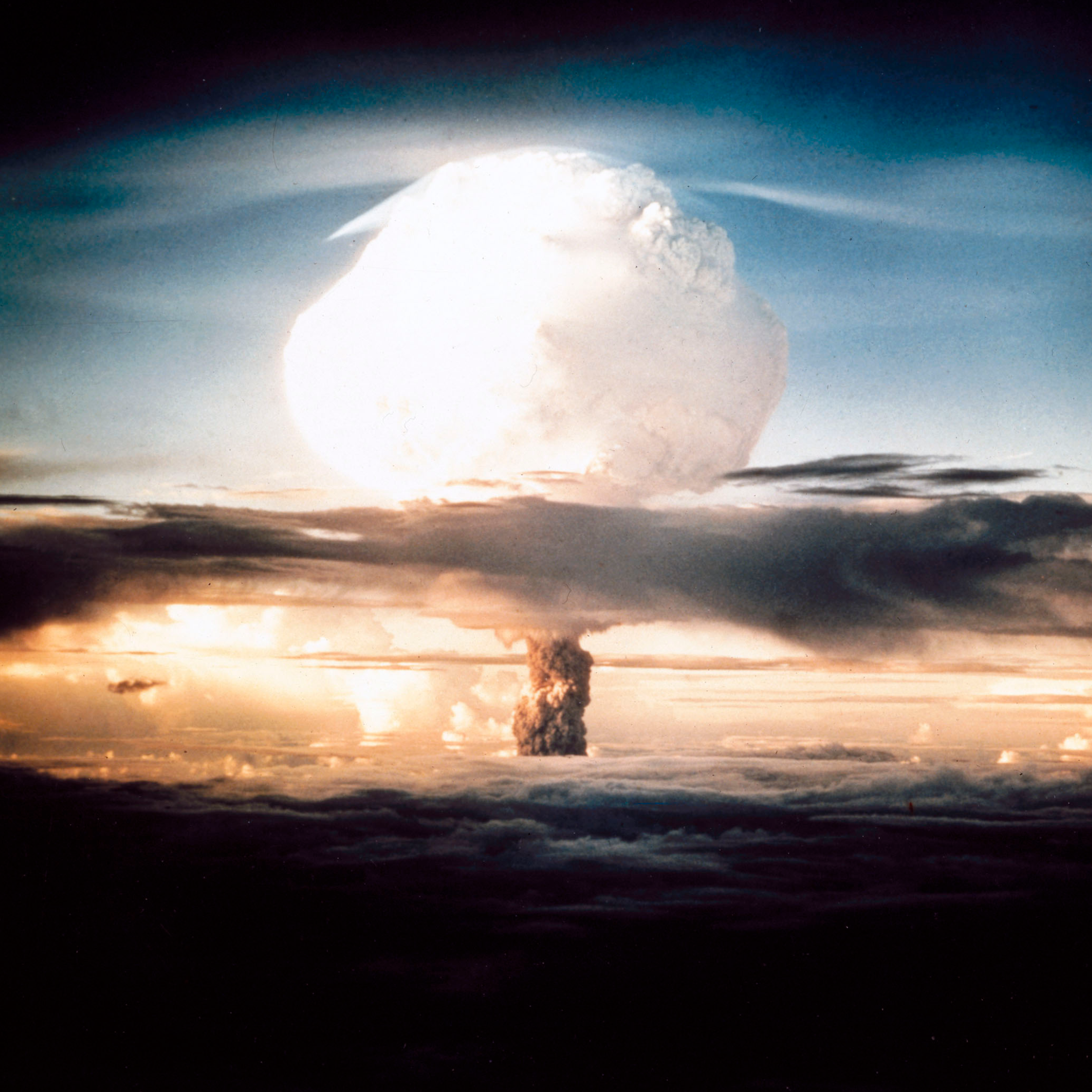
Yeah. So there are different ways to capture this. One is just in the unit of measurement. So an atomic bomb, we measure the yield, how much energy is released by the bomb in kilotons. So that's 1,000 tons of TNT. So you know, the Hiroshima and Nagasaki weapons, that's on the order of 10, 15 kilotons. For hydrogen bombs, we generally measure the yield in megatons, millions of tons. So literally a thousand. It's as if you're dropping a thousand of the Hiroshima or Nagasaki weapons on a city. And so the damage is commensurately greater. So where now you might have imagined if you drop a nuclear weapon on something like New York or Chicago, it would be very damaging if we did it right downtown and some area of some number of miles would be contaminated and lots of people would immediately die. Now with a hydrogen Bomb, especially in an air burst, you're talking about the whole metropolitan region is just vaporized. And if you really want visualization, there's something called the nukemap nuke map. And I'm sure if you Google it, it'll come up and you can put in your city or where you live, and you can dial the yield and detonate on the computer and it'll show you what happens.
- [10:23]
Al Letson
When you're explaining this to me first, I'm filled with horror. I mean, I recognize and understood the threat of hydrogen bombs and atomic war and all of that stuff. I understood it. But hearing you describe the devastation and how bad it would be, and also just being really frank, like I can hear it in your voice that this, this stuff scares you.
- [10:48]
Daniel Holtz
Yeah, I'm genuinely terrified. And one of the aspects that really scares me is the fact that most people aren't scared. During the Cold War, people were scared you might pray out. People had their duck and cover drills. But I think a lot of humanity was worried about nuclear war. And since the end of the Cold war, since the 90s, there's this thought that it's all in the past, that we don't need to worry about this anymore. We have bigger things to worry about. We have climate change and we have pandemics, and there are lots of other things that are of concern. And that's true. We do have these other things to worry about. But the nuclear danger is still there. We still have thousands of weapons on hair trigger alert. And the way it works is at any moment, for any reason, there are a few individuals who can essentially push the button and end civilization. And that is the way the system works. At any moment, and 30 minutes later, it's all over and that threat is there. And I would argue it's gotten much, much worse. And it's a lot for people that kind of think about this and have followed it, it's much scarier right now than it was even five years ago. We've been, I would argue, and I think I'm not alone, I would argue we've been very lucky during the Cold War to avoid a nuclear catastrophe. And at some point, you can't just hope on luck, that luck will run out. So we need a better strategy. And there are things we can do that would reduce the risk. And that's the main message of the Doomsday Clock. And the main message of everything we're doing is it's not the end, it's not inevitable. There are lots of things we can do. We're just not doing them. That's the problem.
- [12:44]
Al Letson
Yeah. Why is it important to have the clock in physical, artistic form?
- [12:49]
Daniel Holtz
Yeah, that's a great question. So why have a clock at all? And why have it be there as an object? And I think we're trying to figure out a way to resonate with the public. We talk about movies and TV shows. The question is, how do you capture this kind of risk, which is fairly abstract. One of the big problems in this kind of existential risk business is that there is no real historical data. It only happens once you destroy civilization. Once. I can't say, look, we did it 10 years ago. We had World War 3 that sucked. We don't want to do that again because once it happens, we're all wiped out. You got to come up with some way to capture the threat. And it has to be something that, especially in this day and age, is pretty directly accessible, that is kind of visceral. And so we ended up with the Doomsday Clock as this very clear symbol. It kind of captures the sense of a countdown to launch. It captures the sense of it's urgent midnight sounds a little scary, but also it captures a sense that we can turn the clock back. And we've done that many times in the past as things improve. And so there's also this kind of hopeful component that captures all these things in a very simple object.
- [14:19]
Al Letson
Yeah. Who helps decide when the hands move?
- [14:24]
Daniel Holtz
There are these boards. There's something called the Science and Security Board, which I chair. And it's a group of about 20 scientists, experts with all different sorts of backgrounds. We have climate scientists and we have nuclear policy experts, and we have experts in pandemics. We have experts on cyber and AI. It's a very diverse board. And we meet and we discuss the threats. We meet a couple of times a year, and then we kind of have these special additional meetings depending on what's happening in the world. And then we bring in other. If we want to hear about something very particular and there's a world's expert, we'll invite them to come and talk to us. And then we meet, we discuss the threats and we make an assessment of the state of the world. And then we set the clock. And that's something we do at least once a year we get together and we formally set the clock. So that's the group. There have been many scientists over the years associated with this, including Einstein and Oppenheimer in the early days. Stephen Hawking was part of this. We've had, I think, over 40 Nobel laureates as part of this. Right now, I think there are nine Nobel laureates as part of this Board of Sponsors, which is this broader group which advises the Science and Security Board. And we have lots of interaction between them. So the idea is we're getting the experts, kind of the deepest thinkers, the people that have dedicated their lives to worrying about these issues. We get them together and we try to get an assessment of the state of the world.
- [16:03]
Al Letson
So the clock has only moved 24 times since 1947. What factors now go into deciding when the hands should move and by how much?
- [16:15]
Daniel Holtz
Yeah, there's part art and part science in this. When we meet, we ask ourselves, what does it say to the world? Are things getting better or worse over the past year? That's kind of our starting point. Let's look at what's happened over the past year. And what does that mean about. About the existential risk. We're very focused on risks that threaten all of humanity. And so there can be lots of bad things happening. There could be regional conflicts or there could be famines in certain region. That stuff is terrible. But if it's not clearly connected to the end of civilization, you know, it's less relevant to our discussion. What we care about is really the big stuff. And we look at that and then we make an assessment. And many years there isn't that much change. We could be in a state where maybe things are bad and they continue to be bad, but they're not getting manifestly worse. There are times where things are going relatively well. Were pretty far from midnight. There was a whole period after the Cold War where, you know, things seem to have settled down. The nuclear threat really was decreasing. There was a feeling that that was. There was unlikely to be World War Three. And even though we knew about climate change, there was a feeling that we would certainly address it when the time came. There was this sense of optimism.
- [17:48]
Al Letson
And this was in 91.
- [17:50]
Daniel Holtz
91 was when we were farthest from midnight. So that was right at the end of the Cold War. And there really was from. For decades, the main threat to civilization was nuclear weapons. Climate change. We didn't really know it was happening, or we've known since the 70s. In fact, the bulletin we first covered climate change in the 70s saying, this is a problem. But at that time, there was plenty of time to deal with it. So really you have scientists that were talking about this stuff, and it wasn't part of the clock setting, because the scientists just assumed, well, of course, no one wants to destroy the planet. So of course, we should invest in renewables and invest in other technologies to prevent climate change. I mean, it just seemed like a no brainer. And only in 2007 did we start putting it into the clock because it was clear it was a risk to civilization because it wasn't clear that humanity would make the choices to save itself.
- [18:54]
Al Letson
Coming up, Daniel reminds us that it's not all doom and gloom, really.
- [18:59]
Daniel Holtz
The Doomsday Clock is a symbol of hope. The whole point of this clock is to, yes, to alarm people, to inform people, but also to demonstrate we can turn back the hands of the clock. And we've done it in the past and we can hope to do it in the future. And we must.
- [19:18]
Al Letson
And just as we have a role to play in helping turn back the hands of that clock, you, our listeners, have a role to play in helping sustain the future of this show. I think of the kind of investigative reporting we do at Reveal in a really similar way to how Daniel describes the clock. It's about hope. And yes, our reporting often points out systematic injustice and yes, sometimes it's dark. But ultimately, reveal's brand of investigative journalism is about shining a light on that darkness because we, we believe the world can be better and we're trying to show a path to get there. To support the show. Just go to revealnews.org gift again, that's revealnews.org gift. All right, thank you. And more with Daniel Holtz in just a minute. So don't go anywhere.
- [20:13]
Nadia Hamdan
Hi, y'.
- [20:13]
Al Letson
All.
- [20:14]
Nadia Hamdan
My name is Nadia Hamdan and I'm a producer here at Reveal. Reveal is a nonprofit news organization organization and we depend on support from our listeners. Donate today@revealnews.org donate and thanks.
- [20:37]
Al Letson
This is more to the story. I'm al Letson. It's 89 seconds to midnight and I'm talking to University of Chicago professor Daniel Holtz about why, why are we that close the closest we've been to global catastrophe?
- [20:51]
Daniel Holtz
There was a lot of discussion this past year, what, what time is it? You know, are things getting better or worse? The one thing that there was broad consensus about is things are not getting better, that we're not doing enough. Climate change is happening. There's increasing evidence and we're just not doing enough. In fact, in some ways, especially in the US we're running the other way. We're subsidizing fossil fuels. We're making it harder to do kind of carbon free, renewable energy. It's very hard to process. Same with nuclear. The nuclear threat has over the process of the Cold War, we had all these treaties, we reduced the number of weapons. We had lots of controls and communications even with our adversaries. So the US and the Soviet Union after the Cuban Missile Crisis, there was a lot of communication. People want to make sure that the close calls that happened in the Cuban Missile Crisis wouldn't happen again. So there was a lot of positive even there'd be terrible rhetoric by the leaders. The generals were all talking and trying to tamp things down and make sure that there was some trust because no one wanted to blow up the world. And right now, again, it's very unclear what's happening. There's still a lot of very kind of macho talk. There's no question that we're in the middle of an arms race now between Russia, China and the U.S. we're modernizing our nuclear arsenal at a cost of almost $2 trillion. So just these huge numbers to make these nuclear weapons better, even though already we have plenty. I mean, we can easily blow up the world many times over. We don't need more, we don't need better ones, and yet we're spending all this money to improve them. Same with Russia and China. What? Why are we doing that? It makes absolutely no sense. It does not make anyone anywhere in the world safer. For the US to make these investments does not make the US Safer. It's very hard to parse, but it's happening. Disinformation also getting worse. We're having a very hard time distinguishing what's true from what's false. We have foreign nations interfering and convincing millions of people of things that didn't happen or things that did happen, convincing them that they didn't. It's a very, very unsettled time. And the clock represents that.
- [23:33]
Al Letson
I'm curious, where does AI fit into all of this? Because I have to tell you that I feel like this impending dread just in the periphery. I feel like it's coming and we're not really grappling with what AI could mean and shift not just in society, but I don't know. I mean, it could be. Look, I'm a sci fi fan. I grew up watching the Terminator. I love those movies. And maybe those movies are the things that are making me feel like, ah, what are we doing? What are we doing? Does that factor? Am I being an alarmist by feeling that way?
- [24:18]
Daniel Holtz
Yeah. No. And I completely agree. And I also agree about the Terminator. And I think for many people that is the vision of AI and so I think there's a range of ways that you can worry about AI. So we do consider AI quite a bit, and we talk about it a lot. There isn't consensus, and I think the short version is we don't really know. This is part of what makes it frightening. It's hard to extrapolate because the rate of improvement with AI has been exponential over the last few years, and it's very hard to know where it's headed. But here there's a range of scenarios that you could worry about. One is the kind of AI takes over and turns the whole world into a paperclip factory or whatever it is. It decides it has some goal, and since it'll be embedded in every system, everywhere, which I think that will happen, it has complete control. And so there's this very dystopian view where AI just really just takes over. That is a concern, but that's very extreme. There's a more pedestrian concern, which is just AI will take over a lot of jobs. It'll embed itself in everything we do, every aspect of society. And that causes a major dislocation in the sense of a lot of people will be out of work. That's problematic from a social point of view, and we don't know what happens next. And that can cause a lot of instability. My main concern from an existential point of view right now is that AI is penetrating. I mean, it's penetrating all of society, including the military. And so there are a lot of AI systems being incorporated into defense. And so you have increasingly systems like autonomous drones that can make lethal decisions. And so we're seeing this in Ukraine. You know, you get to a point where you're just going to launch a bunch a swarm of drones and all of them can try to identify targets and then, you know, destroy them. There's the thing again, that makes me most nervous, is that these AI systems are likely to be incorporated into the nuclear command and control. And there's been a lot of talk about this, and people will say, absolutely not. And, okay, maybe a human is in the loop, but the human is going to be 100% informed by AI. If the AI decides it wants to end the world, it'll be in a position to do so. There are a lot of things about AI that still unsettle people. AI can be very surprising.
- [27:12]
Al Letson
My last big question is, what does humanity need to do to turn back the hands of the Doomsday Clock?
- [27:22]
Daniel Holtz
That is the main question. The most important question is, what is to be done? And I think, and I say this and it takes a while for me to convince people this, but really the Doomsday Clock is a symbol of hope. The whole point of this clock is to, yes, to alarm people, to inform people, but also so to demonstrate we can turn back the hands of the clock. And we've done it in the past and we can hope to do it in the future. And we must. We don't want civilization to end. We have to do these things. So there are many kind of concrete things that can be done that would help turn back the hands of the clock. The kind of highest level, most obvious ones are things like the US and Russia and China need to talk. We have to reduce the nuclear risk. We have to reduce the kind of, the size of the stockpiles. There's no reason to modernize the nuclear stockpiles. We want to change the alert posture right now. The decision to end civilization will be made in a hurry. Somewhere between seven and nine minutes is how long the President would have to make a decision to launch the weapons after an alert. That's our system. It's called launch on warning. It makes very little sense from a kind of long term stability perspective. So there are all these kind of technical things that could be changed that would make the world safer for climate change. Similarly, we need to invest in renewables. We need to make this transition. The transition is so much better for us. It's less expensive to do renewables than it is to do fossil fuels at this point in many parts of the country, and yet we're not doing those things. So there's a lot of stuff we don't understand with AI as well. We need some sort of controls on AI. Europe is kind of ahead of the curve on this stuff, but it's not enough and it's not happening fast enough. We have to engage, inform ourselves, find legitimate sources of news, people that really are expert, that have spent their time studying these things, that know what they're talking about. This is what we need the world to do to make informed decisions going forward. There's a lot. And of course, people need to vote. Personally, one of the things I'm most excited about is something we haven't talked about, which is my existential risk Laboratory XLAB at the University of Chicago, where I'm trying to develop a research program where we focus on these threats and we train students. And then the hope is they go on and they carry that knowledge forward in whatever it is they do, whether they're artists or policymakers, politicians or engineers or lawyers or whatever, whatever they end up doing in the world. You want to be informed by existential risk and be aware that there are these risks and keep them in mind as you go forward in your life. And I think that's one of the most important things for all of us. You have to be informed about this stuff and then take the actions using whatever skills, whatever abilities you have to reduce them.
- [30:47]
Al Letson
Yeah. You can't put your head in the sand. Like, we've all got to be active participants.
- [30:52]
Daniel Holtz
Absolutely. This is not the time to hide and assume it's all going to be okay. This is the time to lean in and get engaged.
- [31:02]
Al Letson
Daniel Holtz, thank you so much for coming in and talking to me.
- [31:05]
Daniel Holtz
Thanks. This has been a great conversation.
- [31:12]
Al Letson
If you want to learn more about Daniel's work, we put some links in our show notes to his lab, to the Bulletin of Atomic Scientists, and to that nuke map he mentioned which allows you to simulate a nuclear detonation in cities across the world. He it's truly horrifying, but it really makes you understand why we are at 89 seconds to midnight. If you like this conversation, I have another one in mind for you. Check out the reveal episode called Weapons with Minds of Their Own. It's about AI warfare and how far we should go in handing control of lethal weapons to machines, a scenario Daniel was talking about. Lastly, to keep up with everything we're doing here, sign up for our free newsletter by going to revealnews.org newsletter. We'll send you the latest from our newsroom in a weekly email. That's revealnews.org newsletter. This episode was produced by Josh Samburn and Carl McGurk. Allison theme music and engineering helped by Fernando my man Yoaruda and Jay Breezy. Mr. Jim Briggs, I'm Al Letson and you know, let's do this again next week. This is more to the story.
- [32:35]
Daniel Holtz
From prx.