Loading summary
Transcript244 lines
- [00:01]
Progressive Insurance Announcer
This episode is brought to you by Progressive Insurance. Do you ever think about switching insurance companies to see if you could save some cash? Progressive makes it easy to see if you could save when you bundle your home and auto policies. Try it@progressive.com Progressive Casualty Insurance Company and affiliates. Potential savings will vary. Not available in all states. Today's episode is sponsored by Strawberry Me. Let's be honest. Are you happy with your job? Like, really happy? The unfortunate fact is that a huge number of people can't say yes to that. Far too many of us are stuck in a job we've outgrown or one we never wanted in the first place. But still, we stick it out and we give reasons. Like, what if the next move is even worse? Or I've already put years into this place and maybe the most common one. Isn't everyone kind of miserable at work? But there's a difference between reasons for staying and excuses for not leaving. It's time to get unstuck. It's time for Strawberry Me. They match you with a certified career coach who helps you go from where you are to where you actually want to be. Your coach helps you get clear on your goals, create a plan, build your confidence and keeps you accountable along the way. So don't leave your career to chance. Take action and own your future. With a professional coach in your corner. Go to Strawberry Me Future to claim a special offer. That's Strawberry Me. Future Future.
- [01:26]
Al Letson
Hey, this is Al. And I'm sure it is no surprise to you that President Trump doesn't like us very much. He called the press the enemy of the people. Credentialed journalists have been banned from press briefings just for asking tough questions. Trump personally sued news networks demanding billions. And now, at his urging, Congress has voted to gut all federal funding for public broadcasting. And I think I know why. I think we all do. It's because real journalism brings sunlight, scrutiny, accountability. When power feels threatened, it lashes out. And that tells you just how vital independent reporting is. Right now here at Reveal, we don't answer to billionaires or politicians or special interests. We only answer to you, our listeners. But we can't do this alone. Stand with us. Support fearless independent journalism that refuses to back down. Donate today. Just visit revealnews.org fearless again, that's revealnews.org fearless. Thanks. From the center for Investigative Reporting and PRX, this is Reveal. I'm Al Letson.
- [02:37]
Najeeb Momini
I believe in the future of the two state solution.
- [02:40]
Al Letson
Back in July, French President Emmanuel Macron announced France would recognize Palestine as an independent State. Soon after Canada announced it would do the same and so did Australia. Here's Prime Minister Anthony Albanese.
- [02:54]
Israeli Official / Benjamin Netanyahu / Other Officials
I've said it publicly and I said it directly to Prime Minister Netanyahu. The situation in Gaza has gone beyond the world's worst fears.
- [03:05]
Al Letson
Belgium followed suit with its foreign minister explaining their decision.
- [03:09]
Israeli Official / Benjamin Netanyahu / Other Officials
Why at this moment? Because we've seen the horrible situation on the ground and with people starving and is totally unacceptable.
- [03:21]
Al Letson
These announcements were made at a strategic moment because Palestinian statehood is on the agenda for the United Nations General assembly, which is taking place this week in New York. Israel's Prime Minister Benjamin Netanyahu had this to say about the wave of countries signaling their support for a Palestinian state.
- [03:41]
Najeeb Momini
To have European countries and Australia march into that, march into that rabbit hole is disappointing and I think it's actually shameful.
- [03:52]
Al Letson
Countries pushing for statehood cite the humanitarian crisis in Gaza as the main reason Israel and Palestine should be separate countries. So this week we're bringing you an updated version of a story we aired earlier this year about the conditions on the ground in Gaza and and a group of Americans who have witnessed them firsthand. Like many Americans, Mimi Saed followed Israel's response to the October 7 Hamas attacks through videos on Instagram and TikTok. This part of the world was foreign to her, shamefully.
- [04:32]
Dr. Mimi Saed
I didn't know anything about the history, I didn't know anything about the occupation and things going on there.
- [04:38]
Al Letson
But she became glued to her phone. Mimi kept scrolling, watching post after post. Then in the summer of last year, she saw one image too many.
- [04:49]
Dr. Mimi Saed
There's a child that was pulled out of rubble and just like a rag doll and was completely dead. I remember driving in the morning to work and I said to my husband, hey babe, I gotta talk to you about something. I texted him and he messaged me back. He goes, you're going to Gaza, aren't you? I have these skills that this population needs. I need to show up.
- [05:10]
Al Letson
Mimi is a board certified emergency room doctor who knows how to help in a very practical way.
- [05:16]
Dr. Mimi Saed
There was a medical obligation on my part, just as a physician, you know, there is a need.
- [05:21]
Al Letson
At the time, doctors were one of the only groups consistently led into Gaza. Israel wasn't allowing outside observers from groups like Human Rights Watch and the only foreign journalists allowed in were were embedded with the Israeli army. Now Mimi, a medical director at a Level 4 trauma center in Olympia, Washington, was about to enter one of the most restricted parts of the world.
- [05:45]
Dr. Mimi Saed
I knew that it was dangerous. I actually didn't realize how much more dangerous it was until I actually got there.
- [05:55]
Al Letson
We're teaming up with Al Jazeera's Fault Lines to look at Gaza through the eyes of American doctors. And a heads up. This story contains descriptions of trauma and violence. Reveals Najiba Meani takes it from here.
- [06:12]
Najeeb Momini
One after another, hundreds of injured people.
- [06:14]
Al Letson
Are brought to Nasser Hospital in Khan Younis.
- [06:18]
Najeeb Momini
When Mimi Syed first arrived in Gaza In August of 2024, she goes straight to work at that same location, Nasser Hospital. It's just a few weeks after this news report. It's in disarray and overcrowded. Far too few beds, far too few doctors, hardly any supplies, and so many people in need of care. And just hours into her first shift, she gets hit by her new reality. Mass casualty events. On a daily basis, sometimes multiple times a shift.
- [06:51]
Dr. Mimi Saed
I was seeing things that I never in my life thought I would see. I think that the explosive injuries and the shrapnel and the gunshot wounds kind of overwhelmed my view at that time because there was nothing else that I was seeing because those are such severe injuries.
- [07:06]
Najeeb Momini
Then there was something else she rarely saw.
- [07:09]
Dr. Mimi Saed
Back home, kids would come in dead with single shots to the head. There was no other injury on them. I mean, it's never normal to have a child with a gunshot wound in his head or her head or chest.
- [07:21]
Najeeb Momini
Mimi was working in the emergency trauma bay where they used a green, yellow, red triage system to handle the injuries. Influx of patients. Green for minor cases, yellow for more moderate ones, and red for the most critical. And then there's one other color. Black.
- [07:39]
Dr. Mimi Saed
Yeah, black is the patient's dead or there is nothing you can do to salvage them. Or if you could, it's wasting resources because the prognosis is so poor.
- [07:48]
Najeeb Momini
One morning around 8 or 9am, the hospital quickly gets overwhelmed. Another mass casualty event. Patients are flooding in. That's when a four year old girl named Meera shows up to the trauma bay. Her injuries are not considered green, yellow or red, but black.
- [08:07]
Dr. Mimi Saed
She had a wound in her head.
- [08:09]
Najeeb Momini
Mimi knows what the other doctors in the room know. Mira's chances at survival are not great.
- [08:15]
Dr. Mimi Saed
In fact, the prognosis for that to survive is very poor, very, very low, near impossible.
- [08:21]
Najeeb Momini
Taking the time and resources to save Mira could mean that someone else might not be saved. But then she notices. Mira wins.
- [08:32]
Dr. Mimi Saed
And that usually is a good neurologic sign.
- [08:35]
Najeeb Momini
Mimi pulls out a medical device, a laryngoscope, which is a small curved blade with a light that allows a doctor to see inside one's throat. She says she had to smuggle this basic device into Gaza because of Israel's restrictions on medical equipment out of security concerns in the medical world, this device is used for airway protection, and she uses it to help intubate Meera. Right away. As the girl's breathing steadies, Mimi orders a CT scan.
- [09:04]
Dr. Mimi Saed
There was a bullet lodged in her head, and I just remember thinking immediately, like, she needs to go to surgery.
- [09:12]
Najeeb Momini
Mimi sprints upstairs to get the attention of a neurosurgeon. They rush Meera to surgery, and miraculously, she survives. It's a tiny win for Mimi, who immediately is tending to newer patients. She only gets to reflect on it much later.
- [09:29]
Dr. Mimi Saed
This was the only child that actually, that I saw. I was able to get to the CT scan that survived. A lot of them came in very similar to her presentation, but were dead already.
- [09:41]
Najeeb Momini
During this trip, Mimi says she treated at least 18 children with gunshot wounds to the head or chest. To her, these injuries seemed deliberate.
- [09:52]
Dr. Mimi Saed
They were in children under the age of 12. That's something I saw every single day, multiple times a day for the whole four weeks that I was there.
- [10:02]
Najeeb Momini
It would take an investigation to determine whether these shootings were deliberate, but to pursue one would be impossible because the Israeli Defense Forces haven't allowed independent observers to enter Gaza. After 30 days in Gaza, Mimi returns home feeling deflated.
- [10:23]
Dr. Mimi Saed
In Gaza, there is no end. It just keeps going. And futility is the only way to describe it, because no matter what you do, you're not changing the outcome.
- [10:34]
Najeeb Momini
But that feeling changes one day when Mimi gets an email.
- [10:38]
Dr. Mimi Saed
Firoz had actually sent out an email shortly after I'd gotten back, asking physicians to complete a survey with some questions about what they saw when they were in Gaza.
- [10:48]
Najeeb Momini
His name is Dr. Faroz Sidwa, a trauma surgeon who's based in Stockton, California.
- [10:54]
Dr. Firoz Sidwa
I kept a diary while I was there, and actually, it wasn't until I came back I realized, like, holy. I saw a lot of kids shot in the head. I saw a lot of kids maimed. A war doesn't explain why. You know, half the people in your ER are 10 years old or younger.
- [11:08]
Najeeb Momini
Like Mimi, Firoz also worked in Gaza, making his first trip in the spring of 2024. Now he was writing a letter to then President Joe Biden and Vice President Kamala Harris. The letter called for an immediate ceasefire and weapons embargo on Israel. He was trying to corral signatures from other American doctors and healthcare workers who also worked in Gaza. But getting them to sign on was harder than he thought.
- [11:38]
Dr. Firoz Sidwa
They were like, oh, no, it's not going to make any difference. Why sign the letter. I'm like, dude, just sign a letter. Like, what is your problem? It takes 30 seconds of your time.
- [11:47]
Israeli Official / Benjamin Netanyahu / Other Officials
Oh, I read it.
- [11:48]
Najeeb Momini
It's a good letter, but I don't.
- [11:49]
Dr. Firoz Sidwa
Think it's going to do anything.
- [11:51]
Najeeb Momini
Who cares?
- [11:51]
Dr. Firoz Sidwa
Just try.
- [11:55]
Najeeb Momini
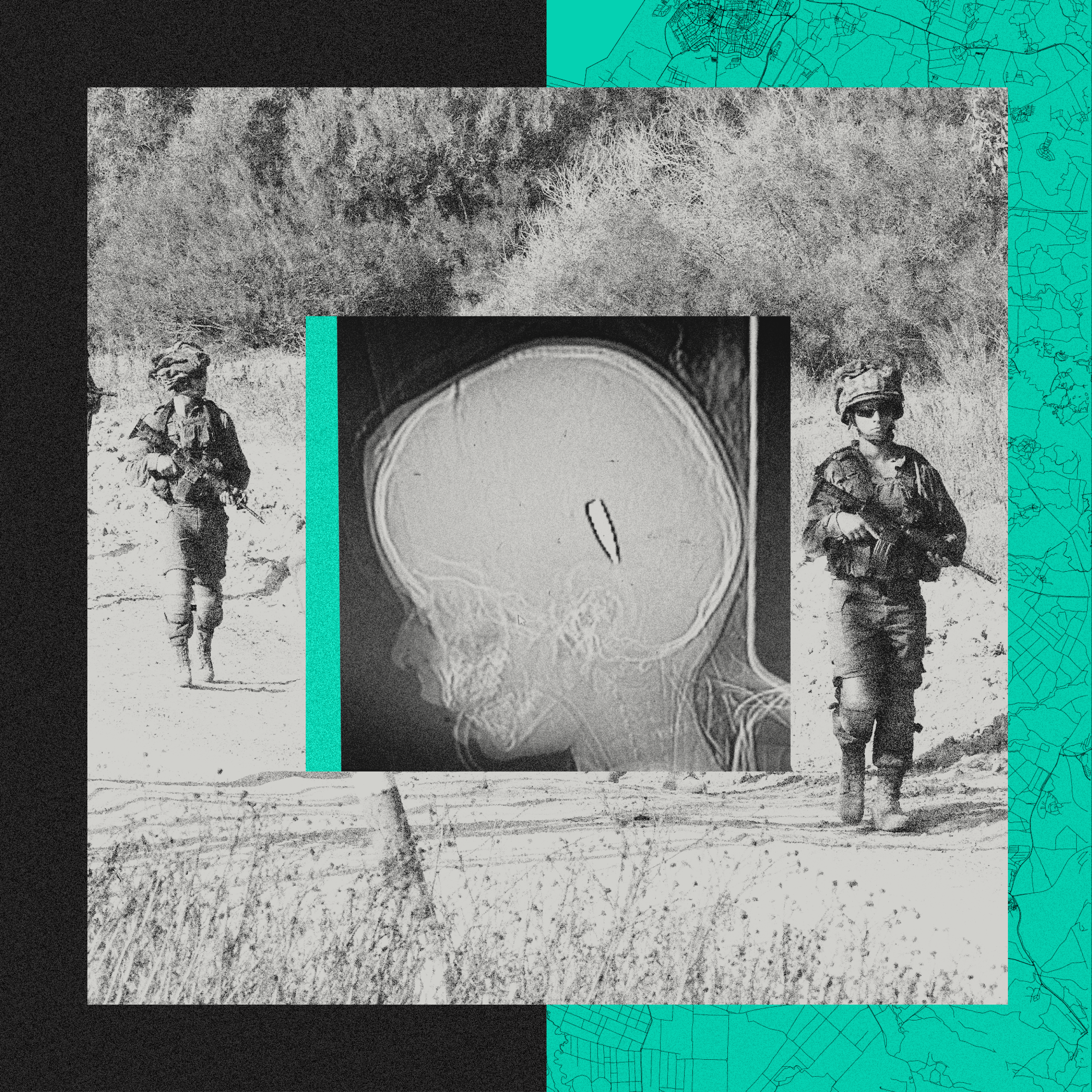
He landed with 99 signatories, including Mimi. Next, Feroz created a survey for the doctors to complete, and he began tallying the data for an op ed for the New York Times. Mimi filled out the survey and submitted a few photos, including one of Mira's CT scan showing a bullet, bright white, lodged deep in her skull. After a rigorous round of fact checking, the op ed went live.
- [12:25]
Dr. Mimi Saed
Suddenly, everyone becomes a ballistic expert and radiologist on X.
- [12:29]
Najeeb Momini
Apparently, people didn't believe Meera had been shot in the head.
- [12:33]
Dr. Mimi Saed
There was like, you know, particular radiologists, surgeons, trauma surgeons, who all started saying like, that's impossible. It is an impossibility that a bullet would just get retained. This is obviously a bullet taped onto a child's head or a person's head or something. Taped, taped.
- [12:54]
Najeeb Momini
People accused Mimi of lying even though the CT scan showed the entry wound and swelling in Meera's brain. For Mimi, having other physicians second guess her work felt like a betrayal.
- [13:06]
Dr. Mimi Saed
I mean, honestly, it felt like this is an impossibility that physicians who call themselves humanitarians are ignoring that children are being shot in the head. How could you do that?
- [13:16]
Najeeb Momini
The Israeli military hasn't publicly commented on the New York Times op ed, but they have in the past rejected the claim that its troops have deliberately fired on civilians. Here's Israeli prime minister Benjamin Netanyahu. Israel does not target Palestinian civilians. We target Hamas terrorists. And when these terrorists embed themselves in civilian areas, when they use civilians as human shields, they're the ones who are responsible for all unintended casualties. Hamas has rejected the Israeli claim that they use human shields. The overall response to the op ed didn't change the reality on the ground in Gaza, which at the time was facing a famine. Israel continued its blockade on aid and the multiple attempts at ceasefires had all broken down. So Mimi, defeated but undeterred, decides to book a return trip back to Gaza.
- [14:15]
Dr. Mimi Saed
I mean, I decided to go back because it was getting worse.
- [14:20]
Najeeb Momini
This time, Mimi goes with a different intention.
- [14:23]
Dr. Mimi Saed
I went back because I felt I was needed. But because I'm a healthcare worker, we are one of few that actually go in to witness this. So I felt another moral obligation to go witness and report and to bring it to attention of media, of humanitarian organizations around the world so that we could stop this.
- [14:42]
Najeeb Momini
And this time she also recorded audio diaries. This is how that second trip starts.
- [14:53]
Dr. Mimi Saed
It's about 6 o' clock in the.
- [14:55]
Progressive Insurance Announcer
Morning.
- [14:58]
Dr. Mimi Saed
And that's what we're waking up to.
- [15:02]
Najeeb Momini
Mimi spends most of her time in central Gaza, working shifts at Al Aqsa Hospital, a large medical complex that's been the target of multiple Israeli attacks since October 7th. She's living inside the hospital in a small area that has been repurposed with a few mattresses laid out on the floor. The kitchen area is just a hot plate. There's no heat, it's cold, and the windows provide very little insulation. The hospital is crowded with people living in the hallways and outside in tent encampments. But as the days unfold, one major difference Mimi notices since her last trip to Gaza is that there aren't as many mass casualty events.
- [15:46]
Dr. Mimi Saed
The trauma cases that we are seeing secondary to military conflict is decreased.
- [15:54]
Najeeb Momini
Instead, she notices a different kind of medical emergency. The kind of thing you see when you look at photos of Holocaust survivors in concentration camps.
- [16:05]
Dr. Mimi Saed
We are noticing patients with temporal hoisting and cachexia.
- [16:09]
Najeeb Momini
Picture images of people with unusually thin faces and protruding cheekbones. That is usually a sign of extreme malnourishment.
- [16:19]
Dr. Mimi Saed
Just terrible conditions that you would typically not see in any other normal country.
- [16:26]
Najeeb Momini
Mimi was seeing this at scale. In Gaza. Mimi continues to treat patients and take photos and document what she can. But the magnitude of it all gets to her.
- [16:41]
Dr. Mimi Saed
I feel defeated, discouraged, and like coming here was a big mistake.
- [16:51]
Najeeb Momini
And then a surprise. Mimi gets to visit with Mira, the four year old girl she helped save.
- [16:58]
Dr. Mimi Saed
Hi, Mira. Mimi, you remember Sunriana? Sunmi, how are you? I miss you.
- [17:14]
Najeeb Momini
Meera is wearing a pink hoodie, sitting in a tent next to her mom, who you can also hear. Mira's a little shy, but she's showing off her nail polish.
- [17:25]
Dr. Mimi Saed
How are you? Look at your fingers. Wow. Love it. Yes, very good. And she's playing and interacting normally. That's amazing.
- [17:53]
Najeeb Momini
Seeing Mira temporarily brightens Mimi's spirits. But Mimi can't shake the fact that so many kids didn't survive. And she wants policymakers to know what she's seen. So not long after she returns home, she plans another trip. This time it's to Washington D.C.
- [18:15]
Al Letson
Up next, Mamie walks the halls of the Capitol.
- [18:18]
Dr. Mimi Saed
I have a little bit of hope being here. Hope, Hope. Hope that someone will listen.
- [18:26]
Al Letson
That's coming up on Reveal.
- [18:40]
Najeeb Momini
Hello, listener. My name is Najeeb Momini and I am a producer here at Reveal. Reveal. Is a nonprofit news organization and we depend on support from our listeners. Listeners like you. Donate today@revealnews.org donate. It helps fund the stories that we tell and helps me feed my cat. So thank you.
- [19:06]
Al Letson
From the center for Investigative Reporting and prx, this is Reveal. I'm Al Edson. This hour we're bringing you an update to a story we aired this past spring about doctors trying to meet the moment in Gaza. Back in January, Dr. Mimi Syed, fresh off her second medical mission, is making her way towards the US Capitol.
- [19:27]
Dr. Mimi Saed
We're in DC and we're walking to some meetings with state reps and hoping to discuss the various issues that are ongoing in Gaza.
- [19:37]
Al Letson
Mimi is here as a part of a grassroots movement of doctors who want to share what they saw in Gaza. Reveals. Najiba is tagging along.
- [19:45]
Najeeb Momini
How are you feeling?
- [19:47]
Dr. Mimi Saed
A little anxious.
- [19:48]
Najeeb Momini
Why?
- [19:50]
Dr. Mimi Saed
I'm not sure what to expect. I've not done anything like this before.
- [19:55]
Al Letson
Donald Trump has just started his second term and is already making headlines.
- [19:59]
Najeeb Momini
You're talking about probably a million and.
- [20:03]
Israeli Official / Benjamin Netanyahu / Other Officials
A half people and we just clean out that whole thing.
- [20:08]
Al Letson
A new ceasefire between Israel and Hamas has gone into effect. Mimi sees the ceasefire as an opportunity to bring relief to those in Gaza. Her day on Capitol Hill is jam packed, meeting both Democrats and Republicans. She's lobbying to get aid in and patients out for treatment. And she brings a photo of one of the patients who she believes needs medical evacuation.
- [20:34]
Dr. Mimi Saed
Yeah, it's a Walgreens photo envelope that says find smiles inside. It's not filled with smiles at all, actually. It's filled with pretty disturbing images of a child with a bullet in her head.
- [20:50]
Al Letson
The child is four year old Meera, who you heard about earlier in the show, one child of many who suffered a critical gunshot wound. As Mimi heads towards one of her meetings, she runs into a familiar face. Dr. Firoz Sidwa, the trauma surgeon who penned the New York Times op ed. They walk down the hallways, passing senators on their left and right.
- [21:15]
Dr. Firoz Sidwa
I'm not a political expert. Honestly, I could recognize Bernie Sanders or Donald Trump. I'm just walking into Pete Aguilar's office in California.
- [21:24]
Dr. Mimi Saed
Yeah, we're about to walk into Senator Thune's office. He's the majority leader of the Senate.
- [21:32]
Dr. Firoz Sidwa
We are going to Representative Ronny Jackson from Texas who as I understand is President Obama's former physician. So this will be interesting.
- [21:42]
Al Letson
The two never meet with any representatives or senators, mostly junior staff and aides. Mimi shows the photo of Mira's CT scan. But during one meeting, there's skepticism.
- [21:53]
Dr. Mimi Saed
Frizz was pointing out the swelling in the head and the entrance of the wound here, the bullet here, on the front there.
- [22:01]
Dr. Firoz Sidwa
And still people are skeptical of this image. It's just completely insane.
- [22:05]
Dr. Mimi Saed
It seems kind of odd to have to convince people that shooting kids in the head is wrong.
- [22:10]
Al Letson
They aren't given any assurances that members of Congress will take action. All they hear is that their requests will be passed on to the Congress. For Mimi and Firoz, meaningful action from policymakers would involve the US Cutting back military support to Israel, which is by far the biggest recipient of aid from Washington. And there's a law already in place that's supposed to do that. It prohibits U.S. aid from going to foreign military units accused of human rights violations. Our partners for this hour, Josh Rushing and the team at Al Jazeera's Fault line spent time looking into that law and how it applies to Israel. Here's Josh.
- [22:57]
Josh Rushing
Policymakers in the United States have been trying to figure out how to punish countries who were accused of violating human rights for decades. So in the 90s, policymakers came up with a Leahy Law.
- [23:08]
Israeli Official / Benjamin Netanyahu / Other Officials
The Leahy Law has utility and is consistent with who we are, what we stand for.
- [23:15]
Josh Rushing
Tim Reeser wrote the Leahy Law when he was a senior advisor to former Senator Patrick Leahy of Vermont. He's known as one of the more influential people on the Hill when it comes to crafting U.S. foreign policy. Under the Leahy Law, if a country doesn't hold its security forces accountable for violations like rape, torture and murder, then the US Is supposed to withhold its security assistance from those specific units. And in a lot of cases, it worked. When the State Department recognized a pattern of human rights violations in countries like Colombia, Guatemala, and Indonesia, it had a mechanism to cut military aid to the units in question. But with Israel, it's never been enforced. The US has poured billions of dollars into Israel and regularly contributes about 15 to 20% of Israel's annual defense budget. That's gone up even higher since hamas attack on October 7, 2023.
- [24:12]
Israeli Official / Benjamin Netanyahu / Other Officials
There's probably not a unit in the Israeli army that either hasn't been trained and or received equipment from the United States. That's just the reality because we provide far more to Israel than we do to any other country.
- [24:26]
Josh Rushing
But for decades, there has been extensive documentation showing that units in the Israeli security forces have committed human rights violations, often against children. One of the most famous cases was caught on camera in 2000. 12 year old Mohamed Al Dhara was shot in his father's arms this weekend.
- [24:47]
Dr. Mimi Saed
Video that has been shown around the world is the video of a man.
- [24:52]
Katie Gallagher
Trying to protect his son.
- [24:55]
Dr. Mimi Saed
He is pleading with the soldiers, saying, I have a child, I have a child.
- [25:00]
Najeeb Momini
And the next frame is his son shot dead.
- [25:05]
Josh Rushing
Three years later, before Israeli forces withdrew from Gaza and Hamas took over, three children were killed in a four hour standoff in a refugee camp there. And then between March 2018 and March 2019, during a series of protests at the border with Gaza, Israeli forces killed at least 41 children, mostly by live fire. According to the UN, the commission has.
- [25:28]
Najeeb Momini
Found reasonable grounds to believe that Israeli security forces committed serious violations of human rights and international humanitarian law.
- [25:40]
Josh Rushing
According to a number of NGOs, the Israeli military has committed gross violations of human rights in the occupied Palestinian territories both before and after October 7th. Take this one report from Defense for Children International Palestine. Between October 2023 and July 2024, they documented 141 Palestinian children killed by Israeli security forces and settlers in the occupied west bank and East Jerusalem. More than three quarters were shot dead, often to the head or torso. That kind of fatal injury, as opposed to an airstrike or a stray bullet, can qualify as a gross violation of human rights under the Leahy Law.
- [26:25]
Israeli Official / Benjamin Netanyahu / Other Officials
Yet according to Tim Reeser, no Israeli Defense unit has ever been denied US assistance under the law that we're aware of. It is the only country they're aware of that the law has been so consistently not applied to. Had the Leahy Law from its inception been applied as it was intended in the west bank and Gaza, that the Israeli Defense Forces, who we train often and whose equipment we provide guns, ammunition, bombs, etc. Knew that the Leahy Law was there and could result in that unit being denied a single. It would help to prevent those types of crimes from occurring.
- [27:15]
Josh Rushing
Tim, the guy who wrote the law, believes the issue isn't with how it's written.
- [27:20]
Israeli Official / Benjamin Netanyahu / Other Officials
I think the law is fine. It could be applied to Israel just the way it is to other countries. It's a matter of political will. And I think if you talk to people even in the State Department or who were in the State Department, they would tell you the same thing, that there was a conscious decision not to apply the law.
- [27:41]
Charles O'Blaha
The standard, the Leahy Law standard is credible information. It's an intentionally low standard. Why is that? Well, it's because it's very difficult to get information about gross violations of human rights.
- [27:54]
Josh Rushing
Charles o', Blaha, who goes by his initials, C O B Cobb, worked at the State Department for 32 years. He was the director of the Office of Security and Human Rights before retiring in 2023, his office vetted about 200,000 cases a year of allegations against U. S. Backed security forces around the world. In most cases, US Military aid is earmarked for specific foreign units. But some countries, including Ukraine, Egypt, Jordan and Israel, have received money and equipment in a lump sum to distribute as they wish. For three of those countries, the US has given a list of units that shouldn't receive aid, but not for Israel.
- [28:35]
Charles O'Blaha
Israel receives assistance that's untraceable, and that's a problem under the Leahy Law.
- [28:42]
Josh Rushing
Cobb tried to solve this problem. He helped design a new process, the Israel Leahy Vetting Form. A form, a convening of staff from the embassy, the State Department in the Department of Defense who would develop a list of ineligible units.
- [28:58]
Charles O'Blaha
So the Israel Lehi Vetting Forum was designed to consider credible allegations of gross violations of human rights against Israeli units.
- [29:08]
Josh Rushing
He says the Vetting Forum has asked Israel about credible allegations against specific units and that the US Accepts Israel's investigations without question.
- [29:17]
Charles O'Blaha
If they respond, the government of Israel, to whom we give billions and billions and billions of dollars, should be responsive to those requests.
- [29:28]
Josh Rushing
Both Tim Reaser, who wrote the Leahy Law, and Charles Oblaha, who helped carry it out at the State Department, have come to a similar question, one that was posed to then Secretary of State Antony Blinken during a press briefing back in 2024.
- [29:42]
Israeli Official / Benjamin Netanyahu / Other Officials
Do we have a double standard? The answer is no. The Leahy Law report that I think you were referring to at the. At the outset, this is a, I think, a good example of a process that is very deliberate, that seeks the.
- [29:58]
Josh Rushing
State Department under Marco Rubio. And the Trump administration has taken a more hardline approach, providing even more aid to Israel.
- [30:06]
Al Letson
Secretary of State Marco Rubio used emergency.
- [30:08]
Najeeb Momini
Authority to expedite delivery of about $4.
- [30:11]
Al Letson
Billion of weapons and ammunition.
- [30:13]
Josh Rushing
Secretary Rubio released a plan to reorganize the State Department and drastically reduce the size of the teams that typically oversee the Israel Leahy Vetting Form. Here he is referring to it during a Cabinet meeting.
- [30:27]
Najeeb Momini
We've also, by the way, Mr. President.
- [30:28]
Israeli Official / Benjamin Netanyahu / Other Officials
Under your direction, reorganized the Department of State.
- [30:31]
Najeeb Momini
We had offices within offices within offices.
- [30:33]
Israeli Official / Benjamin Netanyahu / Other Officials
That didn't even know they existed themselves.
- [30:36]
Josh Rushing
Meanwhile, credible reports of human rights violations continue to stream out of Gaza. While reporting this story, we spoke to 20American doctors who served there, including Drs. Syed and Sidwa, who you heard from earlier. Altogether, their observations are eerily similar.
- [30:54]
Dr. Mimi Saed
I did take care of a child who was brought in dead on arrival, who was shot once in the left side of the chest, so through and through to the heart.
- [31:01]
Najeeb Momini
And they took me to a room.
- [31:03]
Josh Rushing
Where a mother was holding her baby. And they said, this baby was shot, shot when he was 10 days old.
- [31:12]
Najeeb Momini
I picked him up and I looked.
- [31:16]
Josh Rushing
On one side of his head and he had a bullet entry wound on.
- [31:20]
Najeeb Momini
The back of his skull that came.
- [31:23]
Josh Rushing
Out on the other side towards the.
- [31:25]
Dr. Mimi Saed
Back of his head.
- [31:26]
Israeli Official / Benjamin Netanyahu / Other Officials
So it's not just a random sniper, it's not a rogue soldier that lost their ethics. It's widespread throughout the entire Gaza Strip.
- [31:36]
Josh Rushing
Those doctors were Tammy Abu Ghurnaim, an ER physician from Illinois, Yasser Arrayn, a neonatologist from Texas, and Mark Perlmutter, a hand surgeon from North Carolina. Both Al Jazeera and Revil sent detailed lists of questions to the Israeli military's press office and the State Department. We also asked for an interview. We wanted to speak with them about a number of cases involving children, including Mira, the four year old treated by Dr. Mimi Syed. But we never heard back. Cobb retired from the State Department in August 2023, a couple of months before the Hamas attack. Now, two years later, he still wrestles with his decision to approve a form that gave the appearance of accountability while actually providing none.
- [32:30]
Charles O'Blaha
I signed off for two reasons. I believed at the time that the State Department would implement that process in good faith, and I believed at the time in the Israeli military justice system. Both of those beliefs turned out to be incorrect.
- [32:49]
Josh Rushing
What do you believe now?
- [32:52]
Charles O'Blaha
Well, I believe that the state. That the highest levels of the State Department and Embassy Jerusalem had no intention of ever finding an Israeli unit had committed gross violations of human rights.
- [33:06]
Josh Rushing
So you've gone 180 degrees on two major beliefs that are consequential in a lot of people's lives.
- [33:13]
Charles O'Blaha
How does that sit with you? I. It's.
- [33:21]
Dr. Mimi Saed
It's.
- [33:21]
Charles O'Blaha
I. I don't really know what to say. If I'd objected at the time, I certainly would have been overridden. But my name wouldn't. Wouldn't be on the approval line.
- [33:39]
Josh Rushing
It is.
- [33:41]
Charles O'Blaha
That's right.
- [33:42]
Josh Rushing
So how do you reconcile that?
- [33:44]
Charles O'Blaha
I was mistaken, I was wrong.
- [33:49]
Josh Rushing
Would you accept it as credible if dozens of U.S. doctors said there was a pattern of children being targeted by the Israeli military?
- [34:00]
Charles O'Blaha
Yes. And I'd find it credible enough to warrant diplomatic action. But remember the lack of political will at the highest levels of the State Department to impose any consequences on Israel.
- [34:17]
Israeli Official / Benjamin Netanyahu / Other Officials
So it doesn't really matter if kids.
- [34:19]
Josh Rushing
Are being targeted by the idf. There's no reason to expect that would.
- [34:23]
Charles O'Blaha
Change US Support for Israel in the current environment. I doubt that anyone in a position of authority in the United States government would accept the premise that the IDF is targeting children, even in the face of of credible evidence.
- [34:46]
Al Letson
That report was from Al Jazeera, Fault Line's senior correspondent Josh Rushing and producer Amel Ghatafi. You can watch their film Kids Under Fire online. Up next, after getting little traction with policymakers on Capitol Hill, Drs. Mimi Saeed and Firoz Sidwa take what they learned in Gaza to the world stage.
- [35:08]
Najeeb Momini
So just yesterday you were meeting with aides, and now you're meeting the secretary general. How do you feel about that?
- [35:13]
Dr. Mimi Saed
Yeah, it's a privilege.
- [35:15]
Al Letson
The doctors head to the UN that's next on Reveal.
- [35:30]
Dr. Mimi Saed
America is changing and so is the world.
- [35:34]
Al Letson
But what's happening in America isn't just.
- [35:37]
Charles O'Blaha
A cause of global upheaval.
- [35:38]
Al Letson
It's also a symptom of disruption that's happening everywhere.
- [35:42]
Dr. Mimi Saed
I'm Asma Khalid in Washington, D.C. i'm.
- [35:45]
Al Letson
Tristan Redman in London. And this is the GLOBAL story.
- [35:49]
Dr. Mimi Saed
Every weekday, we'll bring you a story from this intersection where the world and America meet.
- [35:54]
Charles O'Blaha
Listen on BBC.com or wherever you get.
- [35:57]
Josh Rushing
Your podcasts.
- [36:01]
Al Letson
From the center for Investigative reporting and PRX. This is Reveal. I'm Al Letson. Dr. Said and Sidwa's efforts on Capitol Hill came to an end without any assurance that U.S. congress members would act. Next, the doctors head to New York, where reveals Najib Amini joins them for another round of meetings, this time with a more global audience. Here's Najeeb.
- [36:28]
Najeeb Momini
Okay, if that wasn't obvious, we're in New York now. All right, we're walking into the Chrysler Building for what is a prep meeting for the rest of the day. It's January 2025. Mimi and Firoz are inside, along with two other American doctors, Thayer Ahmad and Ayesha Khan, who also worked in Gaza. There's coffee and pastries, but it's mostly untouched. As the prep meeting gets underway later that day, they have a series of meetings at the United nations, including one with the secretary general, Antonio Guterres.
- [37:07]
Dr. Mimi Saed
I think I want to what I want to know is how do I relate the Mira story in terms of the U.N. yeah, you know, is it medical evacuation?
- [37:14]
Dr. Firoz Sidwa
Maybe you start with that case, that medical evacuation.
- [37:17]
Najeeb Momini
Aisha, you'll go next.
- [37:18]
Charles O'Blaha
You'll cover the malnutrition part and as.
- [37:20]
Najeeb Momini
Well as the the four doctors know what's at stake. This is a rare opportunity to bring Attention to the most immediate needs in Gaza before the institution that is perhaps best positioned to bring about change. So just yesterday you were meeting with aids and now you're meeting the Secretary General. How do you feel about that?
- [37:39]
Dr. Mimi Saed
Yeah, it's a privilege.
- [37:41]
Dr. Firoz Sidwa
Again, if it's one more kid out, one more sack of flour in, that's good and it's worthwhile.
- [37:47]
Najeeb Momini
They make their way up to the 38th floor of the UN building where they'll meet the Secretary General. They're led to a conference room with a long, glossy wooden table. Before the meeting starts, there's a quick photo op. Okay.
- [38:02]
Al Letson
If you want to look this way, look again.
- [38:07]
Charles O'Blaha
Okay, thank you very much.
- [38:09]
Najeeb Momini
Then the press gets shooed away.
- [38:11]
Al Letson
Okay, guys, we have to go. The meeting is already starting.
- [38:15]
Dr. Firoz Sidwa
The meeting with the Secretary General was great. And to see his reaction to the stories we told him about treating children, about really actually just treating humans in general. It wasn't just kids, was very heartening.
- [38:29]
Najeeb Momini
The Secretary General shared a post on X thanking the doctors for their work. But perhaps more important, he called for the medical evacuations of 2,500 children out of Gaza.
- [38:41]
Dr. Mimi Saed
Secretary General just tweeted a positive note that he was receptive that he will see to change. I feel a lot better than I did yesterday when I came from dc.
- [38:49]
Najeeb Momini
But a post on X, a tweet really can only go so far. In March, Israel launched a surprise military offensive, effectively ending a two month month ceasefire. Since then, some of Gaza's largest remaining hospitals have come under attack. Israel also cut off all food and supplies. The heads of UN agencies like the World Health Organization, UNICEF and the World Food Program responded in a joint statement saying, we are witnessing acts of war in Gaza that show an utter disregard for human life. The international community has responded in several ways to Israel's military offensive in Gaza. The UN Security Council, which was set up after World War Two to help prevent atrocities, has passed two resolutions since October 7 calling for a ceasefire. But the political gridlock and veto power of countries like the United States has significantly weakened the Council's impact. There's also the International Criminal Court, or the icc, which focuses on individuals accused of war crimes, a story now developing in the last few minutes. The International Criminal Court at the Hague.
- [40:07]
Dr. Mimi Saed
Has issued arrest warrants for the.
- [40:09]
Najeeb Momini
The ICC issued arrest warrants for leaders of both Hamas as well as Israel, notably its Prime Minister, Benjamin Netanyahu. It's alleged that Netanyahu used starvation as a tool of war. Just reading some comments. The US Under President Trump responded by placing sanctions on the court and the court's chief prosecutor. And then there's the International Court of Justice, the world's court.
- [40:36]
Dr. Firoz Sidwa
That's where the United nations highest court is hearing allegations that Israel is committing genocide with its military campaign in Gaza.
- [40:43]
Najeeb Momini
Two months after October 7, South Africa filed an application in the International Court of Justice, or icj, alleging that Israel violated the Genocide Convention that it had agreed to follow when it joined the United Nations.
- [40:58]
Katie Gallagher
The fact that the International Court of Justice is looking at a genocide case against Israel is a very big deal.
- [41:06]
Najeeb Momini
Katie Gallagher is a senior staff attorney at the center for Constitutional rights. She spent 25 years specializing in war crimes and crimes against humanity.
- [41:16]
Katie Gallagher
There have been ICJ cases that have resulted in countries being sanctioned. It's also a pretty egregious stamp to have on you as a country to be a genocide committing country.
- [41:30]
Najeeb Momini
South Africa's case against Israel marks only the fifth time that a country has been formally accused of violating the Genocide Convention. At the icj, their case centers around the premise that that Israeli leaders intended to, quote, create conditions of death for Palestinians in Gaza. In their opening testimony, the South African legal team tried to establish the intent of top Israeli officials making dehumanizing comments.
- [41:58]
Al Letson
The Defense Minister, Yoav Gallant, gave a situation update to the army where he said that as Israel was imposing a complete siege on Gaza, there would be no electricity, no food, no water, no fuel. Everything would be closed because Israel is fighting human animals.
- [42:21]
Najeeb Momini
They also shared a video of Israeli troops echoing that sentiment.
- [42:29]
Al Letson
Israeli soldiers in Gaza were filmed dancing, chanting and singing in November. May their village ban may Gaza be erased.
- [42:42]
Najeeb Momini
Establishing intent is one thing, but how do you go about collecting evidence of genocide when access on the ground is so limited, like in Gaza? A big part of the answer doctors.
- [42:54]
Katie Gallagher
At the time we collected statements from doctors, we knew that one of the venues that we would be asking them to put the statements into was the icj.
- [43:06]
Najeeb Momini
Katie is one of a handful of people who have collected testimony from American doctors who worked in Gaza. And she had firsthand experience of how invaluable the medical community's point of view was.
- [43:18]
Katie Gallagher
They are very good at capturing detail, relevant detail. Maybe they don't know whether the shirt was green or blue, but what is the age of the victim? Where did the entry wound happen? Did it happen from the front or from the back? Was it at close range?
- [43:35]
Najeeb Momini
South Africa's case against Israel is sealed per ICJ rules, so it's hard to get a lot of detail about the case.
- [43:43]
Katie Gallagher
What I can say is that we have shared the statements that we took from some of the US Medical professionals with the legal team for South Africa. And what I can confirm is that the legal team found every statement that we shared with them to be credible enough to use in preparing the memorial. So every single medical professional statement went into their memorial.
- [44:14]
Najeeb Momini
The memorial is South Africa's legal filing. It contains more than 750 pages of evidence and more than 4,000 pages of supplemental material, making it one of the most extensive cases in decades. We did reach out to the South African legal team about the importance of the doctor's testimony. They declined to comment because they're not allowed to speak about ongoing cases. I also asked Feroz and Mimi if they gave a statement to legal organizations like the center for Constitutional Rights. They both said they spoke to a number of organizations but couldn't say more. When it comes to the doctor statements included in the South African legal briefing, it's now in the hands of the International Court of Justice.
- [45:01]
Katie Gallagher
Now what we can say yet is whether the International Court of Justice itself will find them as compelling as I did or as we did and as the South African team team did.
- [45:13]
Najeeb Momini
The court has already made a few provisional rulings, notably ordering Israel to prevent its military from committing genocidal acts to lift its blockade of humanitarian aid and halt its offensive in the southern part of Gaza. Israel's military has continued its operations in southern Gaza. Top leaders say its military offensive is in line with international law, and Prime Minister Benjamin Netanyahu has called the ICJ proceedings a disgrace. The charge of genocide levelled against Israel is not only false, it's outrageous and decent people everywhere should reject it. Israel was given a deadline to submit its defense to the overall claims of breaking the Genocide Convention. They asked for a six month extension, which the ICJ granted. Israel now has until January 2026 to respond.
- [46:08]
Katie Gallagher
Look, international justice doesn't happen on its own. It needs to be pushed. And in this case, the doctors unintentionally, maybe have become important witnesses to what the victims have suffered.
- [46:23]
Najeeb Momini
As Israel's offensive continued through the spring, there was growing concern from humanitarian groups as well as some Israeli military officials about widespread starvation spreading in Gaza. President Trump expressed concern too.
- [46:38]
Israeli Official / Benjamin Netanyahu / Other Officials
We're looking at Gaza and we've got.
- [46:41]
Najeeb Momini
To get that taken care of. A lot of people are starving.
- [46:44]
Israeli Official / Benjamin Netanyahu / Other Officials
A lot of people. There's a lot of bad things going on.
- [46:47]
Najeeb Momini
In May, the Trump administration and Israel authorized the Gaza Humanitarian foundation to take control over food distribution in Gaza, bypassing the United Nations. The Gaza Humanitarian foundation, or GHF is a non governmental organization backed by Israel and the US. Before, there were 400 distribution sites coordinated by the UN. After the GHF took over, there were just four sites in all of Gaza with plans to go to 1616 sites meant to feed nearly 2 million people. UN critics call the plan a fig leaf for further violence and displacement. In August, Trump officials, Steve Witkoff, US Special Envoy to the Middle east, and Mike Huckabee, US Ambassador to Israel, visited southern Gaza. They left touting the GHF as a huge success.
- [47:48]
Israeli Official / Benjamin Netanyahu / Other Officials
The GHF food program is working. It's working very well. In fact, today we passed over 100 million meals having been served in two months.
- [47:59]
Najeeb Momini
In the months since the GHF took over, more than 2,100 Palestinians have been killed near these sites. This according to a UN report. But Ambassador Huckabee downplayed reports of mass casualties and deaths taking place at these new distribution sites.
- [48:17]
Israeli Official / Benjamin Netanyahu / Other Officials
I'm so tired of people saying that the IDF are just shooting people. That is simply not true.
- [48:22]
Najeeb Momini
We invited the Israeli military and Foreign Ministry of Affairs for an interview or to comment on the story. One question we asked was whether they would still allow American doctors to treat patients in Gaza. Neither agency responded. For doctors like Firoz and Mimi, the work continues. Firoz plans to return to Gaza as soon as he is able.
- [48:49]
Dr. Firoz Sidwa
There's an element of professional solidarity, but also, again, of just general solidarity. I'm an American and I'm destroying your country. So this is the only way that I know to provide reparations. I don't think in my lifetime, my government will ever do it. And so I can try this way.
- [49:09]
Najeeb Momini
When I spoke to Mimi earlier this year, she also had plans to return. I asked her, given all that she's been through, how she felt about her journey.
- [49:20]
Dr. Mimi Saed
Like an idiot.
- [49:22]
Najeeb Momini
Like what?
- [49:22]
Dr. Mimi Saed
Like an idiot.
- [49:24]
Najeeb Momini
Why is that?
- [49:26]
Dr. Mimi Saed
Like, I keep failing and nothing. I just keep going back at it.
- [49:30]
Najeeb Momini
I don't know failing in what sense.
- [49:33]
Dr. Mimi Saed
I have not been able to accomplish any change for the people of Gaza. It feels like everything I do is moot. I mean, it has literally started over again. And our government is right behind it, proudly and smugly, you know, saying, yes, we stand by Israel. And it is absolutely discouraging. And I don't know how else to describe that.
- [49:58]
Najeeb Momini
And yet you have plans to go back.
- [50:00]
Dr. Mimi Saed
That's all I can do. I can go back. I can be there in solidarity, and that's the least I can do.
- [50:08]
Najeeb Momini
In August, on her way back to Gaza, Mimi shared this video from Jordan.
- [50:14]
Dr. Mimi Saed
And I want to show you what I have here with me and why it was so important. Not only do we possess life saving skills, but I have formula for babies protein to give to people. Half of my suitcase as you can see is filled with baby formula.
- [50:30]
Najeeb Momini
But this trip would be different.
- [50:31]
Dr. Mimi Saed
I just found out the night before we were supposed to enter that I am denied from entering. We were given no reason as to why we were denied. We were just told that we're denied. And both of my colleagues, myself and my other colleague that was denied have been pretty vocal in the media about what we saw in our last missions in Gaza.
- [50:54]
Najeeb Momini
I tried to get a hold of the Israeli military to ask why Mimi was denied entry. They didn't respond to my specific question about Mimi. Instead they said it should be emphasized that the State of Israel does not limit the number of humanitarian teams that can cross into the Gaza Strip on behalf of the international community, subject to the required security arrangements and the operational situation. When Mimi returned to the U.S. she says she gave the baby formula to a shelter for battered mothers because because she wanted to give it to someone who needed it. She hopes to return to Gaza one day. First though, she needs to understand why her entry was denied.
- [51:44]
Al Letson
According to the un, Gaza is in a state of famine with more than half a million people facing catastrophic food insecurity. And they say conditions are worsening. Since the start of the conflict, more than 64,000 Palestinians have been killed and more than 164,000 have been wounded. In recent days. A commission from the United Nations Human Rights Council released its latest report. It cited the testimony of multiple doctors who worked in Gaza.
- [52:16]
Najeeb Momini
The commission concluded that Israel has committed genocide against the Palestinian people in Gaza and that it is continuing with that genocide.
- [52:30]
Al Letson
Israeli military officials dismissed the report, saying that the three judges involved in the UN Commission are serving as Hamas proxies. Meanwhile, Israel has launched a new ground invasion to take full control of Gaza. Our lead producer for this week's show is Najeeb Bhamini. Lou Okowski edited the show. Our partners from Al Jazeera Fault Lines include Laila Al Adayan, Josh Rushing, Amel Ghatatfi, Singhali Agnew, Adrian Haspel, Youssef Else and Meher Sher. You can find a link to their documentary Kids Under Fire on our website. Also, special thanks to Sophie Hurwitz and Jacob Rosenberg for their help on this story. Serena Lynn, Nikki Frick and Kim Frida are our fact checkers. Legal Review by Victoria Baranetsky. Our production manager is Zulema Cobb score and sound design by Jim Briggs and Fernando Arruda. They had help this week from Claire Mullen. Our deputy Executive producer is Taki Telenides. Brett Myers is our executive producer. Our theme music is by Cameraado Lightning. Support for reveals provided by the Riva and David Lynn Logan foundation, the John D. And Catherine T. MacArthur foundation, the Jonathan Logan Family foundation, the Robert Wood Johnson foundation, the park foundation, the Schmidt Family foundation and the Hellman Foundation. Support for reveal is also provided by you our listeners. We are a co production of the center for Investigative Reporting and prx. I'm Al Letsing and remember there is always more to the story.
- [54:15]
Dr. Mimi Saed
From prx.