Loading summary
Transcript59 lines
- [00:03]
Greg Smith
Not only are people starting to doubt whether the United States military would protect them because of their political leanings, but now people are becoming nervous that the military may be used to enforce a political agenda. If that happens, Al, the roots of our democracy are in extreme danger.
- [00:25]
Al Letson
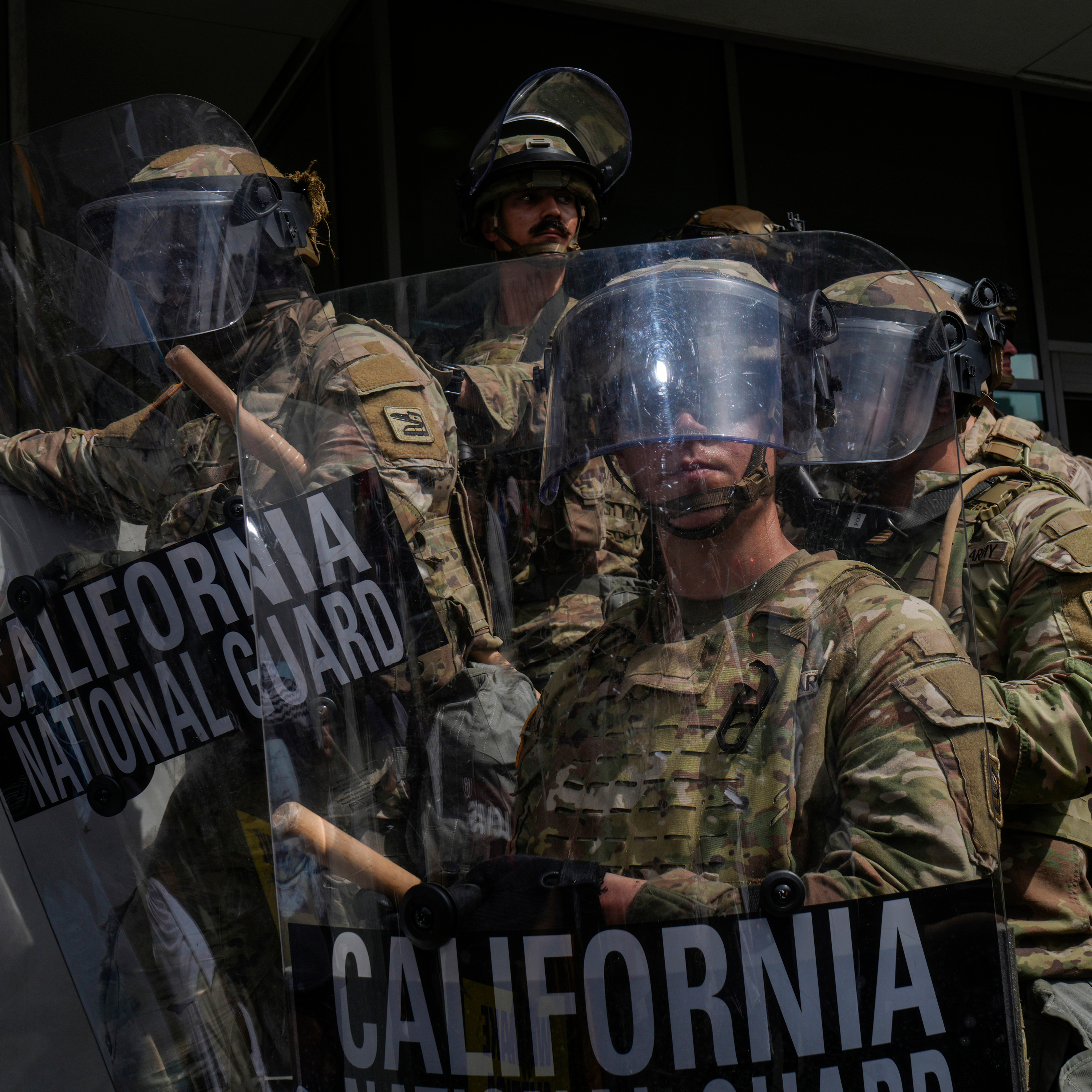
Despite a California lawsuit, National Guard troops and Marines are still on the ground in Los Angeles. And they're not just guarding federal buildings. They're spreading out through the city to accompany ICE officers on immigration raids. Is this about defending the Constitution, or is it about enforcing a political agenda? My guest today is retired Brigadier General Greg Smith. You're listening to More to the Story. Don't go anywhere. This episode is brought to you by Progressive Insurance. Do you ever find yourself playing the budgeting game? Well, with the name your price tool from Progressive, you can find options that fit your budget and potentially lower your bills. Try it@progressive.com, progressive Casualty Insurance Company and affiliates. Price and coverage match limited by state law. Not available in all states. This is More to the Story. Hello, I'm Al Edson. The National Guard has been around since colonial times. It's like the Swiss army knife of the military. Expected to cover a wide variety of tasks and skills, these civilian soldiers are called upon to help with everything from natural disasters to civil unrest. And more recently, the Trump administration ordered them into the streets of la not to just keep the peace, but to accompany ICE agents on raids. This controversial move has led to a legal battle between California Governor Gavin Newsom and the president. My guest today is retired Brigadier General Greg Smith, a teacher in civilian Life. Greg spent 35 years in the Massachusetts National Guard. Greg, thanks so much for joining me today.
- [02:14]
Greg Smith
Thanks, Al. Thanks for inviting me.
- [02:16]
Al Letson
Right now in Los Angeles, people are protesting ICE detentions and they were met with local police, the Marines, and the National Guard. Now, the Guard wasn't called up by Governor Gavin Newsom, but instead by President Trump. Under what authority did Trump have to order the Guard to become involved and why?
- [02:38]
Greg Smith
One of the things that's not well explained in the media is that the California National Guard, as soon as the president calls it to federal duty, stops becoming the State National Guard. So they are no longer answering to the state of California for its governor. They now have the same status as the 82nd Airborne, the 101st Airborne. They are federal troops at that point. That means that there are a whole lot of things that they can't do because they are no longer under state control. So the president, under the Insurrection act, can call up federal forces to protect federal facilities or quell an insurrection or protect citizens whose civil rights are being violated. President Johnson did this in 1965 in Alabama to protect civil rights demonstrators. What President Trump is alleging is that looting and property destruction are violating the civil rights of shop owners. So that's the authority he's using. But here's where it gets a little convoluted. He didn't use the Insurrection Act. He didn't say, I'm calling out the Insurrection Act. He went to an obscure section of Title 10, which governs the armed forces. And if your listeners care, it's section 12406, which authorizes the President to call up forces to protect federal facilities and federal personnel. However, the order is supposed to be executed through the state governor. That didn't happen, and that's the basis of California's lawsuit.
- [04:43]
Al Letson
So, as someone who's been in the Guard and been a commander in the Guard for many years now retired, what were your thoughts on watching this LA response and how it was organized?
- [04:55]
Greg Smith
I'll tell you my thoughts. My thoughts were, this is madness. Let me use the example of the Boston Marathon bombings. Civil support is a tiered response, leveled response. So when something happens, the local authorities respond. When they're overwhelmed, they say to the state, we need help. When the state resources are overwhelmed, they say to the federal government, we need help. That didn't happen here. The reason that it's a tiered response, Al, is to achieve something called unity of effort. And I'll say that again, it's a military term, but unity of effort basically says everybody is singing from the same hymnal, they're coordinated, they're moving together. There's also a concept called incident command. And what that is, is when madness is occurring, that there is one element that says, we're in command here. And the other elements say, okay, what do you need us to do? During the Marathon bombings, Boston police and the FBI did what was called a unified command. So when I'm pushing forces into the city of Boston, I'm in communication with them. Where do you need us? What do you need us to do? What resources do you need? That's not happening in la. You've got the police and the California Highway Patrol dealing with demonstrations and. And by the way, now you've got this whole other military group and there appears to be no communication between the two.
- [06:38]
Al Letson
Yeah, it seems like a recipe for disaster.
- [06:41]
Greg Smith
Yeah.
- [06:41]
Al Letson
So the courts have gone back and forth over the legality of Trump calling the troops without Newsom. I just want to dive through that legal stuff again. So we Already Talked about Title 10. What's Title 32?
- [06:54]
Greg Smith
Title 32 is Federal Funding for National Guard soldiers under the governor's command. So that's typically how you are paid and how resources are provided for an emergency, a flood, a hurricane, a wildfire. But title 32 is gubernatorial command and control. So title 32 has really nothing to do with what's going on in LA right now, because Governor Newsom has been really kind of shoved decide.
- [07:29]
Al Letson
Yeah, and state active duty.
- [07:31]
Greg Smith
So state active duty is when. And I worked on the state active duty a lot is when the governor says, hey, National Guard. And remember, the governor is the commander in chief of the National Guard. Hey, I need you to go sandbag that river. It's not a federal emergency, but I think it's pretty darn important from a stateside. So the money's coming out of the state budget, so. So to be honest, Al, the state active Duty Title 32 provisions are really about who pays the bill.
- [08:03]
Al Letson
Right. Okay.
- [08:04]
Greg Smith
They're both under the governor's command and control.
- [08:08]
Al Letson
Last technical question. What is the Posse Comitatus Act?
- [08:13]
Greg Smith
I'll tell you what it is, and then I'll tell you where it comes from, because it has a very interesting origin. Posse Comitatus is a long, strictly held concept which basically says you cannot employ federal troops to conduct law enforcement activities against people within the United States. Posse Comitata says law enforcement has that responsibility. Military does not. Not allowed. The only exception is the Insurrection act. And that really should only be invoked when there is a civil war. But we've seen presidents sort of use that act under less provocation. Posse Comitatus actually comes out of Southern states during Reconstruction because they didn't like Union troops stationed in Southern states enforcing voting rights. Posse Comitatus comes into the legal framework, I believe, in the 1870s or the 1880s, and it was really a move by the former Confederacy to get Union stabilization troops out of the South.
- [09:28]
Al Letson
So it was used in the Civil War, but it's actually like a good idea that the government cannot use military against its citizens.
- [09:38]
Greg Smith
Agreed. It's a good provision.
- [09:40]
Al Letson
So we talked about this a little bit earlier, but can you tell me what is the Insurrection act, and do you think it should be applied to the protests? I mean, does that act need reform?
- [09:50]
Greg Smith
Yes, yes, yes, yes. The Insurrection act needs reform. So the Insurrection Act, I'm not looking at notes, but I'm gonna say it's been used. Oh, goodness, probably a dozen times. President Eisenhower used it to desegregate schools in the South. President Bush used it in the Rodney King riots response, but that was at the request of the states. And that was the state governor saying, hey, I need help. I need federal troops in here to restore order. So that was, I would say, an appropriate use is when the governor says to the president, send help. But what's an insurrection? The courts have not defined it. And I'm going to go out on a limb and tell you I sure as heck think that January 6th was an insurrection. But we didn't have calling out the Insurrection act then. But the, the activities, the protests, the level of civil disobedience in Los Angeles, is that an insurrection? I'm not a lawyer, but that doesn't look like an insurrection to me. The Insurrection act needs reform. It needs specificity. Congress needs to take that up. And if they won't, then the Supreme Court needs to rule on what constitutes an insurrection.
- [11:18]
Al Letson
So you talked about this a little bit before, but I just want to go a little deeper. While you were in the National Guard, the Boston Marathon bombing happened in 2013. Tell me about that day and the role you played in command.
- [11:35]
Greg Smith
So the Massachusetts National Guard, probably since the Boston Marathon began, has always secured the route along the 26 miles up to the city of Boston. So I had done that as a young officer, and it's not tough duty. Al, you're out there very early, but the job consists of the runners are coming down the route. You're turning to the people behind you in the crowd and saying, hey, can you folks step back up on the curb? And they do. It's a very simple job. You Generally, by 2 o' clock in the afternoon, life is good. However, 2013, I'm at the finish line with Staff Sergeant Patrick Smith. I could not call him my driver. He was my guardian angel, my bodyguard, my conscience. So I'm with him and he's saying, hey, let's watch more runners. And I'm saying, no, no, no, no, no. I got stuff to do. Let's get back to headquarters. We were maybe 20 minutes away from the finish line when my BlackBerry went off. And I remember the voice of Colonel Mark Merlino saying, sir, there have been explosions at the finish line. There are multiple fatalities and widespread injuries. What are your orders? Life changed very quickly. So that's why we have training. We were very concerned about something called a Mumbai style attack, where the initial explosions are actually a feint to draw responders in, and then the ultimate attack follows afterwards. Some people have criticized me for that. You know, they say, well, don't you Feel silly when it turned out to be two people? No, I don't feel silly. You always plan for the worst. So that's how things played out. I will say this, I was unhappy that we were told that we couldn't be armed. And there were some hard words exchanged about that. We paired National Guard teams with armed Boston policemen because I didn't like the idea of soldiers being exposed to danger. Well, fast forward. When the Sarnaevs came up out of hiding, we armed. We actually didn't ask at that point. We just said if we're going after armed and dangerous terrorists, we have to arm ourselves. And so we moved into Watertown and we formed the net around the sir of apprehension area. I'm very proud of what what soldiers did.
- [14:24]
Al Letson
Coming up. Greg says they almost never put National Guardsmen on the street with the kinds of weapons they're using now.
- [14:31]
Greg Smith
Pistols are what we put them on the street with because it looks like law enforcement. It's less intrusive and it leaves their hands free to do other things.
- [14:43]
Al Letson
Did you see guardsmen with long arms in California?
- [14:49]
Greg Smith
Yes.
- [14:49]
Al Letson
Or at the protests in la?
- [14:51]
Greg Smith
Yeah, that's all they have.
- [14:53]
Al Letson
And you think that's a mistake?
- [14:55]
Greg Smith
I do.
- [15:00]
Al Letson
Before we get into that, it's summertime and that means more time to hang out with me, your favorite host. I know. I mean, that's just true right now. Look, I know Reveal is already queued up on that long road trip or maybe some time alone on the beach. We can hang out there. It'll be great. But listen, don't keep Reveal to yourself. Tell your friends about us. Come on, make it official. Feel free to give us a rating and review to help others discover the award winning reporting from Reveal. Okay, we'll be back soon with more from Greg Smith. Don't go anywhere.
- [15:38]
Greg Smith
Hi, this is Marla from the human resources team at the center for Investigative Reporting. Subscriptions, paywalls? No, not here. We believe that groundbreaking journalism should be accessible to everyone. If you can pitch in just a little, please donate today. Just text the word give to 88857 reveal. That's 888-577-3832 or visit revealnews.org donate. No gift is too small. Thank you.
- [16:22]
Al Letson
This is more to the story. I'm Al Letson and my guest today is Greg Smith, a retired Brigadier general in the National Guard. The question I have for you is that in your book, there were times where you talk about guardsmen being relentlessly taunted for hours on end by protesters. Do you think that A guard should have weapons at a protest.
- [16:45]
Greg Smith
So if I can tell another story.
- [16:48]
Al Letson
Yeah, please.
- [16:49]
Greg Smith
When I was very, very Young, I was 24 years old. I was quickly dispatched to a civil disturbance with a force of 40 soldiers, who, by the way, were not the 40 soldiers that I usually commanded. They were the first 40 people to arrive. And somebody said, Lieutenant Smith, take those 40 people and get over and secure that state hospital. The context, which doesn't really matter, but the legislature had declined to fund the budget. The state workers who manned the hospital had gone on a payless payday. And they were angry and they wanted to shut down the hospital. But there were people in the hospital that were on life support. I'm sure you can understand the crisis, Al.
- [17:38]
Al Letson
Yeah, it's tense.
- [17:39]
Greg Smith
So at night we're out there trying to hold back these very angry workers who haven't been paid. Things get worse at night because people have a sense of anonymity. So there was a lot of pushing and shoving. There was a lot of spitting, kicking, those types of things. You know, soldiers are human and you can really only take so much of that before you're. You sort of become tense. So at one point, one of the protesters broke through the line and he grabbed me by the shirt and he said, I want your name. You're in charge here. I want to know who you are. I'm 24 years old, I'm an army lieutenant. He's a drunk, middle aged guy. I grabbed him by the shoulders and I pushed him back outside the picket line. And I said, I don't touch you. You don't touc. What I didn't realize is that he stumbled and he fell and everybody laughed at him. About 15 minutes later, it's pitch black, there's this scuffle and my guys are taking somebody down to the ground and the police, we had a couple of policemen with us are cuffing this guy. And I look down and I realize it's the guy who had grabbed my shirt. He had a baseball bat and he was coming to use my head as a fastball. So let me go. Five days from there. So the operation goes on. This is in the summer. Five days later, it's afternoon and I'm out looking for soldiers on the picket line because I'm back and forth in the hospital looking at our soldiers who are doing operations like feeding and changing beds and. And I can't find the picket line. It's gone. There are no protesters, there are no soldiers. And I look behind this bush and everybody is sitting in the Grass with a case of Budweiser in the middle of them. And they're all drinking their beers, having a great time. Soldiers, protesters, all together. I'm a lieutenant. This can't be drinking on duty. I took two steps forward and I said, what's the mission here? To keep peace. That's about as peaceful as anything's going to get.
- [20:02]
Al Letson
Absolutely.
- [20:03]
Greg Smith
So I shut my mouth and I went back to the hospital. But here's my point. On night one, we would have killed each other. On day five, we were drinking beer together. What I learned is the first mission in crowd control is to de escalate the situation. You don't push people down so that other people laugh at them to try to defuse the situation. Took me a while to learn that.
- [20:30]
Al Letson
Do you think that kind of training is being given to the guards now as far as like to be able to work with protesters? I think that some of our rhetoric when we talk about these protests, when we talk about these clashes, is that the people that you are up against are like your sworn enemies and not fellow Americans. And I feel like that's the missing piece on both sides is that we're not looking at each other like we are fellow Americans, like that we all have stake in this thing and people's First Amendment rights should be respected and the give and pull between how that respect is shown. I'm just curious, is anybody being trained in that fashion?
- [21:19]
Greg Smith
The answer is yes and no. Remember, Al, that as a citizen soldier who's only available for training for a relatively short period of time, there's a lot that has to be done. Weapons qualification, physical fitness, nuclear, biological and chemical training. You know, how to wear a gas mask and protect yourself. First aid, I could go on and on and on and on. Some units get very good crowd control training. When National Guardsmen go into a crowd control situation, they've got, I want to say, three priorities. One, to secure whatever it is they're securing, they're always either securing a building, protecting a group of people, or there's an objective to be secured. Two, they are making sure that no one's rights are being abused. So they are very aware of free speech rights. People can say what they want to say, do what they want to do. The line becomes fuzzy when punches are thrown. Kicks are, where is the line between assault and acting out? And the third thing is safety, to make sure that no one is hurt or killed. So they're aware of that. I'm confident that they know what they're doing there in terms of how to do it and whether they've been specifically trained on crowd control. Maybe, maybe not and probably not.
- [22:59]
Al Letson
Yeah. Which does that concern you when watching what's happening in Los Angeles?
- [23:06]
Greg Smith
So, you know, I certainly don't want to hold myself up as, you know, some guru, but in Massachusetts, when we had to put troops into civil support missions, we generally went to military police organizations or air security police. They have some training around this in terms of their basic job training. They also are likely to also be law enforcement personnel. Remember, when you get a guardsman, you're getting a soldier and you're getting some other profession. So mainly military police and air police units are full of cops. So putting them on the street to do crowd control is a good thing. They know how to do that. I didn't see any effort in LA for them to recruit military police. Mainly because military police will wear an armband that says mp. I didn't detect any of that. It would have been wiser for California to activate their military police units because there's a much higher level of expertise. And I will also tell you this, we very rarely, almost never put National Guardsmen on the street with long arms. Pistols are what we put them on the street with because it looks like law enforcement, it's less intrusive and it leaves their hands free to do other things.
- [24:44]
Al Letson
Did you see guardsmen with long arms in California?
- [24:50]
Greg Smith
Yes.
- [24:50]
Al Letson
Or at the protests in la?
- [24:52]
Greg Smith
Yeah. That's all they have.
- [24:53]
Al Letson
And you think that's a mistake?
- [24:56]
Greg Smith
I do, yeah.
- [24:59]
Al Letson
So my last question to you is the National Guard has been such a huge part of your life and career. Seeing what's happening right now, how concerned are you about the Guard being used for political purposes?
- [25:14]
Greg Smith
Hugely. I mean, I am a citizen soldier. I believe that what makes the United States military unique is that we don't give up our citizenship. And so therefore the military needs to be comprised of people who are progressive, conservative, socialist, I don't know, vegan, carnivores, all sorts of people. And it needs to be that way because we are a pluralistic, expansive society. And the military needs to be able to be an honest broker, a fair minded force that protects everybody regardless of what their opinions are. I'm watching the military becoming co opted by politicians and where that leads is some really troubling places. Not only are people starting to doubt whether the United States military would protect them because of their political leanings, but now people are becoming nervous that the military may be used to enforce a political agenda. If that happens al the roots of our democracy are in extreme danger. The United States military has always accepted that we work for civilian leadership. We've never challenged that. But we've also always maintained that while we work for you, you don't own us. Your party does not own us. There are questions arising about that nowadays, and that makes me fearful.
- [27:04]
Al Letson
Well, it feels like that is specifically what Secretary of Defense Pete Hegseth wants, is that he wants a military that is completely loyal to not the Constitution, but to President Trump.
- [27:19]
Greg Smith
I'm very glad that you mentioned that. Commitment to defend the Constitution is the oath we swear over and over and over again. The president is not part of it, only in respecting the fact that he is the commander in chief of the armed forces under the Constitution. But we are devoted to the Constitution. So, yes, I have concerns.
- [27:44]
Al Letson
Greg Smith, thank you so much for coming in and talking to me today.
- [27:48]
Greg Smith
Yeah, thanks, Al. It's been a pleasure.
- [27:53]
Al Letson
That was retired National Guard Brigadier General Greg Smith. If you like this interview, I really think you should check out one of our earlier episodes called Trump's Mass Deportations are Decades in the Making. It's a conversation with New Yorker staff writer Jonathan Blitzer where he breaks down how entrenched dysfunction gave Trump a window and to radically remake US Immigration. Lastly, just a reminder, we are listener supported. That means listeners like you, you can help us thrive by making a gift today. Just go to revealnews.org gift again, that's revealnews.org gift and thank you. This episode was produced by Josh Samburn, artist cheriscus and Kara McGurk Allison theme music and engineering helped by Fernando Mamano Arruda and Jay Breezy. Mr. Jim Briggs, I'm Al Letson. And you know, come on, let's do this again next week. This is more to the story.
- [29:08]
Greg Smith
From prx.