Loading summary
Transcript254 lines
- [00:01]
Podcast Host (TED Talks Daily)
Add a little curiosity into your routine with TED Talks Daily, the podcast that brings you a new TED Talk every weekday. In less than 15 minutes a day, you'll go beyond the headlines and learn about the big ideas shaping your future. Coming up, how AI will change the way we communicate, how to be a better leader and more. Listen to TED Talks Daily wherever you get your podcasts
- [00:26]
Al Letson
from the center for Investigative Reporting and prx, this is Reveal. I'm Al Letson. South of Downtown Nashville, Interstate 65 cuts through the city and over a piece of American history that's literally buried underground beneath the soil and concrete. Just above the highway here, near a guitar sign, construction cranes, new luxury apartments, and even a brand new soccer stadium, there's a hill that most people driving by don't even notice. And on it, a massive stone fortress called Fort Negley. The Union army built it during the Civil War to defend Nashville from the Confederacy. But what makes this fort remarkable isn't the generals who commanded it. It's the people who built it. Thousands of black men, women and children, many who had just escaped slavery, were enlisted as labor to quarry the stone and raze these walls. And after the war, some of them stayed.
- [01:24]
Angela Sutton
The entire fort was surrounded by neighborhoods of people who had descended from the black veterans of the Civil War.
- [01:29]
Al Letson
Angela Sutton runs the Fort Negley Descendants Project. She says that for decades, the heart of this community was Bass Street. Then in the late 1950s came the
- [01:40]
Angela Sutton
interstate, when it was time to put the highways in most cities in the nation, sort of put them through the neighborhoods that they had blighted because get rid of two problems that way, right? And so it was called the urban renewal. And that happened here, too. So our Bass street neighbors all got forcibly relocated into homes.
- [02:03]
Al Letson
What are the remnants of Bass street that have been lost and buried? What could they tell us about our shared history, who we are and what we've been through? Two years ago, Angela and a team of archaeologists received a Federal humanities grant to collect oral histories from families whose ancestors lived here.
- [02:22]
Angela Sutton
And then use those oral histories to go and determine where we should dig in order to find out more about the Civil War soldiers and veterans who gave their lives and built their families here in this space.
- [02:34]
Al Letson
The excavations began, turning up traces of the community that once lived here. Old building materials and scraps that people used from around the city to make their homes. Children's things, small chalkboards, pencils and marbles and. And bullets believed to be from a battle when residents defended themselves against the Klan. The project is led by historians and descendants of the families who lived here. Their work has helped inform a broader effort by the city to preserve the site. But the research itself depended on federal funding. Then last spring just got an email
- [03:11]
Angela Sutton
out of the blue saying, please stop, you're done.
- [03:14]
Al Letson
The National Endowment for the Humanities was rescinding Angela's grant. It wasn't just this project. Across the country, more than a thousand grants, both from the NEH and the National Endowment for the Arts, were suddenly canceled. They added up to over $100 million. It was a part of a sweeping shift in federal culture funding, and it came on the heels of a series of executive orders from President Trump aimed at reshaping the federal government. One targeted what it called gender ideology extremism. Another moved to end federal diversity, equity and inclusion programs. Another promised to restore truth and sanity to American history. It's a shift that's making artists, historians, and communities rethink the work they're doing. And to ask what happens when the government decides certain stories and certain points of view no longer deserve support, that question has also been on the mind of Reveal's Jonathan Jones. So this January, he started driving the same highway that runs past the old Fort, Interstate 65, traveling south from Tennessee into Alabama. He wanted to meet people directly affected by the cuts as they try to figure out what happens next. Where the fight isn't just about what was cut, but about who gets to decide what counts as American.
- [04:35]
Jonathan Jones
Exit right to I65 South, US31 south toward Huntsville. Here's one thing I did not expect on my road trip through the South. Snow.
- [04:47]
So it's Tuesday. It was a terrible Snowstorm shut down i65. But now the roads are clear. At least the highway is. I first read about the cuts to
- [04:58]
arts organizations in this part of the country last summer in the Nashville Alt Weekly. What interested me was the range of
- [05:05]
what the cuts touched.
- [05:07]
Film, theater, dance festivals, stuff that you might just take for granted in your community. I wanted to understand what this money actually does and what changes when artists are told their work is no longer in the national interest. What does it change in America?
- [05:28]
Narrator/Interviewer
In 0.2 miles, you'll arrive at Studio by the Tracks.
- [05:32]
Jonathan Jones
Your destination will be on your right, approaching a railroad crossing.
- [05:38]
Studio by the Tracks is a small art studio in Irondale, Alabama.
- [05:44]
When I pull up, it's this little
- [05:46]
white building across from the railroad tracks. Tables out front, a yellow door and a handmade sign in the window. Hi.
- [05:54]
I made it.
- [05:55]
Studio Staff Member (Boo)
You made it.
- [05:59]
Welcome to Studio Miller Track.
- [06:01]
Jonathan Jones
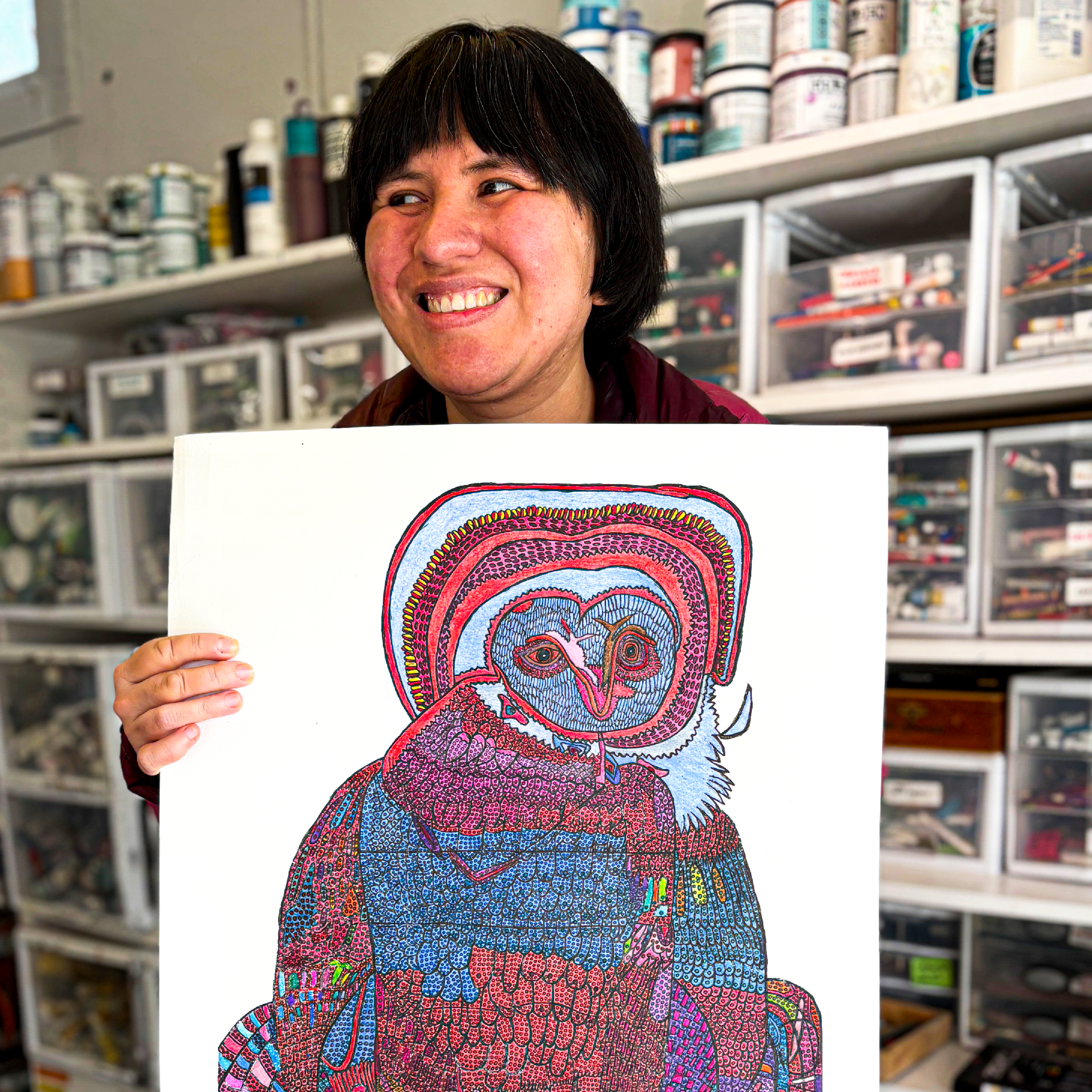
That's Gilder, the executive director the studio was created for adult artists on the autism spectrum. Boo shows me around. And just to be clear, this isn't art therapy. The artists here make their own work and they sell it. It's pretty much what you would expect a busy studio to look like.
- [06:21]
Studio Staff Member (Boo)
It's kind of a weirdly bustly kind of day, so we have an artist residency program, and one of our artist's residents, he's making a video to include in his artwork.
- [06:32]
Jonathan Jones
Tables splattered with paint, stacks of paper, shelves full of supplies. Could I just ask you your name?
- [06:42]
Laura Braman
Laura Braman.
- [06:43]
Jonathan Jones
Laura's working on a watercolor of magnolias. She's 33 years old and lives in Trussville, another suburb of Birmingham, just down the road.
- [06:52]
Laura Braman
Watercolor's basically new to me. I've never really known this many techniques, but I'm really a big gardener, as you can see. And I love it here. The work, the staff, the clients here, everybody here. I feel really at home here, really comfortable. My art comes from my feelings and from my heart. So art is basically my life. It's my solace, it's my comfort. It's my safe place.
- [07:23]
Jonathan Jones
She tells me that sometimes she comes in here stressed, can't focus. And everyone here understands that, that some days are just like that.
- [07:32]
Laura Braman
I don't know what I would do without the place.
- [07:34]
Jonathan Jones
The studio was founded on the basic
- [07:36]
premise that once young people on the spectrum become adults, there are almost no services for them.
- [07:42]
So this is a place where they can come every day and keep creating.
- [07:46]
Willow Molina, a collage and multimedia artist, says the autistic community tends to be misunderstood.
- [07:53]
Willow Molina
Not everyone who's on the spectrum is going to be as verbally articulate as I am. We have a number of nonverbal artists here and through their work, and each even just their body language and their mood and the energy that they give off through the creation of each piece teaches us more about them than any theoretical conversation or therapy might.
- [08:13]
Jonathan Jones
Willow and Boo both tell me about one of their favorite artists. He's non verbal. He walks in the door, sits down, and starts working immediately, mostly doing watercolor and pastels on wood panels. And he won't stop until class is over. His paintings are abstract fields of color and motion, bold strokes pressed up against each other. You can see the movement of his hand in every line, meeting color, building into these layered, almost explosive compositions.
- [08:45]
Willow Molina
Byron does these gorgeous, really saturated color scapes. I reconfigured one of his pieces into what looked like an aquarium, and it was really cool.
- [08:56]
Laura Braman
I am not together
- [08:59]
Jonathan Jones
the studio had been awarded a $95,000 grant, spread over three years. They got the first year, then last year the remaining funding was withdrawn. Boo tells me keeping a place like this open is a constant balancing act. Public money, donations, membership, just enough to pay staff, buy supplies, and keep consistent hours. And there's an art to all that, too.
- [09:25]
Studio Staff Member (Boo)
What I did not expect was that money that we had already been promised would be revoked. That was a really big surprise to me personally. Like, you assume when you make an agreement with the federal government that they are going to hold up their side of the agreement. In the nonprofit world, you're swimming in uncertainty. So it's just another level of promises not kept.
- [09:54]
Jonathan Jones
Boo doesn't talk about the quality of the art that's produced, although some of it is stunning. She talks about the studio as a kind of community, a place where people feel seen and supported. She says that when we as a country decide to fund places like this, we're saying people with developmental disabilities aren't on the margins of American culture, they're part of it. And when the government takes away that money, it feels like they're telling the people here, you don't belong.
- [10:25]
Studio Staff Member (Boo)
And one of the most valuable things I learned was the value with what I call art with a lowercase a, like the value of everyday making that is got innate value that probably ends up as a finished piece, but maybe not. It's not just putting pen to paper. It's talking about your ideas. It's building something from the ground up. It's seeing something take form. It's seeing other people be invested in your creativity.
- [11:02]
Jonathan Jones
The next day, I meet Chuck Holmes in a quiet corner of the Birmingham Public Library. He runs the Alabama Humanities alliance, the state council that distributes money across Alabama. We're not meeting at his office because he no longer has an office. After the NEH cuts, he couldn't afford one anymore.
- [11:23]
Chuck Holmes
When you add up the cost of an office, that's a full time position. And I wanted to go virtual rather than have to lay off somebody on my staff.
- [11:34]
Jonathan Jones
For decades, money flowed from Washington to state councils like his trusted local agencies that helped decide which projects got funded, and then out into communities. In 2024, Chuck's organization distributed about $400,000, reaching about a quarter of a million Alabamians. These are mostly small grants to libraries, schools, senior centers, and community events. And then in April 2025, the cuts came down and their entire operation almost came to a screeching halt.
- [12:10]
Chuck Holmes
It's created a sense in communities of like, let's watch our spending. Let's be careful. Let's not maybe do programs. If they annually thought they were going to get grant funding from us and it's not there anymore, what do you do? Well, you don't do it.
- [12:27]
Jonathan Jones
I asked Chuck about something. You hear a lot from critics these, that federally funded art and culture have become a vehicle for some kind of liberal ideology. He says they have sent educators into the field to deepen how civil rights history gets taught in Alabama. And they funded something called Healing History, an initiative bringing people from different backgrounds together to talk about the state's past. But Chuck says the goal isn't pushing some sort of left wing agenda.
- [12:56]
Chuck Holmes
We're not a bunch of bomb throwers here. We're trying to give people opportunities, trying to get people to see each other as fully human. There's no political agenda here.
- [13:05]
Jonathan Jones
I can imagine a critic or a critic of the arts and humanities saying, they're dividing us. They're pitting groups against each other. They're making us feel bad.
- [13:15]
What would you say to that?
- [13:16]
Chuck Holmes
Yeah, and I get it. And people do sometimes say they feel bad. And I think maybe feeling bad is the cost of living in a democracy. When you're looking at your own history. I can't measure how somebody feels in their heart or what's in their head before or after that conversation. But I can say that we've created a conversation that would not otherwise have taken place about sometimes some pretty hard topics in our state history and our national history. And I just think it is part of our history. Is it black history? Is it white history? We call it shared history.
- [13:59]
Jonathan Jones
I've been driving up and down this stretch of highway between Alabama and Tennessee for days now. Downtown Birmingham, west side neighborhoods, little towns like Pulaski, places that, depending on who you ask, are either struggling or reinventing themselves. And what I started to see was can't really separate the arts and humanities from the life of a town. These places are what bring people together to see each other, have a conversation or a good time, and, yeah, spend money that helps keep everything else going.
- [14:38]
Podcast Host (TED Talks Daily)
Hi, everybody.
- [14:40]
Dennis Barry
Hey.
- [14:41]
Jonathan Jones
Hi.
- [14:42]
Narrator/Interviewer
Thanks for being here at our first
- [14:44]
Al Letson
book in the film club of 2026.
- [14:48]
Jonathan Jones
Take Sidewalk Film center in downtown Birmingham.
- [14:52]
It's an independent cinema tucked into the
- [14:54]
basement of a historic building.
- [14:56]
Part movie theater, part community living room and home to the city's biggest film festival.
- [15:03]
Tonight, there's like a film and book club here. Small, little local cultural space here in downtown Birmingham. It helps Alabama folks tell stories about Alabama in the Lobby. Young filmmakers are hunched over laptops. One of them is Justice Anderson, a local filmmaker who found his footing here.
- [15:27]
Justice Anderson
I came down here for the Black Focus Night in 2023, and I was
- [15:33]
Larry Jarvik
kind of just blown away in a
- [15:36]
Justice Anderson
way that I've never seen a theater like this or a place like this. I'm from a really small town, so I have to drive 20 to 30 minutes to go to any theater. You walk out of here and you just want to talk about the film you just saw for hours. Some people just may not realize that, and they're taking it for granted.
- [15:52]
Jonathan Jones
And what's clear was that Sidewalk isn't some cultural war indoctrination. It's simply a community hub. So when they lost their NEA funding, the community responded. Chloe Cook, the executive director of Sidewalk, tells me that a local brewery reached out asking what they could do to help. And tattoo artists started selling film themed designs to fundraise.
- [16:17]
Studio Staff Member (Boo)
And I just thought, like, what in the. Like, this is incredible, you know, to see this just like other people getting creative and saying, like, how can we step in and what can we do? The show's gonna go on. And people rallied to help us figure out how to make that happen.
- [16:33]
Jonathan Jones
I love that story. But then I'm also like, people had to tattoo, put tattoos on their body
- [16:41]
to save the Sidewalk Film Festival.
- [16:48]
Then you drive to Ensley, west of downtown Birmingham. You meet people like Eric Marable Jr. And Jamon Hill at an organization called Flourish, where they're building a black arts and cultural district in a neighborhood that's been long overlooked.
- [17:04]
Al Letson
We as black people are not just the suffering that you hear about on the news. There's beauty being created here.
- [17:10]
Jonathan Jones
These aren't just arts organizations. They're small businesses, youth mentoring places, rooms where people talk and can be heard. And then if you head north, you'll come to Pulaski, Tennessee, a town of about 8,000 people with a long and difficult history.
- [17:29]
Kelly Hamlin
If you know one thing about Pulaski, it's probably that Pulaski is where the original clan was founded. And it's absolutely the truth. There's a lot more to our community than that.
- [17:38]
Jonathan Jones
Kelly Hamlin wants people to know Pulaski's story is about more than just the Klan. She runs Wolf Gap with humanities grant funding. Her organization helped excavate a one room schoolhouse and church built by formerly enslaved residents in the 1880s. They hosted a homecoming for descendants, ran lights off a generator, and recorded oral histories before the elders were gone.
- [18:04]
Kelly Hamlin
We could just never know anything about the stories and the people. And it would be pulling up an anchor that people didn't even know they had.
- [18:17]
Jonathan Jones
This is what holds communities together. A book and film club on a Wednesday night, an improv group in a basement, a poetry slam in a neighborhood. People once wrote off a one room schoolhouse brought back to life with a generator and plastic chairs. And for decades, the country made the quiet decision that this small local work was worth a modest amount of federal support because it wasn't about taste. It was about whether communities get to tell the stories of who they are, of who we are.
- [18:56]
Al Letson
Coming up. While some projects lose funding, others are being fast tracked. We follow the money and the culture wars behind them.
- [19:04]
Larry Jarvik
It's about the quality of art. The more federal funding, the lower quality it will be.
- [19:09]
Al Letson
That's next on Reveal.
- [19:26]
Victor Sweezy
I'm Victor Sweezy, host of the Land in Between from the Global Reporting Center. Join us on a trip to the Republic of Georgia, a country at the crossroads of the EU and Putin's Russia. From the tear gas filled streets of the capital to the manicured gardens of a billionaire oligarch, I'll take you to a critical moment in Georgia's history and explore what it means for the future
- [19:49]
Jonathan Jones
of our world order.
- [19:53]
Victor Sweezy
Subscribe now, wherever you get your podcasts
- [19:59]
Al Letson
from the center for Investigative reporting and PRX. This is Reveal. I'm Al Edson. In 1965, President Lyndon B. Johnson signed a law creating the National Endowment for the Arts and its sister agency, the National Endowment for the Humanities.
- [20:16]
Larry Jarvik
We will create a national theater to bring ancient and modern classics in the theater to audiences all over America.
- [20:27]
Al Letson
The idea was simple. Arts and culture should belong to everyone. And for decades, the arts and humanities had bipartisan support. The money flowed to big cities and small towns, every congressional district in the country, including individual artists.
- [20:42]
Jane Alexander
Would it fund the big dance and symphonies? Yes, but it would also fund the a little place down the road where you could take your child after school and they would learn how to dance, ballet or jazz or tap.
- [20:57]
Al Letson
That's Jane Alexander. She chaired the National Endowment for the Arts from 1993 to 1997, another moment when the agency was under attack and fighting for its survival.
- [21:09]
Jane Alexander
They ran into some problems with a very partisan part of Congress that wanted to end the NEA immediately.
- [21:18]
Al Letson
In the late 1980s, a photograph of a crucifix against a yellow and reddish backdrop, provocatively called Piss Christ, ended up on the Senate floor. The artist Andres Serrano was under fire for having received NEA funding through a visual arts award. Then came Robert Mapplethorpe Robert Mapplethorpe was
- [21:39]
Jane Alexander
really a well known fellow, but his photographs were pretty extraordinary. The ones that caused the trouble for the NEA were portraits of black gay men naked. They were beautiful. You could liken them to some of the great Roman statues.
- [21:58]
Al Letson
Mapplethorpe's exhibit created controversy for a museum in Cincinnati.
- [22:03]
Dennis Barry
Good evening. The eyes of the nation are focused on Cincinnati tonight.
- [22:06]
Al Letson
The Contemporary Art center and director Dennis
- [22:08]
Dennis Barry
Barry are charged with obscenity for pictures in the Robert Mapplethorpe art exhibit.
- [22:13]
Al Letson
Museums were on trial. So was the nea.
- [22:17]
Jonathan Jones
How can you engage in sadomasochism, homoeroticism without its being obscene?
- [22:25]
Jane Alexander
There were congressmen that really wanted the elimination of the nea. So then I was in the trenches for the next few years just fighting for the agency.
- [22:35]
Al Letson
Congress responded with new restrictions on the agency. Lawmakers debated a proposed ban that explicitly targeted homoeroticism and eventually added a decency requirement to the NEA's statute. The budget was cut and Congress eliminated most direct grants to individual artists. The agency survived, but the culture wars had arrived. Back then, one of the loudest voices arguing that the NEA should disappear was a Heritage foundation fellow named Lawrence Jarvik.
- [23:09]
Larry Jarvik
Well, you can call me Larry.
- [23:10]
Al Letson
So reveals. Jonathan Jones reached out.
- [23:17]
Jonathan Jones
In a 1997 paper, Larry laid out his case for eliminating the NEA.
- [23:22]
Part of it echoed the moral outrage
- [23:24]
of that era over art some critics
- [23:26]
called obscene or offensive.
- [23:28]
But his main pitch was more libertarian. The government shouldn't be in the business
- [23:33]
of subsidizing art in the first place. He argued the arts would thrive without
- [23:38]
federal money, that subsidies lowered quality by
- [23:42]
propping up art that wouldn't survive in the free market, and that NEA funding promoted art not based on merit, but on race, ethnicity and identity. I asked him if it was important
- [23:54]
that the country ensure all Americans and
- [23:57]
have the opportunity to make art and tell their story.
- [24:00]
Larry Jarvik
This is a straw man argument. There's no barrier to participation. Nobody, every city I know of, has some kind of art center or museum or art classes in school or camps or whatever. I mean, there's no barrier. Nobody's putting up a barrier and saying you can't come in. I mean, it's not true. If you go on the Internet, you go to your public library, you can get art lessons. I say leave it to the local level.
- [24:28]
Jonathan Jones
I've been out in the field. I mean, there were like dozens and dozens of art projects that had their grants terminated in Tennessee and Alabama, which was where I'm focusing at.
- [24:37]
Larry Jarvik
That's why you shouldn't Rely on government priorities. If you just sold tickets or books or radio commercials had a sponsor, you wouldn't be dependent on the whims of whichever administration came in. That's another reason not to have it in the first place.
- [24:51]
Jonathan Jones
At the core of this critique is the market. Good art should survive on its own. If it can't, then maybe it shouldn't.
- [24:59]
Larry Jarvik
It's about the quality of art. The more federal funding, the lower quality it will be.
- [25:04]
Jonathan Jones
I'm not like, to me, it's about the quantity of art and humanities.
- [25:09]
Larry Jarvik
Let people go out on their own and do what they're going to do and not be dependent on this sort of fentanyl coming out of the federal government in the terms of subsidy.
- [25:21]
Jonathan Jones
This idea that government money creates dependency and makes art worse isn't new. Ronald Reagan initially proposed eliminating the nea, but a task force of arts leaders and conservatives, including the actor Charlton Heston, urged him to keep it, arguing the agency was doing important work. So it survived. Since the late 80s, the conservative argument has mostly been about whether the government should be funding arts and culture at all. Under Trump, though, that's not really what
- [25:53]
the fight is about.
- [25:55]
Larry Jarvik
There are no cuts, okay? You saw it. They're getting the same amount this year as they got last year. They say they're cuts. They're no cuts. I mean, I wish they'd be cuts. I wish it was cut to zero, but there are no cuts.
- [26:08]
Jonathan Jones
Larry's right. The government didn't really cut the budgets of the NEA and the Nehemiah. They're still getting roughly the same amount of money as before.
- [26:17]
So it's hard to argue this was
- [26:18]
about reducing wasteful spending. What's changed is what the money can be used for and who gets it. The Trump administration has reshaped the endowments around the President's priorities.
- [26:30]
Dennis Barry
In my campaign for President, I pledged to give America the most spectacular birthday party the world has ever seen for America's 250th anniversary.
- [26:40]
Jonathan Jones
And he's using federal arts and humanities money to help pay for it.
- [26:44]
Dennis Barry
Yesterday, I signed an executive order to create a brand new monument to our most beloved icons. The National Garden of American Heroes will be a vast outdoor park that will feature the statues of the greatest Americans who have ever lived.
- [27:07]
Jonathan Jones
Larry says if groups want federal money, there's a lane for it.
- [27:11]
Larry Jarvik
They can just. Each one of them can just do a patriotic art thing for the 205th. It's not going to be hard. And they want to play that game. They can do, you know, George Washington or Rosa Parks is on there and you've got Muhammad Ali on there. It's not hard to pick a name to do something to get a grant if you want to be in that system.
- [27:34]
Jonathan Jones
An artist can pick names for the
- [27:36]
Garden of Heroes statues from a pre
- [27:38]
approved list that includes everyone from the Founding Fathers to Jeopardy. Host and Canadian Alex Trebek, former Lakers
- [27:47]
star Kobe Bryant, and Johnny Appleseed.
- [27:49]
For giving me the things I need. The sun and rain and an apple seed. Yes, he's been good to me.
- [27:58]
Dennis Barry
The people that, that we can look up to and that our children and grandchildren and great grandchildren can look up to into the future and they can say, isn't America just a tremendous place?
- [28:14]
Jonathan Jones
We requested interviews with both the NEA
- [28:17]
and the NEH about the grant cancellations, their new priorities, and how those decisions were made.
- [28:24]
The NEH did not respond, and the NEA declined to make anyone available for an interview. Congressman Shelley Pingree is the top Democrat
- [28:33]
on the House Appropriations Subcommittee which oversees federal arts and humanities funding. I asked her whether she sees this
- [28:41]
as money being redirected away from small nonprofits and community groups towards projects favored by the President.
- [28:49]
Absolutely.
- [28:50]
Congresswoman Shelley Pingree
You can absolutely say that. So the President doesn't have all this power. He doesn't have it legally and he doesn't have it constitutionally.
- [28:57]
Jonathan Jones
She says America 250, a bipartisan celebration of the nation's founding approved by Congress is one thing, but repurposing arts and humanities money to help build more than 200 figures for the President's Garden of Heroes is something else entirely.
- [29:16]
Congresswoman Shelley Pingree
I think it's about 34 million, half from the NEA and NEH to create his sculpture Garden of Heroes. We don't have a lot of information on that. He also got some other outside money on that, but that is 200,000 doll sculptures of the President's Choice created by artists of the President's choice in materials of the President's choice. So, I mean, I think we're in extremely dangerous territory.
- [29:41]
Jonathan Jones
Pingree says the real danger is that artists and institutions will start censoring themselves to survive.
- [29:49]
Congresswoman Shelley Pingree
This whole idea that museums and libraries and artists and everyone who wants to have a future is going to start complying in advance is the most worrisome thing at all. I think it's horrific.
- [30:06]
Al Letson
Coming up, as the political climate shifts under President Trump, artists and arts organizations try to figure out how to respond and fight back.
- [30:16]
Daniel Jones
I don't know if people are afraid. We're angry, we're angry. We're determined to continue the Work that we've been doing.
- [30:24]
Al Letson
That's next on Reveal. From the center for Investigative Reporting and prx, this is Reveal. I'm Al Letson. When the Trump administration announced it was clawing back more than a thousand arts and humanities grants, some organizations decided to fight back. Rhode Island Latino Arts sued the National Endowment for the Arts, arguing that federal restrictions on projects violate their right to free speech. The group's executive director is Marta Martinez.
- [31:05]
Marta Martinez
They were very specific that we could not promote gender ideology. And it was very vague, I guess. What does that mean exactly? That was what was confusing.
- [31:15]
Al Letson
Last summer, MARTA was planning to apply for funding for theater work, and one of the projects in development was an adaptation of Doctor Faustus, the story about a scholar who makes a deal with the devil. It was staged by an openly queer playwright, and the production involved actors shifting between male and female roles.
- [31:35]
Marta Martinez
I didn't want to go up to all the two of them and said, cut it out. You can't do that. You can't be who you are. And it was with that in mind that I became concerned about this particular executive order.
- [31:48]
Al Letson
For marta, it was about the First Amendment artistic freedom, and what happens when the government starts deciding which stories deserve to be told.
- [31:57]
Marta Martinez
It becomes a dictatorship. We're told that this is how we should say it, this is when we should say it. You know, eventually we might be told how to dress. Actually, we are being told how to dress in a way.
- [32:10]
Al Letson
At the same time, another lawsuit was targeting a different federal agency. The Authors Guild sued the National Endowment for the Humanities, arguing that the government had no legal right to yank back grants that had already been awarded.
- [32:25]
Narrator/Interviewer
This is the first time politics has entered the decisions not only what to grant, but also to terminate.
- [32:34]
Al Letson
Mary Ratzenberger runs the Author's Guild.
- [32:36]
Narrator/Interviewer
And they did it without any expertise, any understanding or knowledge of what these grants were for and what they were doing based on these keyword searches.
- [32:49]
Attorney/Interviewer
What LLM did you use?
- [32:51]
Justin Fox
OpenAI.
- [32:53]
Attorney/Interviewer
So you used an LLM to screen the grant descriptions for certain terms?
- [33:02]
Justin Fox
Yes.
- [33:02]
Al Letson
Okay, that's Justin Fox, a staffer with the Department of Government Efficiency who testified under oath that he and other Doge staffers ran humanities grant descriptions through AI for certain keywords like diversity, equity, inclusion, and lgbtq. The lawyers start walking through specific grants that were cut, including an indigenous language preservation project.
- [33:27]
Attorney/Interviewer
What's wrong with promoting a language center?
- [33:30]
Jonathan Jones
Objection.
- [33:32]
Justin Fox
It's wasteful, non critical spend.
- [33:36]
Attorney/Interviewer
But do you have a DEI rationale there?
- [33:39]
Jonathan Jones
Objection.
- [33:40]
Justin Fox
You're promoting a subset Alaskan native language center in the archives to promote diverse perspectives.
- [33:47]
Attorney/Interviewer
A subset of what you said you're promoting a subset. What does that mean?
- [33:56]
Justin Fox
A minority group.
- [34:01]
Al Letson
Then they turn to a humanities project examining violence against women during the Holocaust told through Jewish women's experiences and testimony.
- [34:11]
Attorney/Interviewer
Why is a documentary about Holocaust survivors dei?
- [34:17]
Studio Staff Member (Boo)
Objection.
- [34:21]
Justin Fox
It's the gender based story that's inherently discriminatory to focus on this specific group.
- [34:34]
Attorney/Interviewer
It's inherently discriminatory to focus on what specific group?
- [34:41]
Justin Fox
The gender based. So females. During the whole cost.
- [34:50]
Al Letson
In his deposition, the Doge staffer describes that they were instructed to prioritize funding to align with the president's executive orders.
- [34:59]
Justin Fox
Pro America meritocracy, Mission Critical grants, Garden for American Heroes, elimination of wasteful spending.
- [35:15]
Al Letson
Mary Rasenberger says some of the cancellations were comical.
- [35:19]
Narrator/Interviewer
I think there was a museum had a grant to redo its H VAC system so that it could provide more access. And so access was in the program description, but it wasn't dei.
- [35:32]
Al Letson
And she says that the fallout is already changing behavior across the arts and humanities world.
- [35:39]
Narrator/Interviewer
So many organizations and individuals have just said they want nothing to do with NEA or NEH grants because to get them you have to self censor in many cases. I know organizations that did this, went through their website and took out these buzzwords.
- [35:58]
Al Letson
As the NEA and the NEH lawsuits move through the courts, artists, scholars and institutions across the country are trying to navigate the new cultural landscape and figure out how best to respond. Reveals Jonathan Jones went back to Nashville to see how that's playing out on the ground.
- [36:19]
Jonathan Jones
Yes. So I am here at Centennial park in Nashville. I'm standing in front of one of the most visible high culture symbols here in Nashville, and it's here for the public. And this park, Nashville, has long been
- [36:34]
known as the Athens of the south.
- [36:36]
And right here in Centennial park, there's
- [36:39]
a full scale replica of the Parthenon, the temple from ancient Greece.
- [36:44]
I'm here to meet Daniel Jones. He manages Oz Arts Nashville, a contemporary performing arts center.
- [36:51]
He also co founded Kindling Arts, an
- [36:54]
experimental theater festival that often spot links queer work.
- [36:58]
Both organizations lost federal funding.
- [37:01]
Hi.
- [37:02]
Podcast Host (TED Talks Daily)
Hello.
- [37:03]
Jonathan Jones
How are you?
- [37:04]
I'm well.
- [37:05]
Daniel Jones
How are you?
- [37:05]
Attorney/Interviewer
Good.
- [37:06]
Jonathan Jones
Thanks for meeting me this cool January morning. I ask him what he thinks about the Parthenon as a piece of public art.
- [37:14]
Daniel Jones
The Parthenon is an interesting symbol of sorts for the Nashville art scene, meaning that it is representative of a very traditional style. It's something that borrows from, you know, a very traditional Western European aesthetic and classic aesthetic. But while we're Standing here in this park, far, not even that far away, literally steps away, you have the Centennial Performing Arts Studios, where all of the interesting dance work in town is incubated. And fascinating thing about it, in the back is a sunken garden that used to be a public swimming pool that was shut down because when they tried to desegregate it, people were so mad that they said, we don't even want a pool if we have to share it.
- [38:00]
Jonathan Jones
Daniel says the shifts coming out of Washington didn't just shrink budgets, they sent a message.
- [38:06]
Daniel Jones
It's a deliberate fear being put forward of artists. And it is a potentially lasting attempt to brand culture as something that should not be shared amongst people. That our society should be more afraid of culture than they should be, you know, excited to lean in and engage with it. And I mean, during my lifetime, we've never had a government that is so hostile towards artists. It is one of those signs of authoritarianism that is particularly frightening.
- [38:38]
Jonathan Jones
But Daniel says artists are, aren't retreating. If anything, it's made them more resolute to push back.
- [38:45]
Daniel Jones
I don't know if people are afraid. We're angry, we're angry. We're trying to figure out how we're going to pay for things. We're determined to continue the work that we've been doing.
- [38:58]
Jonathan Jones
Daniel tells me if I really want to understand what's happening in Nashville's art scene, I gotta get out into the community. Visit rehearsal room, small studios, art galleries and the performance centers across town. He introduces me to several artists, people with very different visions of what culture looks like in the modern south. First stop, Kindling Arts. The festival Daniel helped start with Jessica Malone. The idea was give independent artists space to experiment.
- [39:30]
Studio Staff Member (Boo)
Kindling really began because we saw a need in our community for a space that supported artists that were working outside of institutions, artists that were doing experimental things that were pushing boundaries.
- [39:43]
Jonathan Jones
Every year they run a festival where artists debut new work. One of the artists who performed at the festival has a small studio downtown in a place called Arcade Arts. So going up to the second floor
- [39:56]
of Arcade, which is what I hope, Arcade Arts. Ah yes, here we are.
- [40:04]
Artists get small studios here rent free. Rooms filled with drafting tables, prints pinned to the walls and works in progress. Places where they can develop projects, show work and build community. Inside one of the rooms, I meet Arash Shusteri, my artistic name.
- [40:23]
Arash Shusteri
I go under the name immigrant and the work that I make is really everything that I do is really centered around the immigrant experience.
- [40:33]
Jonathan Jones
Arash is an Iranian born artist, now based in Nashville. His latest work, War and Beat, debuted at the Kindling Arts Festival last year. It blends printmaking, performance and music.
- [40:45]
Arash Shusteri
My latest performance piece is a performance
- [40:47]
Jonathan Jones
called War and Beat,
- [40:53]
Arash Shusteri
Which is a story, the story of an alien invasion as told from the perspective of the alien. All as an allegory on the immigrant experience.
- [41:04]
Jonathan Jones
An immigrant story told like science fiction, set to dance music. Sure, why not? Arash shows me another piece, rows of prints repeating the same phrase again and again.
- [41:21]
Arash Shusteri
Export bombs import me.
- [41:23]
Jonathan Jones
We met weeks before the US and Israel started bombing Iran. But for Arash, this type of warfare is nothing new.
- [41:31]
Arash Shusteri
I was born in tehran, Iran, in
- [41:34]
Jonathan Jones
1987, at the tail end of the Iran Iraq war. He says that on the night he was born, Iraqi forces were bombing the neighborhood where he entered the world with weapons bought from the United States and other countries. His father was a dancer, and in 1976, when the United States celebrated its bicentennial, his father was invited to travel from Iran to perform at the Kennedy Center. There was even a moment when he considered staying in the United States. But he returned home to Iran. And then everything changed.
- [42:11]
Al Letson
Crowds take to the streets of Tehran.
- [42:14]
Jonathan Jones
Hundreds of the revolution hit. Growing up in an Islamic republic, Arash says he watched artists learn to police their own words, what they say and how they say it. So when he sees new attacks on artistic expression in the United States today, something feels familiar.
- [42:35]
Arash Shusteri
I feel like I've already seen this movie play out before, you know, and being an Iranian person growing up in the Islamic republic and seeing some of the challenges that people face there, kind of recreate themselves here now.
- [42:51]
Jonathan Jones
Last fall, artists reacted to the Trump administration's cultural policies by organizing more than 700 events in 47 states under the banner Fall of Freedom. There were salons and exhibits here in Nashville, too.
- [43:07]
Chuck Holmes
Fall of Freedom is a nationwide act of creative resistance.
- [43:13]
Jonathan Jones
At Arcade Arts, they installed a looping video where hands try to catch falling objects, a metaphor for a democracy slipping away. Another wave of events is planned this spring.
- [43:27]
Arash Shusteri
Art is incredibly important at this time. It is that resistance. The powers that be are, like, literally lying to you, telling you that blue is actually red. This isn't normal, you know? And what brings me hope is that politics is temporary, but art is permanent.
- [43:54]
Jonathan Jones
We know that we need to fight
- [43:56]
Larry Jarvik
fascism, we need to stop fascism, and we need to stand up to censorship that supports fascism.
- [44:03]
Jonathan Jones
The truth is that despite the administration's efforts to eliminate the NEA and neh, the agencies have survived. Congress has kept their budgets largely intact, even though some programs were Eliminated entirely. And state arts agencies will still receive federal block funding, which they distribute to local groups.
- [44:25]
Kelly barsdate is with the national assembly of States Arts Agencies.
- [44:30]
Kelly Barsdate
One of the most important functions of public investment in the arts is making sure that arts opportunities are available and accessible to all communities, including those that are rural and under resourced.
- [44:46]
Jonathan Jones
And do you worry about that?
- [44:48]
Kelly Barsdate
I do worry about that. So one of the things that concerns me is we misunderstand the arts as a partisan political issue, when in fact it is a smart public policy issue.
- [45:03]
Jonathan Jones
I'm wondering, like, whether you worry that, like, state art councils may self censor,
- [45:08]
reframe, pull back from certain kinds of programming in response to, like, the federal rhetoric.
- [45:13]
Kelly Barsdate
I'm not seeing it so far. I am not seeing state arts agencies shift their investments. Right. Their criteria are about community impact, artistic excellence, management, fitness. Those are the criteria that state arts agencies use to award their grants. They don't have panels adjudicating on the basis of anybody's political agenda.
- [45:42]
Jonathan Jones
But the fact remains, to receive federal dollars, state agencies must comply with the new executive orders, rules that limit what kind of stories can be told. With that funding, the rules of the game have changed. Before leaving the South, I make one more stop to Athens, a small city in north Alabama.
- [46:11]
Outside the Athens Limestone County Public Library, inside, a Smithsonian Museum on Main street exhibit just opened. It's the kind of traveling show that kind of brings national resources into a town that might not otherwise get them. Inside, I meet April Wise, the head librarian.
- [46:35]
April Wise
The Smithsonian Spark exhibit is all about that spark of innovation that developed out of rural communities, out of necessity. And people don't often associate rural places with the things that we create and change the world.
- [46:56]
Jonathan Jones
The displays are full of examples. Small towns turning abandoned buildings into studios, building arts districts hosting festivals to bring people downtown, using local stories to keep communities alive. And the Smithsonian, along with the NEH and state humanities councils, created this traveling exhibit.
- [47:18]
So you don't have to go to
- [47:20]
Washington to see yourself as part of the story.
- [47:23]
April Wise
But it is about the community.
- [47:25]
Jonathan Jones
And yet, in this same library, the one that's celebrating local stories and creativity, another story is playing out. The culture wars are being fought here, too. New state rules, not librarians, now define what's considered appropriate for minors. Sex ed books have been removed. And the week I was there, the
- [47:48]
library was required to relocate books about
- [47:51]
transgender people, what the state called gender ideology. Some staff work that critical history books could be next, and anything else that might cast an unflattering light on some of the darker chapters of our nation's past. And in a way, it feels like the perfect place to end this story.
- [48:14]
In one part of the library, a federally supported exhibit celebrating local creativity and
- [48:21]
quote, stories gathered from diverse communities. But then down the hall, the government
- [48:27]
is removing certain stories that don't fit
- [48:30]
into its vision of America.
- [48:32]
Do you worry that there's a narrowing of those voices? That we're losing? The wide range of voices? Do you feel that pressure?
- [48:40]
April Wise
I think the anxiety part of this is like, what are we losing? Who are we not going to be able to serve? I think that's what keeps most of us up at night. I have people in my community that perhaps now they're not going to get. I'm not going to be able to provide the materials that they need. Everybody's story is important and everybody deserves to have that story heard.
- [49:16]
Al Letson
Jonathan Jones reported and produced this week's show with Steven Rascone. Our editor is Michael May. Artist Cheriskis and Kim Frida are our fact checkers. Victoria Baranetsky is our general counsel. Our production manager is the great Zulema Cobb. Score and sound designed by the dynamic duo Jay Breezy, Mr. Jim Briggs and Fernando My Man Yo Arruda. Additional music by Chicken Bones Jones. Taki Telenides is our deputy executive producer. Our executive producer is Bret Myers. Our theme music is by Camerado Lightning. Before we go, I wanna remind you that there is a really easy way that you can keep up with all the work we're doing here at Reveal. You can sign up for our free newsletter. Just go to revealnews.org newsletter to receive a weekly email reminding you about all our good reporting. We have to stay connected now more than ever. Support for Reveals provided by the Reeva and David Logan foundation, the John D. And Catherine T. MacArthur foundation, the Jonathan Logan Family foundation, the Robert Wood Johnson foundation, the park foundation, the Schmidt Family foundation and the Hellman Foundation. Support for Reveal is also provided by you, our listeners. We are a co production of the center for Investigative Reporting and prx. I'm Al Letson and remember there is always more to the story.
- [50:41]
Jonathan Jones
From prx.