Loading summary
Transcript258 lines
- [00:00]
A
This show is supported by Odoo. When you buy business software from lots of vendors, the costs add up and it gets complicated and confusing. Odoo solves this. It's a single company that sells a suite of enterprise apps that handles everything from accounting to inventory to sales. Odoo is all connected on a single platform in a simple and affordable way. You can save money without missing out on the features you need. Check out Odoo at o d o o.com that's o d o o.com this episode is brought to you by Progressive Insurance. Do you ever think about switching insurance companies to see if you could save some cash? Progressive makes it easy to see if you could save when you bundle your home and auto policies. Try it@progressive.com Progressive Casualty Insurance Company and affiliates. Potential savings will vary. Not available in all states.
- [00:50]
B
Malcolm Gladwell here this season on Revisionist History. We're going back to the spring of 1988 to a town in northwest Alabama where a man committed a crime that would spiral out of control.
- [01:00]
C
There was this joke that said that.
- [01:03]
D
It was easier to get forgiveness in the Church of Christ for murdering somebody.
- [01:08]
C
Than it was to be divorced from revisionist history.
- [01:12]
B
This is the Alabama Murders. Listen to Revisionist History the Alabama Murders. Wherever you get your podcasts from the.
- [01:21]
E
Center for Investigative Reporting in prx, this is reveal. I'm Al Letson. It's the middle of the night in January 2023 and sheriff's deputies surround the home of two Black men in Rankin County, Mississippi.
- [01:37]
C
There's an investigation underway at this hour after a deputy involved shooting in Rankin County.
- [01:42]
E
On paper at least according to the sheriff's department. It was supposed to be a drug bust. Investigators tell us during a narcotics investigation the suspect pointed a gun at the deputies before being shot. But questions started to emerge as Michael Jenkins, the man who was shot, and his friend Eddie Parker came forward with their side of the story.
- [02:02]
C
Attorneys say this was a racially motivated attack.
- [02:05]
F
Deputies handcuffed, tased, beat and waterboarded the man, all while hurling racial slurs.
- [02:12]
B
One of the officers put a gun in Jenkins mouth for a mock execution.
- [02:17]
G
And pulled the trigger.
- [02:20]
E
An injury is one thing, but being repeatedly tased and getting shot in the mouth while handcuffed and the torture allegations caught the attention of reporters Brian Howey and Nate Rosenfield. They investigated this story for Mississippi Today and the New York Times. At this point, nothing had been proven, but if the accusations were true, they wondered, was this just a one off or was it part of a larger pattern of abuse in the department. Early into their reporting, Brian gets a call.
- [02:52]
G
Hi, Brian, this is Andrea Murphy. I understand that you're doing a piece on Rankin County Sheriff's Department, and it sounds promising. I've been through three drug raids with Rankin county, so I think you want to talk to me for sure.
- [03:09]
E
Brian returned that call and it led us to our story today, which we originally brought you earlier this year, and also to next week's show that will follow an unexpected new chapter in this story. Here's Brian.
- [03:25]
D
We had been trying for weeks to get people to tell us about the sheriff's Department, but a lot of folks who'd been arrested by these deputies seemed scared to talk. Not Andrea Detore. She goes by Andy and prefers her married last name Murphy, even though she's divorced. Don't ask.
- [03:42]
G
I'm from Illinois, born and raised, prior military. I'm not a felon.
- [03:45]
D
She says in the voicemail that she's had run ins with some of the same deputies who had just been accused of torturing Michael Jenkins and Eddie Parker.
- [03:54]
G
So I suggest maybe call me back as soon as possible while I'm in the mood to talk about this, if you will, and have the energy. Thanks, Brian. Bye.
- [04:07]
D
Andy's voicemail came at the perfect time. My reporting partner Nate and I had just started working for Mississippi today, and we were still getting to know Rankin County. It's large, partly rural, but with some bustling areas like the city of Brandon. The main drag is lined with old brick buildings. Across the street, we've got the old Rankin County News building, and right in the middle of the road, there's a tall gray monument. There's a Confederate flag carved into the monument just below the soldier. Across the street is the Rankin County Sheriff's Department. Brian Bailey is the sheriff, first elected in 2011, and at the time, drug crime and violence were on the rise in Jackson, the state capital next door, Bailey ran on the promise of keeping communities like Brandon safe.
- [05:03]
C
The day's not gonna come when somebody comes in rank county and commits a crime and thinks that they can race back to Jackson and that it's safe, that they're at home base or something like that. It's not going to happen. We're coming after them.
- [05:15]
D
Jackson and Rankin county are right next to each other, but they can feel worlds apart. Jackson's population is about 3/4 black, while Rankin county is about 3/4 white. Since the 70s, Jackson has been shrinking because of white flight, crumbling infrastructure and declining investment. Over the years, this led to a sharp rise in violent crime and illegal drug sales. Over that same period, Rankin county has grown. It's attracted new businesses and many people who used to live in Jackson. A big part of the draw to Rankin county was the idea that it was a safe place to raise a family. And residents have reelected Bailey again and again to keep them safe.
- [06:01]
C
I see right and wrong, I see criminals, and I see law abiding citizens. This is all about right and wrong, good and evil.
- [06:09]
D
Bailey built up a reputation that he and his deputies were determined to get drugs off the street, sometimes in ways that grabbed headlines.
- [06:19]
G
Sheriff Brian Bailey says his tongue in.
- [06:21]
C
Cheek posts on Facebook says meth recently.
- [06:24]
G
Sold in the Metro might be contaminated with the Zika virus and his office.
- [06:28]
D
Would test it for free.
- [06:29]
G
The post has been shared over 3,600 times.
- [06:32]
C
I thought, you know, hey, well, give this a shot. That'd be funny if I put this out there and somebody actually came and turned in their meth. And of course, we hadn't had anybody do that yet.
- [06:40]
D
Even though he had a bit of a theatrical approach. But residents trusted Bailey to address illegal drug use in Rankin. So it was a shock to the county when Eddie Parker and Michael Jenkins, the man who got shot in the mouth, accused sheriff deputies of abuse. Not here, not under this sheriff's department. When I called back, Andy, the woman who left me that voicemail, she invited me to meet her in Florence. It's a small town in Rankin county, and we're at her friend's house where she used to live.
- [07:16]
G
All right, so my room is up here.
- [07:19]
D
It's also where Andy says she had multiple encounters with sheriff's deputies. This neighborhood came up often in our reporting. Our sources told us that deputies did a lot of drug raids here.
- [07:33]
G
Brian, it's so surreal when it happens. I'm just. I was just worried about next, you know, what they're going to do next.
- [07:43]
D
I met up with Andy multiple times over the following weeks. She can be a bit scattered. One moment she can be showing off the furniture she just dumpster dived and the next, bragging about her five finger discount.
- [07:57]
G
I'm always 100% enlistment at self checkout.
- [08:04]
D
What happens at self checkout?
- [08:06]
G
Oh, Walmart. Look, do not steal and put it on your person because there's no reasonable doubt. Right? Go through self checkout. Boom, boom, boom. Don't get greedy. Look confused when you're looking at that receipt walking out those doors now. And if you get stopped, I'm just wondering why this only costs this. What? I'm fallible.
- [08:29]
D
Before she started Shoplifting from Walmart. And Andy grew up about an hour and a half outside of Chicago. Her dad ran a local bar. And before she set out on her own, she had an important decision to make.
- [08:43]
G
My thing was like, either I'm going to join the Air Force or follow the dead. You know, when I was fixing to.
- [08:47]
D
Graduate, you were deciding between being a deadhead and going into the Air Force. That's a pretty big.
- [08:54]
E
I know, right? I know.
- [08:56]
D
Why did it come down to those?
- [08:57]
G
Jerry died.
- [09:00]
D
That's Jerry Garcia of the Grateful Dead, for the uninitiated.
- [09:03]
G
Isn't that crazy?
- [09:04]
D
You were like, screw it.
- [09:05]
C
I'm going to need.
- [09:06]
G
Gotta go in the Air Force.
- [09:07]
C
Yeah, man.
- [09:09]
D
After her time in the Air Force, Andy would move around for a while, never staying anywhere for long. A few years, two kids and a divorce later, Andy moved to Mississippi to help out a friend. That's where she began using method. When I first met her in 2023, she was part of a community of drug users who lived around Rankin County. Who knew what it was like to be on the other side of the Sheriff's Department.
- [09:36]
G
Drug raids and I'm sorry about my language. You just don't around in Rankin County. It's just a given. Just don't do it. Don't do it. And everybody knows that. And you know that because everybody gets, you know, beaten.
- [09:51]
D
Andy tells me the Michael Jenkins and Eddie Parker case wasn't a one off. She'd seen extreme violence from the Sheriff's Department years before. And a warning for listeners. What Andy saw and experienced includes heavy and violent details. One of the first incidents she witnessed was back in 2018. She and about a half dozen people were partying at her friend's trailer, a guy named Rick Loveday. Rick was a sheriff's deputy in nearby Hinds county at the time. He didn't use drugs, but he let Andy and her friends come and hang out when they needed a place to stay. That night, Andy and her friends are using drugs in the trailer when a guy she later learned was a confidential informant shows up. Right after the informant leaves, a group of deputies bursts into the trailer.
- [10:47]
G
So I'm in the living room, we're at the front door, and when they come in, like I said, it was surreal. They were surprised to see me, and I was surprised to see them.
- [10:54]
D
According to Andy, the deputies start searching the trailer. Two of those deputies were involved in the Jenkins shooting several years later.
- [11:02]
G
So they had us on the ground, and I could just, you know, pivot my head left and right.
- [11:07]
D
Andy watches from the living room floor as the deputies start in on Rick.
- [11:11]
G
I remember Rick somewhat sitting up kinda, and just shaking his head. But they did smash. They smashed my chocolate cake on him.
- [11:19]
D
When we spoke to Rick, he told us that deputies dragged him out of bed at gunpoint, half naked, and threw him on his kitchen floor near Andy. They raided his cabinets and threw food everywhere, yelling at Rick, mocking him.
- [11:34]
H
So they start kicking me and stomping me. I lay over on my stomach. Get your head down. One of them stomps my head onto the floor. Well, that's tacky, but all right, whatever. I can't do nothing.
- [11:45]
D
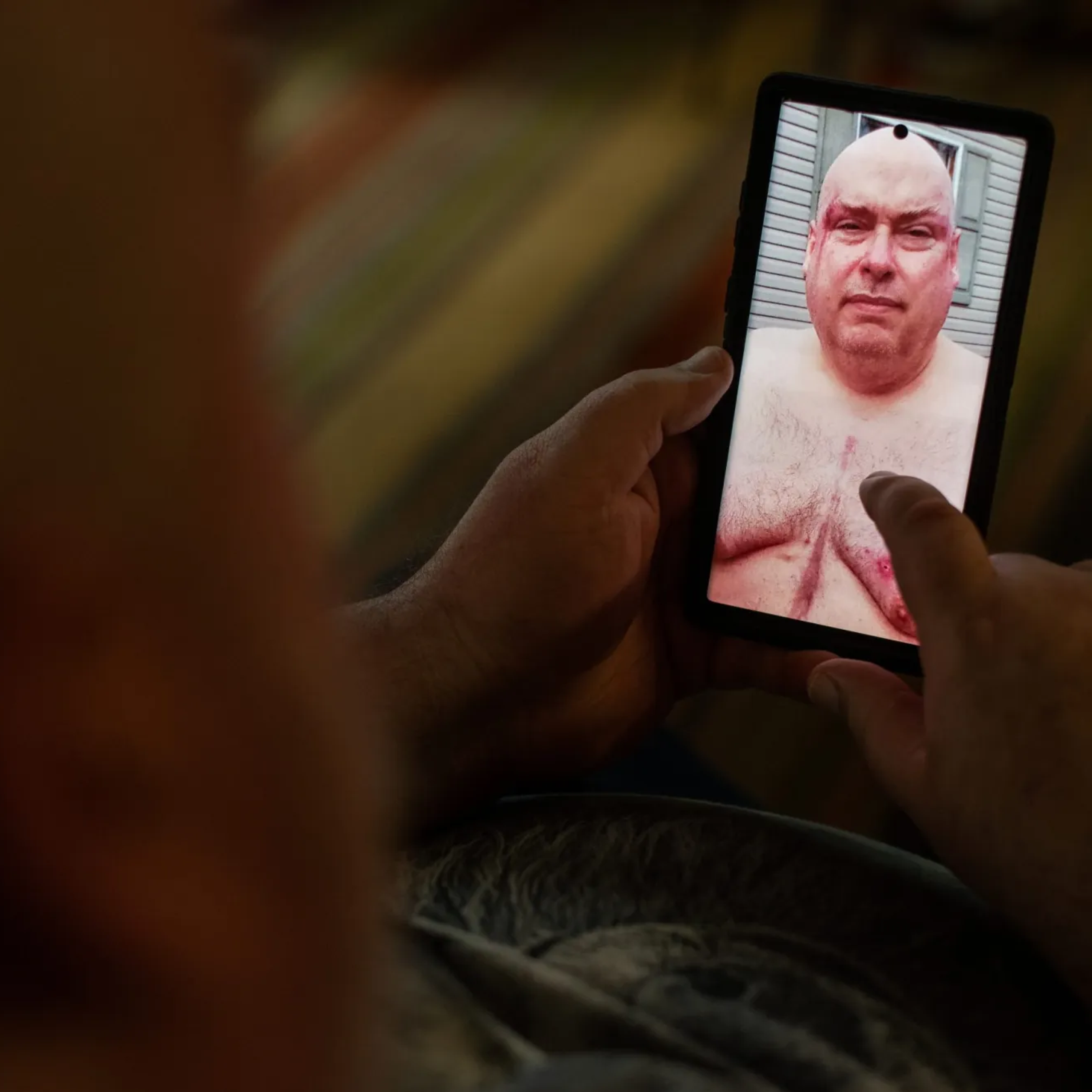
Rick is a big guy. He's in his 50s, bald, with a stubbled beard. He doesn't know why there are deputies in his trailer, but as a sheriff's deputy himself, Rick knows better than to fight back. So they can't charge him with assaulting an officer.
- [12:02]
H
And he keeps hitting me, and I'm like, I'm on blood thinners. If he hits me hard enough and my brain bleeds, I could bleed into my brain and die. And so I said, hey, hey. And he stopped swinging. I said, listen, I'm on blood thinners. And he said, I don't give a. And they were kicking me really good. They were kicking me so good that one of them missed and put his foot through my counter. So I'm looking in the living room at these people, and I'm listening, and I'm not. I'm not understanding what's going on, but I can hear and screaming and hollering coming from the back of the trailer. All right? I can hear someone getting his ass whooped.
- [13:00]
D
A guy named Mitchell Hobson was also at the party. He goes by Mitch. And when we spoke to him, Mitch, like Rick, alleged that the Rankin County Sheriff's deputies assaulted him repeatedly that night, all while demanding that Mitch tell them where his drug stash was. Mitch says deputies kicked him in the stomach, tased him multiple times, choked him with a lamp cord and waterboarded him. Mitch denied having or selling drugs at the party. What Mitch, Rick and Andy were describing didn't just sound like excessive force. The humiliation, the degradation, the brutality. It sounded like torture. Andy says that after she witnessed this, she didn't know what to do. She did try telling her family about it.
- [13:53]
G
When I went home, my family's like, yeah, yeah, yeah, Andy. Yeah.
- [13:56]
C
Mm.
- [13:57]
G
You know when I was telling them about Rankin' and then they didn't believe you? Oh, it's not that they didn't believe me. It's that I'm wild, you know, Like, I have five battery charges, like, to assault back home. So they looked at it like.
- [14:18]
B
Yeah.
- [14:19]
G
Sure, it's everybody else's fault.
- [14:21]
D
Sandy tells me this was just the first incident she witnessed. Five years later, she saw another torture incident. This time she was at her house with a man named Robert Grozier, who goes by Catfish. Catfish sold some drugs to someone who stopped by the house. And then boom, boom, boom.
- [14:39]
G
You can see the flashlights. And I was like. I was like this, look. I was like.
- [14:46]
D
One of the deputies who walked through the door had also been there that night at Rick Loveday's trailer. For years, Rankin county officers had been showing up at Andy's house over and over again looking to make a drug bust. When we spoke to Catfish about that night, he told us that deputies took him to a back room of Andy's house.
- [15:06]
C
He shoved a pistol down my throat. He shoved a pistol all the way down my throat, pushed me in the floor.
- [15:11]
D
Catfish says that's when they took out their Tasers.
- [15:14]
C
They had my legs pinned down. And he kept tasing me. He said, did you get tased here tonight? And I said, yeah, at first. And he tased me again. Fuck. I said, oh, whoa, whoa. No, no, no, no, no. I tried to tell them what they.
- [15:22]
D
Wanted to hear these details. The tasing, the gun in the mouth were similar to what Michael Jenkins and Eddie Parker said happened to them on the night Jenkins was shot. They also lined up with what Andy told us about that night. Andy is upfront about who she is. She's clear with us about her own drug use and her criminal record, not to mention her sticky fingers at the Walmart self checkout line. But she says that what the deputies did wasn't about enforcing the law.
- [15:54]
G
Everybody makes mistakes. I've made many. I have learned behaviors from the streets. I'm trying, whatever, whatever, whatever, but you just don't do things like that.
- [16:07]
D
So she helps us connect with more and more people who say they've had their own experiences with the department. But eyewitness accounts won't be enough. So me and my recording partner Nate, start looking for more evidence.
- [16:25]
E
Up next, Brian and Nate expand their investigation.
- [16:29]
C
What do you mean you got some reporters going to call me?
- [16:32]
E
This is Reveal.
- [16:43]
F
This is Josh Sanborn, producer at Reveal. This episode is made possible by support from nrdc. The Trump administration is gutting environmental protections on a scale never seen before. It's eliminating protections for endangered wildlife, opening wilderness to oil and gas drilling, and sacrificing the safety and beauty of the planet that future generations will inherit. What we stand to lose can never be replaced. But the Natural Resources Defense Council is fighting back, leveraging the full power of the law to defend our environment. Backed by 3 million supporters, NRDC's team of over 700 lawyers, senior scientists and advocates has blocked harmful oil and gas pipelines, stopped toxic mines and protected endangered species through hard hitting lawsuits. They won nearly 90% of cases filed during the first Trump administration and they continue to win, including a recent case defending climate science. Now, as their caseload grows, they need your support. Join the movement that's defending our environment for future generations. Donate@nrdc.org reveal and your gift will be matched 5 times.
- [17:59]
A
Hi Y', all, my name is Nadir Hamdan and I'm a producer here at Reveal. Reveal is a non profit news organization and we depend on support from our listeners. Donate today@revealnews.org donate and thanks.
- [18:20]
E
From the center for Investigative Reporting and PRX. This is Reveal. I'm Al Edson.
- [18:27]
D
You're watching Eyewitness News 16 on 16.
- [18:30]
E
Apt Jackson before Brian Bailey became the sheriff of Rankin county, he worked for a man named Lloyd Jones.
- [18:39]
G
For 20 years, Sheriff Lloyd Jones ran Simpson County. Folks who put him in office say he ran a tight ship and governed with a forceful hand.
- [18:48]
E
Simpson county is next door to Rankin county in Mississippi. And for decades, starting in 1956, Lloyd Jones was an officer in this area, first as a state trooper and then as sheriff. He was a towering figure who cast a long shadow over the culture of policing in this area.
- [19:08]
C
He was strict and I guess that's what made him a good sheriff. If you needed Lloyd Jones, you could call him and as soon as he was aware that you needed him, he'd be there. He'd be there pronto.
- [19:21]
E
Lloyd Jones had a different reputation among civil rights leaders and black residents in Simpson county and a nickname, Lloyd Goon Jones. The term goon referred to Jones brutal approach to policing black communities and that went back decades.
- [19:40]
B
Jones was a commander in 1970 when.
- [19:43]
G
Troopers and police were asked to respond to a possible riot at Jackson State.
- [19:48]
E
Jones and his officers were called to Jackson State College to respond to a student protest. Here's how he described the scene that day.
- [19:56]
C
There's a lot of hollering and cussing and rock throwing and bottle throwing going on. Anybody that said it wasn't a riot doesn't know what they talking about.
- [20:08]
E
Officers shot hundreds of rounds into a dormitory filled with black student protesters, killing two people and wounding 12 others. Community leaders accused Jones of giving the order to fire.
- [20:21]
B
Black leaders held Jones responsible.
- [20:23]
C
He is the man, as keeps saying, is always on the scene, and he's the one who called.
- [20:30]
E
In a separate incident, a local civil rights activist accused Jones and his officers of shoving a fork up his nose and down his throat and beating him. In the Rankin county jail in the 90s, a former inmate shot and killed Jones at his home. A local news team spoke to deputies who worked for Jones about what he meant to them, including Brian Bailey.
- [20:56]
C
You could follow him anywhere. He worked seven days a week, 12 and 14 hours a day.
- [21:01]
E
It was Jones who gave Bailey his first job in law enforcement.
- [21:05]
C
And I wouldn't ask us to do anything that he wouldn't do himself.
- [21:08]
D
And it was an honor for me.
- [21:10]
B
To work with in the short time that I did.
- [21:15]
E
I loved you like a father. Bailey wrote about Jones on a memorial page for the late sheriff. You were no doubt a part of who I am and what I am today. Decades after his mentor was accused of torturing a civil rights activist, Bailey's own deputies would be accused of similar abuse.
- [21:36]
F
The FBI Jackson Field Office, along with the Department of Justice, has opened a civil rights investigation into a Rankin county officer involved shooting that left one man shot in the mouth.
- [21:47]
E
A few months later, all of the officers involved in the shooting of Michael Jenkins and the arrest of Eddie Parker were fired and and then charged with an array of civil rights violations. All of the deputies admitted to brutalizing Jenkins and Parker, and the court filings revealed an important detail. Some of the deputies involved had given themselves a nickname.
- [22:10]
D
According to federal prosecutors, the defendants referred.
- [22:13]
B
To themselves as the Goon Squad because of their willingness to use excessive force and not to report it.
- [22:21]
E
The Goon Squad. This select group of deputies even designed their own custom challenge coin with cartoon mobsters on one side and the Sheriff's department logo on the other. Brian Bailey, once an employee of Lloyd Goon, Jones, says he never heard of the group's nickname, the Goon Squad.
- [22:41]
C
I didn't realize that they called himself that until last week. Somebody asked me, I said, what are you talking about? I've never heard that. Nobody's ever reported that to me.
- [22:50]
E
The DOJ investigation found what Jenkins and Parker said was true, but the scale of the abuse was still unknown. By now, Mississippi Today, reporters Brian Howey and Nate Rosenfield were working with the New York Times, tracking down similar cases for their investigation. But they needed to find out if there was more proof. Here's Nate.
- [23:16]
B
By the end of summer 2023, we knew that many of the details in the Jenkins and Parker case matched what other people had told us. The tasing, the beating, the humiliation. It was all starting to sound like a pattern. And at this point, we'd spoken to people like Andy Murphy, Rick Loveday, Mish Hobson, and Catfish. But was there any evidence that could support their claims? We requested records from the sheriff's department for the arrests we were looking into. We searched for medical records and any other kind of documentation that would help verify the accounts of the people we spoke to. One of those cases involved a man named Gary Curo. We met Gary through Andy, but at first he was hesitant to talk.
- [24:08]
C
She said, well, they doing a story. I don't give a what they doing. What the you telling people to call me for? Telling me what you tell them to call me for.
- [24:16]
B
Gary had reason to be nervous. Many of the people we talked to were scared that deputies would retaliate against them if they came forward. But Andy was persistent and managed to talk Gary into it.
- [24:30]
C
And she probably gonna get off of me for some of the stuff I'm saying right now anyway. Oh, well, she wanted goon squad to pay for what they did to her. And so she was kind of getting everybody, anybody she could to help get in on that for whatever needed to happen.
- [24:51]
B
Brian and I met Gary this February. Where are we headed?
- [24:55]
C
Just go to go all the way down Highway 80. I'll show you where you're going.
- [24:59]
B
Okay.
- [25:00]
C
Just go west on 80.
- [25:02]
B
Today, when you drive out of Jackson across the Pearl river, all you see is just a bunch of warehouses and marshes. But when Mississippi had prohibition laws as recently as the 1960s, this part of Rankin county was a hot spot for bars that served alcohol illegally.
- [25:20]
C
See all this? Right through here, all this was joints, all this, and most of them were nice clothes, nicer clubs.
- [25:27]
D
What kind of joints were they?
- [25:29]
C
Juke joints, like bars, stuff like that.
- [25:33]
B
It was called the Gold coast. And it's where Gary saw his father wheel and deal.
- [25:38]
C
He was a private entrepreneur. He ran slot machines, bootleg. I mean, I ain't talking about no moonshine liquor because it was stolen. They would steal it off freight trains. I didn't know it was outlaw stuff. I thought that's what everybody's daddy did.
- [25:57]
B
Gary wanted out of his father's line of business, so he joined the Air Force as a mechanic. Now that he's in his 70s, he has some trouble walking, in part because of a back injury he got in the military. After all these years, Gary says he still feels more comfortable around people who live on the other side of the law, like his dad.
- [26:18]
C
I've been around it all my life. But the thing about it straight people scare me more than outlaws. Because you know what outlaws gonna do.
- [26:32]
B
Gary tells us that ever since he was a kid, the police around here were corrupt. His dad would tell him how they took bribes and beat people who caused them trouble.
- [26:43]
C
Listen, Rankin county has always been notorious. They don't follow the laws of the land. They. They make their own laws. They'll whip you up, beat you up, beat you. Nothing happens to them. It's like a rite of passage.
- [26:56]
B
Gary's own problems with the Rankin County Sheriff's Department began one night back in 2018, five years before the Michael Jenkins and Eddie Parker case came to light. Gary was at a neighbor's house, a guy named Jerry Manning. Most people around here call him Red Dog. And he was known in the neighborhood for dealing drugs. Gary says he was hanging out with a group of people in Red Dog's bedroom when he noticed something.
- [27:25]
C
I had just put a surveillance system in for him. And anyway, I looked up at the monitor and I kept seeing reflectors and it's carved, but there was no lights on. I kept looking at it and all of a sudden the doors open, Here they come rush in the house and they kicked the bus to the door. And I said, red Dog, Red Dog. I said, cop, cops are here. Cops. And everybody in there just froze.
- [27:51]
B
Gary's account followed the same pattern of so many others. We spoke to officers beat him and the people there that night.
- [27:59]
C
I don't know if he kicked me or pushed me up and knocked me down on the floor and then he handcuffed, you know, my hands behind my back.
- [28:06]
B
Then they tased him repeatedly, man.
- [28:10]
C
They tased me for probably two hours.
- [28:12]
B
And they humiliated him.
- [28:14]
C
One of the cops told me, what's wrong with you, old man? How come you can't walk? What's wrong with you? You want to dope your up? No, man, I said I was in the military. I was in a helicopter crash and I had just had surgery on my back. They told me that you a disgrace to veterans. You don't deserve even call yourself really. And I was not a disgrace in the military. I was decorated special operator in the air force. When I told him that about my back, where is it at? Where does it hurt? I said, well, my lower back. And that's when he put his paratrooper boots he was wearing and he would put them on my scar and grab back of my hair and Just pull me back like this.
- [28:55]
B
We wanted to know if there was any evidence supporting what we'd heard from Gary. So the first thing we did was file a public records request with the department for the official incident report. The report of that night showed officers were there for a planned drug bust. It says the deputies entered the apartment, found drugs out in the open, and made quick arrests soon after. There was no mention of any of the violence Gary told us about. But Gary's case, like many of the ones we'd heard about, centered around deputies using their Tasers. The thing is, you can prove when a Taser is used whether a deputy reports it or not. Police Tasers record each time they're fired in a digital log that stores the date, time, and duration of each use. So we filed another public records request for those logs, and when they came back, they showed us that during the drug raid, which involved multiple arrests, three deputies fired tasers a total of 14 times over the span of 90 minutes. Law enforcement experts told us they couldn't think of a justifiable reason why the deputies would need to fire their Tasers for that long, even with multiple people present. Generally speaking, police officers are supposed to justify every Taser use. But none of those deputies reported using their Tasers at all. We spoke to other people who were there that night, including Red Dog. He told us deputies Tased him, beat him, and choked him.
- [30:43]
C
They put a chair in the kitchen, drove me to the kitchen, put a belt around my neck, and the officer stood on the chair and pulled me up and just choked the mess out of me. I thought I was going to die.
- [30:57]
B
During his torture, he said the deputies drew something on his forehead.
- [31:02]
C
They drew a Nazi sign on my head. Then he found a torch.
- [31:07]
B
Red Dog says officers also used a blowtorch to melt metal onto his skin. We asked the department for the photo they took of Red Dog when he was being booked into the jail. In the picture, you can see the faint outline of a swastika on his forehead. Red Dog also shared with us a photo of the burn on his leg from the hot metal. We use these kinds of documents, Taser logs, pictures of injuries, medical records, booking photos, to help confirm multiple other cases of abuse, including many of the ones that Andy Murphy first brought to us. We spoke to more than 50 people who told us they had witnessed or experienced brutality from Rankin County Sheriff's deputies during drug raids. And we found supporting evidence for 17 cases involving 22 of those people. At this point in the summer of 2020, 3. The only abuse that had been widely reported to the public was the Michael Jenkins and Eddie Parker case, where all the deputies involved pleaded guilty to federal charges. But Brian and I were piecing together a far more widespread pattern of abuse with allegations going back to two decades. This was the 2004 goon squad.
- [32:42]
D
What I can remember being, this is over a decade ago.
- [32:46]
C
It was 2019, sir. Well, I know the date that they come in my house. February 20, 2020.
- [32:52]
B
During police raids, deputies routinely tased, beat, and humiliated people they suspected of using or selling drugs.
- [33:01]
C
He shot me in between the legs with his Taser. They tased me like 30, 30 times or 40 times.
- [33:09]
D
He said, I'm fitting to go back here and kill your partner.
- [33:12]
C
I'll be right back to kill you.
- [33:14]
D
That's when I heard a gunshot, and.
- [33:17]
H
I thought they shot him.
- [33:18]
C
They beat me bad, man. I'll never forget that, man. I'm so racial, man. They beat me. They put a gun in my mouth, dude. I thought, that man won't kill me.
- [33:27]
B
Rankin county is largely white, and so are most of the victims we spoke to. But in the cases where the victim was black, everyone told us deputies used racist language.
- [33:39]
C
When he put his knees in my chest, his exact words was, I hate you that come in ranking county that just try to sell drugs. He was like, if I could kill you and get away with it, I'd do it.
- [33:52]
B
This cycle of violence had gone under the radar for years, but not for a lack of trying. Many of the people we spoke to said they complained to the department, even reached out directly to Sheriff Bailey to report what happened to them. Rick Loveday, the deputy in Hinds county we spoke to, who said he had been beaten in his trailer by the Goon squad, told us he was able to get Bailey on the phone.
- [34:19]
H
So I call. I'm mad. I'm really mad at what's happened. I got their sheriff on the phone with me for maybe two minutes, and I said, sarah, I want to let you know what happened to me. Oh, I know who you are. You're that drug dealer out there and such and such. No, Sarah, I'm not. You probably got this line bugged. No, I don't have this line bugged. I just want you to know. And he hangs up on me.
- [34:50]
B
Five other people say they filed six similar complaints directly to the department. There were also four lawsuits that alleged brutality by deputies, all filed before the Michael Jenkins and Eddie Parker case in 2023. But remember when news first broke out about the Goon squad, the Sheriff denied knowing anything about it.
- [35:13]
D
Again, I'm shocked.
- [35:14]
C
I'm shocked. I cannot believe one team of beer would try another human being the way they did. Again, this is the same thing as.
- [35:22]
D
If you found out a family member.
- [35:24]
C
Or a close friend had committed one of these crimes.
- [35:26]
D
I'm shocked by it.
- [35:28]
C
This cannot be real.
- [35:30]
B
But it was real. It's just that most of the people who said they'd been abused had been written off for years. Many didn't have the resources to hire a lawyer and fight the department in court.
- [35:43]
G
Many.
- [35:44]
B
Some struggled with drug addiction and were easy to discredit as criminals trying to get out of a prison sentence. It may have been a shock to some, but for many of the people we spoke to, the abuses of the goon squad were just a daily reality in Rankin County. People like Andy, the woman who helped connect us with so many others who'd been targeted by the department.
- [36:09]
G
It's just so common what Rankin county does, that it's just like, well, we went over ranking county. We around. We got our ass handed to us.
- [36:17]
B
We know better.
- [36:18]
G
That's the mindset that people have, like, don't. Around in Rankin'. Yeah, around in Rankin'. This is what's gonna happen. So we all just kind of take our. Take our lumps, if you will, you know?
- [36:30]
B
Andy had struggled to get anyone to believe her about what was going on in Rankin county, and that was just a fraction of what she was up against. When we first met Andy, she told us that she had been diagnosed with stage four breast cancer and it was only getting worse. It wasn't clear how much longer she'd be around, but in true Andy fashion, she faced it head on.
- [36:55]
G
You're not allowed to interfere with destiny. I have never been this kooky person, I promise you. And it's not because I have time on my hands. I promise it's not because I'm facing my mortality. Personally, I'm good with dying. Our destiny's our destiny.
- [37:13]
E
Up next, Brian and Nate, try talking to Sheriff Bailey.
- [37:22]
D
Hey, Sheriff Bailey. It's Brian Howey calling back.
- [37:26]
E
That's next on Reveal.
- [37:35]
B
A Deeper Listen is a podcast from.
- [37:36]
A
KEXP where each week we bring you conversations with musicians about the thoughts and.
- [37:41]
B
Experiences that shape their music.
- [37:43]
D
Telling my own story is also fictionalizing it at the same time. Grief really is love with nowhere to go. And making music can really help you heal. I'm not a maker of sad music.
- [37:54]
C
Generally, but my take on music is.
- [37:56]
E
Let's sweat this out.
- [37:58]
A
Take A Deeper Listen. Available Wherever you find podcasts, just search.
- [38:03]
E
Kexp from the center for Investigative Reporting and prx, this is Reveal. I'm Al Edson. Today we're bringing you an update to a story we first aired earlier this year.
- [38:15]
C
New at 10. The calls for the resignation of Franklin County Sheriff Brian Bailey growing louder after.
- [38:22]
E
Five of his deputies pleaded guilty to federal charges resulting from their torture of Michael Jenkins and Eddie Parker. The public pressure on Sheriff Bailey and his department was mounting.
- [38:33]
C
Activists have been demanding this for months now. These calls started after former Rankin county.
- [38:38]
B
Law enforcement officers admitted to physically and.
- [38:42]
C
Sexually assaulting two African American men earlier this year.
- [38:46]
E
Again, Bailey has denied knowing anything about his deputy's misconduct. And he's spoken publicly about the Michael Jenkins and Eddie Parker case just a few times. Like this press conference in August of 2023, right after his officers pleaded guilty.
- [39:02]
C
Sheriff, there have been calls for your resignation. What is your response to that? You know, my only thing I've guaranteed unless it's just right here, is trust grown men that swore an oath to.
- [39:17]
D
Do their job pre. I'm guilty of that.
- [39:20]
C
But the people of Rayn county elected me to do a job during good.
- [39:24]
D
Times, during bad times, yeah, this is a bad time.
- [39:26]
C
But I'm going to stay here.
- [39:28]
D
I'm not resigning.
- [39:29]
C
I'm going to fix these problems.
- [39:31]
E
And he didn't resign. Instead, he ran for re election unopposed and won. A few weeks after Bailey's reelection, our reporting partners Brian Howey and Nate Rosenfield published their investigation of the Rankin County Sheriff's Department in Mississippi today and the New York Times. Their findings showed that Jenkins and Parker weren't alone. More than 20 people had come forward with similar allegations of violence and torture going back two decades. And it involved far more deputies than the handful who were charged. Here's Nate with the fallout.
- [40:12]
B
The reaction to our reporting was immediate from Rankin county residents and the feds. The same day we published our story, we heard from some of our sources that FBI agents had flown into town to talk to some of the same people we interviewed. And more and more community members were starting to voice their outrage against the Sheriff's Department.
- [40:36]
G
I am a normal, ordinary person living in Rankin County. I go to the grocery store, I go to the restaurants, the bars, I walk my dog in the park. I had no flippin idea what was going on in Rankin County.
- [40:47]
B
For weeks, one man stood outside the Sheriff's department holding protest signs, including one that read Brian Topgoon Bailey must go. And the local chapter of the NAACP had already filed a petition to formally remove Bailey from office. Here's the chapter president, Angela English.
- [41:10]
C
We have a person who is running the jailhouse that does not know what he is doing, does not care what he is doing, and has no regard for people's human, human or civil rights. And we are going to make sure that he is removed from office.
- [41:27]
B
The petition was ultimately unsuccessful, but English said it gathered about 12,000 signatures, at least publicly. Local and state lawmakers kept quiet about whether Bailey should step down. But the state representative from Rankin county did propose a new law on police oversight after the revelations about the Goon Squad, and it passed. It allows the state to investigate officers for misconduct and revoke their certification even if they weren't convicted of a crime. It's a big change for a state that isn't typically known for passing police reforms. And then in the spring of 2024.
- [42:19]
F
Judgment day for the goon squad, five disgraced former Rankin county deputies, and an ex Richland police officer.
- [42:26]
B
Something happened that rarely happens in Mississippi. Are really the rest of the country when it comes to law enforcement.
- [42:33]
E
In Mississippi, six former law enforcement officers.
- [42:37]
D
Called the Goon Squad have received police prison terms that add up to more than 130 years from the feds.
- [42:45]
B
The significance of a sentence this long wasn't lost on the legal team representing both Jenkins and Parker.
- [42:52]
E
139 years total for all six defendants. That's strong.
- [43:00]
B
After the sentencing, Malik Shabazz, one of the lawyers representing the men, addressed the local media.
- [43:06]
C
That which a man soweth, that shall he also reap.
- [43:10]
E
It has happened in this courthouse, it said.
- [43:12]
C
What is done in the dark will.
- [43:15]
E
Come to the light.
- [43:20]
B
Jenkins and Parker sued Bailey and the Sheriff's department in a $400 million civil lawsuit. Bailey filed for qualified immunity, which protects police from most judicial proceedings. But a federal judge denied his request. And this May, a lawsuit involving the.
- [43:41]
C
Goon Squad has reached a settlement.
- [43:43]
B
The case settled for $2.5 million.
- [43:46]
D
This is the ending of the Michael Jenkins and Eddie Terrell Parker case from.
- [43:54]
C
The perspective of the Sheriff's Department.
- [43:57]
B
Sheriff Bailey still insists that the Goon Squad was was just a handful of rogue officers. And he says his department is working to earn back the trust of the community.
- [44:08]
C
Rankin County Sheriff Brian Bailey says his office has updated its training policies after former officers pled guilty to torturing two men in January. They have hired an internal affairs investigator from outside the department and would expand the compliance division to include additional internal affairs investigators.
- [44:29]
B
My reporting partner Brian, and I have always wanted to get Bailey on the record about the allegations we uncovered. We tried a couple of times to set up interviews with him, but the department's attorney wouldn't allow it. So when Brian got a hold of Bailey's phone number, he had to give it a try.
- [44:51]
D
Hey, Sheriff Bailey, it's Brian Howey calling back. I just wanted to circle back with you because, you know, we have some really serious allegations against multiple deputies at your department. I mean, you know, we. We found these, you know, a handful of lawsuits against the department making these allegations. We've found taser logs that show your deputies were activating their tasers multiple times, oftentimes far past the limits of national guidelines on how many times they should be using them. I mean, this seems to be something that was fairly widespread among some of the top ranking deputies at your department. It's. I guess that leaves the question.
- [45:31]
C
Yeah, I have 240 employees. There's no way I can beat them each and every day. And I'm working on county. Actually, I don't have a statement to make to you at this time.
- [45:39]
D
It just begs the question of how it's possible you didn't know that this was going on at the time department.
- [45:46]
C
And again, I have no comment.
- [45:49]
D
Okay. All right, Sheriff Bailey. Well, thank you so much for your time. If you change your mind, please let me know.
- [45:56]
C
Yes, sir.
- [46:01]
D
Bailey referred us to the department's legal counsel, who declined to comment. As we kept investigating, I stayed in touch with Andy Murphy. Soon after the deputies entered federal prison, Andy checked herself into the hospital. She'd been fighting stage four breast cancer for years. At this point, Andy had spent months helping us connect to people she knew from Rankin County. By then, we had spent a lot of time together. He looks so disappointed to see me.
- [46:35]
G
I'm not disappointed. So for, like, thank you. For like, 30 seconds, I'm going to just. I have to listen to, like, some kind of music just to chill out for a second.
- [46:46]
B
Okay.
- [46:47]
G
But that's okay.
- [46:49]
A
Thank you.
- [46:50]
B
What is.
- [46:50]
G
What kind of music you like? You like 311?
- [46:53]
D
Do I like 311?
- [46:56]
G
Yeah.
- [46:57]
C
D.
- [47:00]
D
For the record, I do not like 3 11. So thankfully, Andy plays another song to reset.
- [47:07]
B
Ice Cube Baby 99 Baby 99 Baby.
- [47:16]
D
By June of 2024, Andy's health had taken a turn for the worse. Her cancer had spread, her legs had stopped working, and she was stuck in a hospital bed in Jackson. She knew that most of the deputies whose abuses we reported on hadn't been held accountable. Some even still work in law enforcement today. So for Andy, the guilty pleas, the Sentencing, the added pressure on Bailey to resign. All of that wasn't enough. Do you feel satisfied with what you've done?
- [47:51]
G
Um, not yet. I need those people that harmed people just like the other ones did, to. To be accountable. Absolutely. I just can't wrap my mind around certain, you know, like, Rankin county, they want to say, like, we all have our moral compasses. I was a junkie. Excuse my language. There's certain things I'm not gonna do, certain things I would do, but be accountable, be responsible. You know, what the. Is right and what. What's wrong.
- [48:48]
D
In late July 2024, Andy sent me a message on Facebook asking when I was coming to see her again. She said she was proud of our reporting. I was out of town, but I told Andy I'd be back soon to see.
- [49:11]
B
Hey, man.
- [49:12]
G
Hey.
- [49:12]
D
Good morning. A couple weeks later, I called Nate with some news. Gary texted me in very Gary fashion, but then sent pictures of him and Andy together. And I was like, oh, God. I had just spoken to Gary Curo, who told me that Andy was gone. She was 50 years old.
- [49:37]
B
Andy was a really special person.
- [49:40]
D
Yeah, she was. She was a really complicated person who really just wanted to. I think she wanted more than anything to do something good.
- [49:54]
H
I don't know.
- [49:55]
D
I don't know where we would have ended up without her.
- [49:59]
C
Yeah.
- [50:05]
D
A couple weeks later, in September 2024, the Department of Justice announced they were launching a second investigation. Now that the criminal case against the officers who tortured Michael Jenkins and Eddie Parker was closed, they wanted to look at whether the whole department had engaged in a pattern of constitutional violations. That new investigation could force the department to reform its policies and practices and even lead to new criminal charges. After Donald Trump took office for a second term as president, his administration froze all new and ongoing civil rights investigations into police departments across the country. But in October, Angela English from the local chapter of the naacp, who's been coordinating with the doj, confirmed that the investigation into the Rankin County Sheriff's Department will continue.
- [51:11]
E
After the original release of this story in March, the reporting team started to get new tips about the Sheriff's Department, this time about a rehabilitation program it runs for inmates in the Rankin County Jail. It's something Sheriff Brian Bailey has championed a lot.
- [51:26]
C
Y' all have had three cases of people in my program that came to me in tears saying, sheriff, I'm not ready to get out. It was time for them to get out.
- [51:34]
E
But former inmates were saying the reality of the program was much darker and that in addition to rehabilitating prisoners. The program was using some of them to terrorize other inmates.
- [51:46]
C
They were just taking tires, just teeing off, all on me. I'm talking about just literally beating me.
- [51:52]
E
And so the team at Mississippi Today began work on a new chapter of their story and pressing the Rankin County Sheriff's Department for answers. Correct me if I'm wrong, but this.
- [52:03]
C
Is gonna be nothing but a hit.
- [52:06]
D
Piece on the sheriff.
- [52:08]
E
Anyway, that's next week on Reveal. Until then, you can read more of Brian and Nate's work at Mississippi Today and the New York Times. Our lead producer for this week's show is Najeeb Amini. Jenny Costas edited the show with support from Kate Howard. Editorial and reporting guidance from Adam Ganechow, Chris Davis, Dean Bequet and Debbie Skipper. They worked with Brian and Nate on this story from the beginning with Mississippi Today and the New York Times. Special thanks to Alyssa Daly and Jerry Mitchell, who also contributed reporting to this episode. Special thanks also to Reveal's associate producer, Steven Rascone. Sophie Horowitz and Ruth Marais are our fact checkers. Legal review by Victoria Baranetsky. Our production manager is Zulema Cobb. Score and sound design by the dynamic duo Jay Breezy, Mr. Jim Briggs and Fernando My Man Yo Arudo. Our deputy executive producer is Taki Telanitas. Our executive producer is Brett Myers. Our our theme music is by Camerado Lightning. Support for reveals provided by the Riva and David Logan foundation, the John D. And Catherine T. MacArthur foundation, the Jonathan Logan Family foundation, the Robert Wood Johnson foundation, the park foundation, the Schmidt Family foundation and the Hellman Foundation. Support for Reveal is also provided by you our listeners. We are a co production of the center for Investigative Reporting and prx. I'm Al Letson and and remember there is always more to the story.
- [53:44]
B
From prx.