Loading summary
Transcript261 lines
- [00:01]
Josh Sanborn
This episode is brought to you by the University of Massachusetts Press, publisher of Racializing how the White Southern Press Used Journalism Standards to Defend Jim Crow, which exposes how the White Southern press weaponized journalism standards to skew stories about black Americans during the Civil Rights movement. As we navigate a new media landscape, racializing objectivity offers a vital reminder that transparency and accountability are the foundation of a fair press. To learn more, visit umasspress.com.
- [00:38]
Every three minutes, a child is born with clubfoot, a debilitating condition that makes walking painful or even impossible. But you can change that this holiday season. Your donation to Miracle Feet gives a child the simple yet extraordinary gift of walking. Miracle Feet provides the simple and proven treatment that allows children born with clubfoot to walk, run and chase their dreams free from disability and stigma. Your gift of any amount means the world to a child born with Clubfoot. Visit MiracleFeet.org today.
- [01:16]
Al Letson
Hey, it's Al. And 2025 has been a brutal year for public media. I gotta tell you, it is not easy to produce footage. Fearless journalism at a time when truth itself is under siege. The one thing it takes is community. That's you. Your support, your time, your willingness to listen, share and engage. That's what keeps our reporting alive and thriving. Every time you tune into our work, you're part of the community that says, yes, facts matter, yes, power should be challenged, and yes, independent voices are essential. Right now, we need that community to step up for us and donate. We've got a big Year end fundraising goal and we need you on board if we're going to get there. This show just cannot exist without listeners who care enough to help us pay the bills. Listeners like you. So I'm asking you, can can you help? Any amount works for us. Just text give to 88857 reveal. That's give to 888-577-3832 and we'll send a donate link or visit revealnews.org 2026 thank you.
- [02:44]
Nadia Hamdan
From the center for Investigative Reporting and prx, this is Reveal. I'm Nadia Hamdan sitting in for Aletson.
- [02:54]
In late September, somewhere on the Mediterranean Sea. My friend Luna Spuhl sent me this voice note.
- [03:02]
Luna Spuhl
It's crazy to know that I'm laying in a room where to my left and right and everywhere around me is that's the sea.
- [03:13]
I don't know if you can hear it in the background, but that's the sea.
- [03:19]
Nadia Hamdan
The engine is off and the boat is just drifting. Muna is laying on her back looking through a Ceiling, window.
- [03:27]
Luna Spuhl
And I'm seeing a bit of the sky with very visible bright stars, two drones and just a very clear Milky Way. It's such a gorgeous image. I think I need to sit with it.
- [03:48]
And then the sound of the sea. Gorgeous.
- [03:58]
Nadia Hamdan
Less than 48 hours after sending me this message, Luna would be detained by the Israeli navy, driven out to the Negev desert and locked up in one of the country's most brutal prisons. All because she wanted to deliver aid to Gaza.
- [04:15]
Dane Hunter
Israeli forces have intercepted a number of boats that are part of a flotilla attempting to break the naval blockade of Gaza.
- [04:22]
Nadia Hamdan
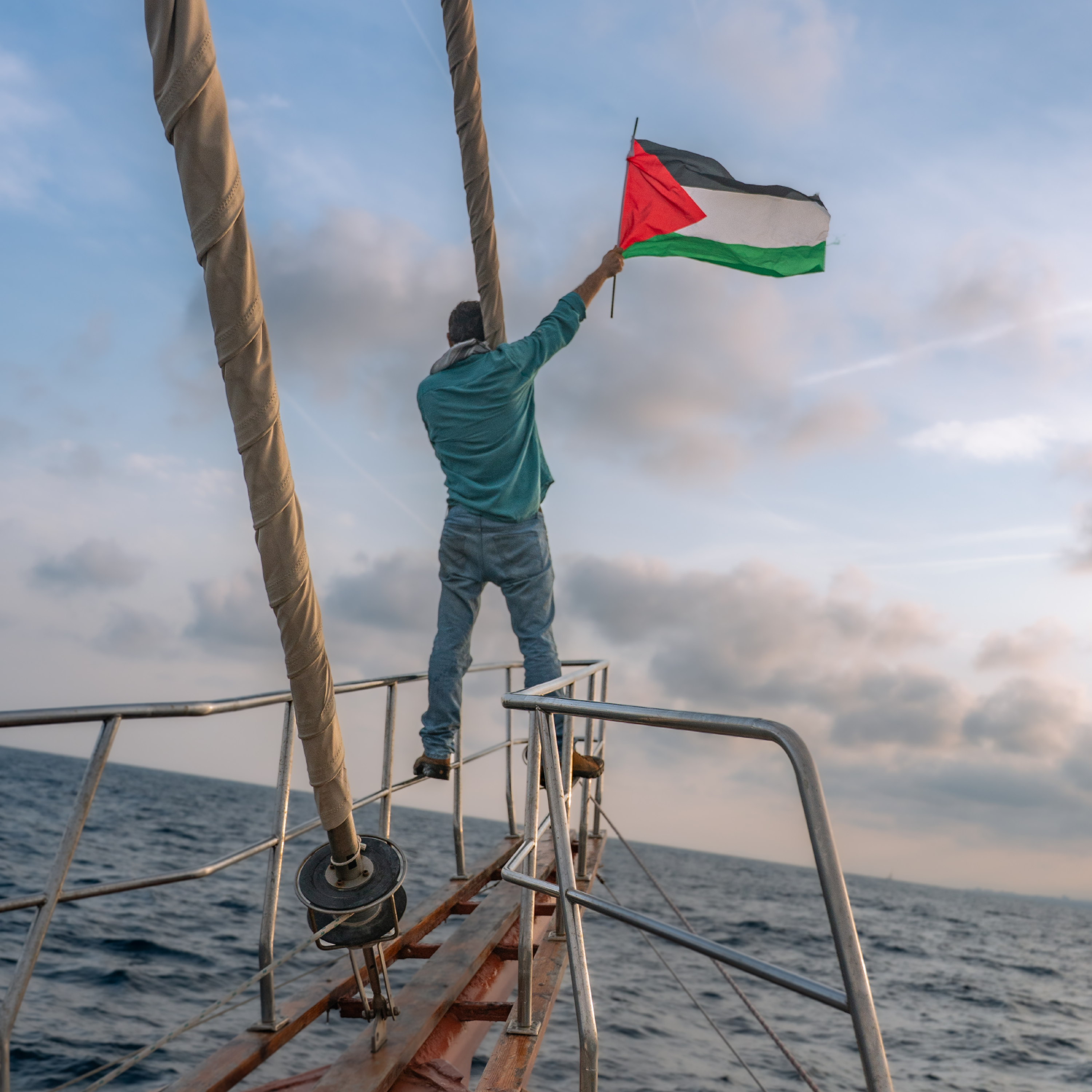
Luna was on One of the 42 boats that sailed to Gaza earlier this fall as part of the Global Sumud Flotilla. It's described itself as a peaceful, nonviolent mission attempting to create a humanitarian corridor by sea. Sumud means steadfastness in Arabic, a reference to what Palestinians have been forced to endure the last two years. In Gaza, the death toll is believed to have surpassed 67,000. Among that number is more than 18,000 children. It is a famine. The Gaza famine. A United nations investigation team says Israel has committed genocide against Palestinians. Organizers of the flotilla say they received around 30,000 applications to join the mission.
- [05:12]
It's now been a couple of months since the flotilla was in the news, and since then, the world has largely moved on. I mean, I get it. A ceasefire and a peace deal were declared, albeit not necessarily honored.
- [05:27]
But I keep thinking about the flotilla. When it was first announced, people didn't really take it seriously. Nearly 500 well meaning activists, many of whom had never sailed a day in their life, crowded onto a bunch of boats, thinking they could end one of the worst humanitarian crises on the planet. With Instagram, it was easy to dismiss the flotilla until it wasn't.
- [05:55]
So today we join Luna and her crewmates for an exclusive look into the Global Sumud Flotilla and find out what, if anything, it achieved.
- [06:09]
I've known Luna for over a decade. We met back in my early 20s when we were both living in Beirut and then then again in Berlin. We used to see each other almost every day. But then I moved back to the US and we got busy with our own respective lives on different continents. Nowadays we go long stretches without speaking. But when she went on the flotilla, I was back to checking in with her daily, asking for updates. Boats taking part in the flotilla originated from several ports, including Spain, Tunisia, and the port of Catania in Sicily, which is where Luna arrived on August 31st.
- [06:48]
Luna Spuhl
Good morning, it's 7:58.
- [06:51]
Nadia Hamdan
She started sending me voice notes Right away.
- [06:53]
Luna Spuhl
Hola. Okay. I had my first sip of coffee, so needed. I have no idea how I'm gonna do it.
- [06:59]
Nadia Hamdan
On the boat, it very quickly started to feel like I was there with her.
- [07:03]
Luna Spuhl
There was a baby cat. He would love it.
- [07:07]
Nadia Hamdan
Luna is Moroccan, but born and raised in Germany. A mother of two, she's soft spoken but formidable, with dark curly hair and a line tattoo down the middle of her chin meant to reflect her ancestral connection to the indigenous people of North Africa known as the Amazigh. And Luna has always considered herself an activist. For her, some things are just black and white, right or wrong. And for as long as I've known her, Palestinian solidarity has always been one of those hard lines. But it reached an inflection point the past two years of the war.
- [07:44]
Luna Spuhl
It's just tough because these are humans. These are humans who are capable of starving kids and civilians.
- [07:53]
I mean, the level of rage that we've been feeling is extraordinary. And it's really hard to stay sane.
- [08:05]
Nadia Hamdan
So when one of the organizers of the Global Sumud flotilla invited her to join, she was interested. But she'd never done anything remotely like this before. She'd also never left her kids this long. Still, if there was a chance it could make even a modicum of difference, it would be worth it. So she said yes.
- [08:28]
One of the people Luna would sail with is Carsey Blanton, a singer songwriter based in New Jersey.
- [08:34]
Carsey Blanton
When October 7th happened, and it became clear very quickly that as a Jewish person, like, my identity was being used in this propaganda push against Palestinian people, that was not okay with me.
- [08:47]
Nadia Hamdan
Carsey was already a public figure with a large social media following, which made her a perfect candidate for the flotilla.
- [08:54]
Carsey Blanton
I got a DM from someone who was like, recruiting influencers to go on the flotilla. And they were like, would you ever consider applying? And I was like, I already applied. You have my application. Call me anytime.
- [09:08]
Nadia Hamdan
This aspect of the flotilla, that it was actively recruiting influencers and celebrities, has been a point of contention for some. The Israeli Foreign Ministry called it a quote, selfie yacht. And critics have argued that many people on the boat were just doing it for attention and it was nothing more than a publicity stunt.
- [09:27]
Carsey Blanton
And my take on that is like, yes, of course it's a publicity stunt. Like, so much of politics is propaganda, and Israel and the US are making, like, trillions of dollars worth of propaganda all the time. So if you can get 100 influencers onto some sailboats to make your own propaganda for free, definitely do that.
- [09:48]
Dane Hunter
I saw Carsey Bland had A video out saying that she was joining the Global Smooth Flotilla.
- [09:54]
Nadia Hamdan
Dane Hunter is from the British Virgin Islands and has been a fan of Carsey's music for years. So he messaged her.
- [10:01]
Dane Hunter
I just commented on her video saying, hey, I'm a sailor, like, wondering if they need any hands.
- [10:08]
Nadia Hamdan
Carsey quickly connected him with one of the organizers for a phone interview.
- [10:11]
Dane Hunter
And they asked if I could come out the next day. And I said sure.
- [10:14]
Nadia Hamdan
Dane arrived in Sicily on September 1st to help prepare the boats.
- [10:19]
Dane Hunter
In terms of what kind of boats, we had all of them. We had sailboats, we had motorboats, we had small boats, we had big boats, very Dr. Seuss kind of boats. The common denominator, I would say was fixer upper.
- [10:38]
Nadia Hamdan
So Dane joined a group of volunteers who had to make sure they were all ship shape, or as Luna put.
- [10:43]
Luna Spuhl
It, ship shift, ship shift safe, making all ships safe, ship shift safe. And then we have to make everything shape shift, ship safe. What is that word? Shapeshift.
- [10:56]
Nadia Hamdan
She ultimately got there. Plumbers, electricians, engineers, organizers say they all donated their time and expertise to outfit these rinky dink boats. Not just making sure they were safe, but also jury rigging them with things like Starlink and cameras so they could live stream their journey on social media.
- [11:16]
Dane Hunter
Me and the mechanic would look at each other and we'd be like, I mean, it's a one way trip. It really just needs to hold up for three weeks. And we'd be like, zip ties. Yeah, zip ties. Let's do that.
- [11:28]
Yassine Benjaloun
So many people now. You just came to Catania just to help prepare the boats, which is enormous, enormous amount of work.
- [11:36]
Nadia Hamdan
This is Yassine Benjaloun who also arrived early to help prepare the boats. Yossin works for a tech company. He's Moroccan, but was born and raised in Montreal and currently lives in Paris.
- [11:48]
Yassine Benjaloun
You hear your parents talk about how the first intifada, the second intifada, people's homes getting stolen and people not being able to come back. And so all these conversations growing up, you know, they are why I think I went on this.
- [12:02]
Nadia Hamdan
Flotilla organizers say the boats would be loaded with as much aid as they could carry. Things like canned foods, medicine and baby formula.
- [12:11]
Yassine Benjaloun
It's nothing in comparison to what they need.
- [12:13]
Nadia Hamdan
And once they were all ready to go, they would all leave from Sicily together and sail towards Gaza.
- [12:20]
Yassine Benjaloun
Many of us have never sailed before. Most of us, I would argue.
- [12:23]
Nadia Hamdan
The Global Summit flotilla says there were a total of 42 boats carrying 462 people from 45 different countries. This was undoubtedly the largest and most ambitious flotilla attempting to sail to Gaza. But it was not the first.
- [12:42]
Israel's naval blockade of Gaza began in 2009, a year and a half after Hamas took control of the territory. Israeli officials argued that it was necessary to prevent the group from getting weapons delivered by sea. But critics of the blockade have long argued that it violates international law because it's collectively punishing Palestinian civilians, severely restricting their movements, the importing of goods, even their ability to fish. Since Israel's blockade began, dozens of flotillas have tried to reach Gaza and create a humanitarian corridor. In those first few years, everything remained largely peaceful, and five flotillas actually made it to Gaza. But that changed in 2010. Aboard the Mavi Marmara, tens of people.
- [13:30]
Luna Spuhl
Civilians, have been injured. There are still sounds of live fire, despite the white flag being raised on board the ship, which holds 600, all of whom are civilians.
- [13:43]
Nadia Hamdan
Ten people were killed by Israeli forces. An investigation by the International Criminal Court said it believed what happened on the Mavi Marmara constituted a war crime. Israel agreed to pay $20 million in restitution to the families of the victims.
- [14:01]
And still the flotillas have not stopped. Most of them have been intercepted by the Israeli navy and the people arrested and sent home. All of this was expressly laid out to everyone going on this flotilla. And on top of all of that, Israel's National Security Minister, Itmar Ben gvir, had publicly called everyone on the flotilla a terrorist, alleging that they were not actually humanitarians, but Hamas collaborators. And they will, quote, meet a firm and unyielding response from Israel.
- [14:39]
I asked Luna if this worried her.
- [14:42]
Luna Spuhl
At all, if we would let them scare us, why would we then continue or even start this mission? I think it's important that we just continue and we see what happens.
- [14:55]
Nadia Hamdan
The Barcelona fleet had already been sailing for a week when they stopped in a Tunisian port on September 7. The plan was to take a break and then continue on to meet the rest of the fleet in sicily. But around 11:30pm the following night.
- [15:14]
A drone dropped an incendiary device on the family, the lead boat carrying all the main organizers of the flotilla.
- [15:26]
The fire was put out and no one was hurt. GSF organizer Yasmina Char quickly took to social media and accused Israel of the attack. They have bombed a boat once again with civilians on it in Tunisian territory. This is an attack against Gaza because they don't want us there. Then a second drone attack happened the following night. Again, there were no injuries or damage. Israel has neither confirmed nor denied the allegations that they were responsible for these attacks. But CBS news reported that two American intelligence officials, speaking under anonymity, told them that Israeli prime minister Benjamin Netanyahu had approved the strikes and that the drones had been launched from a nearby submarine.
- [16:19]
A few people reportedly left the mission after the attacks, but Luna said most everyone she spoke to saw this as nothing more than a scare tactic. For Carsi, this was not only a scare tactic, but. But a big miscalculation.
- [16:34]
Carsey Blanton
I remember my mom sent me a New York Times article about that, and I remember walking around the port in Sicily, like, did you guys see this? The New York Times covered it. We have the attention of the world in a way that is unusual, and so, again, we have to see this thing through.
- [16:55]
Nadia Hamdan
Most people just continued as normal, loading boats and preparing to set sail. Luna's boat was called Paula 1. It's a small sailboat that can fit 10 people. And Luna tells me she hasn't always liked everyone she's met on this mission, but she liked her crew.
- [17:17]
It wasn't long before they were all laughing and playing music together.
- [17:28]
The vibes were good. The boat was loaded, and they were ready to go. But they were told they had to wait for the fleets coming from Tunisia, who were still running behind.
- [17:40]
Dane Hunter
Then they kind of kept telling us, oh, one more day, you know, just one more day, guys. And it really got to the point where it was feeling like, you know, one of those friends calling you up, saying, oh, I'm almost there, and, you know, they haven't even put their pants on yet.
- [17:59]
Nadia Hamdan
Everyone in Sicily had originally been told they would set sail on September 4th, and the entire trip was supposed to take around two weeks total. Now it was pushing two weeks, and they hadn't even started sailing. Boats kept breaking down. There were weather concerns. Seasickness was a real issue. Not to mention, the steering committee was also juggling the wants and needs of nearly 500 different people.
- [18:22]
Yassine Benjaloun
I would argue maybe 60% of the mission was to manage everyone's desires and fears and complications and baggage and, you know, the way they see life.
- [18:34]
Nadia Hamdan
People were getting antsy. Some had kids back home, parents with dementia. A few even lost their jobs to be here. They were getting nervous that this whole thing was about to fall apart. Not to mention, the airstrikes in Gaza were only intensifying, and some people couldn't hide their frustrations anymore.
- [18:57]
This is Hamish Patterson, captain of the boat, Oahu, in one of the many zoom meetings they had about the delays. Yes, we're calling up.
- [19:08]
I'm not gonna hang up. And I'M not gonna get shut down because I'm sick of getting shut down. And I'm gonna call it now for what it is. You're about to have a mutual on your hands. And there was a minor mutiny of sorts. We're not waiting anymore.
- [19:20]
Carsey Blanton
We're going. But then only three of us actually left. And then a fourth boat had to come get us physically and say, we're.
- [19:26]
Nadia Hamdan
Forming a captain's union, come back.
- [19:31]
After Paolo one and the other boats returned. Captains came together and created a list of demands to the steering committee. Any boats that weren't ready to sail right now would not go on the mission. So. And they would leave the following day at 10:00am, no question.
- [19:47]
Dane Hunter
And if they were not all met, every captain would walk.
- [19:51]
Nadia Hamdan
So the steering committee agreed.
- [19:53]
Carsey Blanton
And so the miracle to me was that we did kind of reorganize it from within. And also nobody canceled it.
- [20:02]
Like, you got 500 leftists from everywhere in the world to get together, do a thing that was clearly not very functional. And instead of, like, whistleblowing on each other, everybody just like, got our hands dirty and made it work. And to me, that's like the proudest. That's a really proud moment for the left.
- [20:21]
Nadia Hamdan
And so the Global Sumud Flotilla officially set sail.
- [20:29]
Dane Hunter
Oh, man. So getting underway finally was magical. Everybody cheering, everybody screaming, get out of here.
- [20:43]
Just this sense of, you know, we're doing it, you know, all of this preparation, all of this work, it's actually come together and we're sailing east. Finally, we're heading towards Gaza.
- [20:59]
Nadia Hamdan
With sails unfurled, Paulo 1 joins dozens of boats heading across the Mediterranean. There's a feeling of hope on the high seas.
- [21:08]
Dane Hunter
There's a cargo ship.
- [21:09]
Luna Spuhl
Oh, my gosh.
- [21:11]
Nadia Hamdan
But it wouldn't last long.
- [21:18]
That's coming up on Reveal.
- [21:39]
Josh Sanborn
This is Josh Sanborn, producer at Reveal. This episode is made possible by support from the League of Conservation Voters. The climate crisis isn't a distant threat. It's here. But even though things might feel bleak, there's real progress happening thanks to organizations like the League of Conservation Voters. LCV for short. Mobilizing people to stand up for the environment. For over 50 years, LCV has translated our shared hope for a greener future into pro environmental policies that create clean energy jobs, make air cleaner to breathe and water safer to drink, keep public lands in the public's hands, and ensure every community is a healthy place to live. LCV is counting on people like you who to sustain that work. Every contribution funds LCV's advocacy from pushing for stronger climate policies to standing up to big polluters and the Trump administration. Now through December 31, every donation toward LCV's pursuit of a brighter future gets double matched. Donate@LCV.org reveal today.
- [22:48]
This is Josh Sanborn, producer at Reveal. This episode is made possible by support from nrdc. The Trump administration is gutting environmental protections on a scale never seen before. It's eliminating protections for endangered wildlife, opening wilderness to oil and gas drilling, and sacrificing the safety and beauty of the planet that future generations will inherit. What we stand to lose can never be replaced. But the Natural Resources Defense Council is fighting back, leveraging the full power of the law to defend our environment. Backed by 3 million supporters, NRDC's team of over 700 lawyers, scientists and advocates has blocked harmful oil and gas pipelines, stopped toxic mines and protected endangered species through hard hitting lawsuits. They won nearly 90% of cases filed during the first Trump administration. And they continue to win, including a recent case defending climate science. Now, as their caseload grows, they need your support. Join the movement that's defending our environment for future generations. Donate@nrdc.org reveal and your gift will be matched five times.
- [24:05]
Al Letson
Hey, it's Al again. And before we get back to the show, I'm just following up on my request from earlier. You know the one about how we need your donations before December 31st to ensure that we can keep bringing you investigations like this in 2026. We need you, please. Before you grab another cup of coffee or start scrolling on your phone, just text the word give to 88857 reveal. That's 888-577-3832 or visit revealnews.org.
- [24:39]
And thank you.
- [24:51]
Nadia Hamdan
From the center for Investigative Reporting and prx. This is Reveal. I'm Nadia Hamdan sitting in for Aletson.
- [25:03]
Yassine Benjaloun
The day we left, I was just jumping on the boat, chanting and I kept, you know, doing the very loud horn all the time.
- [25:14]
Nadia Hamdan
After weeks of feeling stuck, everyone on PA1 comes alive on the water. It starts to feel a little like a Disney movie. Luna sends me videos of sunrises, dolphins, wow, wow. And of Carsi leading everyone in song at sunset.
- [25:48]
Carsey Blanton
It was so beautiful. It was like the most beautiful experience of my life and the hardest. It was the best of times and.
- [25:55]
Nadia Hamdan
The worst of times because it's not all sing alongs and lovable sea creatures for one. They all have to get a crash course in sailing. The plan is to take shifts, manning the boat at night so everyone can get some sleep.
- [26:09]
Dane Hunter
And so I was teaching all of my crew in the night and quizzing them constantly like, okay, that boat, do we have to worry about it? No, Joan, they're off our starboard and they're going starboard. Correct. That boat, do we have to worry about. Yes, yes we do. Let's turn right now.
- [26:24]
Nadia Hamdan
Okay, we're going to attack. We got attacked before we get there.
- [26:28]
Josh Sanborn
I'm gonna tack.
- [26:29]
Dane Hunter
Ready to tack.
- [26:30]
Nadia Hamdan
Ready to tack.
- [26:31]
Dane Hunter
Everybody on board? Paola came out as a sailor.
- [26:35]
Nadia Hamdan
Go, go, go, go, go. Yep, nice.
- [26:38]
Dane Hunter
Looking good.
- [26:40]
Nadia Hamdan
And while things are pretty mellow, the boats are being followed by a few drones.
- [26:45]
Luna Spuhl
I'm actually seeing one right now. It's above our window, above the mast.
- [26:50]
Nadia Hamdan
They're far enough away that they don't feel threatening. But the crew wants to be prepared for anything. So at night they practice drills on how they would respond in different emergency situations. Luna records one of these drills in which she pretends to be the Israeli Defense Forces coming to arrest them.
- [27:09]
Dane Hunter
Shit, shit, shit.
- [27:10]
Nadia Hamdan
They're coming.
- [27:10]
Luna Spuhl
They're coming. Irf, Irf.
- [27:15]
Get your passports, you're forward everything. Hurry up.
- [27:18]
Nadia Hamdan
The goal is to get passports ready, life vests on and hands in the air as fast as possible.
- [27:25]
Luna Spuhl
Who's the captain? Who's the captain? Who's the captain? Are you the captain?
- [27:31]
Nadia Hamdan
They all stay silent because they were instructed not to identify the captain.
- [27:36]
Luna Spuhl
Okay, let's see how much time that was.
- [27:39]
Nadia Hamdan
And everyone learns just how loud a soft spoken Luna can be.
- [27:44]
Luna Spuhl
Sorry, this is our phone.
- [27:46]
Nadia Hamdan
We told her two and a half minutes.
- [27:51]
By the fifth night on the water, the crew is feeling pretty confident.
- [27:55]
Dane Hunter
It was a very calm evening.
- [27:58]
Nadia Hamdan
There's a light breeze, virtually no waves.
- [28:02]
Dane Hunter
And I think I even mentioned to Luna, yeah, I think, I think I'm actually going to get some rest tonight.
- [28:09]
Nadia Hamdan
It's Luna's shift at this point. Dane trusts her at the helm so he tells her to just wake him up if there are any issues. And then something strange happens with the two way radio.
- [28:22]
Luna Spuhl
Can we turn off the volume?
- [28:23]
Dane Hunter
Yeah.
- [28:25]
Luna Spuhl
Heard something. There was something here, right?
- [28:36]
Nadia Hamdan
The ABBA song Take a Chance on Me starts blaring on the flotilla's radio frequency.
- [28:43]
Luna Spuhl
Okay.
- [28:48]
Should we wake people up just to stay alert? I think so.
- [28:51]
Nadia Hamdan
Serious?
- [28:52]
Luna Spuhl
What the fuck?
- [28:54]
Carsey Blanton
It was cutting in and out and they scrambled our own communications. And it'd be like. And then Take A Chance on Me would play. It was very horror movie like.
- [29:08]
Luna Spuhl
This is fucking creepy.
- [29:09]
Dane Hunter
Yeah, this is scary.
- [29:11]
Nadia Hamdan
Most of the crew is getting nervous and starts scanning the skies for drones.
- [29:16]
Yassine Benjaloun
Like a star became a drone, an airplane became a drone. The word drone was said out loud many times when it was not.
- [29:25]
Nadia Hamdan
Yassine even tells Carsi, maybe we're overreacting.
- [29:29]
Yassine Benjaloun
And she's like, yeah, I don't really know, but okay. So I go to bed. We're sharing a bunk bed, and I hear a huge explosion.
- [29:39]
Nadia Hamdan
Now, Luna and I had been texting since that ABBA song first came on the radio. I remember telling her I had a bad feeling, but she told me not to worry, this is just another scare tactic. And then, I kid you not, I get a text, literally a second later that just reads, bomb.
- [30:01]
I text her. No answer. I call her. No answer. I remember just feeling paralyzed. Finally, after the longest few minutes of my life, she calls me. And I just stay on the phone and listen.
- [30:18]
Luna Spuhl
Five bones on cardboard side. One phone is getting lower.
- [30:23]
Nadia Hamdan
At this point, everyone is on deck, scanning the skies. The first explosion they had only heard, it had gone off somewhere in the back of the fleet. Ten to 15 minutes later, there's another.
- [30:35]
Dane Hunter
Explosion in that one. We actually saw. We saw the bright flash of it. And then we really realized just how many drones were all around us. I mean, yeah, the sky was littered with stars and drones.
- [30:50]
Nadia Hamdan
Then another explosion.
- [30:51]
Luna Spuhl
Explosion in front one.
- [30:54]
Nadia Hamdan
And another.
- [30:55]
Abir Barakat
Oh, shit.
- [30:57]
Nadia Hamdan
And another explosion.
- [31:00]
Abir Barakat
Fuck.
- [31:01]
Luna Spuhl
Which boat is that?
- [31:04]
You okay? Is everyone okay?
- [31:08]
Nadia Hamdan
For Dane, the scariest moment is when a drone hovers right over their boat.
- [31:14]
Dane Hunter
And we could hear this thing. We could see this thing. It was like a massive wasp. And right away, I remember Luna called out for everybody to get down, and we all just hunkered in place.
- [31:29]
Luna Spuhl
Cover.
- [31:31]
Dane Hunter
We all got down and we all braced.
- [31:34]
Luna Spuhl
Oh, my God. It's okay.
- [31:35]
Nadia Hamdan
Breathe. I stay glued to my phone as reports of the attacks begin to reach the news and social media.
- [31:43]
Yassine Benjaloun
And at that moment, Nadia, I look at my phone. And so I grew up in the Muslim faith, the Islamic faith. And there's this very famous sentence, I'm sure you maybe heard or not, that Muslims say the moment they think they're going to die or the moment they die.
- [32:00]
Nadia Hamdan
The phrase is, inna lilahi wa inna ilahi raja.
- [32:05]
Yassine Benjaloun
We belong to God, and to God we shall return. And so I look at my phone and I see my mother sends me in Arabic that text message. And that was pretty hard to live, because am I going to die? Like, is this the end?
- [32:24]
Nadia Hamdan
Thankfully, his mother was wrong.
- [32:27]
Carsey Blanton
After four or five strikes, it became clear they were all at the front of the boats. They were all near the sails. And then we're like, okay, they're trying to make us scared and or hurt our sails.
- [32:38]
Nadia Hamdan
Soon the sun starts to come up. Four hours have gone by, and I'm still on the phone with Luna. Does it seem to be calming down?
- [32:47]
Luna Spuhl
It's hard to say.
- [32:48]
Nadia Hamdan
I know.
- [32:51]
Luna Spuhl
I was pretty excited.
- [32:55]
Nadia Hamdan
In the end, organizers say there were at least 13 explosions on or around the boats. We learned later that these were mainly a mix of flashbangs and incendiary devices that did end up damaging three of the boats. No injuries were reported.
- [33:14]
This all happened in international waters just south of Crete. So the flotilla decides to stop in Greek waters to regroup process. They quickly point their fingers at Israel, which neither confirms nor denies the allegations. And after hearing reports, reports there could be more attacks, about a dozen people decide to leave.
- [33:38]
Those who stay still believe all of this was a scare tactic, a way to get them to abandon the mission. But they don't want to stop. And it turns out thousands of other people don't want them to stop either.
- [34:00]
Protests break out in places like Italy, Spain, Turkey, and Ireland.
- [34:08]
And that pressure actually seems to do something. Both Spain and Italy agree to send warships to accompany the flotilla as a precaution. And Turkey, a couple military drones.
- [34:21]
Dane Hunter
This mission has become about more than delivering aid.
- [34:24]
Nadia Hamdan
It's testing the gap between.
- [34:26]
Yassine Benjaloun
Between the world's rhetoric and its willingness to act.
- [34:31]
Nadia Hamdan
And so the flotilla sets sail once more.
- [34:35]
It's September 29th, a month since Luna left home. And this is the moment where we began, with Luna laying on her back looking through a ceiling window as the boat just drifts.
- [34:49]
Luna Spuhl
And I'm seeing a bit of the sky with very visible bright stars, two drones, and just a very clear Milky Way. It's such a gorgeous image. I think I need to sit with it.
- [35:10]
Nadia Hamdan
This would be the last moment of calm for Paulo. 12 days after leaving Greece, the flotilla is within 150 nautical miles of Gaza. The Spanish and Italian warships turn around, but people start noticing other military vessels in the distance, and they keep getting closer. On October 1st, this message comes across everyone's radio. This is the Israeli Navy. You are approaching a blockaded zone, attempting to reach the Gaza Strip via sea. While breaching the naval blockade violates international law, the Israeli Navy urges the flotilla to redirect their boats to the port of Ashdod in Israel, where the military would deliver the aid for them. Any further attempt to sail toward Gaza endangers your safety and places you within an active war zone. You bear full responsibility for your actions.
- [36:08]
Dane Hunter
Luna and I responded to them on the radio. Each time they would Send a message like that.
- [36:14]
Nadia Hamdan
They would quote various international laws, including Article 59 of the Geneva Convention, which basically requires any occupying power to either supply the civilian population with basic necessities such as food, water, medicine and clothing, or allow safe passage for humanitarian groups like the Red Cross, who can provide that assistance. So despite the warnings from Israel, the Global Sumud flotilla continues towards Gaza.
- [36:44]
Luna Spuhl
Because the protocol set you go, we don't stop, we just continue.
- [36:48]
Nadia Hamdan
The flotilla is currently in international waters. And this is where things get really nuanced. According to the un, everyone is allowed freedom of navigation on international waters and cannot be intercepted, save some exceptions, such as piracy in the slave trade. That's why the activists and some legal experts say interception of any kind is illegal. But Israel argues that under the laws of naval warfare, if someone tries to breach a military blockade, a navy is within its right to intercept them. And so they do. Behind me is the military vessel. They are intercepting us right now. We do not know how they will intercept us. Oona's crewmates send me videos. It's dark, but you can see some stuff. Bright lights shining onto the boat, Zodiacs speeding by, nearby boats being hit with giant water cannons.
- [37:48]
Dane Hunter
You know, there was a submarine out there with us. There was this big, like mothership, huge barge looking thing. There were like three frigates versus, you know, 40 boats that we like patch together with duct tape.
- [38:07]
Nadia Hamdan
The navy boards boats one by one and takes over the controls. Everyone throws their phones and computers in the water so that the Israeli military can't access their data. So when I stop Getting videos from Paula1, I know it must be happening.
- [38:22]
Luna Spuhl
Before they boarded, we were at gunpoint, like you could see the laser on our chest.
- [38:27]
Dane Hunter
And their very first command was shut your eyes. And we heard them quietly, methodically going around, tearing off the starlink, tearing off the camera, checking the inside of the boat.
- [38:40]
Nadia Hamdan
The first question they ask is, who is the captain?
- [38:43]
Dane Hunter
And nobody said anything. Oh, so you're all the captain. You think this is funny? And then just guns cocking and we all just quickly wipe the smile off our faces.
- [38:59]
Nadia Hamdan
It takes the Israeli navy nearly 48 hours to take over all the boats. Everyone is brought to the port of Ashdod and made to sit on the ground of a parking lot, zip tied for hours. It's late at night when Israel's National Security Minister, Itmar Bengivir arrives at the port.
- [39:19]
Carsey Blanton
And so then we're like, oh, that's why they zip tied us, so that Ben GVIR can like post on his TikTok, like look at all these terrorists. We're treating them like terrorists.
- [39:35]
Nadia Hamdan
Ben Gvir's video cuts off abruptly. I'm told this was because everyone started chanting Free Palestine at one point. Luna remembers people yelling behind her and tries to see what's happening.
- [39:47]
Luna Spuhl
And I see that they've placed a woman on the ground right in front of an Israeli flag. Someone pulled her hair so that she would have her head looking at the flag. And she must have been there for hours. And then I realized, fuck, that's Kita.
- [40:01]
Nadia Hamdan
Greta Thunberg, the now famous climate activist, was on the flotilla and seemed to be singled out by the soldiers.
- [40:08]
Luna Spuhl
They would take selfies, they would spit at her, they would kick her and fix the flag so that it would touch her constantly.
- [40:16]
Nadia Hamdan
Everyone is then sent through an immigration processing center. They're asked to sign a document saying they illegally entered the country of Israel. Everyone on Pala 1 refuses to sign it, arguing that they never wanted to come here and had been kidnapped. Dane remembers one Israeli soldier turns to him and says, you're helping terrorists.
- [40:39]
Dane Hunter
And I push back, saying, hey man, my boat just had baby formula and I kid you not. This guy, without blinking, looks at me and says, fine, future terrorists. That's when I was like, oh, man, that there, that's fucked up, dude. Like, how do you. How do you fix that?
- [41:01]
Nadia Hamdan
People on previous flotillas have been detained in the past, but this was the first time they were sent to Quetziot, a high security detention facility deep in the Negev desert.
- [41:13]
Carsey Blanton
That was the part that, like, for my soft Western brain, was a new understanding. Being detained is not like being in prison. It's not, you don't have anything, you have no control, you have no information and you have no rights. They can do whatever they want to you.
- [41:28]
Nadia Hamdan
And the firsthand accounts paint a disturbing picture. Some allege being beaten and kicked, threatened and humiliated, denied medication, food for long periods and clean drinking water for days. Woken up in the middle of the night with dogs barking in their faces. Others say they were forced to stand outside in the hot sun for hours until they fainted.
- [41:53]
Carsey Blanton
I mean, it was devastating.
- [41:56]
Nadia Hamdan
The Israeli Foreign Ministry called the claims of mistreatment, quote, brazen lies, and that all detainees legal rights were fully upheld. But their national security minister, Ben gvir, said he was proud of the fact that they were treating the activists like terrorists. In a statement, he said, quote, whoever supports terrorism is a terrorist. It is worthwhile for them to experience the conditions in Ketsuyot prison and think twice before they come close to Israel again.
- [42:28]
Yassine and everyone else I spoke to were quick to make one thing clear. This was nothing compared to what Palestinian detainees were experiencing.
- [42:37]
Yassine Benjaloun
I know for a fact that we got it, like, way easy. It was. It was Disneyland for us. You know, we were on a field trip of a prison experience because, you know, we had the good passports. We had the cameras of the world looking at us.
- [42:51]
Nadia Hamdan
Amnesty International and the Israeli human rights group B'tsellem have accused Israeli authorities of abuse and inhumane treatment of Palestinian prisoners, many of whom are being held under administrative detention, a policy that allows officials to hold people without charges or a formal trial indefinitely. According to data from B'Tsellam, as of September 2025, nearly 3,500 administrative detainees were being held across the Israeli prison system.
- [43:23]
Yassine Benjaloun
And so what we did is to start shouting, shouting chats. Free, free Palestine. Free, free Palestine. And you know that they hear you. You know that they're there.
- [43:34]
Nadia Hamdan
Yasine, Luna and Dane joined dozens of people who took part in a hunger strike while they were detained.
- [43:41]
Dane Hunter
Then one guard was trying to force me to take a sandwich, and I was telling him, you know, give it to a Palestinian. Like, I'm not eating any of your food. And, yeah, I just threw the sandwich at him. I just couldn't help myself.
- [43:58]
Nadia Hamdan
Everyone from Paola 1 tells me the entire experience only made them feel closer to the very people they spent years protesting for. Carsi remembers finding a broken pen hidden in one of the cells.
- [44:12]
Carsey Blanton
Like, without the plastic part, just the inside part of the pen. Like, this was almost certainly a Palestinian prisoner smuggled this pen in here, and they could have been in here for years.
- [44:25]
Nadia Hamdan
They all remember seeing writing all over their cell walls, mostly in Arabic. People wrote their names where they were from. Phrases like, God, give us strength. There were also poems and song verses.
- [44:41]
Carsey Blanton
Like some of them were songwriters. You know, like, I'm not different from.
- [44:45]
Nadia Hamdan
These people using that same pen. They all added their own names to the cell walls, and next to them, they drew a sailboat.
- [45:01]
Coming up, the prisoners from the flotilla are released. And even though they didn't reach Gaza, they're surprised to learn their voyage still had an impact.
- [45:10]
Dane Hunter
Carson and I looked at each other, and we just said, we did something.
- [45:15]
Nadia Hamdan
You're listening to Reveal.
- [45:35]
From the center for investigative reporting and PRX. This is Reveal. I'm Nadia Hamdan sitting in for Owletzen.
- [45:45]
It's October 6th, and a crowd has formed at the Athens airport to welcome back around 160 flotilla members who have just been released from Quetziot Prison. Greta Thunberg is one of them. And I could talk for a very, very long time about our mistreatment and abuse in our imprisonment, trust me, but that is not the story. Most people's stuff was either tossed or confiscated, but Greta got her luggage back. Except now the words Whore Greta were written on it with permanent marker. Next to that, a drawing of an Israeli flag and a penis.
- [46:29]
Luna was on the same flight as Greta after nearly a week in detainment.
- [46:34]
Luna Spuhl
I think a lot of us have underestimated the impact of like the violence that we've endured, but we're processing.
- [46:44]
It might take some time, but. Have you called a therapist yet?
- [46:48]
Nadia Hamdan
Luna's partner, Nina, is sitting next to her.
- [46:53]
Luna Spuhl
I messaged them.
- [46:55]
Nadia Hamdan
We reached out to the Israeli government multiple times to ask about the allegations of mistreatment in Ketsiyot and what evidence they had to suggest the activists were colluding with Hamas. We asked about the drone attacks and allegations that the Israeli military was responsible. And we wanted to know what happened to the aid. After the boats were confiscated by the Navy, Israeli officials did not respond. Everyone on the flotilla wasn't released all at once. Remember, these are people from dozens of different countries and each of their respective embassies was handling the release of its own citizens. Yassine was one of the first to leave.
- [47:37]
Yassine Benjaloun
And I was there, you know, drinking water, having my meal on Turkish Airlines, flying over Gaza, the place where we were trying to enter, and it just, it felt so surreal, so surreal.
- [47:49]
Nadia Hamdan
Karsi, Dane and other U.S. citizens were held another three days, making them some of the last to leave.
- [47:57]
Carsey Blanton
Many of us, the Americans were like, we have the quote unquote, strongest passport because Israel really cares what the US thinks. What we hadn't calculated was that by making ourselves an enemy of the Israeli state, we had also made ourselves an enemy of the American state.
- [48:13]
Nadia Hamdan
They were released on October 7, the two year anniversary of the war in Gaza. Carsi and Dane tell me they were bused to Israel's border with Jordan and pretty much left to fend for themselves.
- [48:25]
Dane Hunter
We saw that other consulates, other ambassadors were there with trays of food, bottles of water, packs of cigarettes.
- [48:34]
Carsey Blanton
The US person from the embassy shows up and is like, I just want you to know we're not gonna be babysitting you. You guys are gonna have to find your own way home.
- [48:43]
Dane Hunter
And when she had found out that we were on hunger strike, she dug through her purse and had like half a bag size thing of pretzels, which she offered to us so that was.
- [48:54]
Carsey Blanton
The welcome of the U.S. embassy.
- [48:56]
Nadia Hamdan
I reached out to the State Department and the US Embassy in Jerusalem to ask about this incident. They did not respond.
- [49:06]
The flotilla organizers get in touch with the Americans and tell them to meet at a hotel in the heart of Jordan's capital, Amman. Dane says they walked in looking and smelling terrible. But the welcome they got from the owner of the hotel was a stark contrast to everything they just experienced.
- [49:25]
Dane Hunter
She came around and hugged each of us, and then she let us know that there was a buffet for us upstairs. And I remember walking up and seeing Carsy staring, and she looks at me and she says, there's a chocolate fountain. And then she just starts weeping.
- [49:45]
Nadia Hamdan
Dane says sitting at that hotel in Jordan, they couldn't help but feel like they'd failed. They hadn't broken the blockade, they hadn't delivered the aid. He says it wasn't until he was in a taxi on the way to the airport that he started to feel differently. The driver had just finished his night shift, but wanted to take them free of charge.
- [50:05]
Dane Hunter
This gentleman let us know that many Palestinians, his family included, were able to fish for two days while the Israeli navy was occupied with us. And everybody in the taxi just broke down crying like Karsi and I looked at each other and we just said we did something.
- [50:27]
Abir Barakat
Well, yeah, actually, we could see the fish in the market.
- [50:32]
Nadia Hamdan
This is Abir Barakat, a Palestinian woman in Gaza.
- [50:36]
Abir Barakat
So when Israel was occupied with the global Sumud flotilla, the fishermen were able to go into the sea and at least catch few fish, and I was so happy for them.
- [50:47]
Nadia Hamdan
Abir and her family lost their home two years ago, just a few days into the war. She's now living with her in laws.
- [50:55]
Abir Barakat
In Gaza City, and.
- [50:58]
It'S the last remaining home for the extended family. So if anything happened around here to this area, I think I will have no place to call home.
- [51:08]
Nadia Hamdan
A ceasefire brokered by the Trump administration began on October 10, but Israeli airstrikes have continued, killing hundreds of Palestinian civilians. Israel blames Hamas for violating the ceasefire. Hamas blames Israel. And still President Trump is moving forward with a peace deal, although Abir says that's not what she would call it. If you were to give this peace deal another name, what would you call it?
- [51:38]
Abir Barakat
The deal of shame.
- [51:41]
This is what I call it, because it's like they are putting a gun to your head and a knife to your neck and telling you you must accept it.
- [51:53]
Nadia Hamdan
Abir is A lecturer and PhD candidate who used to spend her days teaching English at the University College of Applied Sciences in Gaza. Now, Abir spends her days doing what she calls stone age chores. She builds a fire to heat water for coffee, makes bread for breakfast, waits for a truck to come by once a day with fresh drinking water. Lunch is usually canned beans.
- [52:18]
Abir Barakat
When I look at my life, it's very miserable. My God, I look at my hand. They used to be very soft. Now they look very black. I have many cuts on my fingers, bruises. I have burns from the wood fire. And my God.
- [52:42]
Just thinking about this makes me have this kind of self pity because of this kind of, you know, abrupt transition in life.
- [52:56]
Nadia Hamdan
When the flotilla started making the news, Israel and other critics argued that this was largely a publicity stunt and that it was taking away attention from people like Abir rather than bringing it.
- [53:08]
Abir Barakat
Well, actually, we don't feel like that at all. In my opinion. To see international activists sailing toward Gaza, risking their freedom to challenge an illegal blockade reminds us that our struggle is not isolated and tells Palestinians, you are not alone and the world still sees you.
- [53:26]
Nadia Hamdan
And it really did feel like the world was watching.
- [53:34]
The Israelis. Interception and detainment of the flotilla prompted worldwide protests that eclipsed the ones we saw after the drone attacks from Israel's border with Gaza.
- [53:47]
To London, Athens, Barcelona, Zurich, Geneva, and Europe's largest pro Palestinian rallies in Milan, Naples and Rome.
- [53:59]
Italy's largest labor union even held a general strike that effectively shut down the entire country.
- [54:11]
And it wasn't just Europe. There were protests in Malaysia and Bangladesh, Turkey and Tunisia, the U.S. brazil and Colombia.
- [54:24]
Where President Gustavo Petro expelled all of Israel's diplomats and ended the free trade agreement between the two countries.
- [54:34]
Abir Barakat
Justice for Palestine has become a global issue of conscience. It's no longer confined to the region. People everywhere are connecting the dots between Gaza and the broader struggles for equality and liberation. So that to me is a source of real hope.
- [54:56]
Nadia Hamdan
While others may not share Abir's optimism, it's become clear that more and more people around the world are are changing the way they feel about this conflict. In the US the shift has been described as seismic, with a recent poll by the New York Times finding that for the first time, voters now sympathize more with Palestinians than with Israelis.
- [55:24]
As for the global Sumud, flotilla organizers say until the blockade of Gaza is lifted, they will continue sailing. The next mission is scheduled for spring.
- [55:42]
This week's show was edited by Taki Telenides. Special thanks to Cynthia Rodriguez and Kate Howard. Artis Cheriscus is our fact checker. Legal review by James Chadwick. Our production manager is Ulema Cobb. Score and sound design by Jim Briggs and Fernando Arruda. They had help from Claire Mullen. Our executive producer is Bret Myers. Our theme music is by Camerado Lightning. Support for Reveal is provided by the Riva and David Logan foundation, the John D. And Catherine T. MacArthur foundation, the Jonathan Logan Family foundation, the Robert Wood Johnson foundation, the park foundation, the Schmidt Family foundation and the Hellman Foundation. Support for Reveal is also provided by you, our listeners. We are a co production of the center for Investigative Reporting and prx. I'm Nadia Hamdan and remember, there is always more to the story.
- [56:53]
Al Letson
Okay, so the credits are over and you're still here. I bet it's because you're hoping for that phone number that you know will allow you to donate to your favorite investigative journalism podcast with your favorite investigative journalism host. Well, my friend, here you are. Just text the word give to 88857 Reveal. That's 888-577-3832 or visit revealnews.org2026. Your support really does make a difference and your favorite investigative journalism podcast host thanks you.
- [57:37]
Nadia Hamdan
From prx.