Loading summary
Transcript190 lines
- [00:00]
A
This show is supported by Odoo. When you buy business software from lots of vendors, the costs add up and it gets complicated and confusing. Odoo solves this. It's a single company that sells a suite of enterprise apps that handles everything from accounting to inventory to sales. Odoo is all connected on a single platform in a simple and affordable way. You can save money without missing out on the features you need. Check out Odoo at o d o o.com that's o d o o.com
- [00:31]
B
want to make a lasting difference to Reveal and protect independent journalism? Right now, it won't cost you a thing. Hi, it's Jane Butcher from Boulder, Colorado. I've spent my life fighting for justice, which is why I'm a longtime supporter of Reveal and the center for Investigative Reporting. I'm stepping up to protect the future of fearless independent journalism. And you can, too, by joining CIR's Legacy Challenge. Just let Reveal know you're going to include them in your legacy plans. Provide some basic information, and here's the really exciting part. A generous donor will contribute up to $10,000 now to fund Reveal's essential reporting in honor of your gift. Your legacy gift of any size makes an impact not just in the future, but right now. If you'd like to join me or want to learn more, please reach out to giftsevealnews.org again, that's giftsrevealnews.org the Legacy Challenge is only available for a limited time. Stand up for the truth today.
- [01:42]
C
From the center for Investigative Reporting and prx, this is Reveal. I'm Al Edson. Today we're going back in time to a moment when a deadly virus was spreading in America. No, not the coronavirus. Think a few decades earlier.
- [02:00]
D
It's morning again in America. Today, more men and women will go to work than ever before in our country's history.
- [02:07]
C
It's the early 1980s, and Ronald Reagan has just been elected president on the promise that better days were ahead for this country. This famous campaign ad said it all this afternoon.
- [02:19]
D
6,500 young men and women will be
- [02:21]
C
married, prosper, if we agree to look away, to look away from the hard stuff, and instead to look ahead.
- [02:30]
D
And with inflation at less than half of what it was just four years ago, they can look forward with confidence to the future.
- [02:38]
C
Except that at the same time, a mystery illness was spreading that completely confounded scientists. Aids. The disease killed millions and people are still dying. It's torn apart families, communities and whole nations. It's hung as a permanent cloud over intimacy, love and lust. And to this day, when most people think about aids, they think about gay men. But according to Kai Wright, host of the Guardian's new show Stateside with Kai and Carter and Lizzie Ratner, the Nation magazine's deputy editor, that oversimplification that AIDS is a gay disease is a dangerous one. In 2024, they created a series called the Plague in the Shadows. It was a collaboration between the History Channel and wnyc. It looked at the early days of AIDS and how entire segments of American society were overlooked by researchers and policymakers. This month marks 45 years since the Centers for Disease Control and Prevention published their very first report about a mysterious illness that came to be known as aids. So we're bringing back a version of Kai and Lizzie's story they prepared for reveal. Here's Kai.
- [03:53]
E
The virus announced its presence to mainstream America in an article that appeared in the back pages of the New York Times.
- [04:00]
D
It was a single column story, if I recall correctly. It was page 820. I don't remember how many pages.
- [04:07]
E
There were a story published on July 3, 1981, written by the OG of Medical Journalism.
- [04:15]
D
I am Dr. Lawrence K. Altman, a former science writer and columnist for the New York Times and covered medicine for the New York times for nearly 50 years.
- [04:31]
E
Larry Altman's July 1981 article is often called the first media report on what would become known as aids. That's not true. The gay press had already begun talking about an odd series of illnesses that were showing up in the community, and there had been coverage in California newspapers as well. But certainly Altman's article in the New York Times was a defining moment. It broke the news to the widest audience, made it a real thing in the way only a New York Times article can do.
- [05:01]
D
The headline read, rare cancer seen in 41 homosexuals. Outbreak occurs among men in New York and California. Eight died inside two years. And then the story began. Doctors in New York and California have diagnosed among homosexual men 41 cases of a rare and often rapidly fatal form of cancer.
- [05:27]
E
Now Larry Altman is writing here as a kind of split personality, as a reporter, but also a doctor who practices and sees patients.
- [05:36]
D
As a physician, I had time to do medicine, take time from the Times to do that.
- [05:42]
E
And as a doctor, his focus is infectious disease, which is why his antenna is up about this so called cancer. Over the previous month, Altman had read two notices about it in a publication called the Morbidity and Mortality Weekly Report, or the mmwr. That wonky name is appropriate. It's kind of a biz to biz trade publication. But for public health, it's what the federal government uses to update local health departments and doctors in real time about emerging trends. Some doctors who were practicing in cities with big gay populations, they noticed all these young men suddenly getting sick. They didn't know exactly what they were seeing, but right away they put it in the mmwr. Heads up, everybody. Something's happening. We don't know what it is yet, but here's what it looks like, and let's call it a cancer for the time being. And now, when Larry Altman read about these symptoms, they sounded really familiar. He had practiced medicine at Bellevue, which is a public hospital that treats a lot of poor patients. And he says he'd been seeing these symptoms there since at least the late 70s.
- [06:55]
D
And we couldn't determine the cause. And we'd work in the medical jargon. We'd work up every case to the hilt, doing all the tests we knew how to do, and still not being able to determine what they had. We knew what they didn't have, but we didn't know what they had. And when we went back and looked, it was clear that they had what we now know as aids.
- [07:20]
E
At this stage, people weren't seeing beyond gay men. What about yourself? What were you seeing at that time? Were you. I mean, the report you wrote was about the 41 men. Could you see more than that?
- [07:36]
D
Yes, because I had the experience at Bellevue, and we had women who had been former IV drug users or injecting drug users, and they had the same generalized swollen lymph nodes that men had. So to me, I didn't see that it would be limited to the gay men population.
- [08:04]
E
But that's not what he reported. So I asked him why he didn't write about what he was seeing in the newspaper. What do you think if, in the newsroom of 1981, if you had said, no, I can see it's more than these 41 gay men, and I want to write about women who are drug addicted that I've seen in the past. And, I mean, how do you think that would have been received amongst your editors?
- [08:32]
D
I think they would have to want to know how that fit into a bigger picture. Was this just an oddity? And if it's an oddity, I don't think the Times would have been interested. If you could show that it was part of a broader pattern, then they presumably would have been interested. But we didn't have the evidence, and nobody was reporting it. There was no data reported. So, yes, it would be in my mind. But we weren't reporting theory. We were trying to report the facts of what was known.
- [09:12]
E
And the facts were coming from the mmwr, which focused only on gay men.
- [09:21]
F
Do you.
- [09:23]
E
Do you wrestle at all with the limitation of reporting on what the CDC is establishing versus being able to raise questions about what you were seeing at Bellevue that was, you know, that you couldn't quite prove, but that you were like, something else is going on here too.
- [09:47]
D
We might have. We weren't writing personal opinion. We were reporters. I was a reporter. That kind of journalism didn't exist at that time. I wasn't writing I, you know, using the word I and writing first person accounts. It was coming off the news and explaining what was going on.
- [10:24]
E
Larry Altman's 1981 article was just one link in a really consequential feedback loop that locked into place over the first year or so of this as yet unnamed epidemic. Each time there was another public comment about the gay cancer, doctors who treated gay men would call the CDC and say, hey, I have seen this too, and this is a good thing. The whole point was to find more cases, but it also steadily narrowed the focus onto who was affected by rather than what was happening.
- [10:59]
D
People were looking where it was easy for them to look.
- [11:02]
E
Phil Wilson has been at the center of AIDS activism in both the gay and black communities since the opening days of the epidemic. I've known him for decades and worked with him for many years. And ever since the mid-80s, he's been begging people to see this epidemic in broader terms.
- [11:20]
G
You've probably heard me tell the story of about the guy who loses his keys. So he loses his keys and he's
- [11:27]
D
looking and he's looking and he's looking
- [11:28]
G
for his keys, and he can't find his keys. And another guy comes up and he says, what are you doing? He says, I lost my keys. And the guy says, well, where were you the last time you saw your keys? And the guy says, about a block down the road. And the guy says, well, why are you looking here? And he says, cause the light's better. So basically, that's how we were developing narratives.
- [11:55]
H
Most people thought about this as well. It's just a gay disease, you know, so we don't need to worry about it. It's somebody else's problem.
- [12:04]
E
This is Tony Fauci, yes, Of COVID fame. But Fauci was head of the federal agency that leads research on infectious diseases for almost 40 years. And so his first public notoriety came as the federal point person on aids. He was at the scientific frontline from the start, which means he's been rehashing what went right and what went wrong for decades, including this narrow focus on gay men at the outset.
- [12:33]
H
I see where you're going.
- [12:35]
E
And he argues, look, you gotta remember that this was an unprecedented epidemic.
- [12:41]
H
When you're dealing with a new disease, it unfolds in front of you in real time. And what you know, like in June and July of 81 is very different than what you learn in 82, very different what you learned in 83, and
- [13:00]
E
very different than what we understand now, 40 some odd years later.
- [13:05]
H
We experienced this as recently as, as COVID 19. When the first cases that came out, it wasn't appreciated that it was very easily transmitted from human to human. It thought it was like a very inefficient. Then after a few weeks to a month, we found out it was transmitted extremely efficiently. So what it means is that you're dealing with a moving target. And when you finally get enough information, you look back and you say, wow, how long did it take the general population, the public health population and other people to realize that the target was moving and expanding?
- [13:55]
E
As for aids, here's what was officially known about the epidemic in the United States. By the end of 1981, there were 337 reported cases of people experiencing a sudden collapse of their immune systems. 130 of those people were already dead. For the cases in which a person's sexual orientation was known, a report that summer found more than 90% were gay or bisexual men, almost exclusively in a few big coastal cities. We now know for certain that the epidemic was far worse, wider than gay men. Already an estimated 42,000 people were living with HIV in the US alone. But for at least the first couple of years after that, MMWR and Larry Altman's New York Times article, that's where the public conversation began and ended.
- [14:47]
F
A mystery disease known as the gay plague has become an epidemic unprecedented in the history of American medicine.
- [14:53]
D
It's mysterious, its deadly and its baffling.
- [14:56]
F
Medical science for Disease control in Atlanta. Topping the list of likely victims are male homosexuals who have many partners.
- [15:03]
E
Which meant if you didn't consider yourself part of that group, you saw no reason for this new health scare to interrupt your morning in America. And even among gay men, you had to be a certain kind of homosexual for for this to be your problem.
- [15:23]
C
But it wasn't just a gay men's problem. It was women. It was black people, heterosexuals, it was Latinos, it was children. AIDS did not discriminate. When we come back, more voices from the podcast the Plague in the Shadows.
- [15:40]
G
We literally had to convince the federal government that there were women getting hiv. We actually had to develop treatment and research agendas that were about women, how
- [15:54]
C
women struggle to be seen as victims of the deadly disease. You're listening to reveal.
- [16:06]
E
You know, Every day on Up First, NPR's Golden Globe nominated morning news podcast. We bring you three essential stories. the heart of of each story are questions, what really happened? What really mattered? What happens next? At npr, we stand for your right to be curious and to follow the facts. Follow up first wherever you get your podcasts and start your day knowing what matters and why.
- [16:31]
C
From the center for Investigative Reporting and prx, this is reveal. I'm Al Ledson. Today we're bringing back an episode of about the early days of AIDS and the fight to get policymakers to pay attention to communities that were hit hardest. It's from the podcast series called the Plague in the Shadows. By the late 1980s and early 90s, a surge of activism had begun to make progress on aids. Public awareness was growing and elected officials could no longer ignore it. In 1990, Congress passed the Ryan White Care act, which provided over $200 million in its first year to fund care and treatment for low income people living with hiv. It was an enormous milestone, but one that overlooked an important group of people. Lizzy Radner from the Nation magazine explains.
- [17:25]
G
Here's the problem amid all these promising new developments. The money that was going to support poor people with hiv, the funding that was going to fight the disease. There were a bunch of people who were being left out, women, studies on HIV and aids, clinical trials to test new treatments, medical conferences. Those were all about men. And the very definition of AIDS itself didn't include symptoms that were being experienced specifically by women. This story begins inside a maximum security prison for women.
- [18:02]
I
We were these supposedly criminals, you know, the outcast of society that was responding to the epidemic in a way that some communities out here were not even responding. And that really made us hype.
- [18:13]
G
One name kept coming up at the center of this story.
- [18:16]
A
Katrina.
- [18:17]
G
Katrina.
- [18:18]
F
I kind of became obsessed with who is Katrina Haslip?
- [18:22]
J
Katrina was an inspiration to all.
- [18:27]
G
Katrina Haslip. She was only in her 20s when she arrived at the Bedford Hills Correctional Facility. She grew up in Niagara falls, one of 11 kids. In her late teens, she found Islam and married a religious man and moved to Brooklyn. But by the age of 21, she'd moved back to Niagara Falls and fallen pretty deep into an addiction to heroin. She could stay out on the streets all night and still somehow manage to go to college in the morning. She soon started doing sex work and stealing, and the word was that she could lift a wallet off of anyone. She ended up getting arrested for pulling a knife on a client. And that is how, in 1985, she ended up in a maximum security prison for women in upstate New York.
- [19:17]
A
Katrina was very fiery, and she had a real temperature.
- [19:22]
G
Judith Clark. She met Katrina in solitary confinement, the prison's prison at Bedford Hills.
- [19:29]
A
I think she got into a scuffle with an officer is my memory of what led her there. And I remember her saying, you know, saying something like, oh, God, it was worth it.
- [19:40]
G
Oh, my God.
- [19:41]
A
With this great big smile on her face.
- [19:45]
G
Judy was also in prison at Bedford, and the crime that got her there, it was a big deal.
- [19:53]
D
Good evening. Echoes of the violent radical underground of the 1960s rolled over the New York suburb of Nanuet today in the botched ambush of an armored car that left one guard and two policemen dead.
- [20:06]
G
Among the four suspects, the Brinks robbery. It was a crime committed by an offshoot of the far left Weather Underground. Three people were killed. Judy was driving the getaway car, and she and Kathy Boudin were among the four people arrested. Judy was sentenced to 75 years to life in prison.
- [20:28]
A
Our cells were very bare cinder block walls and a solid door, and then a small window on the other side that had a lot of mesh on it.
- [20:41]
G
I mean, it sounds kind of terrifying. It was in solitary confinement. They were allowed just one hour a day outside, and most days, Judy would walk laps around the track alone. And then after a few months, suddenly this woman appears.
- [21:01]
A
She's beautiful and very elegant. She wore a head wrap. She wore a long dress and was incredibly stylish. There are people who managed to be stylish in prison, and Katrina was one of them.
- [21:19]
G
And something between the two women clicked. They were both grappling with their lives before prison, what they had done. And so every day they would walk and just talk.
- [21:31]
A
You know, she told me a little bit about her life and about her own struggle toward recovery, having gone through a period of addiction. On the one hand, she's incredibly intelligent. She was a practicing Muslim, but she had this fire, and it could get her in trouble.
- [21:52]
G
And that is what drew them together and got them to start organizing in prison.
- [21:58]
D
Let's take a look at the issue of AIDS in prisons.
- [22:01]
G
This is Dr. Sheldon Landesman. And he's speaking at a forum in 1987.
- [22:05]
D
A huge percentage of the persons in the prison system, and I can't get a good handle on the number, for anywhere from 70 to 80% have used drugs prior to coming to prison. We know from a variety of studies that at a minimum, 50% of the intravenous drug users in the New York City and surroundings area are infected with the aids virus. Taking the most conservative estimates, AIDS was
- [22:29]
G
becoming a huge problem in the prison system, and not just among injection drug users. The New York department of health tested women as they were entering the prison system in 1988. It found that fully 18.8% of women tested positive for HIV. That is almost one in five women higher than the rate for men. In these numbers, they were probably an undercount. In Bedford, so many women had fallen sick and disappeared that rumors were running wild.
- [22:59]
J
Nobody knew what the hell was going on.
- [23:02]
G
Meet Awilda Gonzalez.
- [23:03]
J
Everybody calls me Wendy.
- [23:06]
G
Wendy got to Bedford around the same time as Katrina in 1985. She was in for possessing and selling drugs. And when she arrived, she found everyone on edge.
- [23:17]
J
Well, many women bully other women, harassed them, beat them, shame them, blame them, their own fear. Because at one point, we all looking at these women and saying, wait a minute, how many times did I share a needle? See, but how many times did you make love to somebody and they didn't tell you or they didn't know?
- [23:44]
G
There was still a lot of confusion around how you got hiv. But there was one thing that everybody knew, if you got infected, you died.
- [23:52]
A
I mean, no one wanted to be seen going to the medical department for anything because they were afraid that people would say, oh, she's an aids bitch.
- [24:02]
G
Wendy worked as a hairdresser in the prison hair salon. And she was starting to get lots and lots of questions.
- [24:08]
J
My scissors, the knife that I use to do certain, you know, styles in the hair, and women questioning me, what are you doing to disinfect this? And I say, you know what? I need to educate myself.
- [24:23]
A
Either people were going to turn against each other, as was happening, or people were going to be able to seek each other.
- [24:33]
G
The women started organizing to put together a meeting. You didn't have to be HIV positive to join.
- [24:38]
A
Well, you know, we wanted women among the druggies, we wanted women among the good old Christians. We wanted white women, we wanted Hispanic women, we wanted black women, we wanted religious, we wanted non religious, we wanted hippies.
- [24:52]
G
Katrina was part of that initial organizing group. She worked in the law library. And so she began Spreading the word to other women. Soon they had 30 people who were, were interested. Here's how she described that first meeting in a documentary a few years later.
- [25:08]
I
So we like went around introducing ourselves and about the third woman, she said, my name is Sonia and I have aids, you know, And I had never heard anybody say that before out loud. And I don't think anybody else in the room had heard anybody else say that out loud. And the room went like silent and then people like engulfed her. And it made me cry because it was like there was so much support in the room for this person who was able to say, I have aids, you know. And I thought to myself, I could never say that.
- [25:43]
G
Katrina had tested positive for HIV a few months before this meeting, but she was not ready to be public about it.
- [25:50]
A
She told me, she told a couple of other friends.
- [25:55]
G
Judy Clark, it's sort of all or
- [25:57]
A
nothing in there, I think really once, once she decided that it was too much effort to keep it secret. It liberated her. Like she then could have a voice and a role. And we were connected by then to people on the outside who were also powerfully waging a struggle. And she loved the idea of that struggle. And so I think it gave her a sense of purpose and identity that was part of her own self liberation.
- [26:30]
G
At a meeting one day, Katrina got up in front of everyone and she
- [26:35]
I
told them and people's mouths like dropped, you know, because, like, they see me as this Muslim, you know, they see me as, you know, this girl who jogged in the yard all the time. You know, I was the law library clerk, so no, I was straight, you know, so how did she get infected? You know? And so I said to them, close your mouth.
- [27:00]
J
Katrina never complained about nothing. She would come with her little fragile self and her little notebook. Feisty, fair, soft spoken. Katrina, little piece of chocolate. Her skin was so chocolate, like, you know, nice and soft. Very analytic. While we all going off, she was sitting down listening.
- [27:32]
G
Because Wendy was a hairdresser, she knew everybody. So she was also recruited to join the group.
- [27:38]
J
We were so blessed to really establish something that help us survive at that time and be creative and be productive because society forgot about us. Like they forget. Once you go to prison, that's it. Especially a maximum security. They don't care what happened to us. We're just dogs.
- [28:04]
G
But the women, they did care about what happened to each other. And so they would talk openly in these meetings about their fears and their symptoms and how to protect themselves. Here's Wendy leading a workshop at the prison In Bedford.
- [28:17]
J
Okay, so I bring up,
- [28:29]
G
She's talking about safe sex.
- [28:36]
J
I am the greatest sex educator ever, honey.
- [28:42]
G
By this point, the group had a name for itself. They called it AIDS Counseling and Education, or ACE for short. It was the first known AIDS group for women in the nation, and it was formed in a prison. It was the beginning of what would become Katrina Haslip's life's work.
- [29:00]
I
I represent the excluded and underrepresented groups of women, minorities and HIV positive individuals and, and also prisoners, of which I am a member of all of the above.
- [29:14]
G
Pretty soon, people outside of Bedford began hearing about Katrina's work. One of them was Terry McGovern. She founded the HIV Law Project in Lower Manhattan.
- [29:25]
F
So when these women started to come in, a number of them had been incarcerated at Bedford Hills. And they were all talking about the street jailhouse lawyer who had helped them, Katrina Haslip. And whenever they said Katrina Haslip, they would get these broad smiles. So I kind of became obsessed with, who is Katrina Haslip?
- [29:45]
G
Terri would soon get to find out because it was September of 1990 and Katrina was about to be released from prison. Judy Clark was still inside.
- [29:54]
A
She was very clear that when she left Bedford, she was going to be part of of the movement outside. She was gonna bring the voices of women and black women to that movement that she saw that it was a predominantly white movement at that point.
- [30:13]
C
Katrina would do almost anything to get those voices out there, including breaking her parole.
- [30:20]
I
Mission, change the definition.
- [30:23]
C
When we come back, more from Blindspot. The Plague in the Shadows. You're listening to REVEAL. From the center for Investigative Reporting and prx. This is Reveal. I'm Al Edson. Katrina Haslip was a prisoner in New York State when she helped organize an AIDS group for women. She was determined to take her advocacy to the national stage as soon as she got out. Reporter Lizzie Ratner from the podcast the Plague in the Shadows explains how Katrina went about doing that.
- [31:08]
G
On September 10, 1990, Katrina Haslip was released from the Bedford Hills Correctional Facility. Within three weeks, she breaks her parole by taking a bus to Washington, D.C. to join a massive protest organized by Act Up. Change the definition and there's someone else there. Terry McGovern of the HIV Law Project.
- [31:32]
F
I had been to many Act up demonstrations, but they were never like, you know, predominantly women of color with HIV speaking, you know, so it was a different type of demonstration for sure.
- [31:46]
I
My name is Iris De LA CRUZ. I'm 37 year old woman with AIDS. One of the reasons why women remain untreated is because they don't have Medicaid, and they have no access to health care. They can't afford it.
- [32:03]
G
Terry had just submitted a lawsuit that dealt with precisely that. She was suing the federal government for discrimination. Her argument was that the government's definition of AIDS left out symptoms that that affected women.
- [32:17]
I
I'm Phyllis Sharp from New York. I'm also a plaintiff in this lawsuit against the Social Security, charging them with discrimination against women. I applied April 1989. I couldn't work. I constantly have urinary tract infections, chronic fatigue, and I was denied. It's time they changed the definition and stopped killing women, denying them of their disability. Thank you.
- [32:42]
F
And then suddenly, somebody said, katrina Haslip is getting off the bus.
- [32:46]
G
Teri and Katrina had never actually met before in person.
- [32:50]
F
And I remember I looked over and there she was. And I walked over and we hugged, and I said, are you nuts? What are you doing here? You're gonna get in trouble with your parole. And she said, I don't give it. You know, of course I'm here.
- [33:15]
G
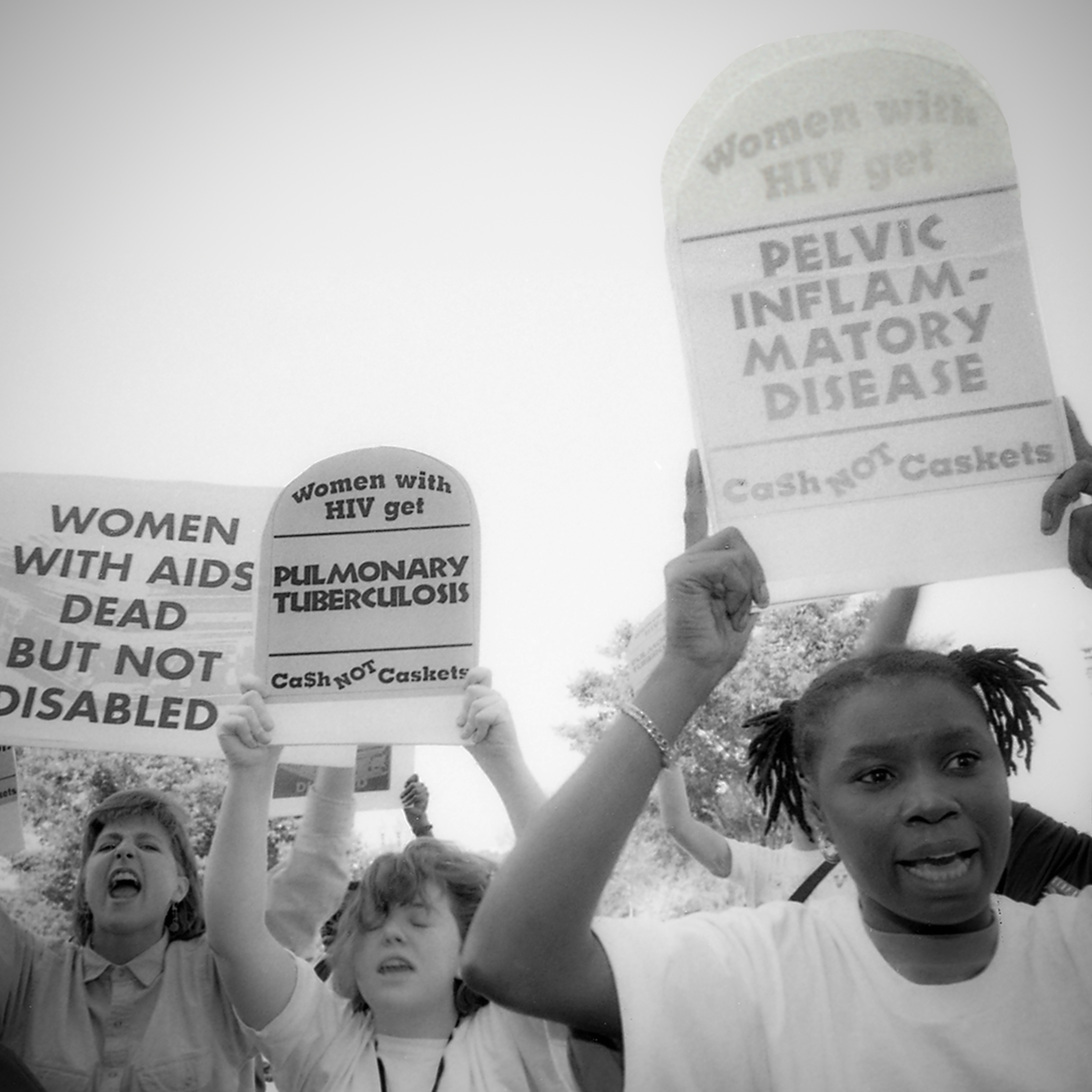
Act UP had organized this demonstration to pressure the federal public health system to recognize women with hiv. Their focus was the fight to change the definition of aids. Now, to understand this fight, it's important to remember the basic difference between HIV and aids. Hiv, or human immunodeficiency virus, is, well, a virus, it disables your immune system, and when it gets really advanced, it can lead to a bunch of illnesses that are collectively known as AIDS or acquired immunodeficiency syndrome. Now, when the Centers for Disease Control first came up with its list of AIDS defining illnesses, it based that list on what they were seeing in men. And it excluded illnesses that were showing up in women, like yeast infections, one
- [34:07]
F
after the other, pelvic inflammatory disease, cervical cancer.
- [34:12]
G
And this led to a lot of problems. First, it meant that a lot of women with these symptoms, they didn't know that they had AIDS or that they might have aids. But it also meant that even when a woman knew she was HIV positive and when she was really, really sick, she still couldn't get an AIDS diagnosis. And this meant that she couldn't qualify for government benefits like Medicaid and disability. And Katrina was one of them. So she joined the campaign by ACT UP to get the CDC to change the definition of aids.
- [34:41]
I
So I've watched, and as an HIV positive woman, I too, have suffered some of these symptoms. It's important for you to know that women are ill prior to any diagnosis of HIV and that they often die of HIV complications without ever meeting the CDC definition of AIDS.
- [35:01]
G
It's just a few weeks after the march in D.C. now, and Katrina is down in Atlanta speaking to a bunch of bigwigs at the cdc. She's there with Maxine Wolf. Now, Maxine, she is not a doctor and she's not a health professional. She is an activist. I had to give a whole list of the assumptions that were underlying the fact that women were not being treated. Did you feel like you accomplished stuff and you actually managed to move them in that meeting? No, we didn't feel like we moved them. We felt like we told them what they needed to know. When we were walking out, Katrina just turned around and looked at them and she said, I hold you responsible for every woman with HIV who dies, including myself. And we left. They didn't say anything. They were just standing there with their mouths open.
- [35:57]
H
I can remember, in fact, I'm having a visual film going in on my mind right now of when I've had a number of women activists come into my conference room on the seventh floor of Building 31 on the NIH campus decades ago.
- [36:14]
G
That's Dr. Anthony Fauci. He was the director of the National Institute of Allergy and Infectious Disease. And that meant that he ran AIDS research in the United States. It also made him a target for criticism from activists like the act up people who were in this meeting who were really, really frustrated with how many people were dying and how little the government seemed to be doing about it. Do you happen to remember just one woman who was part of that? Maxine Wolf?
- [36:41]
H
Oh, yeah. She was a tigress. I mean, she was very proactive, maybe even a little aggressive. But, you know, when people are not listening to you retrospectively, you wind up respecting them for being that way.
- [36:55]
G
Yeah, I mean, we've talked to a number of women who said that, you know, in the late 80s, they really had to work to convince their doctors to test them because this idea that women could get HIV just wasn't out there in the general public that much, I think.
- [37:13]
H
Yeah, I think you somehow or other, the message was either not getting to or the general, very, very busy private physician who is in a region of the country or who has a population of patients that you would not intuitively feel would be at risk.
- [37:36]
G
Where. Where do you think the bridge fell apart? You know, what was missing in the translation?
- [37:42]
H
You know, if I had a clear cut answer, Lizzie, I would tell you. I don't know. It's as puzzling to me. I think there are multiple complicated reasons why that happens. The Lack of people connecting the dots. I've been saying it now for 42 years that everybody can be at risk.
- [38:07]
G
Fauci wasn't exaggerating. He actually did write an article that was published years earlier, and it said that he expected the disease to go beyond gay men. Even so, women were still being excluded from treatments and studies in the medical establishment. It was stubborn. It wasn't moving. And then in December 1990, activists scored a breakthrough.
- [38:32]
F
There was a conference. Finally, because of all this pushing, there was a conference at NIH about HIV in women.
- [38:40]
G
Dr. Kathy Anastas was there. She became an AIDS expert through her work at Montefiore Medical center in the Bronx. It's almost 10 years into the epidemic, and this is the first national conference that focuses on women.
- [38:53]
F
A lot of people invited who had been pushing to have more studies of HIV and have any study of HIV
- [39:00]
G
in women, Actually, activists, doctors, researchers, they were all there, and they were fired up. They were not going to leave without getting something.
- [39:09]
F
During that meeting is when Tony Fauci decided that they needed a study of
- [39:18]
G
women, Finally, a study about women. It didn't begin until 1993, but it continues to this day. And it is the largest study on the progression of HIV in women in this country. But studies take a long time, especially when you have an incurable disease. Katrina had tested positive for HIV three years earlier, and her immune system was getting weaker. She was getting sicker. She didn't have a lot of time, and there was a lot that still needed to change. So she kept speaking out. Y' all ready?
- [40:04]
F
Ready.
- [40:04]
G
Ready.
- [40:04]
I
Do this.
- [40:07]
G
Let's do this. I understand what went wrong. I've been living in this country far too long. I need power.
- [40:15]
I
Condoms, too.
- [40:16]
C
It's a gift of life.
- [40:19]
I
I need power.
- [40:21]
E
Why are you here?
- [40:22]
I
I'm here because I'm an ex prisoner, and I'm also HIV infected, and I learned that status while being confined. And I want him.
- [40:29]
G
Katrina's at an ACT UP protest outside the Department of Corrections in Albany, New York. She's wearing this fake prisoner costume, and she's got this black leather hat tilted kind of to the side, a nose stud, gold hoop earrings.
- [40:43]
I
And because I want adequate health care for prisoners that I left there, and it shouldn't be a death sentence that they have hiv. I want education for them, peer education. I want them to let out terminally ill individuals due to hiv, because that's like double jeopardy, and it becomes a death sentence for those individuals. And if they pose the no threat to society, let them out and Let them die in dignity. So that's why I'm here.
- [41:14]
G
Katrina was a force during this period. She started an HIV support group for women who were getting released from prison. And she called it ACE Out. She also kept fighting to change the definition of AIDS. And she did this on the one hand with Act up through its campaign against the CDC. But she also worked with Terry McGovern on her lawsuit, the one against the government.
- [41:37]
F
So I feel like she taught me this concept of, like, joyful resistance. It's joyful that we get to fight this together. It's joyful that we're standing up and resisting. Yes, we are being victimized, but we are not victims. Victims were models of resistance.
- [42:05]
G
But Katrina was more than a model of resistance. She was also an advisor. As the lawsuit was winding its way through the courts, Terry would go to her for guidance.
- [42:15]
F
She was my primary strategy adviser. I think she really loved the other women that she saw being mistreated and saw dying. She really was drawn to the law and justice cause some part of her just couldn't ever be okay with this. Katrina was not well for very long on the outside. Like, she kept getting pneumonia and lots of gynecological problems and couldn't qualify for Medicaid or disability even.
- [42:46]
G
Katrina couldn't get an AIDS diagnosis, only hiv.
- [42:51]
F
So that meant as she got weaker, she didn't have a home care attendant. And here was, in my view, one of the biggest heroes. I hate that word, but really. And she was, like, falling on the floor with nobody to pick her up. We were sending clients, patients, volunteers to go help her.
- [43:11]
G
Katrina was in and out of the hospital.
- [43:13]
F
She was at St. Luke's Roosevelt a lot. And she'd have, like, high boots on and in the bed. And I'd be like, why are you wearing these high boots? She said, I snuck out and went shopping. And then every time I went to see her, she used to, you know, she used to steal my wallet. You know, she'd say, you missing anything? Not. She did it a few times. So she was so lively, actually, and funny and so wanted to live.
- [43:43]
G
Finally, after years of fighting, in the fall of 1992, the CDC offered the activists a deal. They were going to change the definition of aids, but it wouldn't include every symptom the activists had asked for.
- [43:56]
F
And they were offering this compromise of bacterial pneumonia, tuberculosis, cervical cancer, and 200 or fewer T cells. I remember having very serious conversations with
- [44:08]
G
her, Katrina, from her hospital bed.
- [44:11]
F
And she felt strongly that we should take it. That, you know, it was Too important to not take it at this point, especially with the 200 T cells that. That would bring a lot of people in. And yes, there should be many more things in it, but, you know, there's no time for this, as I remember her saying.
- [44:34]
G
In October 1992, Terry and the coalition of activists decided to accept the CDC's offer. Terry raced to the hospital to tell
- [44:43]
F
Katrina because I wanted Katrina to make a statement. So I told her that the definition was being expanded. And then she gave this statement that was kind of saying, you know, this never would have happened without women standing up for themselves, without activists. This is not the way this should be.
- [45:04]
A
Right?
- [45:04]
F
And, you know, I couldn't say she was happy she was dying. She was so angry and wanted the record to reflect that we had to fight tooth and nail to be acknowledged of dying of aids.
- [45:26]
G
The new CDC definition was set to go into effect in January 1993. So if Katrina lived into the new year, she would get the AIDS diagnosis. But she didn't live. Katrina Haslip died on December 2, 1992. She was 33 years old.
- [45:55]
F
For Katrina to die and never get aids, given who she'd been, it just. I started to just feel just like shell shocked and sick.
- [46:09]
G
After three years of fighting, Terry and the activists had won, but Katrina had died, and it was too late for scores of other women with aids.
- [46:19]
F
I really have this recurrent memory of, you know, walking into the office here and it was those pink messages, like piles of messages of clients that had died. It kind of felt like everybody was dying and the plaintiffs in the lawsuit were dying. So we were winning. Who cares, right?
- [46:41]
G
But the victory did matter. The number of women diagnosed with AIDS went up 45% after the CDC changed its definition. And that's because all of a sudden, HIV positive women suffering from one of the newly included symptoms, they were being counted as having aids.
- [47:01]
F
It's ultimately really weird to win lawsuits for people who are dead, even when I teach it like I teach at a school of public health. So I try to say, here's why science is not neutral, right? And I, whenever I show that 45% increased slide, I never feel joy. I feel really angry and sad. You know, most of these women are not around to, you know, be in the films. On the other hand, you know, as I have, I hope, been able to describe, I carry them, right? But nothing about this is okay.
- [47:47]
G
Did you have a memorial for her in the prison?
- [47:50]
J
Yes, we did. And I think we also had the
- [47:53]
G
quilt for Katrina Awilda Gonzalez. She was still in prison when Katrina died. She was released a few years later, and she and a group of women, they stitched a panel for the AIDS memorial quilt in memory of Katrina.
- [48:10]
J
Because, you know, the quilt was also part of our therapy every time somebody passed away. So we would get together and design the quilt, and we will sit around that big table to design it and to talk about the person and to share beautiful memories. And, yeah, that was part of our therapy. Katrina was a powerful, determined woman. She fought to the end, and that's what counts.
- [48:47]
A
She got the chance to be a movement leader, an eloquent, powerful, incredibly impactful movement.
- [48:56]
G
That's Judith Clark again. She was released from Bedford in 2019,
- [49:01]
A
but she didn't get the chance to then say, okay, that's great, but what about my life and who I want to be? Which is a challenge that all of us have as we reenter life outside of prison.
- [49:21]
G
Before she died, Katrina wrote the introduction to an oral history of AIDS called Breaking the Walls of Silence. And it's the story of how these women came together and began changing the story of AIDS for women.
- [49:34]
J
Hi, Katrina. Katrina de mi Vida, page 10.
- [49:39]
G
Okay, let me see Katrina's old friends Wendy and Judy. They're going to read her words.
- [49:47]
J
We were the community that no one thought would help itself. Social outcasts because of our crimes against society, in spite of what society inflicted upon some of us, we emerged from
- [50:05]
A
the nothingness with a need to build consciousness and to save lives. We made a difference in our community behind the wall. And that difference has allowed me to survive and thrive as a person with aids.
- [50:20]
J
To my PS In Bedford Hills Correctional Facility. You have truly made a difference.
- [50:28]
A
I can now go anywhere and stand openly alone without The Silence.
- [50:34]
J
Katrina Haslip, 1990.
- [50:48]
G
Today, the medical establishment in the United States fully recognizes that women can get HIV and aids. The field of women's health is much more robust, and women with HIV are surviving and, yes, thriving into their 50s, 60s, even 70s. But we have so much farther to go.
- [51:16]
C
To hear other stories from the early days of the HIV and AIDS epidemic, subscribe to the podcast series the Plague in the Shadows from the History Channel and WNYC Studios. Our episode was produced by Michael I. Schiller and edited by Taki Telenides. The Blind Spot team includes Emily Botin, Karen Frohman, Anna Gonzalez Gonzalez, Sophie Hurwitz, and Christian Reedy. Music and sound design for the podcast by Jared Paul, additional music by Isaac Jones, and additional engineering by Mike Kutchman. The executive producers at the History Channel are Jesse Katz, Eli Lehrer, and Mike Stiller. Victoria Baranetsky is our General Counsel. Our production manager is the Great Zula Macabre. Additional score and sound design by the dynamic duo Jay Breezy, Mr. Jim Briggs, and Fernando Mamano Arruda. Our executive producer is Bret Myers. Our theme music is by Camerado Lightning. Support for reveals provided by the Riva and David Logan foundation, the John D. And Catherine T. MacArthur foundation, the Jonathan Logan Family foundation, the Robert Wood Johnson foundation, the park foundation, the Schmidt Family foundation, and the Hellman Foundation. Support for reveal is also provided by you, our listeners. We are a co production of the center for Investigative Reporting in prx. I'm Al Ledson and remember, there is always more to the story.
- [52:48]
A
From prx.