Loading summary
Transcript210 lines
- [00:01]
Jack Morris
This episode is brought to you by Progressive Insurance.
- [00:03]
Michael Montgomery
You chose to hit play on this podcast today.
- [00:06]
Jack Morris
Smart Choice make another smart choice with Auto Quote Explorer to compare rates from multiple car insurance companies all at once. Try it@progressive.com, progressive Casualty Insurance Company and affiliates.
- [00:18]
Michael Montgomery
Not available in all states or situations.
- [00:20]
Jack Morris
Prices vary based on how you buy. What if your perceptions about the past were wrong? Throughline is a podcast that takes you back in time to uncover the parts of the story that may have gone unnoticed.
- [00:35]
Michael Montgomery
It effectively turned day into night and.
- [00:38]
Jack Morris
How it shaped the world.
- [00:40]
Michael Montgomery
Now time travel with us every week.
- [00:43]
Jack Morris
On the throughline podcast from NPR.
- [00:49]
Al Letson
From the center for Investigative Reporting and PRX, this is Reveal. I'm Al Letson. It's winter 2015, and Jack Morris is on a bus that's winding down California's north coast along Highway 101. It's not just any bus. It's used to transport state prisoners. Jack says he's with about 40 or 50 other men. They're shackled, and some are locked in small cages. Jack's used to that. What he's not used to is the vivid scenery rushing by, the rugged coastline, rolling Pacific, and the groves of towering redwoods.
- [01:26]
Jack Morris
I could see big giant trees as we passed them, and some looked black and then some looked green. I mean, the colors were absolutely magnificent. And it's the first exposure I had to this in so long.
- [01:44]
Al Letson
Jack is transfixed, almost like a child seeing an explosion of colors for the first time. And in a sense, he's being reborn. Jack has just emerged from Pelican Bay, one of America's first supermax prisons, where he spent nearly every hour of the day alone behind windowless concrete walls. Now he's being transferred to a lower security prison nearly 1,000 miles away.
- [02:13]
Jack Morris
The further we got, the less weight I had on my proverbial shoulders.
- [02:21]
Al Letson
Along the way, the bus makes some stops. One is at a prison in the Tehachapi Mountains, north of Los Angeles.
- [02:28]
Jack Morris
They put me in the cell by myself, and they gave me a blanket and a sheet and they took all my clothes. They left me with socks, boxes and a T shirt. It's Christmas and Tehachapi has windows. I'm shivering cold. I'm freezing. I got the blanket wrapped around me and I'm standing at the window and it starts snowing and bam, it hits me. And I'm I start singing Bing Crosby's A White Christmas. I'm dreaming of a white Christmas and I'm watching the snow, big flakes fall into the ground And I'm singing A White Christmas. They said, is that you singing down there? I said, hell yeah, that's me singing. I was out of Pelican Bay. I was watching the world outside this little 4 inch window and I was heading to a general prison population after doing decades in solitary confinement. And I wasn't crazy.
- [03:29]
Al Letson
I have a hard time putting myself in Jack's shoes. What it would feel like to see snowflakes, real snowflakes, after having spent half your life almost completely cut off from the outside world. What Jack experienced long term solitary confinement is still a reality for more than 100,000 prisoners in America. But in recent years, public opinion has shifted and states like California have placed some limits on how long a person can be held in solitary. One of the reasons for that shift is a hunger strike initiated by the men at Pelican Bay, Including Jack, the largest prison hunger strike in in U.S. history. This Week we're revisiting a show which is a collaboration with the PBS documentary the Strike. The film's directors, Joe Bill Munoz and Lucas Gilkey, teamed up with Reveal's Michael Montgomery, who's been covering Pelican Bay for 20 years. Today we're telling the inside story about a group of men deemed the worst of the worst and how they overcame bitter divisions and harsh conditions to build an improbable resistance movement. Here's Michael.
- [04:43]
Michael Montgomery
When I first started visiting Pelican Bay's security housing unit, what most people call the shoe, it was bewildering, mind bending. The thick cement walls are like a bunker. And once inside, you're taken down a network of long corridors that lead to clusters of cells known as pods. The corridors are so long you can't quite see where they end. Sort of like you're staring into the abyss. You hear your own footsteps, maybe a prisoner being escorted in shackles. Some muffled conversations, a toilet flush.
- [05:19]
Michael Saavedra
First thing you notice about Pelican Bay, it's so quiet.
- [05:24]
Jack Morris
It's quiet.
- [05:27]
Michael Montgomery
Farouk Salvante spent 19 years locked up in isolation.
- [05:31]
Michael Saavedra
Then the loneliness, man.
- [05:34]
Jack Morris
Man, that loneliness will kill you.
- [05:37]
Michael Saavedra
That thing wrap around you like a long blanket, man.
- [05:42]
Brian Perry
It literally alters your perception of time.
- [05:45]
Michael Montgomery
Richard Brown spent a total of 14 years in the security housing unit.
- [05:50]
Brian Perry
Short periods of time seem to drag on forever. Long periods of time fly by in an instant.
- [05:59]
Michael Montgomery
For Jack Morris, his time in isolation added up to nearly three decades.
- [06:05]
Jack Morris
I had resigned myself to death in a windowless concrete box. How do you fight that?
- [06:16]
Michael Montgomery
Like a lot of men who ended up at Pelican Bay, Jack's journey began in his teen years. He grew up poor in Norwalk, a city in south Los Angeles. He didn't like school and says he started running with a group from the neighborhood that did a lot of drinking and fighting.
- [06:31]
Jack Morris
I didn't know violence had become a part of my life. It was just my life. You know, I had no idea that fighting against somebody else in the park was an act of violence. It was just a daily activity or a weekly activity.
- [06:48]
Michael Montgomery
Jack was in and out of juvenile lockups, and when he was 18 years old, he got into a fight after a day of heavy drinking and stabbed a man to death. He was sentenced to life in prison for murder and in 1979, sent to San Quentin state prison. It was a time when incarceration rates and prison violence were surging.
- [07:09]
Jack Morris
You learn that in order to survive, you yourself then have to become predatorial, and then you then expose somebody else to that, and it's a vicious cycle.
- [07:25]
Michael Montgomery
Beginning in the 1980s, America was getting tough on crime and stepping up the war on drugs. And California was leading the way with mandatory sentencing laws and one of the toughest three strikes measures in the nation. It was the era of mass incarceration. The California Department of Corrections unleashed a prison building boom. Ladies and gentlemen, I am greatly pleased to have this opportunity to join with all of you as we dedicate this newest and most modern correctional facility, Pelican Bay State Prison. In 1990, Governor George Dukemajen inaugurated Pelican Bay as one of America's first supermax prisons.
- [08:12]
Brian Perry
California now possesses a state of the art prison that is serving as a.
- [08:19]
Michael Montgomery
Model throughout the nation.
- [08:23]
Brian Perry
Dear God, we have gathered today to dedicate this institution. Give wisdom to those who have been chosen to lead. Impart our political leaders the courage to do right. Grant strength to those who have been given the responsibility to control the lives of so many. And lastly, help the inmate to understand that this prison is a result of love for humanity, not as a result.
- [08:47]
Jack Morris
Of anger and fear.
- [08:51]
Michael Montgomery
As it was opening new prisons, California was also aggressively targeting prison gangs. They're different from street gangs and began as self defense groups carved out of the racially divided prison population. Some grew into criminal organizations, controlling drugs and other contraband and even ordering hits on the streets. There's the Aryan Brotherhood, the Black Guerrilla family, and Latino groups from northern and Southern California, Nuestra Familia and the Mexican mafia. Some trained like soldiers. This video shows a prison gang leader running new recruits through a series of exercises called the machine. Being a Latino man from Los Angeles, Jack hung Out with the man he grew up around. He says in prison, there really wasn't much of a choice. Still, he insists he was never an active member of a prison gang. And I've seen sworn statements from former gang leaders that support this, but it didn't matter.
- [09:54]
Jack Morris
I'm in the general prison population in San Quentin, and they found this picture, and they said, there's other people in this picture that have been validated, and you're with them. Therefore, this picture also identifies you as being a gang associate.
- [10:13]
Michael Montgomery
In other words, posing for a photograph with alleged gang members was treated as damning evidence that Jack was part of the group. He didn't have to do anything tangible. It was guilt by association, and the punishment was harsh. Jack was placed in isolation and eventually sent to the security housing unit, the shoe, at Pelican Bay, for a, quote, indeterminate term.
- [10:36]
Jack Morris
When I got off the bus, they stripped me naked, and they walked me down the corridor naked in handcuffs. They took me into three block, and they walked me up the stairs naked, and they put me in a cell and closed it, and they didn't give me clothes until the following day.
- [10:53]
Michael Montgomery
To place men in the shoe, California cast a wide net and often relied on thin evidence of gang activity.
- [11:01]
Brian Perry
It wasn't a complicated process at all, and we validated a lot of people very, very quickly.
- [11:07]
Michael Montgomery
Brian Perry is a former assistant director of the California prison system who helped develop the department's gang policies. Years later, he would try to reform the system.
- [11:17]
Brian Perry
There were fixed terms, and there were indeterminate terms. Maybe possession of a weapon or stabbing another inmate, they would get a fixed term, you know, maybe six months, nine months, 18 months. And the indeterminate term was saved for the prison gang members because our policy said, if you're identified as a prison gang member, you're validated as a prison gang member. You pose a threat to the security of the institution.
- [11:40]
Keramet Ryder
The wrong letter, the wrong book, the wrong whispered conversation or telephone call.
- [11:45]
Michael Montgomery
Keramet Ryder is a professor of criminology at the University of California, Irvine. She authored a book about the history of Pelican Bay.
- [11:53]
Keramet Ryder
And you go to solitary confinement at Pelican Bay indefinitely for, it turned out decades, with no recourse, right? No ability as that person who gets sent there to even see the evidence in your file. And no check on the system, no. No oversight to say, did we get it right?
- [12:09]
Michael Montgomery
And the only reliable way to get out of the shoe was to agree to provide information about the gang, basically to become a snitch. Over the past two Decades. I've spoken to dozens of men who were validated and spent years locked up in the shoe. For anyone who's never done prison time, it's hard to get your head around surviving such bleak conditions. Now, initially, some of the men had cellmates. But after a rash of homicides that ended. And most lived in near total isolation. No phone calls, no meaningful contact with another human, no educational programs, no glimpses of the outside world. The only regular time out of your cell is a shower and exercise solo in another, slightly bigger, windowless concrete box. And the prison's remote location makes it difficult for people to visit. What you have is a small television set and the mail, something that would prove vital for the eventual hunger strike. But that was still years away.
- [13:17]
Jack Morris
For Jack Morris, what becomes time is delivery of the meals, eating and sleeping, eating and sleeping and using the bathroom and eating and sleeping. And I would lay there on my bunk for days and weeks at a time, doing nothing, just staring at the tv, not even seeing it.
- [13:42]
Michael Montgomery
To feed his brain, he learned math and read voraciously. He loved books about birds and their migration patterns to just fly away. And he wrote stacks of letters to his friends and family.
- [13:54]
Jack Morris
I told him, tell me the littlest detail. How did it feel turning the knob on the door to step out onto your front porch, to walk to your car so you could drive to the supermarket? I want to know what you saw on that drive. Because being in isolation so long, you lose your memories. And this was a way of, you know, trying to remember something.
- [14:22]
Michael Montgomery
There were lots of strategies for survival. For some, it was religion. Others found meaning in the prison gangs. For Michael Saavedra, like Jack Morris, it was education. He was serving a 21 year sentence when he was validated and sent to Pelican Bay. He says he sustained himself by learning to draw, studying the law, and filing legal complaints.
- [14:44]
Michael Saavedra
I never really felt like I was gonna lose my mind. I never heard voices. And I think one thing that helped me get through that was just literally being off, being mad every day, waking up like, I hate these guards. I hate this system. Because I knew in my heart all that they were saying was untrue.
- [15:09]
Michael Montgomery
There were lawsuits that forced California to reduce prison overcrowding, improve medical services, and make accommodations for people with mental health diagnoses. But nothing that challenged indefinite solitary confinement at Pelican Bay. One person tried to overhaul the system from the inside. Brian Perry, who helped shape the department's gang policies, started getting second thoughts when he saw how long some men were being held in the shoe I had.
- [15:36]
Brian Perry
Visited prisons across the country, and they were shocked that we were still holding people in shoe for so long without losing a lawsuit. It made me look at the system, you know, what we were doing inside the shoe program. So I thought to myself, you know, we can do better.
- [15:54]
Michael Montgomery
With funding from the legislature, Brian pulled together a team of national experts. They proposed policy changes like using the shoe to isolate gang members who commit assaults and other violence and then create a way out without having to snitch.
- [16:10]
Brian Perry
Well, the department looked at it and did nothing about it. Okay, and did that surprise me? No. It probably ended up on a shelf someplace where most reports end up. But you have to understand large agencies, whether they're correctional agencies or police agencies or we all have our own culture, and CDC had a culture for a long time that this is the way we're going to do business. This is how we do business. So don't try to rock the boat too much. Which led to, you know, people being in there 20, 30 years.
- [16:49]
Michael Montgomery
In the SHU, prisoners could talk to each other through the perforated steel doors. Jack Morris says officials tried to keep a lid on that by placing men from rival groups nearby.
- [17:00]
Jack Morris
And they believed, okay, now we got these people in here. None of them get along with each other. It's going to be easier for us to control them. Initially, that was the case because almost.
- [17:14]
Michael Montgomery
Any conversation could be overheard and make you vulnerable. But Jack says if it was the department's plan to use racial animosities to keep men divided, it started to backfire.
- [17:26]
Jack Morris
What they didn't realize is that we need contact with other human beings. We need to be able to talk to somebody else. We need to be able to stimulate our minds, stimulate our vision. So over time, I learned that whether you were from north or south or black or white, you were cool if you were cool. And people started to treat each other with some humanity.
- [17:53]
Michael Montgomery
Jack says a dialogue opened across racial and ethnic lines.
- [17:58]
Jack Morris
We all began to realize that our existence was being suppressed by the same person.
- [18:07]
Michael Montgomery
Influential prisoners started circulating ideas about organized resistance. There was a book about a group of men in Ireland who starved themselves to death.
- [18:17]
Jack Morris
Somebody started reading about Bobby Sands in the Irish Hunger Strikers that took place in the early 80s. And this understanding started to permeate the walls of Pelican Bay.
- [18:31]
Michael Montgomery
As they started to organize, they communicated covertly, sometimes using tiny handwritten notes called kites that are tossed between cells with a makeshift fishing line. They would also shout messages through the pipes and vents.
- [18:46]
Jack Morris
We would empty out the water from the toilet and yell down into the commode, and the sound would travel through the pipe system.
- [18:58]
Michael Saavedra
No matter where we're at or the conditions we're under, we find ways to communicate.
- [19:05]
Michael Montgomery
Michael Saavedra says word of a protest was spreading around the shu. And through a letter writing campaign, they connected with human rights groups beyond Pelican Bay.
- [19:15]
Michael Saavedra
Hey, this is what we're trying to do. Will you all support us? Will you help spread the word?
- [19:21]
Michael Montgomery
The five core demands were clear. Improve the food, allow educational programs, stop group punishment, provide ways out of the shoe other than snitching, and put an end to long term solitary confinement. Now, any kind of collective action at Pelican Bay needed to have the gangs on board, and that was a challenge. Jeremy Beasley, a former member of the Aryan Brotherhood, talked with me about it.
- [19:49]
Jack Morris
It was hard to get people on board. Some of the ABs protested. Some of them said, nah, this is a stupid hair brain idea. Some of them, you know, didn't want to prey on the public sympathy. We're ab. We don't. We don't beg to get out of here. You know, I mean, we can handle this. Don't show no weakness. There was so much opposition. I mean, nobody thought a hunger strike would work. It took about three years of people.
- [20:17]
Michael Montgomery
Talking, and finally all the factions came together. On July 1, 2011, more than 6,000 prisoners in California started refusing their meals. Three days later, Jack says guards had a surprise.
- [20:32]
Jack Morris
It's the 4th of July and it's dinner time. And then they brought in the food carts, and it was stacked high with watermelon and chocolate milk ice cream.
- [20:44]
Michael Montgomery
And.
- [20:45]
Jack Morris
And the guard rolled it in, and he said, all you guys that are on the hunger strike, if you want to get off, let me know. We can give you as much food as you want right here. You can have all this food you want. But there wasn't a single taker.
- [21:00]
Brian Perry
Inmates in at least 11 prisons across the state's troubled prison system have been.
- [21:03]
Jack Morris
On hunger strike for almost two weeks.
- [21:06]
Brian Perry
Protesting what some mental health experts say is tantamount to torture.
- [21:11]
Jack Morris
We collectively struggled together, and we started to realize that, hey, your life is no different than mine. You live the same life. I've lived in a different area, different players, but it's basically the same thing. I've lived.
- [21:33]
Al Letson
At Pelican Bay. No one, not the guards and not the men refusing to eat, had any idea that this protest was just the beginning of a long, grueling struggle.
- [21:44]
Michael Saavedra
After seeing my neighbor pass like that, I thought I was gonna die.
- [21:50]
Al Letson
That's coming up next on reveal.
- [22:07]
Jack Morris
Hello, listener. My name is Najeeb Mamini and I am a producer here at Reveal. Reveal is a nonprofit news organization and we depend on support from our listeners, listeners like you. Donate today@revealnews.org donate. It helps fund the stories that we tell and helps me feed my cat.
- [22:30]
Al Letson
So thank you. From the center for Investigative Reporting and prx, this is Reveal. I'm Al Letson. Deep inside Pelican Bay State Prison, four men are seated at a conference table with a group of guards standing behind them. They're dressed in wrinkled white jumpsuits, and their wrists and ankles are chained to their waists. They look exhausted. It's July 20, 2011, and the men are leaders of a hunger strike that's entering its fourth week. Across the table, Scott Kernan has just arrived from Sacramento. He's the number two at the California Department of Corrections and Rehabilitation, and his mission is to convince these men to call off the protests. They're allegedly leaders of violent and feuding prison gangs, but they've overcome bitter rivalries to launch a peaceful protest against indefinite solitary confinement. Today we're revisiting a show we produced in collaboration with the PBS film the Strike Reveals. Michael Montgomery picks up the story.
- [23:42]
Michael Montgomery
This most unusual summit is being secretly videotaped by prison staff through a one way mirror. The stakes are high, but Scott Kernan appears relaxed, confident. He's a former correctional officer and warden. His mother was also a warden, so he knows the ropes. The recording is a little hard to hear, but Kernan says prison officials won't negotiate, that they're going to do what they think is right. He concedes there are problems in the system, policies that aren't completely correct. And he says the department is drawing up plans to fix them. He asked the men to end the strike and give him some more time. Kernan says any major changes will require an administrative review and an agreement with the powerful guards union in response. The men are respectful but emphatic.
- [24:48]
Jack Morris
None of us ever wanted to have to take this move right here.
- [24:53]
Michael Montgomery
Todd Ashker is one of the top strike leaders, but we, we feel like.
- [24:57]
Jack Morris
We have no choice because we, we.
- [25:00]
Michael Montgomery
All know we're dead already. We're dead here.
- [25:03]
Jack Morris
So what do we have to do?
- [25:05]
Michael Montgomery
Ashker says the hunger strike was the only way to call attention to their situation. He says they'd heard it all before. Promises to fix the system, improve conditions. And nothing ever happened, you know, and.
- [25:17]
Jack Morris
That'S where we come to. And we, we had no other way.
- [25:20]
Michael Montgomery
Of putting it out there.
- [25:21]
Jack Morris
And trying to expose what's really been going on to the public.
- [25:27]
Keramet Ryder
That's probably the closest physical proximity they'd had to someone like, who wasn't an officer in decades.
- [25:34]
Michael Montgomery
UC Irvine professor Keremit Ryder closely studied this meeting for her book on the history of Pelican Bay.
- [25:41]
Keramet Ryder
The incarcerated folks at the table, they're in an incredibly vulnerable position and they're cuffed and controlled, but they're not in a cage, which is how most interactions would have been expected to take place. And that face to face conversation with Kernan, he's talking to them like they're humans. And he's honestly telling them why he feels so stuck. He's not getting angry, he's not threatening them. Maybe that's an incredibly low standard, but I think imagining what that moment was like for those guys and the power of the human interaction they were experiencing for the first time in decades, if you really think about where they were coming from, it's a haunting moment.
- [26:20]
Michael Montgomery
The men go back and forth with Kernan laying out their core demands, which include having a way to get out of the shoe without being required to snitch. In response, Kernan offers a memoir that lays out longer term reforms and some immediate concessions, like allowing the men to have sweatpants, knit caps, craft supplies, and annual photographs to share with families. They're small things, but for men deprived of them for years, they have meaning. After about an hour, the meeting ends. Kernan says he's got to get back to Sacramento. The men are escorted back to their cells, and later that same day, they call off the strike. It turns out this protest is just a rehearsal for something a lot bigger. No one knew it yet, but another hunger strike was coming. A few months later, the department started moving cautiously to make changes. It began a pilot program that allowed a limited number of men who were considered low security risk to transfer out of the shoe and into mainline prisons. In 2012, at a prison in Corcoran, California, I met with a group of men who'd just arrived from Pelican Bay. We sat in a classroom in a semicircle, and they were chatty but didn't want me to use their names. They still had a distinctive look that I'd noticed on my visits to the Pelican Bay shoe. The skin on their faces was pale and washed out from going so many years without direct exposure to the sun.
- [28:01]
Brian Perry
You ever seen that cartoon? That little mouse comes out of a hole and he just like. They're all disoriented. That's how we feel right now you know. Still trying to figure out how to associate with people.
- [28:12]
Michael Montgomery
We strolled out into the prison yard, where the afternoon sun was casting long shadows on the dusty ground. For the first time in years, the men were able to walk without shackles and hang out together in the open air.
- [28:25]
Jack Morris
They smell freedom.
- [28:27]
Michael Saavedra
Even though we're on the main line.
- [28:28]
Jack Morris
They still smell freedom.
- [28:30]
Michael Montgomery
I mean, even though there's concrete walls.
- [28:31]
Jack Morris
It doesn't matter, because these concrete walls are further apart in a bay. There's only 20 foot walls is all you see. It will show you in a large box here, you don't see the walls.
- [28:44]
Michael Montgomery
Perhaps most memorable was feeling the soft, gentle touch from a visiting family member.
- [28:51]
Jack Morris
Amazing, tender. All the emotions that you thought were not there resurfaced.
- [28:58]
Michael Montgomery
How long had it been since you held hands with your mom?
- [29:01]
Brian Perry
Over what, say, 14 years, and my sister's like, what, 20?
- [29:10]
Michael Montgomery
By this point, only a few dozen prisoners had been pulled out of the shuffle and the men locked up at Pelican Bay, they were still waiting for the department to address their core demands. Meanwhile, the world was starting to take notice.
- [29:24]
Jack Morris
Good afternoon and welcome to the Assembly.
- [29:26]
Michael Montgomery
Committee on Public Safety in Sacramento. Lawmakers began scrutinizing conditions at Pelican Bay and the department's gang validation policies. And for the first time, the U.S. senate held a hearing to examine solitary confinement in in America's prisons.
- [29:43]
Brian Perry
The United States holds more prisoners in.
- [29:45]
Michael Montgomery
Solitary confinement than any other democratic nation.
- [29:50]
Jack Morris
These are human rights issues that we cannot ignore.
- [29:54]
Michael Montgomery
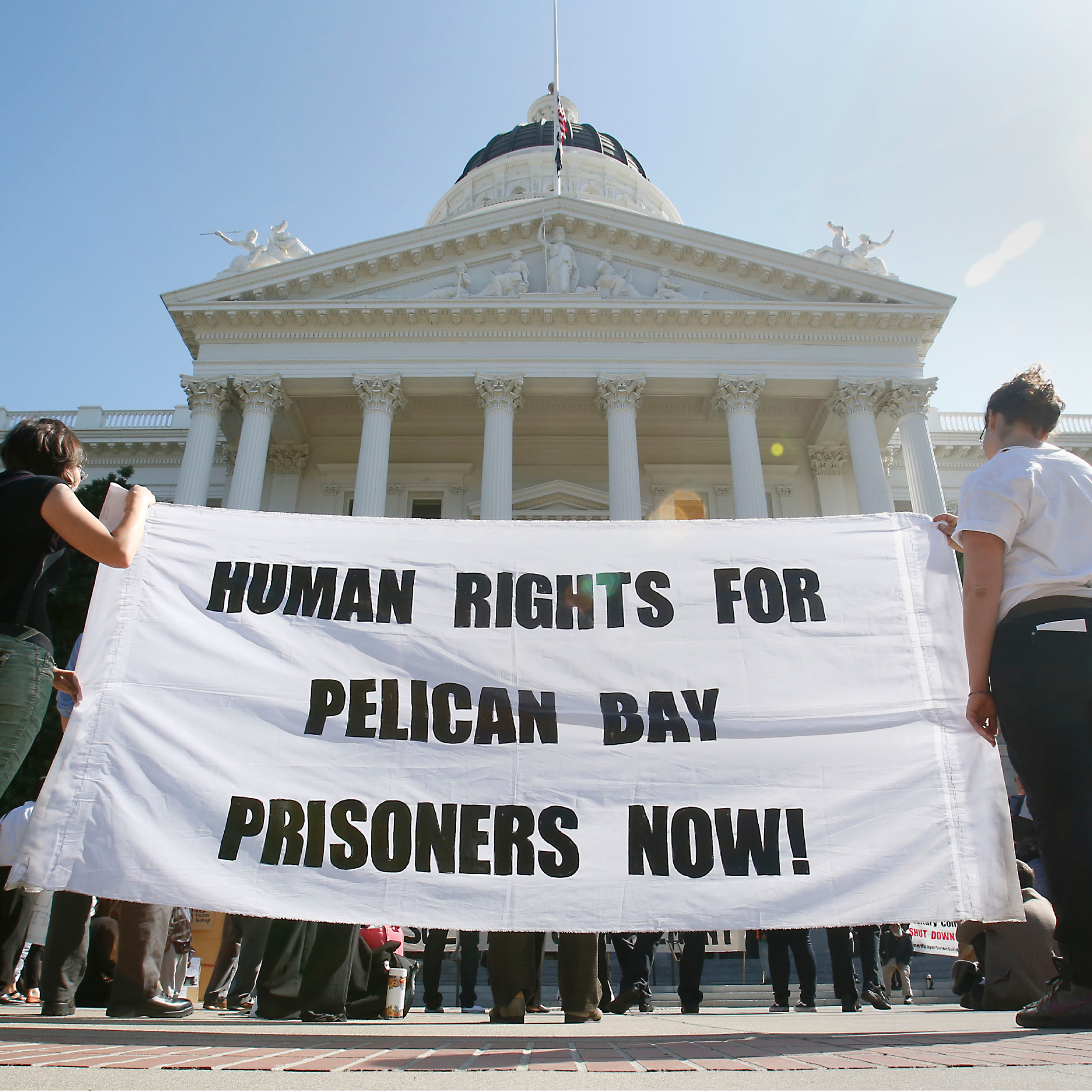
There was also movement on the legal front. The center for Constitutional Rights joined with Men in the Shoe to file a class action lawsuit challenging indefinite solitary confinement in California prisons. And there was a growing protest movement on the streets that was sparked by the first hunger strike. On July 1, 2011, the Pelican Bay prisoners began a hunger strike that spread across the state of California. Dolores Canales helped organize a group of women whose sons and husbands were locked up at Pelican Bay. They had come together to lead rallies like this one near the Capitol in Sacramento, where they brought along a full size plywood replica of a solitary confinement cell. I knew my son had already been.
- [30:43]
Keramet Ryder
A decade in solitary confinement.
- [30:45]
Michael Montgomery
I knew this. And before July 1, 2011, I didn't give it a second thought. Now I cannot stop thinking about it.
- [30:55]
Brian Perry
They flipped the script.
- [30:57]
Michael Montgomery
Brian Perry is the former corrections official who tried and failed to get California to change course. And he says the first hunger strike did more than just start a conversation about Pelican Bay. It helped spotlight a national issue.
- [31:12]
Brian Perry
It was solitary confinement, torture, I mean, all of a sudden Congress was having hearings on solitary confinement. They want it in the press. You know, this avalanche.
- [31:23]
Michael Montgomery
Bryan says he gave state officials some new advice.
- [31:27]
Brian Perry
You need to settle this because if you take this and you lose it, you're going to have a retired federal judge in here running this prison system.
- [31:36]
Michael Montgomery
He says the department wasn't listening, at least not yet. One year after the first protests, strike leaders at Pelican Bay took another step to unify California prisoners. They announced a peace treaty between racial and ethnic groups. By this point, Jack Morris had been locked up in the shoe for, for nearly 25 years. He says it was a historic moment.
- [32:03]
Jack Morris
Everybody that the Department of Corrections said were warring factions of gangs, they collectively got together and they drafted a document that said, hey, we are not fighting against each other. We are not going to fight against each other. We have a non hostility pact taking place here. We have no animosities.
- [32:21]
Michael Montgomery
Jack says the men were aware that some changes were underway, but without more pressure, they believed the department would just backslide on its promises. The shoe would remain full. So he says they started getting ready for another hunger strike, eating extra food to bulk up.
- [32:39]
Jack Morris
But it was going to be difficult because this time they were talking about not stopping at all, not giving up, not listening to the Department of Corrections. We're going to keep going until we start dying.
- [32:53]
Michael Montgomery
On the morning of July 8, 2013, prisoners throughout California stopped eating.
- [32:58]
Michael Saavedra
People were refusing and more people started refusing. And then on the main lines, people didn't even come out of their cells.
- [33:05]
Michael Montgomery
Michael Saavedra couldn't believe what was happening.
- [33:09]
Michael Saavedra
The guards were like, they start getting scared because they don't know what the is going on. And they see this type of unity amongst people who usually are enemies fighting against each other. To be on the same page at the same time was super powerful and it scared the out of them.
- [33:26]
Jack Morris
A friend of mine yelled up to me and he says, hey, Jack, turn on the news and I'm looking at it and then I seen the ticker tape.
- [33:35]
Brian Perry
On Monday, some 30,000 inmates spread across more than half of California state prisons.
- [33:41]
Michael Montgomery
Refused to eat their breakfast.
- [33:42]
Jack Morris
30,000 California prisoners on hunger strike. Nowhere in the history of the United States had this ever taken place.
- [33:52]
Michael Montgomery
This hunger strike was five times larger than the first one and it galvanized protesters. The Department of Corrections took a hard line. Officials alleged the protest was a power play by gang leaders trying to get out to mainline prison. They started to limit the flow of information to hunger strikers and blocked some attorney visits.
- [34:16]
Jack Morris
And then the Days started going by. One week, no one's eating. Two weeks, there are still hundreds of prisoners on strike. My legs, my muscles, I felt weak, shaky, on shaky ground all the time. When I moved, I had to move slowly because I would get dizzy. Soon my brain realized it wasn't getting food, and I started to feed off myself.
- [34:41]
Michael Montgomery
The department used another tactic. It began relocating some of the strikers to other facilities, officially for medical reasons. Michael Saavedra was moved to Corcoran State Prison, where his neighbor was also refusing meals.
- [34:56]
Michael Saavedra
He was a great artist, and, you know, he was telling us that he was feeling really bad, and we told the nurse would come by. We were telling him, hey, the homie is not responding. The homie's not responding. And then they came in with riot gear, handcuffed him, took him out, and he was lifeless. He wasn't moving. In fact, he was dead. He died. Especially after seeing my neighbor pass like that. I thought I was gonna die, like, literally die.
- [35:27]
Michael Montgomery
The death of a prison inmate is prompting calls for the governor to intervene in the prison hunger strike. The authorities determined the man had hanged himself in his cell. Nearing the end of the third week, Jack Morris says he broke down and started to eat again.
- [35:45]
Jack Morris
I did not eat for 18 days, and I feel bad that I could not eat for more.
- [35:54]
Michael Montgomery
A lot of men did the same thing, but Michael Saavedra and dozens of others, they kept going.
- [36:01]
Michael Saavedra
After the first month, you don't think about it no more. You're just trying to stay awake. You're just trying to. Trying to be alive when your whole body is just shutting down, shutting down. And to be honest, I don't really remember everything because I wasn't able to think about things. But in the back of my mind, not giving up. I'm not gonna give up. They really feared me at the beginning. They're going to really fear me now.
- [36:30]
Michael Montgomery
From the outset, California had deployed medical personnel to monitor the hunger strikers. Janet Molbatani was a top medical official with the California Correctional Health Care Services.
- [36:42]
Keramet Ryder
People can survive without eating for two.
- [36:45]
Michael Montgomery
Months, but they will start getting severe.
- [36:49]
Brian Perry
Symptoms after about one month.
- [36:52]
Michael Montgomery
On day 43, citing concerns for the welfare of some of the strikers, a federal judge approved a request from state officials to begin force feeding prisoners if it became necessary. The order was controversial, since it covered men who had signed advance directives saying they didn't want to be revived. On the streets, protesters were calling on Governor Jerry Brown to take action.
- [37:17]
Jack Morris
We are demanding the governor, the California.
- [37:20]
Michael Montgomery
Department of Corrections, meet with the strikers.
- [37:23]
Jack Morris
Negotiate their reasonable Demands.
- [37:26]
Michael Montgomery
At Corcoran State Prison, Michael Saavedra says guards were spreading misinformation to get him to stop.
- [37:32]
Michael Saavedra
We also had guards coming by saying, hey, you know, the guys at Pelican Bay already stopped. Y' all are dumb. Y' all should stop now. Why you guys keep going?
- [37:45]
Michael Montgomery
Alone in his cell and facing possible death by starvation, Michael's mind raced back to his troubled childhood and his road to prison.
- [37:54]
Michael Saavedra
I started thinking about, you know, I brought my mom so much pain all her life, right from coming to heaven to pull me out from juvenile hall to getting me out of jail. That's a up way to see your child, right? Getting shot, you know, going to the hospital, seeing your son shot. I think at that point, my mind was so blank and everything was just so fuzzy and dark that I didn't even think about anything. I just tried to sleep as much as possible.
- [38:32]
Michael Montgomery
On day 60, things came to a quick, quiet end. Michael got a visit from an attorney representing the hunger strikers.
- [38:41]
Michael Saavedra
Literally, they had to take me in a wheelchair. I could not walk. And the attorney was like, hey, how do you guys feel?
- [38:50]
Michael Montgomery
That class action lawsuit filed by the center for Constitutional Rights, it was gaining traction, and the attorney told him that lawmakers were now calling for new hearings to force the Department of Corrections to speed up their reforms.
- [39:05]
Michael Saavedra
Everybody is in agreement to end. I didn't think of anything else but, like, it's over. It's over.
- [39:18]
Al Letson
The hunger strike, along with the class action lawsuit, had put so much pressure on California that eventually the state agreed to sweeping changes.
- [39:27]
Keramet Ryder
On Tuesday, California reached a landmark legal settlement with a group of prisoners held in isolation for a decade or more at the Pelican Bay State Prison.
- [39:37]
Al Letson
The settlement marked the end of indefinite solitary confinement in California prisons and gave Michael Ceavedra and Jack Morris a shot at rebuilding their lives.
- [39:47]
Michael Saavedra
I didn't submit. I didn't conform. You didn't break me so I could walk with my head high out here.
- [39:54]
Al Letson
That's next on Reveal.
- [40:06]
Keramet Ryder
America is changing, and so is the world.
- [40:11]
Michael Montgomery
But what's happening in America isn't just the cause of global upheaval. It's also a symptom of disruption that's happening everywhere.
- [40:19]
Jack Morris
Asma.
- [40:19]
Keramet Ryder
I'm Asma Khalid in Washington, D.C. i'm.
- [40:21]
Brian Perry
Tristan Redman in London, and this is the global story.
- [40:25]
Keramet Ryder
Every weekday, we'll bring you a story from this intersection where the world and America meet.
- [40:31]
Jack Morris
Listen on BBC.com or wherever you get.
- [40:33]
Michael Montgomery
Your podcasts.
- [40:37]
Al Letson
From the center for Investigative Reporting and prx. This is Reveal. I'm Al Letson. The hunger strike that began at Pelican Bay State Prison and spread to lockups around California lasted 60 days. Under illegal settlement, men like Jack Morris were moved out of solitary to regular prisons. All of a sudden, Jack had a shot at freedom. Here's reveals Michael Montgomery.
- [41:04]
Michael Montgomery
After leaving Pelican Bay, Jack was transported to a prison almost 1,000 miles away near the Arizona border. Jack says it felt like freedom just to experience the light and colors of the natural world again. But adjusting from years in isolation had its challenges.
- [41:22]
Jack Morris
I had a headache that was just pounding behind my eyes because all this movement, all these sounds.
- [41:31]
Michael Montgomery
A few weeks later, Jack went before a committee to assess whether he posed a danger to the general prison population. For more than three decades, Jack had been locked in isolation based on allegations that he was affiliated with a prison gang. Now the committee was taking another look at the evidence.
- [41:49]
Jack Morris
That moment right there wrote down, this man is not associated with any prison gangs. And they told me, we're going to put you in the general prison population.
- [42:02]
Michael Montgomery
Jack took full advantage. Over the course of 15 months, he enrolled in about 30 educational and rehabilitation classes, from Alcoholics Anonymous and Victim Awakening Awareness to Bible study and anger management. Then Jack got another opportunity to go before the parole board. He'd been denied before, but this time his record said he was not involved in gang activity. At the hearing, Commissioner cited progress with his rehabilitation and concluded Jack was at low risk to reoffend. They also found he showed genuine remorse for the man he murdered when he was a teenager.
- [42:39]
Jack Morris
His name was Julian Insignia. Every day I say his name, I've had nightmares about him. And I could feel the fear, the sorrow, the pain, the regret. I could feel him in my soul. After almost 40 years, they granted me parole and I walked out.
- [43:05]
Michael Montgomery
Out of prison and back home in south la, Jack moved in with his mom in her small apartment.
- [43:11]
Jack Morris
I stare at the world as it drives past my mom's balcony. And that's part of my pleasures now.
- [43:20]
Michael Montgomery
Like Jack Morris, Michael Saavedra also left prison in 2017 and moved back to Southern California. He started applying to universities and was accepted at UCLA in 2023. 3. After a lot of hard work, he put on a cap and gown. Michael Saavedra from Baldwin Park.
- [43:44]
Michael Saavedra
My gift to my mom is being able to walk down that stage and get my diploma and have my mom there and finally I'm like, able to make her proud, right, for something good as opposed to all this bad, bad that I've caused her.
- [44:09]
Michael Montgomery
For years, Michael and Jack were locked in a prison specially designed to isolate men deemed to be the worst of the worst. And in those concrete boxes, they weren't just isolated from other prisoners and guards. They were walled off from one of the core functions of prison itself, rehabilitation. Now, thanks in part to the hunger strike, they're rebuilding their lives and becoming advocates for other people still behind bars.
- [44:35]
Michael Saavedra
I didn't submit. I didn't conform. You didn't break me so I could walk with my head high.
- [44:41]
Keramet Ryder
Out here, people who were in solitary for 30 years are out in their communities doing good work, just living every day as an argument against these conditions and an example of how irrational they are.
- [44:54]
Michael Montgomery
Kermit Ryder is the UC Irvine professor who's written extensively about Pelican Bay and the broader politics of solitary confinement.
- [45:02]
Keramet Ryder
I think the hunger strike was incredibly inspiring, and I think it absolutely galvanized legislation, litigation. Dozens of states have passed legislation. There's a nationwide conversation now about limiting solitary confinement.
- [45:27]
Michael Montgomery
In October 2023, our partners from the documentary film the Strike visited the shoot at Pelican Bay, where Jack and Michael spent all those years in solitary. The prison's press officer, Lt. Seraphin Leon, leads them down a long corridor to a steel door.
- [45:47]
Jack Morris
We're gonna be going here, 12 lock.
- [45:52]
Michael Montgomery
We're in unit 6, pod, section C. And here we have eight cells where the security housing unit was active and residents would be housed here. The cells are empty. There are no prisoners here. In fact, it's the same in most parts of the shu, and the few men who are here can no longer be held indefinitely. Thanks to the hunger strike and litigation, the Pelican Bay shoe stands as a kind of museum to mass incarceration. Today, Jack Morris and Michael Saavedra are telling their stories. Across the US they're calling for an end to solitary confinement in America's jails and prisons. In January 2025, in a packed auditorium at UC Irvine, they were on hand for a screening of the strike documentary. Afterwards, they took questions from the audience.
- [46:51]
Jack Morris
Can you share what it was like seeing your personal stories represented on screen? Yeah.
- [46:59]
Michael Saavedra
Very weird, very funny. I don't like it. Remember back in the days when you do a recording for your phone voicemail, and you would be like, dang, I sound weird, right? That's how I feel.
- [47:13]
Jack Morris
I liked it. I've seen the film 30 times. I know what it's like to live in a concrete windowless box, and I wouldn't want anybody to have to suffer those same trials and tribulations as I did. And so when I watch the film, it Reminds me of why I fly around this country and I go to visit prisons and I talk to people on the phone about it. Plus, they got my good side.
- [47:55]
Michael Montgomery
Sitting next to Jack was Dolores Canales. She organized some of those street protests in support of the hunger strikers. Jack had seen Dolores on television and admired her work. And after he came home from prison, they met, hit it off, and eventually got married. Now they're campaigning together for a bill that would limit solitary confinement in California to 15 consecutive days. Currently, the state allows for up to five years.
- [48:22]
Keramet Ryder
When I see this film, it just.
- [48:23]
Michael Montgomery
Reminds me every time of the importance of unity. The audience was filled with students, professors, advocates and others. Some were formerly incarcerated and had stories to share.
- [48:36]
Jack Morris
Good evening. My name is Edwin and I've just been released about 70 days ago.
- [48:41]
Michael Montgomery
Edwin says in prison he joined the hunger strike. And though he was never in the shoe, he'd seen men come out traumatized by long term solitary confinement.
- [48:52]
Jack Morris
Some of these men were in there 30 years, just in the SHU alone. They still don't talk. They're from that generation. You guys know? You guys know they're from that generation. It's just like, nah, I'm cool. But they're not.
- [49:04]
Michael Montgomery
As for the hunger strike, Edwin talked about the many positive ripple effects, like that peace agreement between racial and ethnic groups. Reducing hostilities meant that instead of posting up at the prison yard in case a fight broke out, men could now spend more time taking classes.
- [49:22]
Jack Morris
Because of this, I was able to further my education. I was able to, you know, get involved in more pro social activities as opposed to like, you know, always being on the yard and, you know, me gotta hold it down and do all these things. And that gave me the opportunity to present my case before a judge and who resentenced me. I said, all right, you know, I'm gonna give you that opportunity. And here I am. Today.
- [49:52]
Michael Montgomery
Jack responds to Edwin with the same advice he gives to people who are still incarcerated.
- [49:57]
Jack Morris
Get into college, do programs, develop yourself intellectually and inwardly, and then let momentum move you forward.
- [50:10]
Michael Montgomery
Jack and Michael are both moving forward, informed by their many years behind bars. Jack now works with people returning from prison to help them land on their feet. And Michael, who was once a jailhouse lawyer, has big plans for the next stage of his career.
- [50:27]
Michael Saavedra
I just have one question before we finish. Any law students? Law professors? I'm applying to law school this year, so any advice you could give me if you have time, I will gladly take. Thank you.
- [50:48]
Al Letson
If you want to know more about the film the Strike, featuring Michael Ceavedra and Jack Morris. We've got links on our website revealnews.org Special thanks to directors Lucas Gilke and Joe Bill Munoz for working with us. Our lead producer for today's episode is Michael Montgomery. Bret Meyers edited the show. Special thanks to Victor Tadashi Suarez, Daniela Ay Quiros and the rest of the team at the strike Kim Frida, Melvis Acosta and Ruth Marais. Fact check today's show. Victoria Baranetsky is our general counsel. Our production manager is Ulema Cobb. Score and sound design by the dynamic duo Jay Breezy, Mr. Jim Briggs and Fernando My Man Yo Arruda. That help this week from Claire C. Note Mullen. Additional music from Dan Bergeron. Taki Telenides is our deputy executive producer. Our executive producer is Bret Myers. Our theme music is by Cameraado Lightning. Support for reveals provided by the Riva and David Logan foundation, the John D. And Catherine T. MacArthur foundation, the Jonathan Logan Family foundation, the Robert Wood Johnson foundation, the park foundation, the Schmidt Family foundation and the Hellman Foundation. Support for reveal is also provided by you our listeners. We are a co production of the center for Investigative Reporting in prx. I'm Al Ledson and remember there is always more to the story.
- [52:26]
Jack Morris
From prx.