Loading summary
Transcript194 lines
- [00:02]
Jane Butcher
Want to make a lasting difference to Reveal and protect independent journalism. Right now, it won't cost you a thing. Hi, it's Jane Butcher from Boulder, Colorado. I've spent my life fighting for justice, which is why I'm a longtime supporter of REVEAL and the center for Investigative Reporting. I'm stepping up to protect the future of fearless independent journalism. And you can too, by joining CIR's Legacy Challenge. Just let Revil know you're going to include them in your legacy plans. Provide some basic information, and here's the really exciting part. A generous donor will contribute up to $10,000 now to fund Reveal's essential reporting in honor of your gift. Your legacy gift of any size makes an impact not just in the future, but right now. If you'd like to join me or want to learn more, please reach out to giftsevealnews.org again, that's giftsrevealnews.org the Legacy Challenge is only available for a limited time. Stand up for the truth today.
- [01:13]
Al Letson
From the center for Investigative Reporting and prx, this is Reveal. I'm Al Letson. The corner Cafe sits on the main street in Elizabethtown, North Carolina. My friend, journalist and radio reporter John Biewen is here to talk to a group of locals. John walks up to a half a dozen men sitting around a table in the middle of the cafe. They're regulars.
- [01:39]
Ray Cross
Name's Ray.
- [01:40]
John Biewen
Ray, nice to meet you, Ray.
- [01:42]
Ray Cross
Rudy.
- [01:42]
John Biewen
Rudy, nice to meet you.
- [01:44]
Al Letson
These guys meet here every weekday. They're in their late 60s and older. Several of them tell John that an important reason they show up here is to find out what's going on in their community. How these guys find out what's going on around them is actually why John came here. Today Elizabethtown is teeny, population 3,000 plus. It's in Bladen county in what's known as the border belt with South Carolina. And local news is pretty barren, especially compared to what it was a few decades ago.
- [02:17]
Ray Cross
We don't have a source. The Bladen Journal puts something this is
- [02:21]
Al Letson
Ray Cross, the retired dentist. Throughout the 80s and part of the 90s, Ray's wife denied, used to work at the local paper, the Blatant Journal. Eventually she served as the editor. Back then the paper had a staff of several full time reporters.
- [02:38]
Ray Cross
And you know they'd have somebody if there was a commissioner's meeting. Somebody was there, gave you a report. There was a board of education, somebody was there, gave a report, you get nothing.
- [02:48]
Chenjerai Kumanyika
You didn't think we were important.
- [02:50]
Ray Cross
They tell you there's Gonna be a meeting. Not what happened, what's going on, anything. There was a Blaine county planning board meeting last night about a big issue and you will hear what it was about. We are really in a starved area as far as local news goes. We actually looked at the white girl.
- [03:14]
Al Letson
The business model for news has all but collapsed in the US Especially at the local level. Killing off reporting jobs and leaving thousands of communities without the information they need to act as citizens. Another crisis facing trust. Fifty years ago, more than 70% of Americans said they had confidence in the media. Now that number is less than 30%. Today we're going to dig into why so many journalism organizations have gone the way of the dodo and what can be done for the ones remaining to rebuild trust with their audiences. To do this, we're partnering with Seen on Radio, the podcast from PRX and the Kenan Institute for Ethics at Duke University. Later, we'll hear from co host Chenjerai Kumanyika. But first, reporter and host John Biewen picks up the story at the diner in Elizabethtown.
- [04:09]
John Biewen
The men around the table at the corner Cafe, lamenting the decline of their local paper, recognize that the economics of the newspaper business, of course, you gotta
- [04:20]
Ray Cross
have sell advertisements to make a go of it and that kind of thing. But just the small markets started to suffer. We actually looked at the Blade mural.
- [04:31]
John Biewen
That's Robin Summerlin who owns a local business, asking if I've ever read the Bladen Journal. It serves this county of 30,000 people and comes out weekly.
- [04:41]
Robin Summerlin
In my opinion, it's nothing but fluff. The headline the other day was 550 people running in the race at Lou Mill. That was the number one top story. No news news.
- [04:55]
John Biewen
Hear that? No news news.
- [04:59]
Ray Cross
But once again, it's just him and his wife at the paper, isn't that right?
- [05:03]
Michael Massing
Yeah.
- [05:04]
Ray Cross
They have an office person. Yeah. They don't have.
- [05:07]
Robin Summerlin
I don't have heard the paper.
- [05:12]
Mark Delap
We're one of the biggest counties and you know, we go from. From East Arcadia all the way over to.
- [05:18]
John Biewen
To White Oak. And when I met mark Delap in 2025, he was the editor and general manager of the Bladen Journal. He has since retired. He's not from Bladen county and the paper's owners aren't either. Delapp ran the paper for champion media, based 170 miles away near Charlotte. Champion owns a collection of small town papers in seven states.
- [05:43]
Mark Delap
Right now we're heading toward the downtown area. The courthouse is over to the left.
- [05:48]
John Biewen
The Bladen Journal's history in Elizabethtown dates to 18. It was independently owned until the 2000s, when a newspaper chain acquired was sold several more times before Champion bought it in 2017. Mark Delap is originally from Wisconsin. Before coming to the journal in 2024, he edited Rural newspapers in Minnesota, Iowa and Wyoming.
- [06:16]
Mark Delap
I've been used to working in areas where I'm the staff here. When I came here, it was the same thing. And that appeals to me because I have the creative control of what goes into the newspaper.
- [06:30]
John Biewen
Delap does have a customer service rep, a part time sports editor who mainly covers the high school teams, and a few unpaid contributors, including his wife, who writes a food column. Mark inherited a Bladen Journal that had already been downsized. He talks with pride about changes he's made, like ramping up the use of photography.
- [06:52]
Mark Delap
We went from maybe having maybe four or five, maybe up to eight pictures in the newspaper to almost 40 pictures a week. I'm a photographer, so that's kind of one of my passions.
- [07:02]
John Biewen
Mark's own articles are usually profiles of local people and other features, or light personal essays, for example, about his failed attempts to raise houseplants. He admits there's not a lot of news news in his paper.
- [07:17]
Mark Delap
It is a small community. It's not like we've got a lot of news. We have to prioritize what we are putting in. I write so much content sometimes during the week that things sometimes don't get in.
- [07:29]
John Biewen
Delap knows that some in the community are not satisfied with the Journal in its current state. But he says, that's the life of a journalist. You won't please everyone.
- [07:39]
Mark Delap
Some people have said this is the best it's ever been. And some say, no, you don't cover everything you're supposed to cover and things like this. And so when you got one person trying to run to all the stories and cover it all, that's, I think, the best you can do.
- [08:01]
John Biewen
No question, Delapp has a tough job, but the bare bones staffing of a newspaper like the Journal can affect not only the stories that it covers and doesn't cover, but also the quality of its journalism.
- [08:15]
Althea Weaver
The confidence and the trust has really, really diminished.
- [08:21]
John Biewen
This is Althea Weaver. She lives in the tiny, mostly black town of East Arcadia, 25 miles from Elizabethtown. She was chair of the Democratic Party in Bladen county from 2023 until the spring of 2025.
- [08:36]
Althea Weaver
Sometimes there's editorials that are in the Bladen Journal that I would call questionable.
- [08:42]
John Biewen
A disturbing example, she says, came in 2024, the day before the general election. November 4, the Bladen Journal printed a statement from Weaver's Republican counterpart that contained inflammatory misinformation.
- [08:58]
Althea Weaver
The Republican Party chair, he put an article that was very, very controversial, talked
- [09:06]
John Biewen
about
- [09:08]
Althea Weaver
immigrants in Bladen county being allowed to vote and they were not registered and just stirred up a whole bunch of controversy. That was not true.
- [09:20]
John Biewen
The claim was that undocumented immigrants were voting, which of course would be illegal. It would have been one thing if the paper had quoted the man making these accusations in a news article while accurately identifying him as a partisan official and pointing out there was no evidence for his claims, which there wasn't, according to the North Carolina Election Board. Instead, the Bladen Journal published this. The following was sent via email from Wayne Shaffer of the Board of Elections. FYI, important to note that Hispanic voters are suddenly showing up at the polls at the Last minute despite 17 days of available early voting. We are seeing reports of Guatemalan and Venezuelan individuals showing up to vote, but not all of them have proof of citizenship or of legitimate photo id if you see this sort of thing going on. In case you didn't catch it, the article had a serious factual error. Aside from the unsubstantiated allegations about voter fraud, it wrongly identified the author of the statement, Wayne Schaefer, as being a member of the Bladen County Election Board, when in fact he was the county Republican Party chairman. Not a nonpartisan government official, but very much a partisan player. The paper's manager and editor, Mark Delap, told me it was an honest mistake and not his fault.
- [10:51]
Mark Delap
That was kind of a strange situation.
- [10:53]
John Biewen
Delap said he mistakenly described Shaffer as being with the County Board of Elections because a member of that board emailed him Shaffer's statement along with other information from the board.
- [11:05]
Mark Delap
We pretty much just print what the Board of Elections sends us.
- [11:09]
John Biewen
Delap said a board member named Michael Acock sent him the Shaffer statement.
- [11:14]
Ray Cross
Hello?
- [11:15]
John Biewen
Hello, Mr. Aycock. When I reached him on the phone, Mike Aycock, a Republican member of the five member election board, confirmed that he'd received the statement about illegal voting written by the GOP chairman and passed it on to Mark Delap at the newspaper. He told me he's sure that delapp knew who Wayne Shaffer was, so he can't explain why delap's article misidentified Schaeffer as part of the Election board.
- [11:43]
Ray Cross
I am regretful that Mr. Delap apparently had a. Had a lapse or whatever and got it wrong. Sorry that happened. It happened. You can't go back and fix it. I am confident that it wasn't Oopsie, if you will. He did not mean anything malicious by it.
- [12:08]
John Biewen
Mark delap concedes that his paper printed false information. But despite a request from the State Board of Elections that he issue a correction, he told me he'd felt no need to do so.
- [12:22]
Mark Delap
I would not have run a correction because it came out of their office,
- [12:25]
John Biewen
that is from the county election board.
- [12:27]
Mark Delap
If I write something and I make a mistake, I'll write a correction. But if I didn't write it, how am I going to correct it? That's not journalism.
- [12:41]
John Biewen
Actually, it is journalism. DeLapp printed a factual error, not to mention explosive, baseless allegations. Good reporting would have meant correcting those errors. To understand the collapse of the local news economy in places like rural North Carolina, I went to see one of the nation's leading experts on that trend, Penelope Muse Abernathy. As it happens, she lives in the border belt, an hour's drive west of Elizabethtown.
- [13:13]
Penelope Muse Abernathy
I'm Penny.
- [13:14]
John Biewen
I'm Penny. John. We're in Scotland county now, near the county seat of Laurenburg, almost at peak
- [13:21]
Penelope Muse Abernathy
for the azaleas and the rhododendron.
- [13:23]
John Biewen
Penny lives with her husband in her childhood home, which she tells me her parents built themselves after World War II.
- [13:31]
Penelope Muse Abernathy
That that's the what people don't realize is when you live in the country, it's always something. I mean, it is.
- [13:38]
John Biewen
Abernathy decided to come home in retirement, but she had a long career holding important jobs elsewhere.
- [13:45]
Penelope Muse Abernathy
I am a retired professor, retired business executive for the Wall Street Journal, New York Times, and Harvard Business Review, and a journalist, and once a journalist, always a journalist.
- [13:58]
John Biewen
Abernathy ended her career in academia at the University of North Carolina and then at Northwestern. She's one of the nation's leading experts on the collapse of the journalism industry, and in particular on news deserts. More on what that means in a minute. Penny's story offers a revealing window into the media crackup, especially in newspapers, and how it flowed from bigger technological and economic changes.
- [14:27]
Penelope Muse Abernathy
The summer after I graduated from high school, I started as a journalist at the Laurenberg Exchange, right here.
- [14:34]
John Biewen
The Laurinburg Exchange, which serves Scotland county, is another weekly that dates to the 19th century. Today it's owned by the same chain that owns the Bladen Journal and has a similar skeleton staff. Penny went to the University of North Carolina in the early 70s, working summers at the Laurenberg and Greensboro newspapers. After graduating, she for papers in North Carolina, Kansas, and finally at a Dallas daily that no longer exists.
- [15:05]
Penelope Muse Abernathy
While at the Dallas Times Herald. I had one of those great epiphanies where you realize that the great journalism war that was going on then was not going to necessarily be won by
- [15:18]
John Biewen
good journalism at the time. In the early 1980s, Dallas was one of the last cities that still had two daily papers fighting for dominance and survival. The Times Herald and the Morning News. Both had good reporters who covered the city well, she says. But Penny saw that her paper was going to lose out because of unwise
- [15:41]
Penelope Muse Abernathy
business decisions that were often being made by chains with leaders who lived out of the community and basically focused on the profit.
- [15:53]
John Biewen
Penny reached out to a trusted mentor, an executive with the Knight Ritter newspaper chain.
- [15:58]
Penelope Muse Abernathy
And I called him up and I said, I've just realized the war is going to be lost here. And he said, if you care about good journalism, you need to learn the business.
- [16:08]
John Biewen
Abernathy got a mid career fellowship at Columbia to study business and economics journalism. She stayed to get her MBA and learn finance.
- [16:18]
Penelope Muse Abernathy
And you know what it did is it taught me to understand what was going on with private equity at that point. It taught me how to understand hedge funds.
- [16:27]
John Biewen
In other words, she got educated about the piles of capital that drive what happens in the US Economy, including the news industry, and how the people who move that money around really operate. The deep economic changes of the last few decades are key to the story of American journalism and its collapse. But before we tell that story, here's Penny talking about happier times. Just one or two generations ago, I
- [16:56]
Penelope Muse Abernathy
think the kind of golden age of newspaper journalism was from the late 70s up through the early aughts.
- [17:04]
John Biewen
In those years, newspapers were thriving financially and expanding their staffs. Lots of metro papers prided themselves on serving not just their cities, but their states or big chunks of their states.
- [17:17]
Penelope Muse Abernathy
For instance, you get the Raleigh paper in North Carolina saying they covered eastern North Carolina like kudzu. And in fact, they did similarly for Charlotte. So we benefited in North Carolina by having really four or five really robust metro papers. You had one in Charlotte, you had one in Raleigh, you had the Greensboro and the Winston Salem paper, and then you had the Fayetteville and the Wilmington papers and the Asheville papers kind of coming in at the right under that big umbrella.
- [17:50]
John Biewen
Between the 1950s and 2000, North Carolina newspapers, large and small won 10 Pulitzer prizes, including seven just in the 1980s and 90s. In those days, North Carolina's bigger city papers had one person bureaus dotted across the regions they covered. So the Raleigh, Wilmington and Fayetteville papers all had reporters working and competing for stories in the border belt. In addition to the local papers, at least one in each county with several full time journalists. In the early 2000s, North Carolina's two biggest papers, the Charlotte observer and the Raleigh News and Observer, each boasted a newsroom of 250 to 300 people. But that was then. As of 2026, each of those papers employs just a few dozen journalists, A small fraction of their reporting power. A few decades ago, combined with the collapse of most small town papers, this means there's almost nobody covering a lot of these rural counties, period. Through her work at the University of North Carolina, Penny Abernathy popularized the term news desert.
- [19:06]
Penelope Muse Abernathy
I define a news desert as an area, whether urban, suburban, or rural, where there is very limited access, and I want to say very limited access to the type of critical news and information that feeds a democracy at the local level and brings us together to solve problems.
- [19:28]
John Biewen
The latest edition of a national report that Abernathy created at UNC found that about 2/3 of North Carolina's 100 counties are now news deserts. Penny and her husband Harry, a retired pastor and like her, a former newspaper reporter, are active news consumers. But she tells me, even they just come up empty sometimes.
- [19:51]
Penelope Muse Abernathy
Let me give you two examples. The first one is with local county commissioner races. Here. I tried like the dickens to find out where people stood. I basically ended up not voting in that because I'm not going to vote if I can't get the information. The same thing happened with sheriff's race two years before. And I mean, my husband and I, as former journalists, we are diligent. We know how to go get the information,
- [20:20]
John Biewen
but you can't find a news article that no one has written or published. So what happened between that financial golden age for newspapers from the 70s to the 2000s and today?
- [20:36]
Penelope Muse Abernathy
Well, you know, we look at two or three inflection points right here. And so it's really quite common to say digital did it and craigslist killed off the newspapers. In fact, craigslist really hurt the large metros.
- [20:52]
John Biewen
In those lucrative years, Newspapers made most of their money from advertising, including classifieds. Craigslist, founded in 1995, gave businesses and anyone with a couch or a car to sell a cheaper and sometimes free way to advertise. Other online advertisers joined in. From Facebook to Cars.com for Big City newspapers, demand for ads fell off a cliff. That didn't really happen in small towns. Abernathy says. Local businesses like car dealers and retail stores still routinely advertised in their hometown papers into the 2000s. But the spread of big box stores like Walmart took out a lot of retailers. And the Great Recession of 2008 killed off countless other local businesses.
- [21:43]
Penelope Muse Abernathy
When Wall street sneezed and then had a cold and then pneumonia, it was disastrous for many of these small rural communities that were still supporting a local newspaper. Because Main street suffered horrendously, especially in the aftermath of the mortgage crisis and everything else.
- [22:02]
John Biewen
The US has lost 1/3 of its newspapers since 2005, according to Abernathy and her colleagues at Northwestern. The collapse of their business model brought about a dramatic shift in the incentives for newspaper owners. Penny explains, before the Great Recession, if you wanted to buy a strong local newspaper, you had to pay about 14 times that paper's annual profit.
- [22:28]
Penelope Muse Abernathy
Think about that for a moment. That means if you're going to own a newspaper for 14 years, you're going to have to invest if you want to sell it again.
- [22:37]
John Biewen
In other words, you had to keep the paper strong for more than a decade just to get your investment back and to entice the next buyer.
- [22:45]
Penelope Muse Abernathy
In the aftermath of 2008, suddenly you could own a newspaper for three times earnings.
- [22:54]
John Biewen
Now, as an investor, you could get your money back much more quickly. This was like a flashing blue light special for private equity firms to buy up newspapers by the dozen.
- [23:06]
Penelope Muse Abernathy
And at the end of three years, you can decide, you can come in and the first thing you can do is you're going to slash cost and I'll go on and milk the cow, harvest it or I will flip it, which there were a lot of flipping. Or the third thing you can just say, oh gosh, we cut costs. There's just no, we're going to consolidate it with another paper four counties away. And that's how you end up with getting a, what I call ghost newspapers. Papers that are still published either online or in print, but they have really nobody on staff.
- [23:47]
John Biewen
The newspapers we're talking about in the border belt, like the the blatant journal we visited in this episode, are not quite ghost papers. By Penny's definition, they have at least one full time journalist on staff, but they are a shell of what they used to be.
- [24:09]
Al Letson
Money isn't the only challenge facing the news industry. There's also a crisis of trust. A majority of Americans say that major media has a left leaning bias. But is it true? That's coming up next on Reveal. Stay with us.
- [24:28]
NPR Up First Host
You know, Every day on Up First, NPR's Golden Globe nominated morning news podcast. We bring you three essential stories. the heart of each story are questions what really happened, what really mattered, what happens next. At npr, we stand for your right to be curious and to follow the facts. Follow up first wherever you get your podcasts and start your day knowing what matters and why.
- [24:55]
Al Letson
From the center for Investigative Reporting and prx, this is reveal. I'm Al Letson. Today we're looking into the collapse of American journalism, including a crisis of trust. A 2025 Gallup poll found that 7 in 10Americans said they had little to no confidence in the media when it comes to reporting fully, accurately and fairly. And people on the political right are far more likely to say the media has a left leaning bias. But is it true? To dig into that, we're partnering with the podcast seen on radio. Reporter and host John Biewen picks up our story in rural North Carolina, a news desert down in the southeast corner of the state. Here's John.
- [25:42]
John Biewen
We opened the show here, here at the Corner Cafe in Elizabethtown, North Carolina. But I have to tell you about one more thing that happened that morning. Can I just ask, sort of whoever wants to When I asked where they get their national news, the men who spoke up said they watch TV networks that they see as fair to President Trump and Republicans. I don't watch a lot of news,
- [26:05]
Robin Summerlin
but what I watch, I watch Newsmax or Fox, and I feel like it's
- [26:10]
Ray Cross
not as politically leaning, don't believe a thing coming out. I mean, they're so, so biased in telling the untruths. But I'm I sent you a watch Fox.
- [26:23]
John Biewen
I ask, is everyone here on the same page politically? Ray Cross, the retired dentist, says the liberals quit coming. No, the man sitting straight across from me hasn't said much. His name is Robin Summerlin. He's balding with a gray beard and mustache. As he gets up to leave, I'm
- [26:43]
Robin Summerlin
gonna go to work.
- [26:44]
John Biewen
Summerlin writes something on a small piece of paper and casually hands it to me. It's his name and a phone number. I want to know what's up. But we make eye contact and I decide not to ask. I slip the paper in my pocket. Take care, buddy.
- [27:01]
NPR Up First Host
See ya.
- [27:03]
John Biewen
When I get home, I call the number and days later Summerlin and I meet at the small business he owns on the edge of Elizabethtown. So where are we, Robin?
- [27:13]
Robin Summerlin
We're at the front porch party rental warehouse. This is where we're storing our inventory of tents, tables, chairs and linens.
- [27:22]
John Biewen
Robin's been in the party rental business for 25 years. He's in his late 60s. I asked him about what happened at the Diner.
- [27:31]
Chenjerai Kumanyika
Sounds like you had a little something
- [27:32]
John Biewen
more you wanted to say to me.
- [27:33]
Chenjerai Kumanyika
Tell me about it.
- [27:33]
Robin Summerlin
Absolutely. I mean, seriously, I had to go, but I also had to go because my friend right beside me just piped right in with, I watch Fox News and Newsmax all the time. And I mean, I don't even think I would know how to find Newsmax. I might listen to Fox News 20 minutes here and 20 minutes there a week just to see what they're saying. My friends that we eat breakfast with all the time consider me a liberal, but I consider myself in the middle. I am a CNN person. Cnn, I believe, is calling them out correctly on almost everything. Him being Donald Trump, I'm a complete anti Trumper. I despise him. I think he is terrible for our country.
- [28:24]
John Biewen
Summerlin says he voted for Kamala Harris and hasn't voted for any Republican for 30 years. I ask him why he was eager to say all this publicly, but not in front of his friends.
- [28:37]
Robin Summerlin
Well, we don't actually talk about politics much at breakfast, which is fine with me. You know, I mean, it's a good subject to stay away from. I know how they feel.
- [28:48]
John Biewen
Near the end of our conversation, Robin says he appreciates that we're taking a look at the news media.
- [28:54]
Robin Summerlin
I value good journalism. It's important to me. I think it's important to the country. I want somebody to talk truth to power. I want there to be questioning and fact checking and calling people out.
- [29:11]
John Biewen
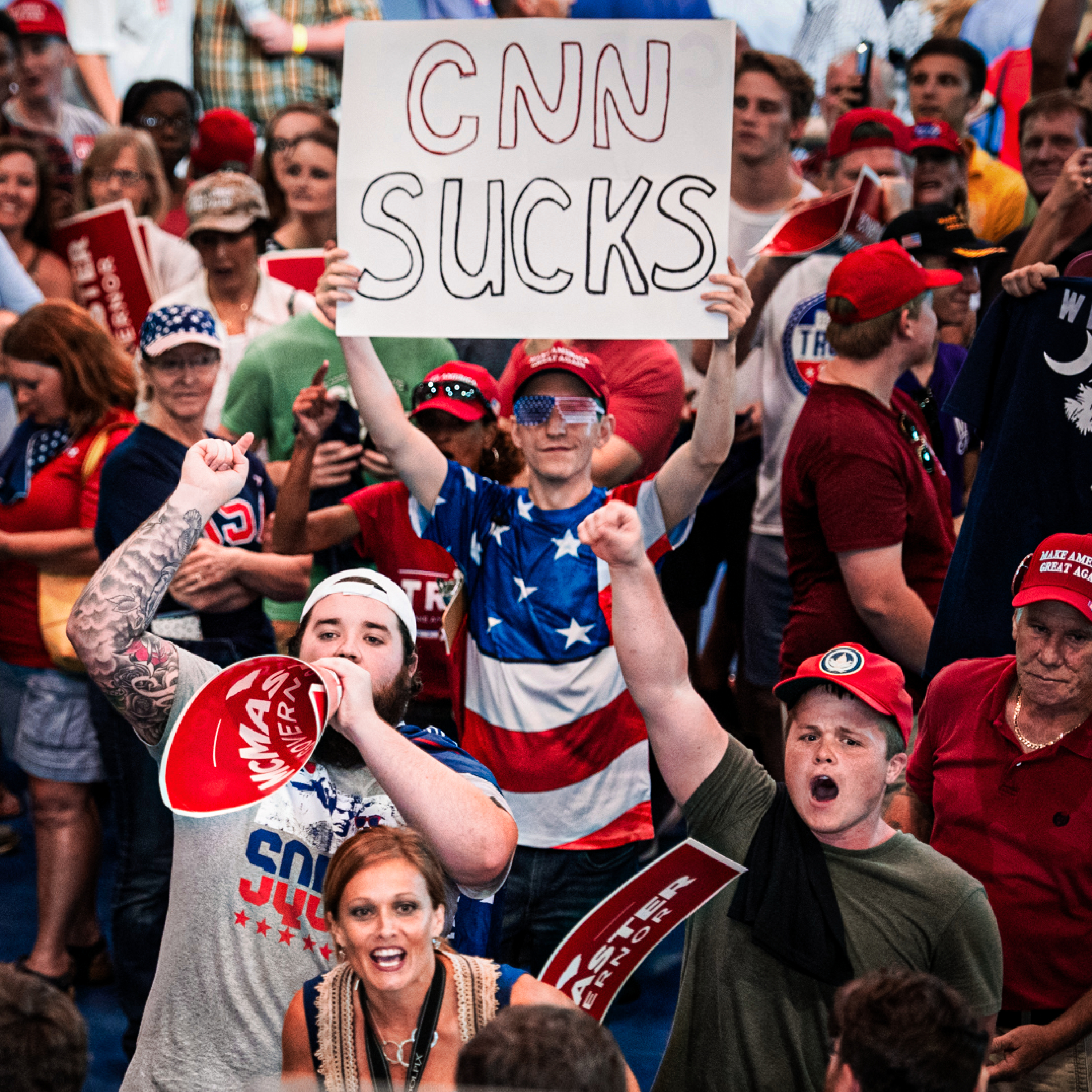
It seems fair to say that most people would agree with that sentiment. In principle. Just about everybody would say the news media should report the facts and hold powerful people accountable. But for more than half a century, there's been a steady drumbeat overwhelmingly on the political right of this accusation.
- [29:33]
NPR Up First Host
Now I recognize, sadly, that the Washington press corps is all too often the praetorian guard of the left.
- [29:38]
Kayla Gogarty
The media's focus on priorities, they don't line up with the rest of America.
- [29:43]
Althea Weaver
No wonder people hate the media. Now, at this point, neither the press nor the Democrats have a shred of cred.
- [29:51]
John Biewen
So what about this claim of a liberal news media? First, we have to get clear on who and what we're talking about. Which media? There's general agreement about the meaning of the phrase mainstream media. Today, the leading national newspapers, New York Times, Washington Post, Wall Street Journal, the big three broadcast TV networks and the major cable news networks. Some would include PBS and npr. But fewer and fewer people get their news from these sources. That's why you increasingly hear them called the legacy media. These outlets used to be dominant.
- [30:32]
Chenjerai Kumanyika
We see that older people, yes, are still sticking with tv, but younger people
- [30:36]
John Biewen
are increasingly preferring to access news via social and video networks. So 54%. This is Richard Fletcher of the Reuters Institute at the University of Oxford. In July 2025, he's presenting the results of an annual survey that his institute does across dozens of countries, including the United States. The survey found that in 2025, social and video networks think Facebook, YouTube, TikTok, Instagram. For the first time, they passed television as the leading source of news for Americans. So what about these fast growing new media sources? Do they exhibit liberal bias? In a 2025 study, Media Matters for America, a left leaning media watchdog group, looked at more than 300 popular online shows.
- [31:29]
Kayla Gogarty
And then we evaluated if they did in fact talk about news and politics and whether they did so with a right leaning or left leaning ideological bent.
- [31:37]
John Biewen
That's Kayla Gogarty of Media Matters at a University of Delaware event in July 2025. She says the researchers used publicly available data to assess the audience size of these various shows.
- [31:52]
Kayla Gogarty
First and foremost, we found substantial asymmetry with right leaning shows having five times as many followers and subscribers across platforms as left leaning shows. As you can see from this chart here, the right leaning shows are indicated by red in the left.
- [32:09]
John Biewen
She's describing an infographic that went viral. Against a white backdrop there's a bunch of big red circles with names like Joe Rogan, Ben Shapiro, Jordan Peterson and Charlie Kirk. The red circles are interspersed with some blue one ones, most of them much smaller. You may have to zoom in to see the names of the left leaning shows. The Young Turks, the Breakfast Club, Midas Touch Podcast.
- [32:37]
Kayla Gogarty
So this means that there are more right leaning popular shows online and that these shows have larger audiences. In fact, we found that nine of the ten top shows with the largest followings were right leaning. Only Trevor Noah's show, which was categorized as left leaning, even breached the top 10.
- [32:56]
John Biewen
Add to this that a relentlessly right wing network, Fox News, is the number one cable news channel in the country, that conservative media companies like Sinclair and Salem own hundreds of local TV and radio stations between them, and that most of the top talk radio hosts are right wingers. Sean Hannity, Glenn Beck, Dana Lash, Hugh Hewitt, and many more. With all this in mind, I was tempted to say, well, so much for the claim about a liberal news media. But not so fast. I talked to this expert who said first of all, don't write off the importance of the legacy media.
- [33:37]
Michael Massing
I think they have not lost their influence.
- [33:40]
John Biewen
Michael Massing is a longtime writer and former executive editor of the Columbia Journalism Review. He pointed out that the legacy media still does the lion's share of original reporting.
- [33:52]
Michael Massing
These are large news gathering operations and I think that that is the critical thing. I think that they are putting out information that everybody else sort of then either feeds on or amplifies on or criticizes and the like.
- [34:07]
John Biewen
All right, Dan, here's the Wall Street Journal story has published.
- [34:11]
Chenjerai Kumanyika
I'm just reading this now for the first time.
- [34:12]
John Biewen
The Washington Post has stunning new details today.
- [34:15]
Penelope Muse Abernathy
Well, again, I don't know if the
- [34:16]
Kayla Gogarty
New York Times actually prod real evidence
- [34:19]
John Biewen
of a so called drug problem, but
- [34:21]
Althea Weaver
again, and it's an explosive news story
- [34:23]
Penelope Muse Abernathy
in the Atlantic that just posted, it
- [34:24]
Althea Weaver
cites dozens of FBI sources, which is
- [34:26]
John Biewen
the same goes for the national news that reaches people through their local outlets, tv, radio and newspapers. A great deal of the actual journalism flows from the legacy media. Massing says another reason to take old media seriously is its powerful influence among elites, at least establishment liberals and centrists. The Times, the Post, the Journal and a few other outlets, the Atlantic and the New Republic, you could argue they are the media for lots of society's most powerful people in government, business, education,
- [35:05]
Michael Massing
the arts, all of these are dependent on these top publications for their information and their worldview.
- [35:14]
John Biewen
The mainstream media are far less dominant than they used to be, but they still matter. So what are their biases? Hello.
- [35:24]
Ray Cross
Hey.
- [35:25]
Peter Beinart
Hi, how are you?
- [35:26]
John Biewen
I asked Peter Beinart, the writer and professor of journalism and political science at City University of New York, what's the best argument for liberal bias in the legacy media.
- [35:37]
Peter Beinart
I think the strongest argument for, for that would not be about coverage of economic policy or foreign policy. It would be that these institutions tend to have people who are of backgrounds that are more secular than most Americans. They're going to be more urban, they may be more young. They will have come often out of particular kind of educational institutions. And that may incline them to a set of views about what we think of cultural issues, whether it's guns or LGBT issues or abortion or perhaps even immigration. That would mean that they see those things quite differently than Americans who are more religious, more rural, maybe less likely to be college educated. And so I think that there is a cultural divide there.
- [36:29]
John Biewen
So Beinart says legacy media lean liberal on social questions. But what about other core issues like the economy and foreign policy? To help make his point, Beinart distinguishes between terms like liberal or left of center and stronger language like left wing, nevermind, far left.
- [36:51]
Ray Cross
The far left Media has spread terrible
- [36:56]
John Biewen
lies and stories about the Trump administration.
- [36:59]
Peter Beinart
And the dependent depends what one means by left wing. You know, one kind of long standing or kind of simple way of thinking about what left wing means is that it involves some fundamental critique of capitalism or connected perhaps in foreign policy, a critique of imperialism.
- [37:17]
John Biewen
Peter says you'd be hard pressed to find a sustained critique of capitalism coming from say the New York Times, CNN or the broadcast networks.
- [37:27]
Peter Beinart
None of those are places that actually regularly platform socialist voices.
- [37:32]
John Biewen
For instance, don't forget, Beinart says most leading news organizations in the US are themselves profit making corporations.
- [37:40]
Peter Beinart
So they're participating in the capitalist system and they themselves are subject to corporate pressure. So to me it just shows the degradation of language to call these institutions left wing. If you wanted to call this the Nation left wing or Jacobin left wing, okay, I think then you could have a reasonable conversation about that, the use of that term.
- [38:00]
John Biewen
Beinart also mentioned imperialism, the long running American project of overseas domination, as he puts it. People on the left often oppose and criticize the country's foreign adventures, as do some on the right. What about the legacy media and its approach to international affairs? States like these and their terrorist allies constitute an axis of evil. This is from a CNN special report in September 2002, during the lead up to the US invasion of Iraq the following March, the case against Saddam.
- [38:37]
Robin Summerlin
The publicly available evidence is largely circumstantial but troubling.
- [38:43]
John Biewen
Most Americans now see the Iraq war as a mistake, a war not worth fighting. Some would say a foreign policy disaster. The Bush administration, with congressional approval, launched the invasion of Iraq based on claims that turned out to be false, that the government of Saddam Hussein was building weapons of mass destruction. Afterwards, some in the mainstream media apologized for their role in backing the administration's claims. Michael Massing wrote a book about the episode. He highlights a New York Times article in September 2002 with the front page headline, US says Hussein intensifies Quest for a Bomb Parts. In the piece, reporters Judith Miller and Michael Gordon chose an ominous image, writing that some in the administration worried, quote, the first sign of a smoking gun may be a mushroom cloud.
- [39:42]
Michael Massing
It was the idea that the smoking gun of Iraq's weapons of mass destruction could end up being a nuclear bomb going off. And it got picked up by the Bush administration officials.
- [39:54]
John Biewen
Condoleezza Rice, Bush's national security advisor, was soon quoted by other news organizations using the very image the Times reporters had coined. We don't want the smoking gun to be a mushroom cloud, she said. Massing says The Times and other major outlets downplayed the more skeptical voices within the US Government about the claims of
- [40:17]
Michael Massing
an Iraqi nuclear program, and the country paid a price. Again, I don't want to overstate. I mean, the Bush administration is obviously the entity that is responsible, but the news media played a, a supporting role led by the Times.
- [40:34]
Chenjerai Kumanyika
A lot of experts have made this
- [40:35]
John Biewen
observation that on international issues, the legacy media are generally more conservative and more in sync with US Government policy than they are on domestic issues. So it seems there is a grain of truth to the liberal media accusation on some social issues.
- [40:54]
Chenjerai Kumanyika
But on the whole, there's a powerful
- [40:56]
John Biewen
case to be made that that narrative is a myth. The decades long drumbeat has had its intended effect. Though it's been a strikingly successful campaign. The story of a left leaning media has caused millions of people to tune out or to go looking for news that aligns with their biases.
- [41:26]
Al Letson
Coming up, I sit down with John and his co host Chenjerai Kumanyika to talk about how the decline of local news has helped fuel the perception that the media leans left. You're listening to Reveal. Don't go anywhere. From the center for Investigative Reporting and prx, this is Reveal. I'm Al Edson. For nearly a decade, Donald Trump has attacked news organizations that publish critical stories, dismissing them as fake news. It's part of a coordinated effort to discredit the press as biased. Our partners today from the podcast seen on radio have been looking into the state of the news media, including accusations of one sidedness. And the hosts are with me now to talk about what they've learned. My good friends John Biewent and Chenjerai Kumanyika. Gentlemen, how you doing today?
- [42:26]
Chenjerai Kumanyika
Doing good.
- [42:27]
Glad to be here, man.
- [42:28]
Al Letson
So you looked at two big ideas here, the implosion of the business model for journalism and also this accusation of liberal bias in the media. Are those completely separate issues or are they related in some way?
- [42:43]
Chenjerai Kumanyika
Yeah, it might seem like they're separate, but I do think they come together. There's been this drumbeat for decades and decades, mostly from the right, that the news media are biased towards the left
- [42:57]
John Biewen
or that are left leaning.
- [42:59]
Chenjerai Kumanyika
But that gets exacerbated in a time when you have the spread of news deserts where local reporting has collapsed across much of the country.
- [43:10]
John Biewen
So why would that be?
- [43:11]
Chenjerai Kumanyika
Well, when you have no local news, people actually pay more attention to national news. And national news is much more heavily oriented towards the Republicans versus the Democrats,
- [43:23]
John Biewen
the left versus Right.
- [43:24]
Chenjerai Kumanyika
And the media that people consume is often Very partisan. Even more so on social media and video platforms and so on. It's the algorithm feeding you the perspective of your side and telling you that the other side hates you and they are against you and they're terrible. Right?
- [43:41]
John Biewen
So that.
- [43:41]
Chenjerai Kumanyika
That actually ends up exacerbating that sort of divide and contributes to the perception of media bias, particularly among folks on the right. So I think the two kind of conversations really come together in that context.
- [43:56]
Al Letson
Your podcast, seen on radio, is all about asking big, hard questions about who we are and how we got this way. Why did you decide to dedicate the newest season to diving deep into the state of journalism? Why do you think it matters?
- [44:11]
Chenjerai Kumanyika
Listen, on one level, one thing I think John and I have encountered, and I'm sure you have, is that everybody is kind of infuriated with the news media, right? On various sides on the political spectrum, people are really, you know, talk about news and you just gonna see everybody's blood start to boil. I mean, certainly the trust in the legacy news organizations is really low, and there's all kinds of data to prove this. But the problem is we need the news media. We can't avoid it. You need to know what's going on with your local politics, your local school board, and you need to know what's going on in the. And so we can't avoid it. And yet I think that the vocabulary we have to talk about the problems, just simply hurling the accusation of bias or the assumptions we have, even I think people who are very smart about this, people I agree with, a lot of the assumptions are off. So I think that this is crucial because I just don't think we can solve the crises that are in front of us right now. And I should say we are in profound crises right now of democracy, of the environment, of all these things. And we need information, good information to be able to solve this. So we wanted to give ourselves better history, a better vocabulary, and suggest some of the ways forward.
- [45:21]
Al Letson
Why'd you decide to focus your reporting on a rural part of North Carolina, Bladen County? Like, what do you think we can learn from this place?
- [45:31]
Chenjerai Kumanyika
In particular, we decided early on that we wanted to have not just the expert voices and the historians and the media experts, but that we wanted to ground the project in a place and in the lives of regular people and sort of looking over the shoulders of, quote, unquote, everyday Americans as they're thinking about and consuming the news that they get. And southeastern North Carolina, it's close to where I live. It's a couple Hours drive. And it's a diverse place that has seen a lot of the economic and political shift that are really quite common across the country. So it's very representative in that way. It's also, these are places that are news deserts where their local news organizations have shriveled to next to nothing and they just don't have information about what's going on around them.
- [46:20]
Al Letson
Chenjerai, you teach journalism at nyu. I'm curious whether anything about what you learned in the reporting that you both did about news media influence, does it change or influence the way you think about teaching journalism?
- [46:36]
Chenjerai Kumanyika
Oh, it definitely does. Like I have, you know, we have a popular intro to journalism class here at nyu and I see these, you know, kind of bright eyed and bushy tailed students who come in and I'm like, wow, y' all are basically like, yo, I'm not gonna go and become some kind of like tech entrepreneur. I want to do this right. They really believe in journalism's power to change the world. I think that some of the myths that we're debunking in this series are built into some of the materials. You get sort of narratives about what has come before. I mean, in some sense I think journalists do a better job than people think about handling the idea of objectivity. A lot of students come thinking that, like, I'm just going to tell them, be objective and that's it. And it's like, no. There's been robust debates about this. Ultimately though, I think the most important thing is that, and one thing we explore in the series is that the best journalism in this country, the journalism that has been the most factual, that has done the most for democracy, has been journalism in which people were part of a tradition that was advocating for something. Whether it's where I'm advocating because I don't want the environment to be destroyed. It was the black journalists who were advocating for black people to have rights and to try to achieve part of a democracy. It was the women who were fighting for women's rights journalism that happened in those contexts. That's literally they created the stuff that we say we're proud of when we talk about America. And they were also factual. It's not a binary between reporting, investigating, trying to figure out what's true, rendering it in its complexity, but ultimately saying, yo, if this ultimately is a white supremacist conclusion, I'm going to report that. What's crucial is that you got to report the truth, even when it challenges your assumptions. Don't go in with a hypothesis and Just confirm your hypothesis. That ain't journalism. But if your journalism condemns people in power, you damn sure better report that.
- [48:29]
Al Letson
Were there things that you guys found that really surprised you?
- [48:34]
Chenjerai Kumanyika
For me, I came away with a stronger sense than I expected going in that most of the problems that we have with our news media at the
- [48:43]
John Biewen
root have to do with the fact
- [48:44]
Chenjerai Kumanyika
that we have an overwhelmingly for profit corporate news media system. And that that is a policy choice that this country has made over centuries and particularly over the last, you know, 50 years. And it's not the choice that other countries like ours have made. And it sets us apart in ways that are not enviable and not good. And that's a debate that we're not
- [49:10]
John Biewen
having in the country.
- [49:12]
Chenjerai Kumanyika
So that if our project could in some small way help to advance a discussion about, well, what would actually constitute a good and effective and functioning news media system in a functioning democracy, we'd be very happy about that.
- [49:31]
Look, this crisis of news that we're exploring in this series has a lot of pieces to it, but we still have to figure out what's true. Every single person has to figure out what's true in the world. And I think that journalism gives us a way to do that. It's the best set of methodologies for us to do that, especially in real time. And we need institutions that can help us do that. So as frustrating as it is, I don't think it's something we can give up on.
- [49:59]
Al Letson
Damn.
- [50:00]
John Biewen
I don't know what to say.
- [50:02]
Al Letson
That's beautiful. Yes. John Biewen and Chenjerai Komanika, thank you so much for coming onto the show.
- [50:10]
Chenjerai Kumanyika
Thanks for having us, man.
- [50:11]
Thanks for having us. Al.
- [50:15]
Al Letson
This week's show was adapted from the latest season of the Seen on Radio podcast. To hear more, and trust me, you will not be disappointed, look for Scene on Radio. That's S C E N E on Radio in your favorite podcast app. Scene on Radio is hosted by John Biewen and Chenjerai Komanika. Story editor is Diane Hodson. It's produced by the Kenan Institute for Ethics at Duke University and distributed by pr. Steven Rascone provided production support for this week's show. Victoria Baranetsky is Reveal's general counsel. Our production manager is the great Zulema Cobb. Music by Michelle Osis, Lily Hayden, Alex Weston, James, Nathan Jones and Jason Hill. Sound designed by John Biewen with additional sound, design and music by Jay Breezy, Mr. Jim Briggs and Fernando My Man. Yo Arruda, Taki Telenides is our deputy executive producer. Our executive producer is Bret Myers. Our theme music is by Camerado Lightning. Support for reveals provided by the Reeva and David Logan foundation, the John D. And Catherine T. MacArthur foundation, the Robert Wood Johnson foundation, the park foundation, the Schmidt Family foundation and the Hellman Foundation. Support for reveal is also provided by you our listeners. We are a co production of the center for Investigative Reporting and prx. I'm Alex and remember, there is always more to the story.
- [51:50]
John Biewen
From prx.