Loading summary
Transcript211 lines
- [00:01]
Al Letson
This episode is brought to you by Progressive Insurance. Do you ever think about switching insurance companies to see if you could save some cash? Progressive makes it easy to see if you could save when you bundle your home and auto policies. Try it@progressive.com Progressive Casualty Insurance Company and affiliates. Potential savings will vary. Not available in all states.
- [00:21]
Brian Howey
Hey, this is Al, and before we start the show, I wanted to talk to you directly. Just you and I. Public media is under attack. Each week, listeners here reveal on local public radio stations, many of which receive funding from the Corporation for Public Broadcasting. The White House recently requested that Congress take back $1.1 billion that had already been approved for the Corporation for Public Broadcasting. This would profoundly destabilize a public service that's all about reporting the truth. And I gotta tell you that in the time that I have been working at Reveal, which is over 10 years now, that I work with some of the most fearless journalists in the business. We are not afraid. We are not intimidated by their threats to silence us. And the reason why we are not afraid is because we have you. Fueled by your support, we'll keep investigating and exposing the truth no matter who tries to hold us back. To help us fight back, please don't Give today. Visit revealnews.org give again. That's revealenews.org give and thank you.
- [01:37]
Bruce Priett
From.
- [01:37]
Brian Howey
The center for Investigative Reporting and prx. This is Reveal. I'm Al Edson.
- [01:43]
Joanna Schwartz
I'm going to turn it over to Bruce today and maybe, Bruce, you can give us a few more words about yourselves and then get started.
- [01:49]
Bruce Priett
Sure. Asking an attorney to talk about himself. This could go on for hours.
- [01:53]
Brian Howey
Bruce Priett is not a household name, but maybe it should be, especially in California, where he's been one of the most influential architects of policing policies for the last two decades.
- [02:06]
Bruce Priett
Yeah, I mean, I was a cop for 10 years and I've been defending him for what, 34 years now in federal court?
- [02:12]
Brian Howey
The last time Bruce put on the badge was back in the 80s. He worked as a patrol officer, was on the K9 unit, and spent time as a detective, all in Orange County, California. Today. One of his claims to fame is the advice he's given to police departments across the state.
- [02:29]
Bruce Priett
Start with a suspect. Please record the suspect and you know he's gonna lie through his teeth. All the better. Paint him into a corner. Make sure he can't wiggle out later in court.
- [02:43]
Brian Howey
Over the years, Bruce has given a lot of talks and a lot of advice in the form of trainings like these online webinars because he's an attorney, a lot of that advice is about legal issues and how to avoid them. He often talks in a tone that says, I've been through it all before. And the situations he describes are often framed as us versus them.
- [03:06]
Bruce Priett
How do you know if there's going to be a lawsuit? Well, when the bad guy says, I'm gonna sue your ass, it's usually a pretty good indication.
- [03:13]
Brian Howey
This audio is from a workshop Bruce ran in 2019 on how officers can protect themselves in court.
- [03:20]
Bruce Priett
I don't understand why cops have this inherent need to take bloody photographs of suspects after they get in a fight or whatever with the bad guy. Stop it. Clean him up. There's a simple formula. You all need to commit this to memory. Red turns to green at the time of trial. If there's blood in the photo, you are going to pay money. Clean them up and get them smiling for the picture. We use that in court later. It is good stuff. Send me copies. I'm gonna publish a book. Stupid People Hurt by Cops. We're all gonna make a million bucks.
- [04:01]
Brian Howey
Back in 2021, investigative reporter Brian Howey started watching Bruce's We. And in one of them, he heard Bruce give a piece of advice that stood out about what to do when an officer kills someone on the job.
- [04:15]
Joanna Schwartz
What's the likelihood you're going to get sued?
- [04:17]
Bruce Priett
And an officer involves shooting?
- [04:20]
Joanna Schwartz
Damn.
- [04:20]
Bruce Priett
Close to 100%. Trust me, somebody will crawl out from.
- [04:23]
Joanna Schwartz
Underneath the rock and decide the dearly.
- [04:25]
Bruce Priett
Departed is finally worth something now that he's dead and you're going to get sued.
- [04:29]
Joanna Schwartz
But what do we do?
- [04:31]
Brian Howey
Today on the show, we're focusing on what Bruce advises officers to do after someone is killed by police. It's advice that some policing experts call inhumane. We teamed up with Brian and the investigative reporting program at UC Berkeley's Graduate School of Journalism for this story we first aired in 2023. Brian starts with how things should be.
- [04:59]
Nadia Hamdan
After spending a lot of time listening to Bruce's webinars, I did a lot of research on what's supposed to happen after an officer kills someone. One of those things is a death notification, basically notifying friends or family that someone has died. It's part of the job for many law enforcement officers. A lot of training materials on how police should do these notifications mention two things. Delivering the news directly and doing so as soon as possible.
- [05:29]
Umberto Guizar
You make it fast. It's kind of like taking a band a dot. You don't pull it one little piece at a time. It's Got to be fast. And that's the compassionate way of telling somebody that their loved one's passed away.
- [05:39]
Nadia Hamdan
You don't play games with them. I found examples like this. Former cops giving interviews on how notifications should be done. FBI training materials say the same thing. Notifications should be done clearly and quickly. So that's the official advice. Bruce Priett's advice is different.
- [06:00]
Bruce Priett
Here's some free advice. Get a profile on the suspect as soon as you can. In this age of social media, the grapevine has gotten lightning speed. Before the dust settles, I want you send in a uniform, a detective, I don't care. Somebody out to their friends and family to find out what they've been up to for the last 24 hours.
- [06:23]
Nadia Hamdan
In Bruce's advice, the investigation is centered on the person who police killed. He's advising officers to find out as much as possible. Who was this person? What were they up to? Were they breaking any laws? In essence, get as much dirt as quickly as possible.
- [06:41]
Bruce Priett
Go out there and get that evasive truth.
- [06:43]
Nadia Hamdan
The evasive truth. Bruce teaches that the truth is harder to access after a death notification. So Bruce recommends police start with questions to get as much information before telling families why they're there. In this training, Bruce acts out both sides of the interaction to demonstrate his advice. Here he's playing an officer. And listen for how he, as the officer, describes why he's there.
- [07:12]
Bruce Priett
Hi, Mr. Jones. We've had contact with your son. We're trying to figure out what he's been up to.
- [07:17]
Nadia Hamdan
Then Bruce plays the part of the mother. He calls her Mrs. Jones.
- [07:21]
Bruce Priett
Oh, you know what? He got laid off. His girlfriend broke up with him. His dog died. He's been on a drinking binge. You know, he's been meth all week long. See that hole in the wall? He just punched his fist. You know what's. What's his bail? Where do we get him? Which point, by the way, you'll get a very concerned look on your face. Say, you know what, Mrs. Jones, I regret to inform you your son was involved in a shootout with the officers, and he didn't survive. What? My. My son, the eagle scout? No, sorry, lady. You're married to that evasive concept called the truth.
- [07:55]
Nadia Hamdan
Consider for a moment what Bruce is suggesting. Imagine you're home and you get a knock on the door. It's the police. You let them in, and they start asking questions about a relative of yours. They ask about their drug use, criminal history, mental health. You answer the questions, but the whole time you're wondering why they're asking them. And only when you ask directly do the officers reveal that your relative is dead.
- [08:21]
Al Letson
That advice that Bruce Priett is giving is, to my view, at the expense of serving the community and recognizing the harm and devastation of a police involved killing.
- [08:41]
Nadia Hamdan
UCLA law professor Joanna Schwartz has been looking into Bruce's influence on policing for years. She does research on police misconduct and accountability and she's the author of a recently published book called how the Police Became Untouchable.
- [08:57]
Al Letson
Bruce Priet is in the circles in which he travels, an exceedingly important figure. He is in the center, I believe, of the community of defenders of police officers in these cases and also at the center of police policymaking.
- [09:20]
Nadia Hamdan
Bruce isn't just shouting this advice from a YouTube soapbox. He co founded a company called Lexapol. Thousands of agencies across the country trust Lexapol. Lexapol has been serving police departments since it was founded in the early 2000s. The company offers trainings like Bruce's webinars and policy. That's Lexapol's bread and butter. In the U.S. police departments are responsible for writing their own policy manuals, the rules for how police officers are supposed to do their jobs. Large police departments in major cities usually can afford an in house team of policy writers who keep the manuals up to date on the latest local, state and federal laws. But for smaller departments without all those lawyers, it can be hard to keep up. That's where Lexapol comes in. The company has a kind of policy buffet which with ready made language that police departments can put into their manuals.
- [10:23]
Al Letson
And the goal of Lexapol? If you look at their materials, their goal is to manage risk, they say, which really means to reduce liability.
- [10:37]
Nadia Hamdan
Joanna and other critics like the American Civil Liberties Union say Lexapol's policies are vaguely worded, so it's hard to tell when an officer violates them. And they're cookie cutter. You can find the same language over and over in manuals from different departments. Agencies are allowed to edit the policies they get from Lexapol if they choose to, but it's unclear how many actually do. And Lexapol's reach is far and wide. How big is Lexapol?
- [11:08]
Al Letson
Lexapol writes the policies for more than 95% of California's law enforcement agencies. And at last count they provided policies for upwards of 3,500 law enforcement agencies across the country. And I am aware of no other private or government entity that comes close to writing policies for that volume of agencies.
- [11:38]
Nadia Hamdan
3,500 agencies across the country subscribe To Lexapolis, that's nearly one fifth of all police departments in the US and that number has almost certainly grown since the company last published those figures.
- [11:55]
Al Letson
When Lexapol provides policies and trainings, and Bruce Priet is a founder of Lexapoll, and Bruce Priet gets on a webinar and gives advice about how to undertake an investigation, you have to assume that officers and their supervisors and the administrators and executives within law enforcement agencies are listening.
- [12:22]
Nadia Hamdan
I wanted to see if Bruce's advice was just advice or if police departments are actually using this tactic after they kill someone, turning death notifications into interviews, and then using the information police get to protect themselves in court. So I focus where Lexapool got its start. California. I called civil rights attorneys all over the state to ask if they'd ever heard of this. I reviewed dozens of court cases, and I filed a bunch of public records requests. And after a few months, I got some answers. Police departments have been conducting death notifications, just like Bruce advises, all over the state. You can hear it for yourself in these scratchy police recordings where instead of opening with what happened, police went into interrogation mode.
- [13:16]
Umberto Guizar
Does your husband own a gun?
- [13:17]
Nadia Hamdan
So was he using drugs or selling drugs?
- [13:20]
Umberto Guizar
Or what was your husband upset about?
- [13:22]
Bruce Priett
Do you know if he's married, if he has a wife, kids?
- [13:25]
Nadia Hamdan
These clips are some of the 20 instances I found across 15 different police agencies. In each of these interactions, officers spent those crucial first minutes with families peppering them with questions instead of telling them someone they know was killed or seriously hurt by police. How long were you guys married? We were married, and I got a divorce two years ago. What was the reason?
- [13:52]
Umberto Guizar
I just need to know what really happens. I'm trying to figure out the whole picture, so I need your honesty. Has he hit you before?
- [13:58]
Bruce Priett
Did you hear him say anything, like, unusual? Where you think he might be having.
- [14:00]
Nadia Hamdan
Like, a mental health issue? Nothing at all. Has he ever been diagnosed with any mental issues?
- [14:07]
Bruce Priett
No.
- [14:07]
Nadia Hamdan
Did he take any medications?
- [14:09]
Bruce Priett
No.
- [14:11]
Nadia Hamdan
In 14 of those cases, the departments that used this interview tactic had been or still were lexible customers. And that's just what I found from the small percentage of California police departments that I requested. Records from multiple civil rights attorneys told me I've only discovered a fraction of what they say is a routine policing practice. In the incidents I found, officers continue asking questions for several minutes as confused and anxious families wait to learn why the police are at their door. Well, I don't. Yeah, it seems like I need to.
- [14:47]
Brian Howey
Have a lawyer present the way you.
- [14:51]
Nadia Hamdan
I hope he's not in big trouble, and I wish you guys would get to the punchline.
- [14:58]
Brian Howey
Once Brian confirmed that this is happening across California, he started looking into how police departments use the information they get from families during death notifications. When we come back, Brian meets with people who have experienced this tactic firsthand.
- [15:16]
Umberto Guizar
As I look back, I sang like a canary. If you haven't really been involved with law enforcement, you think they're your friends. And so I told them more than I should have.
- [15:30]
Brian Howey
That's coming up next on Reveal.
- [15:49]
Al Letson
Free speech is under attack. In a new podcast, the Bullies Pulpit, Trump versus the First Amendment. Journalist Christian Ferrias and the Knight First Amendment Institute investigate how today's legal and political battles are reshaping the First Amendment as we know it. From student protests to newsroom crackdowns, it's a deep dive into power, policy and resistance. Listen to the Bully's Pulpit wherever you get your podcasts.
- [16:17]
Nadia Hamdan
Hi, y'. All. My name is Nadia Hamdan and I'm.
- [16:20]
Al Letson
A producer here at Reveal. Reveal is a non profit news organization and we depend on support from our listeners. Donate today@revealnews.org donate and thanks.
- [16:40]
Brian Howey
From the center for Investigative Reporting and PRX. This is Reveal. I'm Al Edson. One of the first things you'll notice about attorney Umberto Guizar's office is the Los Angeles sports memorabilia. Humberto's commitment to LA teams is even painted on his office walls.
- [16:58]
Bruce Priett
Dodger blue. Can't you tell I'm a Dodger fan? It's Dodger blue.
- [17:04]
Brian Howey
In the fall of 2023, investigative reporter Brian Howey went to his office in the sun baked city of Montebello, just outside of Los Angeles. It's not just decorated with sports souvenirs. Humberto also has a figurine collection, a diorama of toys he bought from a gumball machine at the car wash.
- [17:24]
Nadia Hamdan
It looks like you have a whole scene going on. Tell me the story behind this.
- [17:31]
Bruce Priett
The little homies, I like them. You know, that's the environment I grew up in. So symbolic. Right here you have a car with three guys sitting in there, like, just chilling. Then you have this guy flirting with the little chola girl. This one shows a guy surrendering, right, with an LAPD officer aiming a gun at him, with a dog, a canine dog. And this guy on the bike, like, oh, shit, I'm out of here.
- [17:54]
Brian Howey
But there's no figurine for Umberto. If there was, it'd be one with a stocky build, salt and pepper hair, a goatee, a few Tattoos and a few rings. And maybe there ought to be one. Because this is a familiar scene to umberto. He spent 30 years representing more than 100 families of people who died in encounters with police.
- [18:17]
Bruce Priett
The angle for us is to get you as much compensation as. And that's a vindication of the truth. When you get a big resolution and you get paid a lot of money for the loss of a loved one, that is acknowledging that they did wrong because they don't just pay a lot of money for nothing. Right. So it does bring a sense of justice to the family.
- [18:36]
Brian Howey
Brian met with Humberto to ask if he'd ever heard of a policing tactic. One where officers question the next of kin before notifying them that someone they know has been killed by police.
- [18:48]
Bruce Priett
This has been the case for many years. This turned into a weapon to hide the truth and to get the truth modified in a way that benefits them to justify the use of deadly force and to justify their bad behavior. Simple as that. Why they use that information to minimize the value of the case, obviously.
- [19:11]
Brian Howey
Today we're revisiting a story we first aired in 2023 with Brian and our partners at UC Berkeley's Investigative Reporting program. A story about law enforcement officers questioning families before notifying them that a relative has been killed by police. And a quick warning. This story contains audio clips of actual death notifications that could be difficult for some listeners.
- [19:40]
Nadia Hamdan
Humberto is one of about a dozen attorneys I talked to for this story. He Many say they've seen this tactic so often, they see it as standard practice. And many put me in touch with families who say they experienced it in real life. This led me to Tina Slater.
- [19:57]
Joanna Schwartz
Okay. I had just got off work because I worked 2am to 10am shift at work. So I had just got home.
- [20:05]
Nadia Hamdan
It's a spring morning in 2015. Tina had just wrapped up an overnight shift at Joann Fabrics and finished a meal with her brother and mom, Kathleen. Neither of them expected 2 San Bernardino County Sheriff's deputies to knock on their door. Today is Monday, April 15, 2015. At approximately 11:42 hours. Be attempting to make family notification. Myself and Detective Troy Meridian. Tina's lawyers gave me this tape the deputies recorded that day.
- [20:41]
Bruce Priett
How you doing?
- [20:44]
Umberto Guizar
I wear the detectives from the sheriff's department.
- [20:46]
Bruce Priett
Can you come in?
- [20:47]
Joanna Schwartz
Yeah, sure.
- [20:49]
Nadia Hamdan
The deputies are there to tell tina that her 28 year old son Joseph has been killed.
- [20:55]
Umberto Guizar
Hi.
- [20:56]
Nadia Hamdan
Here, Tina. Mm. Are you Joseph's mom?
- [20:59]
Bruce Priett
Can we talk to you for a.
- [21:00]
Nadia Hamdan
Few minutes inside the house? It's the five of them. Tina her brother, her mom, Kathleen, and the two sheriff's detectives. Instead of opening with the actual death notification, one detective asks a question. So I want to talk to you about Joseph.
- [21:19]
Umberto Guizar
Was Joseph here last night?
- [21:21]
Joanna Schwartz
My mom, I guess, had argued with Joseph the night beforehand. So my mom started telling him stuff about how he was acting. He was here on late last night? Yeah. I tore my things off the windows and to hold the curtains back. I think he was on meth or something. I'm not sure because he'd done it once before, and he acted crazy. And this time he was really out of hand.
- [21:43]
Nadia Hamdan
Kathleen is a little hard to hear, but she says her grandson Joseph was there the night before that. She thinks he was on meth because he was acting out of hand and that he's done this before. The detectives keep the questions coming for nearly 10 minutes.
- [21:59]
Bruce Priett
What time did this start?
- [22:00]
Nadia Hamdan
What was he doing walking up and down the street?
- [22:02]
Bruce Priett
What was he doing inside the house? You said he tore us up and down. He said earlier he looked like he was on methamphetamine.
- [22:07]
Nadia Hamdan
So a couple years ago, when he.
- [22:08]
Bruce Priett
Was climbing the poles and doing that.
- [22:09]
Nadia Hamdan
Stuff, he was acting the same way.
- [22:11]
Bruce Priett
He got mad. Do you know what drugs he uses, if any? What was he saying around what time did he leave?
- [22:18]
Nadia Hamdan
All of these questions get into Joseph's past, His issues with substance abuse, mental health challenges, times where he'd been arrested before, plus more details about his behavior that night, all the while delaying the main reason why detectives are there to tell the family Joseph is dead. The questions stop when Kathleen asks one of her own.
- [22:43]
Joanna Schwartz
Where is he at now, may I ask?
- [22:45]
Nadia Hamdan
Well.
- [22:48]
Bruce Priett
There'S no easy way of saying this. Unfortunately, he did pass away.
- [22:52]
Umberto Guizar
No, no.
- [22:55]
Bruce Priett
I'm sorry to have to tell you. Oh, my God.
- [23:00]
Umberto Guizar
No.
- [23:07]
Joanna Schwartz
I know my mom always felt guilty. She kept saying, oh, God, you know, here I went and told them all this stuff. I feel so bad. I feel so guilty. So, yeah, yeah. She had told me not that long before she passed how she would always feel guilty for that. So.
- [23:22]
Nadia Hamdan
And did you, after they notified you that Joseph had died, did you have a sense as to why they were asking those questions?
- [23:30]
Joanna Schwartz
At the beginning? No. Yeah, no, at the beginning, because I didn't realize how he had died. They had just said, you know, that he was dead. And then I had found out later, hearing on the news and stuff, actually, you know what exactly, you know, he died. They just said that his death was being investigated.
- [23:48]
Nadia Hamdan
The detectives who met with Tina and her family gave few details about what happened. Here's what they shared that day. That's one thing we're investigating, is what caused it. He was at the bolero gas station, and he started doing some things there, which caused them to call the police.
- [24:09]
Bruce Priett
And when the police got there, he was handcuffed.
- [24:12]
Nadia Hamdan
But then he started having some medical problems, and they called him an ambulance.
- [24:16]
Bruce Priett
But unfortunately, he died.
- [24:19]
Nadia Hamdan
All of that is technically true, but news reports, records from the sheriff's department, and the court records paint a fuller picture. The night Joseph died, San Bernardino county sheriff's deputies arrested him at a valero gas station. The deputies restrained Joseph using a hog tie. It's a controversial technique that involves binding someone's wrists to their ankles while that person is lying on their stomach. And it's controversial because it's known to be deadly. Deputies put Joseph in a patrol car while he was hogtied, and after a few minutes, he stopped breathing. Tina and her family sued the sheriff's department in civil court. They accused deputies of killing Joseph with excessive force. The department's lawyers argued that Joseph died from a methamphetamine overdose. That's how the coroner ruled Joseph's death. And to bolster their point, during a deposition, they played the recording from the death notification where Tina's mom shared Joseph's drug history. Just before the case went to trial, the san bernardino county sheriff's department reached an undisclosed settlement with Tina's family. The sheriff's office never responded to my request for an interview, and nor did they comment on why officers questioned Tina and her family before notifying them about Joseph's death. I asked Tina about that, too. Did you think about how they asked those questions before they told you what had happened, Maybe considered why they had asked those questions? Did you have any idea at the beginning?
- [25:57]
Joanna Schwartz
No. You know, I was in too much of a shock. But as time kind of went on, I kind of realized that. That, you know, they were doing that to build their case, you know, for their defense. You know, they don't know Joseph. They only got, you know, like. Like a bad thing that he did yesterday. They don't hear about, you know, yeah, the person that he was a good person. They just go by, you know, how he was acting at a certain point, not the true person that he was.
- [26:29]
Nadia Hamdan
In the months after I spoke with Tina, I found more and more cases like hers, Cases where investigators extracted damning information from families before telling them that their relative had been killed by police. Many of those families and their attorneys tell me they believe the information law enforcement got from them in that Moment may have impacted the outcome of their lawsuit. If there's one case that exemplifies this, it's Jim Shomons. Jim, how was the drive? It was actually pretty good.
- [27:05]
Umberto Guizar
Yeah, I'm surprised.
- [27:06]
Nadia Hamdan
Me too. I went to meet him on a sunny day in the fall of 2023 at his suburban home in San Jose, California. We've been talking on the phone for what like a year and a half now?
- [27:17]
Umberto Guizar
Yeah, it's been a while.
- [27:19]
Nadia Hamdan
In the summer of 2014, Jim had returned from work to find his home surrounded by police cars. Officers tell him that his 19 year old daughter Diana is in the hospital and that they need to ask him some questions. They escort him to the station and seat him in an interrogation room.
- [27:37]
Umberto Guizar
I'm seething, I'm scared, in shock, wanting just to find out what happened. How is my daughter? How is Diana?
- [27:48]
Nadia Hamdan
Jim goes through the same unfortunate pattern. Detectives come in and ask him lots of questions about Diana. Jim tells them she's bipolar and how just a couple days earlier she'd been in an argument that resulted in a 911 call.
- [28:03]
Umberto Guizar
As I look back, I sang like a canary. I guess I was just in this mindset that I guess people, if you haven't really been involved with law enforcement, you think they're your friends and you think that they are there to help you. And so I told them more than I should have and I think soon thereafter they stopped the questioning and I said, what happened?
- [28:34]
Nadia Hamdan
Diana was shot and killed by a San Jose police officer. According to the police report, Diana called 911 and told the operator she had a gun and was going to shoot her family. When officers arrived, Diana, Diana walked out of the house holding a cordless drill that was painted black. The whole interaction lasted one minute. Diana pointed the drill at police and one of the officers shot her. The cop who pulled the trigger said she thought Diana was holding a gun. The San Jose Police Department wouldn't agree to an interview, but they did file a public report on the shooting and concluded the officer legally shot Diana in self defense fence. After Diana was killed, Jim and his now ex wife sued the department. They argued that the officer should have done more to de escalate before shooting their daughter.
- [29:29]
Umberto Guizar
That was our, I guess the only thing we could do to, to hit back.
- [29:35]
Nadia Hamdan
But the department had been working to undermine Jim Showman's lawsuit long before he'd even considered filing one. On a scratchy phone connection, I got a hold of Wayne Smith, a retired San Jose police detective who interviewed Jim that day.
- [29:52]
Joanna Schwartz
I hear Will Recall that we did ask him questions before we let him know that she died. And if a memory shows me he was a bit upset about that.
- [30:03]
Nadia Hamdan
Wayne is hard to hear. He's saying he remembers asking Jim questions about Diana before letting him know she died. He says, quote, if my memory serves me, he was a bit upset about that. I asked him why he performed death notifications this way.
- [30:21]
Joanna Schwartz
What happens when the police kill somebody? Is the next kid sue the police? Sue the police. They sue the city or the county. I mean, they go out, they want money. So it's important to interview the next king as soon as possible. I locked him into a story.
- [30:38]
Nadia Hamdan
Wayne says lawsuits are common when police shoot somebody. So officers question families in order to lock them into a story. He is the only officer I've been able to get on the record acknowledging this tactic as something police do to protect their departments from lawsuits. But later in the interview, Wayne would walk back that statement. You have mentioned the lawsuit aspect a couple of times. I mean, is there an aspect to that when you're interviewing these family members where you're trying to protect the department, or.
- [31:09]
Joanna Schwartz
No, not at all. Not at all. We're not concerned about civil litigation. What we're concerned about is the criminal investigation and the truth.
- [31:19]
Nadia Hamdan
Jim says the city of San Jose initially offered him and his ex wife $10,000 to settle their lawsuit. But Jim says that after reviewing the case, the city took it off the table. Both Jim and his attorney tell me they think it's partly because of what Jim said about Diana in that interrogation room. Instead of the money, the city came back to the table with two things. First, he says he and his ex wife were invited to go through the police department's crisis intervention materials and work with officers to update them. In the city's second offer, Jim took me to visit.
- [31:58]
Umberto Guizar
So this is what the memorial bench here is. And they did a nice job.
- [32:04]
Bruce Priett
They.
- [32:06]
Umberto Guizar
Planted the trees, so there's shade here.
- [32:09]
Nadia Hamdan
What does this plaque say?
- [32:11]
Umberto Guizar
In loving memory of Diana Marie Schoman. July 5, 1995 to August 14, 2014. Play ball.
- [32:24]
Nadia Hamdan
The bench sits in the shade of two young trees and overlooks the third baseline. It's the position Diana play on her softball team as a kid. Jim does his best to visit at least once a year.
- [32:37]
Umberto Guizar
It's a nice gesture, but it's well below what should have been. And it's a nice acknowledgement, but it's not what I'm gonna continue to fight for.
- [32:56]
Nadia Hamdan
Since Diana's death, Jim's grief has fueled his advocacy work. He's met with state officials and academics to talk about how police officers should be trained when they encounter civilians in the middle of a mental health crisis. He has been working with a local advocacy group to push for a new California law that would bar officers from interviewing families before delivering a death notification.
- [33:21]
Umberto Guizar
We are working so this doesn't occur again. But I really don't have any other choice personally than to just keep pursuing justice and change of society. I mean, change of the laws so, you know, other families aren't victims of this.
- [33:45]
Nadia Hamdan
The San Jose Police Department is one of the few in California that does not contract with Lexapol. It's the company we mentioned earlier in the show. Lexapol has contracts with more than 95% of California police departments, and they offer trainings and write policy for law enforcement agencies. And until 2022, the company's website offered a webinar that advises officers to use the same death notification tactic that Tina and Jim experienced. That webinar was run by Lexapol co founder Bruce Pratt. So next on my reporting to do list was to interview Bruce about the consequences of his advice.
- [34:29]
Brian Howey
Brian sent emails. He tried calling him. He left phone messages, but Bruce never responded. Coming up, Brian tries to track down Bruce in person.
- [34:39]
Bruce Priett
I told you I wasn't going to give a comment. And now you've got 10 minutes of my time. So I'm not going to miss my flight for your article or whatever. I gotta find out where the hell I parked.
- [34:50]
Brian Howey
That's next on Reveal.
- [35:02]
Al Letson
Hey, this is Misa from Reveal. How many episodes have you listened to?
- [35:07]
Nadia Hamdan
5, 500?
- [35:10]
Al Letson
And how many times have you donated? It's free to listen to these shows, but great journalism is anything but free to produce. It takes millions of dollars a year to make Reveal, and the truth is it would not be possible if listeners.
- [35:29]
Joanna Schwartz
Did not support it.
- [35:30]
Al Letson
So please donate today. Just text the word give to 88857 REVEAL. That's 888-577-3832 or visit revealnews.org donate thank you.
- [35:56]
Brian Howey
From the center for Investigative Reporting and PRX, this is Reveal. I'm Al Edson. Jonathan Ryan Hernandez ran for a city council seat in Santa Ana, California when he was in his 20s.
- [36:12]
Jonathan Ryan Hernandez
So when I ran against a sheriff at 27, I was seen as a kid, seen as somebody who wasn't necessarily a challenge.
- [36:21]
Brian Howey
He won his election in 2020, and after he took office, he started looking closer at the Santa Ana Police Department and its policies.
- [36:29]
Jonathan Ryan Hernandez
I thought, well, clearly, you know, there are concerns here and these Concerns turn into lawsuits and those lawsuits affect taxpayers. And so when I started following who is training these police departments, what policy manuals they're following, that's when I discovered Lexapol.
- [36:47]
Brian Howey
Lexapol offers training and policies for more than 95% of California police departments today. The company is headquartered in 4 Frisco, Texas, but it was founded in Southern California, just a few miles away from Santa Ana. Jonathan finds out his city has had a contract with Lexapol for nearly a decade. He starts asking around about the company and hears a lot of good things.
- [37:12]
Jonathan Ryan Hernandez
It's a simple, easy platform to use, covers all of your bases and it's cost effective and police departments all over the state of California are using it.
- [37:23]
Brian Howey
But months later, Jonathan would be leading an effort to get Lexapol out of his city. Our reporting partner this week, Brian Howey, met Jonathan to find out why.
- [37:37]
Nadia Hamdan
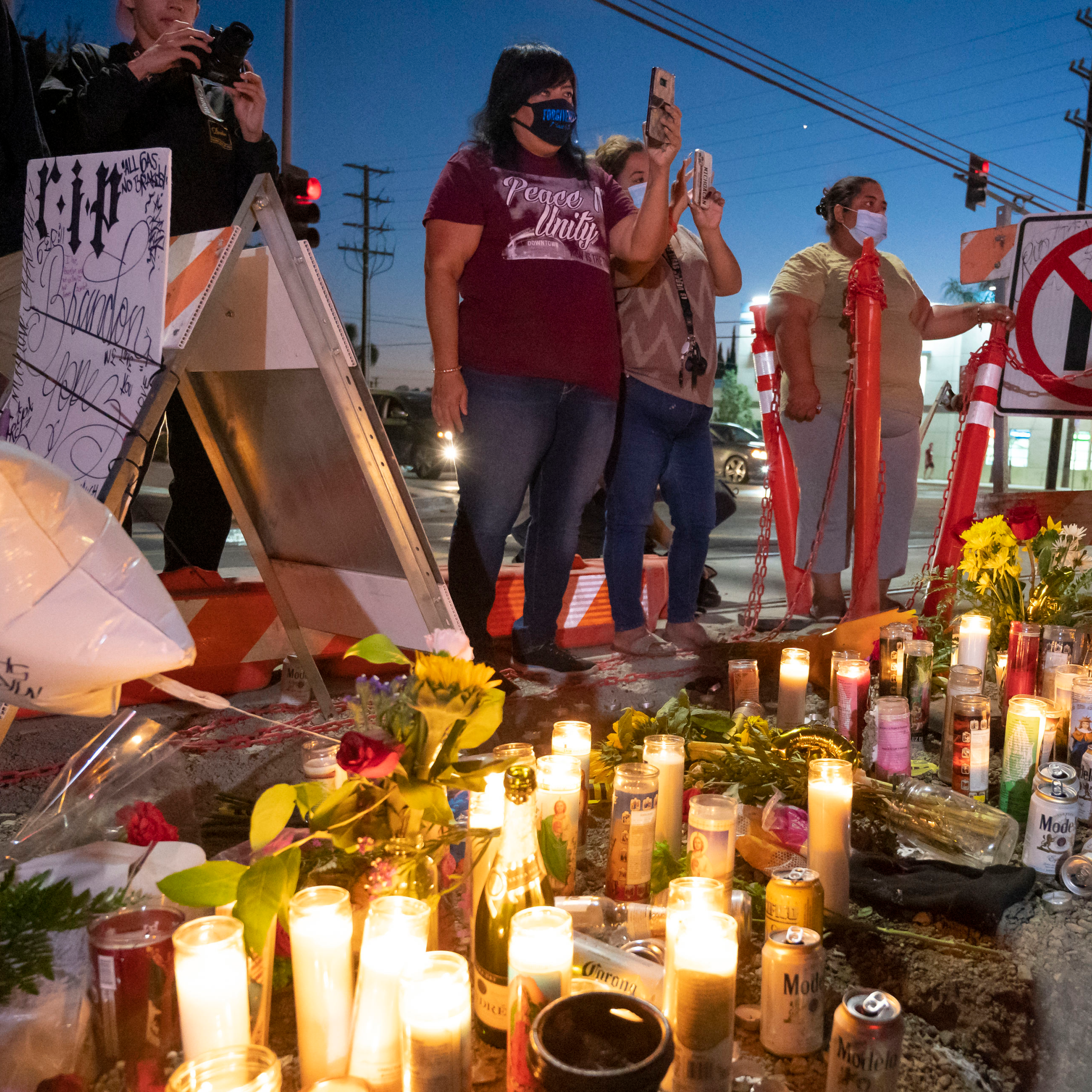
Jonathan's fight against Lexapol isn't just political, it's also personal. On a tour of Santa Ana, Jonathan takes me to a beauty salon on Santa Ana Boulevard. And painted on the side is a 10 foot mural of Brandon Lopez. Brandon was Jonathan's cousin.
- [37:54]
Jonathan Ryan Hernandez
Brandon Lopez was a Santanero. He loved Santa Ana, he was a father. He loved music, he loved tattooing, he loved graffiti art. When we were kids, he was a really amazing skateboarder. He's somebody who went through a struggle like us and sometimes those who go through through the struggle, we don't always make it out.
- [38:17]
Nadia Hamdan
Less than a year after Jonathan took office, Brandon was shot and killed in a standoff with Santa Ana and Anaheim police. The mural is painted a few yards from where he was killed.
- [38:28]
Jonathan Ryan Hernandez
Right there. They murdered him literally right there. 22 bullets. It was a four hour standoff and I was at each of the precincts trying to save his life.
- [38:39]
Nadia Hamdan
Brandon was unarmed and Jonathan thinks the department could have de escalated instead of shooting him. Later that night, Jonathan got a call to come to the scene. He and a family member were greeted by an officer.
- [38:52]
Jonathan Ryan Hernandez
And they didn't confirm right away if Brandon was dead, but they did ask questions about Brandon. They asked about his past. It became very clear the night of the murder that they wanted to begin their investigation then and there before ever telling us that he was deceased.
- [39:15]
Nadia Hamdan
This lines up with what I found across California. Investigators questioning families before sharing the news that police killed their relative. It's the same tactic one of Lexapol's co founders suggested to police officers in an online training. This practice was part of what Jonathan came to see as Lexapol's bottom line, helping police departments lower their chances of getting sued. So he set out to push Lexapol out of Santa Ana.
- [39:43]
Joanna Schwartz
So item number 20 please. This was pulled by. That would be me, Councilman Hernandez.
- [39:49]
Jonathan Ryan Hernandez
Madam Mayor.
- [39:49]
Nadia Hamdan
Yes, sir.
- [39:50]
Bruce Priett
Thank you.
- [39:50]
Jonathan Ryan Hernandez
Thank you.
- [39:51]
Nadia Hamdan
In September 2023, Lexapol's contract was up for renewal and Jonathan tried to block it.
- [39:58]
Jonathan Ryan Hernandez
I do believe that Lexapol has advertised its policies primarily to protect law enforcement from accountability.
- [40:06]
Nadia Hamdan
On the city council floor, Jonathan argued the city should write its own policing manual with community input instead of getting it from Lexapol.
- [40:14]
Jonathan Ryan Hernandez
I believe that for us to be able to do this in house is going to create a sense of trust that we simply don't have.
- [40:20]
Nadia Hamdan
Some city council members agreed with Jonathan. Others weren't swayed. I trust her police chief. I trust her city management to be able to do these things and vet them through the police commission, through the city council. But when it came down to a vote.
- [40:33]
Al Letson
The vote is 4 ayes, 3 nays, nays by council members Hernandez, Vasquez and Mayor Pro Tem Lopez.
- [40:41]
Nadia Hamdan
The motion failed. The contract with Lexapol was renewed for another three years. I got a hold of Jonathan by phone after the vote was cast. He was disappointed, but he's already planning his next move.
- [40:55]
Bruce Priett
So I think what happens next is.
- [40:58]
Nadia Hamdan
Having a magnifying glass on Lexapol.
- [41:01]
Jonathan Ryan Hernandez
We still have the ability to look at the contract and see what policies are being adopted.
- [41:08]
Nadia Hamdan
In the meantime, Jonathan is pushing for an alternative to Lexapoll. But convincing his fellow council members could be a hard sell in part because Lexapol is so convenient for cities and police agencies. I spoke to several California police chiefs whose departments contract with Lexapol. Many told me the company is a valuable and necessary resource for their day to day operations. Take for example the Fremont Police Department. It's contracted with Lexapol for more than a decade. I interviewed Matthew Snelson, who is now a captain in the department. They give us timely updates on when law is being changed, recommendations and best practice as they see it. You know what their attorneys think. When I spoke with Matthew, part of his job was vetting policy updates for the department. Police departments in smaller and mid sized cities often rely on Lexapol to help them keep up to date on the latest local, state and and federal laws. We're really using Lexapoll to be a content provider, to be an alert source, to say hey, there's, there's changes that you should be aware of. Here's our recommendations on how to change that language. Things like that. Matthew and other heads of police departments tell me Lexapol's policies have been legally sound as a public agency. We're sued at times over the years and I'm not aware of a time where our. One of our policies was shown to be lacking or not reflective of law best practice. Okay, so Lexapoll makes life easier for some police departments. But did they know about the company's co founder, Bruce Prayett, and the advice he was giving? Like his take on death notifications? I played parts of Bruce's online trainings for the police chiefs I spoke to. They had a range of reactions. Some said Bruce's advice would never fly at their departments. Others said his advice was legal, albeit a little crass, and brushed it off. Matthew didn't want to talk about it. I'm gonna stop you, Brian. I have no comment on any of this. There's no bearing on our contract with Lexapol or how we interact with Lexapol. Okay. These are on the Lexapol websites though. I mean this is. These are comments from the co founder of the company. Sounds like opinion pieces. Okay. I mean does the opinions. Do you have another line of questioning or is this where you want to go from here? I mean these are the questions that I have about these webinars. Thanks Brian, appreciate your time. You don't want to hear the rest of what I found. Thanks, Brian, appreciate your time. I've spoken with more than a dozen family members of people killed by police who went through a delayed death notification process. Many of them told me they felt betrayed. Many also felt that the little chance at justice they had, their civil lawsuit against the police had been undermined. Families and their attorneys believed departments offered less money to settle their lawsuits, in part because of the information they gave investigators. In other words, these police agencies had argued their relatives lives were worth less because of what they said during the death notification. Bruce Priett might not have invented the tactic, but he advised officers to use it. And he did so from Lexapol's very powerful platform. I tried to interview Bruce. I called him, left him messages, I sent emails. He never responded. So I tried one last time to get his side of the story in person. In June 2022, I heard he was giving a talk in a suburb of Fresno, California. All right, people are starting to come out now. I'm gonna stand up and look over. Turns out Fresno is pretty hot in the summer. I sweat outside of the city hall building where the talk is being held. After about 20 minutes, I see a bunch of guys with buzz cuts and suit jackets file out of the presentation. Then I hear that unmistakable voice coming from the auditorium. Mr. Craig. Hey, sir.
- [45:27]
Bruce Priett
How you doing? Good.
- [45:28]
Nadia Hamdan
This is Brian Howey. I'm a journalist. I'm working on a story about how law enforcement agencies conduct next of kin notifications and police shootings and in custody deaths. I know that you've given some advice to departments on how to do those, and I was wondering if you had a few minutes.
- [45:44]
Bruce Priett
Actually, one. I don't have a few minutes. I got to catch a plane. And I'm not involved in the notification part. That's the coroner's office.
- [45:50]
Nadia Hamdan
Right, Right.
- [45:51]
Bruce Priett
So I wouldn't really be the guy to talk to.
- [45:53]
Nadia Hamdan
Gotcha.
- [45:54]
Bruce Priett
Got that.
- [45:55]
Nadia Hamdan
Bruce turns away from me and starts walking at a hurried pace toward a small parking lot. It's only going to take a couple minutes. I just want to lay on the.
- [46:03]
Bruce Priett
I'm not inclined to give a statement anyway, so. So sorry.
- [46:06]
Nadia Hamdan
Okay.
- [46:06]
Bruce Priett
All right.
- [46:07]
Nadia Hamdan
Mr. Praet, I've been working on this story for nearly a year now, and you're a big part of it. I'd really like to give you an opportunity to just see what I've got here, lay it all out for you, give you an opportunity to respond.
- [46:17]
Bruce Priett
No, I'll decline. Decline? Yep. Are you sure? Yep. I gotta get your money.
- [46:23]
Nadia Hamdan
Bruce walks off looking for his rental car, but I keep asking him questions and he keeps stopping to answer them. After each answer, he spins around and takes off and we walk around in circles in the parking lot for the rest of the interview. So then why did you advise police departments to withhold this from the family?
- [46:42]
Bruce Priett
I didn't say withhold anything.
- [46:44]
Nadia Hamdan
You instructed them to say, hey, Mrs. Jones, we've had contact with your son and allude to some sort of vague interaction with the police department, at which point in your training, you make it.
- [46:55]
Bruce Priett
Out, get whatever information they can up front without any bias or perspective or anything else. Okay, so if Mrs. Jones, whoever Mrs. Jones is, says this is what he was up to for the last 24 hours, hopefully that's the truth, which is what we should have. Okay, so that's what we want them to get as early and often as possible.
- [47:15]
Nadia Hamdan
Okay.
- [47:15]
Bruce Priett
Don't you think that's a good idea to find out what the person was up to?
- [47:19]
Nadia Hamdan
Don't the people who have lost their loved one deserve to know that that person is dead before they're asked questions, though?
- [47:25]
Bruce Priett
Do you think that might taint their perspective on what they say the individual was up to for the first 24 hours.
- [47:30]
Nadia Hamdan
Do you think it would?
- [47:31]
Bruce Priett
I don't know. It's up to the person that's being interviewed. If they want to share what was going on with the law enforcement officer, then they should tell the truth, shouldn't they?
- [47:39]
Nadia Hamdan
So do you think it's okay then for law enforcement officers to withhold the next of kin notification?
- [47:44]
Bruce Priett
You're the one that saying withhold, not me. Don't quote me as saying that I've ever said withhold information. Do I advocate getting out there as early as possible and getting information, the truth, from family, friends, associates or co workers? Absolutely. Get it all while it's still fresh, while it's still truthful.
- [48:02]
Nadia Hamdan
Okay, but the way that you framed it in this webinar certainly seemed that's.
- [48:05]
Bruce Priett
The way that you're interpreting whatever I said. I can't tell you what I said. Okay? But now I'm not gonna do an interview or whatever. You got more interview than I ever intended for you to get. And I'm sure, sure you'll put whatever spin you want on it. Whatever I say, you'll cut and paste whatever you want to put. I just told you, if you want to quote something. Sid, the role of the officer is to get to the truth. Public has a right to know what happened. We have a right to investigate what happened to get to the truth. That truth shouldn't be tainted in any direction. Okay?
- [48:33]
Nadia Hamdan
And it's okay to withhold the truth in order to get the truth.
- [48:35]
Bruce Priett
You're saying withhold the truth. Think about it logically, okay? I know this is a foreign concept, but logic and common sense, okay? If you all of a sudden are a grieving family member, and don't most people jump to the defense of the person who had the encounter with law enforcement, shouldn't the officer be able to get the untainted opinion and perspective and facts from the family or friends or relatives or whatever it was? Shouldn't they get that before this person is tainted and all of a sudden into the face defensive mode, somebody says, why did you have contact with my son? They're going to tell him. Okay? Nobody's. I've never said, don't ever tell somebody that the person has. Has been shot. Okay?
- [49:19]
Nadia Hamdan
But saying we've had contact with your son is a far cry from saying we've shot your son.
- [49:23]
Bruce Priett
Isn't it true they've had contact with the son? I told you I wasn't going to give a comment. And now you've got 10 minutes of my time, so I'm not going to miss my flight for you, your article or whatever. I gotta find out where the hell I parked.
- [49:38]
Nadia Hamdan
I still don't know if Bruce ever caught his flight. I tried to contact him once more before this story went to air, but I never heard back. I reached out to Lexapol for comment. In an email, a company spokesperson confirmed that Bruce is no longer on the company's board of directors and made a point to say he was not an employee. The company distanced itself from Bruce's advice about death notifications. In a statement, Lexapol said that it recognizes that parts of the 2019 webinar were insensitive and potentially hurtful. It went on to say, we apologize for any harm these statements may have caused. Lexapal says the webinars have been removed from its website and are not a reflection of the company's values. The statement also pledged to monitor the opinions expressed by webinar presenters going forward. I followed up to ask when Bruce left Lexapol and why, but the spokesperson never replied. Meanwhile, Lexapol continues to expand its footprint. The company now contracts with departments across the country in states like New York, Texas, Oklahoma, Minnesota and Florida.
- [50:57]
Brian Howey
Since this story first aired, there's been movement to change the way death notifications are done in California, in large part because of Jim Showman, the father we heard from earlier. He and other parents of people killed by police have been working with state lawmakers to craft a bill. If passed, it would bar police from deceiving families to extract information during death notifications. In 2024, the bill failed to pass, but Jim and other families are trying again, and this time several organizations representing California police officers have shown interest in stopping this practice, too. The bill has made it through the assembly, and a vote is expected in the California Senate in the coming months. Our lead producer for this week's show is Najeeb Amini. Jenny Costas edited the show. Editorial and reporting guidance from Wesley Lowry, David Barstow and Christine Schiavo. Special thanks to John Kotz. Nikki Frick is our fact checker. She had help this week from Kim Frida. Victoria Baranetsky is our general counsel. Our production manager is the great Sue Lema Cob Score and sound designed by the dynamic duo Jay Breezy, Mr. Jim Briggs and Fernando My Man Yo Aruda. Our interim executive producers are Bret Myers and Taki Telenides. Our theme music is by Camerado Lightning. Support for reveals provided by the Riva and David Logan foundation, the John D. And Catherine T. MacArthur foundation, the Jonathan Logan Family foundation, the Robert Wood Johnson foundation the park foundation, the Schmidt Family foundation and the Hellman Foundation. Support for Reveal is also provided by you, our listeners. We are a co production of the center for Investigative Reporting in prx. I'm Al Letson and remember, there is always more to the story.
- [53:01]
Joanna Schwartz
From prx.