Loading summary
Transcript215 lines
- [00:00]
Narrator/Host
Every idea starts with a problem. Warby Parker's was simple. Glasses are too expensive.
- [00:06]
Stacey Masters
So they set out to change that.
- [00:08]
Narrator/Host
By designing glasses in house and selling directly to customers, they're able to offer prescription eyewear that's expertly crafted and unexpectedly affordable. Warby Parker glasses are made from premium materials like impact resistant polycarbonate and custom acetate. And they start at just $95, including prescription lenses. Get glasses made from the good stuff.
- [00:28]
Stacey Masters
Stop by a Warby Parker store near you.
- [00:31]
Narrator/Host
This episode is brought to you by Progressive Insurance. Do you ever think about switching insurance companies to see if you could save some cash? Progressive makes it easy to see if you could save when you bundle your home and auto policies. Try it@progressive.com, progressive Casualty Insurance Company and affiliates. Potential savings will vary. Not available in all states.
- [00:50]
Al Letson
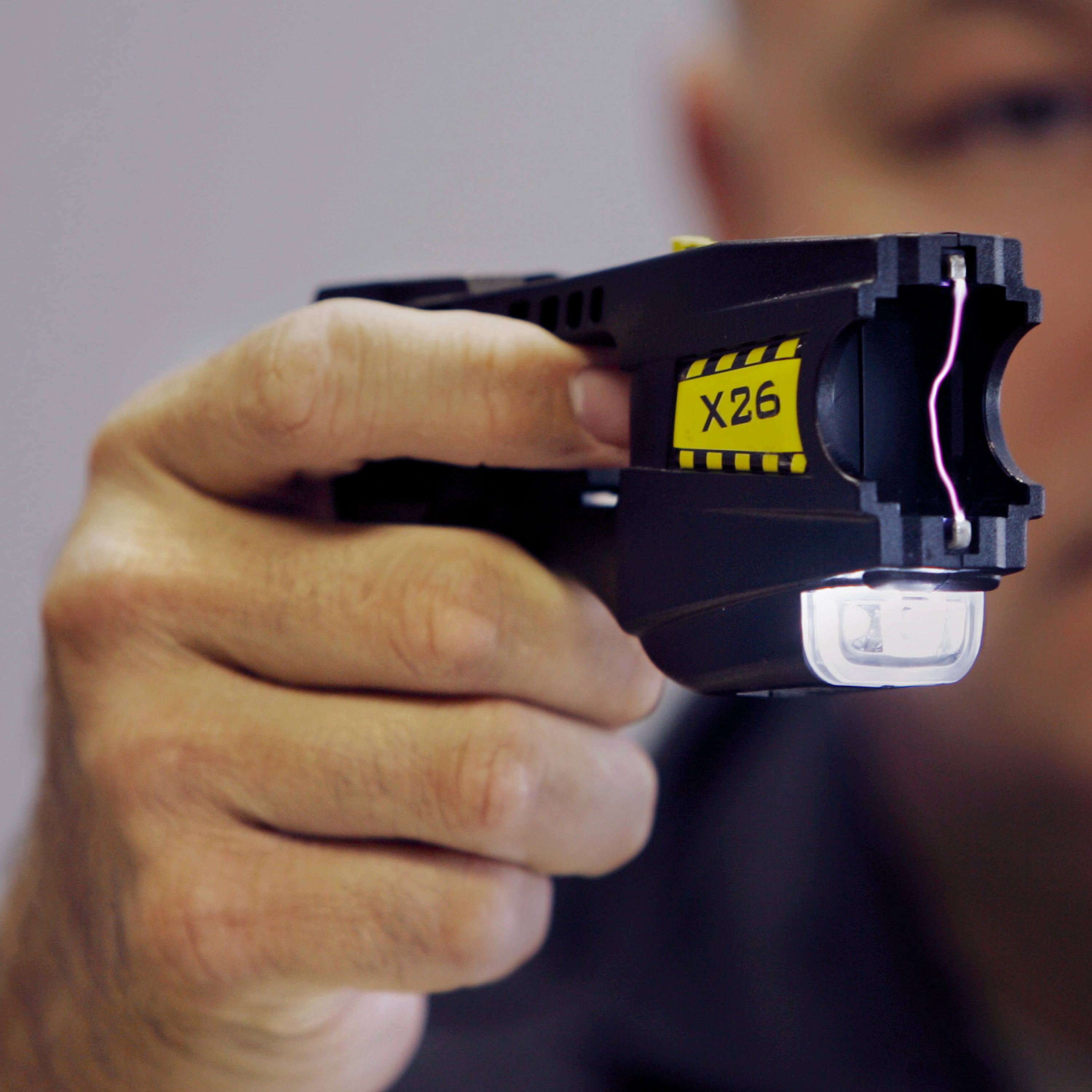
From the center for Investigative Reporting and prx, this is Reveal. I'm Al Letsin. The Taser, it's a weapon that goes hand in hand with modern policing. But of course, it didn't always exist. The first attempt to create one happened in the 1970s at a time when cops across the country were looking for an alternative to firing their guns.
- [01:14]
Rick Smith / Taser Representative
The bosses decided, we gotta find a better way. And that's how I ended up with the Non Lethal weapons project. I had no idea that was gonna become my life's work.
- [01:24]
Al Letson
Greg Meyer worked for the Los Angeles Police Department. He's retired now, but Greg was once in charge of finding a solution.
- [01:32]
Rick Smith / Taser Representative
I actually wrote an article 40 years ago or so, the title of which was Tasers, Tear Gas, Whips, Poles and Chains. Your Non Lethal Weapons alternatives.
- [01:44]
Al Letson
Greg said the LAPD sent out a survey to the 50 biggest police departments in the U.S. what do you guys.
- [01:51]
Rick Smith / Taser Representative
Use besides, you know, the baton and the handgun and the handcuffs to subdue people.
- [02:00]
Al Letson
But cops everywhere were kind of in the same boat. Greg was so stuck, he even ran ads in the newspaper.
- [02:07]
Rick Smith / Taser Representative
We actually had this guy in Australia say that we should use bullwhips on people because that's what they use. And it's like, what?
- [02:15]
Al Letson
Then Greg found a news clip about a scientist working on a kind of electric gun. So Greg calls him and goes over to see the first version of the Taser.
- [02:25]
Rick Smith / Taser Representative
I remember he asked, he said, greg, did you ever tune up on a car and did you ever touch the distributor cap and get a short circuit through your body? And I go, yeah, that happened. He says, but it didn't kill you, right? No, but it really startled you, right?
- [02:41]
Al Letson
Soon the LAPD had a few hundred Tasers it was a great concept, but it had a major problem. It didn't always work.
- [02:50]
Rick Smith / Taser Representative
The Taser should have dropped him long enough for the officers to take control.
- [02:54]
Stacey Masters
It didn't.
- [02:54]
Narrator/Host
From stun guns to Tasers, they can be effective, but have never been totally reliable against focused, combative attackers.
- [03:03]
Rick Smith / Taser Representative
It just wasn't ready for prime time.
- [03:05]
Al Letson
It would be about 20 years after the first version of the Taser was, before a new company would find success. This Taser was made by a young entrepreneur with a biology degree from Harvard and a dream to end police shootings. His name was Rick Smith, and he promised his Taser would work.
- [03:24]
Rick Smith / Taser Representative
Our sales pitch was really easy. We'd go around to the police departments and we'd say, hey, who's your biggest toughest guy? Bring him in. Okay. Think you can beat this? Here's 100 bucks. We hit him with the Taser and boom, down they would go.
- [03:42]
Al Letson
This time, the Taser was doing what it promised to do, and thousands of police departments, including the lapd, started buying them.
- [03:50]
Rick Smith / Taser Representative
And nobody's getting beat up, nobody's getting hurt. So it was like, revolutionary.
- [03:56]
Mike Leonisio
Last year in Phoenix, gun shootings by police went down by half and fatal.
- [04:01]
Matt Masters
Shootings dropped by a third.
- [04:03]
Mike Leonisio
There's a 12 week backlog in demand.
- [04:06]
Al Letson
Rick took his company public, Taser International, which today is called Axon. That was in May of 2001, and he raised about $8 million. Three years later, it was worth 1.9 billion. Taser International sold its product as a non lethal weapon for police and built its business on the trust of law enforcement agencies across the country. But as the Taser grew in popularity, so would the number of serious injuries and deaths. This week, we're revisiting a show we made in partnership with the Lava for Good podcast. Absolute Taser, Inc. Its host and reporter Nick Barradini has spent 15 years investigating the company's claim that the Taser was truly safe. Nick starts the story with one police officer who would find out there was a lot he didn't know the weapon was capable of.
- [05:00]
Narrator/Host
The Kansas City Police Department had tasers back in 2004. Matt Masters remembers getting trained with other cops to use one for the first time.
- [05:09]
Matt Masters
They made all of our guys get tased and they all crumpled up on the floor, you know, from the smallest guy to the biggest guy.
- [05:17]
Narrator/Host
Then it was Matt's turn to get Tased for the first time.
- [05:19]
Matt Masters
I mean, it's probably not appropriate to say I cried like a little girl, but, like, I cried like a little girl, like I was like screaming. It was the most excruciating pain. You don't breathe. I mean, maybe you breathe, but it doesn't feel like you breathe. It feels like you just lock up. That shock goes through you and you're just like, to me it's excruciating pain. But I will say that once it's over and done with, there is no more pain. It's weird.
- [05:45]
Narrator/Host
Tasers were designed to be used against people who were violently resisting arrest, people who might eventually be shot if things got out of hand and cops couldn't get them under control.
- [05:55]
Matt Masters
At the end of the day, if you have to put your hands on somebody and you gotta scuffle with somebody, why risk that? You can just shoot em with a taser. So it became more of a compliance tool, an everyday compliance tool where, hey, put your hands behind your back. You okay? Watch this. You know. And it was a taser deployment and that was how we were trained.
- [06:18]
Narrator/Host
Matt became a cop in 1996 and worked his way up to the department's most elite unit, Snu tac, the street narcotics unit tactical team.
- [06:27]
Matt Masters
It was just like kicking indoors and like, you know, rifles and chasing bad guys and like, that was a level up.
- [06:35]
Narrator/Host
Matt was the first man through the door on over 1000 high risk warrant arrests.
- [06:40]
Stacey Masters
It became part of his identity. It became part of who he was instead of what he did.
- [06:45]
Narrator/Host
That's Stacey Masters, Matt's wife, and the mother of their two sons, Colin and Bryce. She says back then Matt was consumed with the job. Even family dinner revolved around Matt's work as a cop.
- [06:57]
Stacey Masters
It came to a point where I would really resent that question at the dinner table. Hey, Matt, what's a good story? You know, because I didn't want him to be that in that moment, I wanted him to be, you know, a cousin or a son or a husband or I wanted us to shift and. Okay, well, you know, because immediately his body language would change and he would take on that Persona and he would just. You would just, you would just see him leave with him being right next to you.
- [07:30]
Narrator/Host
Tactical cops have this phrase, living in the red. It means living without fear of consequences. Matt was living in the red. He spent years in Snutak kicking down doors until the consequences caught up with him. During a car chase in 2007, Matt's partner was shot and paralyzed in a gunfight. It was a devastating wake up call. And soon after, Stacy gave him a choice, the tactical team or his family. He traded the drug squad for a desk Job in hr.
- [08:03]
Matt Masters
I mean, it was boring. You know, it wasn't fun.
- [08:06]
Narrator/Host
But boring also meant that he had time to be a dad. He finally started going to his son's football games, something he'd missed for years. When their oldest, Colin, got his license, Matt brought him car shopping. They found a used gray Pontiac Grand Prix with leather trim, tinted windows, and a ground effects package straight from Fast and the Furious.
- [08:28]
Matt Masters
It was funny because when we bought it, guy told me, he's like, be careful, man. He's like, the cops do not like this car.
- [08:34]
Rick Smith / Taser Representative
You know?
- [08:34]
Matt Masters
And I was like, that's okay because I'm a cop. I ain't got to worry about it, right?
- [08:39]
Narrator/Host
Matt bought the car, and that's when he put a thin blue line sticker on the back windshield. A few years later, the master's younger son, Bryce, inherited it from his brother. Soon, Bryce was driving everywhere, and the car did start getting attention from cops. Not at Kansas City PD Where Matt worked, but a smaller neighboring department. In the Missouri town where Bryce was about to be a senior in high school, Independence, Bryce was stopped a couple times and was caught with a small amount of marijuana. In one stop, Bryce told his parents that an officer tore the thin blue line sticker off the back windshield. Matt and Stacey didn't like that Bryce was smoking weed. But privately, they worried that the Independence cops were starting to get the wrong idea about their son.
- [09:23]
Matt Masters
They didn't like the tinted windows. They didn't like the ground effects package on the car. They didn't like that this kid, you know, matched his shoes and his clothes up and kind of, you know, dressed a little too flashy for them.
- [09:36]
Narrator/Host
Matt thought that he could straighten things out by talking to the guys he knew at Independence PD but then Bryce was stopped again. In September 2014, the football season was just getting started, and in Kansas City, the Chiefs are the center of the universe. On Sundays, Matt and Stacey were watching the game when Matt's phone rang. It was Bryce's friend Curtis.
- [09:58]
Matt Masters
And he's like, hey, Bryce is getting stopped out in my front yard. And he's like, I don't know what's going on, but the cop's trying to get him out of the car. And I was like, okay. Really? Initially, I didn't really. I didn't panic or anything. I didn't, like, think, oh, my God, you know, my kid's getting stopped. At the time, cops got free passes from me. Maybe Bryce did something wrong. Curtis called me back, and he goes, you need to get here. And I was like, oh, my God. You know, like, what is going on?
- [10:28]
Stacey Masters
The look on his face told me that somewhere somebody wasn't okay.
- [10:38]
Matt Masters
I hung up the phone and I told Stacy. I'm like, there's something else and something's not good. Something's not right. Something happened. We just need to get there.
- [10:45]
Stacey Masters
It's a 10 minute, 11, 12 minute drive probably. And in that period of time of us getting in the car, Curtis is calling us and saying, where are you at? They just tasered him, And he's not moving, he's not breathing. And we're like, what?
- [11:17]
Narrator/Host
Matt weaved his way through traffic and they pulled up to the scene.
- [11:21]
Matt Masters
By this time, there was a fire truck there and ambulance there. And of course, we walk up to the scene. Of course, you know, the cops are like, get back. You know, and you're like, do not touch me. You know, I'm like, that's my kid.
- [11:34]
Narrator/Host
It was chaos. About a half dozen Independence officers marked off the street and rifled through Bryce's car. Neighbors were out in the yard.
- [11:43]
Matt Masters
When they put him on the gurney, they put a tube down his throat and were intubating him with a bag. And then I was over the top of him, looking into his eyes, and he was completely limp. And I remember looking over at him over the top of his head, looking over at his face. It looked into his eyes and there was. I'll never forget that. It was just a. Blake.
- [12:13]
Narrator/Host
Bryce's mom, Stacy, was in a panic. How the hell did this happen? And that's when she spotted Timothy Runnels, one of the Independence officers who had stopped Bryce in his car earlier that summer.
- [12:26]
Stacey Masters
And he's kind of leaned up against his patrol car, like, not a care in the world. I needed him to be like, wow, I really took this too far. I needed that from him. And instead I see this arrogant, proud of himself. And I wanted. I wanted. I don't know what I wanted to do.
- [12:55]
Narrator/Host
Stacy tried to ride in the ambulance with Bryce, but she wasn't allowed to.
- [13:00]
Matt Masters
We decided in that moment to just split up. She took the truck and followed the ambulance to the hospital. And I kind of stayed behind because I was more in the mode of, like, if you're going to cover some up, I'm going to sit here and watch you cover it up. Because I didn't trust that they were going to not spin it in a way that was beneficial to the police department.
- [13:30]
Narrator/Host
At the hospital. They wheel Bryce into the er.
- [13:34]
Stacey Masters
I get right back there and it's bad. It's really, really, really bad.
- [13:44]
Narrator/Host
Bryce was hooked up to a ventilator. His skin was pale and his lips were still blue. Bryce was convulsing, and his body had twisted itself into a kind of horrifying fetal position.
- [13:56]
Stacey Masters
Like, his arms and his legs were, like, just doing unnatural things.
- [14:03]
Narrator/Host
His fingers and toes curled inward and his arms were bent toward his chest.
- [14:09]
Stacey Masters
I didn't want to see him do that. I didn't want him. I didn't want to see him moving that way.
- [14:15]
Narrator/Host
A nurse explained that Bryce's position was a sign of severe brain damage. He needed an MRI immediately so they could know just how bad it was. They brought Stacy out to the waiting room.
- [14:27]
Matt Masters
She called Matt and she said, you need to get here. That's when I kind of started learning how bad it was.
- [14:35]
Narrator/Host
The neurologist pulled them into a private room and explained that Bryce had had a cardiac arrest. Given the signs of brain damage he was already showing, they estimated his heart had been stopped between seven and eight minutes. That's how long his brain went without oxygen. Bryce was 17. His body was strong and healthy. So if anyone had a shot at a miraculous recovery, it would be Bryce.
- [14:58]
Stacey Masters
They had already said, you know, that he may never come out of this vegetative state. This is what he has to look forward to. So as awful as it sounds, I just remember feeling like, do I want him to live?
- [15:16]
Matt Masters
I'll be honest. We thought he was on drugs. I mean, that's what. What else do you think?
- [15:20]
Narrator/Host
Matt and Stacy caught Bryce smoking weed, but they didn't suspect he was on any hard drugs. Still, nothing else made sense. Late that night, the surgeon, Dr. Stanley Augustin, came in to check on Bryce.
- [15:34]
Matt Masters
That was the first thing that came out of our mouth was like, what happened? Is he. Is he high on drugs? And Augustin just kind of. He kind of just matter of factly looked at me and was like, oh, no, he's not on drugs. It was a Taser. Taser caused this. I had no idea that that was even possible.
- [15:55]
Narrator/Host
The surgeon was so confident. In Dr. Augustine's world, this was obvious, but in Matt's world, the cop world, the opposite was true. Matt was just as sure the Taser couldn't cause a cardiac arrest as the surgeon was that it could. Now, these two worlds were colliding, and Matt had to figure out which one was real.
- [16:22]
Al Letson
Coming up, Nick gets a behind the scenes look at the studies on Taser safety.
- [16:28]
Mike Leonisio
Why don't we know about this? Why aren't you reporting it? And I just never was able to get a satisfactory answer to those kinds of questions.
- [16:36]
Al Letson
That's next on Reveal.
- [16:52]
Narrator/Host
I'm Jeffrey Rosen, President and CEO of the National Constitution Center. A few years ago, learning about the forgotten meaning of the pursuit of happiness changed my life. When the founders wrote that famous phrase in the Declaration of Independence, they meant an ongoing commitment to self improvement and lifelong learning. This discovery inspired me to write a book and in my new podcast, I explore the founders lives with the historians who know them best. Plus, filmmaker Ken Burns shares his daily practice of self reflection. Join me for Pursuit the Founder's Guide to Happiness.
- [17:28]
Al Letson
Right now, we are living through some of the most tumultuous political times our country has ever known. I'm David Remnick, and each week on the New Yorker Radio Hour, I'll try.
- [17:37]
Narrator/Host
To make sense of what's happening alongside.
- [17:39]
Al Letson
Politicians and thinkers like Cory Booker, Nancy Pelosi, Liz Cheney, Tim Waltz, Ketanji Brown Jackson, Newt Gingrich, Robert F. Kennedy Jr. Charlamagne, tha God, and so many more. That's all in the New Yorker Radio Hour wherever you listen to podcasts from the center for Investigative Reporting and prx. This is Reveal. I'm Al Letson. Rick Smith had gotten rich selling Tasers to police departments. His company, Taser International, which would become Axon in 2017, marketed the weapon as a non lethal device.
- [18:16]
Rick Smith / Taser Representative
Look, I've been hit with this thing seven times. Every senior employee at this company has been hit with a Taser. Many of our wives, many of our children have been hit with Tasers. So we believe this is the safest way to get a violent person under control.
- [18:30]
Al Letson
But with the weapon's success came a wave of controversy for Taser's Rick Smith.
- [18:35]
Narrator/Host
Sales and profits are skyrocketing, but so is another statistic Taser related deaths.
- [18:41]
Al Letson
The official company line was that Tasers were safe and if someone happened to die while being tased, the cause of the death was something else, like drugs or a tragic coincidence.
- [18:53]
Rick Smith / Taser Representative
None of these cases has the person died while being hit with the Taser.
- [18:57]
Mike Leonisio
You're saying that this was a coincidence?
- [18:59]
Narrator/Host
They would have died anyway.
- [19:01]
Rick Smith / Taser Representative
In every single case, these people would have died anyway.
- [19:07]
Al Letson
Reporter Nick Barradini has been chasing this question for years. If the Taser is safe, then why were some people dying and getting badly hurt? Today we're revisiting a show we first aired last summer. It's a partnership with Nick's podcast series, Taser Incorporated. He starts with someone who saw it all from the inside. A cop who trained other cops on Tasers.
- [19:34]
Narrator/Host
I've read every PowerPoint presentation. Taser International used to train cops from 2000 to 2015. There wasn't anything I saw that made the Taser seem dangerous. One of the slides that jumps out to me is the one that says the Taser is weaker than a Christmas tree bulb. Mike Leonisio was a real believer. He trusted the weapon was safe, and he was skeptical about the reports of Taser related deaths.
- [19:59]
Mike Leonisio
You read the media reports and, I mean, they made this weapon look like it was, you know, people were out there dying left and right. Every time an officer used it, it was basically lethal force.
- [20:09]
Narrator/Host
Mike was a former paramedic turned cop working for the Oakland Police department. And from 2001 to 2008, he trained other cops how to use Tasers.
- [20:18]
Mike Leonisio
I was seeing officers would come in and voice concerns about how, hey, did you see that news article? Somebody got killed by a Taser. I said, no, impossible. Can't happen. We've got a compendium of research. It's three feet tall. And it, no, it can't happen.
- [20:33]
Narrator/Host
Mike was good at training cops. His confidence was contagious. And even though he was confident in his training and the potential of the taser, Mike told me he talked a lot about all these headlines that said people were dying. Taser International was constantly doing cutting edge research to back up its claims. One day as they were talking, Mike just asked, could he actually go see some of this testing for himself.
- [20:59]
Mike Leonisio
I want to make sure this weapon's what they say it is. And, you know, I'll be the first person outside of the company who's ever been able to attend one of these things. I said, so you know, what, does it hurt?
- [21:09]
Narrator/Host
Taser execs said, sure. Mike signed an NDA and flew down to Arizona to watch his first company funded test. It wasn't the scene you might expect. Taser International set up a lab near their headquarters at a veterinary clinic.
- [21:24]
Mike Leonisio
We spent the whole day out there with pigs in the back of a sweltering hot metal truck in the Arizona heat.
- [21:33]
Narrator/Host
The test took place inside a big trailer parked in the parking lot. Mike told me how he watched as Taser scientists took the pigs, sedated them, then laid them out on tables, basically.
- [21:45]
Mike Leonisio
Set up like you would go into surgery.
- [21:47]
Narrator/Host
Pigs are often used in medical research because their bodies are similar to humans. Mike told me the pigs were sprawled out on tables in the back of the truck. Taser scientists hooked them up to ventilators to measure their oxygen levels. They stuck electrodes on their bodies to get a baseline measure of the pig's heartbeats on an EKG machine. Mike told me he looked around. He didn't tell anyone that because he had once been a paramedic. He knew how to read the beeping machines and numbers on screens.
- [22:16]
Mike Leonisio
They had no idea of my background, and they had no idea that when I walked into that study, I knew exactly what I was looking at.
- [22:25]
Narrator/Host
Mike describes how they shocked the pigs over and over for hours, Taking measurements, studying the effects, and monitoring for safety.
- [22:33]
Mike Leonisio
One session in particular, we shocked the pig. Well, it was actually a series of two shocks.
- [22:39]
Narrator/Host
He told me it had been a long day, and he noticed that after so many shocks, this pig was in really bad shape.
- [22:46]
Mike Leonisio
We didn't check a pulse, and immediately following that, we shocked it again, and this time, we shocked it into asystole.
- [22:56]
Narrator/Host
Asystole is basically a flat line. Mike says the pig's heart stopped, it died.
- [23:03]
Mike Leonisio
Pig went straight into flatline, and then that was basically the end of the test. I mean, we were done.
- [23:09]
Narrator/Host
So you see this pig go into asystole. Were you surprised?
- [23:14]
Mike Leonisio
Oh, absolutely. That's not supposed to happen. I mean, cardiac effects. They told us for years that this doesn't have cardiac effects.
- [23:22]
Narrator/Host
He told me he turned to the two taser scientists in charge of the study. I said, that's not supposed to happen.
- [23:28]
Mike Leonisio
And they just kind of chuckled and said, no, no, that happens. We've seen that before. I was like, what do you mean you've seen that before? He says, yeah, that happens. And I think, wow. I said, so when you publish the study associated with this event today, are you going to note that the pig was shocked into asystole? And, you know, the response was, well, we don't handle that end of it. That's not our job.
- [23:59]
Narrator/Host
From Mike's perspective, Taser scientists were acting like it was just another day at the office. Mike says he talked to everyone he could on taser's research team.
- [24:09]
Mike Leonisio
How are you addressing this? They initially said, well, cardiac capture is not a big deal. And that. That really got me.
- [24:19]
Narrator/Host
These studies showed that the taser could interfere with a regular heartbeat cardiac capture. And Mike knew cops around the country who carried a taser were largely trained to think the weapon couldn't do this.
- [24:30]
Mike Leonisio
They believed what they had been told and what they had been taught. You know, we're not talking about a bunch of electrical engineers here. We're talking about a bunch of cops. We're talking about using a weapon that's not designed to do this, being used by a person who's not trained in any kind of real medicine. Maybe first aid, if we're lucky, out in an uncontrolled setting, and you're telling me that cardiac capture is no big deal? And that was a real turning point for me.
- [25:03]
Narrator/Host
Mike says he began to ask questions even to Rick Smith.
- [25:07]
Mike Leonisio
Why don't we know about this? Why aren't you reporting it? And I just never was able to get a satisfactory answer to those kinds of questions.
- [25:19]
Narrator/Host
Matt Masters, the Kansas city police officer whose son was tased by another cop, hadn't heard of the pig study. He believed the taser was safe. So you can see why he was confused when the doctors told Matt that it was the taser that stopped Bryce's heart. But Matt hardly had time to think about it. His son was lying in a hospital bed unconscious. It would be three days before Bryce woke up.
- [25:45]
Matt Masters
He didn't have a very good memory. Like, we would tell him the story. I mean, 20 minutes, 30 minutes later, why am I here? And be like, we just told you. Don't you remember? This is what happened. You got stopped by a cop and you got tased, and he's like. He's looking like, what?
- [26:02]
Narrator/Host
Bryce's face was swollen. Doctors suspected his jaw had been dislocated and popped back into place. Matt and Stacy were so wrapped up in Bryce's coma those first three days that they hadn't focused on the details of why he was in a coma. It turns out the FBI was interested, too. Within hours of the incident, agents started investigating whether the cop who pulled Bryce over and tasered him violated his civil rights. And soon after, Bryce woke up from his coma, they came to the hospital to see him.
- [26:34]
Stacey Masters
But I'm thinking, you know, we're kind of in the middle of something right now. Maybe this can wait a couple days. But they wouldn't wait. They were like, we understand, but we still want to talk right now.
- [26:45]
Narrator/Host
Over the course of several visits, the FBI agents took pictures of Bryce's messed up face, his broken teeth, and the two little red bumps that showed where he'd been tasered on his chest. The agents knew exactly where to look for Bryce's injuries, to the point that Matt and Stacy got the sense that the FBI knew something they didn't. And it was true. The agents told them they knew what happened that day. There was video of the entire incident, but the agents told Matt and Stacy they wouldn't be able to see it until the investigation was over. When the masters finally left the hospital, Matt had the space to Think about what had happened. And that conversation with the surgeon who told him Tasers could cause cardiac arrest.
- [27:28]
Matt Masters
At first, it was kind of like denial. Like, yeah, that's not like that can't happen, you know? And then I just started researching on my own, Googling Taser stuff and looking at videos and looking up court cases and, like, things that had happened around the country.
- [27:45]
Narrator/Host
That's when Matt started to read studies he'd never heard about before. Ones that completely contradicted the studies he was familiar with from Taser training. These studies clearly showed the Taser's electric current could override someone's regular heartbeat. It could lead to a cardiac arrest. And it hit Matt. It wasn't some myth. It was science. And yet the only reason he was learning about the danger was because his own son got hurt.
- [28:11]
Matt Masters
Nobody ever told us any of this. When I first got trained in, I want to say around 2004 ish, you know, fast forward to 2014, 10 years later. There was no change in what I was trained in.04 to 2014.
- [28:27]
Narrator/Host
If Matt didn't know a Taser could possibly cause a cardiac arrest, why would the guy who shot his son in the chest with a Taser know?
- [28:35]
Matt Masters
And then I started kind of doubting myself and really thinking, well, maybe. Maybe he really didn't do anything wrong.
- [28:42]
Narrator/Host
Matt wondered if this was all a tragic mistake. Maybe the cop who tased his son, Timothy Runnels, was just following his training. That is, until Matt was finally able to watch the video of what happened to his son. The video shows Runnels pulling Bryce over in front of his friend Curtis's house. Runnels goes to the passenger side of the car. First. He demands that Bryce roll down the window, but it's broken. Runels then crosses over to Bryce's side.
- [29:15]
Rick Smith / Taser Representative
Is this one open?
- [29:17]
Matt Masters
Yeah.
- [29:17]
Narrator/Host
What are you doing?
- [29:18]
Rick Smith / Taser Representative
Get out. Pull it out now.
- [29:21]
Narrator/Host
Runnels opens Bryce's door.
- [29:23]
Rick Smith / Taser Representative
Am I under arrest? I'm gonna pull you if you don't come out.
- [29:28]
Narrator/Host
He opens the door and says, I'm gonna pull you out if you don't get out. He reaches into the car and starts to pull Bryce out by the collar of his shirt. But Bryce grabs the steering wheel and Runnels loses his grip.
- [29:42]
Rick Smith / Taser Representative
Get out. You really want to get tased right here in the middle of your car? Get your out now.
- [29:48]
Narrator/Host
Runnels tries to pull Bryce out one more time.
- [29:54]
Rick Smith / Taser Representative
Give me your hand. You're under arrest. For what?
- [29:56]
John Burton
For what?
- [29:57]
Rick Smith / Taser Representative
For what?
- [29:59]
Narrator/Host
Runnels steps back about 2ft and pulls out His Taser. He points it at Bryce.
- [30:04]
Rick Smith / Taser Representative
All right, fine. Just get out. Out, out. Right now. Out of the car.
- [30:11]
Narrator/Host
You can hear the familiar rhythmic sound of the Taser. Bryce steps out of the driver door, his arms tense and stiff at his side as the Taser's electric current pulses through his body at 19 times a second.
- [30:24]
Rick Smith / Taser Representative
Taser deployment. On the ground, under the car. On the ground. On the ground. Told ya. Hands behind your back.
- [30:39]
Narrator/Host
Bryce is not moving on the screen as Runels handcuffs him. The click, click, click. Still ticking. Finally, after about 20 seconds, it stops. A taser cycle only lasts for five seconds. This was the moment when Matt first understood that Bryce had been Tased more than once. That Runnels had held down on the trigger, Tasering Bryce for at least 20 seconds straight. In the video, Runnels yanks Bryce up by his arms. He drags him behind Bryce's car toward the curb, and he throws Bryce, handcuffed on his face. Almost one year to the day after Runnels tased Bryce, he pleaded guilty in federal court to violating Bryce's civil rights. It was for dropping Bryce on his face, not for tasing him. The prosecution agreed the Taser shot was reasonable and within common police practice. Runnels was sentenced to four years in prison. Matt told me about how a couple months later, he attended an annual in service training on Tasers. Kind of like an annual refresher course for the Kansas City pd. They would go over any changes in case law or new information from the previous year. Matt thought Bryce's case would come up. During the session, he described how he sat in the back of the room and watched patiently as the instructor went over the same talking points he'd always heard. But the moment Matt says he was waiting for, when they would go over what happened to Bryce and bring up that there was a chance the Taser could cause cardiac arrest. That warning never came up. He told me. He raised his hand. He pointed out that the risks of cardiac arrest were very real. Hell, they were personal, you know, and.
- [32:37]
Matt Masters
You'Re sitting there going, hey, my kid got tased and went into cardiac arrest. Like, if you need somebody to talk to, come talk to this guy, right?
- [32:46]
Narrator/Host
Matt says the instructor told him in front of the entire class that he was simply teaching the slides that Taser International provided. Matt warned the other cops in the room they weren't getting the full story. That Taser training clarified a lot for Matt. That's where he changed his mind about who was to blame for what. Yes, Timothy Runnells was responsible for being cruel and brutal, and he was going to prison for it. But what happened to Bryce wasn't just on Runnels. Now Matt decided Taser International was responsible for misleading hundreds of thousands of cops all over the world, making them think they had a weapon that couldn't kill. Taser International was responsible for Bryce's brain damage, and he wanted to make them pay.
- [33:38]
Al Letson
Coming up, Nick meets the team of lawyers ready to take the company to court. And the company doubles down.
- [33:45]
Rick Smith / Taser Representative
Are chest hits with the Taser dangerous? And the answer to that is definitively no.
- [33:52]
Al Letson
You're listening to Reveal.
- [34:03]
Narrator/Host
There's a lot going on right now. Mounting economic inequality, threats to democracy, environmental disaster, the sour stench of chaos in the air. I'm Brooke Gladstone, host of WNYC's on the Media. Want to understand the reasons and the meanings of the narratives that led us here and maybe how to head them off at the pass that's on the media specialty.
- [34:27]
Al Letson
Take a listen wherever you get your podcasts from the center for Investigative Reporting and prx. This is Reveal. I'm Al Letson. When Matt Masters decided he was going to sue Taser International, he wanted to learn as much about the company as possible. So he collected articles and court documents from wrongful death suits. And there was one lawyer whose name kept coming up. John Burton. John had studied the company's every move.
- [34:58]
Narrator/Host
They had convinced their customer base, which are law enforcement agencies, that this device was absolutely safe and that anybody who says differently is just trying to take this great tool away from you and is probably some ACLU liberal pinko who wants to take your car away or something or make it so you can't eat hamburgers.
- [35:25]
Al Letson
John first took the company to court in 2005. Three years later, he'd win his first case. He worked with his partner, Peter Williamson.
- [35:33]
John Burton
I mean, the amount of time we spent researching and studying, I can't even calculate the amount of hours we spent.
- [35:41]
Al Letson
But their victory was based on an argument that was hard to prove in most other cases. So John and Peter went looking for a new strategy. They wanted to find proof that the Taser could kill and proof that Taser International knew about it and didn't warn anyone. Reporter Nick Barradini has the rest of the story.
- [36:03]
Narrator/Host
John and Peter started with the Taser's electric current. Was it strong enough to affect the heart? They dug through Taser International's research in the company's training material and. And zeroed in on how the Taser delivers an electric shock. Even though it seems like the shock delivered By a taser is constant. The electricity actually comes in extremely short, fast waves. And at the peak of one of those waves, the electric current was high. Once John understood this, he noticed that taser's lawyers and master instructors referred to the average current when they explained how safe the weapon was. I mean, this would be typical of taser propaganda that maybe fooled me at first. Using average current would be like trying to argue your way out of a speeding ticket using your average speed. Like after you got caught driving 85 in a 55, you told the cop, I was just stopped at two red lights. You should measure my average speed. John realized the peak current was much higher and much more dangerous than the average. This is how the company made the taser look weaker than a Christmas tree bulb. That's when they go back to a study they had overlooked before, One of the pig studies. These studies of these pigs show that there's cardiac capture. So I was really shocked that the science actually supported that. This was the proof that the taser's electric current was strong enough to override a normal heartbeat and speed it up, sometimes causing death. But more importantly, the studies showed the company had known for at least two years that the taser could affect someone's heart, and they had not warned their customers. It was exactly what John and peter needed. In 2009, Taser International was staring down the barrel of over 40 separate lawsuits. Even the Canadian government was investigating them after someone died in the Vancouver airport after being tased, Peter Williamson decided it was a good time to offer Taser a chance at legal surrender.
- [38:11]
John Burton
We actually approached Mike brave.
- [38:14]
Narrator/Host
Mike brave, one of taser's lawyers.
- [38:16]
John Burton
And we said to mike brave, I tell you what, we're gonna make you an offer. You resolve the few cases at that point that we had, and we'll sit down with you, and we'll rewrite your warnings for you. And if we do that, you're going to insulate yourself from all future cases. And, you know, you'll settle the cases that we have with us, and we'll be done, and we'll move on in our lives to other things. And he said, wow, that's really interesting. I don't know how long it was after that. Probably maybe a month or so after. And we got an email from Mike brave. And the email just said it just contained three initials and fw. That was their response. So at that point, we said, okay, game's on. You know, no way. And that decision ended up paying major dividends for us. I'll just leave it at that, what.
- [39:22]
Narrator/Host
Peter means is that Taser kept fighting them. If the company kept refusing to warn cops, they were going to keep paying for it.
- [39:29]
John Burton
And somebody got the clue, hey, we gotta do something here or we're gonna keep getting sued.
- [39:36]
Narrator/Host
On September 30, 2009, Taser International issued a training bulletin that for the first time said the risk to the heart from the Taser is not zero. It also said cops, when possible, should avoid shooting people in the chest. Maker of the Taser is now telling police officers where to shoot. This new requirement is to stay away from the head, the neck and the chest when an officer Tasers a suspect. Cops who read this bulletin, who had been under the impression that the Taser was completely safe, were confused. The company immediately started getting calls and emails from cops asking for more information. This was a huge change for officers. CEO Rick Smith scheduled a 2009 version of a Zoom, a conference call with hundreds of police departments around the country. Good day, ladies and gentlemen, and welcome to the Taser International Incorporated customer update.
- [40:36]
Rick Smith / Taser Representative
I would now like to turn the.
- [40:37]
Narrator/Host
Call over to Mr. Rick Smith, CEO of Taser International. Please proceed.
- [40:42]
Rick Smith / Taser Representative
Thank you very much. I want to start by addressing a couple of the questions we've been receiving over email. The first one is, are chest hits with the Taser dangerous? And the answer to that is definitively no.
- [40:59]
Narrator/Host
Definitively no. Rick explained this addition to the training wasn't because the Taser was dangerous. Chest shots were just less effective than shots to the back or stomach.
- [41:10]
Rick Smith / Taser Representative
But the real sort of the biggest reason here in my mind is risk management and avoiding the controversy.
- [41:18]
Narrator/Host
He was basically saying new training recommendations were just to keep the greedy lawyers and anti cop critics off all their backs. If you still needed to shoot someone in the chest with a Taser, the company would be by your side. Taser International wasn't backing down or abandoning officers.
- [41:36]
Rick Smith / Taser Representative
Will Taser help defend officers where there's chest shots involved? And the answer is unequivocally, yes. We pride ourselves that we stand up both for our technology and for officers here.
- [41:49]
Narrator/Host
Cops were looking for the truth, but there wasn't any real dialogue about research results or science.
- [41:56]
Rick Smith / Taser Representative
So there is an acknowledgement that there's a minute possibility that a shot to the chest could result in cardiac arrest. I think the better way that I would answer that, not better, but from the company's perspective, is we cannot prove it's zero.
- [42:15]
Narrator/Host
Why didn't Rick just tell them? It's rare, but it's a real risk. That's not what happened.
- [42:23]
Rick Smith / Taser Representative
Thanks to all of you at Taser for what you've done for law enforcement. Thank you, Hay. And I would say sorry for this situation. I don't enjoy it either, unfortunately. We live in a country where you spill hot coffee and you're like. And you can sue for $10 million. So appreciate your understanding and support.
- [42:41]
Narrator/Host
This call happened five years before Matt Masters son, Bryce, was Tased and went into cardiac arrest. Until then, he still believed the Taser was safe. Matt wanted John Burton to bring Bryce's case against Taser International.
- [42:58]
Matt Masters
I called John's office and got through to him and just kind of explained to him who I was.
- [43:06]
Narrator/Host
He raced through the details. He was convinced that Officer Runnels didn't understand how dangerous the Taser was when he shot Bryce and that Taser International was legally responsible for what had happened. John looked through everything Matt sent him, and he knew it wouldn't be an easy case. Taser International could now point to all these new warnings that had been added to its thick training packet. A laundry list of fine print that insulated the company from liability. But if Matt wanted to try, they could sue both Taser International and Timothy Runnels. Together, they could argue that Taser International's warnings weren't enough to teach Runnels that the Taser was dangerous. In March 2018, they deposed runnels to pin down what he knew about the cardiac risk when he Tased Bryce in the chest.
- [43:55]
John Burton
What was your training and information on the potential for cardiac arrest as it related to chest shots that were close.
- [44:07]
Narrator/Host
To the heart muscle?
- [44:09]
Al Letson
Chest shots are still appropriate if it's.
- [44:11]
Rick Smith / Taser Representative
The option, provided that was still okay.
- [44:15]
John Burton
Under the City of Independence, correct?
- [44:17]
Rick Smith / Taser Representative
Yes.
- [44:18]
Narrator/Host
More than two hours into the deposition, Taser International's lawyer takes her turn. And it's hard for me to hear the company defending or standing up for Officer Runnels in her line of questioning. They specifically say avoid chest shots when possible, right?
- [44:37]
Rick Smith / Taser Representative
When possible, yes.
- [44:39]
Narrator/Host
And that was your understanding just by reviewing this training bulletin that you received? Correct.
- [44:44]
Rick Smith / Taser Representative
My understanding that any shot is acceptable. It's preferred to try to aim for lower center mass.
- [44:51]
Narrator/Host
Show me where it says any shot.
- [44:53]
Matt Masters
Is acceptable in this bulletin.
- [44:55]
Rick Smith / Taser Representative
It says when possible and also says preferred, which would indicate any area.
- [45:00]
Narrator/Host
So it doesn't say it's acceptable, does it? John Burton was infuriated by Taser's legal strategy. The company he'd battled for so long was using the warning he pushed them to write to try to win a case against him. It specifically says that to reduce any risk of sudden Cardiac arrest. Right. And it says, minimize repeated continuous or simultaneous exposures.
- [45:28]
Rick Smith / Taser Representative
That's what was in the warning that.
- [45:30]
Narrator/Host
You reviewed and signed off on, Right?
- [45:32]
Rick Smith / Taser Representative
Right.
- [45:33]
Narrator/Host
I wish I could ask Runels about this moment, but he declined to be interviewed. What he did to Bryce was terrible, but Runnels was in prison for that crime. Taser International, on the other hand, never admitted the Taser caused Bryce's cardiac arrest. But here was their lawyer throwing it back in his face, implying with her questions that he didn't heed the warnings. As Peter Williamson explained to me, writing the warning in 2009 deflected the liability of the Taser from the company that made them to the cops who used them. Here they were.
- [46:09]
John Burton
The company was formed in order to, you know, do something favorable for law enforcement. Right. We're going to give you a device that won't kill people, and it ends up killing people. So now what they do is they put the onus on the officers.
- [46:26]
Narrator/Host
After the depositions, John Burton spoke with Matt.
- [46:29]
Matt Masters
John knew that, like, do we want to continue this route and go after both, or do we want to go after the easy money, which is Timothy Runnels and his insurance company?
- [46:45]
Narrator/Host
They dropped Taser from the lawsuit.
- [46:47]
Matt Masters
It was much easier to pin it all on Reynolds and say he shouldn't have shot the kid and held the trigger down for 24 seconds. Which is all true.
- [46:59]
Narrator/Host
Whether or not Runnells knew his Taser could be lethal didn't matter. He signed training documents that warned him, and he fired the Taser anyway. Two years earlier in the criminal case, Officer Runnells wasn't even charged for Tasing Bryce and causing his cardiac arrest, only for dropping him onto his face. Now, in the civil case, Bryce's lawyers had to prove that the Taser shot on its own was excessive force. Fortunately for the Masters, their attorney called an expert witness to the stand, a former cop himself who'd seen firsthand how dangerous the Taser could be. Mike Leonisio, a now retired use of force expert from Oakland pd. Mike explained to the jury that every five second Taser shot was its own individual use of force. So even if you thought the first five seconds was reasonable, the next 15 seconds of taser shock was unnecessary. Runnells should only have Tasered Bryce for as long as he needed to get him into handcuffs.
- [48:03]
Mike Leonisio
I don't think that he understood that that weapon was capable of affecting the human heart. And I think, unfortunately, there's still a lot of officers out there today who, because of their department training, don't understand the capabilities of this weapon.
- [48:22]
Narrator/Host
Rannells would be found guilty again, and Bryce Masters would be awarded $6.5 million. Stacey Masters, Bryce's mom, remembers what a relief it all was.
- [48:36]
Stacey Masters
We had made it, and it wasn't all for nothing. And we didn't end up with, you know, nothing for Bryce's future. Nothing to make sure he was taken care of. And it was quite literally, you know, payday.
- [48:50]
Narrator/Host
They had imagined this moment for years. Rick Smith at the defense table and listening as the jury found his company guilty. But Rick wasn't there. Timothy Runnells was alone.
- [49:02]
Matt Masters
It's hard for me, like, because I know Rick Smith is a father. I mean, there's crazy numbers out there that at least a thousand people have died from Tasers. You know, how do you live with yourself? Like, do you live with yourself that, oh, I'm just, I'm saving lives. Oh, you're really. You're not saving lives 100%.
- [49:29]
Narrator/Host
Do you feel like they got away with it a little bit?
- [49:31]
Matt Masters
Oh, yeah, 100%.
- [49:34]
Stacey Masters
By design, they got away with everything.
- [49:44]
Al Letson
In 2017, Taser International was renamed to Exxon Enterprise. The company still supplies Tasers to police departments all over the country. And it also has expanded into a new market. Surveillance technology, think body cams, drones, and artificial intelligence that can analyze the footage their cameras record. Today, Exxon is worth over $45 billion. And it doesn't just serve cops. Its customer base now includes civilian markets like hospitals, radio, retail stores, and even schools. In the 15 years Nick has reported on Rick Smith's company, Rick has never agreed to speak to Nick directly. The Masters family still lives in Kansas City. Matt was promoted. Now he's a lead investigator working on drug cases, sometimes in collaboration with the Drug Enforcement Administration. Bryce used some money from his lawsuit to buy a house close to his parents.
- [50:42]
Narrator/Host
He.
- [50:42]
Al Letson
He and his longtime girlfriend are expecting their first child next spring. You can hear more about Axon Enterprise and how it became the most powerful company in policing on Nick's series, Absolute Taser Incorporated. Listen wherever you get your podcasts. The Absolute Taser Incorporated podcast is a production of Lava for Good in collaboration with Signal Company Number One. Their team includes executive producers Jason Flom, Jeff Kempler, and Kevin Waters, senior producer Kara Kornhaber, writer and producer Hannah Biel, and producer Jackie Pauley. Story editing was done by Marianne McCune and fact checking by Danya Suleiman. Additional reporting by Matt Stroud. Engineering and sound design by Joe Plord with music composed by Alexis Cuadrado. Our lead producer for this week's show is Stephen Rascone. Jenny Kostas edited the show. Victoria Baranetsky is our general counsel. Our production manager is the Great Zulem. Score and sound design by the dynamic duo Jay Breezy, Mr. Jim Briggs, and Fernando My Man Yo Arruda. And they had help from the amazing Julia Haney. Taki Telenides is our deputy executive producer, and our executive producer is Bret Myers. Our theme music is by Camarado Lightning. Support for reveals provided by the Riva and David Logan foundation, the John D. And Catherine T. MacArthur foundation, the Jonathan Logan Family foundation, the Robert Wood Johnson foundation, the park foundation, the Smith Family foundation, and the Hellman Foundation. Support for Reveal is also provided by you, our listeners. REVEAL is a co production of the center for Investigative Reporting and prx. I'm Al Ledson and remember, there is always more to the story.
- [52:42]
Narrator/Host
From prx.