Loading summary
Transcript52 lines
- [00:02]
A
So we are going to run the country until such time as we can do a safe, proper and judicious transition. And it has to be judicious because that's what we're all about.
- [00:16]
B
Maduro was a terrible leader for Venezuela, but the idea of removing him in the night using special forces, that's quite an escalation.
- [00:26]
A
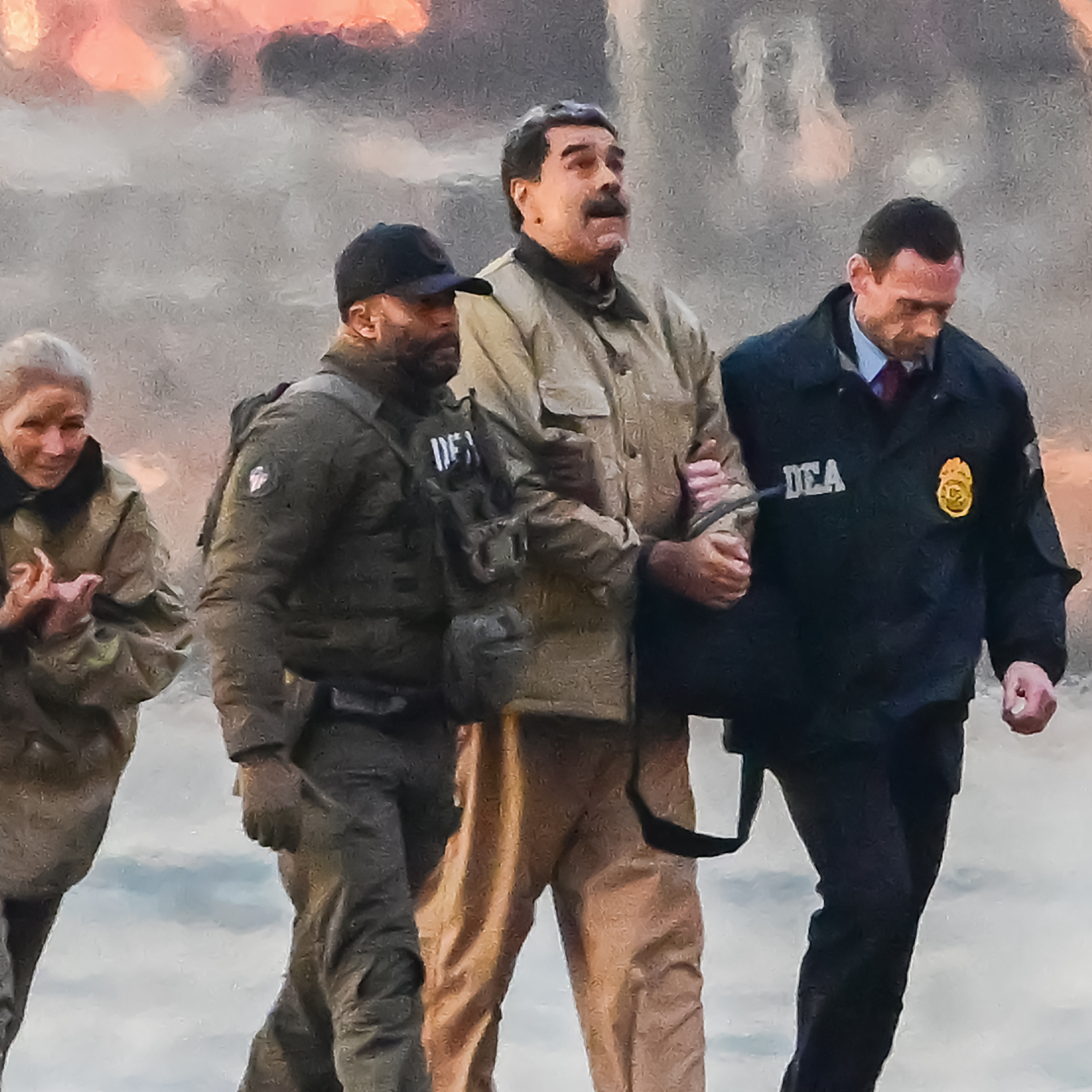
On this week's More to the story, I sit down with Foreign Policy Magazine columnist and Stimson Center Senior fellow Emma Ashford. We examine what's behind the Trump administration's decision to forcibly remove Venezuelan President Nicolas Maduro, and whether the move signals a new era for US Foreign policy around the globe. Stay with us.
- [00:54]
B
This episode is brought to you by Progressive Insurance. You chose to hit play on this podcast today. Smart Choice. Make another smart choice with Auto Quote Explorer to compare rates from multiple car insurance companies all at once. Try it@progressive.com, progressive Casualty Insurance Company and affiliates not available in all states or situations. Prices vary based on how you buy. If your eyes are the windows to your soul and your glasses are the windows to your eyes, then it's pretty important to find your perfect frames. That's why at Warby Parker we've made shopping for eyewear as easy and fun as can be. Peruse endless styles in our stores or use our app to virtually try on frames and get personalized recommendations. To find your next favorite pair of glasses, sunglasses or contact lenses, or to locate your nearest Warby Parker store, Hunter, head over to warbyparker.com that's warbyparker.com.
- [01:55]
A
This is more to the story. I'm Al letson. Last week U.S. forces entered Venezuela, capturing President Nicolas Maduro and his wife in a nighttime raid. They've since been indicted in the US on narco terrorism charges. The military action followed a months long pressure campaign that included a number of deadly strikes on boats off the Venezuelan coast that the Trump administration alleges were used for drug smuggling, as well as a naval blockade on oil tankers moving in and out of the country. The US Has a long history of exerting power and influence in South America. This week's guest, Emma Ashford, a Foreign Policy Magazine columnist and Stimson center senior fellow, examines that history and looks at what the US Is latest actions could mean for the region and the world. Emma, nice to talk to you again.
- [02:47]
B
Good to be with you. Happy New Year.
- [02:49]
A
Happy New Year. So the New Year brings us stories to talk about, namely Nicolas Maduro being removed from power by the Trump administration. When the news first came out, what went through your mind.
- [03:04]
B
To be perfectly honest, it was a rough start to the new year. I think, like a lot of people, I was incredibly surprised that the Trump administration had taken the this step, which was, I mean, frankly, in many ways unthinkable. Even a month or so back, the fact that the administration chose to effectively snatch Maduro and change the leadership in Venezuela. Ostensibly, it's a criminal case, but in practice, this is just not something that we do to foreign leaders.
- [03:35]
A
Can you give me a brief summary of what happened this fall that eventually led to the capture of Maduro by US Forces?
- [03:43]
B
So there's been pressure on Maduro and Venezuela going way back into the first Trump administration and before, but mostly that's taken the form of sanctions. What we see starting in the last year has been first, an attempt by the administration to actually negotiate with Caracas. So Rick Grenell, the president's special envoy, went down there to see if they could get concessions from the Maduro regime on drugs or migration, things like that. That didn't work out. And so then you see the administration dial up the pressure quite substantially, starting with an indictment of Nicolas Maduro himself for various kinds of drug trafficking, and then a parallel military buildup where we start to see more and more US Military assets, naval and air assets, poured into the Caribbean, around Venezuela in a very threatening way. And I think the administration clearly hoped that this would pressure Nicolas Maduro to give up power voluntarily, to go off into a comfortable exile somewhere. That didn't happen. And so the snatch and grab that we saw this weekend, where Maduro was forcibly removed from power, is clearly where the administration decided that they would go next.
- [05:00]
A
I'm curious, when we talked last fall, did you think the US Removing Maduro by force was even a possibility? I mean, were you shocked when you first saw the news alerts coming into your phone?
- [05:12]
B
I was rather surprised, yes. Donald Trump has had this pattern in his presidency of brinksmanship, of engaging in a lot of very coercive threats. If people don't do what the US Wants, we will add more tariffs or we will bomb your nuclear facilities. And often he has backed away from those threats. Sometimes, as in the case of Iran, he has followed through. This is one where I thought that he would probably back down, but he appears to have decided that it would simply look too weak after all of these threats, this military buildup, to back down, and he went ahead with the snatch and grab. I do think it's notable that this was an incredibly aggressive, assertive military operation. Right. I mean, very shocking in that regard. But actually, the political goals that are being sought here are pretty modest. Right. We've taken out Maduro, we're continuing to work with the existing government that was under Maduro, and hopefully they'll be more palatable and more pliable. Now, that's actually a pretty limited set of political objectives. So very shocking on the one hand, quite modest on the other.
- [06:27]
A
So Trump was kind of laying the groundwork, though, for this to happen for a little while. I mean, like, we know that he designated drug cartels as foreign terrorist organizations, but it seems like he was positioning Maduro to say that, like, this is a bad guy and we need to take action against him.
- [06:46]
B
Yeah, there's two things we can, we can point to here in the run up to this. I mean, one is that the Trump administration and the first Trump administration have both had this really conflictual relationship with Venezuela. Right. There was an attempted coup in some ways backed by the US during the first Trump term. There were a lot of sanctions. The US Recognized Juan Guaido as the president of Venezuela at one point. So this has been on the radar for a long time. And then we also have this pattern, particularly in the second Trump administration. So this time around, engaging in this kind of brinksmanship with other states, whether it's trade with China or whether it's threatening Vladimir Putin over Ukraine. And so we see this military buildup in the Caribbean over the last few months saying, Nicolas Maduro, you must go. You must give up power voluntarily. What's different, I think, in this case, or what was surprising, was that when Maduro refused to go, Trump actually crossed the line. He didn't back down. He said, right, okay, Maduro's going. And that's what we saw.
- [07:47]
A
Yeah. Trump has repurposed the 1823 Monroe Doctrine. He's now calling it the Donroe Doctrine. What's the purpose of the Monroe Doctrine, and how would you describe the Donroe Doctrine?
- [08:01]
B
The Monroe Doctrine dates back to the earliest days of the US and it actually was something a little different than what the Trump administration is saying. So it was basically this statement that European countries shouldn't colonize in the Americas anymore, but that the US Would help to ensure that Latin America remained friendly and open to commercial trade and all of these things. So it was an assertion of American interests in the hemisphere, but it wasn't nearly this belligerent. We do have something called the Roosevelt Corollary to the Monroe Doctrine, where we start to see the US Say, well, we can go out and act in A more imperial fashion in the hemisphere, we will conquer places, overthrow regimes. And when you read the. This national security strategy from the Trump administration, the Trump corollary is what they call this. It does seem to be closer to that, the idea that America has free reign in the Western hemisphere to use economic force, military force, whatever. We want to impose our will.
- [09:01]
A
How has the rest of the world reacted to the United States taking Maduro out of power?
- [09:07]
B
There have been a mixture of reactions. In many ways, we've actually seen stronger reactions in Latin America, whether it's from Claudia Sheinbaum in Mexico or from Gustavo Petro in Colombia, who've been pretty openly critical of this choice. In Europe, where we might actually expect leaders to be more critical because this violates international law or because they want to see the US not engage in military interventions, leaders have actually been quite muted in their criticisms of this choice. And I think that reflects a lot of the broader politics of Trump's foreign policy rather than necessarily this specific incident.
- [09:45]
A
Yeah, it feels like I'm wondering if there's a lot of. A lot of holding back because. Fear of what Trump is saying about Greenland.
- [09:54]
B
Yeah. And it's interesting to see, again, you know, in Latin America, Mexico, which the Trump administration has now explicitly threatened, you know, as saying, well, you could be next after Maduro. They've come out quite strongly and said, you can't do this. This is not a place where America gets to call all the shots. But in Europe, as you say, you know, the Trump administration has also threatened Greenland, and other Europeans have actually been a lot friendly towards this move. They've said, oh, well, Maduro needed to go anyway. And they seem to be much more trying to appease Trump than they do trying to oppose him.
- [10:30]
A
Yeah. And just to be clear, Maduro was not necessarily a good leader for this country.
- [10:38]
B
Maduro was a terrible leader for Venezuela, as was Hugo Chavez before him. They took a country that, for all its flaws, had a relatively healthy economy, a functioning major oil export industry. And over time, you know, Chavez was popularly elected initially, but they basically stripped the state of all its functioning economic institutions, took power, and the last several elections in Venezuela, it's pretty clear that they weren't even legitimately conducted and that Maduro and Chavez effectively stole elections. So this has been very bad for the Venezuelan people. There's been a wave of migration. Living standards cratered. Again, none of this is to say that he was a good leader, is a good leader, but the idea of removing him in the night using special forces, that's quite an escalation.
- [11:31]
A
Have we been able to hear from the Venezuelan people about how they feel about this?
- [11:36]
B
We actually have not, certainly about this raid itself. But we do know that the Venezuelan people had turned pretty decisively against the Maduro regime. Right. Again, the elections that were held, even pretty unfair elections that were held a few years ago, showed that the pro democracy opposition in Venezuela got a very large majority of voters. There's a lot of Venezuelan migrants in the United States. Many of them, you know, came here because they could not earn a living, support their families in Venezuela. I'm sure many would like to go home, see their family in Venezuela in a better place. So we know that the Venezuelan people want a future that is not what Maduro is offering them. I think, again, as with. As we saw with Iraq, Afghanistan and elsewhere, the question is whether there is a path from this sort of snatch and grab to a more stable or even potentially democratic Venezuela that remains very unclear.
- [12:38]
A
Yeah, I mean, it doesn't seem like the Trump administration has given any kind of roadmap to how they want to do this. Like at one point, President Trump said that we were going to take over Venezuela. Then he took that back a little bit. Whatever the path forward is, I think the Trump administration wants to see Venezuela and the leaderships kind of kiss the ring, so to speak.
- [12:59]
B
Yeah. I mean, look, I think there's been a lot of theorizing about why this happened, that it was about seizing the oil, which President Trump keeps saying that it was about migration, et cetera, drugs. But genuinely, I think this was as much about a display of force whether that was to the Chinese or the Russians or more likely, to regional states. Right. If the US can do this in Venezuela, the administration has been quite explicit that they can do it elsewhere in the region if they don't receive cooperation from the Mexicans, the Colombians or others on some of these issues that they care about. So I see this as much about trying to send a message. They even tweeted yesterday, from the State Department's official account, a picture of the president. It said underneath it, this is our hemisphere. Message is not usually quite that explicit.
- [13:49]
A
Yeah. How important are Venezuelan's ties to countries like Russia, China and Iran? Did that impact the decision to remove Maduro?
- [13:58]
B
There's been this tendency in Washington in recent years to talk about an axis of authoritarians, or crinks is another acronym you'll hear, but. Right. So the Chinese, the Russians, the Iranians, the Venezuelans, the North Koreans. The idea that these are all tied up in some kind of web of countries that all cooperate together as an alliance. And I think what we saw this weekend, just like we saw in the Iran strikes back in June, is the limits of this notion, right? The Chinese and the Russians are happy to sell Venezuela weapons. The Chinese even had a delegation on the ground in Caracas to talk about trade when this snatch and grab happened. But the Chinese, the Russians, they're not going to step in and fight on behalf of Venezuela, Right. This is something less than a full alliance. And I think again, it helps us to understand that while there are strong connections here, this isn't some global alliance fighting the United States.
- [14:56]
A
When you think about Central America and South America, that a lot of the movements that the United States have done over the years have also been a factor in migration coming to America, which, you know, the MAGA way of thinking is, you know, immigration from those countries is frowned upon. Upon. So it's almost like the moves that we are making right now could, if history is any indication, could show up at our door five to ten years from now and cycle a whole new issue of illegal immigration to the United States.
- [15:35]
B
Well, to give one example, Venezuela's neighbor, Colombia, the US has been heavily involved in Colombia as part of the war on drugs since well back into the Cold War, fighting against sort of insurgency that were left leaning, but also drug trafficking and all kinds of things. And that did not cause stability in Colombia. Right. That was a long running, decades long conflict that did at least cause some migration and certainly instability. What we can say about this current operation in Venezuela is that it is in many ways a gamble. Right? But if this intervention ends up undermining the government's ability to control the country, if you end up with chaos or internal insurgency, then you're probably, probably going to get more migration. So this is a significant gamble if you care about that migration.
- [16:26]
A
Question more with Emma Ashford when we come back. But first, we can't bring you important and timely conversations like this one without your support. It just wouldn't be possible. And you know what really helps? Sharing Reveal. Let me tell you, it's easy. Just tap those five stars, leave us a review and tell everyone about our award winning we do week in and week out. All right, we'll be back in a minute with more from Stimson Center Senior Fellow Emma Ashford. I'm Jeffrey Rosen, President and CEO of the National Constitution Center. A few years ago, learning about the forgotten meaning of the pursuit of happiness changed my life. When the founders wrote that famous phrase in the Declaration of Independence, they meant an ongoing commitment to self improvement and lifelong learning. This discovery inspired me to write a book and in my new podcast I explore the founders lives with the historians who know them best. Plus, filmmaker Ken Burns shares his daily practice of self reflection. Join me for the Founder's Guide to Happiness. Right now we are living through some of the most tumultuous political times our country has ever known. I'm David Remnick and each week on the New Yorker Radio Hour Hour, I'll try to make sense of what's happening alongside politicians and thinkers like Cory Booker, Nancy Pelosi, Liz Cheney, Tim Waltz, Ketanji Brown Jackson, Newt Gingrich, Robert F. Kennedy Jr. Charlemagne, tha God, and so many more. That's all on the New Yorker Radio Hour. Wherever you listen to podcasts, This is more to the story story. I'm Al Letson and we're back with Foreign Policy magazine columnist and Stimson center senior fellow Emma Ashford. I wanted to kind of move the conversation into oil because that seems to be a really big thing that the Trump administration is thinking about. In your first book, Oil the State and Foreign Policies of Petro States, it really talks about all of these issues. So, so how much of this is really about the control of an oil rich nation?
- [18:41]
B
Look, I think President Trump has always had this fixation on oil. If you go back all the way to the 2015 presidential primary, you can see I'm talking about Iraq and how he should have taken the oil. And that was one of our big mistakes. And so I think for him this is something he focuses in on. But as a practical matter, it is simply not the case that the US Is going to control Venezuelan oil production, extract a bunch of it. It's not even necessarily necessarily the case that companies like Exxon or Chevron are going to want to invest much more in Venezuela. Chevron is already there, was already exporting under a license and both those companies have had a lot of their assets expropriated over the last couple of decades by the Venezuelan government. They've seen a lot of destruction of the money and the capital that they've put into the country. So I mean, again, I think I understand why the Trump administration is talking about the importance of sort of getting the Venezuelan oil industry back on its feet and how that will be economically good for everybody. I don't see a practical plan to get there.
- [19:44]
A
My understanding of the oil market right now is that oil is pretty cheap right now and adding more Venezuelan oil would only drive the price down because there'd be more supply so if there's more supply and you're driving the price down, I don't think it's actually something that oil companies would want.
- [20:04]
B
It's certainly not something the people of Texas would want or the Dakotas. Look, I mean, again, Venezuela, Venezuela used to be one of the world's largest oil producers. They were significant. And it was mostly America that bought that oil. We were importing most of it and refining it on the Gulf Coast. But as Venezuelan production declined because of mismanagement, we found other substitutes. And one of the biggest substitutes that we found was our own production of oil. America has, in the last two decades, gone from being a net importer of oil to being the world's largest producer of oil and often exporting as well. And then more broadly, broadly, we're in this situation globally where there is almost too much oil on the market. So there is this kind of strange situation where we were able to go ahead with this operation without spooking markets because there's so much oil. There was no real concern about that. But the oil itself is not nearly as valuable as it would have been two decades ago because of that. So I think, again, Trump has this intuitive understanding of oil is good and we should have more, but that's not where the market realities are.
- [21:12]
A
What's special about Venezuelan's oil, because my understanding about their oil reserves is that it's a type of oil that takes a lot of refinement. Therefore you need to build a lot of infrastructure in order to do it. And currently Venezuela doesn't really have that.
- [21:32]
B
That's true. So Venezuela mostly, they do have some of the world's largest oil reserves. But it is this kind of oil, crude oil, that is heavy and sour in the language of sort of the way oil producers talk about this, which means it requires a lot of refining. And like I said, it used to be the United States that did most of that refining. So the refineries were not in Venezuela. It would be shipped across the Caribbean, the Gulf of Mexico, and then refined in Texas and elsewhere for use in the United States. Many of the refineries that used to do that have shifted to other supply sources, have retooled themselves in the intervening years. So that would require significant changes in parts of the US if we were to see a significant uptick in Venezuelan oil again. And the notion that we might then start to build refining capabilities in Venezuela, that these companies would be interested in doing that, I think is even more far fetched. Right. So that requires just a lot more capital poured into a country where these companies have already lost so much money. That seems like, again, a pretty poor business decision.
- [22:44]
A
Is that what Trump means when he says that Venezuela stole US Oil industry in the country, that they built infrastructure that didn't work out? Is that what he's talking about?
- [22:54]
B
Yeah, that's actually true. The Venezuelan government under Chavez expropriated the assets of U.S. oil companies. And this is something that has happened again in oil rich countries around the world over the last however many decades. Aids. But in Venezuela, what we see is that the government took over many of these assets, kicked out Exxon, mostly. Chevron gave these assets to the state oil company, Petroleum de Venezuela, pdvsa. And then basically through political mismanagement, these facilities started to produce less and less and became less and less capable of actually exporting. So if you think about it from the point of view of one of these U.S. companies, they put in this money, they lost a lot in the expropriation. Now they're being asked to go back in, put in more money to rebuild these assets again. That's sort of a very bad bet, I think, particularly in this market where oil is so flush at the moment.
- [23:58]
A
Yeah, I'm curious because I've done some reading and it points to strong ties between Venezuela and Cuba, which brings Marco Rubio to mind. I am from Florida, I'm actually talking to you from Florida right now. So I've been watching Marco Rubio his whole career. And Marco Rubio is very much, I think what he would say is about Cuban liberation from the communist regime. And I am curious if all of this is connected to that.
- [24:34]
B
So there's very much a theory that's circulating within parts of the Republican right, the more hawkish parts at the moment, that suggests that Venezuela is the first domino on the way to Havana and elsewhere. And there is some basis to this. As you say, the Cubans have relied for a number of years now on things like Venezuelan shipments of oil to help to keep their economy afloat. The Cubans lost a lot of their external support back when the Soviet Union collapsed. And since then, they've pretty much been relying on some regional countries to prop them up. And Hugo Chavez was a huge patron of the regime in Havana. However, I think it's really problematic to suggest that cutting that off is going to cause some kind of collapse in Cuba. And this is why I think a lot of the sort of folks like Lindsey Graham and others that you see talking about Cuba next would suggest that, that some kind of US military action is probably going to be needed as well, if that's what they want to do. This isn't just a simple matter of cutting off Venezuelan supplies and standing back and letting things happen in Cuba.
- [25:47]
A
Yeah. And Cuba's not the only country that they've been talking about. I've heard talk about Colombia and then Greenland as well. How likely do you think it is that we will go after these other countries?
- [26:04]
B
It's difficult to tell with the Trump administration because they engage in so many threats that it's often difficult to tell where they're really serious. And I think one of the reasons why we've seen European states, in particular, panic over the weekend about Greenland is that there was genuinely an assumption until Saturday morning that Trump wasn't serious about Greenland, that he would never actually engage in any kind of action in order to seize Greenland. Now, I still think that's pretty unlikely that the US Would engage in some military action, but it's very clear that the Trump administration hopes to turn these European fears into concessions. Right. Whether that's allowing the US Significantly more basing access in Greenland, whether it is making sure that Greenland could become independent so that it can be tied to the US Through a military alliance of some kind. I do think there is a genuine hope in the Trump administration that they can coerce, force the Danes to give up Greenland by these actions in Venezuela. So, you know, we see it in Latin America, but Greenland is the one where it starts to impact Europe as well.
- [27:13]
A
And if we try to take Greenland by force, that effectively breaks NATO.
- [27:21]
B
I think that probably would. Now, I don't think that if some deal were reached to buy Greenland or to allow Greenland to have an independence referendum, like, I think those options would not necessarily necessarily break the NATO alliance. U.S. troops landing in Nunavut, in Greenland probably would. But it is astounding to me the extent to which we have seen European leaders continue to try and appease the Trump administration rather than getting very serious about their own defense, rather than building up their own capabilities. They continue to try and keep US Troops groups on the continent. They continue to try and sustain NATO. And so thus far, we haven't actually seen them, you know, push back or get out of any sort of alliance with the United States. They seem pretty happy to sort of just give up as much as they have to to keep the US Involved.
- [28:19]
A
So on Monday, Venezuelan Vice President Delsey Rodriguez became the interim president. What's next for Venezuela? Will she be a better president? Will she cooperate with Trump? Like, how do you think that's going to work? Out.
- [28:32]
B
Look, I mean, I think it's a very clear choice by the Trump administration to just remove the man at the top and then hope that the rest of the apparatus of the Venezuelan party and state fall into light. Right. So in many ways, this is less a regime change and more a demonstration of the things that the US can do if Venezuelan leaders don't fall in line. In that, at least thus far. It's been a few days, they seem to be being somewhat successful. Rodriguez gave a few speeches talking about how Maduro is the rightful president of Venezuela, but then immediately issued some statements saying they look forward to working with the United States, that she looks forward to working with US Companies and the Trump administration and all of these things. So I think she's signaling pretty strongly that she is willing to work with the U.S. the question is going to be whether she can do what the Trump administration wants to do without making domestic political enemies. Right. Can she keep the Venezuelan military happy while simultaneously pleasing the Trump administration? Can she give up, say, you know, drug kingpins to the United States without losing her domestic support? That is a very fine balancing act that Rodriguez is going to have to walk, and I'm not sure whether she's going to be able to do it.
- [29:54]
A
So what about Maria Karina Machado? Is she coming back to Venezuela? Is she calling for new elections?
- [30:01]
B
This is one of those areas where I think a lot of sort of more traditional Republican neoconservatives were extremely happy to see Maduro removed from power. They assumed, particularly with Rubio's involvement in the administration, that the next step would be to attempt to install Machada at the top of the Venezuelan state. She and her allies do have some legitimate claim to have won the last election, but Trump came out very quickly and said, no, no, we're more interested in stability. She doesn't have the support. She doesn't have the capabilities to do so. There's been reporting that the CIA did a set of analyses that basically showed that she would struggle to consolidate support in Venezuela. And so I think she's still out there. There is this potential for a democratic transition somewhere down the road, but the administration's signaling pretty strongly that mostly it cares about stability right now and less about democracy. Democracy.
- [30:55]
A
So about 8 million Venezuelans have already fled the country since 2014 due to the humanitarian crisis, gang warfare, violence, inflation, food shortages, all of those things. So what could this additional instability in Venezuela in the next few months mean not only for the surrounding countries, but also for the U.S. i mean, look.
- [31:17]
B
I think I'M glad you mentioned the surrounding countries because there's a lot of focus on migration and what it has meant for America. But actually, the majority of the Venezuelans that left the country are located in Colombia, Brazil and other surrounding countries, and they have often struggled in those places to integrate into society, to find economically viable work and all of these things. Mostly Venezuelan migrants are either fleeing repression or they're looking for better economic opportunities. And that's entirely understandable given how bad the Venezuelan economy has been. You mentioned, mentioned food shortages. I mean, it has been difficult to buy food in places in Venezuela, but the country has not descended into sort of absolute chaos or civil conflict. And that I would say is probably the biggest concern because if we start to see the central government, the instruments of state power, lose control over that stability, then you could see a significantly larger wave of refugees fleeing the country trying to get away from the instability. So that would be, I think, the most significant fear rather than further sort of economic degradation.
- [32:31]
A
Emma, thank you so much for your time. This has been great, always great to chat. That was foreign policy columnist and Stimson center senior fellow Emma Ashford. If you like this episode, you should check out our reveal episode, trump's New World Disorder. It's about how the Trump administration administration's foreign policy is destabilizing some US Allies and includes an interview with Emma about why Trump has floated the idea of taking control of Panama, Greenland and even Canada. Lastly, a reminder, we are listener supported. That means listeners like you, you can help us thrive by making a gift today. Just go to revealnews.org gift again, that's revealnews.org gift and and thank you. This episode was produced by Josh sanburn and Carl McGurk. Allison Brett Myers edited the show, theme music and engineering, helped by Fernando my man, Yo Arruda and Jay Breezy. Mr. Jim Briggs, I'm Al Letson. And you know, let's do this again next week. This is more to the story.
- [33:56]
B
From prx.