Loading summary
Transcript206 lines
- [00:01]
Heath Druzen
20 years after Hurricane Katrina, the storm still lingers. Join Mother Jones, Capital B and the Texas observer for the lingering storm 20 years after. Stories of hope and action. Live from Houston and streaming online, this powerful event features Soledad o', Brien, Garrison Hayes, Adam Mahoney and local change makers reflecting on climate displacement and resilience. Watch the livestream@motherjones.com stream on Wednesday, September 10, 7 to 9pm Central. Let's honor the past and build a more just, resilient future.
- [00:43]
Al Letson
Hey, this is Al. And I'm sure it is no surprise to you that President Trump doesn't like us very much. He called the press the enemy of the people. Credentialed journalists have been banned from press briefings just for asking tough questions. Trump personally, personally sued news networks demanding billions. And now, at his urging, Congress has voted to gut all federal funding for public broadcasting. And I think I know why. I think we all do. It's because real journalism brings sunlight, scrutiny, accountability. When power feels threatened, it lashes out. And that tells you just how vital independent reporting is. Right now here at Reveal, we don't answer to billionaires or politicians or special interests. We only answer to you, our listeners. But we can't do this alone. Stand with us. Support fearless independent journalism that refuses to back down. Donate today. Just visit revealnews.org fearless again, that's revealnews.org fearless. Thanks. From the center for Investigative Reporting and PRX, this is Reveal. I'm Al Edson.
- [01:56]
Heath Druzen
So we're looking for the trail again. It's been disappearing on us at this juncture here.
- [02:03]
Al Letson
This is Idaho based public radio reporter Heath Druzing, and he's a little lost.
- [02:08]
Doug Smith
Yeah, it's gone. We've lost it.
- [02:11]
Al Letson
He's with wildlife biologist Doug Smith, and they're hiking in the backcountry of the first national park, Yellowstone. They're in a remote part of Wyoming near the Montana border, walking through Thailand. Thick grass, miles away from any road.
- [02:26]
Heath Druzen
What's your tips and tricks when you're, when you're looking for a trail like this? Like, are there some sort of telltale signs ahead?
- [02:34]
Doug Smith
Well, you know, terrain's a big one. Where would you walk? That's best.
- [02:40]
Al Letson
Doug has spent much of his life in Yellowstone. He's crisscrossed it on foot, horseback, and overhead in small planes. So he knows the park better than most.
- [02:49]
Heath Druzen
You found it. Oh, there it is.
- [02:52]
Doug Smith
I don't know how we lost it. It's pretty good here.
- [02:57]
Heath Druzen
We're back on the trail for now.
- [03:01]
Al Letson
Heath and Doug are searching for something that many of us would try to avoid. Wolves. Doug has kind of been the wolf guy for decades, ever since the federal government first reintroduced wolves to the Rocky Mountains.
- [03:16]
Doug Smith
Where we're going is a beautiful area, Cache Creek, that isn't really visited that much, and it's important to wolves. So, you know, we're gonna just head in there and kind of immerse ourself in wolf world.
- [03:29]
Al Letson
Reviving this population was controversial. Wolves had mostly been exterminated in the region by the 1940s to protect cattle and sheep. But the absence of this top predator left the ecosystem out of whack. So in 1995, the federal government brought in a few dozen wolves from Canada and released them in Yellowstone and Idaho. From there, the feds nurtured and monitored that population in partnership with state wildlife agencies and indigenous tribes. It was a huge success. This year is the 30th anniversary of wolves being reintroduced to this area. There are now roughly 3,000 of them in the West.
- [04:11]
Doug Smith
Yellowstone's a very different place. With and without wolves, they have a big influence.
- [04:17]
Al Letson
Labor Day weekend is the end of the peak season for many of the country's national parks. Parks officials think this year's visitorship might break last year's record of nearly 332 million visitors. Out of the view of the visitor centers and crowded trails, biologists and researchers have spent decades monitoring and protecting the biodiversity that many people come to the national parks to see. And their work is under threat. In the last few months, the National Park Service has lost 24% of its staff. President Donald Trump's big, beautiful bill rescinded $267 million that was promised for the Park Service. The Trump administration has proposed more cuts to the tune of more than a billion dollars, roughly a third of its budget. It's the work that happens off the trail, like Yellowstone's wolf program, that is the most at risk of losing staff and funding. This hour, we're spending time in our national parks to see firsthand what conservation work has accomplished. And we hear about the big changes, financial and ideological, that threaten these parks as we know them. First up this hour, Heath takes us into wolf world.
- [05:37]
Heath Druzen
Just getting into wolf country was difficult enough. We had to carry 40 pound packs heavy with food, cook stoves, sleeping bags, and tents. Okay, we're at the Lamar river trailhead, and we're just finishing up packing, getting some sunscreen on. I'm no stranger to backpacking. I've visited more than 25 national parks, and living in Idaho, I spent a ton of Time exploring public lands which make up nearly two thirds of the state. But it's also my job. I've reported from national parks and forests for more than 15 years and I convinced Doug Smith to be my guide on a two day backpacking trip to learn more about how the reintroduction of wolves had reshaped the landscape.
- [06:20]
Doug Smith
Hiking this trail now we're up seven, eight miles into it. There's moderate wolf use of this area, could be current wolf use.
- [06:29]
Heath Druzen
Doug is retired now, but he's been studying wolves since College for over 40 years. After that, hikes like these were just another day at the office.
- [06:39]
Doug Smith
Right over the hill is Lamar Valley, Grand Central Station. For a lot of people who visit the park short distance away for a wolf, they're kind of back here in Shangri La for them.
- [06:51]
Heath Druzen
Doug is tall and fit with a bushy handlebar mustache straight out of Mountain Man Central casting. And he's kind of famous for his work with Yellowstone wolves, which themselves are the most famous wolves in the world. Walking around with him in the park was a little like being with the conservation equivalent of Mick Jagger. I half expected tourists to ask him to sign their binoculars. Doug said that attention never stopped being weird for him.
- [07:17]
Doug Smith
I don't feel like a person deserving of recognition. So it's always nerve wracking because you feel like, oh, I better bring it up enough so I don't blow this person's impression.
- [07:30]
Heath Druzen
But out in the backcountry, that's when I really saw him in his element. All around us were 9,000 foot peaks thick with pine forests. Nearby, the Lamar river cut through its namesake valley in long meandering ribbons where large herds of bison grazed. But Doug had his eyes below the horizon on something a little less majestic.
- [07:53]
Doug Smith
I can't say holy on the air.
- [07:55]
Heath Druzen
Oh yeah.
- [07:56]
Doug Smith
Holy mackerel. That's a big wolf scat, no question. It's so big, it's a mixture of meat and hair. So this is wolf country, as evidenced by that gigantic scat, which is a scientific term for feces.
- [08:15]
Heath Druzen
For wildlife researchers, feces are a big part of the job.
- [08:19]
Doug Smith
I know that sounds bad, but all biologists study poop at some point in their career because it really gives you a good idea of one, where they're going and two, what they're eating.
- [08:31]
Heath Druzen
Doug has worked with wild wolves more than just about anyone else on the planet. He's got an encyclopedic knowledge of these animals and how they affect the environment. On the trail, Doug stopped at groves of aspen trees to Explain how wolves and other predators are changing the landscape.
- [08:50]
Doug Smith
This young aspen forest here is all really recent, and I would say, I think, really cool. And, you know, I just did the thing. You're not supposed to put a value judgment on nature. Nature just is. But with the return of carnivores to this ecosystem, wolves, cougars, increase in bears. They've all kind of come back. You've got this, which you didn't have before, and this means life to other things.
- [09:21]
Heath Druzen
Basically, wolves keep elk nervous and on the move. That means they don't chew young aspens to the nub before they can grow tall.
- [09:29]
Doug Smith
But you guys don't have to be ecologists to see all these Aspen are young within a few years, and man, give them 20 or 30, you're gonna have a forest here which for most of the 20th century, was not here.
- [09:44]
Heath Druzen
In turn, this aspen forest provides wood for beavers to build dams and cover for fish like trout. So wolves can even indirectly improve rivers. It's a process known as a trophic cascade. This is why there was such a push to bring them back. They restore balance to the ecosystem. At the end of a long day on the trail, we sit around our campfire. We're about 10 miles from any road. It's one of the largest intact ecosystems in the world. A place that was never logged, farmed, or significantly developed, Left as it was thousands of years ago, Feels like time travel.
- [10:34]
Doug Smith
I want to share the pleasure of moments like this, and I want more people to feel that just from a purely, hey, this is great. You should do it. But also, we need help, and I want more people to be preservationists. Like, we're looking out here. Save this exactly as it is.
- [10:56]
Heath Druzen
After two days and 20 miles under a heavy pack in a climb of more than 3,000ft, I was exhausted. And we didn't see any wolves, just their scat. But they were most certainly out there, probably watching us. Even for someone like Doug, it's hard to find wildlife that doesn't want to be found. And this was just a tiny peek into the exhaustive work wildlife researchers like Doug do, the kind that's at risk if Congress cuts already tight budgets. And for national parks and forests. Our backpacking trip was in July 2024, before the presidential election. A lot has already changed, and the future of ecological programs like these, they're uncertain.
- [11:44]
Doug Smith
I believe in nature. That has been my life.
- [11:49]
Heath Druzen
Doug and I have stayed in touch, and so I reached back out to him to ask him why preserving nature means so much to him.
- [11:57]
Doug Smith
There are times when you are out in the environment alone and a bird, a beaver or a wolf is free ranging and humans usually to them mean bad. So they usually almost always flee. Once in a great while they won't. They stop. And sometimes that's all they do. Other times they'll actually come towards you. And there is nothing like that. Nothing. Those moments make me a different person. An animal chooses to stay with you, approach you, look at you, think about you. It rearranges everything in your life.
- [12:44]
Heath Druzen
I know what he means. A few years ago I was hiking by myself in Yellowstone. I was in the Lamar Valley, not far from where Doug and I spent our two days. It was an unseasonably chilly summer morning and I was winding my way up through a mix of pine trees and sagebrush. I was about a mile into the trail when I saw something large move in the bushes ahead of me. I froze. Then she emerged. A black wolf. And she wasn't alone. She had three pups with her. They were just a couple hundred feet from me. The mama wolf sat on her haunches and locked eyes with me, panting. She looked so relaxed. I stared at her wide eyed, trying not to move a muscle for what felt like the longest 30 seconds of my life. She eventually padded off out of sight with her brood. Then this happened. I knew how rare this was, so I quickly whipped out my phone to record it. I was alone in the wilderness, surrounded by the eerie wolf howls. The feeling I had was a tingling of excitement mixed with awe and a touch of fear. It's the feeling you get from being a visitor in the domain of the wild. That squishy idea of conservation becomes the tangible idea of protecting what's right in front of your face. Doug was right. It does change you. America's national parks and wildernesses are some of the last truly wild places. The question is, will they stay that way?
- [15:04]
Al Letson
This segment was reported by Heath Druzen with production help from Reveal's Nadia Hamdan. Heath just completed a five part series about the controversial and violent history of the effort to reintroduce wolves into the West. It's called Howl in partnership with Boise State Public Radio. You can hear it wherever you get your podcasts. You can also read a version of Heath's reporting at the Idaho Capital Sun. That's IdahoCapitalsun.com up next, how the cuts to national parks are threatening conservation efforts like Doug's.
- [15:38]
Ed Sterley
If you want your grandkids to come back and see bison or other species, you need to have those scientists behind the scenes Making sure that they're protected there as well.
- [15:49]
Al Letson
You're listening to Reveal.
- [16:04]
Najeeb Mamini
Hello, listener. My name is Najeeb Mamini and I am a producer here at Reveal. Reveal is a non profit news organization and we depend on support from our listeners. Listeners like you. Donate today@revealnews.org donate. It helps fund the stories that we tell and helps me feed my cat. So thank you.
- [16:32]
Al Letson
From the center for Investigative Reporting and prx. This is Reveal. I'm Al Letson. It wasn't until college and mammalogy class that Andrea Townsend learned about fishers. Not people who hunt fish. Fisher the mammal.
- [16:48]
Andrea Townsend
They're like a dark chocolate brown that can kind of vary in color with like golden highlights and silver highlights. They have like rounded ears and a cute little pointed face.
- [17:00]
Al Letson
They're often called fisher cats because they're about the same size as a cat with long fluffy tails, but they're actually part of the weasel family. Think otters, badgers, wolverines.
- [17:11]
Andrea Townsend
If anyone listening doesn't know, they should definitely Google Fisher right now and check them out because they're so cute.
- [17:18]
Al Letson
And there are fewer than 500 of them left in the Sierra Nevada.
- [17:22]
Andrea Townsend
They've really suffered in the last decade or so from the drought that California experienced.
- [17:29]
Al Letson
There are hundreds of endangered animals across the National Park System, and it's biologists like Andrea who do the behind the scenes work to make sure they aren't lost forever. And to get to do this in a place like Yosemite national park, well, it was a dream job for Andrea. Then came February.
- [17:47]
Andrea Townsend
It was Valentine's day. It was February 14th when I got an email that told me that I was being fired because of my probationary status.
- [17:57]
Al Letson
Andrea was a part of the Trump administration's mass layoff of federal workers. The White House and its Department of Government Efficiency, or doge, fired thousands of probationary workers in one day to eliminate what they called waste, fraud and abuse. The National Park Service alone lost about 1,000 people.
- [18:15]
Andrea Townsend
I was the only one in the office on like a Friday afternoon and just kind of lost it a little bit. And I was very, very sad.
- [18:25]
Al Letson
This was the first in a line of very specific budget threats to mps. Not only has the agency already lost a quarter of its staff since January, it could lose tens of millions of in government funded research. And in October, we'll find out if even more cuts are coming down the pike when Congress reaches its deadline for a new budget. Reveal producer Nadia Hamdan spoke with 20 people who worked in and around NPS to find out what we've Lost what we could lose and what it means for the future of the national park system. Nadia takes it from here.
- [19:03]
Nadia Hamdan
The mass firing in February coincided with one of the busiest times of year for Andrea and her team. Capture season. To monitor fishers, they have to catch them, fit them with GPS collars, then let them go. They only do this in the fall and winter when the animals aren't breeding.
- [19:20]
Andrea Townsend
And so for me, you know, that was what felt the worst was to be leaving my colleagues like that and not being able to continue contributing to the work that we were doing.
- [19:30]
Nadia Hamdan
Andrea and her team also monitor red foxes. To do this, they set up remote camera stations up in the high alpine parts of Yosemite. These red foxes are even more rare.
- [19:42]
Andrea Townsend
There's estimated to be fewer than 50 individuals in the park.
- [19:46]
Nadia Hamdan
Andrea got a lot of calls from reporters after she was fired. And we all asked her the same question. What did the layoffs mean for those fishers and foxes?
- [19:55]
Andrea Townsend
I think I didn't have like a satisfactory answer because, you know, it's not one of those things where everything just falls apart immediately and, you know, species are going to go extinct tomorrow.
- [20:06]
Heath Druzen
Right.
- [20:07]
Andrea Townsend
What it really meant is that the people that I work with had to take on a lot more.
- [20:14]
Nadia Hamdan
But there was another question she got a lot. One I also had to ask. Why should I care about that box?
- [20:24]
Andrea Townsend
Yeah, totally. That question kind of came up a lot in many different ways. And even now I still, it's hard for me because I see intrinsic value in wildlife. So I don't know how to make people care about that necessarily.
- [20:44]
Nadia Hamdan
At a time when the Trump administration has slashed spending on health care, ramped up immigration arrests, and shuttered life saving foreign aid programs, it can be hard to make a case for programs that don't immediately impact humans. But poll after poll shows that national parks are beloved in this country. We go to these places to escape from the news, from politics, from the day to day grind of being alive in the modern world.
- [21:15]
Andrea Townsend
I think sometimes it takes people kind of having experiences with wildlife or having experiences in a wilderness area or in a national park to really maybe fully understand what that means.
- [21:31]
Nadia Hamdan
And those experiences don't just happen by accident. There is someone right now monitoring the animals, the grass, the streams, the air. It's part of the original mission of the parks. To provide enjoyment, yes, but also to conserve the environment for future generations. After five weeks, Andrea was ultimately rehired with back pay, along with about a thousand other Park Service employees. A ruling out of a federal court in California found that the firings were illegal, but there's still so much uncertainty.
- [22:09]
Andrea Townsend
I would say myself and every other federal employee has not felt safe in their position going to work every day, wondering, do I still have a job? And it makes it challenging to feel that same passion and drive that you maybe had for your work before. Because now you're wondering, does it mean anything anymore if this is all just going to be torn down from the inside out?
- [22:33]
Nadia Hamdan
In July, a ruling from the Supreme Court cleared the way for the Trump administration to execute more mass federal layoffs. This means all those probationary workers are at risk of losing their jobs again. And there could be an even bigger reduction in NPS staff.
- [22:50]
Ed Sterley
So when you lose people that do a lot of these studies, you lose a lot of that institutional knowledge.
- [22:54]
Nadia Hamdan
This is Ed Sterley, and we're so.
- [22:56]
Ed Sterley
Concerned about that, because that's not something that you can just go and rehire. Right.
- [23:00]
Nadia Hamdan
Ed is a regional director with the National Parks Conservation Association. Founded in 1919, the NPCA is the country's oldest watchdog group to protect national parks. And Ed tells me the Park Service has lost more than 4,000 employees this year. The jobs lost were through a mix of firings, buyouts, and just plain old attrition since the Trump administration's hiring freeze is still in place. Many were the people working directly with wildlife or doing other long term scientific research.
- [23:33]
Ed Sterley
And unfortunately, this administration has really centered their target on them and those programs, thinking that they're expendable because they are not in the customer service business.
- [23:46]
Nadia Hamdan
These are people like the two fish biologists whose job it was to monitor wild salmon and steelhead over 4,000 miles of river at Olympic National Park. There were the people whose job it was to protect infrastructure, like the staff restoring the seawall near the National Mall to protect it from flooding. Then there were the people at the top who manage these long term research programs and studies.
- [24:10]
Ed Sterley
You know, if you want your grandkids to come back and see bison or other species, you need to have those scientists behind the scenes making sure that they're protected there as well. Because we're in the forever business here, right? It's not about what my experience is like next month. It needs to be also about what the experience is about three generations from now. People are looking for other jobs, and I don't blame them, especially because, I mean, they're not there for the money. Right. They're there because they're passionate about conservation and they're going to look for a different avenue to pursue that passion.
- [24:43]
Nadia Hamdan
I'm Always hesitant to throw around a word like passionate. But I've heard some pretty incredible stories during my reporting. One biologist told me about a time he carried an overheated wolf into a near freezing river to cool it down, with little concern for his own well being. Another biologist told me that when budget cuts made it impossible to afford new bear traps, he got creative. He scoured antique stores for old foot snares that he could rehab in his workshop, busting a few fingers in the process. And then there was this story from Jim Shabril, a former manager at Shenandoah national park in Virginia. He's been a wildlife ecologist for nearly 40 years and worked with all sorts of species.
- [25:26]
Jim Shabril
Black bears, gray wolves, bald eagles, common loons.
- [25:32]
Nadia Hamdan
But this story involves a moose. It was the mid-1990s at Voyagers national park in Minnesota. Wintertime. Jim and a couple of guys from New Zealand were in a helicopter trying to tag and track the animal.
- [25:45]
Jim Shabril
The term for the person doing the physical restraint of the animal is called a mugger.
- [25:50]
Nadia Hamdan
The muggers were trying to catch the moose, not with anesthesia, not with a tranquilizer, but with a net gun, which is exactly what it sounds like. So Jim and his team shoot the net and catch the moose mostly.
- [26:04]
Jim Shabril
Well, the back legs were free on that moose, and I watched as one mugger went airborne. I saw this orange jumpsuit fly backwards, eagle spread, and fell on his back in the snow.
- [26:19]
Nadia Hamdan
The mugger had been kicked so far by the moose. Jim was sure he would have to call in for a medical rescue. But instead, the mugger quickly got up, shook it off, and went right back to tackling the moose.
- [26:31]
Jim Shabril
So that, that really, I can't do the accent very well, but it was just really a kick because, you know, he said, I'll tell you the other animals we've been working on. And he pulled up his sleeve and there was a big scar.
- [26:42]
Doug Smith
See that?
- [26:43]
Jim Shabril
That's a bison. And he pulled up his shirt.
- [26:46]
Ralph Akin
That's a wolf right there.
- [26:48]
Al Letson
Scratch me.
- [26:48]
Najeeb Mamini
Bit me right there, you know, and.
- [26:50]
Jim Shabril
He'S just showing all the different scarves that he had over his mugging career.
- [26:56]
Nadia Hamdan
Jim says he comes back to this story all the time because it not only showcases the dangers associated with this kind of work, but also the insane dedication of the people who do it.
- [27:06]
Jim Shabril
Anybody else would have probably quit their job that day.
- [27:13]
Nadia Hamdan
This story also highlights the role of federal research funding. Trapping a moose requires expertise that doesn't come cheap. Jim says they were able to pay for those two New Zealand muggers thanks to A grant from the National Science foundation, one of the world's biggest supporters of scientific research. But that wouldn't be possible today. The Trump administration has reportedly frozen all outgoing funding from the NSF until they can identify which grants are aligned with agency priorities. Not only that, but the White House's proposed budget for next year would cut the foundation's funding by more than half. The same goes for the Environmental Protection Agency, which also funds a ton of research in national parks. Then there's the $27 million in grant funding Doge has earmarked for cancellation, which would directly impact climate related programs within the Park Service. And this is all on top of a $267 million budget cut from NPS, thanks to Trump's big, beautiful bill. In short, it's a lot of money lost. We reached out to the Department of Interior asking how all these cuts to staff and funding are impacting conservation efforts. They didn't answer our questions, but Jim says if the original mission behind the national parks was to leave the land unimpaired for future generations, we shouldn't be playing fast and loose with the science that's supposed to fulfill that mission.
- [28:45]
Jim Shabril
This up and down business of funding and funding cuts and, you know, working on a project proposal for a year or two just to see it dashed because somebody doesn't like the term climate change, you know, that's a dangerous game to play.
- [28:59]
Al Letson
National parks.
- [29:04]
Nadia Hamdan
The National Parks Conservation association has started compiling a list of the different programs that it thinks could be most dangerous, damaged by these cuts. There are 16 of them on that list, but one stood out to me immediately, and it's one you've already heard about this hour, the Yellowstone Wolf Project.
- [29:22]
Doug Smith
Am I worried? Yeah.
- [29:25]
Nadia Hamdan
Wildlife biologist Doug Smith. Again, the Mick Jagger of wolves.
- [29:29]
Doug Smith
There's a lot of red flags right now, a ton of red flags.
- [29:33]
Nadia Hamdan
Doug says he's glad that the program has led to a booming wolf population in Yellowstone, but that doesn't mean you just stop paying attention.
- [29:42]
Doug Smith
Wolf monitoring, which I think is vitally important. Bird monitoring, beavers, elk, whatever. It's environmental monitoring. It's what's going on in the world.
- [29:52]
Nadia Hamdan
And Doug says what so many people fail to realize is that we are a part of that world, not separate from it.
- [30:01]
Doug Smith
We're all connected. What wolves need is the same thing. We need other life counts. And that ultimately is a healthier viewpoint for existence, for everything, humans included.
- [30:19]
Nadia Hamdan
And while all these programs aren't gone yet, almost everyone I spoke to is worried, especially when they've seen budget proposals for similar Programs across other public land agencies getting slashed. If the Trump administration gets its way, the entire research arm of the US Forest Service would be gone. The US Geological Survey Ecosystem Studies Unit, gone. The US Fish and Wildlife Service's conservation funds, gone.
- [30:47]
Doug Smith
I was a government employee 28 years. I wrote out hard times. You know, politics are politics, but you kept the programs going. They might have got less money money, you might have got more staff turnover, but you got it done. Now they're ending.
- [31:10]
Nadia Hamdan
The Trump administration has said that this is all in an effort to eliminate waste, fraud, and abuse. But nearly everyone I spoke to, Andrea, Jim, and others who've worked closely with national parks, they all had another theory that the underlying goal of this administration is to sell off and privatize more public land.
- [31:32]
Andrea Townsend
I completely feel like it's a systematic approach of making things inefficient under the guise of efficiency.
- [31:41]
Jim Shabril
Well, look at the government is not working. Look, we can privatize this.
- [31:45]
Ralph Akin
It's really part of this bigger agenda to transfer wealth from the public to the private sector that the government.
- [31:51]
Doug Smith
Let's turn it into dollars. Let's sell it. I mean, and I'm speaking, just because we're living in an era of conspiracy theories doesn't deny that there are real conspiracies.
- [32:04]
Nadia Hamdan
I heard this fear again and again. And if true, it would be wildly unpopular with the American people. Polling shows that an overwhelming majority of Americans oppose selling or closing federal public lands. This brings me back to what Andrea said about intrinsic value. The entire national park system was created on this very idea. Most people just want these places to exist. And Doug Smith says that should be enough.
- [32:37]
Doug Smith
You know, public lands are vital to this country. I think they in a lot of ways make this country. And I've been to Europe a few times. It's great. I love it. You know, the ancient kind of cities and buildings and culture. But what the United States is known for is more wildness, more wide open spaces. And I. I'm worried about losing that.
- [33:03]
Al Letson
Up next, a trip to a different kind of national park where an ideological battle is underway.
- [33:09]
Chandra Manning
We want the past to make us feel better.
- [33:11]
Nadia Hamdan
But here's the thing.
- [33:12]
Chandra Manning
The past has no responsibility to how we feel.
- [33:16]
Al Letson
That's next on Reveal from the center for Investigative Reporting and prx. This is Reveal. I'm Al Lets.
- [33:36]
Najeeb Mamini
I am on this farm that has this huge event for Civil War reenactors.
- [33:43]
Al Letson
It's the 4th of July at a farm out in Pennsylvania. Reveals. Najiba Meaney is there walking around a Civil War reenactment just outside of Gettysburg National Military Park.
- [33:54]
Najeeb Mamini
There's a lot of memorabilia, flags. You can guess which kind of flags.
- [34:04]
Al Letson
It's like a Renaissance fair, but Civil War themed. Najeeb is here because of an executive order issued by President Trump. It's titled Restoring Truth and Sanity to American History. It directs the Department of Interior to do an internal audit of all public monuments, memorials, statues and signs. And that audit is supposed to find and remove any content inside national parks that disparages Americans past or living, to instead focus on the greatness of the American people. The National Park Service is responsible for more than the sprawling wilderness of places like Yosemite and the Grand Canyon. It also maintains more than 200 sites because of their history. But how do you accurately tell the story of America without explaining the many periods of its troubling past, like the Civil War? Mark.
- [35:03]
Doug Smith
No charge.
- [35:03]
Najeeb Mamini
It's on the house.
- [35:04]
Al Letson
At this reenactment, Najeeb asked people about the executive order and how it would change the official story being taught at Gettysburg. Just a few miles away, they have.
- [35:14]
Ralph Akin
A narrative that they want to keep pushing. The reason for the Civil War was slavery. The north was right. The south were bad.
- [35:22]
Al Letson
In one of the booths, Najib meets Ralph Akin. He's dressed as an embalmer, someone who prepares the dead. Ralph was in favor of Trump's order if the changes meant the narrative at the park would line up with his views of the war.
- [35:36]
Ralph Akin
The war was not about slavery originally. It was about states rights.
- [35:43]
Al Letson
Najeeb heard different versions of this again and again from people like Steve Reinke, a reenactor on the Union side.
- [35:50]
Heath Druzen
People want to make sure they get that opinion out there, which I think is great.
- [35:54]
Doug Smith
But it's not just about slavery. There were so many political things.
- [35:58]
Heath Druzen
You follow the money they did not want, big government in their hand and in their pockets.
- [36:04]
Al Letson
And Jason Vanhart, a young reenactor dressed up as a Confederate officer.
- [36:08]
Ralph Akin
There's a lot of people who want to have one narrative of the Civil War, and maybe it's a pro Confederacy narrative, maybe it's a pro Union narrative. I think all of them are important. While there were two sides to it, there isn't one story for the Civil War.
- [36:21]
Al Letson
The Park Service is tasked with interpreting this country's history, including the Civil War. On its website, it describes slavery as a cause of the war. But when you're on the actual battlefield, amidst hundreds of monuments, memorials, and markers, there is almost no mention of war. Why the Civil War started, that is, except for six signs, six signs with just a few paragraphs and usually an image, six signs that could be taken down under Trump's executive order. Najib starts on the battlefield.
- [36:55]
Doug Smith
Italian.
- [36:56]
Nadia Hamdan
Italian.
- [36:58]
Najeeb Mamini
We're going to break through the Union line up there and chase the Yankees back north.
- [37:02]
Doug Smith
Let's do it this way.
- [37:03]
Al Letson
Sounds good, General. Yes. Okay.
- [37:05]
Najeeb Mamini
The main attraction here at Gettysburg National Military park is the battlefield. Nearly 6,000 acres of it. It is the site of the bloodiest battle of the Civil War that took place 162 years ago.
- [37:19]
Al Letson
We are going to take a moment.
- [37:23]
Najeeb Mamini
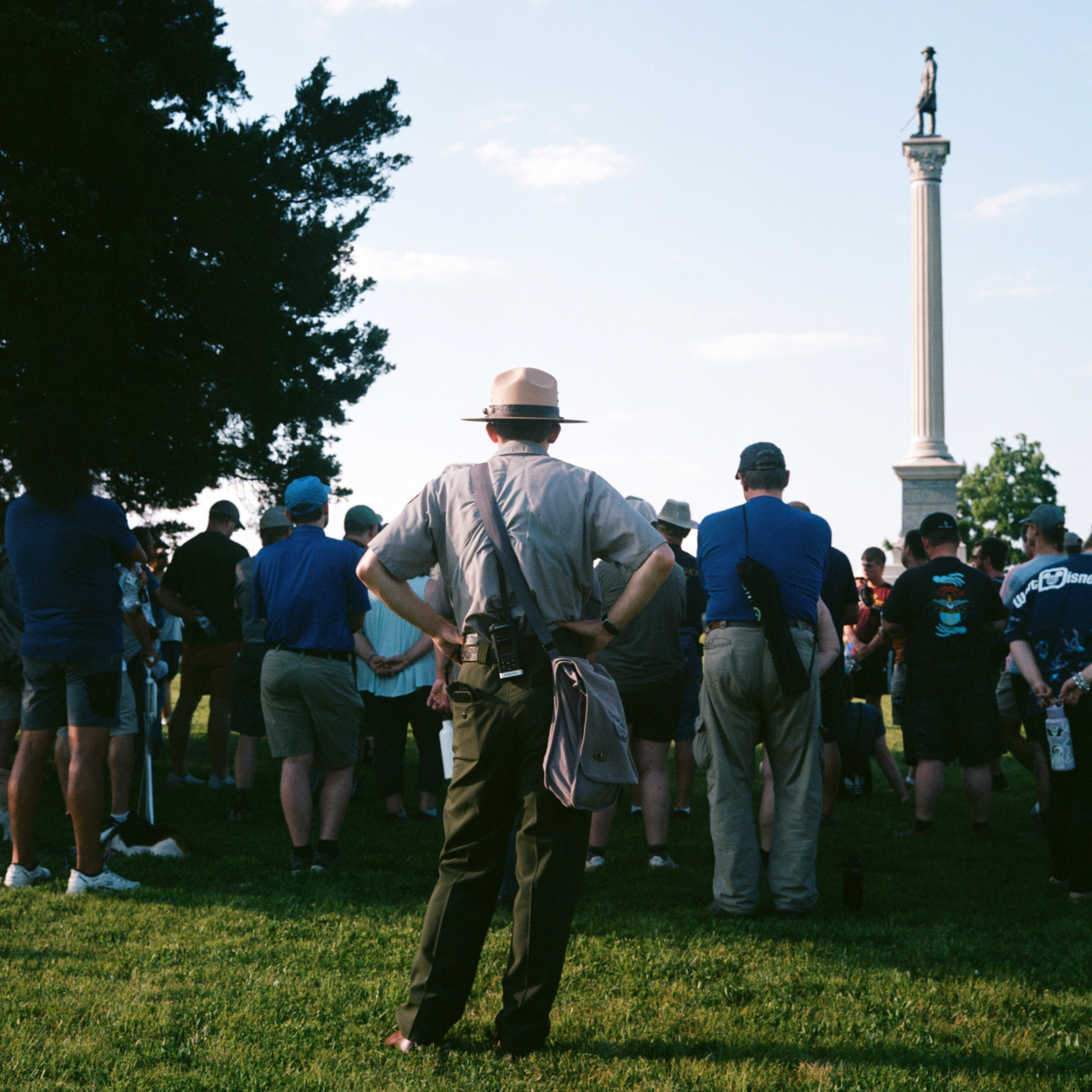
And we'll do some remembrance. This holiday weekend, there are plenty of reenactors walking around the park. This small group dressed up as Confederate soldiers is here to salute the largest monument on this side of the park, a 14 foot bronze statue of Robert E. Lee on his horse Traveler. They're on top of a granite pedestal. When you add it all up, it's 41ft of commemoration.
- [37:50]
Ralph Akin
You drive on the other side of the battlefield, you can see this easily from a mile away.
- [37:55]
Najeeb Mamini
Next to me is Scott Hancock. He's not a reenactor or tour guide, but he knows a lot about this site. Scott is a professor of history and Africana studies at Gettysburg College. He's in his early 60s and he hides it well. He's in shorts and a black shirt.
- [38:12]
Ralph Akin
Well, my shirt says I'm black every day, but today I'm blackety black black.
- [38:18]
Najeeb Mamini
And as we're looking up at this giant monument, he points to a much smaller, almost half its size, a speck on the horizon.
- [38:27]
Ralph Akin
See the statue between the two trees?
- [38:30]
Najeeb Mamini
Yes.
- [38:31]
Ralph Akin
So that you can barely make it out. Right. That's General Meade. He's the commander of the Union Army. He's the winner. This is the loser.
- [38:40]
Najeeb Mamini
At the base of the General Lee monument, there's an inscription that reads, Virginia to her sons at Gettysburg. Again, this is four stories tall. But Scott says there's one major story that's missing.
- [38:54]
Ralph Akin
So what it doesn't say is that Robert E. Lee, through his wife, owned 189 people.
- [39:00]
Najeeb Mamini
But you don't get any of that here.
- [39:02]
Ralph Akin
No.
- [39:03]
Najeeb Mamini
Should you get that here?
- [39:04]
Ralph Akin
I think yes. Because if you're going to have this that is such a glorification of Lee, then I would argue, well, let's telephone story.
- [39:16]
Najeeb Mamini
Scott never wanted to be a Civil War historian. His work focuses on American history between the 1600s and 1800s. But the battle of Gettysburg is a difficult topic to avoid when you're this close to the site.
- [39:30]
Ralph Akin
So the Union won the Battle of Gettysburg. The Union won the American Civil War. I would argue, and many others, that in many ways, the white Southerners and their descendants won the battle of culture and minds through the 20th century because they were able to effectively erase slavery and black people from what this battle and what this war was about.
- [39:55]
Najeeb Mamini
In the wake of the protests over George Floyd's murder in 2020, almost 100 Confederate statues and memorials were taken down across the country. But the 40 or so Confederate monuments at Gettysburg are still standing. Historians like Scott advocated that the Park Service keep the statues, but also put up interpretive signs that give more context. Scott had many talks with the local rangers, and in 2021, the park put up six new signs. These signs, some written with Scott's input, mentioned the role of slavery, race, and the African American experience.
- [40:35]
Ralph Akin
We want more history, not less history. And part of more history means understanding that this specific landscape is part of a battle that's connected to a larger story of the war, and that war is connected to a larger story of America.
- [40:50]
Najeeb Mamini
Take for example, the sign that overlooks the Warfield House, a black owned property that was shot up during the battle. The sign reads freedom threatened and has a line about how the Confederate army, while in Pennsylvania, abducted black men, women and children and forced them into slavery.
- [41:09]
Ralph Akin
It's got a picture down in the right and inset black and white image from Harper's Weekly of African Americans being rounded up and kidnapped by the Confederate Army.
- [41:20]
Najeeb Mamini
This is pretty in your face.
- [41:22]
Ralph Akin
Yeah, this is probably evolved. All the signs is probably the most explicit.
- [41:31]
Najeeb Mamini
Do you feel like this could be one of the signs in jeopardy?
- [41:34]
Ralph Akin
Oh, yeah, definitely.
- [41:36]
Najeeb Mamini
Why is that?
- [41:37]
Ralph Akin
It certainly doesn't make the Confederate army sound good in any way. Or like this was just all about noble sacrifice.
- [41:44]
Najeeb Mamini
These are the types of unflattering details that President Trump's executive order is trying to remove.
- [41:51]
Nadia Hamdan
In the last 20. In 24 hours, President Trump signed an executive order aimed at what he calls restoring truth and sanity to American history.
- [41:58]
Najeeb Mamini
The Trump administration is reviewing all signs and National Park Service sites and planning to remove them if they, quote, minimize the value of certain historical events or figures. The administration has already signaled it's especially focused on references to systemic racism, transgender people and diversity, equity, and inclusion more generally. The executive order has also received congressional support. Republican Senator Jim Banks of Indiana has introduced a bill that would turn the order into federal law if passed. Senator Banks is also the founder of the anti woke caucus in Congress. Yes, there's a caucus for that. And said in a press release about his bill, quote, it's time to stop letting activists rewrite our past. I asked Scott about this critique that signs like the ones he helped put up in Gettysburg are just some woke liberal exercise.
- [42:59]
Ralph Akin
To the people who would discount it as woke, I think I would argue, show me the evidence that says that the Civil War was not about slavery. That race and racism wasn't central to this story convinced me of that.
- [43:17]
Najeeb Mamini
There are about 1400 monuments, markers and signs scattered all over this battlefield. Union veterans had long resisted the idea of commemorating the Confederacy, wary of honoring a cause they'd fought to defeat. But by 1917, reconciliation became the dominant theme, Especially as the nation was entering the first World War. The nation's leaders pushed the country to come together and move on. It wouldn't be until 54 years after the battle of Gettysburg when the first state Confederate monument was placed on the battlefield. It's the one of Robert E. Lee on his horse. But the timing of the Robert E. Lee monument was part of another national trend. Across the country, Confederate statues were appearing in city squares and courthouse lawns.
- [44:09]
Chandra Manning
The big push for Confederate monuments is not right after the war. No, it is directly hard on the heels of the establishment in 1909 of the NAACP.
- [44:20]
Najeeb Mamini
Dr. Chandra Manning teaches 19th century US history at Georgetown University. And she says that there's also a second wave of Confederate monuments that go up across the country during the civil rights era, Notably after the Supreme Court ruled on Brown vs Board of Education, where state sponsored segregation was deemed unconstitutional.
- [44:43]
Chandra Manning
What are those monuments doing? They are certainly. They're sanitizing and they're erasing, and they're also making a strong argument about who belongs and who doesn't. And making an argument about who belongs and who doesn't in the past is a way of making an argument about who belongs and who doesn't in the present as well.
- [45:05]
Najeeb Mamini
Though these memorials were often sponsored by state legislatures, they echoed the efforts of another group that wants to rewrite Civil War history through bronze and stone. The United Daughters of the Confederacy.
- [45:19]
Chandra Manning
They're largely elite white women. They come from families who had the most to lose by the destruction of slavery, but have started to get it back. Not slavery, but their wealth and their status back. By the 1880s and 1890s, with their.
- [45:34]
Najeeb Mamini
Wealth and status restored, they rallied around the so called Lost Cause narrative. In that version of the story, the Confederates are mainly the victims and slavery is a footnote. But this movement didn't just build statues. They edited textbooks, trained teachers, and made sure many students across the country learned that the Civil War was about tariffs and States rights, not slavery.
- [46:01]
Al Letson
April 12, 1861. Confederate guns fire on Fort Sumter.
- [46:07]
Najeeb Mamini
The war had come, and for generations, classrooms taught a feelgood version of the Confederacy, full of fearless generals.
- [46:17]
Jim Shabril
Then I will follow my native state.
- [46:19]
Al Letson
With my sword and if need be, with my life.
- [46:23]
Najeeb Mamini
In a way, it was historical fanfiction.
- [46:27]
Al Letson
The north lost more than a state.
- [46:30]
Najeeb Mamini
It lost the general, and it stuck.
- [46:36]
Chandra Manning
My students walk into my classrooms convinced that slavery is the simpleton answer and that it has to be more complicated than that because we don't want slavery to be central to this central drama of US history. That's a hard truth.
- [46:49]
Najeeb Mamini
In 1864, the rebels had enough of the war.
- [47:03]
Chandra Manning
We want a nicer story. We want the past to make us feel better. But here's the thing. The past has no responsibility to how we feel.
- [47:14]
Najeeb Mamini
By now, the head of the National Park Service was ordered to have completed the internal review of all public monuments, memorials, statues and signs. And in mid September, any of these signs, monuments, or memorials that are deemed to disparage America's past are slated to come down based on the Secretary of Interior Doug Burgum's order.
- [47:36]
Ralph Akin
I don't know if they're doing anything specifically these six signs in there. In some ways it's almost like I'm afraid to talk to you about them because I think, do we want them to get attention? But in a way, we do want them to get attention because we want people to see them and read them.
- [47:49]
Najeeb Mamini
I sent a list of questions about the executive order to the National Park Service and the Department of Interior. The response I got back didn't answer any of them. Instead, they sent me two paragraphs confirming that all signs are under review. I also sent a list of questions to the White House that also went unanswered. Instead, a spokesperson wrote back saying the executive order was a necessary response to the woke left's attempts to force our nation to adopt a factually baseless ideology. Back at the battlefield, Scott takes me to his favorite sign. We make our way towards a watchtower, obviously built after the war, where we walk up 120 plus steps to a panoramic bird's eye view of the battlefield.
- [48:40]
Ralph Akin
Everybody comes up here and they do. What we did is they look this way, right over the battlefield, which makes sense.
- [48:45]
Najeeb Mamini
But if you turn around and face the west, you'll see a tree line that goes out towards the horizon. It leads to a natural passageway, the South Mountain Pass. And Scott remembers one of the first times he took his own son who had just started high school. Up this watchtower.
- [49:03]
Ralph Akin
But I was telling him the mountains to the west are part of the reason why there's a battlefield. And I said to him, if Africans never come to these shores, there's no battlefield here. And my own son says to me, well, I don't know, dad. You know, states rights and stuff like that. And I thought, he's been in that high school for like, two months and he's already drinking the Kool Aid.
- [49:21]
Najeeb Mamini
Scott took that interaction with his son into the language he wrote for the sign. In just a few short sentences, the sign acknowledges the mountain range in the distance and how it both guided freedom seekers from the south and protected the Confederate army in its final retreat from Gettysburg.
- [49:40]
Ralph Akin
I like this sign because I think it wraps it all together. You know, that this is. None of this is discrete and separate from the other. It's all connected. I'm not fooling myself that this is going to change the whole narrative.
- [49:54]
Heath Druzen
But.
- [49:55]
Ralph Akin
If this little bit is removed, moved, it's just another step in the wrong direction.
- [50:04]
Najeeb Mamini
Before we part ways, we stand at the battlefield's high water mark. Cannons rest silently in front of us. And behind the modest statue of Union General George Meade looks over us. Remember, he's the winner. There's one of the new six signs near a patch of old trees, and one of those trees is believed to be a witness tree.
- [50:28]
Ralph Akin
Witness trees were trees that they can document were here during the battle.
- [50:33]
Najeeb Mamini
I guess if that witness tree could speak, what do you think it would say?
- [50:40]
Ralph Akin
One, I think that tree would say keep funding the National Park Service, because otherwise they're not going to be able to take care of it because they won't have the manpower, the funds to do it. And that. And that's a great way to think about it, because that tree remembers right what happens in ways that we have often forgotten.
- [51:00]
Najeeb Mamini
The Department of Interior has yet to publicize which signs, markers, and monuments might be replaced. The signs Scott helped work on remain at Gettysburg, at least for now.
- [51:18]
Al Letson
The Trump administration has already moved to restore Civil War era symbols, like renaming military bases after Confederate leaders. And the administration has begun re erecting Confederate monuments that were taken down in recent years as a part of its broader campaign to restore, quote, truth and sanity to American history. Our lead producers for this week's show were Nadia Hamdan and Ajib Amini. Additional reporting from Heath Druzen and Clark Corbett. Special thanks to producer Ashley Kleek. Jenny Kostas edited the show, and Kate Howard was the executive producer for this hour. Nikki Frick is our Fact Checker Legal Review by Victoria Baranetsky. Our production manager is the great Zulema Cobb. Score and sound design by the dynamic duo Jay Breezy, Mr. Jim Briggs and Fernando My Man Yo Arruda. Taki Telenides is our Deputy Executive Producer. Our executive producer is Bret Myers. Our theme music is by Camerado Lightning. Support for reveals provided by the Reeva and David Logan foundation, the John D. And Catherine T. MacArthur foundation, the Jonathan Logan Family foundation, the Robert Wood Johnson foundation, the park foundation, the Schmidt Family foundation, and the Hellman Foundation. Support for reveal is also provided by you our listeners. We are a co production of the center for Investigative Reporting in prx. I'm Al Letson and remember, there is always more to the story.
- [52:50]
Doug Smith
From prx.