← Revenue Builders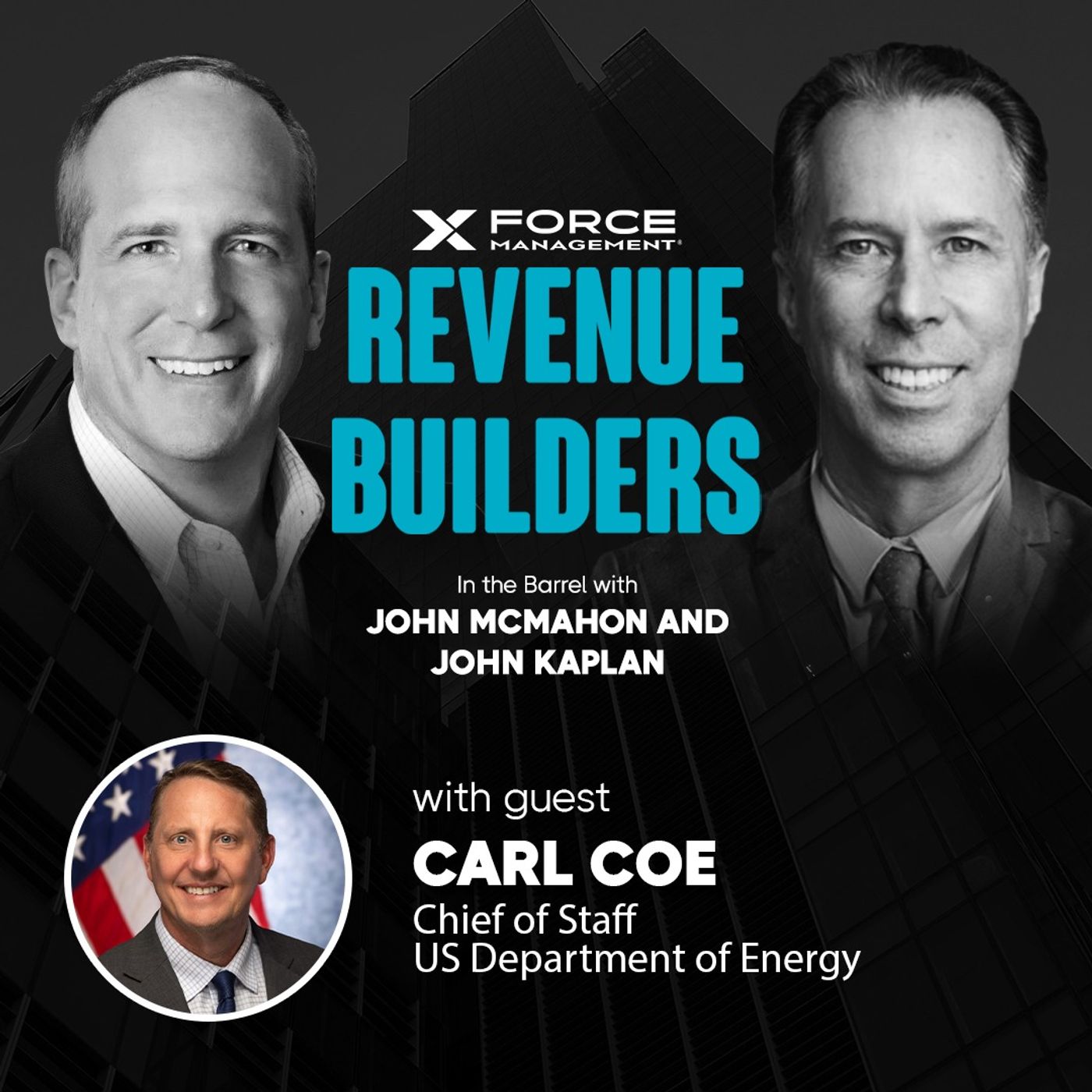
Revenue Builders
Navigating Energy Challenges and Innovations with Carl Coe
01:00:43
In this episode of the Revenue Builders Podcast, our hosts John Kaplan and John McMahon are joined by Carl Coe, Chief of Staff for the US Secretary of Energy. Carl shares his impressive career journey, from his initial sales role at PTC to his current influential government position. The conversation covers the urgency of addressing the United States' power capacity, the role of nuclear and renewable energy, and the intricate relationship between DOE and industry leaders. Carl also speaks about the pivotal role of the national labs, the impact of outdated IT systems, and the strategic use of AI in regulatory processes. The discussion highlights the importance of mission-driven work, the critical race against China in AI and energy, and the transformative changes needed in both government operations and the education system to support the future workforce. ADDITIONAL RESOURCES Connect with Carl Coe: https://www.linkedin.com/in/carl-coe-912b82/ Explore Force Management’s Free SKO ...
Loading summary
Transcript162 lines
- [00:05]
A
Welcome to the Revenue Builders Podcast, a weekly show featuring B2B sales leaders and executives. Hosted by five time CRO John McMahon and Force Management Co founder John Kaplan, the show goes behind the scenes with the people who have been there, done that, and seen the results. If you enjoy our content, please subscribe, rate and review the show to help us reach more people. Revenue Builders is brought to you by Force Management. We help companies improve sales performance, executing the growth strategy at the point of sale. Find us@ForceManagement.com Enjoy today's episode hi, it's Rachel with Force Management. Before we get started with today's Revenue Builders episode, a Quick Plug we know a lot of you are planning your SKO and planning for 2026 force has a ton of great resources for you as you strategize. We just put out an ebook on six priorities for driving growth in your organ and we have a whole SKO resource page that has helpful insights as you think through making your SKO more than an event. Check it out in the show notes.
- [01:16]
B
Hello and welcome to another episode of the Revenue Builders Podcast. I'm John Kaplan and I'm joined today by my good friend and author of the wildly successful book the Qualified Sales Leader and also a five time Croat, John McMahon. And today we have a real treat with the this guest and specifically the guest is Carl Ko, Chief of Staff for the US Secretary of Energy. Let me just read that over again. Carl Ko, Chief of Staff for the US Secretary of Energy. I've read that over and over again to practice this because Carl and I go way, way back and I was fortunate to hire him as a Sales rep at PTC where he had an incredible career. And when I think about where Carl is today and the impact that he's having on the country, it does not surprise me. You're going to hear some great disposition from him, some great knowledge that he was exhibiting all the way back then when he was just a wee lad. Carl joined the Department of Energy to lead Doge and their efforts in 2025 and in that role he worked closely with Secretary Wright of the Department of Energy in 40 key offices in the DOE focused on process improvement and cost savings. And Carl grew up in Ohio and graduated from the Ohio State University. So I have to apologize to my Michigan friends and fans. I had to say it that way or Carl would not agree to join us for this podcast. And if you know how Carl and I go back and forth on the Michigan Ohio rivalry, you'll understand that he since after PTC he spent 17 years at PTC in various senior roles, including positions in London, Brazil and Americas. And that was all while at ptc. And he worked extensively with the Department of Energy and the national labs focused on product development and life Cycle Management. In 2018, Carl acquired Mango Practice Management. And over the next five years, with Carl serving as CEO, the company grew by over 700%. So today's episode is going to be really, really fun. It's a personal treat for me and Johnny as we go back the PTC days. I hope it's a treat for you as well. Let's listen in.
- [03:51]
C
So, Carl, this is a little bit surreal to have you on the podcast sitting where you're sitting today. We were just talking before we got this started off. Thank you for everything you're doing for the country and, and it's great to have you here today. And we're just going to start off with a little bit of a, kind of like an icebreaker and get you to think back since we all have that in common back in our PTC days, you know, foundational things from your background and your PTC days that, that still kind of ring true for you today in such a, you know, such a vastly different environment that you're in. And we'll get more specific into the environment, but let's just do a little nostalgia first.
- [04:42]
D
Oh, man.
- [04:43]
E
Of course. First of all, thanks for having me.
- [04:46]
D
It's.
- [04:46]
E
It's an honor to be with two legends. Two, two big names in my, in my career that John, I think I might have been the first. Your first hire at ptc. First or second, you were my dm. Grant Wilson was the rd.
- [05:02]
C
Yeah.
- [05:03]
E
Terry, Terry Powers was the AVP Chap Delane was the svp. And then, and then they all worked for Johnny Mac, I believe, if I have it right. So 20, 29 years ago, I think.
- [05:14]
C
You, Maddie, you, Matt, Mart, Corley, you guys all came in around the same time, I think, didn't you?
- [05:20]
E
That's right. Oh yeah. Hampton was, I think. Yeah, that's right. And Dave Kennedy, some, some old names. But yeah, so, I mean, I just have such fond, fond memories of every bit of it. I remember, John, you worked so hard, so many hours and you would travel every day and then sometimes on a Friday, we couldn't find you. And you literally, I think, just passed out and slept about 15. I remember that so distinctly.
- [05:50]
C
But you or in the emergency room.
- [05:53]
E
Yeah, probably so. Probably so. Gosh, what did I, what do I think back on and what do I remember? You know, it's it, it's super applicable to what we're doing here. It's just think big, be incredibly urgent. Don't take no for an answer. Literally push farther, harder than you think you can. And, and, and outwork out, hustle out, compete. That, that's what PTC was. That's what we're trying to do here. And qualify and qualify.
- [06:25]
D
Qualify, qualify, qualify.
- [06:28]
E
That's right.
- [06:28]
C
That's exactly, that's exactly how I remember your brother. So you, you, you have incredible experience of working in high growth tech.
- [06:41]
B
For years.
- [06:42]
E
Yeah.
- [06:43]
C
And then we'll. Let's save the trans. You know because I really want people to understand how that transformed into what you're doing today. Give us a little bit of, you know, insight on all those different levels and the career progression and, and, and then let's get started on how in the world did, did you, did you bump into or, or go after what you're doing now?
- [07:07]
E
Yeah. So. Well you know my, I was 17 and a half years at PTC and a long time. Had a bunch of different jobs like we all did. Right. So started with you John. Then went to major accounts, then moved to Europe to do we back. We were trying to figure out how to, how to drive the Pro E business. You know the early 2000s at PTC were pretty bleak. It was a weird time. We didn't have windchill yet. Pro E was slowing down and so went over there to try to drive services. Drive the services business. Came back and joined Fand under, under Johnny D' Agostino which was a gift and then spent gosh, 12 years in that group. Started as an RD, then then VP, then ended up having Latin America and half the Americas with Pete Matamore. So that experience was just incredible. Right. It prepares you for anything and you sort of get to that crossroads at a company like ptc. It's probably similar to an IBM or an SAP where you're either going to spend your whole career there or you better jump or you get too deep. And I was at that point where I needed to learn something new and had the opportunity. I got recruited by a guy, an incredible guy named Mark Newman who was the founder and CEO of a company called HireVue, Sequoia and TCV backed based in Salt Lake and just a rocket ship. High growth, typical. You know this was 2014 or so. Just a great leader, great company, great tech. The guy started as a college project and ended up selling it for over 500 million a few years later. From there went, you know that was A tough one because I had global responsibility. I lived in Raleigh, but commuted to Salt Lake and that was a grind. And ended up taking a COO role with a company called Mercury Gate and Raleigh, a Warburg Pincus company. And then from there I bought a little tiny software company, four employee software company doing less than a million in revenue, and bought that and did our thing, brought in incredible sales team, people that I just love dearly and still text with almost every single day. We ran our play. We had good tech, we had good customers, and we had great salespeople and crushed it. Sold that to light your capital and hung around there for a couple years. After I sold the business, I just couldn't leave. I just loved the team so much. And it's hard, though, to go from owning your own, running your own to work for the man, to work for a PE company, and it's just tough. But the team was great and. And so I left there in 23 and was just hanging out. I own a. I own a couple of. I own three or four companies. I own two supplement companies, traditional stuff, vitamin D, CoQ10, that sort of thing. And then I've got a real estate development company, a land development company. But I. I was just hanging around. My wife was. You know, these were more projects as opposed to a career. They were. They were things to do. And. And then this came up and we'll. I'm sure we'll get into this, but. But there's the progression. There's a lot to it. I left a lot out, but I owe it all, I owe a lot of it to you, John, and I mean that. And you've. I've always told you that. I remember the day I took the job. You said, welcome to the Yankees. And the Yankees were in their heyday at that point. I was standing in my kitchen, I was 26 years old, and, And. And I hung up the phone and I said, I don't know what I just signed up to, but we better get going.
- [10:56]
D
Okay.
- [10:56]
C
But you got to tell the real star, because I have to. I don't know if I ever apologized to you.
- [11:02]
E
Your wife apologized for you, and he.
- [11:05]
C
Apologized when you were in the kitchen.
- [11:08]
E
Yeah.
- [11:08]
C
And it might not have been on the same day that you committed, but I distinctly remember having a conversation with you about, you know, hey, I'm, you know, I was recruiting you from, you know, you were a coveted. You were a coveted recruit, and you were, you know, you're kind of talking out loud a little bit about, hey, I'm not sure about this and that. And I, I remember being a little bit short in the conversation, and then Grant Wilson, Johnny, you're gonna love this. So that I might have said, like, well, call me back when you figure it out or something.
- [11:44]
E
I'll tell you exactly what you said.
- [11:45]
C
Tell me what happened, because Grant Wilson was horrified, and he, he had to call you back.
- [11:49]
E
Yeah, he did. So I, I, it's the same kitchen it might have been the day before. And I was like, man, I don't know, John, I'm, I'm giving up a lot here. You know, I thought I was going to, you know, go be CEO of whatever. And I was like, man, John, I, I, I'm giving up a lot of goods. I don't give a shit what you're giving up. You got to do this.
- [12:08]
C
Oh, man.
- [12:09]
E
And you don't curse a whole lot so that you. So, Grant, like, 15 minutes later, you get the call from Grant, and it's like, you know, it was hilarious.
- [12:20]
C
Oh, I remember. Thank you for joining. Even though you're an Ohio State guy. Thank you for joining. You.
- [12:26]
E
Well, you're, yeah, you're a Bowling Green guy. You're not a Michigan guy. You fake that part of your life.
- [12:31]
C
I did fake that part of my life. But I'll tell you what, the last four years have been very good, my friend. Very good.
- [12:38]
E
Yes. And the previous 20 weren't bad either, for us.
- [12:41]
C
Yeah, but you're only as good as your last four, bro. Come on.
- [12:44]
E
I don't know. We got a ring. You got a ring. All good.
- [12:47]
C
Yeah. Okay, Johnny, you're gonna have to take over, because my mind's floating on Michigan, Ohio State, and I got something, but.
- [12:54]
D
From maybe just the last piece. So maybe the biggest lesson you learned at ptc, the biggest one you learned when you bought the software company and the biggest one you learned when you, when you sold it. Can you share some of those lessons learned that some people, you know, they never learn those lessons until they get to a spot where you've, where you've achieved.
- [13:15]
E
Yeah. And I don't know about you guys, but still, I think about the mistakes more than the lessons, like, why didn't I do this? Or what I could have done different. And no matter how well you do or don't do, like, anything else, you think about what you could have done better. But back to ptc, it was extreme competitiveness. I, I was re. I mean, I really, really, really had to win. And that was part me, but that was part what, what the company Taught and trained, and know your product, know your customer, know the problem you're solving. Build champions. Don't cut corners. Follow the math. Four demos a week. Do the right thing, you'll get there. And I don't care what situation you're in in life, those are all the same. They're all the same. PTC had it at the extreme. It taught me to be tough. It taught me to. It also taught me to be myself in an environment that you weren't always. You didn't know if that was the right play, but if you did it your way and you did it well and you stuck to what you believed in, you could win. I love that guy. I, John, I don't know if you remember, I took over for a guy named fred Weber in 1996. Fred was, Fred was the sales rep before me. And I used to say I'd walk in, you know, customers had a hard time with PTC back in the day.
- [14:47]
C
Yeah.
- [14:47]
E
And I used to say all the time, I said it over and over. I said, I'm going to be the exact opposite of Fred Weber, and you're still going to want to buy from me. I said it over and over because my audience was, they were sick of ptc. They didn't like that. And so I had to win and I had to adapt and do it my way, but still put the numbers up that PTC wanted. So we're going way back in that. It's a different environment, dude.
- [15:11]
C
What I loved about you, though, like, you and traits for sellers. One of the things that attracted to me when I was recruiting you was you were very socially aware. Very socially aware, high eq. You had great iq, went to a great school, had great iq, but you were socially aware. And I think customers really love that about you. And I think you took that into leadership, and you just did a really, really good job of understanding human behavior. And I'm assuming that's exactly what you're doing now to get people across the aisles to, you know, to, to, to agree on stuff. But that's, that was, I thought that was always a big calling card for you.
- [16:00]
E
I appreciate that. I, I, I hope that's true.
- [16:05]
C
Yeah, I think it is. So how in the world I get a text from you and it's a picture of you standing. It's to me and granted, you standing next to Elon Musk, and you're like, hey, dudes, this is, there's gonna be, there's gonna be a little announcement. Thought I'd give you a little Preview. And we went ape nuts. Like, tell us how the. I still haven't had a chance to talk to you live.
- [16:30]
E
Yeah.
- [16:30]
C
How in the world did that all come about?
- [16:33]
E
Yeah, so, like I said, I was sort of just kicking around, doing a little bit of board work, trying to figure out what I was gonna do next. I thought I was done, to be honest. And a guy named Scott Cooper and John, you may know Scott from Andreessen Horowitz. Scott was, you know, the third guy there behind Ben Horowitz and Mark Andreessen Scott and I didn't know each other, but we knew of each other. We'd been on email strings in the past. Well, he was nominated to be the head of opm, Office of Personnel Management, which is essentially HR for the government. And Trump nominated from that. And he reached out into his network and said, hey, anybody. Anyone want to join me at opm? And I said, let's talk. And so we talked a few times, and I was like, let's go. We're going to. I'll do that. And as you might see in the press, it takes forever once you're nominated to get through the process. And he finally just got in last month. Wow. Well, in the meantime, he had me talk to the DOGE guys, just as he didn't really know government either, and he knew Elon and that whole crew. And he said, well, talk to these guys about onboarding. And I got on the phone with them, and literally they. Five minutes in, it's like they'd never heard of Scott Cooper. They no idea who that guy was. I work for them now, literally. And I called Scott. I said, I. I don't know what's going on, but I. I think I work for them now. I think they want me to join them. And he's like, well, I don't know what to do. So I did it and joined. They. They assigned me to lead DOGE at Department of Energy, and we can get into all of that. So I did that for about a month or so. And in that process, I got to know the Secretary of Energy really well, Chris Wright. And Chris Wright is one of the greatest human beings on this planet. He is smart guy, insanely smart. Yeah, in. In a. He's smart on every level, scientifically, science, math, interpersonal, treats people the right way. He's kind, he's smart, he cares, he's one of a kind. The country is so lucky to have him. So once I got associated with him, I got to know him a little bit. We did good work for Him. And he called me in his office one Monday morning and said he was going to make some changes and asked if I'd be his chief of staff. And I said no, by the way. Wow. I said no.
- [19:04]
D
I said no.
- [19:05]
E
I said no. And so I said, no effing way. He said, what? I said, I'm not here for three or four years. I was planning to be here till Memorial Day. And he said, well, can you give me this amount of time? I said, let me call my wife. And so what I do is I still live in North Carolina, but I commute. I take the 6am Monday morning and the 6pm out Friday night. And my, we're, we're empty nesters now. So my wife's not thrilled with this whole thing, but it's, it's working.
- [19:35]
C
Your boy is playing. Isn't your boy playing at golf in college?
- [19:38]
E
Yeah, my youngest. He just started last week, was his first week. He's at Western Carolina playing golf.
- [19:43]
C
So how you gonna make those? You're gonna make those tournaments?
- [19:46]
E
Well, it's funny, I told the secretary, I said, I'll do it, but this is the one, one caveat, I'm not missing any tournaments. And he's like, I don't care.
- [19:53]
D
Good for you.
- [19:54]
E
So, yeah, yeah. So anyway, so that, that's how it happened. And the Doge experience was incredible. Working with Elon was incredible. That entire team of people just absolute off the charts, world class. And, and then, and then into Doe. We. Doe's got 150, 175,000 people. It's a big machine. And so there's a lot, Carl, without.
- [20:18]
C
Talking about any political aspects of, no matter where somebody sits on the line of doesn't matter what DOGE is, what they do, how they did it or whatever. But could you just give us your experience of like, looking at a problem, sifting through, you know, data and, you know, getting people on board to make a decision? And again, it does. It's not a political conversation. It's just the magnitude of the problems are amazing.
- [20:48]
E
No, and on the political comment, I don't think you would look at what we've done or the work we did in Doge from either side of the aisle. I think you would have looked at it and been proud as a taxpayer, proud as an American, because that's how.
- [21:01]
C
I look at it.
- [21:03]
E
And I think the career employees here, the thousands of them that we've interacted with, I think the high, high, high majority would say the same thing. They want the government to be efficient. They don't want to wait to waste taxpayer money. They don't want, they, they want nothing better than the government to succeed, the taxpayer to succeed, for, for the country to succeed. And, and when I came in, before I came into the job, I think there was a lot of perception that people don't really care. They're just the grifting and all these things. The fact is it's just absolutely not true. It's not the people, it's the process and the way that any bureaucracy works. And so what we did is just absolutely rolled up the sleeves to try to dig as deep as we possibly could to understand what the organization's all about, what the mission is. We have 45 offices within the core DOE interviewed every single office multiple times, tried to do zero bait based budgeting. What do you need to do? What is it the essence of what you do and how do you do it with just the right amount of people. So deep evaluation on that, Deep, deep, deep evaluation on contracts where we're spending the money doing this in, in a tech stack that is, you just can't believe how far behind the government is in their tech stack. So there was just no, no easy place to go to find the data. So it was you know, pulling just 18 hour day after 18 hour day trying to understand where the money's going, making sure it's going in the right place and making change where it wasn't. And I, that's where we built the relationship with, with the Secretary because his job is, is, is so hard to explain but his job is more outside the agency, working with the White House, working with the press, working with Congress, working with industry, working with foreign countries. He did in early days didn't have a lot of time to work inside the agency. So we were sort of his inside team and he was working the outside. And it was a really good marriage where we were doing work not as you know, the press might say, 22 year old people don't know what they're doing. No, we were, you know, senior people that have done a lot in their careers just digging in to try to help make the government as good as it possibly could be. And, and I'm really proud of that work. I'm really proud of. We didn't end up, we didn't end up having to do a riff of one single employee. What we did is we, we offered an early retirement, several packages that, that let people make their own decision so that we wouldn't, you know, it's better, much better for people to look at their own career, where they are and make their own decision on. On where they go, as opposed to us having to make reductions. And we ended up, enough people opted for that option. We didn't have to make any reductions.
- [24:06]
C
What advice would you give to. To. To the audience? Understand, like, what did. What did you learn about understanding a magnitude of a problem, understanding data and disparate locations, understanding different ways of doing things? The thing that I'm amazed about that Doge did so quickly was the quickness, was the velocity of it and the accuracy of it. What did you learn that's that business could learn from that and how fast you guys were able to identify a problem and come up with some solutions? Anything, Any takeaways?
- [24:51]
E
Yeah, no. I think everybody's a little bit different. First off, the hours put in were incalculable. That can't be avoided. These people just put their entire lives completely on hold and worked in a way that only Elon could drive, frankly. And I mean that there is a reason that man is who he is. He sees no barrier. He sees there's no rest, there's no barrier when you're on mission. So that's number one. The other thing, in my case, I had to do it my way. And my way was to build alliances with the team in the building. I just couldn't go at this without having the doors open for me, as opposed to me knocking them down. And so spent a massive amount of time getting to know people in the building, getting to know what the organization was all about, respecting the organization, respecting the people, so that when it came time to get the information I needed, they did it with open arms, they were willing to do it, and I just couldn't have done it any other way. I don't think it would work any other way. In the long run. You might have. You might have gotten there in the short run, but if you don't have an organization like this with behind you, as opposed to pushing against you, you got no shot.
- [26:13]
D
What about some of the lessons that you or best practices that you had in business? Are there some that stand out on how you transferred that into what you're doing today?
- [26:23]
E
Absolutely.
- [26:24]
D
I mean, you just talked about how you had to think of it as a people business and meet people where they are. That would definitely be one. That's one amazing sales guy. What. What else?
- [26:36]
E
Yeah, you know, it, it this. I got this from the secretary. And. And it's really true. Lose the small battles, win the big ones. I mean, there are so many battles so Many fights to be had and. Same thing in business, right? You. You could chase every little thing and you could get fired up about every little thing, but get fired up about the big stuff, let the little stuff lose the small battles. In the end, you win the war if you do it that way. That's one from d'. Agostino. A lot more deposits than withdrawals. I don't care if you're working with customers and you're engaging and you're selling. You make more deposits before you ask for the withdrawal. I don't care if you're an executive with your employees. You are making them better every single day. You are helping them advance in their career. You're helping them do their job. So when it comes time for you to ask for something, they're happy to do it. It's deposit many, many more deposits than withdrawals. And the same thing goes for this.
- [27:41]
C
I like that. And what about the, the messaging, the common denominator of the right thing to do or like? What I, What I loved about the vantage point that I had was politically, it didn't matter where you were. The mission, the why was so powerful and galvanizing that it stripped away, not in all cases, but it stripped away a lot of. Some of the noise that would, that would be involved normally. Do you have advice for that on the business side, on what you saw there? Because that's a monumental task.
- [28:29]
E
Well, it's, it's, it's, you know, using your core skills in the selling environment. You gotta have champions. They're carrying your message when you're not in the room. Yeah. What did you used to say? They'll sell for you when you're not there.
- [28:42]
C
Yeah.
- [28:43]
E
So that's a big one in this role too. And the second part, you already said it, is mission. When, when you're in a campaign of any kind, all parties need, need to know what the mission is and know that they're that, that everybody's in it earnestly for the right reasons and they're chasing the same thing. So if you, you, you have to do a lot of explaining. Why. Why are we doing this? Why that action? Why this action? You're not there to, to, to, to reduce, you know, to take people's jobs. You're there to, to drive mission. And as long as you're doing that and every. In business, whether you're. You've got people working for you or you're in a sales campaign or you're doing what we're here doing at doe, it's all about mission and you got to remind people, and if you don't, they'll float away on you.
- [29:36]
D
Carl, what about the, you talked about antiquated IT systems, which everybody's heard about, you know, even before you commented on that. Do you get to try to redo some of these IT systems in the, in the doe?
- [29:50]
E
Yeah, that's what we're doing right now. So I'm fortunate. So the way the doe, you know, as chief of Staff to the Secretary of Energy, all the offices report into me, dotted light into me, into the secretary or into the Deputy Secretary. And so we see across the entire field and the DOE is really four agencies. It's, you've got core DOE here in Washington, you've got the 17 national labs, you've got, we own the nuclear arsenal and the nuclear stockpile. And then finally we've got what are called power marketing authorities out west. The, the dam system and the electricity system. They're all four distinct but under one umbrella. And so we're trying to drive IT modernization across the entire agency. It's actually one of the few things that will be pervasive for generations past us. There's a lot of stuff we're doing that's about point in time solving a problem today. But as we modernize the IT structure of DOE and all of government, that will last, you know, another generation or so. So it's incredibly important that we get that right. And for those that are selling into government, this is not, this is an incredible opportunity for you. This is more opportunity than you might even recognize, because if you've got winning solutions, they're going to drive efficiency, be a better user experience, a better customer experience, and you can do it at scale. You're going to win.
- [31:27]
D
And are you seeing AI start to play a role at all in the way in which people do business, you know, internally?
- [31:35]
E
Yeah, John, we, we've got a massive initiative right now called permit AI and, and it's all about. So we can talk, and I hope we do talk about our mission here and, and the challenges that the country has as it relates to energy and power. One of the biggest.
- [31:52]
D
Love to talk about that.
- [31:53]
E
Yeah. And, and I, I'll get into it. But one of the biggest challenges the country face is over regulation. The permitting process to build anything in this country is too arduous, it's too hard. So we're using AI to help us strip out unneeded regulations, unneeded permitting. So that's just one piece. But dozens and dozens of AI projects going on just within the doe.
- [32:19]
D
Well, let me ask you this, since you kind of almost got us there. What I read is that by 2030, there'll only be enough electrical capacity in the country to fuel the data centers and nothing else. And I think that's why you see a lot of stocks run up that are portable nuclear facilities and then other types of portable energy systems to not only help fuel the data centers, but other parts of the country and other industries.
- [32:54]
E
Yeah.
- [32:54]
C
So.
- [32:57]
E
There'S a lot of truth in that. Let me describe what's going on in the country, the challenge we've got, and then. And then how we're going to solve it.
- [33:04]
D
Perfect.
- [33:05]
E
So we have the exact same power capacity in the country that we had in 1985. We've got 1.2 terawatts of power in the country, same as we had in 1985. And you know what? That was perfectly fine. As the country grew, power demand stayed stagnant because we had more efficient systems, et cetera. That's all good and fine until AI shows up. Now we need to literally double from 1.2 to 2.4 terawatts of power over the coming years if we don't. So AI is a race. It's a race between us and China. It's us and the rest of the world against China. And China today is creating about 1.2 terawatts of incremental power every 18 months. So they're creating a United States level of power capacity every year or two.
- [34:02]
C
Wow.
- [34:03]
E
We. This is not a choice. This is a national imperative. And, and as Secretary Wright calls it, this is Manhattan Project 2.0.
- [34:12]
D
Yes, we have.
- [34:13]
E
We have no choice but to win this battle. We will win this battle, but our barrier, our challenge, is capacity. And so, and frankly, if we did nothing in this administration other than just run the regular plays, we would solve that problem in 10 years or so. That's not going to get it done. The race is over at that point. We wait that long. So everything we do every single day is trying to shrink time, close the gap, the power gap to build. It's not just by AI, by the way, guys, it's really important to note, it's all the reshoring of manufacturing coming back into the country. We're doing that. We're driving that. It's happening. But the combination of that with the demand for power, with AI demand really raises the bar on what we. What we have in capacity. So the way we're going to solve it is with natural gas in a big, big way with nuclear, small nuclear, micronuclear and advanced and the large reactors, it's with partnering with other countries. So a lot of these trade deals, and we, we were with Korea today. The trade, the money that they're committing to the country, in Korea's case, $350 billion. We're going to invest that into the energy infrastructure, hardening the grid, building the turbine, using US and Korean companies to build the turbines that we need to drive natural gas. It's everything you can possibly imagine at the very highest level with some of the smartest people in the world. Guys like Howard Letnick, Scott Besant, Chris Wright, Doug Burgum, they are, they are so committed and it's taking the politics out of it. Whether you like the president or don't, I do. The truth is he's put the 27 Yankees together, the best team you could possibly put together, the smartest minds that have achieved incredible things, put them together to solve these big problems that the country's facing. And so it's all hands on deck, driving with urgency, trying to find ways to close the gap, to, to move that 10 years down to four years, that sort of thing.
- [36:37]
D
And what about incentives? I mean, when you really, when you listen to and read a lot, you say that, okay, there's been so many incentives for solar and wind. Yeah, maybe rightfully so, but then everybody turned their attention to solar and wind.
- [36:52]
E
Yep.
- [36:52]
D
And there was no attention to other sources of energy to solve the electrical capacity issue. So our incentives, part of the program also to get industries and new industries and startups to look at, you know, other sources of energy besides wind and solar.
- [37:11]
E
Yeah. So the wind and solar subsidies, there's a lot of misunderstanding there. You know, we had wind and solar subsidies for over 25 years, and it really bastardized the market. And so because you had, because you had so many incentives to drive towards wind and solar, if you were an investor or you were a builder, you weren't building nuclear, you weren't building the other alternatives because the financial incentives weren't there.
- [37:39]
D
Right.
- [37:40]
E
But you guys may not know this, but 20 years ago, the country was about 85% fossil fuels. 20 years later, today, despite all those incentives, we're about 84% fossil fuels. It just didn't solve the problem. There is a place for solar on the fringes, but it's not baseload power. You can't count on it to run a factory. You can't count on it to drive a data center. So what we've done in turn is we've put in place a seven year subsidy for nuclear and geothermal to launch that industry and only to launch that industry. It was virtually dead when nuclear was became viable in the early 50s. Commercially we built over 100 nuclear reactors. And in the last 40 years we've built two. So the industry, we killed the government killed the nuclear industry. And so we have to relaunch it. And that takes incentives. We have to put incentives in place to launch, but only to launch. We shouldn't be in the business of subsidizing industries of any kind for the long term.
- [38:50]
D
Hey, I got agree 100%. Thank, thank you for that explanation, Carl.
- [38:54]
C
I got a. I love. I heard the secretary in a press conference a couple of weeks ago and I was just loving everything he was saying about additional incentives. Like if you build a factory here, you're going to get incentives for that. You're going to get power incentives if you build power associated with that and then you can sell it back to the government. I loved all that. But I got to tell you, Carl, I came away from, I came away thinking about it like our college education system right now is not set up for. We don't have anybody that can build these factories right now. I mean we, it's an overstatement. But electricians and plumbers and H Vac and like. Well, it's, that's a massive change in dynamic right now for skill sets. Yes.
- [39:48]
E
No, it's, it's, it all fits together. And you are so right, it is. That's a huge initiative for the country and it's actually really, really good for the country. John, look at the towns you and I grew up in.
- [40:00]
C
Yeah.
- [40:00]
E
And look at the devastation and, and, and the fentanyl epidemic and manufacturing left and these people. For guys like you and me, you know, the last 30 years have been incredible. Right. But think about if you're a blue collar worker in the Midwest and all the employers left, it's not been a great 30 years for you. So that's not good for the country. And that's what we're working really hard on. When you bring the manufacturing back, it's not just the manufacturing jobs, it's all the jobs to build the infrastructure. So we have to turn on our head. Our entire education system. The shop class that we had in high school.
- [40:38]
C
They don't teach it anymore, bro.
- [40:39]
E
They don't teach it anymore. So it's fundamental. I met with Mike Rowe, the guy from Dirty Jobs.
- [40:45]
D
Oh yeah.
- [40:46]
E
He's unbelievably cool and so dedicated to this problem. So we're going to have him in. We're going to run a program with him to. We're trying to build an infrastructure fund for the 17 national labs. Just the buildings themselves, the roads, the infrastructure needs a massive influx of cash. And we want to partner with Mike Rowe to do a Dirty Jobs episode and drive a whole jobs program just within that segment. But it's pervasive across the board. That is a huge initiative that we have to get right because we can't do what we need to do if we don't have the people to build it right.
- [41:25]
C
What about a lot of our listeners? Like, my kids are grown, I got five grandkids now. I have a lot of conversations with people and they're telling me about colleges and they're. Again, I don't want to get political. It's not a political statement, but they're the, the, the myth of the return on investment of, you know, and plus my generation of people looking at their kids and telling them, you got to go to this type of traditional college or what have you. I just think, for me, that's the big gap that I think's going on is this perception that, you know, who's going to take those jobs. And I think for really sharp people. Yeah, I think really sharp young people that are going to take these paths. And I would, I would hope that the education system would also teach them not just the trades, but teach them the business behind the trades. Yeah, we can get some incredible entrepreneurs in this next generation. I'm down in Marco Island, Florida. Johnny, you're in Naples. We have neighbors that, you know, made incredible wealth in the trades and then built companies in the trades. I'm just hoping that. I'm hoping that can happen.
- [42:37]
E
No, you know, it's. There, first of all, there's honor in it. It's, it's, it's, it's a job that you should be proud of. The money coming out to do those jobs is significant. And it's sort of like, you know, I always, I really believe the best employees, the best training was anybody that had an engineering degree, because if you could think that way, you could go anywhere with it. It's the exact same thing in these blue collar, in these trades jobs where you get in, learn the skill, watch how the work is done, watch how the business is done, and the sky's the limit for you. It's not limiting. It's unlimited. If you start there.
- [43:14]
C
Yeah, I'm all fired up.
- [43:17]
E
Yeah.
- [43:17]
C
Johnny.
- [43:18]
E
Yeah, Mike. Row that guy. He's the real deal. One of the best things about this job is the people you meet you have engagement with. Jensen Wang I've met multiple times. The guy is just incredible. Yeah. Amazing. You just sit with him in awe, like they're, thank God there's a human being like this on the planet. It's Tony Robbins I've met with several times. I got to meet Bibi Netanyahu. And you just sit there and you just think, I'm a kid that grew up in a town of 300 people in Central Ohio. I cannot freaking believe I get to do this.
- [43:56]
C
It's unbelievable, bud. It's unbelievable. Hey, on some of this, things like, you talked a little bit about, you know, talked a lot about what's going on in the government. Let's just stay on the Department of Energy for a second. I'm a software technology company, and I want to approach the Department of Energy is anything. And you spent time in the government sector of technology. I think that's what your huge relevance is and what you're doing now, in my opinion.
- [44:25]
E
But, yeah.
- [44:29]
C
What advice do you have for the best approaches? Because you still have all the procurement challenges, you still have all of the past performance challenges and all that stuff, which is a little bit difficult sometime in technology. What's the best advice you could give companies that are, you know, Department of Energy is a hot one right now. What's the best advice on how to approach Department of Energy?
- [44:54]
E
Yeah. So let me point to what's happening in the big picture, and then we'll get into the direct answer to your question. But if you look at the next 10 years, there may be more technological change in the next 10 years than at any point in history. Reason being, you've got quantum not that far out. You've got fusion. We're getting close. You've got fission at scale, which is the small nuke business, and you've got AI. All four of those go dead through the heart of doe. We are responsible for the success with industry, the success of failure, those four big things. That's our job. And incredibly fortunate to be involved in that in a big way. The work the national labs are doing on these topics is people have no idea what gyms they are for the country and how important they are. So if you give that context at the highest level, but then you just go to what you already know, you better understand your customer, you better understand what their initiatives are, you better know what their buying patterns are. You better know what it is they're facing. I had A guy, this is unbelievable to me. And I was really fortunate and unfortunate to get to be on this side of the table. He came to me, I'm not going to say the company, but it's a large software company that everybody knows. He's the national accounts manager for all of DOE. We spend 27 million a year with them today. And he came to me with this proposal for a $50 million deal. And I said to him, after listening and I'm thinking, wow, this, I'm not, I'm not connecting here. I said, who's asking for this? No one. The answer was no one. It's his idea. He thinks the DOE should spend 50 million a year and it might be a great idea. But he skipped every single step, he thought, because he got a meeting with the chief of staff. He had a campaign and he was dead wrong. Now, fortunately, I lived his life. I could tell him exactly what he was doing wrong, right? And what play to go run. And he went and ran that play. And you know what he found out? Nobody wanted what he was selling. But you just, this is so fundamental that we've all known our entire careers. You can't skip steps. You gotta know what problem your customer's trying to sell, solve and build champions around it. And then you have people preaching for you when you're not there. If you don't have that, you're not gonna win.
- [47:24]
C
With your knowledge of both sides of the table, are you able to impact from your seat? You know, an initiative comes up, funding gets created by the doe, but the process of procuring it out and contracts and all of that stuff is like, you were lucky to have that at ptc. But typically if you don't understand that process, you'll never sell a pencil. You never sell a pencil to the government.
- [47:52]
E
No, you do, you have, do you.
- [47:53]
C
Have influence on the backside of that on the contracting piece, the contract vehicles, the partnering, do you have visibility into that?
- [48:03]
E
Very much. And we, we did a, we did an eight figure deal with another large software company, Net New, never done a dollar business with it before. The sales campaign was probably five weeks.
- [48:19]
D
It's really fast for the government. So fast.
- [48:21]
C
Never heard of it.
- [48:23]
E
Because they were selling at the right level to a real problem that had to be solved. By the way, that one was all about in the doge days, solving, getting to the contract information to understand where we're spending money. Very important. You'll spend eight figures to save nine. Right. It's not that complicated. This administration, my boss Chris Wright and everybody around me, most of us are entrepreneurs or business people. Show us strong roi, show us a strong business case, show us a strong implementation plan. We're going to do it.
- [49:04]
D
Yeah. Now, Carl, you quickly, you talked about things like nuclear quantum fusion. How do you stay intimate with the current state of the art of those different types of technologies? Is it through the labs or is it through the labs? And what's going on outside the labs, how do you stay on top of that?
- [49:26]
E
People don't realize the deep relationship between industry and the DOE and the labs.
- [49:31]
D
Okay.
- [49:33]
E
The secretary and I meet every day with at least one CEO. So last week we had Safra, the CEO of Oracle. Last week, every major CEO, whether it be Amazon, all the hyperscalers. I mentioned Jensen, they're here every week.
- [49:56]
B
Wow.
- [49:57]
E
And they're investing in a big way with the through and with the labs. So the lab's job is to spend money and solve problems. That industry is too early for industry, but the intersection is pretty tight. So when do you know when it hands off from one to the other? So. So people like Jensen and Oracle and AMD and these others, they know the value of the labs. They can be an extension of their R and D. Right. And so we are very, very heavily in tune with trends and the tech. The other thing I want to mention is the level of talent in the national labs. These the most brilliant people in the world. And I have a lot of respect for them because they could go make 10 times what they're making. They could go, you know, we've got Livermore lab in Northern California. They could walk across the road and make 10 times what they make. And they don't do it because they're focused on the mission. They care about the country, and they put that above their own personal gain. And they make that decision point blank. And you don't think they lay down to go to bed at night. Later, their wife. And their wife says, hey, why don't we go make 10 times? Why aren't we doing that? You better have your story right. You better believe, you better be convicted. And they are. I have a lot of respect for people like that. So that's pervasive across doe. And. And the combination to your question of industry and DOE is very tight.
- [51:29]
D
On.
- [51:30]
C
The example that you gave. You don't have to say the software company. One of the things that's surprising me in my interaction with the government back in the day, past performance was the biggest part of decision criteria for contracting with the government. And that obviously is probably past performance. Is probably still there, but with the speed, at the rate of change and the speed of change that you guys are doing. Can you give some advice for people out there that like we'll look at things and maybe not bid on something because past performance typically comes out and I don't know if the procurement agencies have changed it to, you know, and it's coming out saying, you know, past performance is less important. But do you have a thought on that?
- [52:19]
E
Yeah. So we, we completely, completely reengineered and gutted our procurement organization. Put in all new leadership at the oe, all new leadership, all new people, complete, complete mentality shift. So that, that's one part of it. So you're going to get, you've got much fresher eyes on the problem. The other thing that's for any sellers out there selling into DOE or into the labs. We've just kicked off a massive initiative where we're driving efficiency across all 17 national labs. And at the top of the list where we're starting is on tech transformation, tech consolidation. So all the labs have their own procurement arm. There's very little consolidation to buy to buy common systems where it's possible. So we're doing that. We've partnered with Battelle, who's the main M and O for seven of the labs, the 17 lab directors and DOE. The three of us together are completely committed to driving out cost unnecessarily. That is an incredible opportunity for these software players that are either differentiated or can scale across. That's a big change, as simple as it sounds. I mean, think back at PTC. You know, I think Doe might be PTC's largest customer. There's no one single consolidated contract. So you might take a little bit of a haircut to do a consolidated contract, but you're locked in across all 17 labs. If I'm a seller into the government right now, I'm pretty pumped because good decisions are going to get made and your upside is huge.
- [54:05]
D
Talk a little bit about that.
- [54:06]
C
Expecting us to get that kind of energy from this podcast as it related to opportunities and but thank you for that. I'm really, really excited for what you're saying. For companies that are companies that are trying to make a difference in your environment. Great advice.
- [54:25]
D
Well, you knew something changed when he talked about Doge and a vendor did a five week sales cycle like you have five weeks, that's sometimes really quick just to negotiate the contract, let alone.
- [54:37]
C
A new logo, no past performance. That's.
- [54:39]
E
Yeah, we did a three week pilot and cradle to Grave in probably less than five weeks.
- [54:45]
C
Wow.
- [54:47]
D
What about the commitment to cloud? Like the government was always scared of the cloud and then you know, you have Fedramp. Is there now like more of a commitment to the cloud and the technologies that are in the cloud versus trying to stay on prem. And I'm certain that there's some things you need to stay on prem for. But is there more of a commitment to the cloud now?
- [55:09]
E
Much, much more. I mean even Fedramp needs to be re evaluated because it's, it's, it's too painful. But look, the world runs on the cloud. It's secure that those, those excuses of the past had to have changed.
- [55:30]
D
Sometimes that's just someone protecting their.
- [55:32]
E
That's right, that's right.
- [55:35]
C
What about cybersecurity in doe in the grid, like related to the grid aspect? I know I'm asking a big pie question, but I gotta believe that's a huge area of opportunity.
- [55:47]
E
It is and that's our responsibility. So if we went down the hallway, we've got, you go into one room, you've got a massive board of full wall size screens. You can see the grid across the US at any given time. There's a lot of concern about the grid, the security of the grid. We do need to improve it. It is something we think a lot about and we're putting a lot of money into for the average citizen. They should know the grid is. We're pretty secure. The grid is not one thing. The grid is. There's no one central grid. So there are vulnerabilities but nobody's coming in and shutting down the entire grid anytime soon. But you have to that fight, you know, we probably get thousands of malicious hits on the grid every single day. More than tens of thousands.
- [56:41]
C
Yeah.
- [56:42]
E
And so you've got to have incredible software, incredible processes, incredible hardware to stay in front of that and you just can't rest. So you've got, you know, we've got a proposal right now that is, you know, half of half, you know, half a billion dollars to, to tighten the, solidify the grid and then you just have to do that periodically.
- [57:05]
C
Another great area of opportunity for companies I think.
- [57:07]
E
Yes. It's in private sector. Yeah. We had, we had a cyber company in on Friday that is another net new logo presenting to us.
- [57:18]
D
Those guys are glad to have you. Carl.
- [57:21]
C
Dude, are you. That's a little surreal, isn't it Johnny? It's a little surreal.
- [57:24]
D
I called on all the labs, like Livermore, Sandia, all those labs and you know like I said just to negotiate the contract. Sometimes way more than five weeks.
- [57:33]
E
Yeah, yeah.
- [57:34]
C
Well, you guys were smart enough to get the clearance. I could never get the clearance. I had to manage the forecast. I wasn't allowed to go in, so I had to manage the forecast from outside the labs.
- [57:45]
E
I love it. So awesome. By the way. This mentality is. I mentioned those cabinet members that the president's put around him. I say it all the time, every meeting, staff meeting. We have urgency. It's about urgency, you know, not for us. I don't care. I don't need this. I don't need this job. It's for the country. It's a race. We've got to win. There's no choice. You know, think of what we did in World War II and how quickly we rallied as a country just to go after the big problems and. And, you know, human beings, the American mentality is still there. We just gotta light it up and that's what we're trying to do.
- [58:25]
C
Buddy. I. Yeah, I thank you so much for taking time out of your busy schedule. It's surreal to me to have these conversations with you, but I tell you, bud, I'm not going to be condescending, say, I'm proud of you, I'm really proud for you. And just, you know, somebody putting their best foot forward with their capabilities and making a difference in the country is just amazing. Really, really hats off to you, buddy. Well done.
- [59:00]
E
I appreciate it. I. I'm incredibly grateful. I can't believe I get to do this. It's the hardest thing I've ever done, mentally, physically, being away from home. But, man, I'm just so lucky and fortunate and I'm proud of it.
- [59:18]
C
You should be.
- [59:19]
D
It's just amazing to watch, you know, someone like yourself over the years and then what you've accomplished and now being able to put it all into good use. So thank you so much for everything you're doing and you haven't used a huge effect and hope so. More people.
- [59:34]
C
They better put you in Ohio State hall of Fame, dude, because there's not a lot of Ohio State guys doing what you're doing, so.
- [59:40]
E
Oh, man. You couldn't resist. I love you, dude. I love it. All right, we'll see you in November.
- [59:47]
C
Amen. You going? I would invite you, but I don't want to be. I don't want to have to go through any pat down and vetting process.
- [59:56]
E
Yeah, yeah. I. You ask me if I'm going, I. There aren't many days off, so I don't know, man.
- [60:03]
C
If you can get away, be my guest. And I'd love to take you there. We do a huge tailgate. I'm going to bring Johnny this year if he, if he says he's going to go. But I'd love to see you, buddy. I'd love to catch up with you. I'm really, really proud for you and your family. Well done.
- [60:18]
E
Thank you, fellas, very much. Good to see you boys. Take care.
- [60:22]
C
Thank you all for joining us. Go ahead, Johnny.
- [60:26]
D
And thanks to everyone for listening to another episode of the Revenue Builders podcast.
- [60:32]
A
Thanks for listening to today's episode. Be sure to check us out@ForceManagement.com.